INTRODUCTION
Assessing the abundance and distribution of a species of conservation concern is fundamental to determining its status. The grey seal (Halichoerus grypus Fabricius, 1791) of the north-east Atlantic and Baltic Sea is a priority species listed in Annex II of the EU Habitats Directive (Council Directive 92/43EEC). Central to this Directive was the creation of Special Areas of Conservation (SACs) and a requirement to maintain or restore priority species and habitats to ‘Favourable Conservation Status’. Consequently, there is considerable local, national and international interest in the status of grey seal populations within Europe.
Approximately 45% of the world's grey seal population is found in the UK (between 82,000 and 138,700 individuals) (SCOS, 2010) with 90% breeding at large colonies in Scotland. Approximately 4% of the UK population breed in Wales (Duck, Reference Duck2009) where most are found in Pembrokeshire, the largest breeding population in the Irish Sea and south-west Britain (Baines et al., Reference Baines, Earl, Pierpoint and Poole1995; Strong et al., Reference Strong, Lerwill, Morris and Stringell2006; Duck & Thompson, Reference Duck, Thompson, Haug, Hammill and Olafsdottir2007). Grey seals are listed as a species of qualifying interest in three SACs in Wales: Pembrokeshire Marine/Sir Benfro Forol SAC in the south-west, Cardigan Bay/Bae Ceredigion SAC in the west and Lleyn Peninsula and the Sarns/Pen Llyn a'r Sarnau SAC in the north (see Figure 1). One of the key responsibilities of the statutory nature conservation agency in Wales is to monitor the number of grey seal pups born in these SACs (JNCC, 2005). Pup production can be used as an index of seal population size, if age structure is stable and where rate of change is constant, or where alternative information on fecundity or survival rates is available (Hiby & Duck, Reference Hiby and Duck2003; Duck & Thompson, Reference Duck, Thompson, Haug, Hammill and Olafsdottir2007).
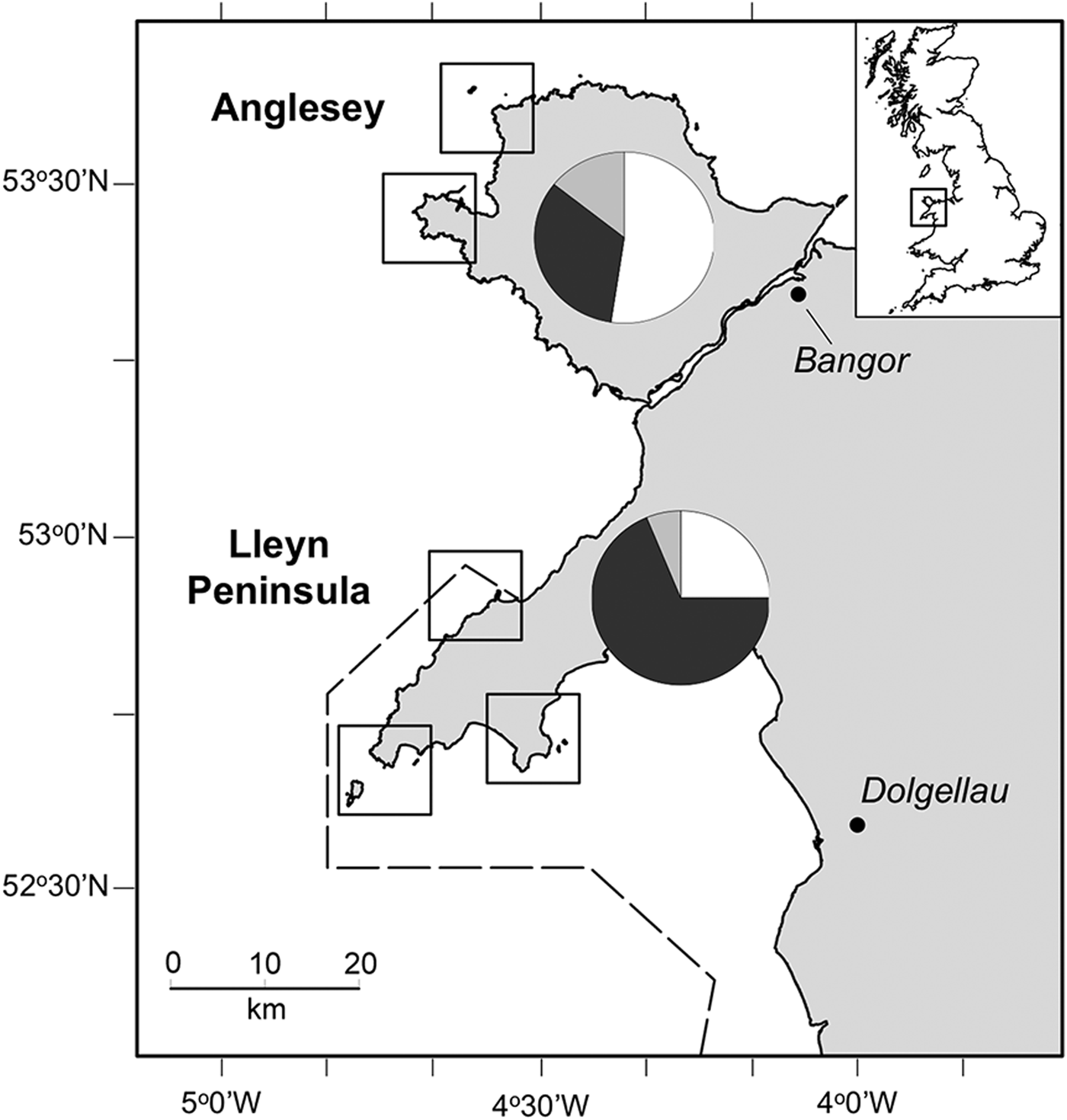
Grey seal pupping sites in North Wales (open boxes). Pie charts show proportion of cave (black), other cryptic (grey) and non-cryptic/open shore (white) pupping habitats (number of sites) per region: Anglesey (N = 21 sites), and the Lleyn Peninsula (N = 16 sites). Dashed line shows the Lleyn Peninsula and the Sarns Special Area of Conservation boundary. Grey seals are listed as sensitive to recreational disturbance by the Countryside Council for Wales (Reg. 12. (5)(g) of The Environment Information Regulations 2004); individual site locations are not shown in accordance with these regulations.

Throughout their range aerial surveys have been used extensively to count grey seal pups at major breeding colonies (e.g. Bowen et al., Reference Bowen, McMillan and Mohn2003; Cronin et al., 2003; Matthiopoulos et al., Reference Matthiopoulos, McConnell, Duck and Fedak2004; Duck & Thompson Reference Duck, Thompson, Haug, Hammill and Olafsdottir2007; Wood et al., Reference Wood, Brault, Gilbert, Haug, Hammill and Olafsdottir2007; Duck, Reference Duck2009). In Wales however, much of the pupping occurs in caves (Baines et al., Reference Baines, Earl, Pierpoint and Poole1995; Westcott, Reference Westcott2002; Westcott & Stringell, Reference Westcott and Stringell2003) or ‘cryptic’ habitats where topographic features completely or partially obscure the habitat from aerial view. Ground-based pup surveys that access both cryptic and non-cryptic pupping habitats are therefore the most applicable methods for monitoring grey seals in Wales and likely to result in more accurate estimates. However, these surveys are costly in boat-time and personnel, and where resources are limited this may prove challenging.
In this study we compare a ground-based pup production census with a reduced effort plot-sampling survey to estimate pup production, derive a total population size for North Wales and assess cost-effectiveness of the two strategies. We describe how the reduced sampling strategy may be used as part of a future countrywide monitoring design and discuss its utility for use in other geographical regions with cryptic breeding habitats. Our study represents the most recent systematic survey and production estimates of grey seal pups in North Wales since the 1970s (Anderson, Reference Anderson1977).
MATERIALS AND METHODS
Study area
This work took place in 2004 at 37 known breeding haul-outs (Westcott, Reference Westcott2002; Westcott & Stringell, Reference Westcott and Stringell2003) distributed along the coasts of Anglesey and the Lleyn Peninsula (and its SAC) in North Wales (Figure 1). The coast was accessed by powerboat with a four-person team and sites were searched for seals by paddle-ski and on foot. A total of seven surveys were made during daytime low to mid-tides between the end of September and mid-November at approximately 10-day intervals; we planned to begin surveying early September at the start of the pupping season, but due to bad weather, surveying unavoidably commenced on 29 September 2004.
Pupping habitat was classified as: cryptic, (1) caves, and (2) other cryptic—sandy or rocky shores where cliffs, overhangs, large boulders or other topographic features completely or partially obscure the habitat from aerial view, or (3) non-cryptic—open aspect sandy or rocky shores suitable for aerial observation. Pup abundance by habitat type was compared with a Kruskal–Wallis one-way analysis of variance.
Sampling design
In this study we report on a total count through time of marked white-coated pups. A site-based colour-coding scheme was devised where each white-coated pup encountered was marked, on its hindquarters with coloured stock marking spray to enable future identification of counted pups, prevent recounting over the survey period, and determine any pup movement from their natal site. It was assumed that white-coated pups were from a closed population because they do not travel extensively at this age (Davies, Reference Davies1949; Hewer, Reference Hewer1957). Other standard pup survey information such as pup class (see Smith, Reference Smith1966), estimated pup age in days, and presence of adults and conspecifics were recorded but not reported here.
We used a design-based plot-sampling approach to survey a random sub-sample of the 37 known pupping sites (plots) from the North Wales coast. With this approach, pup abundance was estimated using a Horvitz–Thompson-like stratified random estimator, where the number of pups counted in these plots was multiplied by the proportion of plots surveyed to estimate the total number of pups born in the region (Horvitz & Thompson, Reference Horvitz and Thompson1952; Borchers et al., Reference Borchers, Buckland and Zucchini2002; see Supplementary Material). A 95% confidence interval (CI) of the estimate was calculated based on its variance and approximated degrees of freedom (Thompson, Reference Thompson1992) (see Supplementary Material).
Known pupping sites were first stratified based on the number of pups per site observed in previous censuses (Westcott, Reference Westcott2002; Westcott & Stringell, Reference Westcott and Stringell2003): ‘Low’ (≤3 pups) and ‘High’ (≥4 pups). Prior to the survey, 20 of the 37 sites were selected on a stratified random basis where sampling effort was optimally allocated (sensu Neyman, Reference Neyman1934) per stratum so that eight and 12 sites were randomly chosen from these strata respectively. The decision to take a sample size of 20 was primarily based on logistical constraints, but in order to evaluate the efficiency of the sampling scheme, a ‘true’ value of pup abundance was required. For this we relaxed our logistical constraints to additionally survey in parallel the remaining 17 sites (hereafter called additional census sites), which, because of their proximity to the plot-sample sites and minimal addition of associated travel time, took only an equivalent of two of the seven days of survey and effectively generated a complete count (census) of the pup population.
We compared the pup abundance estimate derived from the plot-sampling design to the total count of pups censused at all 37 sites. As population estimates are used for the assessment of conservation status under the Habitats Directive, we derived a grey seal total population size-range for North Wales using a simple alternative to population modelling (see Cronin et al., Reference Cronin, Duck and O'Cadhla2007). Here, we multiplied our census-based pup production count by the minimum (2.524) and maximum (3.201) ratios of British total grey seal pup production to total population estimates from between 1984 and 2002 (Sea Mammal Research Unit unpublished data in Cronin et al., Reference Cronin, Duck and O'Cadhla2007). Finally, we compared the logistical costs (person days) of the reduced survey with the full census and inferred the putative savings for a scaled-up Wales-wide monitoring programme.
RESULTS
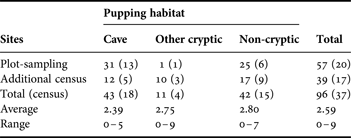
A total of 96 seal pups were counted in the complete census and 57 pups were counted in the plot survey, which accounted for 59% of the total pup abundance in 54% of the pupping sites (Table 1). Using the stratified plot-sampling approach, pup abundance was estimated to be 91 (95% CI: 70–112) and is a good approximation of the ‘true’ value of 96 pups derived from the census of pups at all 37 sites (Table 1).
Counts of grey seal pups by pupping habitat and survey type. Additional census sites are those not already surveyed by the plot-sampling scheme. Total is the complete count (census) from all sites. Average and range in number of pups per site are given for habitat types. Number of sites are given in parentheses.
Extrapolating from the census derived pup abundance to a total population size for North Wales sensu Cronin et al. (Reference Cronin, Duck and O'Cadhla2007), provided an estimate of between 242 and 307 grey seals.
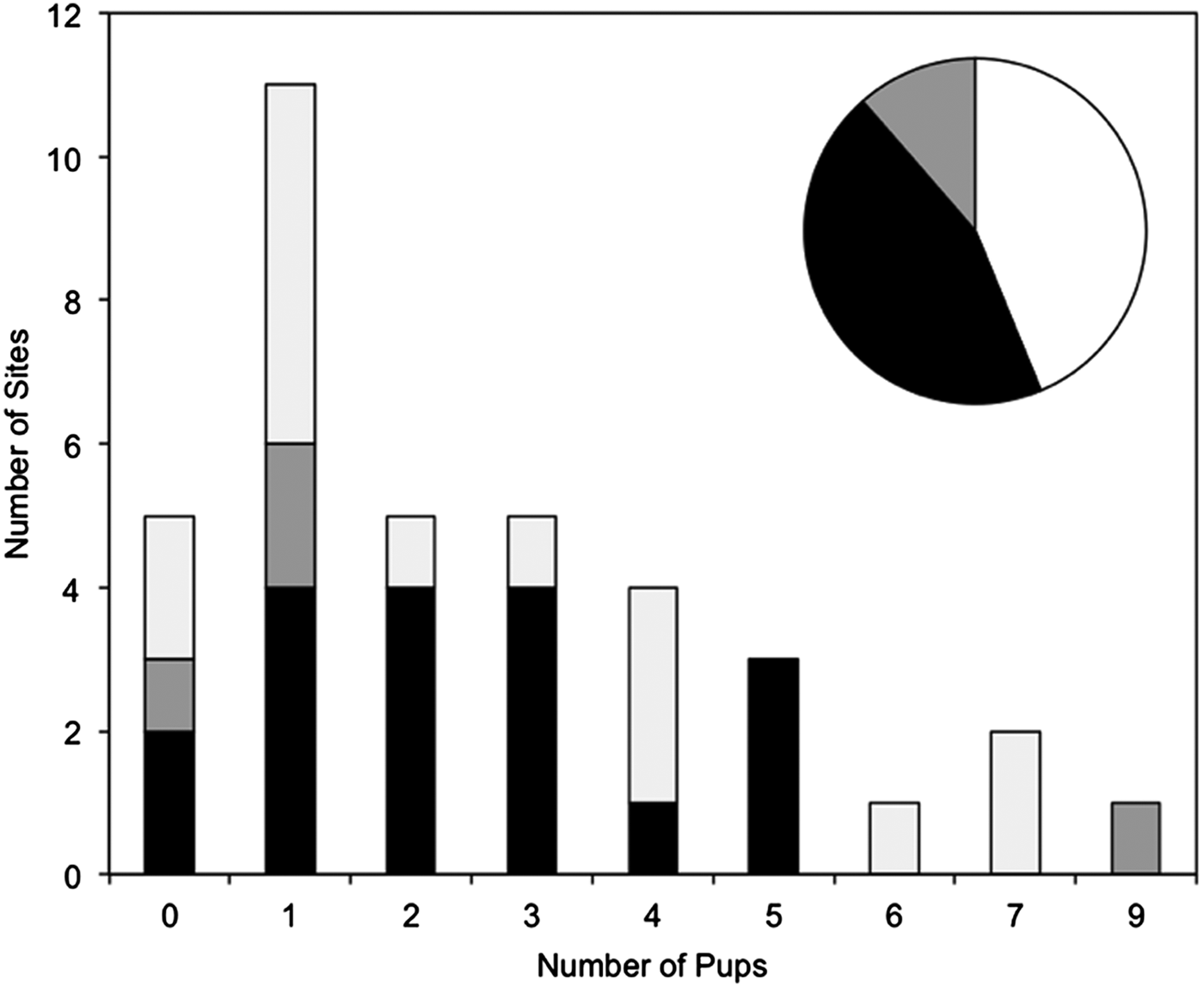
From the full census data, the majority (N = 54, 56%) of pups were born in cryptic habitats, with cave sites (N = 18, 49%) and other cryptic sites (N = 4, 11%) contributing 45% (N = 43) and 11% (N = 11) respectively to the overall pup production (Table 1). Cryptic habitat comprised 48% (10 of 21) and 75% (12 of 16) sites on Anglesey and the Lleyn Peninsular respectively (Figure 1). Most sites (N = 11) had a single pup but one cryptic site had the maximum of nine pups (Figure 2). The average number of pups born per site was similar across the three habitat categories (Kruskal–Wallis X 22 = 0.50, P = 0.78) with an overall average of 2.6 pups per site (range: 0–9) (Table 1).
Frequency-distribution of grey seal pups in cave (black), other cryptic (grey) and non-cryptic/open shore (white) habitats from all sites (N = 37) surveyed in North Wales. Pie chart indicates pup production by habitat type.
It took 28 person-days (seven days with a four-person team) to repeatedly census all 37 sites, or approximately 1.3 sites per person-day. Compared to the full census, the plot-sampling scheme took 20 person-days (five days with a four-person team) and reduced survey effort (number of sites) by 46% and saved approximately 30% of resources (eight person-days: two days with a four-person team). A full census of the 304 recorded Welsh pupping sites—267 sites identified in Pembrokeshire and mid—Wales (Baines et al., Reference Baines, Earl, Pierpoint and Poole1995) plus 37 sites in North Wales—would take approximately 234 person days (304/1.3 sites per person-day) or 58 days of survey with a four-person team. A Wales-wide plot-sampling scheme would potentially save 67 person-days (17 days with a four-person team) of survey.
DISCUSSION
It is generally known that grey seals use caves for pupping (e.g. Hewer, Reference Hewer1974; Haug et al., Reference Haug, Hammill and Olafsdottir2007), but the extent of this use is not widely reported in the primary literature, perhaps because caves are considered marginal habitats, are infrequently surveyed, and do not occur in large numbers at major breeding colonies. In this study however, over half of the total pup production occurred in caves or other cryptic habitat, which comprised the majority of pupping habitat. Similarly, in Pembrokeshire, cryptic sites accounted for 55% of the pupping habitat (148 of 267 sites) and 42% of the pup production (Baines et al., Reference Baines, Earl, Pierpoint and Poole1995).
Whilst aerial surveys are suitable on open beaches, which made up 41% of the breeding habitat and 44% of the pup production in North Wales, they may be ineffective for the majority of pupping habitat and miss the bulk of pup production in Wales. The use of ground-based counts that directly access cryptic habitats as well as open beaches is therefore necessary throughout Wales, and potentially applicable to similar coastlines in the regional seas. For example, recent surveys of seal colonies on the west coast of Ireland (Cronin et al., Reference Cronin, Duck and O'Cadhla2007) tested the use of aerial surveys and found that boat based surveys were still required to ground-truth the aerial data and alleviate survey difficulties associated with cave breeding sites. Surveys of seals on the Pembrokeshire coast (Strong et al., Reference Strong, Lerwill, Morris and Stringell2006) utilized cliff-top monitoring, a technique that was also impaired by cryptic breeding habitat and likely underestimated pup production due to the high proportion of this missed habitat. Similarly, Leeney et al. (Reference Leeney, Broderick, Mills, Sayer, Witt and Godley2010) surveyed seals on the Cornish (UK) coast, but with their boat-based survey methods were unable to observe seals that were using caves. Ground-based counts are therefore necessary to make appropriate assessments of pup production in the full range of pupping habitat in the regional sea context and the present study suggests that plot-sampling may be an efficient method to achieve this.
The North Wales pupping season spans from the beginning of September to the end of November covering 95% of pup production, and the number of births are thought to peak in mid-September (Westcott, Reference Westcott2002; Westcott & Stringell, Reference Westcott and Stringell2003). Due to bad weather it was likely that this peak was missed in the present study, which may have caused us to under-estimate pup production, assuming that the timing of the pupping season followed those reported previously (Westcott, Reference Westcott2002; Westcott & Stringell, Reference Westcott and Stringell2003). The pup production estimate and census count should therefore be considered minima in this instance.
Nevertheless, our plot-sampling survey and the full census were undertaken at the same time, so the efficiency of these methods and their estimates can be compared directly. The plot-sampling derived point estimate was a good approximation of the ‘true’ census based pup abundance. The confidence interval however, was quite large (point estimate ±23%); to reduce the variance of the estimate in future surveys it would be necessary to reliably predict the timing and duration of the pupping season and sample at regular intervals throughout this period. Despite likely under-recording, the pup production estimate and total count from the present study are similar to past censuses where 103 and 110 pups were counted from 37 breeding sites during two full pupping seasons (Westcott, Reference Westcott2002; Westcott & Stringell, Reference Westcott and Stringell2003). A trend in pup production over time cannot be confidently described here because we only have three annual census counts, but pup abundance would appear to be stable or increasing within these limits of detection and may indicate favourable conditions for SAC assessment. Annual pup production is highly variable and subject to a range of stochastic influences (SCOS, 2010). Longevity of monitoring and good knowledge of pupping sites in the recent past is therefore required to improve our ability to detect changes and inform SAC management.
The total North Wales population size reported here is in the order of several hundred grey seals. Throughout the year however, non-breeding haul-out counts at a single site in North Wales frequently exceed this upper total population estimate (Westcott & Stringell, Reference Westcott and Stringell2004). This may be because of an immigration of seals from other areas, e.g. Pembrokeshire, or that the seal population is larger than our estimates indicate. The method of Cronin et al. (Reference Cronin, Duck and O'Cadhla2007) utilized in this study may be too simplistic for the open population structure of grey seals in this part of the Irish Sea (Kiely et al., Reference Kiely, Ligard, McKibben, Connolly and Baines2000), and models that consider age structure, rate of change, fecundity, survival rates and density dependent factors are probably more suitable (Hiby & Duck, Reference Hiby and Duck2003; Duck & Thompson, Reference Duck, Thompson, Haug, Hammill and Olafsdottir2007). Nevertheless, the pup production data presented here are of value to future UK-wide population modelling assessments (e.g. SCOS, 2010).
Since this study, there have been severe fiscal constraints in monitoring pup production in Wales, making the results presented here and the suitability of a reduced sampling design pertinent to future regional conservation management. Our plot-sampling approach gave a good estimate of pup production, and reduced survey effort and cost compared to a full census. Regionally, a far greater saving is likely if applied to more extensive breeding regions such as Pembrokeshire. Given that an expensive census of grey seals in Pembrokeshire has not been repeated since the mid-1990s and that over half of the pupping habitat is cryptic, the suitability of a ground-based plot-sampling approach here becomes even more apparent.
ACKNOWLEDGEMENTS
We acknowledge the work of our co-author Dr Mandy McMath who passed away in September 2012. She was dedicated to marine vertebrates, marine conservation management, and the people associated with these. Her energy and commitment will be dearly missed. This work was supported and carried out by the Countryside Council for Wales (CCW). We are grateful for the support of Charlie Lindenbaum, Rohan Holt, Paul Turkentine, and staff from the Marine Monitoring Team at CCW who assisted with fieldwork. Thanks to David Borchers and members of the Estimating Animal Abundance Workshop (CREEM, University of St Andrews, August, 2004) for their valuable comments and discussion about our seal data. We thank Brendan Godley and the anonymous referees who helped improve the manuscript.
Supplementary Materials
The Supplementary Material referred to in this paper can be found online at journals.cambridge.org/mbi.