The Chinese Government is keenly aware that foreign publics increasingly view their country with unease. On 11 January 2003, Li Changchun, the Politburo member responsible for propaganda, told China's National Conference on Foreign Publicity that they must ‘continue to objectively introduce all facts about China to the world and actively engage in the struggle for world public opinion’ (Xinhua, 2003). Over the past decade, the Chinese Communist Party (CCP) has indeed prioritized improving international attitudes toward China. Over 282 Confucius Institutes and 241 Confucius Classrooms have been established in 87 countries and regions worldwide, tasked with ‘improving the popularity and reputation of China’ (People's Daily, 2010). On 1 July 2010, Xinhua News Agency launched a 24-hour English language global news channel, CNC World.’ Expected to reach some 50 million viewers by the end of 2011, CNC World is designed to provide ‘an international vision with a Chinese perspective’ (Barboza, Reference Barboza2010). Chinese leaders have also been doing their part. Visits to local Chinese communities, touring Chinese investments, and taking in local culture are all now de rigueur stops during Chinese leaders’ visits abroad. More substantially, China has sought to demonstrate its international responsibility by expanding foreign aid, bolstering its multilateral cooperation, and supporting UN peacekeeping missions.
For some experts, China's ‘charm offensive’ is deeply worrying, particularly in Asia. Joshua Kurlantzick (Reference Kurlantzick2007: 43), for example, warns that China has become the preeminent regional power in Southeast Asia though ‘increasingly sophisticated diplomacy’, enabling it to ‘shift influence away from the United States, creating its own sphere of influence’. Other scholars question this claim, highlighting serious constraints on China's promotion efforts (Zhao, Reference Zhao and Li2009). Even among Chinese experts, the extent to which China is seen positively in the Asian region remains highly disputed (Sheng, Reference Sheng2009; Zhang and Li, Reference Zhang and Li2006). A recent poll by the BBC World Service (2011) suggests that while China is still viewed relatively positively around the world, publics are becoming increasingly concerned about its rise.
Much of the focus by policy specialists has been on China's efforts to improve its public image around the world. This begs two important questions. What factors shape individual views of China in the first place; and how broadly applicable are such factors across a number of countries? These are critical questions in Asia, the region of the world likely to be most affected by China's rise due to its geographical proximity, high level of economic interdependence, and historical ties. In this article, we assess which factors most consistently predict individual perceptions of China across a variety of Asian nations. According to Hurwitz and Peffley's (Reference Hurwitz and Peffley1987) hierarchical model of foreign policy attitudes, uncertainty in the sphere of foreign affairs leads people to rely on cognitive heuristics, or mental shortcuts, as a simplification strategy to reduce information costs. Identifying how people think about China is important because previous studies (e.g., Page and Bouton, Reference Page and Bouton2006) suggest that images of foreign nations shape the more specific foreign policy attitudes of individuals. This study contributes to understanding what factors influence perceptions of China and how prevalent they are across the Asian region.
By testing 14 theoretically motivated hypotheses in a dataset of over 14,000 individuals from 13 Asian societies, we find evidence supporting two hypotheses. Perceptions of China in Asia, we argue, are structured by (1) an individual's view of whether or not they consider it to be an economic threat, and (2) their familiarity with Chinese popular culture. Our findings show that how a person views China tends to be most strongly associated with concerns about how their government is handling the economy and with the frequency with which they watch Chinese television programs and movies.
Despite the growing political and economic influence of China in the region, little has been presented about what shapes its image among individual citizens in Asian nations. Previous work on China's image, most notably in terms of its soft power, suggests that although the country is viewed as important, its appeal remains limited among Asian publics. A number of scholars have drawn upon survey data to assess attitudes toward China in Japan (Kotler et al., Reference Kotler, Sugawara and Yamada2007), in Korea (Lee, Reference Lee2008), and in Australia (Shearer, Reference Shearer2010) revealing a trend of declining affinity toward China, in concert with a growing recognition of its significance.Footnote 1 Drawing upon a 2008 Chicago Council of Global Affairs/East Asia Institute poll conducted in China, Indonesia, Japan, South Korea, the US, and Vietnam, Lee (Reference Lee2009: 186) concludes: ‘China's soft power in the region remains at a low level compared to its hard power’ and that ‘China's hard-power rise in the region has been viewed by neighboring nations as uncomfortable and even intimidating’. Based on the same data, Whitney and Shambaugh (Reference Whitney and Shambaugh2009: 5) note that ‘believing that China's rise is inevitable is not the same as liking it’. Substantial majorities in the United States (71%), Japan (89%), and South Korea (77%) say they are either ‘somewhat’ or ‘very’ uncomfortable with the idea of China one day becoming the leader of Asia. A 2011 BBC survey found that levels of discomfort with China's economic influence have risen across Asia since 2005. Even in two of China's major trading partners, Japan and Australia, a slight majority of the public feels negative about China becoming more economically powerful in the future (BBC World Service, 2011). In short, despite China's massive soft power push, both qualitative and quantitative indicators suggest that China's appeal in Asia remains limited and, in fact, may even be getting worse.
The current study seeks to improve on past research in three main ways. First, we expand upon studies that have compared aggregate Asian public opinion about China by instead focusing on the individual as the unit of analysis. Some previous work has been done at the individual level. For example, examining the impact of the Beijing Olympics on the attitudes of American university students, Gries et al. (Reference Gries, Crowson and Sandel2010) found that attitudes toward China actually declined following the Games, most notably among those individuals with less cosmopolitan attitudes and those exposed to media coverage that is more negative. While valuable, however, such findings may be specific to the US, or to university students, and, therefore, of limited generalizability. In a study that drew on Asian Barometer Survey data, Wang and Yang (Reference Wang and Yang2009) compared views of China, the US, and Japan across six countries: Vietnam, Thailand, Philippines, Singapore, Indonesia, and Malaysia.Footnote 2 They found that women, respondents who paid attention to national and international affairs, and respondents who had travelled abroad all tended to have views of China that are more positive. Ethnicity, religion, and nationality were also found to have significant associations. While useful, their study does not test theoretically based sets of hypotheses, thus leaving questions of model specification largely unexplored.
Second, despite the fact that much work has been done on China's soft power, the hypothesis that more information about its culture can generate a greater affinity for the country and its foreign policy has not been subjected to empirical testing at the individual level. Even as the Chinese government continues to expand its soft power strategy through Confucius Institutes (Paradise, Reference Paradise2009; Guo, Reference Guo2008) and other forms of public diplomacy (d’Hoogh, Reference d’Hoogh and Melissen2007; Wang, Reference Wang2008; Shambaugh, Reference Shambaugh2007) several influential US institutions question the effectiveness of China's strategy (McGiffert, Reference McGiffert2009). The Congressional Research Service (2008: viii), for instance, concludes that China's charm offensive has had ‘mixed’ success and that ‘its influence remains modest’. While intuitively it makes sense that people who like Chinese culture will also be more favorable towards China and its foreign policy, this has yet to be compared cross-nationally. This article thus utilizes an item in the AsiaBarometer asking respondents about the frequency with which they watch Chinese television and films to examine whether a positive relationship exists between exposure to popular culture and perceptions of China.
Finally, the sample of societies in our study is larger than in previous studies. No study has tested individual-level hypotheses across samples from more than a handful of Asian societies. Any generalization about public views of China in Asia should include as wide a range of countries as possible. Our sample includes 12 countries across Northeast Asia and Southeast Asia, and India. We are particularly interested in assessing consistency – whether particular variables have an effect on perceptions of China across a number of national contexts.Footnote 3 For the purpose of this paper, a variable is defined as having a ‘consistent’ effect if evidence of its influence is found among respondents in at least half of the societies included in the sample.
Theoretical framework
In this section, we derive a series of hypotheses from five theoretical frames – interests, information and contacts, identity, core values, and demographic characteristics.
Interests
It is possible that people evaluate China based on how it is perceived to be affecting either their own material interests, or those of their country. Hermann et al. (1997: 408) posit that the key question for a person when evaluating a foreign nation is ‘do the other actor's intentions threaten to reduce my country's current achievements of valued objectives or does the other actor represent an opportunity for me to advance and expand my country's interests?’ Goldsmith et al. (Reference Goldsmith, Horiuchi and Inoguchi2005: 410) argue that mass publics are usually familiar with such interests, which they learn about from the media and political elites. It is possible that concerns over a rising China as a threat to their society's material interests, or their own personal interests, may lead a person to have a more negative perception of China.
One of the greatest areas of concern among political elites in various countries is the effect of China's rapid economic growth, trade surplus, and power to attract foreign direct investment (The Economist, 2003). A recent poll found world publics to be increasingly concerned about China's growing economic power (BBC World Service, 2011). Individuals in Asian nations should feel even more vulnerable to China's economic power than those in other regions because of their smaller economies and close economic links. We posit that individuals who evaluate their own country's economy as weak are especially likely to see China as an economic threat. We predict, therefore, that concern over domestic economic conditions should be consistently associated with unfavorable perceptions of China.
It is possible that people may consider the effects of more economic interdependence with China on their personal well-being. Within Asian nations, those individuals with higher socio-economic status should be less anxious about China than those with lower status, since they may see benefits from Chinese economic activity through trade and the lower prices on goods while at the same time remaining secure in their professional or skilled jobs. In contrast, people with lower socio-economic status may feel greater anxiety about their personal circumstances and therefore be more concerned about the potential influence of China's economy. For example, the growing volume of Chinese exports is more likely to affect blue-collar workers’ employment prospects (The Economist, 2009a). We hypothesize that higher socio-economic status should be consistently associated with perceptions of China's influence that are more favorable.
Another issue likely to concern Asian citizens is China's growing military power. Political elites’ discourse and media coverage describing China as a potential threat to regional security likely affects public opinion. One survey report claims ‘anxiety about the growing strength of China's military is nearly universal in Japan . . . that concern is shared with others’ (Pew Global Attitudes Project, 2006). We propose that those individuals concerned about security issues will consistently have perceptions of China that are more unfavorable than those who are less concerned.
The movement of Chinese migrants in Asia may also be a source of anxiety among some people in the region. Domestic political elites and the media may raise concerns about both legal and illegal Chinese immigrants to advance their own interests. Competition with Chinese immigrants for low-wage jobs raises unemployment fears for low-skilled workers in Asian nations, while reports of illegal immigration or crimes committed by Chinese immigrants also stoke public anxiety. Furthermore, ethnic Chinese citizens have repeatedly been subject to waves of discrimination throughout Southeast Asia. Given the highly politicized nature of immigration, we hypothesize that concern about immigration will be consistently associated with perceptions of China that are more unfavorable.
Information and contacts
We derive our second set of hypotheses from what can be called the ‘information and contacts’ theoretical framework. Familiarity with foreign nations in general and China in particular is likely to lead to perceptions that are more positive. This draws upon the psychological theory that increasing the amount or quality of intergroup contact reduces bias between particular groups (Hewstone et al., Reference Hewstone, Rubin and Willis2002: 589). Our assumption, therefore, is that greater information and direct contact with foreign nations and people in general, and with China in particular, will reduce an individual's hostility towards the People's Republic of China (PRC).
One of the most well-known generalizations in the study of foreign policy attitudes is that higher levels of education tend to be associated with greater support for internationalism (Holsti, Reference Holsti1996: 178). Education, it is assumed, increases information about foreign nations and, therefore, leads to lower levels of hostility. Page et al. (2008: 33) advance a ‘knowledge breeds friendship’ hypothesis; namely, that formal education can have a socializing effect, encouraging attitudes towards other countries that are more positive. In Asia, it may be that better educated people will be more familiar with China and so not see it as a threat. In general, we posit that higher education should be consistently associated with perceptions of China that are more favorable.
Individuals who interact with foreigners and travel overseas are similarly likely to see other countries as less threatening. Familiarity and greater information should facilitate internationalist beliefs and encourage attitudes towards other countries that are more positive. Chiozza (Reference Chiozza, Katzenstein and Keohane2007: 112) and Carlson and Nelson (2008: 312), for example, have both shown that people who know more about the world around them tend to evaluate the United States more positively. We predict that, in general, greater exposure to international contacts and information should be associated with perceptions of China that are more favorable.
Many assessments of Asian attitudes toward China's rise have, to date, been largely conducted under the rubric of assessing China's soft power.Footnote 4 Although it is possible that a person who learns Mandarin and who enjoys its popular culture can nonetheless remain indifferent towards China and its foreign policy, this literature suggests that a person's exposure will produce a greater affinity. More information about China may increase a person's familiarity with the country and therefore reduce their feelings of threat. We thus hypothesize that exposure to Chinese popular culture should be consistently associated with a more favorable perception of the People's Republic of China (PRC) and its foreign policy.
Identity
Our third set of hypotheses is derived from the proposal that an individual's identity can shape their perceptions of particular countries. Herrmann and Fischerkeller (1995: 426) argue that the image of a foreign nation is affected by judgments about its cultural sophistication and what norms of behavior it is likely to respect. Individuals may tend to trust those states that are perceived to be culturally similar to the groups they identify with and distrust those that are not (Carlson and Nelson, Reference Carlson and Nelson2008: 312).
Ethnic identity is one factor that might influence perceptions of China in a positive way. A person who identifies him- or herself as a member of a particular ethnic group may have positive feelings towards a nation with a similar ethnicity (Page et al., Reference Page, Rabinovich and Tully2008: 33). Even though they are citizens of other countries, and may have never lived in China nor speak the language, those individuals who identify themselves as Chinese might still feel an affinity for their country of ancestral origin. We hypothesize, therefore, that individuals who identify themselves as Chinese should consistently have perceptions of China that are more favorable than those who do not.
An individual's religious identity may also play a role in their evaluations of China for two reasons. First, people of particular religions may see a formally Communist and authoritarian state such as China as a threat to religious beliefs and religious freedom in general. Second, people who identify with a particular religion that the Chinese government is known to repress may see the state as a threat to their coreligionists. The Chinese government has a history of restricting religious groups (The Economist, 2009b). In particular, reports have been widespread of repression of adherents to Tibetan Buddhism, Islam, Catholicism, and Protestantism (The Economist, 2007). Followers of these particular religions should be more likely to be cognizant of such suppression from religious leaders and through their social networks as well as be more likely to pay greater attention to such information. This leads to the hypothesis that adherents of these religions should consistently have perceptions of China that are more unfavorable.
Core values
Our fourth set of hypotheses draw on theories of cognitive heuristics and the notion of ‘core values’. Hurwitz and Peffley (Reference Hurwitz and Peffley1990) argue that a person's values can shape their beliefs about a particular country because individuals can use these as part of a simplification strategy when dealing with a complex sphere of policy such as foreign affairs. Given the ambiguity of information about China's behavior both domestically and in international politics, it may be a cognitively cost-effective strategy to rely on one's principles and beliefs as a guide in evaluations of China and its foreign policy.
One important value that may have an effect on views of China is an individual's level of patriotism. Patriotic individuals may favor their own country and view other foreign nations with suspicion. This preference for one's own country may lead to the resentment of the rapid rise of China, a country that was until relatively recently considered backwards and poor. We hypothesize, therefore, that patriotism is consistently associated with perceptions of China that are more unfavorable.
A second value that may affect how a person perceives China is their level of religiosity. This concept is distinct from that of religious identity discussed above. Rather than the type of faith practiced, this concept focuses on the intensity of religious belief and practice in daily life. For some people, religion plays an important role in how they make sense of the world around them. As a result, they may feel hostility towards China as a Communist country that not only limits freedom of religion but also tries to control it. We hypothesize, therefore, that religiosity should be associated with perceptions of China that are more unfavorable.
A third value that may influence perceptions of China is concern for human rights. People concerned about civil and political liberties may feel hostility towards China because they perceive it as a threat to their notions of right and wrong. People interested in human rights throughout Asia are likely to be aware that China is regularly criticized by foreign leaders and international organizations for its treatment of its citizens. Suisheng Zhao (Reference Zhao and Li2009: 263) notes that ‘there are many fundamental constraints on China's soft power promotion related primarily to China's political system, political values, and problems with its ongoing economic transformation’. Gill and Huang (Reference Gill and Huang2006: 30) also point to China's ‘gap between an increasingly cosmopolitan and confident foreign policy and a closed and rigid domestic political system’. For those individuals who view civil liberties as important, China may pose a symbolic threat to their values. We hypothesize that concern about human rights will be consistently associated with perceptions of China that are more unfavorable.
Socio-demographic characteristics
We expect that socio-demographic characteristics may influence an individual's views of China. This should occur primarily through the socialization process as well as a person's social networks. Gender may also be a cause of different perceptions of Chinese influence, an effect that may be exacerbated in Asian nations where social and economic factors shape varying levels of access to information about foreign affairs for men and women. We hypothesize that perceptions of China may be influenced by a person's gender; though whether this results in favorable or unfavorable perceptions may vary by national context.
The other characteristic we include is age. People from different age cohorts are likely to have diverging memories of China. Older people, for example, may remember China during the Maoist era, while younger citizens are more likely to identify China as a growing economic power and source of both soft and hard power. The effects of age, however, are likely to depend upon a particular national context.
Data and method of analysis
To test these hypotheses at the individual level, we rely on the AsiaBarometer, a survey of Asian publics headquartered at Japan's University of Niigata Prefecture and University of Tokyo.Footnote 5 This is a particularly appropriate tool for increasing our understanding of perceptions of China because it allows us to measure perceptions among individuals across a range of different Asian societies using a consistent methodology. Our sample includes surveys for the following countries and years in which respondents were asked about their perceptions of China's influence: Cambodia (2007), Hong Kong (2006), India (2008), Indonesia (2006), Japan (2006 and 2008), Laos (2006), the Philippines (2006), Singapore (2006), South Korea (2007), Taiwan (2007), Thailand (2007), and Vietnam (2007). For each society, a nationwide survey of adults between the ages of 20 and 69 was conducted through multistage stratified random sampling and quota sampling.Footnote 6 The total sample size is 14,146 respondents.
The dependent variable of interest is an individual's perception of China's influence, as measured by the following AsiaBarometer question: ‘Do you think the following countries have a good influence or a bad influence on your country? Please select the response closest to your opinion.’ Responses were measured using a five-point scale ranging from 1 (bad) to 5 (good). The original codes were reversed so that higher numbers indicate views of China's influence that are more positive. As the item asked about China's ‘influence’, we interpret responses as an indicator of the overall evaluation of China and its foreign policy as it relates to their own society.
The method of econometric analysis is ordered probit estimation, which is appropriate when the dependent variable is ordinal and of limited range (Aldrich and Nelson, Reference Aldrich and Nelson1984; Long, Reference Long1997). This is a form of maximum likelihood estimation, which is preferable to simple linear regression for such data. Although coefficients’ sign and significance may be interpreted much as in a linear model, the model is restricted to predict values only within the actual range of the dependent variable (for details on measurement of our independent variables, see Appendix 1). We turn now to analysis of the survey data.
Perceptions of China by country
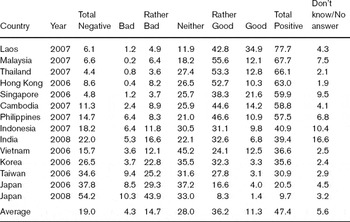
We begin by comparing the perceptions of China across Asian societies. Table 1 describes aggregate responses to the question about China's influence by country.
Perceptions of China's influence by country

Notes: Data from AsiaBarometer. Question wording is ‘Do you think the following countries have a good influence or a bad influence on your country? Please select the response closest to your opinion for each country listed . . . China?’ Sample size ranges from 1,000 to 1,052 including Don't know/No answer responses.
China's influence tends to be viewed on average as moderately positive in most Asian societies. The mean of the 14 aggregate scores for the response ‘rather good’ in Table 1 is 36.2%, with a smaller percentage of respondents describing China's influence as ‘good’ (11.3%). In contrast, fewer respondents see China's influence as ‘rather bad’ (14.7%) or ‘bad’ (4.3%). Japan, South Korea, Taiwan, and Vietnam stand out as exceptions to these positive perceptions. A plurality of Japanese and Taiwanese respondents described China's influence as ‘rather bad’ or ‘bad’ in 2006 (37.8% and 34.6%, respectively). A majority of Japanese saw China negatively in 2008 (54.2%). In South Korea, almost exactly as many respondents held neutral views, choosing ‘neither good nor bad’ (35.5%), as held positive views of China (35.6%). In Vietnam, a clear plurality (45.2%) chose ‘neither good nor bad’. These are all societies with a history of problematic relations with China, including territorial disputes or military conflicts, so this finding is not particularly surprising. What is unanticipated, however, is that, despite the common assumption that most people in Asia are deeply concerned about China's rising economic and military power, a plurality of people in almost all countries surveyed view China as having either a positive or neutral a influence.
Society-specific model analysis
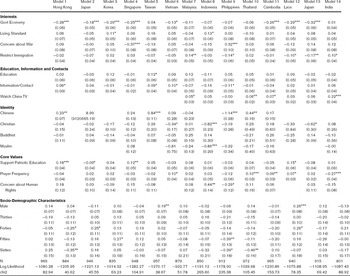
We turn now to our econometric models, which assess the association of each independent variable with individuals’ perceptions of China's influence while controlling for the effects of the other independent variables. Variables are discussed according to our theoretically grouped hypotheses, with results in Table 2 grouped accordingly.Footnote 7
Perceptions of China

Notes: Tables show ordered probit coefficients and standard errors (in parentheses); * p < 0.05, ** p < 0.01; *** p < 0.001; Source is Asiabarometer, Models 1–6 (2006), Models 7–12 (2007), Models 13–14 (2008); the 4 cut points for each model are not shown to save space; Question wording ‘Do you think the following countries have a good influence or a bad influence on your country? Please select the response closest to your opinion for each country listed . . . . China?’
First, we examine the hypotheses based on expectations about ‘interests’. As predicted, concerns over how one's government is handling the domestic economy are consistently associated with negative perceptions of China. The coefficient for concern about government handling of the economy was negative and statistically significant in eight of the 14 models – Hong Kong, Japan (2006 and 2008), South Korea, Singapore, Cambodia, Laos, and (weakly) in Vietnam. Respondents who were concerned about how their government was handling the economy tended to have less favorable perceptions of China in more than half of cases examined, controlling for a wide range of other factors. This suggests that throughout the region, a considerable percentage of people are concerned about China's economic influence. It is notable that concern is shared across some of the wealthiest societies, such as Japan and Singapore, as well as some poorer nations such as Cambodia and Laos.
It should be pointed out, however, that concern about the domestic economy is not measured by directly asking respondents about the state of the economy but rather about how their government is handling it. As a result, it is an indirect measure of domestic economic concerns. Nonetheless, the robustness of this finding across a wide range of societies suggests that anxiety about domestic economic conditions is associated with perceptions of China that are more favorable.
Although the expectation was that respondents of higher socio-economic status tend to have perceptions of China that are more favorable, the standard-of-living coefficient was positive and (weakly, at 90%) statistically significant in only South Korea and Indonesia. The lack of a robust relationship between socioeconomic status and perceptions of China suggest that a person's level of prosperity does not determine their views of China.
The expectation that respondents throughout Asia who are concerned with security issues tend to have perceptions of China that are more unfavorable also failed to find consistent support. Only those respondents in Singapore who expressed such a concern were more likely to have unfavorable perceptions of China. This finding is particularly surprising. It appears that while political elites may be uneasy about China's growing military power, most Asians do not see China as a military threat.
Neither was support for government efforts to restrict immigration consistently statistically significant. Respondents who expressed a preference for a more restrictive immigration policy tended to have less favorable perceptions of China only in Japan in 2008 and (weakly) in the Philippines and Laos. The association may be specific to a particular societal context. While citizens from a country without a history of large-scale immigration such as Japan may express concern about Chinese immigrants, people from societies in Asia that are more ethnically diverse may simply not consider this a salient issue.
We now turn to the hypotheses based on the roles of ‘information and contacts’. Contrary to expectations, education was not a consistent explanatory factor. In fact, it was (weakly) statistically significant in only Taiwan. Since we are controlling for the effects of standard of living, this suggests that when it comes to shaping a person's views of China, at least in most of Asia, education does not mollify fears or increase feelings of ‘friendship’ (but nor does it lead to perceptions that are more negative). Similarly, the hypothesis that contact with foreign people, countries, and information will encourage perceptions of China that are more positive did not find strong support. The information and contacts index was (weakly) statistically significant in only Hong Kong, Taiwan, and Vietnam, suggesting that across Asia respondents who had greater points of contact internationally did not consistently have perceptions of China that are more positive. The significance of this factor in Hong Kong and Taiwan – societies with extensive interactions with the PRC – suggests that contact with China, Chinese people, and exposure to information about China may facilitate views that are more favorable (though this point may not hold for Vietnam).
As predicted, frequency of watching Chinese television and films was consistently associated with perceptions of China that are more favorable. The coefficient was positive and statistically significant in India, Thailand, Cambodia, and (weakly) in Malaysia. In half of the cases in which this item was included, respondents who watched Chinese television and films tended to have perceptions of China that are more positive than those who did not. Seven of eight coefficients are also positive, suggesting that familiarity with Chinese popular culture is a factor influencing perceptions of China across a range of societies in the region that are more favorable.
While statistically robust, this finding contains three important limitations. First, this variable is only included in the models for 2007 and 2008. As a result, the effects of Chinese television and films in Hong Kong, Japan (2006), South Korea, Taiwan, and Vietnam are unknown. Second, the item in the AsiaBarometer does not distinguish between popular culture from the PRC, Hong Kong, and Taiwan. As a result, it is impossible to know whether watching Hong Kong or Taiwanese films, for example, can also lead to views of China that are more favorable. It may be that a general familiarity with Chinese culture has a positive effect upon individual attitudes towards the PRC regardless of its origins. As a result, this outcome cannot be directly linked to the PRC's cultural diplomacy. Third, causality may be reversed. It is quite possible that individuals who already felt positive toward China were more likely to seek out Chinese television shows and films. Despite these qualifications, this finding is consistent with, but not decisive for, expectations that China's popular culture has a significant soft power dimension.
Among our ‘identity’-based hypotheses, although those who identified as Chinese were expected to be more likely to have favorable perceptions of China than those who did not, this did not find consistent support. The coefficient was significant and positive in only Hong Kong, Taiwan, and Thailand. Chinese ethnic identity appears to be quite different from identifying with the Chinese state.
The hypothesis that religion is associated with unfavorable perceptions of China also failed to find consistent support. The coefficient for Christian was negative and statistically significant in Indonesia, and (weakly) Vietnam, and Japan in 2008. The coefficient for Muslim was statistically significant and in the expected direction only in Indonesia. The coefficient for Buddhist was never statistically significant.
Among the hypotheses regarding ‘core values’, despite the expectation that patriotism may lead to unfavorable perceptions of China, this hypothesis also did not find consistent support. The coefficient was (weakly) significant and negative in only Japan in 2006, suggesting that supporters of patriotic education in most Asian societies are not more likely to have unfavorable perceptions of China.Footnote 8 It is noteworthy that even in the case of Japan, where nationalist issues such as visits to the Yasukuni Shrine, history textbooks, and territorial disputes have long inflamed relations, the coefficient was only weakly significant in 2006 and was not significant in 2008. Patriotism alone, it seems, does not determine an individual's view of China.
The hypothesis that concern about human rights is associated with unfavorable perceptions of China also found little support. The sign for worries about human rights was (weakly) statistically significant and negative only in the Philippines. Like patriotism, concerns about human rights do not seem to structure individuals’ views toward China. Frequency of prayer, our measure for religiosity, was statistically significant and negative only in India.Footnote 9 This suggests that respondents that are more religious do not tend to have views of China that are consistently more favorable. Although Hurwitz and Peffley (Reference Hurwitz and Peffley1990) found religiosity to affect American perceptions of the USSR during the Cold War, most people in Asia do not appear to structure their beliefs about China based on this. It may be that religiosity is a more salient heuristic in the US context than in Asia or that Communism was more strongly associated with the USSR during the Cold War than with China in the late 2000s. While the effects of religious identity may depend on societal context and information availability, the evidence suggests that people in Asia do not tend to structure their views of China in religious terms.
Finally, among socio-demographic factors, neither gender nor age was consistently associated with perceptions of China. The coefficient for male was statistically significant and positive only in Vietnam and Laos, suggesting that in the majority of cases men and women did not tend to have different perceptions of China. The age factor was also of limited significance. The coefficient for thirties was not statistically significant in any society; forties was statistically significant and positive in South Korea and Laos and negative in Japan (all weakly, at 90%); fifties was statistically significant and positive in Singapore and negative in the Philippines (again, both weakly so); and sixties was statistically significant and negative in Japan (2006), Thailand, and (weakly) the Philippines. While age appears to be a factor influencing perceptions of China in a few societies, the effect was not consistent across the region.
Discussion
The purpose of this paper was twofold: to examine how Asian publics perceive China's influence and to identify the factors that most consistently affect individuals’ perceptions of China across a range of different countries. The results clearly show that Asian publics in most societies tend to view China's influence as rather good. The exceptions are Japan, South Korea, Taiwan, and Vietnam. The variation in the percentage of respondents who saw China's influence as positive (from 77.7% in Laos to 9.7% in Japan in 2008) suggests that national context matters greatly – a claim supported by other scholarly findings (Tucker, Reference Tucker2009; Reilly, Reference Reilly2012). However, it should be noted that even in Japan, a country which had problematic relations with China during the three years of the AsiaBarometer, over one-third of respondents in both 2006 and 2008 do not see China's influence as either good or bad. Future surveys, with question items that are more nuanced, could begin to unpack this surprisingly high level of ambivalence.
Two further implications follow from the national-level data. First, the substantial negative perceptions of China prevalent in Japan – almost 38% of respondents in 2006 and over 54% in 2008 – should concern Beijing. China's brash rhetoric and assertive diplomatic tactics toward Japan may exacerbate popular anxieties, increasing the political risks for Japanese leaders in cooperating with China. Second, foreign policy makers in the United States, Japan, and across Asia should also take note that most Asian citizens do not seem to view China as a threat. While regional elites frequently express concerns about a potentially dangerous China (for instance, Wong, Reference Wong2010), it appears their concerns are not widely shared by Asian publics. This study did not detect widespread threat perceptions or even a plurality of negative views toward China among most people in the region. Asians tend to be neutral, or more often, positive toward China. Both the US and Japan should pay careful attention to popular attitudes throughout Asia if they seek to convince allies in the region that more should be done to counter growing Chinese military and economic power. If they are unable to do so, they may find regional partners less enthusiastic about ‘balancing’ or ‘containing’ China for fear of running counter to the will of their people.
Although the results show that China's influence is viewed as mainly positive in Asia, the measure used for perceptions of China is rather simple. As we rely on a single survey question yielding an ordinal variable with five values, respondents were limited in their range of responses. The preference would have been to use multiple instruments across various dimensions of perceptions of China. Furthermore, as with any survey, these findings may be specific to a particular time period. This study compares results from surveys from three different years. Although the methodology is consistent, salience effects associated with China in a particular year may have led to an overestimation or underestimation of results.Footnote 10 The most notable reason to be cautious in interpreting the positive perceptions of China is that all three surveys were conducted in a period just prior to the Beijing Olympics in 2008.Footnote 11 This may have affected China's behavior and how it was perceived in the region, resulting in an overestimation of favorable perceptions. Further research will help clarify which of our findings may be specific to a particular point in time and which are generalizable.
Our econometric analysis suggests that two factors consistently influence individual perceptions of China throughout Asia – concerns about a society's economy and familiarity with China itself. The literature on international images suggests that images of particular nations are based on whether they are considered to be a threat or an opportunity (Boulding, Reference Boulding1959; Holsti, Reference Holsti1967; Herrmann and Fischerkeller, Reference Herrmann and Fischerkeller1995). While military threats may have been the foremost factor shaping a nation's image during the Cold War, we suggest that in Asia today, the greatest concern about China is that it poses an economic threat. This should not be too surprising, as Americans may also tend to view China as more an economic than a military challenge. Fordham and Kleinberg (Reference Fordham and Kleinberg2011), for example, found that economic interests help explain individual Americans’ assessment of China as a danger. It is interesting to find that people in Asian societies, which are most directly affected by China's growing military power, also tend to evaluate China in economic rather than security terms. Further research could explore the conditions under which Asian citizens tend to see China (and the US) as security threats, and seek to isolate which aspects of the domestic economy (unemployment, imports, foreign investment, etc) are associated with negative perceptions of China.
More broadly, the finding that concern about domestic economic interests are associated with perceptions of China that are more unfavorable suggests that economic conditions in China's Asian neighbors, or at least how their governments are perceived to be handling these conditions, will be an important factor in determining whether China is perceived as a positive or negative influence in the region. Fair or not, Asian citizens may blame China when their own economies threaten to turn downward. To improve its image among Asian publics, Beijing should pay close attention to domestic economic trends in these countries. The pursuit of trade policies portrayed as advantageous to its neighbors, such as the ‘early harvest’ offers in the 2010 ASEAN–China Free Trade Area and the 2010 Economic Cooperation Framework Agreement with Taiwan can also enhance China's regional image.
The finding that familiarity with Chinese popular culture is associated with perceptions of China's influence that are more positive suggests more traction for Chinese soft power in the region than most recent analysis has assumed (e.g., Wright, Reference Wright2009). Greater familiarity with Chinese culture may lead to perceptions that are more favorable – but, as we note, the causal connection could be the reverse as well. Furthermore, the relatively large percentage of respondents who see China's influence as neither good nor bad suggests that a considerable number of people in Asia remain ambivalent over whether China poses a threat or opportunity. Asia may thus be responsive to a well-designed and concerted future soft-power push by Beijing. Finally, this study contributes to the study of perceptions of China by identifying a number of factors that do not consistently structure perceptions of China through Asia. Twelve of our hypotheses found support only in particular cases, suggesting that analysts should think carefully before offering sweeping claims about broad trends in ‘Asian’ perceptions of China. Attentiveness to change over time, varying national contexts, and crucial intervening variables are essential for identifying which factors shape individual perceptions of China across the diverse region of Asia.
About the authors
James Reilly is a Senior Lecturer in Northeast Asian Politics in the Department of Government and International Relations at the University of Sydney. He is the author of Strong Society, Smart State: The Rise of Public Opinion in China's Japan Policy (Columbia University Press, 2012), and the co-editor of Australia and China at 40 (UNSW Press, 2012). His articles have appeared in a number of academic journals, including: Journal of Contemporary China, Modern Asian Studies, Washington Quarterly, China: An International Journal, Asian Survey, and Survival. He has also published numerous book chapters in edited volumes. He holds a Ph.D. in Political Science (George Washington University 2008) and an M.A. in East Asia Area Studies (University of Washington 1999), and was a post-doctoral research fellow at the University of Oxford (2008–09). He also served as the East Asia Representative of the American Friends Service Committee (AFSC) in China from 2001–08.
Matthew Linley is an Assistant Professor in Political Science at Temple University Japan. He holds a Ph.D. in Political Science (Australian National University 2009), an L.L.M. (Nagoya University 2002), and an M.A. (University of Victoria 1998). He has been a recipient of a Monbukagakusho Scholarship (1998–2002) from the Japanese Government and two Japan Foundation Fellowships (1997, 2006–2007).
Benjamin E. Goldsmith is Associate Professor in the Department of Government and International Relations at the University of Sydney. He holds a Ph.D. in political science (Michigan 2001). His articles have appeared in leading academic journals including European Journal of International Relations, Journal of Conflict Resolution, Journal of Peace Research, Journal of Politics, and World Politics. He has recently received major research grants from the Australian Research Council and the Asia Pacific Centre for the Responsibility to Protect to investigate regional patterns of interstate conflict, and to develop forecasting models for genocide, respectively.
Appendix 1: Measurement of the independent variables
Government Economic Policy Evaluation: item used to measure concerns about the domestic economy asking respondents how they evaluate their government's handling of the domestic economy, on a 4-point scale, 1 = Not well, 4 = Very well.
Socioeconomic Status: item asking respondents to evaluate their standard of living, on a 3-point scale, 1 = Low, 3 = High.
Immigration Policy Evaluation: item used to measure an individual's concerns about immigration asking respondents if they think that the central government should restrict the flow of a foreign workforce to protect domestic people's interests, with a 5-point scale, 1 = Strongly disagree, 5 = strongly agree.
Worry about Security Issues: item asking respondents which issues caused them great worry, coded as a dichotomous or ‘dummy’ variable, with 0 = Not mentioned, 1 = National security.
Frequency of Watching Chinese TV and Movies: item asking respondents how often they were exposed to Chinese TV programs, movies and animation produced in the PRC, Hong Kong, or Taiwan, with a 6-point scale, 1 = Never, 6 = Almost every day. Since this item was included only in the 2007 and 2008 AsiaBarometers, it is excluded from the models for 2006.Footnote 12
Education: coded on a 3-point scale, with 1 = Primary/lower secondary education, 3 = Tertiary education.
Information and Contacts Index: summed index of six information and contact items, with 0 = No contact with foreign nations or people and 6 = High contact with foreign nations or people.Footnote 13
Chinese: ethnic identity; a dummy variable, with 0 = non-Chinese, 1 = Chinese.
Religion: religious identity, all variables listed are dummy variables.Footnote 14
Patriotic Education Support: item measuring individual's level of patriotism asking respondents how much they agree with the statement that their government should emphasize patriotic education to foster patriotism, with 5-point scale, 1 = Strongly disagree, 5 = Strongly agree.
Frequency of Prayer: item measuring individual's level of religiosity asking respondents the frequency with which they pray, with 1 = Never, 5 = Daily.
Human Rights Concern: dummy variable, item asking respondents which issues caused them great worry, with 0 = Not mentioned, 1 = Human rights.
Gender: dummy variable, with 0 = Female, 1 = Male.
Age: All variables listed are dummy variables with respondents in their 20s comprising the excluded category.
Note: The mean of the aggregate scores for respondents saying they ‘don't know’ when asked about China's influence was 5.6% (varying from 1.9% to 16.6%, see Table 1). We coded these as missing data and excluded them from the analysis.