1. Setting the Stage: Three Carnapian Desiderata
In the second edition of Logical Foundations of Probability (LFP), Carnap (Reference Carnap1962, xvi) distinguished two kinds of inductive-logical confirmation relations: confirmation as firmness, which he informally characterized as “how probable the hypothesis H is on the basis of the evidence E,” and confirmation as increase in firmness, which he informally characterized as “how much the probability of H is increased when new evidence E is acquired (in addition to the prior evidence which, for simplicity, we shall take here as tautological).” Carnap devotes almost all of LFP to the task of explicating the former. Presently, I will discuss Carnap's approach to the former and sketch my own approach to the latter. My discussion will focus, ultimately, on the relation between inductive logic (the confirmation as increase in firmness relation) and epistemology (the relation of incremental evidential support).
I begin with some quotes from LFP to set the stage. The first gives a general sense of the very idea of inductive logic, as a quantitative analogue (or generalization) of deductive logic:
Deductive logic may be regarded as the theory of the relation of logical consequence [
 $\vdash $
], and inductive logic as the theory of another concept [
 ] which is likewise objective and logical … degree of confirmation (Carnap Reference Carnap1962, 200).
The next two quotes give Carnap's (Reference Carnap1962, 200) informal characterizations of the terms `logical' and `objective' as they apply to the relations
 $\vdash $
and
 :
The principal common characteristic of the statements in both fields is their independence of the contingency of facts. This characteristic justifies the application of the common term ‘logic’ to both fields.
That  is an objective concept means this: if a certain
 value holds for a certain hypothesis with respect to a certain evidence, then this value is entirely independent of what any person may happen to think about these sentences.
It is clear that Carnap, at least, intends here to be saying that confirmation relations should be analytic. But, mere analyticity is not all that is required of confirmation. Confirmation ( ) must be analogous to entailment (
 $\vdash $
) in certain other ways as well. Specifically, Carnap (Reference Carnap1962, 202) adds:
They both involve the concept of range. ‘E L-implies H’ [‘
 $E\vdash H$
’] means that the entire range of E is included in that of H, while … ‘
 $\mathstrut{\frak c} (H,\, E) =3/ 4$
’ means three-fourths of the range of E is included in that of H.Footnote 1
Moreover, Carnap emphasizes that both relations (
 $\vdash $
and
 ) should be applicable to epistemology in analogous ways. He endorses analogous epistemic bridge principles for both relations. For the
 $\vdash $
relation, Carnap (Reference Carnap1962, 201) endorses the following closure principle:
If E is known by the person X at the time t, then H is likewise known by X at t [provided that
 $E\vdash H$
is also known by X at t].
For  , Carnap (Reference Carnap1962, 201) endorses the following principle, which he takes to be analogous to closure:
If E and nothing else is known by X at t, then the degree of belief justified by the knowledge of X at t is 3/4 [provided that
 $\mathstrut{\frak c} (H,\, E) =3/ 4$
is also known by X at t].
For Carnap, then, inductive logic involves a confirmation relation  , which has (at least) the following three characteristics (I take these to be neutral between the firmness and increase in firmness conceptions of confirmation):
• Analyticity: Statements involving
 should be analytic, like statements involving
$\vdash $
are.
Carnap had a philosophical theory of analyticity. We will not worry too much here about the details of his theory of analyticity (since that is not our emphasis). Roughly, here we will (following the spirit of Carnap's informal characterizations of analyticity rather than the letter of his technical theory thereof) take ‘analytic’ to mean “true in the way that mathematical truths are true.”
• Logicality:
should be a quantitative generalization of
$\vdash $
.(H,E) should be maximal (minimal) when
$E\vdash H$
(
$E\vdash \sim H$
).Footnote 2• Applicability:
should be applicable to epistemology in ways analogous to the ways in which
$\vdash $
is applicable to epistemology.Some kind of epistemic bridge principle(s) should hold, which connects
with some epistemic concept (much more on this below).Footnote 3
 should be analytic, like statements involving

 should be a quantitative generalization of

 (H,E) should be maximal (minimal) when


 should be applicable to epistemology in ways analogous to the ways in which

 with some epistemic concept (much more on this below).
2. Carnap's Approach to Confirmation as Firmness
Carnap's  (·, ·)'s are, basically, measures of the relative frequencies with which certain syntactical particles occur in the sentences of certain simple formal languages.Footnote 4 The building blocks of early Carnapian
 's are “regular logical measure functions”
 (·). Such
 's assign numbers on (0, 1) (which sum to 1) to each of the state descriptions () of some (monadic) first-order language
 . In his earliest system, Carnap uses
 †(·), which assigns equal measure to each state description in
 . Conditional “logical” probability (
 †) is then given by a ratio of these unconditional logical probabilities (in the usual way):
 $\mathstrut{\frak c} ^{\dagger }(H,\, E) =[ \mathstrut{\frak m} ^{\dagger }(H\& E) ] / [ \mathstrut{\frak m} ^{\dagger }(E) ] $
. This function
 † satisfies the first two desiderata above, because (i)
 † statements are analytic, since, given
 †, they are determined by the structure of
 ; and (ii)
 † generalizes entailment, since
 † is maximal (minimal) when
 $E\vdash H$
(
 $E\vdash \sim H$
).Footnote 5 Nonetheless, Carnap eventually rejects
 †, because he thinks its applicability to epistemology is unsatisfactory. Interestingly, this is not because
 † fails to undergird his desired epistemic bridge principle. Carnap (Reference Carnap1962, 565) explains:
The choice of  † as the degree of confirmation would be tantamount to the principle never to let our past experiences influence our expectations for the future.
What Carnap means here is that, according to  †(H,E), no E can ever increase the firmness of any H (unless
 $E\vdash H$
). That is, we can never have
 $\mathstrut{\frak c} ^{\dagger }(H,\, E) > \mathstrut{\frak c} ^{\dagger }(H,\,\mathsf{T}) $
, unless
 $E\vdash H$
.Footnote 6
Because of this “no learning from experience problem,” Carnap abandons  † in favor
 *, a function constructed using a different measure function
 *, which in turn assigns equal measure to the structure descriptions (
 ) of
 . The structure descriptions of
 are just collections of state descriptions of
 that are invariant under permutations of individual constants. This “clumping” of state descriptions avoids the no learning from experience problem. But, Carnap thinks
 * has other shortcomings concerning its epistemic applicability. This causes Carnap to add an adjustable parameter λ to his
 -constructions, which yields a λ-continuum of
 -functions.Footnote 7 Later, Carnap puzzled over still other epistemic application requirements that he thought no
 λ-function could adequately meet. This led to the addition of further adjustable parameters to his systems, which allowed Carnap more flexibility in the ways in which he could carve up his languages
 . But, even this broader class of
 's never seemed fully satisfactory to Carnap from the point of view of its epistemic applicability. In the end, the classes of probability functions that one can construct Carnap-style from such
 's do not seem rich enough to meet all the demands of general epistemic application (Maher Reference Maher2001).
At this point, I want to step back and ask two questions:
• Why bother with such syntactic constructions in the first place?
• Can we have analyticity, logicality, and epistemic applicability?
3. Analyticity and Logicality on the Cheap
Carnap acts as if the analyticity of  requires its syntactical construction (within
 ) out of “logical measure functions.” It is unclear why this should be true (even if you accept Carnap's formalistic understanding of analyticity). There seems to be an additional presupposition at work here: that the function
 should be two-place in the same way that
 $\vdash $
is two-place. But, the attempt to construct a two-place
 seems to have failed. Even Carnap found the need to add adjustable parameters to his recipes for constructing
 's. And, the resulting
 statements will not even be analytic until all of these parameters are adjusted. So, in the end,
 is not really two-place, even for Carnap. I suggest another (more direct and general) way to ensure analyticity:
 is a three-place relation between E, H, and a probability model (or a family thereof)
 .Footnote 8
By making  explicitly a three-place relation in this way, we do not restrict ourselves to a limited class of probability models that can be cooked up using simple first-order languages
 according to some Carnapian recipe. This is advantageous, because there are many probability models that seem salient to statistical and inductive inference that cannot be simulated by even the most sophisticated of Carnapian constructions (Maher Reference Maher2001). Note: this still gives us analyticity (even in Carnap's technical sense), since given
 , all probability statements—relative to
 —are mathematically true.Footnote 9 So, we can easily obtain analyticity (and increased generality) by making
 three-place rather than two-place. How about logicality? Yes, that's not a problem either, since, in all probability models
 (Carnapian or otherwise),
 $\mathrm{\Pr}_{\mathstrut{\cal M} }(H\vert E) $
will be maximal (minimal) when
 $E\vdash H$
(
 $E\vdash \sim H$
).
However, when we make the three-place nature of  explicit, the epistemic applicability problem becomes prominent. To see this, consider the following naive, Carnap-style bridge principle:
If X knows E and nothing else (a posteriori), and X knows (a priori) that
 $\mathrm{\Pr}_{\mathstrut{\cal M} }(H\vert E) =r$
, then X's credence in H, given E, should be r. (This is tantamount to treating arbitrary probability functions as “expert probabilities” in the sense of Gaifman [Reference Gaifman, Skyrms and Harper1988].)
This just cannot be true, since if it were true, then nothing about the relationship between the model  , the agent X, and/or the world would be required to constrain X's credences. Hence, this principle is implausible even if we understand what it means (in general) to “know E and nothing else.” What made Carnap's bridge principle at all plausible (perhaps modulo the “and nothing else” clause) was that his models were supposed to be models of “a priori” probability. As such, they had their epistemic credentials built-in from the start. But, what if there is no such thing as “logical” or a priori probability (as many of us now suspect)? Does this mean that inductive logic is impossible? Not necessarily. At least, that is what I will try to argue.
4. Confirmation as Increase in Firmness Revisited
Let's return to confirmation as increase in firmness now. It is well known (Fitelson Reference Fitelson2001) that there are many measures of the degree to which E increases the firmness of H. Interestingly, very few of these satisfy logicality. We can sum up the desiderata of logicality and sensitivity to increase in firmness (or relevance) as follows. For all contingent E and H:Footnote 10

As it turns out, of all the relevance measures used or defended in the historical literature on confirmation (up to ordinal equivalence), only
 $l(H,\, E,\,\mathstrut{\cal M}) =\mathrm{log}\,\{ [ \mathrm{\Pr}_{\mathstrut{\cal M} }(E\vert H) ] / [ \mathrm{\Pr}_{\mathstrut{\cal M} }(E\vert \sim H) ] \} $
and
 $l^{\prime }(H,\, E,\,\mathstrut{\cal M}) =\mathrm{log}\,\{ [ \mathrm{\Pr}_{\mathstrut{\cal M} }(H\vert E) ] / $
 $[ \mathrm{\Pr}_{\mathstrut{\cal M} }(H\vert \sim E) ] $
satisfy logicality.Footnote 11 And, if we impose the following additional constraint (which seems to be accepted by all historical practitioners of probabilistic confirmation theory):
If
 $\mathrm{\Pr}_{\mathstrut{\cal M} }(H\vert E_{1}) \geq \mathrm{\Pr}_{\mathstrut{\cal M} }(H\vert E_{2}) $
, then
 $\mathstrut{\frak c} (H,\, E_{1},\,\mathstrut{\cal M}) \geq \mathstrut{\frak c} (H,\, E_{2},\,\mathstrut{\cal M}) $
.
Then, we get historical uniqueness of l.Footnote 12 That's neat. But, I do not want make too much of fuss here about quantitative relevance confirmation claims of the form
 $\ulcorner \mathstrut{\frak c} (H,\, E,\,\mathstrut{\cal M}) =r\urcorner $
, since I think the most objective claims (and the claims most analogous to entailment claims) are qualitative claims of the form
 $\ulcorner \mathstrut{\frak c} (H,\, E,\,\mathstrut{\cal M}) \lesseqqgtr 0\urcorner $
. Are there bridge principles relating the qualitative increase in firmness confirmation relation and some epistemically important relation? I think so. But, these principles will not bridge confirmation as increase in firmness and credence (since confirmation as increase in firmness measures are not probability functions). Rather, they will bridge confirmation and (incremental) evidential support. Moreover, I suspect that there are also comparative bridge principles, which bridge comparative confirmation claims and comparative claims about evidential support (but these will be more controversial). Let us look at the qualitative case first.
It is useful here to compare the deductive and inductive cases. In the deductive case, the bridge principle is rather simple. If a rational agent knows
 $E\vdash H$
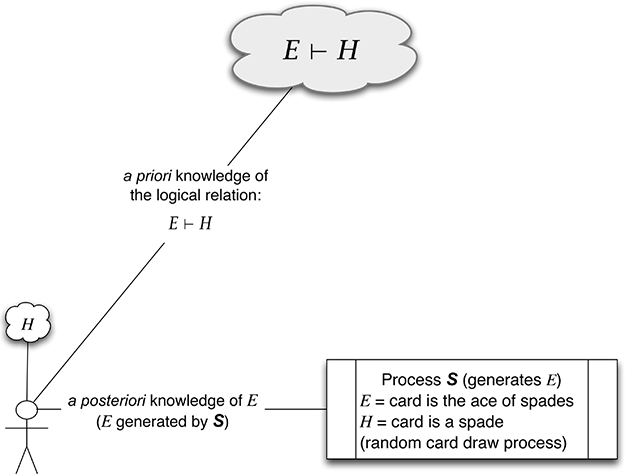
and E, then (ceteris paribus) they may be said to know H on the basis of E.Footnote 13 Figure 1 allows us to picture a concrete example.
Entailment and knowledge.

In Figure 1, our agent learns a posteriori that (E) a card drawn at random from a standard deck is the ace of spades, and they know a priori that E entails (H) that the card is a spade. So, the agent may (ceteris paribus) be said to know that H on the basis of E. The important thing to note here is that we may ignore the stochastic properties of the process that generated E. It does not matter whether our typical model of random card draws is a correct model of the process that generated E—because the agent knows that E entails H in this case, the agent will know H on the basis of E here independently of such considerations. Carnap wanted the same kind of independence to obtain in the case of inductive-logical bridge principles. In other words, he wanted the inductive-logical picture to look as simple as our Figure 1. As I have implied above, I think that dream of Carnap's cannot be achieved. I think things just are not so tidy in the case of inductive-logical bridge principles. That is, I think that it is all but hopeless to have anything like the sort of bridge principle Carnap wanted (as stated above) for confirmation as firmness and credence. I am skeptical here (mainly) for two reasons. First, I do not know what it means for an agent to know E and nothing else (a posteriori).Footnote 14 Second, such a principle would seem to require the existence of objective, a priori probabilities, and I do not think that there are such things. That's the bad news. The good news is that I think that we can avoid these problems when it comes to bridging confirmation as increase in firmness and evidential support. I will argue that bridging these concepts does not require either a “and the agent knows nothing else a posteriori” clause or the existence of objective a priori probabilities. But, some additional complexity is required in the inductive case, because in the inductive case the nature of the stochastic process that generates E cannot be ignored.
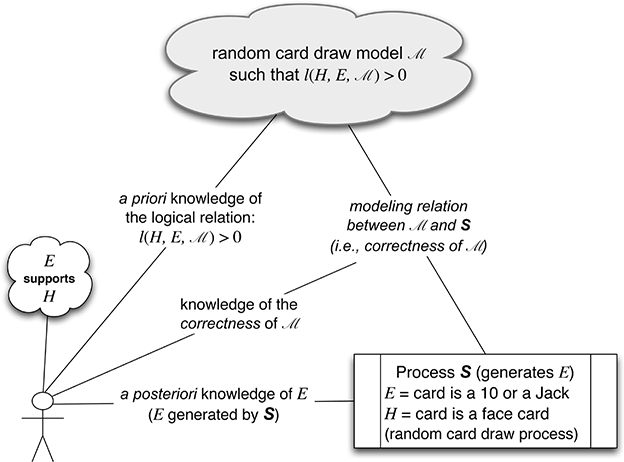
Again, it helps to picture the sort of case I have in mind. Figure 2 depicts an agent who learns a posteriori that (E) a card drawn at random from a standard deck is either a 10 or a jack, and they know a priori that—in the standard probability model  used to model random card draws—E is positively correlated with the proposition that (H) the card is a face card.
Qualitative confirmation and evidential support.

I submit that in such cases the agent knows (ceteris paribus)Footnote 15 that E evidentially supports H—provided that the agent also knows that the model  is a correct model of the stochastic process
 that generated the event E. That is, I am suggesting the following bridge principle (or inference rule) relating confirmation as increase in firmness and evidential support:
a knows (a posteriori) that E by observing the outcome of a stochastic process
.a knows (a priori) that E confirms (increase in firmness sense) H in the model
.a knows (a posteriori) that
is a correct model of the stochastic process .Footnote 16- $\therefore $
a knows that E evidentially supports H.
 .
 .
 is a correct model of the stochastic process
 .

I think that there are lots of examples illustrating the plausibility of the bridge principle stated above (and implicitly pictured in Figure 2).Footnote 17 For instance, when a pregnancy test ( ) that is known to be reliable is administered (properly, and on an appropriate individual, etc.), the observation of a positive test result (E) constitutes evidence in favor of pregnancy (H). This sort of example fits the mold of our bridge principle perfectly. In such cases, the observation is of E, an event generated by a stochastic process
 , and in the probability model
 of
 , which we know (let us assume) to be correct, there is a large positive likelihood ratio l(H, E,
 ). Such cases are canonical ones in which we are inclined to infer that E constitutes strong evidence in favor of H. Indeed, these are precisely the kinds of cases that statisticians use to illustrate how we should interpret the evidential import of the outcomes of stochastic processes (Royall Reference Royall1997). As such, whereas Carnap was trying to provide a logical foundation for credence (or subjective probability), we can now be seen to be aiming for a logical foundation for evidential support.
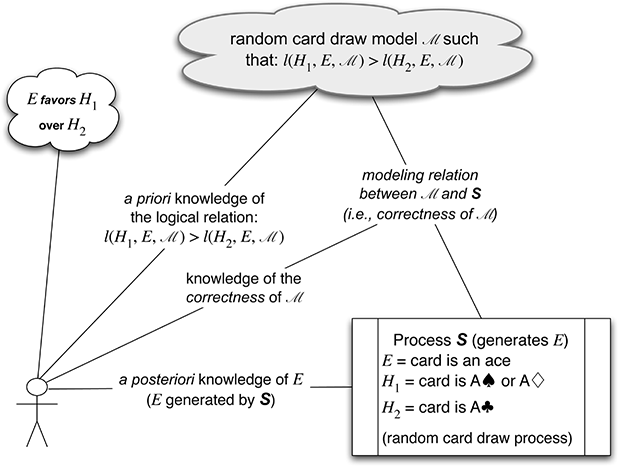
Finally, I would like to say something about the prospects of formulating bridge principles relating comparative confirmation (as increase in firmness) and comparative evidential support. This case is more controversial, because the content of any such principle will depend sensitively on the ordinal structure of one's particular measure of confirmation. And, there is widespread ordinal (or comparative) disagreement between such measures (Fitelson Reference Fitelson2001). Nonetheless, I think such principles can be formulated. Figure 3 illustrates how I think such principles would work.
Comparative confirmation and favoring.

In this example, our agent learns a posteriori that (E) a card drawn at random from a standard deck is an ace, and they know a priori that—in the standard probability model  used to model random card draws—
 $l(H_{1},\, E,\,\mathstrut{\cal M}) > l(H_{2},\, E,\,\mathstrut{\cal M}) $
, where H 1 is the hypothesis that the card is either the ace of spades or the ace of diamonds, and H 2 is the hypothesis that the card is the ace of clubs. I submit that in such cases the agent knows (ceteris paribus) that E favors H 1 over H 2. That is, the agent may infer in such cases that E constitutes better evidence for the truth of H 1 than for the truth of H 2. I have intentionally chosen an example here in which there are other measures of confirmation as increase in firmness that disagree with l on this comparative claim. For instance, if we follow Milne (Reference Milne1996) and use the ratio measure
 $r(H,\, E,\,\mathstrut{\cal M}) =[ \mathrm{\Pr}_{\mathstrut{\cal M} }(H\vert E) ] / [ \mathrm{\Pr}_{\mathstrut{\cal M} }(H) ] $
, then we get
 $r(H_{1},\, E,\,\mathstrut{\cal M}) =r(H_{2},\, E,\,\mathstrut{\cal M}) $
in this example, which would not undergird the inference that E favors H 1 over H 2. This sort of example reflects a long-standing controversy over alternative probabilistic accounts of comparative (or relational) confirmation (and support). I do not have the space here to expand on this controversy, but I have written extensively on this topic elsewhere (Fitelson Reference Fitelson2007).
5. Conclusion
Carnap tried to provide an inductive-logical foundation for (epistemic) probability. I have explained what I think the shortcomings of his project were. Mainly, these involved problems with simultaneously satisfying three Carnapian desiderata for inductive logic, which I have called analyticity, logicality, and applicability. I then explained how one can overcome these difficulties by opting for an inductive-logical foundation for a different epistemic concept: evidential support. I briefly sketched my favored theory of inductive logic (in this sense), and I explained how it can simultaneously satisfy all three of our Carnapian desiderata for inductive logic. Moreover, I argued that the resulting framework is widely and intuitively applicable to the interpretation of statistical evidence. I have provided only a broad sketch of how I think this new approach to inductive logic should work. I plan to produce a fuller treatment in a future monograph.
 (H, E) is defined. I am ignoring the paradoxes of entailment (see below). I have generalized Carnap's “logical range” analogy, since that analogy breaks down when we are talking about increase in firmness. I have settled on this desideratum, since it is the strongest one I can think of that is capable of meaningfully applying to both the firmness and the increase in firmness conceptions of confirmation.
 's get more than just the “endpoints” right; they give a tighter quantitative generalization in terms of “logical range.” This cannot be achieved by measures of confirmation as increase in firmness. See Kemeny and Oppenheim (
 †, and if λ is set to a certain finite value, then it yields
 *, and so on.