Since December 2019, there has been an outbreak of coronavirus disease (COVID-19), Reference Zhu, Zhang and Wang1 which has spread worldwide. COVID-19 is extremely contagious, Reference Wang, Hu and Hu2 and the outbreak of the disease has seriously threatened global health and challenged economic and social development. Reference Bogoch, Watts and Thomas-Bachli3 The prevention and control of COVID-19 focus on controlling the source of infection, cutting off the route of transmission, and protecting vulnerable groups. Individuals do their part by taking preventive and control measures, such as wearing masks, handwashing, and isolation, which are essential for controlling the pandemic. Reference Pal, Yadav and Grover4
On January 2, 2021, Gaocheng District, Shijiazhuang City, Hebei Province reported the first local confirmed case in a rural area. By January 26, 2021, there had been 931 confirmed cases in Hebei Province. This outbreak occurred with clustered sexual transmission in rural areas; the infected population mainly consisted of rural residents. Rural areas are weak links and key locations in coping with public health emergencies due to the lack of medical facilities, prevention and control measures, and health care personnel. Reference Cuadros, Branscum and Mukandavire5 Rural residents have significant shortcomings in risk awareness and level of public health knowledge. Reference Haischer, Beilfuss and Hart6,Reference Fang, Chen and Rizzo7
Studies have shown that residents’ knowledge, attitudes, and practices (KAP) about COVID-19 influence their compliance with preventive and control measures. Reference Pal, Yadav and Grover4 According to the KAP model, knowledge is the foundation of behavior change, and attitude is the driving force of behavior change. Reference Li, Liu and Yu8 The success or failure of a country’s implementation of epidemic prevention measures depends largely on the behavior of residents, and residents’ knowledge and attitudes about COVID-19 may influence their compliance with government precautions. Reference Al-Hanawi, Angawi and Alshareef9 Therefore, improving rural residents’ knowledge of COVID-19 and cultivating an attitude of active prevention and control of COVID-19 are important for improving rural residents’ COVID-19 behavior.
The purpose of this study is to evaluate the current situation of residents’ COVID-19 KAP in rural areas during the COVID-19 outbreak, analyze the influencing factors of rural residents’ COVID-19 KAP level, and provide a theoretical basis for relevant departments to further epidemic prevention and control and health education in rural areas.
Methods
Study Design and Population
From January 22 to 26, 2021, which was the rising period of new cases of COVID-19 in Hebei Province, the snowball sampling method was used to select residents in rural areas in Hebei Province as the study subjects. The study population included rural residents age 18 years and older who currently live in rural areas of Hebei Province, are able to complete the questionnaire using their own smartphones, and are able to read and understand the questionnaire content. Participation in this survey was anonymous, consensual, and voluntary, with informed consent given by all prospective respondents.
Measurement
Based on the COVID-19 prevention and control guidelines issued by the National Health Commission of the People’s Republic China 10 and the Chinese Center for Disease Control and Prevention 11 and combined with relevant domestic and foreign literature, Reference Pal, Yadav and Grover4,Reference Zhang, Ma and Chen12 a questionnaire on epidemic prevention for rural residents in Hebei Province was finally compiled. The contents included a general data questionnaire (including gender, age, marital status, education level, occupation, living situation, family income, whether to participate in COVID-19 training) and the COVID-19 KAP questionnaire, which was divided into 3 parts to assess knowledge (questions 1–10), attitudes (questions 11–20), and practices (questions 21–30). Responses were scored from 0–30. The higher the score, the better the study subjects’ COVID-19 KAP. In this study, we determined that a high-level score was 27 points and above, and a low-level score was less than 27. Reference Zhang, Ma and Chen12
Data Collection
Due to the epidemic and epidemic prevention requirements, participants could not be contacted face to face. A network questionnaire (questionnaire star) was used to distribute the questionnaire on social platforms such as WeChat and QQ. Some rural residents who met the inclusion criteria were selected as the initial survey subjects, and then they recommended additional respondents who met the inclusion criteria. This process was continued, which created a snowball effect. The online survey was carried out voluntarily, without involving any identifiable private information. The results showed that the Cronbach’s α coefficient was 0.731, and the KMO was 0.780. To ensure the quality of the data, only 1 questionnaire per IP address was allowed. A total of 789 questionnaires were distributed, and 736 valid questionnaires were returned, with a valid recovery rate of 93.3%. All respondents voluntarily completed this questionnaire.
Statistical Analysis
The data were statistically analyzed using SPSS version 22.0 (IBM, Armonk, NY). Descriptive statistics such as frequencies and percentages were used to describe participants’ characteristics and their knowledge, attitudes, and behavioral responses to COVID-19. Cross-tabular univariate analyses with chi-square or Fisher’s exact tests were used to explore the relationship between basic characteristics of rural residents and COVID-19 KAP levels. The variables with statistical significance in univariate analysis (P < 0.05, 2-tailed variables) were the only variables analyzed using binary logistic regression modeling. The significance level was set at 0.05.
Results
Demographic Characteristics of the Studied Respondents
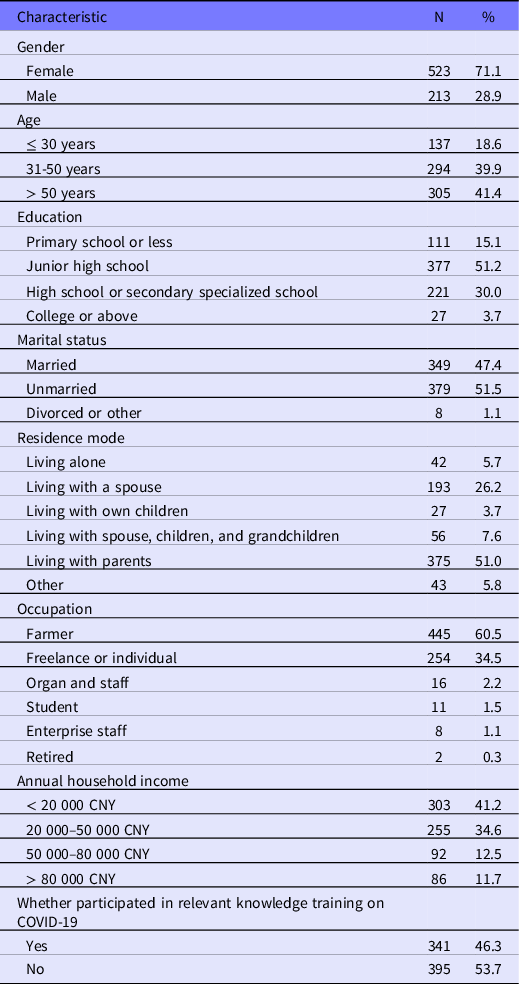
Of the total participants, 71.1% were female, 81.3% were over 30 years old, 66.3% had a junior high school education or less, 60.5% were farmers, 75.8% had an annual income of less than 50 000 CNY, and 53.7% did not participate in COVID-19-related training (Table 1).
Basic information of respondents

CNY, Chinese Yuan (currency).
COVID-19 Knowledge, Attitudes, and Practices Among Rural Residents
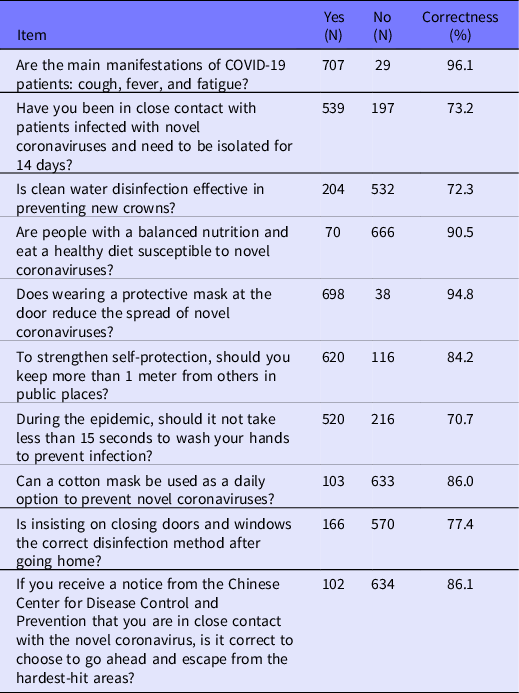
A survey of 736 rural residents in Hebei Province showed that most residents had a good understanding of COVID-19 and the population with the disease (96.1%, 90.5%). Residents had a higher understanding of wearing masks to reduce the transmission of COVID-19 (94.8%), but some residents had certain problems in the choice of masks (14.0%). Residents had a better understanding of public place precautions (84.2%) and cooperated with policies (86.1%). Compared with residents’ understanding of masks (94.8%, 86.0%), isolation (73.2%), and disinfection (72.3%, 77.4%), the residents had a poor understanding of handwashing (70.7%) (Table 2).
Knowledge of epidemic prevention of new crown among rural residents

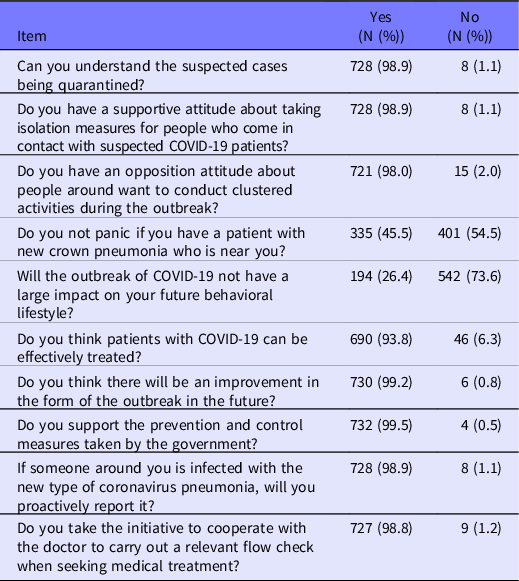
Rural residents in Hebei Province expressed high recognition of the isolation policy (98.9%, 98.9%) and the requirements for not conducting clustered activities (98.0%), which were practices adopted by rural residents in the face of the epidemic. Residents held highly positive attitudes toward the treatment of the epidemic situation (93.8%) and the future of the epidemic (99.2%). Most residents expressed supportive attitudes toward the government’s prevention and control work (99.5%), active reporting of the disease (98.9%), and cooperation with policies and procedures (98.8%). A total of 26.4% of the residents indicated that the outbreak had an impact on their lifestyles; 54.5% indicated that they still felt panicked about the COVID-19 condition around them (Table 3).
Attitudes of rural residents to epidemic prevention of COVID-19

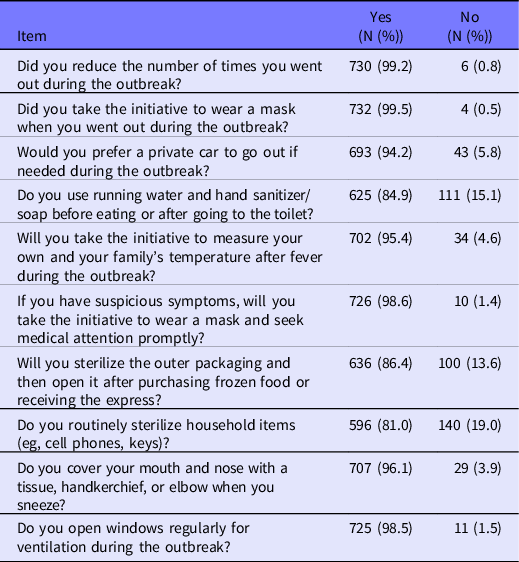
The survey showed that 99.2%, 99.5%, and 94.2% of residents actively reduced going out, wearing masks, and choosing private cars over public transportation when they had to go out, respectively; 84.9% of residents washed their hands correctly, 96.1% of residents took protective measures when they sneezed, 86.4% of residents disinfected frozen food and express deliveries, 81.0% disinfected household items, and 98.5% regularly opened windows for ventilation. If suspicious symptoms occurred during the epidemic, 98.6% of residents sought medical attention promptly, and 95.4% of residents actively measured their body temperature (Table 4).
Epidemic prevention practices of new crown among rural residents

Univariate Analysis of COVID-19 KAP Levels in Rural Residents
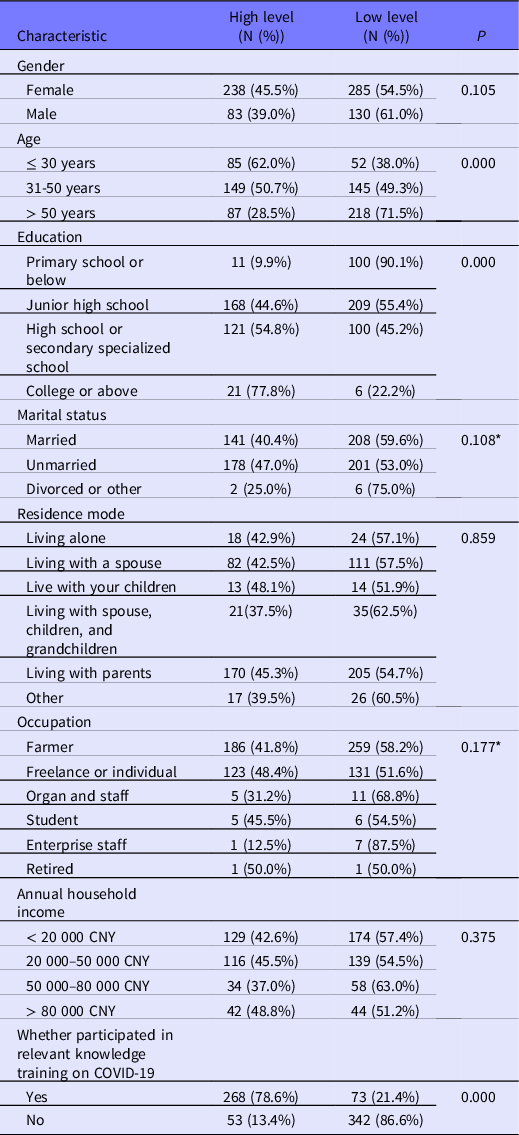
The results of the univariate analysis showed that age, education, and participation in relevant knowledge training on COVID-19 were all associated with differences in the level of COVID-19 KAP among rural residents (P < 0.05). Gender, occupation, marital status, mode of residence, and annual household income were not associated with the level of COVID-19 KAP among rural residents (P > 0.05) (Table 5).
Univariate analysis of COVID-19 KAP in rural residents

* Fishers exact test; CNY, Chinese Yuan (currency).
Binary Logistic Regression Analysis of COVID-19 KAP Levels in Rural Residents
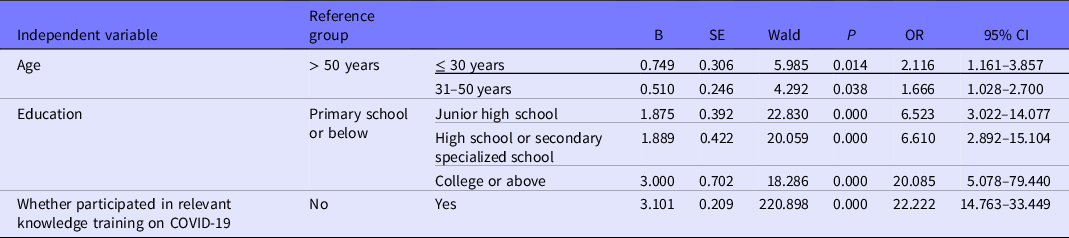
Binary logistic regression analysis was performed under the entry-level α = 0.05 and the removal level β = 0.10 with the level of COVID-19 KAP of rural residents (high-level assignment = 1, low-level assignment = 0) as the dependent variable and age, education, and participation in the COVID-19 training as independent variables. Three groups of variables—age, education, and participation in the training on knowledge of COVID-19—were set as dummy variables. The results showed that after controlling for confounding factors, the level of COVID-19 KAP was higher in people ≤ 30 and 31–50 years old than in people over 50 years old (OR = 2.116, 1.666); the level of COVID-19 KAP was higher in respondents with junior high school, high school or secondary specialized school, college and above education levels than in those in primary school or below (OR = 6.523, 6.610, 20.085); and the level of COVID-19 KAP was higher among individuals who had participated in relevant knowledge training on COVID-19 than in those who had not (OR = 22.222) (Table 6).
Logistic regression analysis of COVID-19 KAP level of rural residents

Discussion
The Overall Epidemic Prevention and Control Situation Among Residents in Rural Areas
Through investigation, it was found that rural residents had a high awareness of knowledge related to COVID-19, and the awareness rate of all items was more than 70.0%, indicating that rural residents had good overall attention and an understanding of the pandemic. Residents had a high degree of awareness of the virus, the at-risk population, and mask wearing, which were consistent with the results of related studies. Reference Paul, Sikdar and Hossain13 This shows that the vigorous health education information disseminated by relevant government departments about the prevention and control of COVID-19 achieved great results. Rural residents performed well on COVID-19 attitudes except on panic items. Rural residents performed well in COVID-19 practice, and the correct rate of each item was above 70.0%. This shows that most rural residents have positive attitudes toward the prevention and control of COVID-19, give attention to the prevention and control of the epidemic, and have good overall prevention and control practices.
Weak Links in Epidemic Prevention and Control Among Residents in Rural Areas
The source of epidemic prevention knowledge of residents in rural areas is too fragmented and diversified, and there were some false and unconfirmed information, resulting in some blind spots or misunderstandings in residents’ comprehension and implementation of relevant knowledge. Reference Shimizu14,Reference Thomas, Peterson and Walker15 The transmission route of COVID-19 is mainly through respiratory droplets and close contact, and masks are an effective barrier to prevent such transmission. Reference Chu, Akl and Duda16,Reference Li, Guan and Wu17 There were some problems in rural residents’ perception of cotton cloth masks in this study (14.0%). This reminds relevant government departments to focus on details in the process of publicity and education and to explain the best types of masks for prevention of transmission.
Standardized hand washing is the simplest and most economical way to interrupt disease transmission. However, the cognitive effect of knowledge about handwashing among rural residents (70.7%) was slightly lower than that of a study in Iran (74.0%). Reference Honarvar, Lankarani and Kharmandar18 Approximately 84.9% of residents reported washing their hands with flowing water and hand sanitizer/soap before eating or after going to the toilet. This suggests that some rural residents have a weak awareness of hand hygiene and cannot ensure effective cleaning of the hands, which in turn affects the prevention and control of the epidemic.
In the process of fighting the epidemic, individuals who came in close contact with an infected person or had suspicious or mild symptoms were advised to isolate as the main preventive method to block the source of infection and the route of transmission. Reference Xin, Li and Cheng19 This survey showed that rural residents had a weak understanding of isolation (73.2%) and may not have isolated for sufficient periods. In addition, this study showed that rural residents had some shortcomings in disinfection knowledge (72.3%, 77.4%) and practices (86.4%, 81.0%). Thus, residents in rural areas have certain problems in mask selection, hand hygiene, isolation, and disinfection, and these links are precisely the key links and measures for epidemic prevention and control. This may be an important reason for the COVID-19 outbreak in rural areas of Hebei Province.
Psychological problems were common among residents during the COVID-19 outbreak, Reference Qiu, Shen and Zhao20,Reference Wang, Pan and Wan21 and a German study showed that more than half (59.0%) of its respondents reported an increased fear associated with COVID-19. During the current investigation, the epidemic in Hebei was on the rise, and there was an outbreak of rural cluster cases; more than half (54.5%) of rural residents said they still felt panic in the face of COVID-19 surrounding them. This suggests that the relevant government departments should take the necessary measures to determine the psychological problems of rural residents and provide corresponding psychological support, which is very important to effectively prevent and control the spread of the disease and reduce the psychological damage and subsequent psychosocial problems caused by the epidemic. Reference Paul, Sikdar and Hossain13,Reference Moreno, Wykes and Galderisi22
Influencing Factors of Epidemic Prevention and Control Among Residents in Rural Areas
Binary logistic regression analyses revealed that the level of COVID-19 KAP was higher in rural residents with a junior high school degree or more than in those with a primary school degree or less. The higher the participants’ level of education, the higher the level of their COVID-19 KAP. This may be because residents with higher education have a higher learning ability, higher mastery of relevant knowledge, and show stronger learning motivation, which is consistent with the relevant research results at home and abroad. Reference Lu, Guo and Han23–Reference Zhong, Luo and Li25 It is suggested that the relevant departments strengthen publicity and education on COVID-19 for less-educated residents of rural areas.
The level of COVID-19 KAP in rural residents who have participated in the training on epidemic prevention-related knowledge is higher than that in rural residents who have not participated, which has the same results as the investigation by Zheng, Reference Zheng, Zhang and Xu26 and the relevant domestic training plays an important role in the prevention and control of the COVID-19 epidemic, suggesting that the training on epidemic-related knowledge in rural areas should be strengthened to better improve the epidemic prevention.
COVID-19 KAP levels were significantly higher in people ≤ 30 and 31–50 years of age than in people > 50 years of age, indicating that the older the resident was, the lower the level of COVID-19 KAP, which is consistent with the results of previous studies. Reference Qutob and Awartani27 At present, publicity and education about the COVID-19 epidemic are based on multimedia and multiway publicity. Young people master relevant knowledge at a significantly greater level than do elderly individuals, which may also be related to the relative lack of learning ability and learning willingness among the elderly population, suggesting that the relevant departments should carry out corresponding offline publicity and education in combination with the local population distribution and the characteristics of the elderly population.
Suggestions on Epidemic Prevention and Control in Rural Areas
Systematic education, strengthening the relevant knowledge and beliefs of rural residents
Acquired knowledge and skills do not always translate into healthy behaviors, and it is not enough to improve the mastery of knowledge alone. Effective interventions to improve practice patterns should improve residents’ knowledge mastery and attitudes. Reference Masoud, Zaazouee and Elsayed28 Therefore, in the late prevention and control of the epidemic situation in rural areas, the relevant departments should cooperate with the grassroots health care staff to provide accurate, clear, continuous, and cutting-edge epidemic-related information for rural residents promptly. They should continuously and systematically carry out health education for rural residents, including relevant information on COVID-19 infection, behavioral norms during the epidemic period, ways to seek medical treatment, and ways to obtain information and psychological intervention. Eventually, the health beliefs of rural residents or patients will be improved, the transformation of individuals from knowledge to practice will be promoted, and their enthusiasm for disease coping will increase.
Supplement the shortboard to ensure that the key measures for epidemic prevention are implemented
Cancel the public health education for population gathering during the epidemic period, replace it with 24-hour telephone or online consultation services, or carry out health education and health consultation services through remote consultation centers and health groups. Reference Zhang, Yao and Wang29 Targeted, separate follow-up health education was conducted for rural residents who could not receive online consultation services to ensure that each resident could obtain health education and receive guidance in behavioral norms such as wearing masks, hand hygiene, isolation, and disinfection for rural residents in epidemic periods. When communicating with residents, attention should be given to the use of language. Professional terms should be avoided in favor of terms that are easy to understand, and the actual effect of communication with rural residents and patients should be considered and ensured.
In addition, we should make full use of the achievements of medical and health informatization construction, safely and efficiently carry out prevention and control of the epidemic situation using isolation, avoid the illegal gathering of groups of people who might transmit the infection, and prevent cross-infection between medical staff and isolated objects. Reference Zhang, Yao and Wang29 As the main measure to cut off the transmission route, disinfection is an important link in the control of infectious diseases, and people are paying increasing attention to the role of disinfection in the prevention and control of infectious disease epidemics. Reference Cui, Yang and Ji30 In the process of health education, the relevant departments should intensify the popularization of disinfection-related contents for rural residents. At the same time, the courier industry should strengthen the disinfection of transported articles and cut off the transmission route. The quality inspection department should strengthen the inspection of frozen food and better ensure the food safety for the people.
This study has some limitations. Due to COVID-19 epidemic limitations, this study adopted a web-based survey approach, and there was some sample loss for people who did not have smartphones. Second, this study was conducted during the rising phase of the pandemic, which may only reflect our participants’ response to COVID-19 KAP during the questionnaire collection. Finally, participants were limited to rural residents in Hebei Province, and further research should cover all rural areas of the country.
Conclusion
The outbreak of COVID-19 in rural areas of Hebei Province has given us a warning, that epidemic control in rural areas is an important part of epidemic prevention. This study found that rural residents had good COVID-19 knowledge, positive attitudes, and good practices during the COVID-19 outbreak. The results of this survey can provide a reference for the subsequent improvement of COVID-19 prevention publicity and health education in rural areas. Due to the limitation of sample representativeness, more research is needed to investigate the COVID-19 KAP among Chinese rural residents.
Data availability statement
All the data generated or analyzed during the study are included in this published article. The raw data of this research can be obtained by contacting the authors.
Acknowledgments
The author team thanks all the participants who spent their valuable time completing the online questionnaire.
Author contributions
The first author designed the study, collected and analyzed the data, and recorded the results. The second and third authors supported the first author in all aspects of the study. The fourth, fifth, sixth and seventh authors provided insight on the design, data analysis, and final write-up. All authors read and approved the final manuscript.
Funding statement
This work was supported by the Jiangnan University Public Health Research Project (JUPH201810) and Appropriate Technology Project of Wuxi Health Committee (T201913).
Conflict(s) of interest
None.
Ethical standards
This study was approved by the Ethics Committee of the Affiliated Hospital of Jiangnan University (LS2020035).