The personality disorder research field is increasingly recognizing the relevance of within-person dynamic processes resulting from person-situation contingencies (Hopwood et al., Reference Hopwood, Kotov, Krueger, Watson, Widiger, Althoff and Zimmermann2018; Meehan, Clarkin, & Lenzenweger, Reference Meehan, Clarkin and Lenzenweger2018a, Reference Meehan, Clarkin and Lenzenweger2018b), with special interest in conditions characterized by core features of psychopathology such as emotional instability and impulsivity, as exemplified in borderline personality disorder (BPD; Conway, Hipwell, and Stepp, Reference Conway, Hipwell and Stepp2017, Reference Conway, Hopwood, Morey and Skodol2018). Increasing evidence from ecological momentary assessment studies demonstrates that substantial within-person variability in BPD symptom expression is due to perceptions of negative (often interpersonal) situations, including feelings of anger/hostility (Hepp et al., Reference Hepp, Lane, Carpenter, Niedtfeld, Brown and Trull2017; Stiglmayr et al., Reference Stiglmayr, Grathwol, Linehan, Ihorst, Fahrenberg and Bohus2005), impulsivity (Tomko et al., Reference Tomko, Lane, Pronove, Treloar, Brown, Solhan and Trull2015), and aggression (Lazarus et al., Reference Lazarus, Scott, Beeney, Wright, Stepp and Pilkonis2018; Scott et al., Reference Scott, Wright, Beeney, Lazarus, Pilkonis and Stepp2017). As these dysregulated states in BPD are associated with difficulties in accurately perceiving the interpersonal world (Fonagy & Luyten, Reference Fonagy and Luyten2009), the downward spiral toward impaired socio-emotional functioning unfolds over time.
Although these existing studies on single-symptom responses to specific situations have contributed to our understanding of the within-person dynamics characterizing BPD, examining single symptoms may not provide a full picture of a clinical syndrome, especially not in cases with high co-occurring symptoms such as in BPD (Southward & Cheavens, Reference Southward and Cheavens2018; Wright & Simms, Reference Wright and Simms2016). Similarly, previous studies have largely examined specific negative interpersonal situations related to rejection and abandonment (De Panfilis, Riva, Preti, Cabrino, & Marchesi, Reference De Panfilis, Riva, Preti, Cabrino and Marchesi2015) whereas a broader assessment of situational perceptions beyond specific adverse situations may demonstrate how symptom expression is exacerbated or dampened in response to everyday contexts. Finally, situation perceptions as described thus far represent the subjective evaluation of situations with discernable influences on individuals (Edwards & Templeton, Reference Edwards and Templeton2005), but it is also likely that responses may differ based on the actual context in which situations are perceived because of different social expectations or dynamics (Alaybek, Green, & Dalal, Reference Alaybek, Green, Dalal, Zeigler-Hill and Shackelford2018; Kahneman, Krueger, Schkade, Schwarz, & Stone, Reference Kahneman, Krueger, Schkade, Schwarz and Stone2004). Indeed, borderline symptoms are not only displayed in private contexts, but also in the professional context, where they have been shown to relate to negative occupational outcomes (Miller, Lewis, Huxley, Townsend, & Grenyer, Reference Miller, Lewis, Huxley, Townsend and Grenyer2018), including perceptions of low co-worker support (Juurlink et al., Reference Juurlink, ten Have, Lamers, van Marle, Anema, de Graaf and Beekman2018). Moreover, research shows that this context might affect the expression of personality, with lower within-person variability in personality and higher mean levels of conscientiousness being displayed at work (Beckmann et al., Reference Beckmann, Birney, Beckmann, Wood, Sojo and Bowman2020). More research is thus needed to provide insight into how associations between situation perceptions and borderline symptoms differ across contexts.
The current study will therefore explore bidirectional, within-person associations between situational perceptions and borderline symptoms in young adulthood more comprehensively by (1) describing BPD with an item-set covering the full range of symptomatology, (2) operationalizing situational perceptions using a comprehensive situational taxonomy (CAPTION model; Parrigon, Woo, Tay, and Wang, Reference Parrigon, Woo, Tay and Wang2017), and (3) differentiating between situational perceptions in the private v. the professional context.
Importantly, the current study also adds an etiological perspective on these situation-symptom effects in young adulthood. Normative emotional development theories assert that adults' perception and regulation of environmental stimuli rely on skills that are substantially nurtured by supportive and positive parenting (Dykas & Cassidy, Reference Dykas and Cassidy2011; van der Voort, Juffer, & Bakermans-Kranenburg, Reference van der Voort, Juffer, J. and Bakermans-Kranenburg2014). Through socialization, children acquire skills of emotion and self-regulation that facilitate adaptive responses to everyday situations (Bariola, Gullone, & Hughes, Reference Bariola, Gullone and Hughes2011; Perry, Calkins, Nelson, Leerkes, & Marcovitch, Reference Perry, Calkins, Nelson, Leerkes and Marcovitch2012), making them more resilient when confronted with adverse situations. Developmental models of BPD (Crowell, Beauchaine, & Linehan, Reference Crowell, Beauchaine and Linehan2009; Linehan, Reference Linehan1993) emphasize that when children do not learn to express or modulate emotions within a responsive and supportive parenting context (i.e. lack of emotional support: Linehan, Reference Linehan1993; and harsh parental strategies: Patterson, Chamberlain, and Reid, Reference Patterson, Chamberlain and Reid1982), they develop maladaptive emotion expression, eliciting further invalidation from parents, which maintains and exacerbates dysfunctional socio-emotional processes core to borderline pathology (Fonagy & Bateman, Reference Fonagy and Bateman2008; Linehan, Reference Linehan1993). This includes dysregulated responding to situations, represented with high sensitivity, reactivity, and prolonged response to stimuli (Kuo & Linehan, Reference Kuo and Linehan2009).
While long-term effects of early parenting experiences on overall levels of later BPD have been examined in several studies (see Boucher et al., Reference Boucher, Pugliese, Allard-Chapais, Lecours, Ahoundova, Chouinard and Gaham2017 for a review), no study has yet evaluated the role of early parenting experiences on within-person associations between situational perceptions and borderline symptom expression. This would provide an important complement to the literature by demonstrating that, beyond increasing overall borderline symptomatology, early parenting experiences influence later within-person-situation transactions relevant to BPD. To more closely map onto the developmental theories described above, the current study tests a model in which early parenting experiences influence the effect of daily situation perceptions on borderline symptoms.
In sum, this study has the ability to shed light on the mechanisms by which early parenting experiences impact daily expressions of later borderline symptomatology in relation to a wide range of proximal situational perceptions. In response to calls to measure situational perceptions more broadly, Parrigon, Woo, Tay, and Wang (Reference Parrigon, Woo, Tay and Wang2017) utilized a lexical approach to arrive at a taxonomy of situation perceptions consisting of seven major dimensions (Complexity, Adversity, Positive valence, Typicality, Importance, humor, and Negative valence: CAPTION). This model is currently the largest lexical analysis of psychological characteristics (i.e. subjective evaluation) of situations. For this study, we developed a situational assessment using these dimensions, which were empirically reduced (EFA; see below) into four dimensions of situational perception representing the overall environmental atmosphere beyond the interpersonal perceptions traditionally included in BPD research: negative valence, positive valence, stress, and typicality/boring, with negative valence representing overall unpleasant perceptions and stress representing difficulty/challenge. We tested the predictive effects of situational perceptions on borderline symptom expression and vice versa. Importantly, we examined not only concurrent (same day) associations, but also lagged (next day) associations in order to capture both the highly reactive and prolonged response characteristic of BPD (Kuo & Linehan, Reference Kuo and Linehan2009). Additionally, testing lagged effects provides information about the direction of effects between situational perception and borderline symptoms. We also systematically tested differences in reciprocal associations across contexts (i.e. professional v. private). Because the behavioral code is more prescribed in professional contexts, leading to less variability and more adaptive behavior (Beckmann et al., Reference Beckmann, Birney, Beckmann, Wood, Sojo and Bowman2020), we assumed that situational perception would be influenced similarly across contexts by borderline symptomatology, although manifestation of symptoms in response to perceptions would be more likely at home, due to the constraining nature of professional environments.
More specifically, and in line with previous studies (Hepp, Carpenter, Lane, & Trull, Reference Hepp, Carpenter, Lane and Trull2016; Lazarus et al., Reference Lazarus, Scott, Beeney, Wright, Stepp and Pilkonis2018; Miskewicz et al., Reference Miskewicz, Fleeson, Arnold, Law, Mneimne and Furr2015), we expected in a first hypothesis that – after accounting for the stability of borderline symptoms and situation perceptions across days – perceptions of situations as negative or stressful would predict increases in borderline symptomatology on the same day and next. Based on a smaller body of studies finding negative associations between positive affect and borderline symptoms (Harp⊘th et al., Reference Harp⊘th, Hepp, Trull, Bateman, Kongerslev and Simonsen2019), we expected positive perceptions to predict decreases in borderline symptoms on the same day and next. Because boredom includes a psychological feeling of emptiness, a core component of borderline symptomatology (Speranza et al., Reference Speranza, Pham-Scottez, Revah-Levy, Barbe, Perez-Diaz, Birmaher and Corcos2012), and because boredom has been associated with activation of arousal mechanisms (Miskewicz et al., Reference Miskewicz, Fleeson, Arnold, Law, Mneimne and Furr2015; Stringaris, Reference Stringaris2016), we expected that perceived boredom would predict increases in borderline symptoms.
Hypotheses regarding the tests of borderline symptoms predicting same day and lagged situational perceptions relied on established evidence on negative perceptual bias associated with BPD. Individuals with BPD tend to perceive neutral and negative social stimuli (Domes, Grabe, Czieschnek, Heinrichs, & Herpertz, Reference Domes, Grabe, Czieschnek, Heinrichs and Herpertz2011), as well as positive interpersonal stimuli (e.g. social over-inclusion; De Panfilis et al., Reference De Panfilis, Riva, Preti, Cabrino and Marchesi2015) more negatively. The current work broadens this research focus towards other environmental perceptions, and presumes in a second hypothesis that in addition to negative perceptions, BPD symptoms would also predict less positive and more stressful perceptions of the overall environment. As the etiology of boredom has been situated in a mental state of low arousal, contrary to borderline symptoms, we expected that borderline symptoms would not lead to increases in boredom.
In addition, as low emotional support and harsh punishment are assumed to have a scar effect on the development of emotion regulation processes, a third hypothesis assumed that increases in borderline symptoms after perceiving negative, boring/typical, or stressful events would be seen moreso in individuals who experienced these adverse parenting strategies. Relatedly, from the abovementioned diathesis-stress model (Crowell et al., Reference Crowell, Beauchaine and Linehan2009; Linehan, Reference Linehan1993), we expected decreases in BPD symptoms to be seen in the vulnerable group of low emotionally-supported children when encountering positive events, such that levels of borderline symptoms in young adults raised with either high or low emotionally supportive parents would be similar when perceiving a positive environmental atmosphere.
Methods
Participants and procedures
The current sample (N = 131) was part of a larger five-wave longitudinal study spanning 10 years. Participants (64.9% females) came from a mixed community and referred sample at wave 1 (Mage = 10.73, s.d.age = 1.39) and were asked to participate in a daily diary design as adults (wave 5; Mage = 20.97, s.d.age = 1.64). On average, participants provided 7.89 diaries (s.d. = 5.42; 56%; 1239 diaries completed). While 157 participants were originally recruited, individuals were included in the analysis if they completed at least two diaries (required to separate between-person from within-person differences), resulting in the exclusion of 26 participants. The excluded participants did not differ from those included on gender [χ2(1) = 1.14, p = 0.287], age [t(155) = 0.22, p = 0.828], or employment status [χ2(4) = 2.13, p = 0.713]. All subjects were Belgian, with 99.4% of participants' mothers and 96.8% of fathers having Belgian roots. Breakdown of ethnocultural background showed that 98.4% of the participants were Northern-European, 0.69% were Southern-European, 0.28% were Indian, and 0.55% were Middle Eastern/Northern African. At baseline, 96.1% of participants' fathers and 82.1% of the mothers were working. The majority of participants (75.2%) were full time students at the time of the daily diary study. In addition, 1.3% (n = 2) were working while in school, 18.5% (n = 29) were working, and 4.5% (n = 7) were looking for a job.
At wave 5, participants reported a life-time mental health care use of 24.8%. At baseline, 14% of the children were in psychological treatment, including anxiety or depressive complaints (40.9%), behavioral problems (9%), psychosomatic complaints (4.5%), problems in divorce processing (13.6%), social problems (9.1%), problems related to a developmental disorder (9.1%) and victimization of bullying (13.6%). While no information regarding official DSM-5 personality disorder diagnoses were available, we used the scoring algorithms outlined in Samuel, Hopwood, Krueger, Thomas, and Ruggero (Reference Samuel, Hopwood, Krueger, Thomas and Ruggero2013) for the Personality Inventory for DSM-5 (Krueger, Derringer, Markon, Watson, & Skodol, Reference Krueger, Derringer, Markon, Watson and Skodol2012), collected at wave 5, showing that 61.4% of the participants had no elevated scores on any DSM-IV BPD criterion. The remaining group met one (19.6%), two (7.2%), three (8.5%), four (2.0%) or five (1.3%) criteria.
Data collection procedures were approved by the Ghent University Ethical Review Board (protocol number 201 201). For detailed descriptions of the methods across waves, see De Bolle, Beyers, De Clercq, and De Fruyt (Reference De Bolle, Beyers, De Clercq and De Fruyt2012) and De Clercq, Hofmans, Vergauwe, De Fruyt, and Sharp (Reference De Clercq, Hofmans, Vergauwe, De Fruyt and Sharp2017).
Measures
Daily borderline symptoms were measured with 11 items created for the current study, rated on a 5-point Likert scale. This borderline construct covered both Criteria A and B as defined in the DSM-5 Alternative Model for Personality Disorders (AMPD) (Criterion B: emotional lability, anxiousness, separation insecurity, depressivity, impulsivity, risk taking, and hostility; Criterion A: self and interpersonal functioning) and two aspects of BPD that are not included in the AMPD but relevant for clinical presentation (self-harm thoughts and bitterness). The average of these items was calculated as an index of borderline symptoms.
Daily situations. Every day, participants rated 19 adjectives, covering the seven CAPTION domains, on a 5-point Likert scale for both the home and school/work context. We conducted a multilevel EFA to identify broader homogeneous situational scales as target constructs for main analyses. A four-factor structure including Negative valence, Stress, Positive valence, and Typicality (boredom/understimulation) demonstrated good fit to the data [home: χ2(202) = 494.62, p < 0.001, RMSEA = 0.034; CFI = 0.944, SRMRwithin = 0.027; school/work: χ2(202) = 406.03, p < 0.001, RMSEA = 0.035; CFI = 0.940, SRMRwithin = 0.027]. Although broad domain descriptions were similar, there were slight differences in factor structure across contexts. Negative valence included six items representing a range of negative or unpleasant terms (gloomy, unreliable, unpleasant, sad, repulsive, and terrifying). Positive valence consisted of six items (nice, exciting, funny, lively, heartwarming, and important). At work/school, intellectually challenging was also included in this scale. Stress included two items for school/work (frustrating and stressful) and two additional items at home (intellectually challenging and relaxed-R), thereby representing situations deemed as presenting a challenge. Finally, Typicality included three items (boring, predictable, and passive) and an additional item for the school/work context (relaxed).
The Ghent Parental Behavior Scale (GPBS; Van Leeuwen and Vermulst, Reference Van Leeuwen and Vermulst2004) was completed at the first wave of the study by fathers, targeting the behavior of their spouse (mothers of the target child) on 60 items with a 5-point Likert scale. The GPBS is a validated measure describing parental rearing along several domains. The domains of harsh punishment (physical punishment) and emotionally supportive parenting (describing the affective nature of the parent-child relationship) were selected for the present paper.
Sleep Quality was included as a covariate given clear evidence that BPD is associated with sleep disturbance (Winsper et al., Reference Winsper, Tang, Marwaha, Lereya, Gibbs, Thompson and Singh2017), mediated by dysregulated emotional and behavioral responses to stimuli (Lereya, Winsper, Tang, & Wolke, Reference Lereya, Winsper, Tang and Wolke2017). Specifically, daily sleep quality was measured objectively (hours slept) and subjectively (a single item rated on a scale from 1 to 5 asking about feeling well-rested, referred to as vitality).
Data analytic strategy
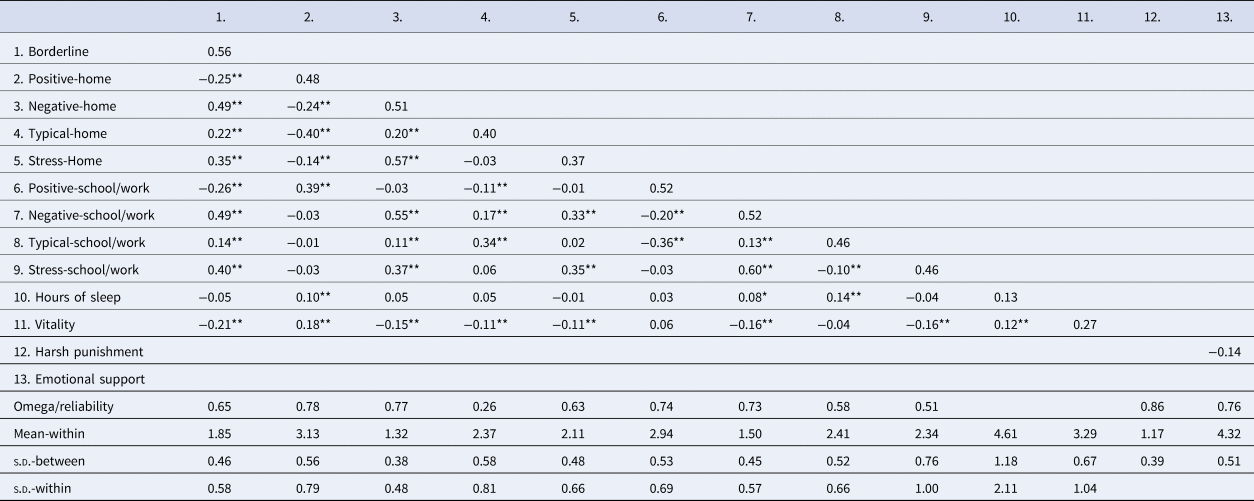
All analysesFootnote 1 were conducted in R using the lme4 package, with the exception of multilevel EFAs and calculations of Omega reliability statistics, which were conducted in Mplus 8.1 (Muthén & Muthén, Reference Muthén and Muthén1998–2017). Descriptive statistics, reliability indices, and within-person correlations for the daily diary variables are displayed in Table 1. A series of multilevel regressions were run in which daily predictors were person-mean-centered and parenting was grand-mean-centered. Inclusion of random slopes was tested in an iterative fashion, with random slopes being included if they resulted in a statistically significant improvement in model fit (based on chi-square difference tests) relative to a random intercept, fixed slope model. 95% confidence intervals are reported for all models based on 5000 bootstrap samples; in cases that bootstrap intervals included 0, results were not interpreted.
Descriptive statistics and correlations

Note. *p < 0.05, **p < 0.01; ICCs are listed on the diagonal; all correlations are at the within-person level with the exception of the two parenting variables (harsh punishment and emotional support), which are at the between-person level. Reliability was calculated using Omega coefficients, with the exception of daily scales of perceptions that consisted of only two items – for these scales, reliability was approximated using within-person correlations between the two items making up the scale.
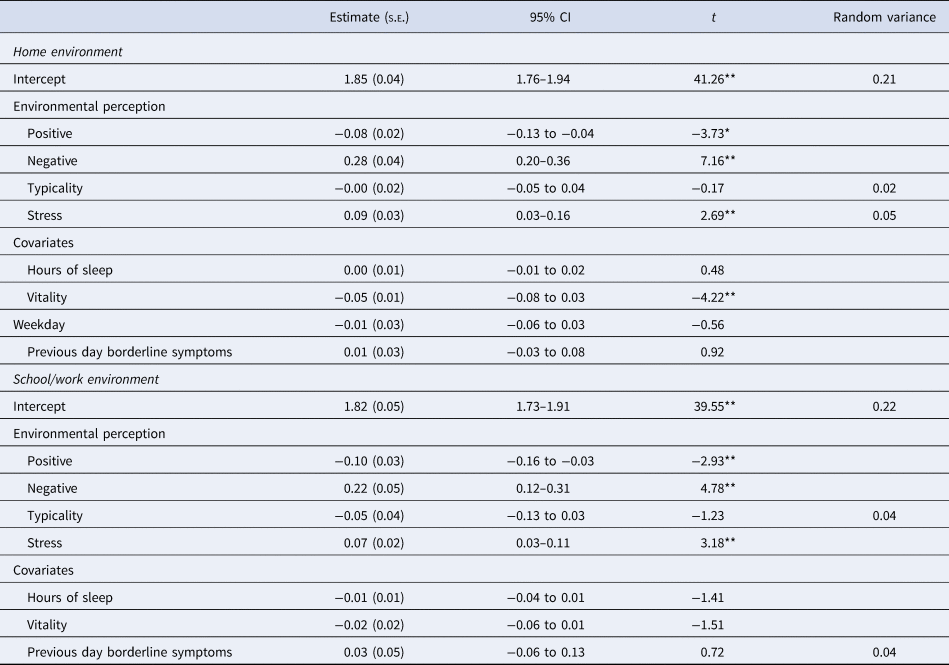
First, we examined concurrent effects in two separate models (home and school/work environments). We simultaneously tested the effects of the four situation perceptions on borderline symptoms controlling for previous day symptoms, vitality, and hours slept. In the home model, we included the covariate of weekend/vacation. Next, we tested whether perceptions of the environment on the previous day predicted next day borderline expression above and beyond previous day symptoms. Separate models were tested for each situation perception across environments. Next, the predictive effect of BPD symptoms on situational perceptions on the following day were tested, in the same manner as the previous set of models.
Finally, we examined how both domains of parenting moderated the effect of situational perceptions on borderline symptoms in concurrent and lagged models with separate models for each situation perception and context. Borderline symptoms from the previous day and environmental perception were entered as Level 1 predictors, parenting as Level 2 predictor, and a cross-level interaction between each situational perception and parenting. We first tested whether a random slope for the lagged effect of borderline symptoms should be included. Next, we tested the full model including the random slope for perception (either concurrently or lagged). If the random slope for perception correlated (almost) perfectly with the random intercept, the random slope was removed. All significant cross-level interactions were probed and graphed using an online calculator for simple slopes analyses (Bauer & Curran, Reference Bauer and Curran2005) at ±1 s.d. of the respective parenting construct. Pseudo R 2 was calculated to determine the amount of random variance in borderline symptoms accounted for by parenting.
Results
ICC values (see Table 1) revealed that 37–56% of variance in daily diary variables was due to within-person fluctuations, with the exception of sleep quality. Interestingly, ICCs of situational perceptions were higher in the school/work context than at home (except negative valence). On average, results indicated that home was perceived as more positive [t(785) = 4.89, p < 0.001; d = 0.19], less negative [t(785) = −10.15, p < 0.001; d = 0.34], and less stressful [t(785) = −5.61, p < 0.001; d = 0.23] on the same day, whereas perceptions of typicality were quite similar [t(785) = −0.57, p = 0.569; d = 0.04] across contexts. Situational perceptions across home and school/work were related to borderline symptoms to a similar degree (|0.14| to |0.49|), with the strongest associations for negative situational perceptions. Results also show that parallel domains of situational perception were mostly correlated to a moderate degree, reflecting consistency of perceptions across contexts (rwithin = 0.34–0.55).
Prediction of borderline traits from perceptions of the environment and vice versa
Concurrent effects on borderline symptom expression by situation perceptions, covariates, and previous day symptoms (stability effect) are displayed in Table 2. Across contexts, we found negative effects of positive perceptions and positive effects of negative and stressful perceptions. Vitality was negatively related to borderline symptoms, but only at home. Testing the moderating effect of gender, we found that the effect of negative perceptions of home on same day borderline symptoms was stronger among females, while perceptions of typicality at home had a negative effect on borderline symptoms, but only among males (see online Supplementary Fig. S1).
Concurrent effects between aspects of the home and school/work environment and borderline symptoms

Note. *p < 0.05, **p < 0.01.
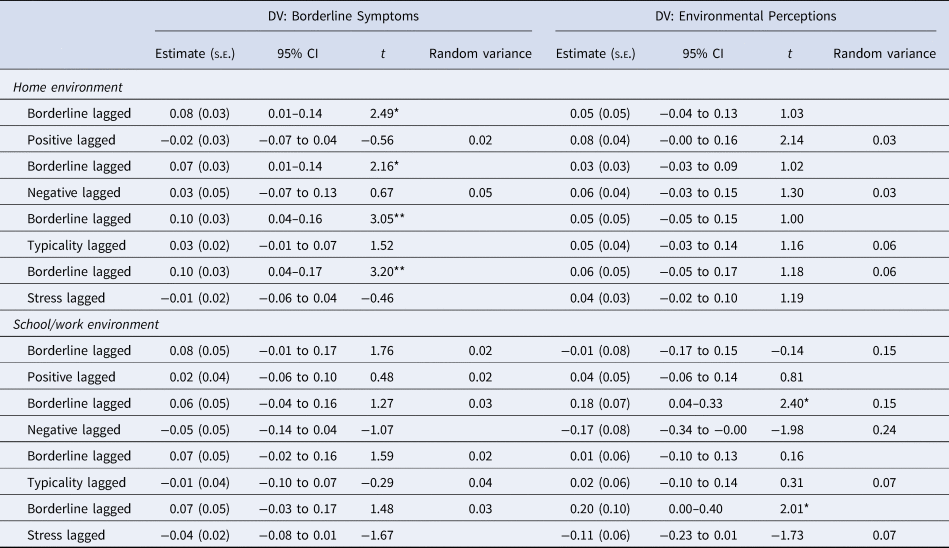
Next, we tested whether perceptions of the environment predicted next day borderline symptoms, with results displayed in the first set of columns in Table 3. Across contexts, there were no significant lagged effects of previous day perceptions on borderline symptoms.
Lagged predictive effects of borderline symptoms from perceptions of the environment

Note. *p < 0.05, **p < 0.01; weekday/weekend was entered as a covariate for models predicting perceptions of the home environment.
Lagged models testing the opposite direction of effects (second set of columns in Table 3) indicated that borderline symptoms predicted greater negative and stressful situational perceptions at school/work, but not at home, on the following day. Borderline symptoms did not predict perceptions of boredom/typicality or positivity in either context.
Interactions of childhood parenting experiences with associations between perceptions of the environment and borderline symptoms
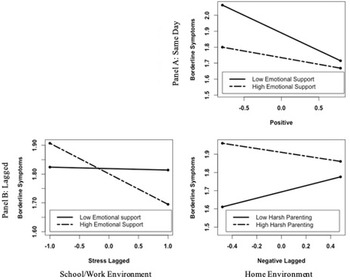
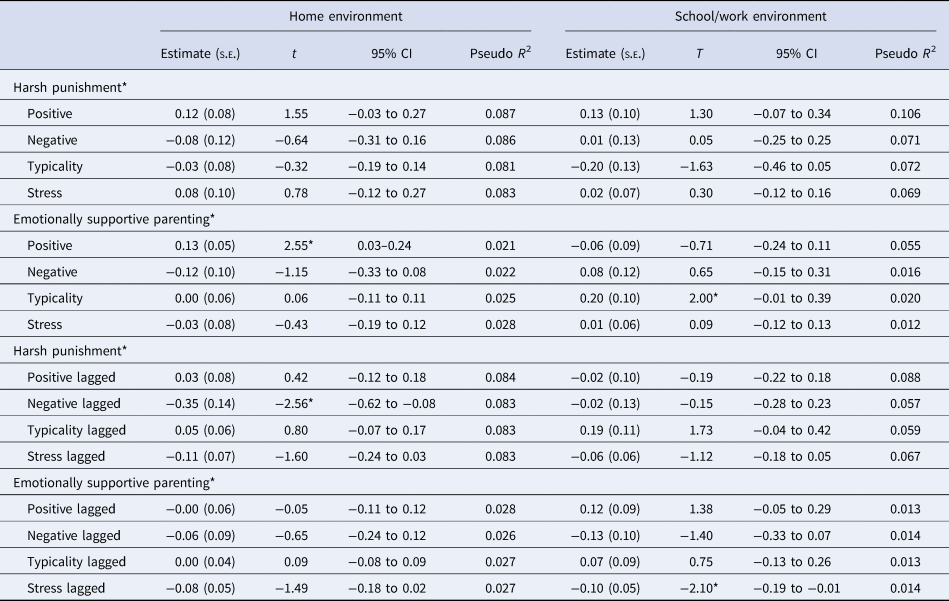
Models predicting borderline symptoms from same day perceptions of the environment as moderated by both forms of parenting are displayed in the top half of Table 4. Panel A Fig. 1 shows that in the absence of a positive perceived environment, people who experienced low emotional support during childhood display more borderline symptoms compared to subjects who were emotionally supported. Likewise, a positive atmosphere is more strongly negatively related to borderline symptoms for this low supported group v. the highly emotionally supported group. Tests of the moderating role of gender on these effects revealed that this interaction effect was only present for females. For males, the effect of perceptions of positivity on borderline symptoms was not affected by the level of emotional support during childhood (see online Supplementary Fig. S3).
Interactions between parenting and situational perceptions in predicting borderline symptoms.

Interactions between parenting and perceptions of the environment (both concurrently and lagged) in the prediction of borderline symptoms

Note. *p < 0.05.
The bottom half of Table 4 lists the parameters for interaction terms from models testing the interaction between previous day situational perceptions and parenting experiences. Results show a significant interaction between harsh punishment and negative perceptions at home and between emotionally supportive parenting and stressful perceptions of school/work. Young adults who experienced more emotional support as a child displayed less borderline symptoms after days that school/work was perceived as more stressful compared to the low emotionally-supported group (Panel B, Fig. 1). In addition, whereas high harsh punishment was related to overall higher scores on borderline symptoms, this harshly-raised group displayed less borderline symptoms after days the home was perceived negatively, while the group that experienced low harsh punishment showed increased borderline symptoms after negatively perceived days.
Discussion
The current study is the first to evaluate a wide range of environmental perceptions across both the private and professional context and their associations with borderline personality symptoms in young adults in a daily diary, while also looking at the role of early parenting experiences in the situational perception-borderline symptom link. The current study thus expands on earlier findings that largely focused on interpersonal transgressions (with the exception of Glaser, Van Os, Mengelers, & Myin-Germeys, Reference Glaser, Van Os, Mengelers and Myin-Germeys2008 who examined daily hassles) and explored the relevance of perceptions of the atmosphere as a whole, while also differentiating between qualitatively different contexts. The results of this study add to our understanding of daily fluctuations in borderline symptoms in relation to environmental perceptions.
First, negative, stressful, and less positive environmental perceptions are most robustly associated with borderline symptoms in young adulthood. This finding parallels previous research suggesting that borderline symptomatology is associated with adverse events on a momentary to daily level (e.g. Bhatia, Davila, Eubanks-Carter, & Burckell, Reference Bhatia, Davila, Eubanks-Carter and Burckell2013; Sadikaj, Moskowitz, Russell, Zuroff, & Paris, Reference Sadikaj, Moskowitz, Russell, Zuroff and Paris2013). Notably, the present findings suggest that these associations occur regardless of the context, and may be interpreted along two perspectives. Most evident, this finding points to the presence of a negative perceptual bias associated with BPD that seems to reflect a dispositional tendency, hence explaining consistency of person-environment associations across qualitative different contexts (and in relation to other types of stimuli than those measured in existing studies). It is also possible that individuals with greater borderline symptomatology actually experience more tumultuous and negative environments. In fact, research has found that BPD is associated with romantic relationship conflict and dissolution as reported by romantic partners (Beeney et al., Reference Beeney, Hallquist, Scott, Ringwald, Stepp, Lazarus and Pilkonis2019; South, Reference South2014), unemployment (Sansone & Sansone, Reference Sansone and Sansone2012), and problems at work (Juurlink et al., Reference Juurlink, ten Have, Lamers, van Marle, Anema, de Graaf and Beekman2018). Future designs including multiple informants across contexts and objective environmental ratings may enable us to parse between perceptions and actual events that happen in daily life. From a gender-specific perspective, stronger effects of negative home perceptions on borderline symptoms among females and unique associations between perceived typicality and borderline symptoms in males suggest that etiological mechanisms of borderline pathology may to some extent differ for boys v. girls.
Second, the concurrent associations between negative and stressful environmental perceptions with borderline symptoms seem to extend to a directional relation, in which borderline symptoms drive perceptions of stress and negativity up until the next day, albeit only at school/work. This contextual difference in lagged effects of borderline symptomatology may be due to differences in types of situational cues (Rauthmann, Sherman, & Funder, Reference Rauthmann, Sherman and Funder2015) at home v. in more formal contexts. School/work contexts can overall be assumed to be more demanding and less tailored to the individual, and therefore more prone to be perceived as negative and stressful, especially by vulnerable people. Previous research has for instance demonstrated that individuals with BPD experience more negative affect after perceiving others as more dominant (Sadikaj, Russell, Moskowitz, & Paris, Reference Sadikaj, Russell, Moskowitz and Paris2010). It is plausible that perceptions of dominance occur much more in professional environments (i.e. interactions with authority figures or supervisors), accounting for the more negative and stressful perceptions individuals experience after days that borderline symptoms are elevated. Additionally, professional contexts require skills in executive functioning, such as planning, decision-making and impulse control, that are particularly compromised among those with BPD (McClure, Hawes, & Dadds, Reference McClure, Hawes and Dadds2016), hence inducing persistent stress at work when BPD symptoms are manifest.
Third, our results suggest that previous evidence on amplifying effects of specific interpersonal perceptions (e.g. rejection; Scott et al., Reference Scott, Wright, Beeney, Lazarus, Pilkonis and Stepp2017) on subsequent symptomatology cannot be broadened towards broader environmental perceptions as operationalized in the current study. This finding aligns with trait-activation theory (Tett & Guterman, Reference Tett and Guterman2000), indicating that borderline symptoms are only activated in environmental circumstances contingent on this mental condition. This finding has important clinical implications, because it suggests that intervention programs for BPD may be most effective when prioritizing a reduction of specific environmental triggers within the interpersonal field (as established in existing studies), rather than optimizing the other domains of people's lives.
From an etiological perspective on person-situation transactions, we found among females, when the home was perceived as less positive, borderline symptoms were highest when they had experienced low emotional support in childhood, whereas in high positive environments, borderline symptoms were not notably different based on emotional support. This finding may point to a differential susceptibility (Belsky & Pluess, Reference Belsky and Pluess2009) in adulthood to adverse circumstances directly resulting from early socialization processes, indicating that individuals raised by non-emotionally supportive parents suffer more in adverse contexts, but benefit the most in positive contexts. The findings also suggest that girls especially rely much more on their early socialization experiences in coping with a low positive environment compared to boys. Emotionally supportive parenting also seemed to ‘protect’ individuals from stressful experiences at school/work, in line with Linehan's original theory (Reference Linehan1993). Here again, the more demanding environment of the school/work compared to the home context may challenge individuals to retain mental balance, thereby activating stress-management skills that are acquired through supportive parenting experiences. The interactions with harsh parenting were somehow counterintuitive and may potentially be understood from the idea that at least on a daily level, for those who experienced harsh punishment as children, adverse environments are more familiar, leading to less reactivity in terms of borderline symptoms. Alternatively, there is research suggesting that in childhood environments characterized by harsh punishment or violence, children cope with withdrawing (safety) behaviors, leading to less bids for autonomy and relatedness (Bender et al., Reference Bender, Allen, McElhaney, Antonishak, Moore, Kelly and Davis2007). This would lead to individuals being less rather than more reactive to situational triggers.
Our final conclusion is supplementary to our main aims. On days that the home environment was perceived to be more negative, the school/work environment was perceived as negative to a similar degree. In fact, negative perceptions across contexts demonstrated the strongest correlations, suggesting that perceptions with a negative valence are generally more prone to be carried over to new contexts. Rauthmann and Sherman (Reference Rauthmann and Sherman2019) discuss this tendency of individuals to view different situations in a consistent manner as a perceiver effect, which can be interpreted as a response style or how individuals generally perceive situations (Kenny, Reference Kenny1994; Rauthmann & Sherman, Reference Rauthmann and Sherman2019). In the context of the current study, this effect was most pronounced for negatively valenced perceptions. These results may be related to cross-situational consistency of affect found in previous research (Oishi, Diener, Napa Scollon, & Biswas-Diener, Reference Oishi, Diener, Napa Scollon and Biswas-Diener2004) suggesting that, particularly in response to negative events, affective reactions blend into subsequent contexts, leading to similarly negative views of those contexts.
Some limitations should be noted when interpreting these findings. The current sample was recruited mostly from the community and no diagnostic interviews were conducted. While we estimated the prevalence of BPD to be about 12% in this sample, future research should replicate these analyses among individuals with more elevated symptomatology. It should further be noted that the majority of our sample was still in school and that our findings may not be generalizable to working individuals. Also, the majority of the sample was White, originating from Northern Europe, which also limits generalizability to racially and ethnically diverse samples. Additionally, it should be noted that maternal parenting was rated by fathers. This design was chosen to reduce social desirability sometimes seen in self-reported parenting (Janssens et al., Reference Janssens, Goossens, Van Den Noortgate, Colpin, Verschueren and Van Leeuwen2015). Despite the existence of very limited research examining the quality of father's reports of maternal parenting behaviors (with the exception of Bögels and van Melick, Reference Bögels and van Melick2004), the psychometric properties of the included scales suggest sufficient reliability. Finally, we did not collect information about medication use. It is likely that psychotropic medication and other biological markers may have influenced daily diary ratings (e.g. hormonal changes; Eisenlohr-Moul, DeWall, Girdler, and Segerstrom, Reference Eisenlohr-Moul, DeWall, Girdler and Segerstrom2015, Reference Eisenlohr-Moul, Schmalenberger, Owens, Peters, Dawson and Girdler2018), which should be controlled for in future studies.
Despite these limitations, the current study is the first to utilize a broad assessment of environmental perceptions across contexts to further understand person-situation transactions specific to borderline symptomatology, while also exploring the relevance of childhood experiences of parenting in these more proximal person-situation transactions. Overall, the findings point to a similar connection between daily expressions of borderline symptoms and broad perceptions of the environment as being negative, stressful, and less positive in both the home and professional context; however, with borderline symptoms specifically increasing negative/stressful perceptions of the professional context. This connection can be further understood based on the etiology of BPD. Most notably, the current study provides the first evidence that the lasting nurturing effects of emotionally supportive parenting during childhood exhibit themselves when young adults are navigating stressful contexts or environments that lack positivity.
Supplementary material
The supplementary material for this article can be found at https://doi.org/10.1017/S0033291720000987.
Acknowledgements
This research received no specific grant from any funding agency, commercial or not-for-profit sectors.
Conflict of interest
None.