Introduction
Traumatic injuries (e.g. fractures, lacerations, concussions) represent the reason for 17%–24% of all visits made by older adults to EDs in Canada (Scott et al., Reference Scott, Pearce and Pengelly2005; Latham and Ackroyd-Stolarz, Reference Latham and Ackroyd-Stolarz2014). If the injury is relatively minor, individuals who are seemingly independent and globally healthy are usually treated rapidly and discharged home with minimal follow-up treatment (e.g. analgesics) (Russell et al., Reference Russell, Hill, Blackberry, Day and Dharmage2006; Sirois et al., Reference Sirois2013) despite the fact that about 15%–17% will experience functional decline within 3 months of the trauma (Sirois et al., Reference Sirois2013). It has been suggested that the millions of visits made to EDs each year by elder patients represent opportunities to screen for health problems and put in place strategies to prevent decline in physical, cognitive, or other domains (Shah et al., Reference Shah, Jones, Richardson, Conwell, Katz and Schneider2011).
The Society for Academic Emergency Medicine recommends that some form of assessment of mental status should take place in the ED, and urges physicians to try to recognize any potential change in cognitive function from before the ED visit. Medical personnel is encouraged to refer patients for further evaluation, medical follow-up, and support when cognitive impairment is suspected (Terrell et al., Reference Terrell, Hustey, Hwang, Gerson, Wenger and Miller2009). Cognitive impairment is known to be present in 15%–40% of elderly patients presenting to the ED for a vast array of health conditions, unfortunately, it goes largely unnoticed, even when it presents as delirium (Hustey and Meldon, Reference Hustey and Meldon2002; Salvi et al., Reference Salvi, Morichi, Grilli, Giorgi, De Tommaso and Dessi-Fulgheri2007). Hustey and Meldon (Reference Hustey and Meldon2002) found that 26% of persons 70 years and older presenting to the ED had impaired mental status (including delirium) but that it was documented in only 28% of cases. Even more worrisome, the presence of cognitive impairment did not change the types of treatments and follow-ups given to these patients (Hustey et al., Reference Hustey, Meldon, Smith and Lex2003). The authors pinpoint a double problem, first that there is a lack of recognition by physicians of mental status impairment, and second that even when it is recognized, its presence does not alter the trajectory of care for these elderly patients (Hustey et al., Reference Hustey, Meldon, Smith and Lex2003). It is well known that cognitive impairment increases the risk for falls (Muir et al., Reference Muir, Gopaul and Montero Odasso2012), may compromise a patient's ability to comply to treatment recommendations (Han et al., Reference Han2011; Ouellet et al., Reference Ouellet2014), and increases the probability of a return to the ED (Lee et al., Reference Lee2015). Furthermore, global cognitive ability has been found to be significantly related to the elderly person's functional status in terms of activities of daily living (Duda et al., Reference Duda, Puente and Miller2014).
Recent data clearly indicates that cognition is not optimal in community-dwelling elderly persons visiting an ED for a minor injury. Our group recently studied cognitive functioning in a sample of 320 individuals aged 65 years and older who were discharged home within 48 hours of visiting the ED for minor injury (Ouellet et al., Reference Ouellet2014). At the ED, 62% of the sample performed below the traditional cut-off of 26 on the MoCA (Nasreddine et al., Reference Nasreddine2005), and 23% even scored below a much more severe cut-off of 21. However, MoCA scores improved 3 and 6 months later, but still 48% and 40% of individuals had a score below 26. Corroborating other studies, a lower MoCA score at the ED was significantly associated with the occurrence of falls and new hospital visits in the first 6 months following the initial ED visit.
Care in the ED is characterized by its fast pace, rapid decision-making, high levels of stress for clinicians as well as patients, and growing volumes of patients (Terrell et al., Reference Terrell, Hustey, Hwang, Gerson, Wenger and Miller2009; Do et al., Reference Do, Chang, Kuran and Thompson2015). As such, the ED context may be viewed as a major barrier to a valid evaluation of cognition, even though this domain is increasingly recognized to be essential when providing health services, especially to older adults. Efforts have been made to develop short measures, and cognitive screening in the ED is considered feasible (Terrell et al., Reference Terrell, Hustey, Hwang, Gerson, Wenger and Miller2009). Short, well-validated cognitive screening measures exist, such as the Mini-Mental State Examination (MMSE) (Folstein et al., Reference Folstein, Folstein and McHugh1975) or the MoCA (Nasreddine et al., Reference Nasreddine2005). The latter has been increasingly used in hospital settings around the world since its initial validation study.
If formal evaluation of cognition with screening tools is not possible, at a minimum, knowing the characteristics of people who tend to obtain lower scores on cognitive assessments could prove particularly useful. Few studies have examined these however. Plassman and colleagues (Reference Plassman, Williams, Burke, Holsinger and Benjamin2010) reviewed the literature for risk factors associated with cognitive decline in the elderly and only found low evidence that certain factors, like depression and tobacco use, are linked to cognitive decline. To our knowledge, correlates associated with cognitive functioning in patients treated at the ED for an injury have not been studied. Considering the very large and increasing numbers of older adults who consult for minor injuries in the ED, it could be very useful for health professionals to have certain associated factors in mind so that they could at least recommend that patients more susceptible to present with cognitive impairment consult their general practitioner for a follow-up related to the injury (e.g. to ensure that recommendations are well understood and applied) or suggest further evaluation.
Following up on our previous publication (Ouellet et al., Reference Ouellet2014), the aim of the present study was to explore sociodemographic, psychological, functional, and health characteristics associated with general cognitive functioning at the time of injury. Identification of patients at higher risk of cognitive decline during their ED visit could guide medical staff through assessments and interventions needed.
Methods
Study design and setting
Data are derived from a prospective cohort study conducted in three Canadian teaching EDs (Québec, Montréal, Ottawa) and involving three assessments (i.e. baseline at the ED, 3-month follow-up, 6-month follow-up). The present study focuses solely on the baseline assessment. Data on the incidence and predictors of functional decline and descriptive data on cognition, and the association between cognitive impairment and occurrence of falls, return to ED and hospital visits, have already been published (Sirois et al., Reference Sirois2013; Ouellet et al., Reference Ouellet2014). The institutional review boards of the three sites have approved the study protocol.
Participants and procedure
Potential participants were recruited between May 2009 and March 2011. Treating physicians and research nurses at each site identified potential participants in the ED (on any day or time; 24/7 recruitment schedule). To be included in the study, participants had to: (1) be 65 years or older, (2) be presenting to the ED specifically for a minor traumatic injury (i.e. soft tissue/osseous lesions such as lacerations, contusions, sprains, simple extremity fractures, minor thoracic injuries, or minor head injury), (3) be discharged home within 48 hours of the ED visit, and (4) be independent in basic activities of daily living in the month prior to the ED visit. Exclusion criteria were: (1) injuries leading to admission to any ward, (2) living in long-term care, (3) diagnosis of dementia, (4) delirium or confusion at the ED visit, and (5) inability to give a verbal consent, to communicate in French or English, or to attend follow-up assessments.
After validating eligibility and obtaining consent from participants, the research nurse at each site collected sociodemographic and injury variables, and administered the baseline assessment, which took place either at the ED during the initial visit for minor injury, or at the participant's home, or at the ED in the early days following discharge from the ED within 48 hours of the first visit. The assessment included measures of cognition, functional status, mobility, psychological functioning, and other health-related variables.
Measures
The MoCA (Nasreddine et al., Reference Nasreddine2005) was used as a global cognitive functioning measure. The validated English or French version was used, depending on the participant's native language. The MoCA includes items assessing orientation, verbal memory, language, visuospatial functions, and executive functions. The total score ranges from 0 to 30, with higher scores associated with better cognitive functioning. Participants with 12 years of education or less have one point added to their total score. The authors of the MoCA suggest to use a cut-off of 26 (scores below 26 indicating cognitive impairment) (Nasreddine et al., Reference Nasreddine2005), but more stringent cut-offs have been proposed by other research groups, as low as 21 (Waldron-Perrine and Axelrod, Reference Waldron-Perrine and Axelrod2012), to improve specificity and reduce the likelihood of false positives.
Several potential correlates of cognitive functioning were included in the baseline assessment:
Sociodemographic variables: sex, age, and education.
Number of days elapsed between ED visit and baseline assessment (< 3 days vs. ≥ 3 days).
Injury-related variables: mechanism of injury, diagnosis of mild traumatic brain injury.
Depression and anxiety symptoms: evaluated by the Hospital Anxiety and Depression Scale (HADS) (Zigmond and Snaith, Reference Zigmond and Snaith1983). Each subscale (HADS-D for depression, HADS-A for anxiety) includes 14 items, with subscale scores of 8 or more corresponding to clinically significant symptoms.
Social support: assessed by the Social Support Index (SSI) from the Quebec Health Survey (Audet et al., Reference Audet, Lemieux and Cardin2001). Scores in the lowest quintile are considered to represent poor social support (quantity, satisfaction regarding available support).
Physical mobility (two measures): (1) Timed Up & Go (TUG) (Podsiadlo and Richardson, Reference Podsiadlo and Richardson1991) was administered. A TUG of less than 10 sec suggests free mobility. (2) Self-reported weekly number of times the participant leaves his/her home (Canadian Study of Health and Aging Working Group, 1994).
Falls: the occurrence of falls in the three months preceding the assessment was recorded.
Fear of falling: Modified Falls Efficacy Scale (MFES) (Hill et al., Reference Hill, Schwarz, Kalogeropoulos and Gibson1996). The MFES has been shown to predict future falls and functional decline (Russell et al., Reference Russell, Hill, Blackberry, Day and Dharmage2006). In a sample of healthy elderly persons, an average score of 9.7 ± 0.5 has been reported (Hill and Stinson, Reference Hill and Stinson2004).
Functional status: Functional assessment scale of the Older American Adult Resources and Service (OARS) (Fillenbaum, Reference Fillenbaum1978). As participants were only included if they were fully independent in basic activities of daily living, we only used the subscale for instrumental activities of daily living (IADLs, i.e. meal preparation, homemaking, shopping, using transportation, using the phone, managing medication, and money). A perfect score (14/14) indicates full independence in IADLs.
Physician's prediction of functional decline: assessed at the end of the ED medical consultation on a 100-mm visual analog scale (0 mm = 0% risk of functional decline; 100 mm = 100% risk of functional decline).
Health variables (three measures): (1) number of self-reported medical comorbidities; (2) self-reported pain intensity, rated on a 100-mm visual analog scale; and (3) Identification of Seniors at Risk (ISAR) (McCusker et al., Reference McCusker, Bellavance, Cardin, Trepanier, Verdon and Ardman1999). The ISAR is a screening tool including six dichotomous items measuring premorbid and acute change in functional status, recent hospitalization, impaired memory, impaired vision, and polymedication. Each of the six items was included as a potential correlate of cognitive functioning.
Statistical analyses
First, for potential correlates of cognitive functioning, continuous variables were transformed into categorical variables according to predefined clinically significant subgroups (i.e. age, education, weekly frequency of leaving home, number of medical comorbidities), previously validated or proposed cut-offs (i.e. HADS-D, HADS-A, SSI, TUG, MFES, OARS), or median split (i.e. delay between ED visit and assessment, injury mechanism, physician’ prediction of functional decline, pain intensity). Second, generalized linear mixed models (GLMM) with normal distribution and identity link function were used to evaluate the bivariate association between each potential factor and the MoCA score at baseline. These models use all available information and are thus robust to missing data. As residuals of the MoCA scores were negatively skewed, they were transformed to verify the normality assumption. The values were first reflected to become positively skewed and were then modeled using a natural logarithm transformation (ln(31-MoCA score)). The variability associated with multi-center design was taken into account by specifying a random center intercept effect in the model (Hedeker et al., Reference Hedeker, Gibbons and Flay1994). Variables with a p-value < 0.15 were retained and considered for possible inclusion in a multivariate model. A stepwise backward selection strategy was used until only statistically significant factors remained with a p-value < 0.05. The sample size was appropriate for the number of factors included in the multivariate analysis. The possible collinearity of the final model was verified using the condition index and the variance inflation factors.
Results
Sample description
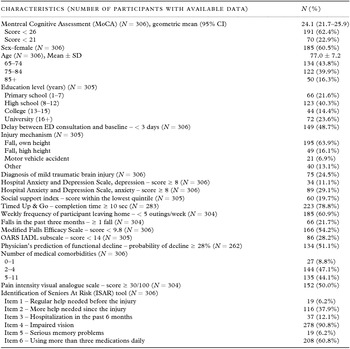
Of 335 independent elderly adults who were recruited at one of the three participating sites, 29 were subsequently excluded because they did not complete the MoCA, yielding a final sample size of 306. Table 1 presents descriptive statistics for the MoCA and all potential predictors that are considered for bivariate and multivariate analyses. Geometric mean of the MoCA total score was 24.1 (95% confidence interval = 21.7–25.9), with 62.4% participants scoring below the recommended cut-off of 26, and 22.9% scoring below a more stringent cut-off of 21. For further details about the sample and distribution of MoCA scores see Ouellet et al. (Reference Ouellet2014). Most participants were women (60.5%), mean age was 77 years, and the most common injury mechanism was a fall (own height: 63.9%; high height: 16.1%). Participants who had their baseline assessment within 48 hours of ED consultation (48.4%) and those who had theirs more than 48 hours after ED consultation (51.6%) were compared on their performance on the baseline MoCA, and they did not significantly differ.
Descriptive statistics for cognitive functioning (MoCA) and potential correlates of cognitive functioning for participants who completed the baseline MoCA (N = 306)

Note. Descriptive data for the MoCA include the bonus point for participants with less than 12 years or less of education. Percentages are calculated based on the number of participants with available data. IADL = instrumental activities of daily living; OARS = Functional assessment scale of the Older American Adult Resources and Service.
Characteristics associated with baseline MoCA total score
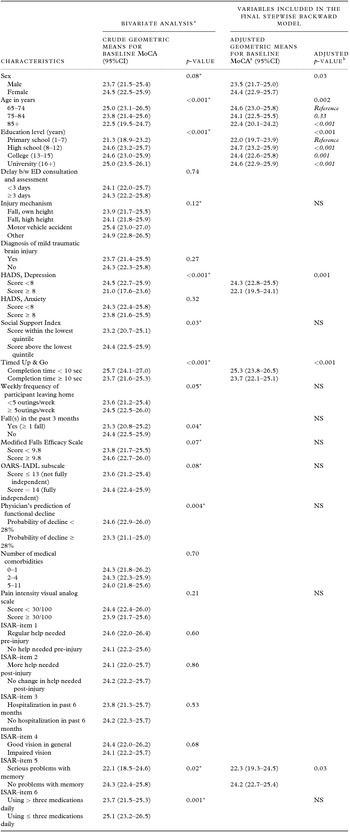
Results of bivariate and multivariate analyses are presented in Table 2. Using a p level of 0.15, 14 factors were found to be associated with significantly lower MoCA scores compared to other level(s) of the same variable: (1) male sex, (2) older age (85 years and over, compared to 65–74 and 75–84 years), (3) lower education level (primary school, i.e. 1–7 years, compared to high school, college, and university), (4) injury mechanism (fall from own height, compared to other mechanisms), (5) clinically significant depression symptoms (HADS-D ≥ 8), (6) lower social support (SSI score in the lower quintile), (7) slower mobility (TUG completion time ≥ 10 sec), (8) leaving home less frequently (< 5 outings/week), (9) recent occurrence of falls (at least one fall in the past 3 months), (10) being more fearful of falling (MFES score < 9.8), (11) not being fully independent in IADLs (OARS IADL subscale score ≤ 13/14), (12) having a greater risk of functional decline as rated by ED physicians (probability of decline equal to or greater than the median, 28%), (13) self-reported serious memory problems (ISAR item 5), and (14) using more than three medications daily (ISAR item 6). Six of these 14 factors remained significant in the multivariate model: male sex, older age (85+ years), lower education (primary school), clinically significant depression symptoms, slower mobility as suggested by a longer TUG completion time, and self-reported memory problems.
Results of bivariate and multivariate stepwise backward analyses (GLMM) to explore variables associated with baseline MoCA score

Note. HADS = Hospital Anxiety and Depression Scale; IADL = instrumental activities of daily living; ISAR = Identification of Seniors At Risk; NS = not significant; OARS = functional assessment scale of the Older American Adult Resources and Services.
*Factors considered in multivariate analysis, p-values obtained by bivariate GLMM.
a Each mean is adjusted for other variables present in the model.
b The p-values in italic refer to the level of statistical difference between each category and the reference value. The other p-values refer to the global level of statistical significance of the variable.
Discussion
This study aimed at exploring correlates of global cognitive functioning in elderly individuals being evaluated in the context of a consultation in the ED following a minor traumatic injury. Participants were assessed during their ED visit (which lasted at most 48 hours) or in the early days following discharge. Cognitive functioning was assessed with the MoCA, a widely used screening tool covering a broad range of cognitive functions. Correlates included sociodemographic, injury-related, psychological, physical, and functional status indicators. Results of multivariate analyses indicate that the variables most strongly associated with lower MoCA scores are: being a man, being 85 years or older, having a lower education, being more depressed, being slower in terms of mobility, and reporting serious memory problems. These characteristics could help ED physicians or professionals identify patients requiring further cognitive evaluation or closer monitoring.
It is hardly surprising that older age and lower education were related to lower MoCA scores, as these factors are consistently associated with lower cognitive functioning. An American population-based study using the MoCA has documented gradually decreasing mean scores throughout adulthood and older age, including from 65 to 80 years, and important differences between individuals with less than 12, 12, and more than 12 years of education (Rossetti et al., Reference Rossetti, Lacritz, Cullum and Weiner2011). In a recent study by Duda and colleagues (Duda et al., Reference Duda, Puente and Miller2014), it was found that education level modestly but significantly attenuated the relationship between cognitive reserve and functional status in terms of activities of daily living. In fact, these authors suggested that community-dwelling elderly persons with lower levels of education may be at greater risk for functional problems associated with age-related cognitive decline, especially when they display lower levels of cognitive functioning. Thus, taking a few seconds to collect information on education level in the ED is probably feasible and could add perspective to an ED professional's clinical judgment about risks for subsequent comorbidity or functional decline in elder patients.
We found male sex to be associated with lower MoCA scores, which was somewhat surprising since women are known to have a higher risk of developing Alzheimer's disease compared to age-matched men and also show faster decline and greater deterioration of cognition than elderly men (Li and Singh, Reference Li and Singh2014). However, as men are well known to be more at risk for traumatic injuries in general, it is possible that injury might be a sentinel event or marker for potential cognitive decline in men more particularly. This hypothesis remains to be investigated further. It is also possible that men with cognitive impairment are more likely than females to have a family caregiver and thus were perhaps more likely to get to ED after a minor injury.
More depressed mood was also found to be related to lower MoCA scores, an expected result given the well-documented link between depression and mild cognitive impairment and other more severe forms of cognitive decline. However, measures of mood are probably more complex to integrate to a fast-pace ED context yet could be part of a parallel interview with a geriatric nurse for example. The HADS consists in seven questions, but further research could examine whether single-item screeners could be sufficient to establish a link with lower cognitive functioning.
Walking speed was found to be linked to lower MoCA scores. Data by Ayan and colleagues (Ayan et al., Reference Ayan, Cancela, Gutierrez and Prieto2013) have clearly shown that walking speed is decreased significantly with more severe cognitive impairment. Although the administration of a TUG test might not be routinely implementable in an ED, at least subjective observation of walking of the elderly patient is feasible (if the injury allows).
Finally, questioning patients about memory problems could prove useful in identifying persons with lower cognitive functioning. Indeed, a positive answer to a simple question from the ISAR tool : “In general, do you have serious problems with your memory ?” was linked to lower MoCA scores, suggesting that at least some patients have ongoing awareness of their potential cognitive difficulties. However, asking this question alone is not sufficient as in the present study, only 6.3% of all participants reported having serious memory problems before their minor injury, yet 23% scored below a quite stringent cut-off of 21 on the MoCA.
A complex combination of factors thus needs to be considered when appraising the potential link between minor injury and cognition in elderly patients who just have been injured: pre-injury cognitive decline may or may not have been present, the injury itself can alter cognitive performance at the time of the injury, and the injury may cause or exacerbate cognitive or functional decline. Methodological issues also arise: cognitive measures need to be realistically administered in an ED context: factors such as the busy ED (noise, multiple stimuli), pain, anxiety, poor nutrition or hydration, and fatigue or even lack of sleep, can have an impact on cognitive test performance. Furthermore, the injury itself may cause mobility or sensory restrictions (e.g. right arm fracture, oedema to face or eyes) which can impede the completion of certain test items. Furthermore, cognitive evaluation methods, even if short, need also to be sensitive to rather mild forms of cognitive impairment since many older adults presenting to the ED are independent in their activities of daily living and have no prior diagnosis of cognitive impairment. Additionally, attention must be given to potential education or sociodemographic factors (e.g. socio-economic status, social deprivation) affecting cognitive performance.
Several other variables were individually associated with the MoCA score, but were no longer so when taking into account all 14 significant bivariate correlates. These include injury mechanism (fall from own height), lower social support, lower weekly number of outings, occurrence of recent falls, being more fearful of falling, not being fully independent for IADLs, higher probability of functional decline according to ED physicians, and using more than three medications daily. This might suggests that their contribution is partially or totally explained by that of other predictors which were retained in the multivariate model. For instance, older age and slower mobility, both significant correlates in the multivariate analyses, could encompass the individual contribution to cognition of several other variables, such as those related to falls (injury mechanism, recent falls, fear of falling), or independence for IADLs. Furthermore, presenting with significant depression symptoms might be closely linked to lower social support, lower weekly number of outings, and polypharmacy. Interestingly, head trauma was not linked to lower MoCA scores, suggesting that regardless of the type of injury, attention to cognition is warranted.
This cross-sectional study has several methodological limitations that need to be considered when interpreting the results. First, part of our results are based on self-report (e.g. fall history) and are thus prone to memory or social desirability biases. Furthermore, our results might not be generalizable to settings different from large urban EDs. We also did not have access to data on medications taken by patients at the time of their evaluation, and since 68.7% report using more than three different medications, we can expect these to have influenced cognitive performance. From our previous study, we also know that cognitive function improved in several patients when they were re-evaluated at 3 or 6 months, suggesting that factors related to the injury or the ED environment, such as pain, noise, fatigue, or irregular routine, were probably influencing measurement of cognition. This study has several strengths however, including its multi-center approach, large sample size, recruitment 24 hours a day, and high proportions of eligible patients recruited (55%) and complete data (91.3% of all recruited).
Elderly individuals frequently use the ED and are known to find a significant portion of their healthcare via the ED (Terrell et al., Reference Terrell, Hustey, Hwang, Gerson, Wenger and Miller2009). There is a growing consensus that persons 75 years and older considered at higher risk should be screened for cognitive impairment (Molnar et al., Reference Molnar, Wells and McDowell2008). Without labeling any patient as “cognitively impaired,” a passage in an ED could however be an opportunity to flag potential cognitive impairment, as the injury itself may be a potential marker of ongoing decline. Adequate referral for further evaluation and follow-up could be relatively easy to implement for ED professionals, and these simple practices could influence positively elderly's trajectory of care.
Funding
This study was funded through a Canadian Institutes of Health Research grant (CIHR-91752).
Conflict of interest
None.
Description of authors’ roles
M. Émond, M.-C. Ouellet, M.-J. Sirois, J. Morin, J. Perry, and R. Daoust conceived the study, designed the protocol, and obtained research funding. N. Allain-Boulé and L. Wilding coordinated the recruitment and data collection. S. Camden provided statistical advice. S. Camden, S. Beaulieu-Bonneau, and M.-C. Ouellet analyzed the data. M.-C. Ouellet, S. Beaulieu-Bonneau, and M.-E. Gagné drafted the manuscript. All authors reviewed the manuscript critically for important intellectual content and approved the final version.