Children who are less skilled in oral language at age 3 years and older have been found to be at a disadvantage in acquiring speaking, listening, and reading skills during formal schooling (e.g., Catts, Reference Catts1993; National Institute of Child Health and Human Development Early Child Care Research Network [NICHD ECCRN], 2005; Snowling, Reference Snowling2004; Storch & Whitehurst, Reference Storch and Whitehurst2002). In particular, oral vocabulary has been found to play a role in emergent literacy by supporting phonological awareness (Bowey, Reference Bowey1994; Goswami, Reference Goswami, Newman and Dickinson2001; Metsala, Reference Metsala1999), to play a direct role in reading (e.g., Chaney, Reference Chaney1998; Dickinson, McCabe, Anastasopoulos, Peisner-Feinberg, & Poe, Reference Dickinson, McCabe, Anastasopoulos, Peisner-Feinberg and Poe2003), and to predict later reading comprehension competence (Davis, Reference Davis1942; Just & Carpenter, Reference Just and Carpenter1987; Mason, Stewart, Peterman, & Dunning, Reference Mason, Stewart, Peterman and Dunning1992; Ricketts, Nation, & Bishop, Reference Ricketts, Nation and Bishop2007; Whitehurst & Lonigan, Reference Whitehurst, Lonigan, Neuman and Dickinson2001). Children who start to lag behind their peers on measures of emergent literacy skills (e.g., print knowledge) in the preschool years fall further behind as they begin formal schooling (e.g., Dickinson et al., Reference Dickinson, McCabe, Anastasopoulos, Peisner-Feinberg and Poe2003; Juel, Reference Juel1988; Shonkoff & Philips, Reference Shonkoff and Philips2000; Stanovich, Reference Stanovich1986), and this gap persists into adulthood (Bruck, Reference Bruck, Hulme, Joshi and Malatesha1998). The importance of vocabulary in reading research and instruction has also been highlighted by the National Reading Panel (NICHD, 2000).
Early vocabulary during preschool years has been found to be predictive of subsequent vocabulary growth up to Grade 3 (Storch & Whitehurst, Reference Storch and Whitehurst2002), creating a scenario of “the rich get richer, and the poor get poorer.” Moreover, children with a small vocabulary size at age 2 tend to experience difficulties in other areas of language development such as syntax at age 3 or 4 (Moyle, Weismer, Evans, & Lindstrom, Reference Moyle, Weismer, Evans and Lindstrom2007; Paul, Reference Paul1993). Vocabulary size at age 2 has been shown to be more strongly correlated with grammatical development than the child's chronological age (McGregor, Sheng, & Smith, Reference McGregor, Sheng and Smith2005). In addition, many studies indicate that oral language and reading abilities are closely related. These studies demonstrate that vocabulary (at age 3 or 4) either plays a direct role in early reading abilities along with other oral language skills such as grammar and semantics and continues into later literacy performance as posited by the comprehensive language approach (e.g., Dickinson et al., Reference Dickinson, McCabe, Anastasopoulos, Peisner-Feinberg and Poe2003; Hart & Risley, Reference Hart and Risley1995; Metsala, Reference Metsala1999; NICHD ECCRN, 2005; Scarborough, Reference Scarborough1989; Whitehurst & Lonigan, Reference Whitehurst, Lonigan, Neuman and Dickinson2001) or an indirect role in early reading abilities by providing the foundation for the emergence of phonological awareness, a crucial skill to code-related early reading (e.g., Bryant, MacLean, & Bradley, Reference Bryant, MacLean, Bradley and Crossland1990; Stanovich, Reference Stanovich, Gough, Ehri and Treiman1992; Storch & Whitehurst, Reference Storch and Whitehurst2002; Vellutino & Scanlon, Reference Vellutino, Scanlon, Neuman and Dickinson2001; Wagner et al., Reference Wagner, Torgesen, Rashotte, Hecht, Barker and Burgess1997).
In this paper, we investigate the relationship between early oral language ability at age 2 and literacy development up to age 11 using a large longitudinal data set of 1,137 typically developing children from the NICHD Study of Early Child Care and Youth Development (SECCYD). Most studies on literacy development have only spanned the kindergarten years to the second grade. For example, vocabulary assessment in the realm of reading development is often restricted to measures such as the Peabody Picture Vocabulary Test—Third Edition (Dunn & Dunn, Reference Dunn and Dunn1997) that are administered to children who are at least 3 years old (e.g., Pearson, Hiebert, & Kamil, Reference Pearson, Hiebert and Kamil2007). This focus on preschool children is found even within the field of emergent literacy that suggests a continuum between reading and prereading phases (Craig, Connor, & Washington, Reference Craig, Connor and Washington2003; Sulzby & Teale, Reference Sulzby, Teale, Barr, Kamil, Mosenthal and Pearson1991; Teale & Sulzby, Reference Teale and Sulzby1986; Thomas-Tate, Washington, Craig, & Packard, Reference Thomas-Tate, Washington, Craig and Packard2006; Van Kleeck, Reference Van Kleeck2008; Whitehurst & Lonigan, Reference Whitehurst and Lonigan1998). Exceptions include Justice, Bowles, Turnbull, and Skibbe (Reference Justice, Bowles, Turnbull and Skibbe2009) and Silven, Poskiparta, Niemi, and Voeten (Reference Silvén, Poskiparta, Niemi and Voeten2007). As a result, although considerable evidence exists that vocabulary is crucial to the development of literacy (e.g., Dickson et al., Reference Dickinson, McCabe, Anastasopoulos, Peisner-Feinberg and Poe2003; Snow, Burns, & Griffin, Reference Snow, Burns and Griffin1998), the question remains whether early vocabulary in toddlerhood plays a role in subsequent reading competence.
Nevertheless, early vocabulary acquisition has been studied extensively to investigate oral language development in typically and atypically developing infants and toddlers. The MacArthur–Bates Communicative Development Inventories (CDI), a set of parent-report inventories designed to assess the receptive and productive vocabularies of children between ages 16 and 30 months as well as between 30 and 37 months, has been extensively used to assess child language and communication (e.g., Fenson et al., Reference Fenson, Dale, Reznick, Bates, Thal and Pethick1994, Reference Fenson, Marchman, Thal, Dale, Reznick and Bates2007). Parents, usually the mothers (being the primary caregivers), are asked to indicate words and sentences their child understands or produces from a representative list. Because of their ease of administration, these sets of inventories are also available in many different languages such as Dutch, Finnish, Mandarin Chinese, French, and Spanish. Another reason for their popular use is the ease of comparing a child's language skills with that of his/her peers by using the percentile rank tables. These tables were generated using normative samples of 1,089 children between 8 and 30 months of age, as well as 1,461 children between 16 and 30 months of age.
The CDI has been used both as a language outcome measure and a precursor in many studies. As a language outcome measure, it has been used to describe the developmental patterns of typically developing children from birth to adolescence (e.g., NICHD SECCYD longitudinal study), children at risk for developmental dyslexia (e.g., Dutch and Finnish longitudinal dyslexia projects), and children with developmental disorders such as Down syndrome (Caselli et al., Reference Caselli, Vicari, Longobardi, Lami, Pizzoli and Stella1998; Miller, Sedey, & Miolo, Reference Miller, Sedey and Miolo1995). It has also been recently used with children who were born prematurely (Kern & Gayraud, Reference Kern and Gayraud2007; Stolt et al., Reference Stolt, Klippi, Launonen, Munck, Lehtonen and Lapinleimu2007).
The CDI has been increasingly used as a predictor or precursor to identify children who are at risk of developing language delays such as specific language impairment or dyslexia (e.g., Dutch, Koster, et al., 2005; Finnish, Lyytinen, Reference Lyytinen, Hulme and Snowling1997, Reference Lyytinen1999; Lyytinen et al., Reference Lyytinen, Ahonen, Eklund, Guttorm, Laakso and Leinonen2001). It is also commonly used by clinicians to identify late talkers (e.g., Klee et al., Reference Klee, Carson, Gavin, Hall, Kent and Reece1998; Klee, Pearce, & Carson, Reference Klee, Pearce and Carson2000; Rescorla, Dahlsgaard, & Roberts, Reference Rescorla, Dahlsgaard and Roberts2000; Thal & Bates, Reference Thal and Bates1988) and early talkers (e.g., Dale, Bates, Reznick, Morisset, Reference Dale, Bates, Reznick and Morisset1989; Thal, Bates, Zappia, & Oroz, Reference Thal, Bates, Zappia and Oroz1996), as well as children who exhibit unique linguistic profiles such as those who are slow in producing word combinations but are otherwise within the typical range of vocabulary size (e.g., Thal et al., Reference Thal, Bates, Zappia and Oroz1996). Some researchers have cautioned about the low predictive value of the CDI to identify children for language delays or disorders at ages 3 or 4 (Dale, Price, Bishop, & Plomin, Reference Dale, Price, Bishop and Plomin2003; Feldman et al., Reference Feldman, Dale, Campbell, Colborn, Kurs-Lasky and Rockette2005). However, several studies have reported that children identified as late talkers at age 2 based on their expressive vocabulary are still at risk for persistent language delays or deficits in other areas such as syntax, despite the fact that their expressive vocabulary has moved into the normal range at age 3 or 4 (Moyle et al., Reference Moyle, Weismer, Evans and Lindstrom2007; Paul, Reference Paul1993; Rescorla, Roberts, & Dahlsgaard, Reference Rescorla, Roberts and Dahlsgaard1997; Scarborough, Reference Scarborough1990). Nonetheless, the vocabulary size assessed using the CDI at age 2 has been found to predict moderately well for typically developing children at age 3 (Dale et al., Reference Dale, Price, Bishop and Plomin2003; Feldman et al., Reference Feldman, Dale, Campbell, Colborn, Kurs-Lasky and Rockette2005). In addition, the CDI has been widely used in research studies to examine many issues such as the contributions of genetic and environmental factors in language development (Dionne, Dale, Boivin, & Plomin, Reference Dionne, Dale, Boivin and Plomin2003; Price et al., Reference Price, Eley, Dale, Stevenson, Saudino and Plomin2000) as well as the link between early speech perception and language development (Newman, Ratner, Jusczyk, Jusczyk, & Dow, Reference Newman, Ratner, Jusczyk, Jusczyk and Dow2006; Tsao, Liu, & Kuhl, Reference Tsao, Liu and Kuhl2004).
The primary purpose of the current study is to test whether early words measured at age 2 using the CDI will significantly and uniquely predict subsequent language and reading skills of typically developing children. Although there is emerging evidence suggesting the importance of early oral language in fostering literacy development (e.g., Dickinson et al., Reference Dickinson, McCabe, Anastasopoulos, Peisner-Feinberg and Poe2003), the focus of most studies has been on children at risk for language delays or disabilities such as dyslexia. For example, early vocabulary size assessed at age 3 using other measures was found to predict later language skills during preschool years for late talkers (e.g., Weismer, Reference Weismer, Bishop and Leonard2001; a novel word-learning task) as well as for children with delayed expressive language development (Paul, Reference Paul, Bishop and Leonard2001; Language Development Survey, Rescorla, Reference Rescorla1989). Furthermore, early words as measured by the CDI that were produced by Finnish children at risk for dyslexia at 2 and 3 years were predictive of their language comprehension and production at 41 months (Lyytinen, Poikkeus, Laakso, Eklund, & Lyytinen, Reference Lyytinen, Poikkeus, Laakso, Eklund and Lyytinen2001). However, these language acquisition studies usually had a sample size of only 100–150. In addition, they only tracked subsequent language development up to 4 years of age. Other studies on emergent literacy have involved samples of typically developing children from low-income families such as those from Head Start programs or children from different ethnic backgrounds. Similar to studies on language acquisition, most of these studies had small sample sizes (n = 100–150) with a few exceptions such as Storch and Whitehurst (Reference Storch and Whitehurst2002; n = 626). Thus, some have questioned the generalizations of these findings to different samples such as typically developing children who are not economically disadvantaged or children who have a larger vocabulary size (e.g., Dickinson et al., Reference Dickinson, McCabe, Anastasopoulos, Peisner-Feinberg and Poe2003).
This study utilizes a large sample of longitudinal data from the NICHD SECCYD (N = 1,137) that can help determine whether early oral vocabulary is linked to subsequent reading development. The results of this study could have important implications for early language and literacy curricula (e.g., putting a focus on vocabulary development) and for early identification of children at risk for underachievement in literacy skills (e.g., children with small vocabularies at age 2). Some may argue that there is large individual variability in terms of the early words produced at 24 months, and thus vocabulary size assessed at 30 months (after their vocabulary spurt) is a more stable measure to use as a predictor (e.g., Fenson et al., Reference Fenson, Dale, Reznick, Bates, Thal and Pethick1994; Goldfield & Reznick, Reference Goldfield and Reznick1990). However, there are grounds to hypothesize that early vocabulary produced by children at 24 months can serve as a good predictor of their later language and even literacy development.
First, existing research indicates that there are positive relationships between infant speech processing abilities before their first birthday and language outcomes such as expressive vocabulary at age 2 (Newman et al., Reference Newman, Ratner, Jusczyk, Jusczyk and Dow2006; Tsao et al., Reference Tsao, Liu and Kuhl2004) and at ages 4 and 5 (Newman et al., Reference Newman, Ratner, Jusczyk, Jusczyk and Dow2006; Rescorla & Lee, Reference Rescorla, Lee, Layton and Watson2000). Second, a recent study by McMurray (Reference McMurray2007) on the mechanism of the vocabulary spurt phenomenon suggests that early vocabulary size is important because of the snowballing effect of acquired words bootstrapping the acquisition of new words. Moreover, studies such as Moyle et al. (Reference Moyle, Weismer, Evans and Lindstrom2007) suggest that lexical bootstrapping occurs between 2 years and 2 years and 6 months, and McGregor, Sheng, and Smith (Reference McGregor, Sheng and Smith2005) reported a strong relationship between vocabulary size and grammatical development during this period. These findings are consistent with the comprehensive language approach, which suggests that oral language development involves different aspects such as grammar and semantics developing independently and interacting interdependently at different times (e.g., Dickinson et al., Reference Dickinson, McCabe, Anastasopoulos, Peisner-Feinberg and Poe2003; Scarborough, Reference Scarborough, Neuman and Dickinson2001). In sum, individual differences in early word learning could be an indicator or a precursor of one's subsequent language development trajectory. This assumption is analogous to the physical growth trajectories of weight and height that physicians use to track the physical development of children.
We examined two measures of early expressive vocabulary assessed at 24 months to ascertain their predictive value for subsequent language and literacy development: total vocabulary size (nouns, verbs, and adjectives) and lexical composition. Lexical composition was computed in two ways: (a) the proportion of verbs as a function of total words and (b) the total number of verbs. It is included because some have questioned the predictability value of total vocabulary size and thus have suggested that other language measures or predictors should be explored (e.g., Feldman et al., Reference Feldman, Dale, Campbell, Colborn, Kurs-Lasky and Rockette2005). In addition, differences in lexical composition in terms of number of verbs and closed class words produced have been reported in Dutch children at risk for dyslexia at 19 months (Koster et al., Reference Koster, Been, Krikhaar, Zwarts, Diepstra and Van Leeuwen2005) and in preterm babies at 24 months (e.g., Stolt et al., Reference Stolt, Klippi, Launonen, Munck, Lehtonen and Lapinleimu2007). These children at risk for dyslexia produced fewer verbs and closed class words than did their typically developing and full-term peers. Such difficulty in acquiring verbs is also observed in children with specific language impairments. These children produce fewer verbs and have more difficulties with grammar in terms of verb morphology than do their typically developing peers (Conti-Ramsden & Jones, Reference Conti-Ramsden and Jones1997). Many of them also experience difficulties in learning to read (Leonard et al., Reference Leonard, Lombardino, Walsh, Eckert, Mockler and Rowe2002; Snowling, Bishop, & Stothard, Reference Snowling, Bishop and Stothard2000). Despite the importance of lexical composition as a language measure, its predictive value assessed at 2 years of age in subsequent language and literacy development remains unknown for children at risk and even typically developing children. This is also true for total vocabulary size as a predictor.
Therefore, the present paper seeks to address three specific questions. First, can early expressive vocabulary at age 2 years predict later language and literacy outcome for typically developing children from age 3 to 11 years? Second, which early vocabulary measure is a better predictor: total vocabulary size or lexical composition? Third, if lexical composition is found to be a better predictor than total vocabulary size, which measure of lexical composition (proportion of verbs as function of total words or the total number of verbs) is more predictive of subsequent language and literacy competence?
METHOD
NICHD SECCYD sample
The data used in this study were drawn from the NICHD SECCYD, a longitudinal data set collected by the NICHD ECCRN. A total of 1,364 families were recruited in nine US states (Charlottesville, VA; Irvine, CA; Lawrence, KS; Little Rock, AR; Madison, WI; Morganton, NC; Philadelphia, PA; Pittsburgh, PA; Seattle, WA; and Wellesley, MA) a month after the birth of a newborn in 1991 and followed up to adolescence. A total of 8,986 mothers from 24 hospitals were interviewed following after the birth of their child during a 24-hr period to determine eligibility based on the following criteria: (a) the child has no serious medical complications or preexisting disabilities; (b) the mother is proficient in English, over 18 years of age, and has no substance abuse problems; and (c) the family plans to stay in the area for more than 1 year. For a detailed description of the recruitment and collection procedures, see NICHD ECCRN (2000). Appropriate procedures were used by the original NICHD ECCRN researchers to ensure the collection of high-quality data. Although this large data set is not nationally representative, it is a sample that is diverse geographically (nine states), ethnically (about 24% ethnic minority children), and economically (e.g., about 14% single-parent mothers and 10% of mothers who did not complete high school; e.g., NICHD ECCRN, 2000, 2005).
The current study included the 1,071 children (549 boys, 522 girls) in this data set who had a completed CDI checklist at 24 months. There were 485 first borns (45.3%), 380 second borns (35.5%), 155 third borns (14.5%), and 51 fourth borns and higher (4.8%). The sample consisted of 893 Whites (83.4%), 112 African Americans (10.5%), 50 Hispanics (4.7%), and 16 Asians and American Indians (1.5%). Socioeconomic status (SES) was determined by dividing the family household income by the federal poverty threshold value for that family size, as given by the Census Bureau. Threshold values for a specific family were determined by the total household size, the number of children in the household, and the year the income was earned. A family was defined as poor if the median income/needs ratio was less than 2.0, middle income if the ratio was between 2 and 4, and high income if the ratio was greater than 4. In this study, we averaged all available median income/needs ratio ascertained at several time periods: when the child was 6, 15, 24, 36, and 54 months, as well as in kindergarten, Grade 1, Grade 3, and Grade 5. As a result, there were 283 families in the low SES group (26.4%), 407 families in the middle SES group (38%), and 381 families in the high SES group (35.6%). English was the language of the home.
The children were categorized into the large and small vocabulary groups if their CDI score fell in the top and bottom one-third for each of the three predictors: total words, total verbs (action words), and proportion of verbs and total words. This ensured that we had two distinctive groups of children (n s and n l) for each of the predictors. Sixteen language and literacy outcome measures were examined in the series of analyses.
Language measures
MacArthur–Bates CDI: Words and sentences form. This CDI (Fenson et al., Reference Fenson, Marchman, Thal, Dale, Reznick and Bates2007) or parent report, which is frequently used with children between 16 and 30 months of age, consists of two parts: Part 1 assesses words produced by children and Part 2 assesses morphology and syntax. Mothers completed this vocabulary production checklist at the 24-month visit in the study. They were asked to indicate which words their child produced. Because the focus of this paper is on early expressive vocabulary, only Part 1 of the inventory was included in the analysis. It is a 680-word vocabulary checklist, which is organized into 22 semantic categories such as nouns (animals, vehicles, places to go), action words or verbs, sound effects and animal sounds, and connecting words. This was used to generate two measures of the total number of early words produced by a child: total vocabulary size and total verb size.
To address the three questions raised in the paper, a series of multivariate analyses of covariance (MANCOVAs) were conducted to compare the top and bottom one-third of 2-year-olds based on their CDI expressive vocabulary size, proportion of verbs relative to total words, as well as the total number of verbs using the NICHD SECCYD longitudinal data set. Control variables such as child gender, birth order, SES, and ethnicity were included to account for individual differences in vocabulary size. For example, girls were found to acquire a larger vocabulary size than boys (e.g., Bauer, Goldfield, & Reznick, Reference Bauer, Goldfield and Reznick2002; Fenson et al., Reference Fenson, Dale, Reznick, Bates, Thal and Pethick1994), as were first-born children (Hoff-Ginsberg, Reference Hoff-Ginsberg1998). Moreover, children from low-income families were reported to have smaller vocabulary size compared to children from middle- and high-income families (e.g., Pan, Rowe, Singer, & Snow, Reference Pan, Rowe, Singer and Snow2005; Roberts, Burchinal, & Durham, Reference Roberts, Burchinal and Durham1999).
In our sample, the children in the small vocabulary size group (n s = 312) produced fewer than 230 total words whereas those in the large vocabulary group (n l = 311) produced more than 460 words at age 2. For the second measure, the total number of verbs or action words produced, the small and large verb size groups (n s = 377 and n l = 410) had fewer than 33 verbs and more than 67 verbs, respectively. In terms of the proportion of verbs as a function of total words (a third measure derived from the other two), the small verb proportion group (n s = 332) produced less than 0.12 compared to between 0.16 and 0.29 by the large verb proportion group (n l = 293).
Reynell Developmental Language Scale. This scale (Reynell & Gruber, Reference Reynell and Gruber1977), which is administered at 36 months of age, provides a broad assessment of verbal comprehension (what the child understands) and expressive language (what the child actually produces) abilities by examining language skills in vocabulary, morphology, grammar, and communication. It consists of a 67-item scale for verbal comprehension and another 67-item scale for expressive language. To ascertain verbal comprehension ability, the child was asked to locate a specific object in a set. Expressive language ability was assessed by asking the child to identify an object picked out by the experimenter. The standardized scores were used for the analysis.
Preschool Language Scale—Third Edition. This scale (Zimmerman, Steiner, & Pond, Reference Zimmerman, Steiner and Pond1979) also provides a broad assessment of verbal comprehension and expressive language abilities. It was administered at 54 months of age. Standardized scores were used for the analysis.
Literacy measures
The subtests of Woodcock–Johnson Psycho-Educational Battery—Revised (Woodcock & Mather, Reference Woodcock, Mather, Woodcock and Johnson1989, Reference Woodcock, Mather, Woodcock and Johnson1989–1990) were used to assess the different aspects of literacy development, namely, decoding skills and word recognition, vocabulary development, and reading comprehension at various time periods. For each of the subtests, standard scores were computed (M = 100, SD = 15).
Letter–word identification subtest. Decoding skills and word recognition were assessed at 54 months, and in the first, third, and fifth grades. For the first five items, the child was asked to match a picture of an object with its word. For the remaining items presented in increasing difficulty with less frequent words, he/she was required to identify isolated letters and words.
Word attack subtest. This subtest, administered in the first and third grades, measures children's ability to read aloud letter strings that are novel words (words that conform to the phonological pronunciation but do not have a meaning) or very low-frequency words.
Picture vocabulary subtest. This measure was administered in the first, third, and fifth grades to obtain a measure of children's vocabulary development. Each child was asked to name familiar and unfamiliar pictured objects, although for the beginning six items in multiple-choice format, he/she needed to point to the correct picture.
Passage comprehension subtest. This measure, administered in the third and fifth grades, examines comprehension and vocabulary skills. Each child was required to provide the most appropriate key word in the context of a closed passage. The first four items were presented in a multiple-choice format in which each child pointed to the picture that best matched the phrase in the passage.
The psychometric properties of the language and literacy measures are summarized in Appendix A.
Data analysis
A MANCOVA was used to test the hypothesis that children with a larger early expressive vocabulary at 24 months of age would perform significantly better in the 16 language and literacy measures from age 3 to 11 than children with a smaller expressive vocabulary. A MANCOVA was chosen over regression analysis because the primary focus of the current study is to identify young children at risk for later language and literacy competence. A MANCOVA allows children with a small vocabulary size to be treated as a group to examine how the subsequent language and literacy development trajectory of this group unfolds over the period of 9 years relative to children with a large vocabulary size. Specifically, questions such as whether these two groups of children (small vs. large vocabulary size) continue to have separate developmental trajectories or whether the children with a small vocabulary size would close the gap in language and literacy skills over time. In contrast, regression analysis would consider all the children as part of a continuum without differentiating them into distinct groups. Three sets of MANCOVAs were conducted using (a) total number of words produced, (b) total number of verbs produced, and (c) proportion of total verbs as a function of total words produced as the independent variable or predictor. Gender, birth order, SES, and ethnicity were included as covariates to account for their effects on language outcome.
As with any large longitudinal databases, missing data because of attrition and incompletion of assessment is inevitable. The percent of missing data was 6.07% for the Reynell Developmental Language Scale at 36 months, 13.17% for the Preschool Language Scale at 54 months, as well as 12.98%, 14.85%, 17.65%, and 19.89% for the WJR subtests at 54 months and in the first, third, and fifth grades, respectively. In this study the missing values in the language and literacy outcomes were replaced by values estimated using the expectation maximization (EM) algorithm method available in SPSS under the missing value analysis option. Using an iterative process, the EM algorithm estimated the means, the covariance matrix, and the correlation of quantitative variables with missing values by assuming that the pattern of missing data was related to the observed data only. The three criteria for the EM algorithm were set as follows: (a) tolerance value to control numerical accuracy = 0.001, (b) convergence criterion to determine when iteration ceases = 0.0001, and (c) maximum number of iterations in the estimation process = 25. Note that these values are also the default values in SPSS.
RESULTS
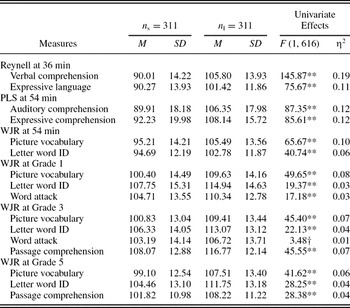
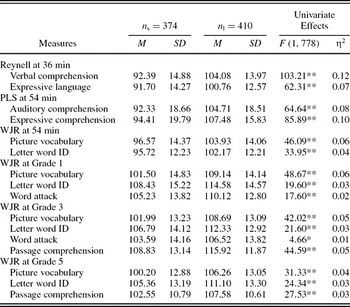
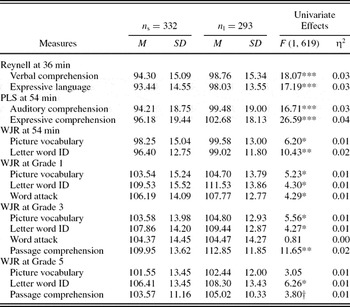
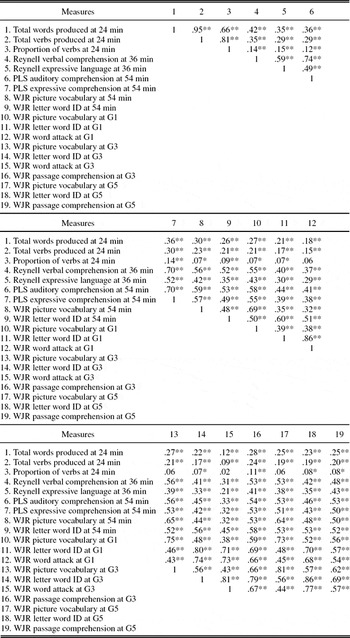
The descriptive statistics for the group categories based on the three CDI measures and the associated language outcome measures are reported in Table 1, Table 2, and Table 3. Correlations of the longitudinal language measures for the entire sample (n = 1,071) are listed in Table 4.
Total vocabulary size group comparisons on language and literacy outcomes

Note: PLS, Preschool Language Scale; WJR, Woodcock–Johnson Psycho-Educational Battery—Revised.
†p = .06. **p < .001.
Total verb size group comparisons on language and literacy outcomes

Note: PLS, Preschool Language Scale; WJR, Woodcock–Johnson Psycho-Educational Battery—Revised.
*p < .05. **p < .001.
Proportion of verb size group comparisons on language and literacy outcomes

Note: PLS, Preschool Language Scale; WJR, Woodcock–Johnson Psycho-Educational Battery—Revised.
†p = .052. *p < .05. **p = .001. ***p < .001.
Correlations of language and literacy measures (N = 1,071)

Note: PLS, Preschool Language Scale; WJR, Woodcock–Johnson Psycho-Educational Battery—Revised; G1, G3, G5, Grades 1, 3, and 5.
*p < .05. **p < .01.
Total number of words and language/literacy outcome measures
After accounting for differences on the four covariates, a significant multivariate main effect for the total vocabulary size was obtained, F (16, 601) = 11.32, p < .001, η2 = 0.23. At the .001 significance level, univariate tests revealed that children who produced a larger number of words (>460 words) at 24 months consistently outperformed those with a smaller vocabulary (<230 words) in subsequent language development as measured by Reynell verbal comprehension, F (1, 616) = 145.87, η2 = 0.19, and expressive language abilities, F (1, 616) = 75.67, η2 = 0.11, at 36 months and by Preschool verbal comprehension, F (1, 616) = 87.35, η2 = 0.12, and expressive language abilities, F (1, 616) = 85.61, η2 = 0.12, at 54 months.
It was not surprising that the children in the larger vocabulary group also consistently had a greater vocabulary size as measured by the Woodcock–Johnson picture vocabulary subtest at 54 months, F (1, 616) = 65.67, η2 = 0.10, first grade, F (1, 616) = 49.65, η2 = 0.08, third grade, F (1, 616) = 45.40, η2 = 0.07, and fifth grade, F (1, 616) = 41.62, η2 = 0.06, than did the smaller vocabulary group. All tests were conducted at a significance level of .001.
Similarly, at the .001 significance level, the decoding skills and word recognition of the larger vocabulary group were also consistently better than the smaller vocabulary group, as measured by Woodcock–Johnson letter–word identification subtest at 54 months, F (1, 616) = 40.74, η2 = 0.06, first grade, F (1, 616) = 19.37, η2 = 0.03, third grade, F (1, 616) = 22.13, η2 = 0.04, and fifth grade, F (1, 616) = 28.25, η2 = 0.04. Furthermore, they also showed stronger decoding skills than their peers in the smaller vocabulary group in the Woodcock–Johnson word attack subtest at first grade, F (1, 616) = 17.18, p < .001, η2 = 0.03, but only marginally so at third grade, F (1, 616) = 3.48, p = .06, η2 = 0.01.
Children in the larger vocabulary group also performed significantly better than those in the smaller vocabulary group in the Woodcock–Johnson passage comprehension subtest in both third, F (1, 616) = 45.55, p = .001, η2 = 0.07, and fifth grades, F (1, 616) = 28.38, p = .001, η2 = 0.04. A summary of the results is provided in Table 1.
An examination of our covariates also revealed significant multivariate main effects at the .001 significance level for SES, F (16, 601) = 12.24, η2 = 0.25, gender, F (16, 601) = 5.15, η2 = 0.12, ethnicity, F (16, 601) = 3.24, η2 = 0.08, and birth order, F (16, 601) = 2.90, η2 = 0.07. Univariate tests indicated that children from higher income families significantly outperformed children from lower income families for all 16 language outcome variables, at the .001 significance level (η2 = 0.07–0.15). Furthermore, girls were found to have significantly higher verbal comprehension and expressive language abilities at 36 months as well as to have a larger vocabulary at 54 months and first and third grades but not at fifth grade as assessed by the Woodcock–Johnson picture vocabulary subtest (for the outcome variables, η2 = 0.01 or 0.02). Detailed results of the univariate tests are available on request from the author.
Total number of verbs and language/literacy outcome measures
Given that total expressive vocabulary size has been found to be a good predictor of subsequent language and literacy outcome measures, the next question is to determine whether lexical composition is also a good or even a better predictor than total vocabulary size. We first examined the lexical composition in terms of the total number of verbs produced by the 2-year-olds.
A significant multivariate main effect for the total number of verbs was obtained, F (16, 763) = 8.86, p < .001, η2 = 0.16. The univariate tests yielded a similar pattern of results as the first MANCOVA with total vocabulary size as a predictor. That is, the total number of verbs was predictive of the 16 language and literacy outcome variables at the significance level of p < .001 except for the Woodcock–Johnson word attack subtest at third grade (p < .05). The effect size ranged from 0.02 to 0.12. Once again, these results suggest that children who produced more verbs at age 2 consistently outperformed children who produced fewer verbs in later language and literacy skills. A detailed summary of the univariate tests and effect sizes is detailed in Table 2.
Significant multivariate main effects for SES, F (16, 763) = 16.41, p < .001, η2 = 0.26, gender, F (16, 763) = 6.05, p < 0.001, η2 = 0.11, ethnicity, F (16, 763) = 3.33, p < .001, η2 = 0.07, and birth order, F (16, 763) = 2.55, p = .001, η2 = 0.05, were similarly obtained. Univariate tests also yielded similar results to those reported in the first MANCOVA with total vocabulary size as a predictor.
Proportion of verbs and language/literacy outcome measures
A significant multivariate main effect for the proportion of verbs as a function of total words was obtained, F (16, 604) = 2.64, p = .001, η2 = 0.07. Unlike the two earlier predictors, the second measure of lexical composition—proportion of verbs—did not turn out to be a good predictor of later language and literacy outcomes. First, the effect size revealed by the univariate tests for the 16 outcomes was small, ranging between 0 and 0.04. Second, the univariate tests indicated that proportion of verbs was predictive of 13 language and literacy outcomes but not of the Woodcock–Johnson word attack at third grade, picture vocabulary and passage comprehension at fifth grade. Table 3 provides details of the univariate tests and effect sizes.
As for the four covariates, significant multivariate main effects were found for SES, F (16, 604) = 13.86, p < .001, η2 = 0.27, gender, F (16, 763) = 5.58, p < .001, η2 = 0.13, ethnicity, F (16, 763) = 3.53, p < .001, η2 = 0.09, and birth order, F (16, 763) = 2.76, p = .001, η2 = 0.07. Furthermore, the univariate tests revealed that only SES was predictive of the 16 language and literacy outcomes at the significance level of p < .001, with η2 values ranging between 0.07 and 0.15. Specifically, children from higher income families significantly outperformed children from lower income families for all 16 language and literacy outcome variables. Girls significantly outperformed boys in expressive language ability at 36 months and at first grade at the .001 level. Their verbal comprehension ability at 36 months and auditory comprehension ability at 54 months were higher than those of the boys at the .01 level. Although their vocabulary size ascertained by the Woodcock–Johnson subtest was larger than that of the boys at 54 months, in third grade, and in fifth grade, none of these differences were significant at the .001 level.
DISCUSSION
This study set out to test whether toddlers’ expressive vocabulary size at age 2 significantly predicted their subsequent language and literacy abilities up to fifth grade using a large longitudinal data set from the NICHD SECCYD. It is one of the few studies to directly ascertain the predictive ability of early vocabulary in language and literacy development in a large population of typically developing children. Moreover, it is of a comprehensive nature by tracking typically developing children in their language and literacy development from age 2 to preteen years. Most existing studies focus on either atypical population such as late talkers (e.g., Rescorla et al., Reference Rescorla, Dahlsgaard and Roberts2000), children at risk for dyslexia and specific language impairment (e.g., Koster et al., Reference Koster, Been, Krikhaar, Zwarts, Diepstra and Van Leeuwen2005; Lyytinen et al., Reference Lyytinen, Ahonen, Eklund, Guttorm, Laakso and Leinonen2001) or for a shorter period of time (e.g., Pearson et al., Reference Pearson, Hiebert and Kamil2007). Our findings indicate that early expressive vocabulary at age 2 can significantly predict the 16 language and literacy outcomes such as letter identification, phonological awareness, vocabulary, and reading comprehension over the span of 9 years. Thus, expressive vocabulary at age 2 is shown to be crucial to subsequent literacy development.
Specifically, both total expressive vocabulary size and total number of verbs are found to be good predictors after controlling for individual differences in terms of SES, gender, birth order, and ethnicity. However, total vocabulary size was found to be a better predictor than total verb size (a measure of lexical composition) because it accounted for a larger proportion of the total variability in the 16 outcomes. The proportion of verbs as a function of total words did not turn out to be a good predictor. Although there is evidence suggesting that children at risk for dyslexia or specific language impairment have difficulties acquiring verbs at a young age, these children also have a smaller total vocabulary size compared to their typically developing peers (e.g., Conti-Ramsden & Jones, Reference Conti-Ramsden and Jones1997; Koster et al., Reference Koster, Been, Krikhaar, Zwarts, Diepstra and Van Leeuwen2005). Our findings are consistent with those of children who are at risk for language or reading difficulties. Although total vocabulary size and verb size were found to be good predictors of later literacy outcomes, our findings demonstrate that total vocabulary size is a more powerful predictor because to be proficient in a language requires children to learn all the grammatical classes of words such as nouns, verbs, and adjectives. Thus, our results show that children with a larger vocabulary size (or even total verb size) at age 2 continue to be on an advanced language and literacy development trajectory than their peers with a smaller vocabulary size.
Early vocabulary at age 2 rather than grammar was chosen as a predictor of subsequent literacy outcomes because vocabulary development has been found to be a good predictor of grammar development (Bates, Bretherton, & Synder, Reference Bates, Bretherton and Snyder1988). This is consistent with the critical mass hypothesis put forth by Marchman and Bates (Reference Marchman and Bates1994) that children need to acquire a certain number of words, especially verbs, before progressing to learn the grammar of the language. Moreover, the focus of the paper is to bring to light the role of early vocabulary in toddlerhood on literacy development. Our findings are consistent with the comprehensive language approach, which postulates that early oral language abilities such as vocabulary play a critical role on subsequent literacy development (e.g., Dickinson et al., Reference Dickinson, McCabe, Anastasopoulos, Peisner-Feinberg and Poe2003); they also demonstrate that we have to place a strong emphasis on early vocabulary learning as young as age 2 if children were to become highly competent in later literacy skills.
It is worth noting that early vocabulary size predicted marginally the decoding skills on the word attack task of the two groups of children at third grade. However, our results are in keeping with previous studies suggesting that differences in technical literacy skills such as word decoding, which are more affected by formal schooling, usually disappear by third grade (e.g., De Jong & Lesserman, Reference De Jong and Leseman2001).
In sum, the current findings are consistent with existing research in both language acquisition and literacy literature in highlighting the positive relationship between early vocabulary size and subsequent grammatical development (e.g., Moyle et al., Reference Moyle, Weismer, Evans and Lindstrom2007) as well as emergent literacy (e.g, Stanowich, Reference Stanovich, Gough, Ehri and Treiman1992). Of the most importance, the ability of expressive vocabulary size at 24 months to predict later literacy outcomes underscores the pivotal role that vocabulary plays in literacy development, even after controlling for well-documented factors such as SES, gender, ethnicity, and birth order. Our findings fit with and extend existing studies such as NICHD ECCRN (2005) and Ricketts et al. (Reference Ricketts, Nation and Bishop2007) by demonstrating that there are long-term effects of early language competence on later literacy abilities.
Furthermore, they also demonstrate that early vocabulary size assessed by the CDI is a reliable measure that can be used as a predictor of language development if a sufficiently large sample size is included. This highlights the effective use of the CDI as a language assessment tool for pediatricians, speech pathologists, early educators, and researchers.
LIMITATIONS AND CONCLUSION
The present study has some limitations. First, as the objective of our study is the predictability of early expressive vocabulary on subsequent language and literacy competence, the causal relation between these variables cannot be determined using the present analysis. In addition, our present analysis does not tease apart the specific role, be it direct or indirect, that early expressive vocabulary plays in reading development. Second, our measures of lexical composition were restricted to the number of verbs produced. Other measures such as mean length utterances and grammatical markers were not included in the present analysis as they are not available in the NICHD SECCYD data set. Only the percentile of sentence complexity (i.e., Part 2 of the CDI) was available. Grammatical markers could potentially be a good predictor as children at risk for language delays have been reported to have difficulty acquiring them (e.g., Koster et al., Reference Koster, Been, Krikhaar, Zwarts, Diepstra and Van Leeuwen2005; Stolt et al., Reference Stolt, Klippi, Launonen, Munck, Lehtonen and Lapinleimu2007). In contrast, they may not be a good predictor, as grammar development has been hypothesized to emerge from lexical development and not the other way round (Marchman & Bates, Reference Marchman and Bates1994). It would still be worthwhile for future research to explore these aspects of lexical composition using a comparable sample to this study in order to verify that vocabulary size is the best predictor for subsequent language and literacy competence.
A potential issue with using the CDI is that parents with low SES tend to underreport the vocabulary size of their child compared to parents with middle and high SES (e.g., Roberts et al., Reference Roberts, Burchinal and Durham1999). However, this underreporting was observed only when the CDI was administered for children at 30 months, but not at 18 or 24 months. Besides this reliability issue, some might question the accuracy of the CDI measure itself as parents might be biased to either underestimate or overestimate their child's language abilities. To examine this concern, Reznick and Schwartz (Reference Reznick and Schwartz2001) compared one group of parents who completed the CDI longitudinally and three groups of parents who completed the CDI cross-sectionally when their children were 8, 10, and 12 months. The four groups of parents did not differ in their CDI scores, thus suggesting that parents are relatively objective when it comes to assessing their children's language abilities. Moreover, the concurrent validity of the CDI assessed at 20 months with other measures such as the Preschool Language Scale auditory and expressive comprehension at 54 months is 0.40 and 0.61, respectively.
Despite these limitations, the current findings have important theoretical and practical implications. Theoretically, the results of the present study suggest that there is a continuum between early oral language development and literacy development, as evident in the differential abilities between children with a larger expressive vocabulary size and those with a smaller vocabulary size. In addition, extrapolating from infancy studies such as Tsao et al. (Reference Tsao, Liu and Kuhl2004) and Newman et al. (Reference Newman, Ratner, Jusczyk, Jusczyk and Dow2006), our findings further suggest that there are differential language abilities between individuals at 24 months of age and even in the prelinguistic year which result in differential language developmental trajectories that continue even up to age 11.
In a practical sense, our findings suggest that the groundwork for literacy development has to start as early as 2 years old. What should parents, caregivers, and early childhood educators do today to prepare infants and toddlers for the road to reading when they start formal schooling? It is as easy as providing children with rich lexical input and language-rich activities to help them in word learning at home or at the daycare center (Hart & Risley, Reference Hart and Risley1995; Weizman & Snow, Reference Weizman and Snow2001). Children who hear more speech from their parents or caregivers, particularly in terms of a more varied and richer vocabulary as well as different sentence structures, are more advanced in their vocabulary and grammar development than children who do not (e.g., Hoff & Naigles, Reference Hoff and Naigles2002; Huttenlocher, Vasilyeva, Cymerman, & Levine, Reference Huttenlocher, Vasilyeva, Cymerman and Levine2002; Naigles & Hoff-Ginsberg, Reference Naigles and Hoff-Ginsberg1998). Children who do not have rich lexical input provided by their parents or caregivers are often from lower SES families (e.g., Hart & Risley, Reference Hart and Risley1995; Hoff, Laursen, & Tardif, Reference Hoff, Laursen, Tardif and Bornstein2002). Therefore, there is an urgent need to provide parent-focused enrichment programs, especially to families with low SES, that educate parents and caregivers on the importance of providing a rich language environment to their children in order to prevent them from becoming at risk of reading underachievement or even reading difficulties.
APPENDIX A
Psychometric properties of language and literacy measures

Note: CDI, MacArthur Child Depression Inventory—Toddler Form (expressive production); RDLS, Reynell Development Language Scale; PLS-3, Preschool Language Scale—3; WJR, Woodcock–Johnson Psycho-Educational Battery—Revised; COG, Tests of Cognitive Ability; ACH, Tests of Achievement.
Given the persisting advantage of acquiring a large expressive vocabulary size (at least 460 words at age 2) on later language and literacy outcome, this paper underscores the importance of providing a language-rich environment in the earliest years of life to lay a solid foundation for our young children.
ACKNOWLEDGMENTS
This study was conducted by the NICHD ECCRN and was supported by the NICHD through a cooperative agreement that calls for scientific collaboration between the grantees and the NICHD staff. A training grant from the NICHD was awarded to the author to attend a 3-day American Psychological Association Advanced Training Institute workshop in June 2006 on the use of the NICHD SECCYD data set in Chapel Hill, NC.
Portions of this research were presented at the 2008 meeting of the International Association for the Study of Child Language in Edinburgh, Scotland. Partial financial support to present the paper was received from a grant funded by Wilfrid Laurier University Operating Funds and a Social Sciences and Humanities Research Council Institutional Grant.
I thank Maura Moyle, Eric Terry, Eileen Wood, and two anonymous reviewers for their insightful comments.