Introduction
The US Office of War Information (OWI) was one of the most far-flung organizations of propaganda and intelligence in wartime China during the period of the Pacific War (1941–1945). Originally the propaganda division of the better-studied Office of Strategic Services (OSS), the OWI's formal task was to disseminate information within the US and those areas under US military control.Footnote 1 In time, its Overseas Branch became a sprawling bureaucracy devoted to mass manipulation, which even sympathetic observers regarded as wielding dangerous influence over the political process of foreign countries.Footnote 2 As the ‘largest and in many respects the most influential of the United States government agencies operating in the field of overseas information prior to 1945’, the OWI represented part of the broad effort by the US Executive Branch to bring a sprawling information structure with pre-war origins to bear on the problem of sustaining domestic and international support for an increasingly costly global conflict. Within China, and the Far Eastern war zones more generally, the OWI's influence was first felt in the form of its broadcasting efforts (based in San Francisco) to ‘transmit war propaganda programs to East Asian theatres of war’.Footnote 3 By war's end the OWI Overseas Branch, China Division would control a growing informational network stretching from Chongqing and Chengdu to Kunming, and ultimately to Yan'an.
Because it touched the lives of so many people within China, the OWI Overseas Branch deserves mention in any account of the War of Resistance (1937–1945) which attempts to grapple with the tremendous cultural changes unleashed by total war and mass-mobilization. One reason why it is entirely absent from such accounts is that it was not, and is not, considered a Chinese entity, and as such is not eligible for inclusion within the master narrative of Chinese nationhood. The OWI did not contribute to China's cultural unification, or to the politicization of popular culture by intellectuals sympathetic to either the Communist- or Nationalist-led war effort.Footnote 4 While they may have galvanized people for—or, in the case of its anti-Japanese psychological warfare programmes, against—the war effort, OWI policies reflected US national interests and in some cases alienated the Americans’ Chinese allies. Nor have the records of the OWI, housed in the US National Archives at College Park, Maryland, attracted much attention from specialists in East Asian studies, with the exception of those interested in issues of wartime operations and intelligence. Recently, scholars willing to widen the focus of their research to include the broad spectrum of wartime experience, rather than the spread of nationalism solely, have begun to discover the importance of propaganda activities conducted by the pro-Japanese Reorganised Nationalist Government headed by Wang Jingwei, or carried out by the Communist-Nationalist united front during the early war years.Footnote 5 Japanese propaganda, or ‘thought war’, in north and east China also attempted to win Chinese hearts and minds away from the distant Chongqing and Yan'an governments.Footnote 6 Military combat generated a contest for allegiance in the ideological sphere.
In many ways, China provides compelling evidence that ‘the Second World War witnessed the greatest propaganda battle in the history of modern warfare’.Footnote 7 Ordinary citizens became targets for campaigns of information, propaganda, and mental coercion. Mass communications technologies (film, radio, and the press), institutional forms (the information office and propaganda department), and censorship made political organization of opinion, and behaviour, appear feasible on an ever-widening scale. For China, as has been well-documented, the arrival of war also contributed to the rapid erosion of sovereignty for Chiang Kai-shek's Republic of China, with the result that the territory formerly held by Chiang and his generals was suddenly open to numerous governments and international organizations which became drawn into this new theatre of ‘world struggle’.Footnote 8
Under these conditions US entry into the Pacific War, and participation in the ongoing War of Resistance, was inevitably accompanied by propaganda, which in its various guises was also referred to as ‘morale operations’ or ‘information’ when targeting allies, and ‘psychological warfare’ when directed at enemy populations and combatants. Previous scholarship on wartime US efforts to transform China's mental terrain has primarily focused on cultural affairs, educational exchange, and the relationship of these programmes to other aspects of American Far East policy, particularly those concerned with democracy and political modernization.Footnote 9 While cultural programmes are acknowledged to have overlapped with the ‘strengthening of China's morale’ as a goal of more immediate US war aims, there has been less attention to propaganda as such. From this earlier perspective, erosion of ‘the rigid wall originally separating cultural and foreign policy objectives’ was a consequence of the war, not a pre-existing feature of American foreign policy, and particularly not an observable feature of Sino-American relations in December, 1941, when US commitment to the war in China became linked to total defeat of the Japanese Empire.Footnote 10
By contrast, OWI records suggest that US propaganda efforts in China were considerable, and based on this evidence it becomes possible to argue that because the war was total from a US perspective, and because China was an important theatre of that war, mobilization of allies and defeat of enemy forces became a task too important to be entrusted to foreign governments. Under the direction of F. McCracken ‘Mac’ Fisher, the OWI Overseas Branch, China Division became one of the most prolific sources of propaganda within the Chongqing government-controlled territories of ‘Free China’. From 1942 onwards, OWI outposts in Chongqing, Chengdu, Kunming, Yong'an, and ultimately Yan'an used every means at their disposal to create a coherent, believable portrait of US war aims and the war effort that would appeal to Chinese audiences. Many of those who worked in the OWI's China offices were themselves Chinese, while OWI psychological warfare and intelligence-gathering efforts relied on American-born Japanese (nisei), Japanese Prisoners-of-War (POWs), Korean exiles, Central Army informants, and Communist Party political commissars in formulating a policy of ‘white’, or US-attributed, propaganda intended to win the war by:
Weakening the morale and fighting spirit of Japanese troops; weakening the morale of the population of Japan; weakening the war production effort of Japan by creating confusion, doubt, and dissatisfaction within Japan; disrupting the exploitation of Japanese-occupied countries for the benefit of the Japanese war production effort by promoting non-cooperation and passive sabotage on the part of workers and inhabitants of occupied countries; hampering Japanese military operations in occupied countries by urging labour to desert the Japanese Army and Navy; [inducing] surrender on the part of Japanese troops, and [inciting] active sabotage and resistance against the Japanese on the part of local populations.Footnote 11
While some might argue against describing such aims in the same terms as cultural and education programmes the logic was, for OWI planners and operatives, inescapable—information and attitudes were crucial elements in a broader war effort.Footnote 12 As such, they were to be transformed in accordance with the goals of US wartime and Far East policy.
In keeping with the themes of this special issue of Modern Asian Studies, the purpose of examining OWI activities in China is to illustrate how important non-Chinese governments and institutions were to the lived experience, and cultural landscape, of the War of Resistance. A second, but related, point concerns the fact that Chinese, Japanese, Korean, and US participants in the war effort worked alongside one another to bring about the defeat of occupied China and the Japanese military invasion. Like the Japanese Empire, resistance was generated through multi-ethnic networks of cooperation, which did not exclude experiences of infighting and coercion. Perspectives on the depth of foreign involvement in wartime mobilization and thought-war have been largely missing due to nation- and region-centred approaches to East Asia history. As diplomatic historian Akira Iriye writes:
National histories have been the predominant scholarly category since the study of history was established as a discipline in Europe in the nineteenth century, but historians are paying increasing attention to developments and themes that cut across national boundaries, in the process forcing a revaluation of the concept not just of nation but also of history. Such a phenomenon is attributable in part to what is usually referred to as globalisation, something that has seriously compromised the stability and endurance of the nation state. Transnational forces—economic, social, and cultural—have breached state boundaries and at times even violated national sovereignties’.Footnote 13
The OWI was not a transnational institution, but an instrument of national policy with international reach; the Second modern Sino-Japanese War was destructive in ways which adjectives like ‘compromised’ stability and even ‘violated’ sovereignty fail to express. At the same time, Iriye draws attention to how national histories fail to account for the fact that, under particularly unstable conditions such as war, other forces—transnational, international, and potentially invasive—may rush in.
The Office of War Information in China
In broad terms, the OWI Overseas Branch represented the international wing of a wartime propaganda establishment, one with roots in interwar mass-opinion research and sustained cooperation between academics, journalists, advertisers and the state.Footnote 14 OWI Overseas Branch operations included the foreign dissemination of information, and securing psychological victory over US enemies.Footnote 15 Production of OWI propaganda materials drew on teams of experts with knowledge of non-English languages; methods of delivery included air-dropped leaflets, radio broadcasts, and visual media such as film, filmstrips, and photographs.Footnote 16 A less-observed, but nonetheless crucial, OWI function was the creation of communications channels which could be used for a wide range of purposes related to the war effort, such as informal diplomacy and the transmission of intelligence and coded information. While the US Embassy in Chongqing maintained its own cultural programmes, these primarily existed to send ‘educational and scientific of value to Chinese universities and. . .intellectual leaders who are guiding the war effort’ whereas OWI activities, which included sending of ‘war information and current opinion of propaganda values’, were intended to reach a ‘different economic and social level in China’.Footnote 17 The OWI, in other words, was among its many functions a mass organization. Within China alone, outposts prepared materials in Chinese, Japanese and Korean, which added to the OWI's flexibility and reach as an agent of US policy in East Asia.
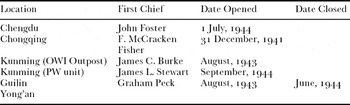
Although ultimately beholden to civilian and military leaders in Washington, the OWI Overseas Branch China Division was controlled for much of its existence by direct order of the military theatre commander, General Joseph W. Stilwell. In practice, however, several outposts of the China Branch were involved in morale operations and psychological warfare within China on a daily basis. On 17 December, 1941, F. McCracken Fisher, head of the Chongqing Office of the United Press, had been selected by future OSS Director for Intelligence Brigadier General John Magruder to spearhead ‘counter propaganda work’ by promoting US war aims.Footnote 18 Within two days, Fisher was receiving daily news reports transmitted from the OWI Pacific Bureau in San Francisco, and instructed to disseminate these materials in Chongqing by newspaper and radio. Microfilmed magazines and newspapers followed, thus establishing a direct information pipeline between the US and China for the purpose of maintaining Chinese morale. Publicly, the OWI functioned as a press agency, operating across a variety of media. OWI network equipment, however, was supplied by the US Army signal Corps, and its activities on behalf of the US government and war effort were more extensive than its Chinese name, The ‘American Information Service’ (AIS, or Meiguo xinwen chu), let on.Footnote 20 As the US became more involved in the War of Resistance, OWI facilities in China multiplied. The China Division maintained outposts in Chongqing, Chengdu, Yong'an, and Kunming by war's end, with another office in Guilin closed by June, 1944, under mounting Japanese military pressure (see Table 1).
China Outposts, Office of War InformationFootnote 19

By July 1942, the OWI's activities included both a public, embassy-affiliated component and a clandestine, intelligence-focused complement. Washington and New York offices of the OWI provided press releases, advance texts of speeches, maps, recordings, additional intelligence material, and announcements from other branches of the US government via teletype circuit, short wave, and cable wireless.Footnote 21 The Chongqing outpost engaged in distribution of microfilmed US magazines ‘of current news and opinion’ for delivery to Chinese newspapers and other press organs.Footnote 22 Other media distributed by the OWI included film-strips, films with a ‘military bearing’ (i.e. newsreels and war pictures), and radio programmes broadcast by shortwave from San Francisco to Chongqing, where they were then rebroadcast by medium wave transmission. US-produced news was redirected to Chinese newspaper offices by telegraph, or through a network of Chinese outpost personnel with contacts in the press world. In addition to these informational activities, the OWI China Branch conducted intelligence gathering for redistribution to US forces, primarily in the areas of radio and press monitoring. Its outposts also gathered information on Chongqing-based foreign governments in exile—Korea being a prominent example—and Washington. Another important intelligence function was the routing of psychological warfare materials and studies to other US military units.Footnote 23 From 1944 onwards, the Kunming outpost played a notable and active role in psychological warfare.Footnote 24 These activities primarily took the form of airborne leaflet drops behind Japanese lines by the 14th Air Force and 20th Bomber Command, although radio broadcasts from the western US (Anchorage, San Francisco) and Pacific islands also played an important role in psychological operations. OWI China outposts alone generated ‘some 40 to 50 leaflets in Japanese, Chinese, Annamite, French, Thai, and Korean. . .a weekly news sheet in Japanese, a weekly pictorial news sheet in Chinese, and a fortnightly pictorial news sheet in French and Annamite’.Footnote 25 As Department of State-appointed political advisor to the China-Burma-India (CBI) theatre commander, John Paton Davies and Foreign Service officer John F. Service supervised the production of psychological warfare materials, as did the US Army's Forward Echelon military intelligence (G-2).Footnote 26
Like the Overseas Bureau and its China Division, the OWI Pacific Bureau also played a critical role in saturating China with US-created war propaganda. Although based in San Francisco, the bureau's shortwave radio broadcasting facilities distributing programming in 22 languages throughout the Pacific region, with a separate station for troop news and psychological warfare based in Anchorage, Alaska. In December 1942, noted scholar of Eurasia, Owen Lattimore, resigned as advisor to Chiang Kai-Shek to become OWI Director of Pacific Bureau and Deputy Director for Policy Application in the Pacific Area.Footnote 27 During the war the Pacific Bureau had more than 400 personnel, and was granted considerable leeway in formulating news content and overseeing dissemination based on directives from Washington.Footnote 28 Lattimore's representative on the Central Intelligence Panel, which coordinated all Far Eastern planning and intelligence in Washington, was George Taylor. When the Overseas Branch was reorganized on 19 February, 1943, Taylor was made head of Region VII (China, Japan, Indonesia, and the Philippines), and Lattimore a member of the Overseas Planning Board. Further reorganization took place in September, 1942, after which Lattimore oversaw all propaganda operations against Japan, including those in China, while Taylor moved on to become Assistant Deputy Director for Pacific Operations.Footnote 29
Origins, assumptions, and objectives
Both the OWI and better-known OSS emerged from the office of the Coordinator of Information (COI), headed by William Joseph ‘Wild Bill’ Donovan and created on 11 July, 1941, by President Franklin Roosevelt. A key distinction between the two was that unlike the OSS, the OWI was not charged with the duty of influencing ‘enemy thinking by means of black [i.e. non-US attributed] propaganda’ that would appear ‘as though it had come from within the enemy's own ranks’, and this distinction appears to have been upheld within China by the theatre commanders.Footnote 30 Like the COI, the OSS was vaguely charged with managing intelligence collection and overseas propaganda around the world. OSS agents were attached to US diplomatic facilities, often as ‘cultural attachés’. The OSS clashed with both the FBI and the State Department, which resented new intrusions into the information-gathering and diplomatic process. The Sino-American Cooperative Organization (SACO), established in April, 1942, established a role for OSS under the supervision of Military Statistical Bureau (Jun tong) head Dai Li; the appointment of OSS Far East coordinator was briefly filled by Milton ‘Mary’ Miles.Footnote 31 Yet while misunderstandings between the OSS and Jun tong head General Dai Li have become an enduring theme in histories of US intelligence operations in China during the Pacific War, the OWI became an early ‘winner’ in the inter-agency competition for US military patronage.Footnote 32
One of the most enduring characteristics of OWI policy in China was the attempt to incorporate area and linguistic experts into the propaganda production process. British-born China historian George Taylor, as OWI Deputy Director for the Far East, was apparently shocked by the crudeness of US military propaganda leaflets and attempted to remedy this situation through the recruitment of anthropologists, social scientists, and other Japan specialists.Footnote 33 Another of Taylor's recruits was the Harvard University China historian John K. Fairbank.Footnote 34 Likewise, the OWI China Branch received direction from the Washington-based Overseas Branch offices, which oversaw all aspects of moral operations, psychological warfare, and additional information activities in ‘blacked out’ and ‘enemy occupied’ areas within Japan and China proper.Footnote 35 At the same time, OWI propagandists specifically avoided use of racist language—two examples given were ‘natives’ and ‘yellow race’—in order to avoid alienating allies.Footnote 36 Regional directives reflected this shift towards a culture- and context-specific understanding of how OWI materials should address their intended targets.
OWI China operations, and associated upper-level directives, also betrayed a distinct lack of trust regarding Chiang Kai-shek and the Chongqing-based Nationalist Party. Late in the war Fairbank described the Chongqing Nationalists as being just as ‘authoritarian’ as their Communist counterparts, and cautioned that the US should avoid offering Chiang any signs of unconditional support.Footnote 37 Instead, the goal of OWI informational work was to make China ‘as useful and cooperative an ally as possible’ in the war against Japan. In this endeavour, the obstacles to be combated were:
Indifference, complacence, [and] confidence that the war will be won without further Chinese participation, reluctance to engage in the type of political-guerrilla warfare for which China is pre-eminently qualified, plus an unrealistic ambition for the type of war machine for which China is not at present qualified.Footnote 38
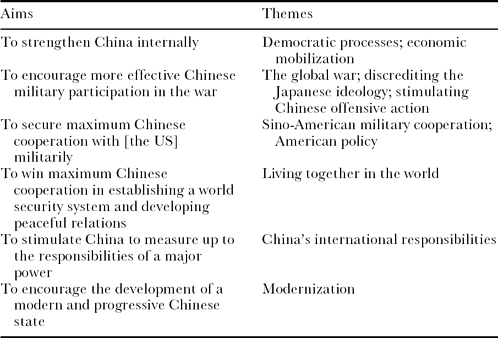
American scorn for Chinese ‘passivity’ thus found its full expression in the OWI, an institution intended to transform the attitudes and opinions from which this condition supposedly sprang. While US policy was unambiguously to foster China's role as a major power in East Asia, and ‘responsible member of the family of nations’, policymakers charged the OWI with ‘develop[ing] Chinese understanding of the standards to which China must measure up’ as a major power. By 1945 the focus on internal reform of political and economic systems, rather than economic, financial, and industrial aid, was itself rooted in the belief that the role of the US was to make China into a ‘genuine democracy’ with the aid of local cooperation. In the short-term, the OWI China Division attempted to shorten the duration of the war against Japan by encouraging an offensive military strategy, while its long-term directives aimed at the transformation of China politically and economically.
At the local level, OWI branch office directors described their role as creating ‘goodwill’ towards US organizations among the Chinese population, and even improving what they saw as the impoverished cultural lives of their audiences.Footnote 39 Ensuring that America and Americans were ‘understood’ was another important goal, as was ‘furnish[ing] the Chinese people with the latest reliable news of the war’ and other world events. In Chongqing, the functions of the OWI outpost included assuring China of US support and telling the story of the war effort, maintaining American prestige, and attacking Japan through propaganda. Prestige was important insofar as ‘the vast resources and markets of China [would] become prominent factors in international economics’.Footnote 40 OWI operations were thus intended to assure that US interests would remain pre-eminent in post-war China. An important tenet of OWI doctrine, however, was that these operations consisted of disseminating information rather than engaging in cultural or diplomatic affairs—two areas of activity reserved for the US State Department. Providing news coverage in a way which favoured the US while upholding Chinese morale for the war effort was one overarching goal; destroying Japanese morale was the other.
There appears to have been no planned date of termination for OWI informational activities in China. Plans for expansion into former Japan-occupied territories began taking concrete form in March, 1945. A long-range policy directive written two months earlier, the first ever issued for China, suggests that US policymakers hoped to use the OWI as an instrument for shaping mass opinion in order to establish a ‘secure peace’ following Japanese defeat war (see Table 2).Footnote 41 At this point in the war it was China, not Japan, which appeared to be the most likely candidate for cooperation with the US and United Nations in creating a ‘world security system’ and ‘peaceful relations among nations’, especially in the Far East. The OWI was to complement this strategy by presenting China's war effort as a key stage in the restoration of Chinese civilization, and as a first step towards reformation of a fundamentally—in the eyes of American planners—weak political and economic system.
Aims and themes of planned OWI materials according to long-range policy directive, China, January, 1945Footnote 42
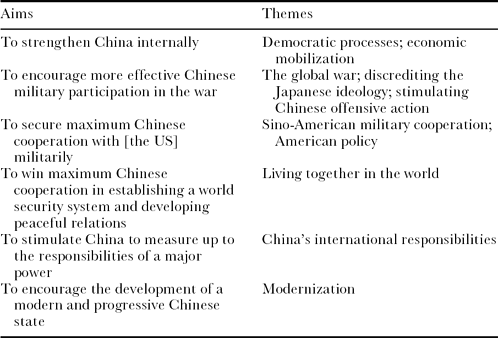
Although messianic and domineering in tone, OWI post-war planning directives also revealed a concern for conditions affecting audience receptivity. One persistent theme was that Chinese ‘cultural pride’, and related fears of ‘new American imperialism’, should be countered by limiting descriptions of American ways and aims. America was not to appear anti-communist, or its material conditions overly luxurious. At the same time, OWI propagandists were to openly espouse the belief that American-style reforms in China would satisfy both American and Chinese self-interest.
Information and public relations: the mass media
Although OWI planners often took pains to distinguish between psychological warfare (‘propaganda war’) and informational activities within the broader scope of OWI functions, they also admitted that each service possessed ‘vestments’ of the other. What united the two was the emphasis on manipulation of opinion, emotion, and perception in ways which benefited American interests in China. Dissemination of news materials as ‘public relations’ for the US was intended to enhance international relations through ‘intensification of communications’, and to reach out to a social group deemed most important to the future of Chinese politics—students.Footnote 43 The OWI printed approximately 4,000 copies per week of American Digest, a magazine of articles from US magazines and newspapers appearing in both English and Chinese. Photographs, microfilmed periodicals, and press-clippings reached Chinese audiences through public exhibits and libraries. The OWI's Chongqing outpost maintained its own film theatre; its flagship publication, the United Pictorial (Lian huabao), was believed to sell more per week (25,000 copies) than the leading Chinese magazine, West Wind (10,000 copies).Footnote 44 The OWI maintained three distinct translated and English-language news services, in addition to a library and distribution network for US magazines, books, and booklets with titles such as ‘Famous Military Leaders’, ‘The World of 1944’, and ‘Pocket History of the United States’. OWI operations in Chengdu were credited with a ‘remarkable job of public relations’ in creating acceptance of recently-arrived US Air Force personnel among the populace of Western Sichuan. Other field offices, some of them temporary, included a location in Guilin (later closed due to the Japanese military advance), one in north-western Lanzhou, and one carefully-guarded location in Yong'an, Fujian province.
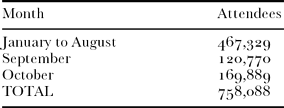
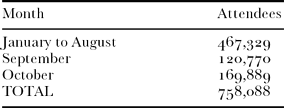
A steady supply of audiovisual equipment also streamed into Chongqing government-controlled or ‘Free’ China following US entry into the war, including 35mm and 16mm projectors, loudspeakers, films, and recordings. OWI offices in Chongqing represented the hub of informational activities, with weekly newsreel and film screenings at the compound, located adjacent to the US Embassy (see Table 3). During March, 1945, the OWI China Division Information Branch embarked on a far-reaching programme to increase the coverage of US activity in the China Theatre for consumption by Chinese audiences. A second programme, carried out by both Chinese and American OWI representatives, aimed to reach all towns along the highways and waterways within Free China with OWI material. Reports indicated large crowds for picture exhibits (approximately 4,500 attendances per day) and letters from attendees asking for additional copies of OWI publications; regions covered included the Chongqing-Guiyang highway, Yangzi River, and areas adjacent to forward air bases. OWI news departments in Chongqing and Kunming also reported a rise in acceptances of articles prepared for the Chinese press. Books and pamphlets with titles like ‘Crimea Conference Statement’ (a synopsis of the February, 1945 ‘Yalta conference’, from which Chiang Kai-shek had been excluded) or produced for the series ‘Our Armed Forces’ proved popular in schools and among military corps of educated youth.Footnote 46 OWI libraries, which also served as additional distribution points for printed materials, reported frequent use, and overcrowding. Measured in terms of audience, the programmes appear to have been successful. In one month alone, the OWI Picture Department recorded approximately two million attendances for its exhibits and displays.Footnote 47 In cooperation with the Chinese War Production Board (WPB), the OWI distributed ‘inspirational and educational material’ in Chongqing factories.Footnote 48
Motion picture attendances reported by OWI Chongqing outpost, 1943Footnote 45
The end of the war in Europe coincided with a second large increase in the use of OWI media in China from May, 1945 onwards. China Division representatives noted increased demand for information on post-war Europe and US conditions.Footnote 49 The Kunming outpost reported greater popular interest in photographic exhibitions and library services.Footnote 50 New offices opened in the city of Xi'an, while representatives made contact with local government, military, and political leaders, journalists, educators, and heads of social organizations. OWI film screenings, picture exhibitions, and distribution of printed materials took place in the Han River valley along the Longhai Railway. United Pictorial circulation in Sichuan (Chongqing and Chengdu) and Yunnan (Kunming) expanded, as did the OWI's artistic and production staff. The Kunming Branch Office held free evening film showings in the local YMCA, and claimed to give ‘two movie shows daily’ to local organizations and journalists.Footnote 51 A sense of the scope of these screenings, compared with efforts during previous years, is contained in two OWI reports from May, 1945:
From Chengdu during the month, two showing teams covered 265 miles, showed 50 times at 34 places to a total audience of about 500,000 people. Audiences [per screening] averaged about 10,000. Expansion in the movie field was continued by contacting local distributors and theatre managers who have agreed to show 35 mm United Newsreel in the commercial movie houses.
and
During the month of May, 3 programs comprising 17 filmstrips with 3,715 copies were sent to showing stations. There are 381 active stations in over 100 cities in 12 provinces. A total of 69 exhibits were sent out, with additional sets for special stations. Reports were received from 125 stations indicating 813 shows with 3,548 filmstrips to 446,628 persons (Chongqing).Footnote 52
In general, OWI films were shown in commercial theatres, with loans made to schools, universities, workers’ training centres, and hospitals.Footnote 53 ‘Reports indicated that the newsreel on the opening of the Stilwell Road would break all box-office records’.Footnote 54
Films distributed by the OWI were mainly produced by the United Newsreel Corporation, a consortium formed by five major US newsreel companies and which oversaw synchronization of soundtracks in Mandarin.Footnote 55 Universal Studios, which managed United Newsreel distribution in China, then shipped the Chinese-language prints to Chongqing for further distribution. OWI film imports and screenings were conducted with the permission of the Chongqing government, US filmmakers having negotiated a lend-lease arrangement with China to ‘restore and increase the distribution of American films throughout Free China’ following a memorandum from Mr Lo (Luo Jingyu) of China Motion Picture Corporation and Dr Shaw, Secretary General of the Chinese American Institute of Cultural Relations. Two prints of ‘escape films’ and films concerning the US war effort to be distributed by a Chinese Chongqing-selected agency in exchange for a place in China's post-war market. Profits were to be put into a wartime trust fund, and would be duplicated by the Chinese Government, to ‘allow an expansion of the American film market throughout Free China’.Footnote 56 The films themselves were selected in the US, and so remained essentially consistent with policy aims.
Mobile photo exhibition teams were another important means by which OWI operations extended into the areas surrounding Chongqing and Chengdu. During April, 1945, Chinese OWI personnel set up their displays at the foot of Emei Mountain, attracting the interest of regional natives as well as Buddhist pilgrims.Footnote 57 Other exhibit sites included the Sun Yat-Sen Memorial Hall, in Luoshan Park, and Meishan mass education centre. Posters described the Stilwell Road—’the lifeline of Interior China’. Audiences numbered 20,000–30,000 per two- or three-day exhibit, and were reported as including local residents, vacationists, Buddhist worshippers, university students and faculty, government officials, and intellectuals. Mobile OWI teams reached the south-western provinces of Guangxi and Guilin sometime after 6 June, 1945.Footnote 58 Lanzhou, in Gansu province, also hosted a branch office, although most activity in Northwest China was primarily devoted to information gathering rather than dissemination. Pictures were shown behind glass cases, procured from the OWI's New York office, British agencies, or produced in China by Chinese army units and the US 14th Air Force and Signal Corps.Footnote 59 As many as 20,000 pictures were distributed from Chongqing, Chengdu, and Kunming within a one-month period. Like films and filmstrips, pictures were part-sent in from outside, part-locally produced.
OWI radio operations, based in China and in San Francisco, represented another important aspect of wartime propaganda. Four Chinese stations were used by the OWI—XGOY and XGOA (Chongqing), XGOG (Chengdu), and XPRA (Kunming). An additional 14 stations also existed in Free China, although two—XGOE in Guilin and XGOQ in Luoyang—were essentially unavailable due to Japanese military activity in those regions. Chongqing transmitters broadcast ‘The American Hour’ to English-speaking Chinese and American audiences, and re-broadcast US-produced programmes such as ‘Report to China’ along with shortwave programmes consisting of speeches and special events.Footnote 60 Stations in Chungdu and Kunming were less open to US influence. In Chengdu OWI programmers were limited by their inability to generate live radio content or replay-ready ‘transcriptions’, while in Kunming (controlled by Yunnan governor Long Yun) low broadcasting power, and restrictions placed by local authorities on OWI use of Chinese-language broadcasts, delayed the execution of OWI plans. In general, programming remained overwhelmingly focused on news, despite allocation of additional funds by the China Cultural Relations Programme for ‘broadcasts of a cultural nature’.Footnote 61
One way of circumventing the physical, technological, and political restrictions limiting OWI radio operations within China was to broadcast from other locations in the Pacific. The Overseas Branch Office of the Deputy Director for Pacific Operations maintained a bureau in San Francisco which engaged in round-the-clock short wave broadcasting. This radio station, KGEI, was supported by teams of linguistic experts who translated and tailored scripts written in Washington and New York for broadcast in 22 foreign languages.Footnote 62 Chinese programming averaged approximately six and one-half hours daily. Another station, KWID, was completed soon after US entry into the Pacific War. Programming included non-news scripts, broadcasting reached 24 hours a day, and more multilingual translators and broadcasters were added:
In line with the two general functions, propaganda (psychological warfare) and informational services, the programs are of two types. For China and liberated areas they are primarily informational—propagandistic only in the sense that the description and explanation of one's own culture to an allied nation is propaganda; for Japan they are definitely propaganda programs even though they often assume informational vestments. For Occupied Countries both types are used in order to encourage resistance and to provide news and information suppressed by the enemy.Footnote 63
By March, 1942, KGEI was broadcasting in both Mandarin and Cantonese. For Chinese-speaking audiences, Pacific Bureau-produced scripts were further divided into five main types:
• programmes dealing with the war fronts and related political developments in the form of news reports, commentaries or eye-witness accounts;
• accounts of life in America;
• programmes by Chinese in America, either Chinese Americans or visitors from China;
• discussions of some phase of European life;
• programmes on China.
As in Chongqing and south China, OWI radio activities were coupled with monitoring and analysis of non-US broadcasts. OWI offices not only communicated news and information, but also transmitted US Army and Air Force war communiqués for the China Theatre, via the Chongqing office's Code Room.
The Press Monitoring Department, also located in Chongqing, covered Chinese-language publications and prepared bulletins on sensitive topics, such as prices, inflation, and farming conditions, for US and United Nations organizations. The outpost's own Radio Department took down ‘nearly one-half million words of press material a month from enemy stations’.Footnote 64 Monitoring for use as intelligence by US and British operations covered 14 dailies in Chongqing and more than 50 newspapers in other parts of China, and distributed to more than 200 separate sources within the OWI, Department of State, Foreign Economic Administration, and WPB.Footnote 65
Psychological warfare
Despite its informational functions, psychological warfare was a priority for the OWI. From San Francisco came radio reports describing heavy Japanese casualties and unfavourable (‘seven Japanese to one American’) ratios of war dead.Footnote 66 Daily programmes of news reporting on the course of the war in all theatres described impending Axis collapse. According to a November, 1944, description of the OWI's mission in the China theatre, the intent was to
attack enemy morale in every way available, utilizing every possible medium-leaflets-newssheets-radio. [And influence] native populations in occupied areas from assisting the enemy—don't work—fight, or feed.Footnote 67
As this report indicates, Japanese servicemen were not the sole targets of leaflet-dropping operations, and leaflets intended for Chinese living behind Japanese lines were dropped directly inside cities like Shijiazhuang and Canton (Guangzhou), along with Chinese-language copies of the OWI-produced Hua bao (China Pictorial). By November, 1944, the OWI was able to produce 25–30 unique leaflets, and 25 issues of Jisei, a newssheet intended for Japanese servicemen, every six months.Footnote 68 Propaganda policies were determined by a Washington-drafted ‘Weekly Coordinator’ approved by the Joint Chiefs of Staff, and shared with the psychological warfare branches of other anti-Japanese US forces. Content-control over OWI publications resided with the senior US Army officer responsible for psychological warfare within the China Theatre.Footnote 69
The primary unit responsible for psychological warfare was the Kunming outpost. Radio operations in China included the monitoring of Japanese Domei and transmission of intercepts totalling approximately two-million words per month by January, 1945.Footnote 70 OWI China representatives James Stewart and Neil Brown, assisted by a staff of editors, writers, and artists, produced leaflets under the supervision of the Psychological Warfare Board established by Stilwell's successor, General Albert C. Wedemeyer, in Kunming. These leaflets, in turn, were dropped by US Air Force aeroplanes over south China and Indochina—airborne leaflet drops would remain the most common form of American psychological warfare in China for the duration of the war. A second, and secret, OWI unit operated in Yong'an (Fujian province). In addition to monitoring medium-wave Japanese broadcasts, operatives working at this facility engaged in informational work, according to one report, ‘intended to produce certain attitudes among the heavily populated coastal area which will be conducive to cooperation and assistance if and when there is a landing on the coast’.Footnote 71 The US Army and US Navy conducted frequent survey work in the region relations with local civil and military authorities, including the governor, were deemed ‘very close’.
As in the case of information work, one of the most important tasks associated with psychological warfare was the gathering of Japanese-language materials, which mined for additional insight into the psychology of the Japanese Imperial Army. John K. Fairbank, initially working on behalf of the Interdepartmental Committee for the Acquisition of Foreign Publications (IDC), had contacted numerous officials of the National Military Council and Ministry of Information in Chongqing, had been one of the most active US representatives in this respect until his recall to Washington.Footnote 72 Thereafter, the OWI and OSS were foremost among American organizations competing to locate contacts within China who would provide these sought-after materials. Much of the work of translating captured Japanese sources, creating linguistically-fluent psychological warfare propaganda, and interrogating captured Japanese prisoners was carried out by American-born Japanese, or nisei, OWI operatives. One of the most notable operatives was US Army Technical Sergeant Koji Ariyoshi, a Japanese-American from Hawai'i, graduate of the University of Georgia, and former San Francisco dockworker who was assigned to survey the anti-Japanese psychological warfare of the Chinese Communist-led forces and their prisoner re-education of captured Japanese POWs.Footnote 73
Early returns were not promising. The Central Government, although nominally engaged in psychological warfare activities, was deemed too disorganized, ineffectual, and prone to factionalism for the OWI to pursue a serious partnership, in spite of the fact that the Ministry of Information claimed to manage an extensive anti-enemy propaganda network throughout occupied and unoccupied China.Footnote 74 A more serious rift between the two national agencies was created by the question of whether the US government would be willing to support Chiang Kai-shek's Nationalist Party in their own psychological warfare efforts.Footnote 75 As Fisher explained the impasse, ‘Until the political questions, which affect all Chinese-American relations and co-operation, are settled at the highest levels, we feel that any liaison committee with the power to direct policies and lines would hamper our efforts seriously’.Footnote 76 Official US policy rejected cooperation wholesale: ‘The American psychological effort in the China Theatre, being a function of command of the American Theatre Commander, must remain an American effort. Furthermore, by order, the policies which must guide this effort are those originating in Washington’.Footnote 77
Although the OWI and Central Government would never reach a cooperative agreement, other options for extending American influence in China existed among the disaffected and recently-uprooted segments of wartime society. In Chongqing the OWI made contact with the Japanese Anti-War League, a POW organization headed by Kaji Wataru. Kaji, a former left-wing writer and confidante of Lu Xun, was eager to negotiate better treatment for himself and his fellow prisoners: prior to OWI arrival, the league had been in contact with British forces concerning the possibility of aiding their operations in India and North Burma.Footnote 78 With no immediate answer forthcoming, Kaji then turned to the OWI, which accepted his assistance as a producer of Japanese-language psychological warfare materials.Footnote 79 This marked a promising breakthrough for the US psychological warfare in general, which had previously relied on the efforts of the OSS IDC for the Acquisition of Foreign Publications representative, John K. Fairbank, who had been largely stymied in his attempts to gather further intelligence on the Japanese Imperial Army and those areas under its control.
In addition to employing the services of Kaji, the OWI's psychological warfare operations also benefited from intelligence, advice, and linguistic support provided by Japanese POWs attached to the Communist Party's Eighth Route Army forces. OWI personnel travelled to Yan'an along with the US Army Observer Section (hereafter ‘Dixie Mission’) in July, 1944, and remained there until April, 1947, when the unit, renamed the ‘Yenan Observer Group’ after 13 April, 1946, was withdrawn from northern Shaanxi just prior to the Nationalist attack. Yan'an provided a rare window onto conditions under Japanese rule due to frequent travel between the Communist and occupied areas. Moreover, by 1944, visitors to the region had begun reporting that the CCP was involved in a wide range of cultural activities within its base areas, including the training of Japanese prisoners for military propaganda work.Footnote 80 Surveys conducted personally by F. McCracken Fisher confirmed that the Japanese People's Emancipation League (Nihon jinmin kaiho renmei)—the name of the Japanese POW organization under Eighth Route Army control—represented a superior alternative to the more limited assistance that Kaji Wataru's Japanese Anti-War League could offer. Fisher enthusiastically reported that Eighth Route Army's methods could be used to enhance the US psychological warfare effort, and gain additional intelligence concerning conditions inside the Japanese Army and Japan.Footnote 81 A working relationship between the OWI and Eighth Route Army began to solidify in October, the month in which OWI operatives John K. Emmerson and US Army Technical Sergeant Koji Ariyoshi arrived at the Communist base as the organization's forward intelligence unit.Footnote 82 Thereafter, OWI operatives were able to obtain glossaries of new Japanese terms and military slang, lists of phonograph music banned by Japanese authorities for possessing ‘a deleterious effect on morale’, and POW writings on their own backgrounds and experiences—all of which the OWI deemed essential to understanding the ‘fundamental psychology of the Japanese soldier’.Footnote 83
Like its Chongqing counterpart, Kaji Wataru's Anti-War League, the Japanese People's Emancipation League was defined by the leadership of a single political figurehead—Okano Susumu. Born Nosaka Sanzō, and an influential leader of the Japanese Communist Party both before and after the war, Okano publicly claimed to have arrived at Yan'an in 1943, but in reality he had reached China in March, 1940, when Stalin froze ties with non-Russian branches of the Comintern and expelled their representatives from Moscow.Footnote 84 Okano was not the sole architect of psychological warfare (‘anti-enemy work’, or dui-di gongzuo) within the Communist base areas; the most influential figure in this regard was most likely Luo Ruiqing, Mao Zedong's high-ranking Eighth Route Army political commissar.Footnote 85 However Okano, along with head of the Anti-Enemy Work Department Li Chuli, became one of the key points of contact between OWI operatives Emmerson and Aryoshi during their extended stay in Yan'an. The Japanese People's Emancipation League Propaganda Committee, also headed by Okano, had compiled a large quantity of resources for leaflet production based on newspapers from Japanese-occupied areas, interrogation of recently-captured POWs, Chinese-supplied materials, and demands gathered from former Japanese soldiers at the Japanese Soldiers’ Conference convened in Yan'an in August, 1942.Footnote 86 Emmerson and Ariyoshi were also impressed with the effectiveness of the League-run Japanese Workers and Peasants School in re-educating Japanese troops following capture.Footnote 87 On 15 November, Emmerson conducted a survey involving 98 Yan'an prisoners to measure attitudes towards the war, and post-war Japan. Emmerson subsequently described the poll, which revealed that only a small minority of POWs favoured either the war or the Emperor system, as ‘proof that the beliefs and attitudes of the average Japanese soldier can be changed by systematic indoctrination’.Footnote 88 Observing the success of the Chinese Communist Party's Japanese POW and psychological programmes in general, Ariyoshi recommended that the OWI ‘get the opinions of Japanese prisoners to gauge and adjust our propaganda contents, appeal and style of writing so that our message will be understood and effective against Japanese troops’.Footnote 89 While the education and use of Japanese POWs by the OWI never became a widespread phenomenon, these ‘Yenan reports’ did provide a significant insight into the attitudes of Japanese soldier for OWI outpost and US Army propagandists working in various Pacific War theatres. The Okana's Propaganda Department did, moreover, provide criticism of OWI radio broadcasts from San Francisco and Hawai'i, solicited by the Yan'an-based OWI team, and subsequently relayed back to Washington and other outposts.Footnote 90
Communist-organized Japanese POWs were not the only group to volunteer their services to the OWI psychological warfare effort. Members of the Korean Provisional Government demonstrated interest in producing Korean-language materials, although the OWI was hesitant to accept the offer for political reasons.Footnote 91 Other Korean, French, and Vietnamese citizens, relocated to Chongqing in the course of the war, served the OWI as staff or as volunteers. The OWI also relied on contacts in Central Government guerrilla units to provide information concerning conditions in Beiping, Tianjin, and Shanhaiguan.Footnote 92 These sources revealed that non-Communist guerrilla forces on both sides also engaged in psychological warfare and morale operations: pamphlets and packets of salt were the two most frequently-employed methods. A report on leaflets prepared by the National Military Council Political Department, Third Section, indicated Chongqing's attempts to influence the morale of Chinese in occupied areas, Japanese troops, Japanese citizens in China, Korean soldiers and civilians in China, and people in Indo-China, Burma, and Thailand.Footnote 93 According to eminent scientist and representative of the Operations Board (Junling bu), National Military Council Shu Xingbei (Hsin P. Soh), the Ministry of Information Anti-Enemy Publicity [Propaganda] Commission ‘was solely a Ministry. . .show’, intended to garner US support.Footnote 94 In fact, Chiang Kai-shek had ‘instructed the Operations Board to consult with the Political Training Board (Zhengzhi bu) and with the Central Broadcasting Administration’, but little progress on a renewed anti-Japanese propaganda initiative had been made.Footnote 95 Moreover, the governments 23 broadcasting stations, which included a 50kW facility in Kunming and two 35kW facilities in Chongqing, broadcast only just over eight hours a day on average, according to OWI China Division chief, McCracken Fisher. By contrast, Japanese-controlled stations numbered 62 and broadcast at 816.685kW total power. In addition to Tokyo's 150kW station, 100kW stations in Changchun, Beiping, Nanjing, and Wuhan were active up to 18 hours a day, and disseminated propaganda, speeches, and music (apparently in multiple languages).
Anti-enemy propaganda work carried out under GMD government direction was primarily written by returned-students from Japan, as well as ‘Japanese, Koreans, and Formosans’ such as those employed by the Ministry of Information in 1945.Footnote 96 The Ministry also claimed ‘a number of agencies’ in Japanese occupied areas capable of operating underground receiving stations, publishing and distributing handbills, pamphlets, posters, and other printed material, and engaged in the fabrication of newspapers and newssheets using materials received from Chongqing. Ministry-operated broadcasting stations disseminated programming in ‘Japanese, Korean, Formosan, and French languages and various Chinese dialects’, while Ministry researchers analysed enemy news and propaganda, monitored broadcasts, and collated reference materials.Footnote 97 Head of the GMD research bureau on enemy studies, Li Chaoying (Li Ch'ao-ying) and members of the National Resources Commission formulated a plan to establish a collection station for enemy materials, but lack of funding and coordination appear to have left the project in limbo. Fairbank noted that General Zhang Zhizhong (Chang Chih-chung), head of the National Military Council, employed Japanese communist ‘Rockuchi’ as a consultant in anti-Japanese warfare. According to OWI field intelligence officer, Theodore Herman, the Third Section of the Political Department, National Military Council was involved in the fabrication of over 100 leaflets between 1943 and 1944, which appear to have been dropped from US planes.Footnote 98 Targets included Chinese in occupied areas, Japanese troops and civilians, Korean troops and civilians, and people in Indo-China, Burma, and Thailand. Leaflets were printed in Chinese, Japanese, Korean, Annamite, Burmese, and Thai. Messages varied by target group. Signatories, both real and fabricated, included the Political Department of the National Military Council, [Japanese] Soldiers’ Anti-War League Committee, Japanese Peoples Anti-War League, Japanese Peoples Freedom and Peace League, ‘Chinese officers and soldiers’, ‘A Japanese—SAKURAI Katsu’, ‘A Japanese—ARISHI’, and the Korean Independence Party. According to OSS historian Maochun Yu,
on the GMD government side, a vast newspaper enterprise was operated by the intelligence apparatus for the single purpose of gathering intelligence and spreading disinformation to destabilize the enemy's will to fight. Both Wang Pengsheng's Institute of International Research and Tai Li's Bureau of Investigation and Statistics (BIS) ran newspapers and other media outlets for intelligence purposes.Footnote 99
Mistrust amongst allies
John Emmerson and Koji Ariyoshi had travelled to Yan'an as optimistic participants in the Dixie Mission, whose brief moment of contact with the CCP marked a watershed in Sino-American relations.Footnote 100 By late May, 1945, however, Chinese Communist-US relations had become seriously strained, particularly in Fuping and the other forward bases in which US forces were most active. Statements made by US Ambassador Hurley in support of the Nationalists were taken as grounds for much of the mistrust. Okano and Li Chuli confided to Ariyoshi that the ambassador's statements would likely be taken as a pretext for civil war.Footnote 101 Eighth Route Army liaison officers expressed reservations about providing support for US airmen and ‘OSS men’ when so little US support for the Communists had been forthcoming following promises of assistance made earlier that year. Reported Ariyoshi: ‘To put it in a nutshell, the liaison officers said that we have been here practically a year, had done nothing to help the 8RA (meaning in weapons, ammo, etc., and training), and at the moment, it is clear as daylight that we will not help the Communists’.Footnote 102 While cooperation between Communist and US forces continued in the field, Eighth Route Army liaison officers based in Yan'an refused to engage with Dixie Mission counterparts deemed unsympathetic to the Communist cause, especially those who ‘treat[ed] the Chinese Communists as coolies.’ Based on US promises, the Communists had expected supplies and training. Instead they found themselves doing the ‘dirty work’ of providing security and aid to US operations in North and East China, while US agents hoarded information gathered during their frequent missions beyond Yan'an and the forward areas.Footnote 103 Some liaison officers suggested that it would be better for Dixie Mission forces to pull out, given the low levels of cooperation overall.
Ariyoshi, however, stayed on. Armed with reproductions of American news photos, periodicals, books, a movie projector, and films, he had also come to serve as ‘an American propagandist in the Chinese hinterland and rural areas’.Footnote 104 After an introduction to the base area and its way of life, Ariyoshi began his propaganda tasks by screening US-produced films on the Tennessee Valley Authority, mechanized farming, industrial production, and the successful African-American planter ‘Farmer Henry Brown’ to invited students from Yenan's English School, Japanese Workers and Peasants’ School, Korean Independence League, and other organizations.Footnote 105 With the Eighteenth Group Army photo-section, he toured adjacent villages on mule-back, screening the same titles for peasants. Ariyoshi set up photographic exhibitions concerning the Pacific and European wars, and life in the US. US periodicals, photographs, and film strips were sent to forward areas in North China; a grateful General Ye Jianying indicated that as long as additional films, photographs, printing presses, and other materials were delivered, the OWI would continue to enjoy Communist trust.Footnote 106 Nonetheless, cooperation quickly faded with the end of the war, although the last US personnel would not leave until April, 1947. Since the Dixie Mission's arrival, Yan'an-based radio operators from the OSS had been attempting to discover evidence of radio communication between the Soviet and Chinese communist parties.Footnote 107 OWI intelligence reports gathered immediately after surrender did reveal that Chinese Communist forces were ‘continuing to take over and retain for their own use arms and military supplies abandoned or surrendered by the Japanese’, and in defiance of Central Government orders.Footnote 108
Similarly, US cooperation with Chongqing turned quickly toward mutual suspicion and recrimination. Plans for the incorporation of Chinese and Korean ‘surrogates’ into US intelligence and propaganda operations dated back to the establishment of the OWI's predecessor organization, the Coordinator of Information (COI), which also spawned the OSS. This policy had, in turn, been borrowed from the British Special Operations Executive; in both cases, the choices of surrogates often ignored complex local politics and ‘gave off of a strong odour. . .of colonialism.’Footnote 109 In a glowing report from H. Preston Peters concerning the work of F. McCracken Fisher as head of the outpost, Peters noted that Fisher was particularly adept at deflecting inquires made by Ministry of Information heads, Wang Shih-Chieh and Hollington K. Tong, concerning the nature of US psychological warfare plans in China. The Chinese officials were also frustrated by criticisms of Chiang Kai-shek and the GMD appearing in OWI news releases and San Francisco-based radio broadcasts. In the eyes of Nationalist Party officials, such limited cooperation remained inadequate as compensation for the damage which OWI activities did to their government's authority. On 2 August, 1943, Fisher informed George E. Taylor (Deputy Director of Pacific Area) and Owen Lattimore (Deputy Director of Pacific Operations) that articles appearing in the US on the subject of ‘two Chinas’ had antagonized the Chongqing government.Footnote 110 The result was a withdrawal of free transmission privileges from Chongqing to the Institute of Pacific Relations (‘steadily more anti-China’) over XGOY. Japanese propaganda seized on allegations of Chongqing's unreliability in the war effort as evidence of American attitudes of ‘racial superiority’. In December, 1944, Wang Shih-Chieh (Wang Shijie), Chinese Minister of Information, and Vice-Minister Hollington K. Tong (Dong Xianguang), called on Fisher at the OWI's Chongqing compound to ‘voice their disturbance of the frank criticism (of the Generalissimo [Chiang Kai-shek] and Kuomintang) appearing in the American press, OWI news releases, and broadcasts from OWI San Francisco’.Footnote 111 Wang and Tong also expressed interest in OWI psychological warfare operations, although Fisher refused to divulge any detailed information.Footnote 112 Months later, Fisher was still deflecting accusations that the OWI's activities included ‘spying on our Allies and forwarding reports on their doings to Washington’.Footnote 113 From a Chinese government perspective, however, the OWI's activities were difficult to distinguish from those of the other 13 US intelligence services then active in Chongqing. Nor were the accusations baseless. In March, 1945, Fisher suggested to George Taylor that the Chongqing outpost's services could be expanded beyond reporting on public opinion to encompass political and military intelligence.
Because of the mistrust which characterized both sides of relations between the Nationalist and US governments, American forces were largely restricted in their ability to make contact with Chinese populations behind Japanese lines. According to Fisher, many of the Chinese puppet military units possessed ‘vague connections’ to the Nationalists, and represented a sphere of influence which Central Government officials were unwilling to cede to their American allies.Footnote 114 Treaty arrangements prevented the installation of US-owned radio facilities within China, thus at least partially guaranteeing Central Broadcasting network hegemony on the airwaves. With the retreat of Japanese troops from Guizhou, and increases in US military aid to the Central Government beginning in early 1945, Nationalist officials like Hollington Tong heightened their scrutiny of OWI operations, particularly the relationship between OWI offices and the Chinese press.Footnote 115 OWI Chinese staff included known members of Dai Li's secret police, as well as both Nationalist and Communist Party members. Where the organization's loyalties ran in connection with Chinese politics was thus a critical issue from the perspective of Nationalist Party and government censors. In response, Fisher frequently cited American commitment to truth, Chinese newspapers’ demand for OWI-circulated materials, and the OWI's practice of submitting all published materials to the Central Government as defence against allegations of fomenting opposition to Nationalist rule.Footnote 116
The fact that the OWI maintained direct connection with the Chinese press through circulation of uncensored news file materials (xinwen ziliao) represented one of the clearest examples of how, for US information agencies, the wishes of local governments were only one consideration within a broader policy framework designed to serve American aims by disseminating official American views. Yet Nationalist censors still maintained strict control over the flow of information. One August, 1944, estimate placed the amount of OWI-produced news appearing in Chinese newspapers at ten per cent of all stories released.Footnote 117 American sources from the period reveal considerable scepticism concerning the ability of foreign criticism to bring about significant policy changes in the Nationalist Party.Footnote 118
The US Army Public Relations Office in Chongqing hampered dropping of news releases in occupied areas concerning victories against the Japanese.Footnote 119 US Ambassador Clarence E. Gauss described OWI operations as ‘extensive and expensive’, frequently criticized the OWI's American Digest for irresponsible supervision, and disapproved of the office's civilian staff conducting themselves as US government representatives.Footnote 120 Similarly, OWI efforts to secure cooperation with the Chongqing-based Ministry of Information came to very little, despite ministry claims to oversee a large ‘anti-enemy propaganda’ bureaucracy consisting of ‘thirteen commissioners, two secretaries, two section chiefs, two senior clerks and two editors, mostly returned students from Japan, and nine junior members, in addition to a number of Japanese, Koreans, and Formosans’.Footnote 121 While it is quite plausible that underground radio and publishing operations were carried out by Nationalist agents in occupied areas, few opportunities for further collaboration developed even during the last months of the war. Reporting in May, 1945, Captain James Dolan was unable to confirm that any of the US leaflets dropped over North China were being read by the intended Chinese recipients.Footnote 122 Those dropped inside Shijiazhuang and other cities were often confiscated by Japanese and local police forces. In South China, the 14th Air Force periodically attempted to gain the upper hand in OWI operations by exercising control over content, or dropping only over specific locations or on specific dates selected by its own officers.Footnote 123 F. McCracken Fisher admitted little knowledge of the actual drop locations, while the OWI was unable to report accurately on reactions to the leaflets. Price increases, which often outstripped changes in the exchange rate between US and Chinese currency, destabilized OWI budgets and operations. Due to weight limitations on Chongqing-bound cargo, and periodic shortages of printed material, OWI dissemination activities in China were uneven, if not sporadic. Electricity was another concern, especially in areas like Kunming where reliable generators were either nonexistent or in short supply. Finally, although an estimated one million radio sets existed in China at the beginning of the war, less than 800 usable sets remained in Chongqing by 1945.Footnote 124
Epilogue: peace, communication, and the Communist spectre
During the war, US forces had constructed a vast informational network stretching from Europe to the Pacific. News of major wartime events, such as the collapse of Germany or liberation of Paris, appeared in propaganda materials designed and distributed in China. Chongqing's leaflet production facilities supplied Air Force psychological warfare operations based in Kunming and Calcutta. New technologies, like the radio-photo, introduced the possibility that texts and illustrations created in one wartime theatre could be transmitted to another theatre almost instantaneously. Translating staffs working in Chinese, Japanese, Korean, French, and Vietnamese created propaganda in multiple languages, while editors and policy controllers tailored content to suit particular local conditions, or to achieve diverse psychological effects. Although the OWI spoke with the official voice of the US government, organizations like the OSS engaged in ‘black’ propaganda, or disinformation, activities designed to sow panic, confusion, and terror among enemy populations. Throughout World War II, commentators on the OWI had taken pains to distinguish its methods, and use of terminology such as ‘propaganda’ and ‘psychological warfare’, from the methods and terminology of the ‘Nazi Propaganda Ministerium’.Footnote 125 And yet the disavowal of independent US propaganda operations targeting allied governments was fully (if not openly) abandoned by war's end, as evidenced by a draft plan of OWI operations in the Far East, which called for greater integration of the OWI with US combat forces, and expansion of duties to include:
A. Long range propaganda into occupied countries in the Far East, aimed at maintaining the maximum possible resistance against efforts of the Japanese to consolidate, hold, or expand their present position. . .B. Long range propaganda directed toward the civilian population of Japan itself. . .C. Operational propaganda, both ‘black’ and ‘white’. . .D. Propaganda directed toward the solidification of native support for the Allied cause in unoccupied areas and especially in countries where our troops are based. E. Projects directed toward maintenance of a high state of morale among our overseas forces.Footnote 126
In short, the distinction between enemy, occupied, and allied populations had become easily blurred. Where the latter was concerned, propaganda replaced ‘information’: policy-related and strategic effects, not understanding, were the goals. If, as Maochun Yu has argued, the major point of crisis in China-US relations was over issues related to Chinese sovereignty, OWI policies seemed designed to violate that sovereignty as a matter of course.Footnote 127 Although held back in part by logistical shortcomings and Nationalist censorship, by war's end the US ‘propaganda apparatus’ in China had reached a considerable size when compared with its Chinese counterparts in Chongqing and Yan'an.
From 1945 onwards, the dismantling of Japanese propaganda operations in Shanghai and North China only accelerated the growth of the US press, media, and educational presence. Although the domestic OWI was dissolved in 1945, its international offices were transferred to the Department of State, and its functions taken over by overseas US consular offices. In China, the physical network for US public relations coverage was provided by the Army Signal Corps, in response to which ‘[the] Nationalist Government after 1946 many times raised question networks operation through Ministry of Communications, then Foreign Office, on grounds infringement national sovereignty, commercial facilities available and fact US refused China reciprocal privilege’.Footnote 128 Other methods of informational distribution included the United States Information Service (USIS), whose representatives delivered films to schools, hospitals, and social organizations during 1947, particularly in strategically, and commercially vital cities such as Beiping, Shanghai, Canton, Hankou, Mukden (Shenyang), Shanghai, and Taibei.Footnote 129 Where US consulates appeared, USIS branch offices followed.Footnote 130 The USIS pushed motion pictures, ‘a highly effective medium for reaching the Chinese masses as well as specialized groups of the population’, for their ability to attract audiences of 2,000 to 10,000 individuals at a single screening; during periods of warm weather, average monthly attendances reached 900,000. USIS projectionists travelled deep into the countryside, while USIS-supplied equipment was used for screening American films in YWCA schools and at hotel banquets. Like their OWI antecedents, these offices also mounted photographic exhibits, opened libraries, and monitored the Chinese-language press for the benefit of Department of State officials in Washington. Newspaper and pamphlet distribution, and deals with Chinese broadcasting stations in Canton and Shanghai, ensured that American views continued to be circulated in Chinese schools and among the liberal or ‘third force’ intellectual circles whose support was so coveted by policymakers. Encouraged by these short-term gains, the US ambassador in China, John Leighton Stuart, noted that even in the event of a Communist Party victory:
USIS and trade opportunities [will] likely remain two principal US means [of] influence. . .Based on OWI experience Yenan and Exec Hqtrs Peiping, Dept believes there will be heavy demand from Communist functionaries for books, movies, pictures all other info materials from US Even though many items will obviously be censored, Dept believes in long run it will be most advantageous maintain maximum flow info through all media possible even though much will reach only Communist officials and censors.Footnote 131
This was not to be. Yet taking a longer view, while war against Japan was incredibly destructive, it also marked a turning point for international communications and the domination of those communications by a rising global power. As a result of the war, ‘360 radio transmitters in more than fifty countries were sending more than 2,000 words a minute round the world in over forty languages’ rhapsodized one former OWI consultant.Footnote 132 Moreover, it ushered in a new era in which propaganda and information, which F. McCracken Fisher had, in 1944, called the ‘cutting edge of policy’, became permanent rather than wartime functions of nearly every state and government agency.Footnote 133 This new orientation toward attitudes and mentalities permeated the international organizations of the Cold War era. According to the Constitution of the United Nations Educational, Scientific, and Cultural Organization (UNESCO):
The governments of the states parties to this constitution on behalf of their peoples declare that since wars begin in the minds of men, it is in the minds of men that the defences of peace must be constructed; that ignorance in each other's ways and lives has been a common cause throughout the history of mankind, of that suspicion and mistrust between the peoples of the world through their differences have all too often broken into war. . . . For these reasons, the States, parties to this Constitution, . . . are agreed and determined to develop and to increase the means of communication between their peoples and to employ these means for the purposes of mutual understanding and a truer and more perfect knowledge of each other's lives.Footnote 134
At the time of the Constitution's promulgation, the US had already been building defences in China for five years, during which time the OWI had integrated the entire Far East region into a film, telecommunications, print media, and broadcasting network. Whether used for psychological warfare or information, the structure of this network had become very nearly a permanent feature of China's political and social landscape.
The post-war rubric of ‘communication’, and particularly ‘communication between peoples’ as a precondition of peace, would thus be used to justify the continued existence of an entire mode of global order built on propaganda, a term whose negative connotations post-war architects were eager to dispel by replacing it with a different vocabulary. From the perspective of US scholar-consultants like Siepmann, propaganda was associated with falsehood and control, standing like ‘a great dragon folded in the gate to forbid all entrance’ to a future in which communications would unify the earth.Footnote 135 Siepmann was specifically arguing against the ‘squandering’ of US resources and pre-eminence as a result of peacetime re-conversion. He saw a great future for US companies in applying telecommunications knowledge to global problems, such as illiteracy, and worried that international peacekeeping organizations would be weakened without the information and awareness that US state-private partnerships could provide. Indeed, the establishment of the US Department of State Division of Cultural Relations had been preceded by the McCormack Act, which pointed out that foreign countries had used US domestic channels of communications to their own ends.Footnote 136 To abandon the geopolitical and informational space created by wartime agencies would be to create a vacuum which, in the context of a new Eurasian power's emergence, American post-war planners abhorred.