Introduction
Immunological stress affected physiological and pathological processes of domestic animals. Stressful situation in which feed consumption, body-weight gain and feed-conversion efficiency of chickens are decreased (Benson et al., Reference Benson, Calvert, Roura and Klasing1993; Korver and Klasing, Reference Korver and Klasing1997). This change results in the partitioning of nutrients away from growth and toward processes associated with inflammatory immune responses in chickens (Korver and Klasing, Reference Korver and Klasing1997). Tumor necrosis factor-α (TNF-α), interleukin-1 (IL-1) and IL-6 are among the most important pro-inflammatory cytokines produced by monocytes and macrophages. These cytokines activate neutrophils, monocytes and macrophages to initiate bacterial and tumour cell killing, stimulate T and B lymphocyte proliferation in inflammatory responses (Calder, Reference Calder2001b). In addition, these cytokines mediate the systemic effects of inflammation such as fever, weight loss and acute-phase protein synthesis in the liver. Production of appropriate amounts of TNF-α, IL-1 and IL-6 is clearly beneficial in response to infection, but inappropriate or overproduction can be dangerous and these cytokines, especially TNFα, are implicated in causing some of the pathological responses that occur in inflammatory conditions (Calder, Reference Calder2001a).
One of the goals for modulating the immune system of domestic animals by nutrition is to alleviate decreased performances following immune stimulation. Many animal studies investigating the effects of dietary oils on inflammation and immunity have now been published (Calder and Grimble, Reference Calder and Grimble2002; Sijben et al., Reference Sijben, Klasing, Schrama, Parmentier, Van der Poel, Savelkoul and Kaiser2003). Lai et al. (Reference Lai, Yin, Li, Zhao, Qiao and Xing2005a and Reference Lai, Yin, Li, Zhao, Qiao and Chen2005b) found that conjugated linoleic acid (CLA) was effective in preventing body-weight loss and suppressing the production and expression of IL-1, IL-6 and TNF-α in pigs following immune stimulation. Liu et al. (Reference Liu, Li, Gong, Yi, Gaines and Carroll2003) showed that fish oil also improved performance and decreased indices of the inflammatory responses in pigs. Diets that have a relatively high ratio of n-3 polyunsaturated fatty acids (PUFA) have been demonstrated to offer protection against growth depression and inflammatory responses in chickens following LPS challenge (Korver and Klasing, Reference Korver and Klasing1997; Korver et al., Reference Korver, Wakenell and Klasing1997 and Reference Korver, Roura and Klasing1998). Most of these studies indicate that, at the levels (5 g/kg, 10 g/kg, 20 g/kg, 40 g/kg, 60 g/kg) used in studies, fish oil is anti-inflammatory. However, not all studies agree with this generalisation (Revajová et al., Reference Revajová, Pistl, Kaštel, Bindas, Magic, Levkut, Bomba and Šajbidor2001). Reasons for contradictions might relate to the species of animal studied, the total fat content of the diets used, the amount of fish oil fed, the comparison being made and so on. A well-documented system for inducing sickness in laboratory animals is injection of lipopolysaccharide (LPS), a component of the outer membrane of gram-negative bacteria. Treatment of animals with LPS evokes a multitude of symptoms of sickness and elaboration of systemic inflammatory cytokines (Johnson and von Borel, Reference Johnson and von Borel1994; Korver and Klasing, Reference Korver and Klasing1997; Warren et al., Reference Warren, Finck, Arkins, Kelley, Scamurra, Murtaugh and Johnson1997; Webel et al., Reference Webel, Finck, Baker and Johnson1997; Balaji et al., Reference Balaji, Wright, Turner, Hill, Dritz, Fenwick, Carroll, Zannelli, Beausang and Minton2002). LPS is a potent inflammatory mediator and has been used to model bacterial infection experimentally in chickens (Korver and Klasing, Reference Korver and Klasing1997). The present study was designed to determine the effects of dietary fish oil and maize oil on growth performance and immune responses in chickens subjected to an inflammatory challenge, LPS.
Material and methods
Animals and experimental procedures
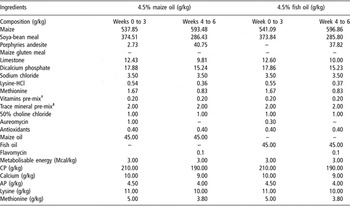
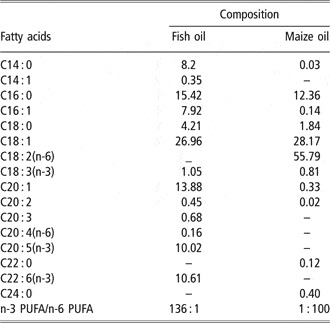
A total of 288 male Arbor Acres chicks on 1 day of age were used. Birds were fed with the starter diets from 1 day through 21 days of age, and the grower diets during 22 days to 42 days of age. The two kinds of isoenergetic and isonitrogenous maize-soya-bean meal-based diets were supplemented with maize oil 45 g/kg and fish oil 45 g/kg, respectively (Table 1). The fatty acids profiles of fish oil and maize oil were analysed by gas chromatography as shown in Table 2.
Ingredients and nutrient levels of trail diets

†Supplied per kg of diet: vitamin A, 12 500 IU; vitamin D3, 2500 IU; vitamin K3, 2.65 mg; vitamin B1, 2 mg; vitamin B2, 6 mg; vitamin B12, 0.025 mg; vitamin E, 30 IU; biotin, 0.0325 mg; folic acid, 1.25 mg; pantothenic acid 12 mg; niacin, 50 mg.
‡Supplied per kilogram of diet: Cu, 8 mg; Zn, 75 mg; Fe, 80 mg; Mn, 100 mg; Se, 0.15 mg; I, 0.35 mg.
Fatty acids composition of fish oil and maize oils

These 288 chickens were assigned in a 2 × 2 factorial arrangement. The main factors were dietary fat type (4.5% maize oil or 4.5% fish oil) and immunological challenge (LPS or saline). Birds were randomly assigned to four groups of 72 chicks each, with six replications of 12 chicks in a cage with constant lighting. At 20 days and 27 days of age, chickens were injected intraperitoneally with either 1 mg/kg live weight of Escherichia coli LPS (E. coli serotype 055: B5, Sigma, St Louis, MO, USA) or sterile saline. Body-weight gain, feed-conversion efficiency and feed intake were measured weekly throughout the experiment. This experiment was conducted according to protocols approved by the China Agricultural University Animal Care and Use Committee.
Immune responses measurements
The ratio of CD3+CD4+/CD3+CD8+ of peripheral blood mononuclear cell (PBMC) isolation and culture of PBMC of birds were prepared by a modification of the method of Wallace et al. (Reference Wallace, Miles and Calder2003) and Hayek et al. (Reference Hayek, Han, Wu, Watkins, Meydani, Dorsey, Smith and Meydani1999). One day after the first and the second LPS or saline challenge, blood was aseptically sampled from the wing vein into 5-ml heparinised vacutainer tubes. Blood was layered onto two volume lymphocytes separation medium (Dingguo biotech Inc., Beijing, China), and centrifuged at 4800 r.p.m. for 30 min at 4°C, then viable mononuclear cells could be recovered and then washed in RPMI1640 (GIBCO; Invitrogen, Carlsbad, CA, USA). Viability of PBMC was determined by trypan blue exclusion, and cells were adjusted to 1 × 10⁶ per ml. The fluorescence monoclonal antibodies were purchased from Southern Biotechnology Associates, Inc. (Birmingham, AL, USA), including mouse anti-chicken CD3-FITC (cluster of differentiation, 3-fluorescein isothiocyanate, NO.8200-02), mouse anti-chicken CD4-PE (cluster of differentiation, 3-phycoerythrin, no. 8255-09) and mouse anti-chicken CD8-PE (no. 8220-09). In all, 5000 cells per sample were analysed using flow cytometer (BD, Franklin Lakes, NJ USA).
Cytokines of peripheral blood
Blood samples were obtained by puncturing the wing vein of chickens at 300 h postinjection of LPS. Blood was collected in 5-ml heparinised vacutainer tubes. The blood samples were centrifuged (3000 × g for 15 min) to collect plasma. Plasma was harvested and stored at −30°C until analysis for IL-1, IL-6 and TNF-α. The levels of IL-1, IL-6 and TNF-α were measured with the commercial ELISA kits (Rapid & Biotech, Beijing, China) of IL-1, IL-6 and TNF-α, respectively, according to the manufacturer instructions. Briefly, This assay employs the quantitative sandwich enzyme immunoassay technique. A monoclonal antibody specific for cytokines has been pre-coated onto a microplate. Standards, controls and samples are pipetted into the wells and any cytokines present is bound by the immobilised antibody. After washing away any unbound substances, an enzyme-linked polyclonal antibody specific for cytokines is added to the wells. Following a wash to remove any unbound antibody–enzyme reagent, a substrate solution is added to the wells. The enzyme reaction yields a blue product that turns yellow when the Stop Solution is added. The intensity of the colour measured is proportionate to the amount of cytokines bound in the initial step. The sample values are then read off the standard curve.
Lymphocytes proliferation of peripheral blood
Isolation and culture of PBMC of birds were the same as above. Viability of PBMC was determined by trypan blue exclusion, and cells were adjusted to 1 × 10⁷ per ml. The cells were cultured in 96-well microtitre plates and incubated for 48 h with 45 μg/ml of Concanavalin A (ConA) at 40°C, 5% CO2 and optimum humidity. Subsequently, 10 μl of MTT (3-(4,5-dimethylthiazol-2-yl)2,5-diphenyltetrazolium bromide) solution (5 mg MTT/ml) was added to each well and the plates were incubated at 37°C for another 6 h. Following incubation, 100 μl of a 10% sodium dodecyl sulphate in 0.04 mol/l HCl solution was added to lyse the cells and solubilise the MTT crystals. Plates were read at 570 nm using an automated microplate reader (model 550; Bio-Rad, Hercules, CA, USA).
Serum IgG analysis
One day after the first and the second LPS or saline challenge, blood samples were obtained by puncturing the wing vein of chickens for the analysis of the serum immunoglobulin G (IgG) levels by the method of immunoturbidimetry. Serum samples were diluted with 0.01 mol/l phosphate-buffered saline (pH 7.2) at a dilution of 1 : 5. Briefly, the 10 μl diluted serum samples and 150 μl diluted (1:200) rabbit anti-chicken IgG (The Academy of Military Medical Sciences, China) were added to the 96-well microtitre plates. Then, a 10 μl of reactive buffer solution (0.01 mol/l phosphate-buffered saline including potyethytene glycol 53.0 g) was added to each well (Kastner and Jakse, Reference Kastner and Jakse2003). After incubation for 30 min at room temperature, the plates were read at an absorbance of 260 nm using a SAFIRE 2 spectrophotometer (Tecan, Lausanne, Switzerland).
Real-time quantitative RT-PCR
Spleen was removed on 21 days and 28 days of age, respectively. Total splenic RNA was extracted using the TRIzol Reagent (Invitrogen Life Technologies, Gaithersburg, MD, USA) according to the manufacturer’s instructions. RNA integrity was verified electrophoretically by ethidium bromide staining. The RNA purity was determined using the Biophotometer (Eppendorf, Cambridge, UK) at OD260. Total RNA was reverse transcribed according to the method described by Sijben et al. (Reference Sijben, Schrama, Parmentier, van der Poel and Klasing2001) and Lai et al. (Reference Lai, Yin, Li, Zhao, Qiao and Xing2005a). Briefly, 1.0 μl of each RNA sample was added to a 40 μl reaction system containing 1.0 μl of oligo-dT, 1.25 μl of dNTPs (Sigma), 0.5 μl of RNasin inhibitor (Promega, Madison, WI, USA), 1.0 μl of M-MLV transcriptase (Promega), 5.0 μl of M-MLV reverse transcriptase (RT) reaction buffer (Promega) and 15.25 μl of RNase-free water. Cycle parameters for the RT procedure were 1 cycle of 37°C, 1 h; 1 cycle of 70°C, 15 min; and 1 cycle of 4°C, 5 min. The RT products (cDNA) were stored at −20°C for relative quantification by PCR.
The reverse-transcribed products (cDNA) were for relative quantification by PCR. Nuclear factor kappa B (NFκB) amplification primers were designed using the Primer Premier 5.0 software program. The following sequences of PCR primer pairs were used: forward 5′-GTG TGA AGA AAC GGG AAC TG-3′, reverse 5′- GGC ACG GTT GTC ATA GAT GG -3′.
Real-time PCR for quantification of NFκB mRNA levels in chicken spleens were quantified using a method based on that of Sijben et al. (Reference Sijben, Klasing, Schrama, Parmentier, Van der Poel, Savelkoul and Kaiser2003). Briefly, quantitative analysis of PCR was carried out according to optimised PCR protocols and SYBR Green PCR master Mix Kit (Applied Biosystems, Foster City, CA, USA). The volume of reaction system is 40 μl, including 20 μl SYBR Green PCR master Mix, 3.0 μl forward primer, 3.0 μl reverse primer, 2.0 μl template and 12 μl DNase-free water. For the PCR reaction, the following experimental run protocol was used: enzyme incubation (50°C for 2 min), denaturation program (95°C for 10 min), amplification and quantification program repeated 38 times (94°C for 20 s, different annealing temperature for different target genes for 20 s, 72°C for 20 s with a single fluorescence measurement), melting curve program (65°C to 95°C with a heating rate of 0.1°C/s and a continuous fluorescence measurement) and finally 72°C for 10 min. The annealing temperature for NFκB was 53°C. Quantification was based on the increased fluorescence detected by the DNA Engine Opticon 2 fluorescence detection system (MJ Research, Waltham, MA, USA).
To generate standard curves for the NFκB reaction, the NFκB products of RT-PCR were serially diluted from 10−3 to 10−7. The housekeeping gene, β-actin, was used as an internal standard for the quantification. The threshold cycle value (Ct-value) was determined and was used to calculate the relative expression level compared with β-actin.
Statistical analysis
Statistical analysis of the chicken data were conducted using the GLM procedure of Statistical Analysis Systems Institute (2001) in a 2 × 2 factorial arrangement of treatments in a randomised complete block design with the two main effects of LPS challenge and dietary oil source. Meanwhile, the data were analysed by the procedure appropriated for a completely randomised design by the GLM procedure of SAS when the LPS challenge, dietary oil source main effects or the interaction between the two main effects is significant. Differences among each treatment group were tested by Duncan’s multiple-range test. Differences due to diets treatment were considered significant if the P value for the effect was <0.05.
Results
Growth performance
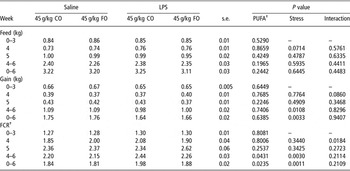
Performance data are presented in Table 3. There were no significant effects of dietary oils on feed intake, body-weight gains and feed-conversion efficiency on 21 days of age in the chickens. During the first challenge period (from 21 days to 27 days of age), LPS challenge reduced feed intake (P < 0.10) of chickens. The interaction between dietary oils and LPS challenge was significant in feed-conversion efficiency during the first challenge. Feed-conversion efficiency was significantly higher in chickens fed the maize oil diet than in those fed the fish oil diet during the first challenge. After the second LPS challenge, chickens challenged with LPS had lower body-weight gains (P < 0.05) than that in those treated with saline during week 4 to week 6. Feed-conversion efficiency was significantly higher in chickens challenged with LPS than in those treated with saline. LPS challenge significantly reduced body-weight gains of chickens at week 4 to week 6. There was no significant interaction between dietary oils and LPS challenge during the second challenge and the whole experiment period.
Effects of dietary oils and lipopolysaccharide (LPS) challenge on growth performance of chickens

†FCR = feed conversion efficiency; PUFA = polyunsaturated fatty acids.
Lymphocytes proliferation and IgG levels
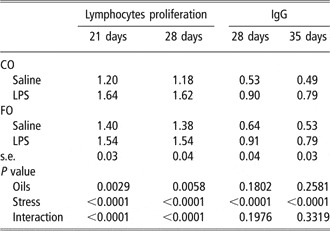
Lymphocyte proliferation was measured in cultures of purified PBMCs after the first and the second LPS challenges, and the data are presented in Table 4. There was significant interaction between LPS challenge and dietary oils on lymphocyte proliferation in chickens in vitro during both the first and the second LPS challenge periods. Both the first and the second LPS challenges significantly increased lymphocyte proliferation of PBMCs incubated with ConA in vitro. Fish oil decreased lymphocyte proliferation of PBMCs in chickens challenged with LPS (P < 0.05). Serum IgG concentration in chickens after the first and the second LPS challenges was measured by the method of immunoturbidimetric quantification. LPS challenge significantly increased the levels of IgG in chickens. There was no significant interaction between LPS challenge and dietary oils on the serum IgG levels in chickens (Table 4).
Effects of dietary oils and lipopolysaccharide challenge on lymphocytes proliferation isolated from peripheral blood and humoral responsesin chickensFootnote †

† Values are expressed as stimulation index calculated as OD570 absorbance of wells incubated with concanavalin A divided by OD570 nm absorbance of wells incubated without concanavalin A. The values of IgG were expressed as absorbance at 490 nm when determined by a microplate reader.
The ratio of CD3+CD4+/CD3+CD8+ of peripheral blood mononuclear cells
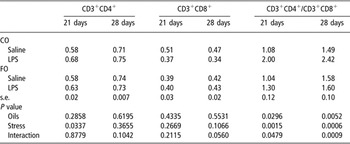
The CD3+CD8+ and CD3+CD4+ proportion of T lymphocytes in the chickens is shown in Table 5. Dietary oils did not significantly affect the CD3+CD8+ and CD3+CD4+ proportion of T lymphocytes in the chickens. One day after the first and the second LPS challenges, the ratio of CD3+CD4+/CD3+CD8+ of PBMCs was significantly higher in chicken challenged with LPS than in those treated with saline. And there was significant interaction on the ratio of CD3+CD4+/CD3+CD8+ of PBMCs in chickens between LPS challenge and dietary oils. Compared with maize oil, fish oil significantly decreased the ratio of CD3+CD4+/CD3+CD8+ in chickens at 1 day after the first and the second LPS challenges.
Effects of dietary oils and lipopolysaccharide (LPS) challenge on the distribution of CD4+ and CD8+ of lymphocytes isolated from peripheral blood in chickensFootnote †

† Data for CD3+CD4+ and CD3+CD8+ are the ratio of CD3+CD4+ cells and CD3+CD4+ cells divided by the total T cells of peripheral blood mononuclear cells in chickens.
Pro-inflammatory cytokines
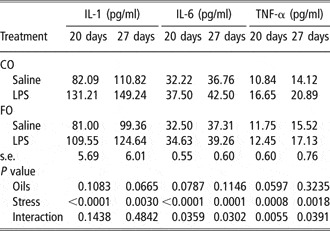
Table 6 shows the data for the pro-inflammatory cytokines levels in chickens at 3 h after the first and the second LPS challenges. LPS challenge significantly increased the release of IL-1, IL-6 and TNF-α in chickens compared with that in chickens treated with saline. There were no significant differences in the release of IL-1, IL-6 and TNF-α in chickens fed fish oil and those fed maize oil. However, the increased IL-6 and TNF-α production in chickens challenged with LPS were significantly attenuated by dietary fish oil.
Effects of dietary oils and lipopolysaccharide (LPS) challenge on cytokines production of chickens 3 h after LPS administration

Nuclear factor kappa B
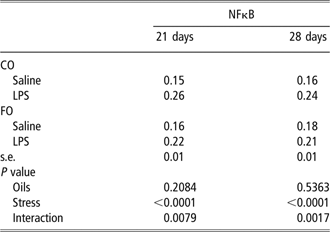
The first and the second LPS challenges significantly increased (P < 0.001) the expression of NFκB of spleen in chickens at 1 day after challenge (Table 7). There was an interaction between LPS challenge and dietary oil (P = 0.0079 for the first challenge; P = 0.0017) for the mRNA abundance of NFκB. Among chickens challenged with LPS, those fed fish oil diets had significantly lower mRNA abundance of NFκB than those fed maize oil diets.
Effects of dietary oils and lipopolysaccharide challenge on NFκB mRNA of spleen in chickensFootnote †
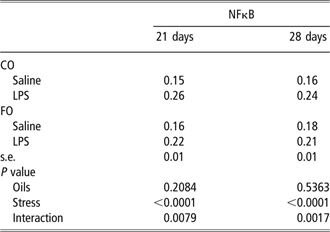
† Data of the NFκB expression are the ratio of the mRNA abundance of NFκB divided by corresponding housekeeping gene (β-actin) in spleen of chickens.
Discussion
Decreased feed consumption, body-weight gain and feed-conversion efficiency are the common results of an inflammatory response in different animals (Klasing and Korver, Reference Klasing and Korver1997; Korver and Klasing, Reference Korver and Klasing1997; Takahashi et al., Reference Takahashi, Kawamata, Akiba, Iwata and Kasai2002; Gaines et al., Reference Gaines, Carroll, Yi, Allee and Zannelli2003). In this study, we found that LPS challenge decreased the performance in chickens (Table 3). When chickens were challenged with LPS firstly, the fish oil diets mitigated the decrease in feed-conversion efficiency. However, the beneficial effects were not observed after the second challenge. The present study indicated that fish oil would ameliorate the growth depression at acute inflammation early. The reason as to why an immediate effect of LPS challenge on immune response but a late cumulated effect on performances (except for a significant interaction at week 4 for FCE) that fish oil diet did improved acute immune responses not stress situation over a long period of time. A previous study showed that a fish oil diet did initialise a reduced host natural resistance to infectious diseases (Listeria monocytogenes) in mice mainly because of the suppression of immune function generated by the fatty acids contained in this diet (Puertollano et al., Reference Puertollano, Puertollano, Ruiz-Bravo, Jiménez-Valera, De Pablo and De Cienfuegos2004). Thus, this kind of experiment could be finally detrimental to the overall animal performance.
The acute-phase response is a hallmark of inflammation. Increased lymphocytes proliferation and humoral response are all associated with an inflammatory response (Liu et al., Reference Liu, Li, Gong, Yi, Gaines and Carroll2003). In our study, LPS challenge had similar dramatic effects on lymphocytes proliferation and humoral response in chickens (Table 4). The immune response led to the changes in the partitioning of nutrients away from growth and toward processes associated with the acute-phase response. It can be explained that LPS challenge decrease body-weight gains and feed-conversion efficiency in chickens. As has been shown with CLA, fish oil had no effects on antibody levels in chickens challenged with LPS (Cook et al., Reference Cook, Miller, Park and Pariza1993). In our present study, fish oil diets did ameliorate the increased lymphocytes proliferation of PBMCs challenged with ConA (Table 4). The result is consistent with our previous results in laying hens (Guo et al., Reference Guo, Xia, Chen and Yuan2003 and Reference Guo, Chen, Xia and Yuan2004).
Generally, the generation of specific immune responses is believed to depends on the help of activated CD4+ T cells. CD4+ T cells can produce lymphokines that amplify the cytotoxic activity of CD8+ T cells and other inflammatory cells. These findings imply that a high CD4+/CD8+ ratio may be a universal prognostic indicator in immune system activation (Sheu et al., Reference Sheu, Hsu, Lin, Torng and Huang1999). In this study, inflammatory response of chickens challenged with LPS resulted in increased ratio of CD4+/CD8+ of lymphocytes of PBMCs in the chickens (Table 5). Similar to the present result, Lai et al. (Reference Lai, Yin, Li, Zhao, Qiao and Chen2005b) reported that LPS challenge increased the ratio of CD4+/CD8+ of lymphocytes of PBMCs in pigs. In our study, fish oil attenuated the increased ratio of CD4+/CD8+ of lymphocytes of PBMCs in chickens challenged with LPS (Table 5). It is believed that fish oil plays an important role in ameliorating inflammatory response. However, oral administration of seal oil with abundant n-3 PUFA to germ-free piglets resulted in a significant increase in the total value of CD4+, CD8+ lymphocytes in peripheral blood (Revajová et al., Reference Revajová, Pistl, Kaštel, Bindas, Magic, Levkut, Bomba and Šajbidor2001). Differences between studies may be related to the animal species used, level and type of oils used and immune status of the animal under study.
The immunological challenge resulted in the poor performance of animals (Benson et al., Reference Benson, Calvert, Roura and Klasing1993; Klasing and Korver, Reference Klasing and Korver1997; Halloy et al., Reference Halloy, Bouhet, Oswald, Goret-Nicaise, Kobisch, Mainil and Gustin2004), which was attributed to the partitioning of nutrients away from growth and toward processes associated with inflammatory immune responses in chickens (Korver and Klasing, Reference Korver and Klasing1997). Some studies indicated that these changes are attributed to the release of pro-inflammatory cytokines (Johnson, Reference Johnson1997; Webel et al., Reference Webel, Finck, Baker and Johnson1997; Sijben et al., Reference Sijben, Schrama, Parmentier, van der Poel and Klasing2001), including TNF, IL-1 and IL-6. In this study, the first and the second LPS challenges significantly increased the pro-inflammatory cytokines. There was an interaction on IL-6 and TNF-α in chickens between LPS challenge and dietary oils (Table 6). This observation suggested that fish oil had beneficial effects on inflammation in chickens challenged with LPS. Dietary fish oil resulted in decreased release, relative to dietary maize oil, of IL-1 by peritoneal macrophages of inflammatory immune responses in chicks (Korver and Klasing, Reference Korver and Klasing1997), and improved performance of chickens challenged with LPS. During the challenge period, pigs treated with LPS had higher serum TNF-α and lower body-weight gain compared with pigs fed complex diets supplemented with maize oil as compared with pigs fed complex diets supplemented with menhaden fish (Gaines et al., Reference Gaines, Carroll, Yi, Allee and Zannelli2003). It may be that in one way fish oil exerts its beneficial effects on chicken performance by lessening pro-inflammatory cytokines (IL-6 and TNF-α) of the inflammatory response in chickens, such as TNF-α, IL-6 and IL-1. Often presented as detrimental to the organism, inflammation is however required for culling a progressive infection (Puertollano et al., Reference Puertollano, Puertollano, Ruiz-Bravo, Jiménez-Valera, De Pablo and De Cienfuegos2004). A fish oil diet did initialise a reduced host natural resistance to infectious diseases (Listeria monocytogenes) in mice mainly because of a suppression of immune function generated by the fatty acids contained in this diet (Puertollano et al., Reference Puertollano, Puertollano, Ruiz-Bravo, Jiménez-Valera, De Pablo and De Cienfuegos2004). Thus, although presented here as a means to preserve good zootechnical parameters in acute stress period, this kind of experiment could possibly be finally detrimental to the overall animal health.
Several pro-inflammatory cytokines, such as TNF-α, IL-6 and IL-1, are encoded by target genes of NFκB activation pathway. The classical pathway of NFκB as a crucial transcriptional activator of pro-inflammatory cytokines is triggered by pro-inflammatory stimuli and genotoxic stress, including bacterial cell-wall components, such as LPS (Karin and Greten, Reference Karin and Greten2005). In this study, LPS challenge in chickens resulted in increased abundance of NFκB mRNA (Table 7). Lo et al. (Reference Lo, Chiu, Fu, Lo and Helton1998) reported that fish oil decreased macrophage TNFα gene transcription by altering the NFκB activity. It is believed that the NFκB plays an important role in the production of pro-inflammatory cytokines in chickens challenged with LPS. The present experiment showed that fish oil could ameliorate the increase of NFκB mRNA in chickens challenged with LPS (Table 7). Thus, the result of the present experiment suggested that fish oil decreased pro-inflammatory cytokines production in chickens challenged with LPS through ameliorating NFκB gene transcription.
In conclusion, fish oil decreases the release of pro-inflammatory cytokines possibly through ameliorating NFκB gene transcription, which would improve performance of chickens in an immunological challenge over a short time not over a long time.
Acknowledgements
This work was supported by the Key Project of China Ministry of Education (no. 104018) and National Basic Research Program of China (no. 2004CB117504).