Introduction
In many production systems in Kentucky, common practice is to apply a soil residual herbicide before or at planting of the main crop, although their use has declined after the release of glyphosate-resistant crops. Recently, however, the use of residual herbicides is strongly encouraged along with other techniques in an integrated approach to combat resistant weeds, so their use has increased and may continue to rise (Givens et al. Reference Givens, Shaw, Johnson, Weller, Young, Wilson, Owen and Jordan2008; Owen et al. Reference Owen, Young, Shaw, Wilson, Jordan, Dixon and Weller2011). However, residual herbicides that persist in the soil may complicate the integration of cover crops, especially interseeded cover crops that are sown into the standing cash crop. Soil type and climate have a strong impact on residual herbicide persistence (Wallace et al. Reference Wallace, Curran, Mirsky and Ryan2017). Soils with higher cation exchange capacity (CEC) and organic matter (OM) content will retain herbicides longer than soils with lower CEC, affecting the herbicides’ availability for plant uptake (Curran Reference Curran2001). Higher temperatures accelerate degradation of herbicides if moisture is available. Likewise, given adequate temperature, increased precipitation will also accelerate degradation, whereas drought conditions will encourage herbicide persistence (Curran Reference Curran2001).
Soil residual herbicides ideally persist long enough to provide adequate weed suppression, but they can have adverse impacts on subsequent crops, including cover crops, if they persist too long. As interest in cover cropping increases, the need arises to evaluate how common soil residual herbicides affect the establishment and performance of various cover crop species that are established at different times. The effect of herbicide persistence on cover crops planted after harvest was examined in Missouri, which has a climate similar to Kentucky; Cornelius and Bradley (Reference Cornelius and Bradley2017) found that some corn and soybean [Glycine max (L.) Merr.] herbicides may cause injury to some cover crops. The most injurious herbicide to crimson clover (Trifolium incarnatum L.) was clopyralid, whereas pyroxasulfone, rimsulfuron, and a combination of atrazine, glyphosate, mesotrione, and S-metolachlor caused significant injury to Italian ryegrass [Lolium perenne L. ssp. multiflorum (Lam.) Husnot] (Cornelius and Bradley Reference Cornelius and Bradley2017). Cover crop survival in this study was variable between treated and untreated plots, suggesting that environmental factors may have been more important than the herbicide treatments in determining survival.
Interseeding offers an alternative to the model of planting winter annual cover crops after harvest and alleviates concerns about time and labor availability at harvest (CTIC 2017) and the potential for adverse weather to delay cover crop planting and establishment. Various models are available for interseeding cover crops into standing cash crops, among them the use of high-clearance, no-till drills (Curran et al. Reference Curran, Hoover, Mirsky, Roth, Ryan, Ackroyd, Wallace, Dempsey and Pelzer2018; Johnson et al. Reference Johnson, Kaspar, Kohler, Corak and Logsdon1998; Noland et al. Reference Noland, Wells, Sheaffer, Baker, Martinson and Coulter2018; Wilson et al. Reference Wilson, Baker and Allan2013). Such drills can interseed the cover crops into the cash crop following the critical weed-free period but before canopy closure. In corn, optimal establishment of drilled interseeded cover crops occurs when they are planted at the V4 to V6 growth stage (Roth et al. Reference Roth, Curran, Ryan and Mirsky2015). Ideally, this will allow the cover crops to establish before the corn canopy closes while minimizing competition with the established corn. Although the V4 to V6 growth stage is the optimal interseeding time, other conditions at planting may limit establishment. Poor establishment of interseeded cover crops has been attributed to high weed pressure before interseeding, highlighting the importance of weed management earlier in the season (Abdin et al. Reference Abdin, Coulman, Cloutier, Faris, Zhou and Smith1998). Mohammadi (Reference Mohammadi2010) reported up to a 30% reduction in cash crop yield coupled with reduced cover crop biomass due to uncontrolled high weed pressure compared to plots where weeds were controlled by hand weeding.
Studies have suggested that integrating chemical control with interseeding will aid in the successful establishment of the cover crop, although it may be challenging to find herbicides that can be used without injuring the interseeded cover crops (Tharp and Kells Reference Tharp and Kells2000; Wallace et al. Reference Wallace, Curran, Mirsky and Ryan2017). Interseeded cover crops that are planted into standing cash crops may be more vulnerable to damage from soil residual herbicides than cover crops planted after cash crop harvest because they are sown earlier, thus allowing less time for herbicide degradation. Wallace et al. (Reference Wallace, Curran, Mirsky and Ryan2017) interseeded cover crops into corn at V5 and reported that annual ryegrass and red clover could be interseeded following applications of many soil residual herbicides. The most injurious herbicides included S-metolachlor and pyroxasulfone for annual ryegrass and mesotrione for red clover, though results were inconsistent across environments (Wallace et al. Reference Wallace, Curran, Mirsky and Ryan2017). Fall biomass of cover crops from untreated plots was often lower than treated plots, leading the authors to conclude that the environment or other site-specific factors such as timing of interseeding relative to canopy closure or soil type may influence the interseeded cover crop establishment and growth more than herbicides used. Tharp and Kells (Reference Tharp and Kells2000) reported that, in Michigan, some herbicides may cause injury or stand reductions in annual ryegrass and crimson clover when planted at corn stage V5 to V6. S-metolachlor and pendimethalin caused the most injury to annual ryegrass (Tharp and Kells Reference Tharp and Kells2000). None of the herbicides applied caused stand reductions to crimson clover, and only S-metolachlor caused injury (Tharp and Kells Reference Tharp and Kells2000). This study, however, did not utilize interseeding. Instead of interseeding, annual ryegrass and crimson clover were sown as a monoculture, and planting times were based on the corn planted adjacent to the field.
Given the large impact of soil type and climate on the persistence of different herbicides, soil residual herbicide influence on interseeded cover crops should be examined in specific combinations of soil type by climate. Furthermore, previous studies evaluating the impacts of soil residual herbicides on cover crop establishment, particularly interseeded cover crop establishment, have focused primarily on single active ingredients (Wallace et al. Reference Wallace, Curran, Mirsky and Ryan2017). Although such studies provide useful information, many growers in Kentucky now utilize PRE products that contain multiple active ingredients. Thus, evaluating these combinations is also necessary. The objective of this study was to determine the impacts of common corn PRE herbicides and PRE herbicide tank mixes on interseeded annual ryegrass and red clover establishment, growth, and survival through the winter in Kentucky.
Materials and methods
Plot establishment
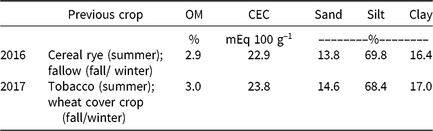
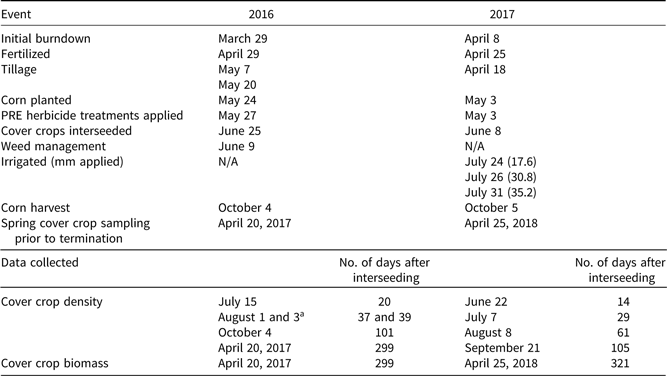
This experiment was conducted at the University of Kentucky Agricultural Experiment Station Spindletop Research Farm near Lexington, KY (38.1274°N, 84.4927°W) in 2016 to 2017 and 2017 to 2018. The soil type in 2016 to 2017 was a Donerail silt loam (fine, mixed, active, mesic Oxyaquic Argiudolls) with 2.9% soil OM, and in 2017 to 2018 it was a Bluegrass-Maury silt loam (fine/fine-silty, mixed, active, mesic Typic Paleudalfs) with 3.0% soil OM. Other soil characteristics (CEC, % sand, silt, and clay) are given in Table 1. The field used in 2016 to 2017 was previously cropped to cereal rye (Secale cereale L.) and lay fallow over fall and winter; the field in 2017 to 2018 was previously cropped to tobacco (Nicotiana tabacum L.) followed by a cover crop of wheat (Triticum aestivum L.) (Table 1). An initial burndown herbicide application to control winter annual weeds or the cover crop was completed on March 29, 2016 and April 8, 2017 using 0.84 kg ae ha–1 of glyphosate (Table 2). Both fields were then tilled prior to planting corn (Table 2).
Soil characteristics and history for the fields used.

Abbreviations: CEC, cation exchange capacity; OM, organic matter.
Dates of major field events and data collection.

a Due to rainfall during data collection, data were collected over 2 d.
Corn planting and treatment establishment
Fertilizer was applied based on soil sampling and the University of Kentucky’s recommendations for corn: 155 kg ha–1 of nitrogen (as urea) and 58 kg ha–1 of potassium (as potassium chloride) were applied on April 29, 2016. On April 25, 2017, 168 kg N ha–1 (as urea) was applied. Phosphorus was not applied in either year. In each year, the entire field was planted to field corn with 76-cm row spacing and a population of approximately 74,000 seeds ha–1. Stine ‘R9740VT3pro’ (relative maturity 111 to 113 d) was planted on May 24, 2016, and Stine ‘9714G’ (relative maturity 109 to 111 d) was planted on May 3, 2017. Different corn hybrids were used because of seed availability but were chosen to maximize similarity between key traits that might affect success of interseeded cover crops (i.e., height, leaf angle, relative maturity).
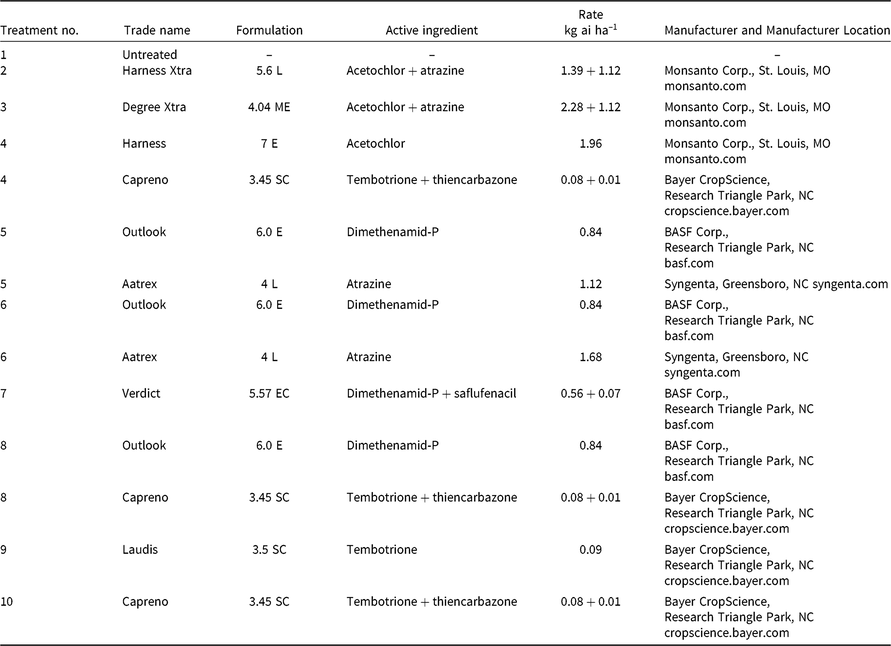
Soil residual herbicide treatments (Table 3) were assigned to plots using a completely randomized design with four replications in both years. Plots contained four corn rows and were 9 m long. Treatments were applied PRE immediately following planting using a backpack sprayer calibrated to deliver 224 L ha–1 at 207 kPa using DG8004 nozzles (TeeJet Technologies, Glendale Heights, IL, USA). All herbicide application rates were low recommended rates. Dates of other significant field events (e.g., corn harvest and cover crop termination) are shown in Table 2. Weeds were controlled in each plot prior to interseeding in 2016 (June 9) with an application of glyphosate (0.84 kg ae ha–1) plus 1% ammonium sulfate (v/v). This application was not necessary in 2017.
Herbicide active ingredients and rates used.

Abbreviations: E/EC, emulsifiable concentrate; L, liquid; ME, micro-encapsulated; SC, soluble concentrate.
Cover crop planting
Two cover crop species (annual ryegrass variety ‘Marshall’ and red clover variety ‘Kenland’) were interseeded in each plot using a two-row interseeder unit (Interseeder Technologies, Woodward, PA, USA) on June 25, 2016 and June 8, 2017 (Table 2). This unit is a high-clearance drill designed to drill three cover crop rows spaced 19 cm apart between cash crop rows on a 76-cm row spacing. The annual ryegrass was seeded at a rate of 22.4 kg ha–1 and the red clover at a rate of 11.2 kg ha–1. Each species was interseeded in half of each plot to facilitate independent evaluation. The corn was at V6 when interseeding occurred in each year.
Plot maintenance
No other weed control was performed in the experiment. The corn was scouted for insects and diseases, but no additional pest management was necessary. Based on poor cover crop survival in 2016, drip irrigation was used (total amount 83.6 mm) during the growing season in each plot in 2017 to ensure there was adequate moisture. Dates and amounts of irrigation are included in Table 2.
Data collection
Cover crop density was measured periodically each year; collection dates are provided in Table 2. Initial density was measured prior to any tillering but after emergence had ceased; this timing differed between years. The number of cover crop plants was counted within two 0.25-m2 quadrats in each plot, with two rows of the cover crop included in each quadrat. Initial placement of the quadrats was random, and subsequent measurements were taken from the same quadrats. Cover crop density was measured again in the spring before cover crop termination. In spring 2017, due to low density, density was measured between two rows of corn stubble (area 76 cm wide and 3 m long). Density was not measured in spring 2018 because the red clover had branched and the annual ryegrass had tillered. All cover crop density was standardized to consistent units for analysis. Cover crop biomass was collected prior to termination in the spring of each year (Table 2). In the spring of 2017, density of both species was low so to ensure adequate biomass for analysis, all plants between two corn rows (area 76 cm wide and 3 m long) in each plot were collected. At cover crop termination in 2018, annual ryegrass biomass was collected in a similar manner. The red clover stand in spring 2018 was much denser, so biomass was collected from two 0.25-m2 quadrats per plot. The biomass was dried at 60 C until a constant weight was achieved and then weighed to obtain dry weight.
Data analysis
Prior to analysis, all data were checked for normality and homogeneous variances. When assumptions were not met, a log or square root transformation was used. Once assumptions were met, data were subjected to ANOVA using PROC GLIMMIX in SAS v 9.4 (SAS Institute 2012, Cary, NC, USA). When ANOVA indicated significant treatment differences (P < 0.05), each treatment was compared to the untreated control, and pre-planned comparisons between select treatments were also made using single degree-of-freedom contrasts. Years were analyzed separately because of differences in management (i.e., irrigation) and significant year-by-treatment interactions; each species was also analyzed separately. Treatment was considered as a fixed factor, and replicate was considered a random effect. As a result of low red clover survival in spring 2017, plots with < 5 g m–2 of red clover dry biomass were not included in the analysis. We considered these low biomass values to be of negligible agronomic importance and elected to drop them for a more robust analysis of other treatments.
Results and discussion
Total precipitation and average daily minimum and maximum temperatures 14 d prior to herbicide application, between herbicide application and interseeding, and 35 d after interseeding are given in Table 4, as well as 10-yr averages. During most of these time periods there was either more precipitation or higher temperatures than the 10-yr average. In 2016, before herbicide application and between herbicide application and interseeding, precipitation was higher than average; after interseeding, temperatures were higher than average. In 2017, before herbicide application, temperatures were higher than average, and after interseeding, precipitation was higher than average. Between herbicide application and interseeding in 2017, temperatures and precipitation were similar to average. Increased precipitation and temperature accelerate the degradation of herbicides (Curran Reference Curran2001). Given that there were periods with higher temperatures or more precipitation than average during the study, the PRE herbicides may have caused less injury to the interseeded cover crops compared with what might be observed during years with lower temperatures or less rainfall. Precipitation amounts in Table 4 do not include irrigation applied in 2017. Even though total precipitation in 2017 was higher than in 2016, irrigation was done in 2017 on the basis of poor cover crop survival in 2016 to eliminate any water stress the cover crops may have experienced.
Environmental conditions for the period 14 d before herbicide application, between herbicide application and interseeding, and 35 d after interseeding. The 10-yr average values in Lexington, KY, for these periods is also provideda.

a Refer to Table 2 for dates of herbicide application and interseeding.
b Precipitation amounts presented do not included irrigation applied in 2017. Irrigation added 83.6 mm during the growing season in 2017.
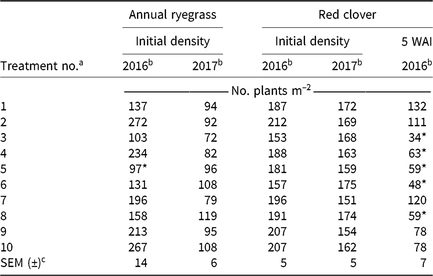
The untreated control did not consistently have the highest numerical initial cover crop density or biomass prior to termination for either species in either year (Table 5). Environmental conditions may have influenced the establishment and growth of the interseeded species and masked effects of the PRE herbicides. Other studies have also reported variable establishment and growth in untreated plots (Wallace et al. Reference Wallace, Curran, Mirsky and Ryan2017).
Effect of PRE herbicide treatments on initial density of interseeded annual ryegrass and red clover measured 3 wk after interseeding (WAI) in 2016 and 2 WAI in 2017 in Lexington, KY. The effect on red clover density 5 WAI in 2016 is also shown. Annual ryegrass and red clover density did not differ at other times.

a Herbicide active ingredients and rates used in each treatment are given in Table 3.
b Treatment means followed by (*) are significantly lower than the no-herbicide control at α = 0.05.
c Standard error of the mean based on untransformed data.
Interseeded annual ryegrass
The initial annual ryegrass density in 2016, measured 3 wk after interseeding, was affected by PRE herbicide treatments (P < 0.001; Table 5). The only PRE herbicide treatment that resulted in an initial density lower than the untreated control was dimethenamid-P (0.84 kg ai ha–1) + atrazine (1.12 kg ai ha–1) (Table 5), which led to a 29% decrease in density compared with the control.
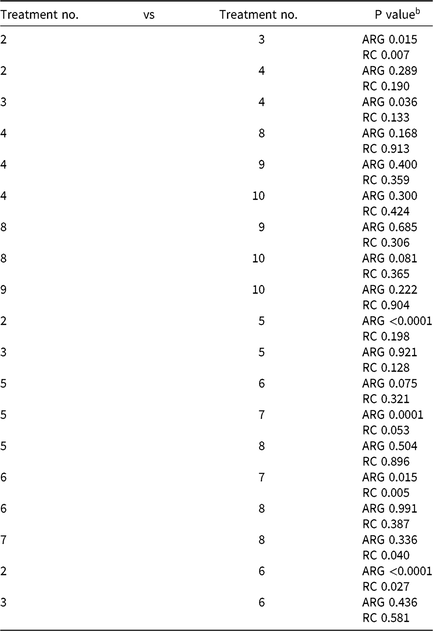
Some combinations of active ingredients resulted in lower initial annual ryegrass density than other combinations in 2016 (Table 6). Atrazine combined with a high rate (2.28 kg ai ha–1) of acetochlor resulted in 62% lower initial plant density than atrazine combined with a low rate (1.39 kg ai ha–1) of acetochlor. The combination of acetochlor (at the 2.28 kg ai ha–1 rate) with atrazine also resulted in 56% lower plant density than a lower (1.96 kg ai ha–1) rate of acetochlor tank-mixed with tembotrione (0.08 kg ai ha–1) and thiencarbazone (0.01 kg ai ha–1). However, the lowest rate of acetochlor tested (1.39 kg ai ha–1) in combination with atrazine, resulted in a higher initial density than dimethenamid-P combined with either rate (1.12 or 1.68 kg ai ha–1) of atrazine (Table 6). The combination of dimethenamid-P with either rate of atrazine also caused lower initial plant density than dimethenamid-P + saflufenacil (Table 6). Though not statistically significant, the high rate of atrazine (1.68 kg ai ha–1) resulted in a higher initial density than the low (1.12 kg ai ha–1) rate of atrazine when both were combined with dimethenamid-P (Table 5). The higher atrazine rate applied is generally more injurious to annual ryegrass than the lower applied rate (Wallace and Curran Reference Wallace and Curran2017), so this finding provides further evidence that the environment played a bigger role in establishment than the PRE herbicide treatments.
Results (P values) of comparisons between PRE herbicide treatment effects on initial annual ryegrass density 3 wk after interseeding and red clover density 5 wk after interseeding in 2016 in Lexington, KYa.

In 2017, there were no effects on annual ryegrass density 2 wk after interseeding (P > 0.05; Table 5). Average initial density over all treatments was 94 plants m–2. Although there was less rainfall prior to herbicide application in 2017 than in 2016 (Table 4), more precipitation occurred between herbicide application and interseeding in 2017. This interval was also longer in 2017 because of the earlier corn planting date (Table 4; corn planting in 2016 was delayed because of wet conditions). These factors may have contributed to reduced injury in 2017, as herbicides generally degrade more rapidly with high soil moisture through enhanced microbial degradation (Curran Reference Curran2001).
Averaged over all treatments, initial annual ryegrass density in 2016 was 180 plants m–2. By early August 2016, however, the annual ryegrass stand had decreased to about 38 plants m–2, and there were no differences in density between the treatments (data not shown). By corn harvest in October 2016 there were few surviving interseeded annual ryegrass plants (less than two plants per square meter; data not shown). Prior to spring termination in 2017, there was too little annual ryegrass biomass to analyze. Annual ryegrass density also declined over the summer of 2017, though less dramatically than in 2016. Treatment did not affect density during the summer, nor at corn harvest. The density remained relatively high, compared to 2016, through early July, with an average of 90 plants m–2 (data not shown). By early August the density had declined to 76 plants m–2, and by corn harvest in October 2017 there were 37 plants m–2 (data not shown). At termination in April 2018, herbicide treatment did not affect annual ryegrass biomass, and biomass ranged from 5 to 28 g m–2 (P > 0.05; data not shown).
In 2016, increasing acetochlor rate in PRE-mixes led to lower annual ryegrass establishment, as did the addition of atrazine rather than tembotrione + thiencarbazone to acetochlor. Previous research found that acetochlor alone resulted in a 32% reduction in Italian ryegrass density 28 d after emergence and < 20% reduction in fall annual ryegrass biomass (Cornelius and Bradley Reference Cornelius and Bradley2017; Wallace et al. Reference Wallace, Curran, Mirsky and Ryan2017). In the present study, acetochlor did not affect annual ryegrass establishment in 2017, and in 2016, only high rates of acetochlor reduced establishment relative to low acetochlor rates (Table 5). This suggests that higher rates of acetochlor, when applied with atrazine, may decrease annual ryegrass establishment when applied in drier years.
Dimethenamid-P applied with atrazine was more detrimental to annual ryegrass establishment in 2016 relative to acetochlor plus atrazine (Table 5). Wallace et al. (Reference Wallace, Curran, Mirsky and Ryan2017) found a 16% reduction in fall annual ryegrass biomass when dimethenamid-P was applied, but reported no reduction from atrazine or acetochlor applied alone. Dimethenamid-P + saflufenacil resulted in higher initial annual ryegrass density than when dimethenamid-P was applied with atrazine, suggesting that this combination may be less injurious (Table 6).
Beyond the initial establishment period, no significant effects of the herbicide treatment on annual ryegrass density or biomass were observed (data not shown). Any differences that may have existed from herbicide treatment may have been masked by poor survival in both years. As all treatments (including the untreated control) showed a decline in annual ryegrass survival over the summer, an environmental factor was likely to be responsible. Similarly, Tharp and Kells (Reference Tharp and Kells2000) reported up to 86% reduction in annual ryegrass density, which they attributed to dry conditions for 20 d after seeding. In the present study, close to or above-average rainfall occurred in the 35 d after interseeding (Table 4), so limited moisture is not a likely explanation for poor annual ryegrass survival. Light transmittance can affect interseeded cover crop biomass production (Youngerman et al. Reference Youngerman, DiTommaso, Curran, Mirsky and Ryan2018). Belfry and Van Eerd (Reference Belfry and Van Eerd2016) attributed early senescence of interseeded alfalfa (Medicago sativa L.) and oilseed radish [Raphanus sativus (L.) var. oleoferus Stokes] to low solar infiltration through the corn canopy. The current study intentionally utilized short corn hybrids with upright or semi-upright leaf angles, though we cannot rule out the role of light penetration, especially combined with stressful temperatures, on survival. Annual ryegrass starts to show severe signs of stress when temperatures reach 38 C (Richardson Reference Richardson2004). We recorded air temperature 2.54 cm above the soil surface in a different interseeding study at the same location in 2017; temperature exceeded 40 C for 66 h between July 13 and August 10 (V.L. Stanton, unpublished data). Thus, it is possible that heat stress played a part in the decline of the interseeded cover crops over the summer. The inconsistent annual ryegrass survival in the current experiment makes it difficult to provide strong support that the tested corn PRE herbicides will or will not reduce the initial density or spring biomass of interseeded annual ryegrass compared to a no-herbicide control. Thus additional study on environmental factors is warranted. However, growers who do interseed annual ryegrass in this region are cautioned against the use of dimethenamid-P, and atrazine plus high rates of acetochlor.
Interseeded red clover
The initial density of red clover measured 3 wk after interseeding in 2016 and 2 wk after interseeding in 2017 was not influenced by treatments in either year (P > 0.05; Table 5). Average initial density was 188 plants m–2 in 2016 and 164 plants m–2 in 2017. By 5 wk after interseeding in 2016, there were treatment differences (P < 0.05), with five treatments resulting in red clover density lower than the control (Table 5). Dimethenamid-P (0.84 kg ai ha–1), mixed with either rate of atrazine (1.12 or 1.68 kg ai ha–1), or tembotrione (0.08 kg ai ha–1) and thiencarbazone (0.01 kg ai ha –1), lowered red clover density (Table 5). Tembotrione and thiencarbazone combined with acetochlor (1.96 kg ai ha–1), as well as acetochlor (2.28 kg ai ha–1) combined with atrazine (1.12 kg ai ha–1), also resulted in red clover density lower than the control (Table 5).
Three of the specific active ingredient combinations affected both initial annual ryegrass density and red clover density 5 wk after interseeding in 2016 (Table 6). The combination of atrazine with a high rate (2.28 kg ai ha–1) of acetochlor resulted in lower plant density than atrazine with a lower rate of acetochlor (1.39 kg ai ha–1). Dimethenamid-P and atrazine resulted in lower plant density than a combination of dimethenamid-P + saflufenacil and a combination of acetochlor (1.39 kg ai ha–1) + atrazine (Table 6). One possible reason annual ryegrass showed stand reductions at 3 wk and red clover did not show reductions until 5 wk is the differences in root growth of each species. Annual ryegrass produces shallow, fibrous roots, whereas red clover initially sends out a tap root that extends into the soil profile, followed later by fibrous roots closer to the surface (Bryson and DeFelice Reference Bryson and DeFelice2009; Smith [Reference Smithdate unknown]). Thus, herbicide treatments would not affect the red clover until it puts out its fibrous roots closer to the surface.
Interseeded red clover density in 2016 declined over time but not as severely as the annual ryegrass. At corn harvest in October, density had declined to 24 plants m–2, and by termination the following spring there were less than five plants per square meter (no treatment differences, and data not shown). Only five treatments had > 5 g m–2 biomass in spring 2017 and were included in the ANOVA, which indicated no differences in red clover biomass prior to termination due to herbicide treatments (P > 0.05; data not shown). Of the treatments not included in the analysis, acetochlor (2.28 kg ai ha–1) + atrazine (1.12 kg ai ha–1) had zero biomass, dimethenamid-P (0.84 kg ai ha–1) + atrazine (1.12 kg ai ha–1) and tembotrione (0.09 kg ai ha–1) had < 1 g m–2, and dimethenamid-P (0.84 kg ai ha–1) + atrazine (1.68 kg ai ha–1) and tembotrione (0.08 kg ai ha–1) + thiencarbazone (0.01 kg ai ha–1) had 4.9 and 4.4 g m–2, respectively (data not shown). In 2017, red clover survived through the summer and maintained a good stand through the winter. By termination in April 2018, biomass was not affected by treatment (P > 0.05) and ranged from 247 to 335 g m–2.
Red clover density, measured 5 wk after interseeding, was only affected by PRE herbicide treatments in one year. Previously, it was reported that only mesotrione and mesotrione + S-metolachlor + atrazine reduced red clover fall biomass, whereas dimethenamid-P, saflufenacil, acetochlor, and atrazine did not (Wallace et al. Reference Wallace, Curran, Mirsky and Ryan2017). In the current study, dimethenamid-P combined with atrazine reduced red clover density 64% compared with the control (Table 5). Another study reported 35% and 38% reduction in crimson clover biomass when atrazine and tembotrione, respectively, were applied prior to planting in Missouri (Cornelius and Bradley Reference Cornelius and Bradley2017). In the current study, atrazine was in three out of five of the combinations that reduced density relative to the control, with an average reduction of 64%, and tembotrione was in two of the five, with an average reduction of 54% (Table 5). These studies highlight the variability of herbicide impacts on cover crop establishment, growth, and biomass accumulation in different soil types and across different locations. We had more success with red clover survival than annual ryegrass, though adequate spring biomass (247 to 335 g m–2) was only produced in one year of the trial. Growers who may interseed red clover in this region are advised to avoid products with dimethenamid-P and with higher rates of acetochlor.
These results suggest that the commonly used PRE corn herbicides used in this study do not consistently or severely reduce interseeded annual ryegrass or red clover establishment or growth in Kentucky, though further investigation of some active ingredients is warranted. In the current experiment, survival of annual ryegrass in both years and of red clover in one year was poor. In years and environments with better survival, the differences observed in annual ryegrass initial density and red clover density 5 wk after interseeding may have longer-lasting negative impacts, so dimethenamid-P, tembotrione, and atrazine should be studied further. Environmental effects in this state and region should be studied further to determine which factors cause interseeded cover crop mortality and whether these can be alleviated through management before annual ryegrass and red clover are recommended for interseeding in Kentucky. Additionally, these results highlight the importance of utilizing locally adapted species for interseeding and the need to determine these for various regions of the United States.
Author ORCIDs
Erin R. Haramoto https://orcid.org/0000-0002-2013-7720
Acknowledgments
The authors would like to acknowledge the assistance of Matthew Allen, Sara Carter, James Dollarhide, Tim Phillips, Michael Hurak, Austin Sherman, and Vinicius dos Santos Cunha. No conflicts of interest have been declared. This research received no specific grant from any funding agency, commercial, or not-for-profit sectors.