Introduction
Eastern box turtles (Terrapene carolina carolina) are small terrestrial reptiles native to the eastern and central United States (Dodd, Reference Dodd2001). In Indiana, they are mostly found in the southern half of the state (MacGowan et al., Reference MacGowan, Kingsbury and Williams2004). Despite high annual adult survivorship (Currylow et al., Reference Currylow, Zollner, MacGowan and Williams2011), populations are declining throughout its range due to habitat loss, road kills and poaching (Dodd, Reference Dodd2001; Indiana Department of Natural Resources, http://www.in.gov/dnr). Eastern box turtles are protected in Indiana and it is illegal to collect them from the wild. Very little is known about diseases of eastern box turtles and only two studies have been published on parasitic diseases for this species collected from North Carolina and Louisiana. The objective of this study was to examine the parasitic fauna of eastern box turtles collected from southern Indiana. This constitutes the first study of this kind for the state.
Materials and methods
Turtles (n = 40) were salvaged mainly from the southern part of the state of Indiana (counties: Brown, n = 12; Monroe, 7; Morgan, 5; Green, 5; Morgan-Monroe, 4; and Putnam, 1; with 6 without any identification) between May and October of 2009. Centroid latitude and longitude coordinates in decimal degrees for each county are as follows: 39.196, − 86.227; 39.160, − 86.523; 39.481, − 86.446; 39.036, − 86.962; and 36.666, − 86.844). A total of 35 turtles were salvaged as road kills and 5 were salvaged as the result of an accidental fire. No animals were killed for the sole purpose of examining their parasite load. All adult turtles were sexed via secondary sex characteristics or grouped as sub-adults if the gonads were small and undeveloped. Twenty-two adult females (body weight 229 ± 137 g; total length 178 ± 31 mm), 5 adult males (344 ± 88 g; 158 ± 23 mm), 10 subadult females (181 ± 103 g; 117 ± 26 mm) and 3 subadult males (288 ± 71 g; 140 ± 25 mm) were sampled. Each animal was placed in an individual plastic bag with information on location and date of collection and immediately stored at − 20°C until processed for the collection of parasites.
Prior to each dissection, turtles were measured to the nearest centimetre (plastron length and carapace width), and weighed to the nearest gram using a digital scale. All animals were examined for the presence of ectoparasites, especially in the head, neck and limbs. This inspection excluded nasal passages and shell. Plastic bags were also checked for ectoparasites. Internal organs, including gastrointestinal tract, gonads, liver, heart, kidney and urinary bladder, were examined for the presence of endoparasites. Skeletal muscle was also examined. All organs and skeletal muscle were minced before being washed under running water and contents were collected using different sized mesh screens (35–60 mm). Organs were examined in their entirety when specimens were in good condition (i.e. not severe autolysis). All parasites found were enumerated and placed in small glass vials and fixed in 70% ethyl alcohol. Parasites were keyed to the lowest taxonomic level using the Commonwealth Institute of Helminthology (CIH) Keys to the Trematoda (Bray et al., Reference Bray, Gibson and Jones2008) and the CIH Keys to the Nematoda (Chabaud, Reference Chabaud, Anderson, Chabaud and Willmott1975, Reference Chabaud, Anderson, Chabaud and Willmott1978). Abundance (calculated as total number of each species of parasite collected/total number of hosts examined regardless of whether or not the host was infected); prevalence (number of hosts infected with a particular parasite/total number of hosts examined); and mean intensity (total number of parasites found in a sample/total number of hosts infected with that parasite) were calculated following the definitions by Bush et al. (Reference Bush, Lafferty, Lotz and Shostak1997). A representative number of parasites from each species identified have been deposited in the National Parasite Collection, Beltsville, Maryland, USA (accession numbers 103565–103569).
Results and discussion
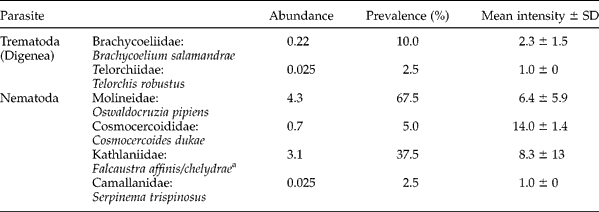
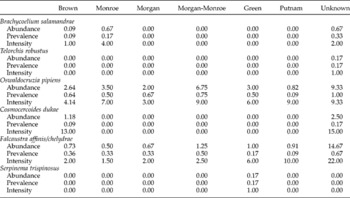
A total of seven species of helminths was found, including two digenean trematodes and five nematodes (tables 1 and 2). Two species of Falcaustra nematodes were found: F. affinis and F. chelydrae. The latter was only observed in two animals. Since these two species are very similar and only distinguishable by measuring the size of the male spicules, in the present study they are reported as one in terms of abundance, prevalence and mean intensity of infection. The nematodes Oswaldocruzia pipiens (67.5%) and F. affinis/chelydrae (37.5%) had the highest prevalence. Overall, mean intensity of infections was low (1–14 parasites/host) suggesting that these parasites are likely not associated with negative health impacts.
Helminths collected from eastern box turtles (n=40) from southern Indiana between May and October, 2009.
a Data summarized for the two species combined.
Helminth parasites from eastern box turtles from Indiana, by county.

Helminths found in this study were also reported by Stuart & Miller (Reference Stuart and Miller1993) in eastern box turtles sampled from North Carolina. However, they found an additional three helminth species (two nematodes, Aplectana sp. and Physaloptera sp., and one acanthocephalan, Macracanthorhynchus ingens) which were not detected in our study. This is not that surprising considering that they examined over 110 animals collected over a much longer period of time (1982–1989) compared to our study, which only examined 40 animals over a 5-month period. Herban & Yaeger (Reference Herban and Yaeger1969) also reported a filariid nematode, Cardianema cistudinis, from hearts and blood smears of eastern box turtles from Louisiana, which again was not found in our study despite the fact that hearts were closely examined. Thus, it is likely that these helminths are not very common in this host and perhaps are restricted to a particular geographic region/and or time of year. Helminths were not found in heart, gonads, liver, heart, kidney or urinary bladder, and no ectoparasites were found. It is important to mention that in many instances salvaged turtles were in poor condition having undergone different degrees of autolysis which could have compromised the ability to detect ectoparasites and the overall accuracy of the helminth data.
An interesting finding from our study was the presence of C. dukae, a nematode that commonly parasitizes frogs and snails (Ogren, Reference Ogren1953; Baker, Reference Baker1986). Eggs from the faeces develop in the soil to filariform larvae which are then infective to the definitive host (Ogren, Reference Ogren1953). It is not known whether this is primarily a parasite of snails that occurs occasionally in frogs and turtles, or vice versa. Oswaldocruzia pipiens and F. affinis have also been reported from both amphibian and reptile hosts, although O. pipiens is more closely associated with frogs and F. affinis is more closely associated with turtles (Baker, Reference Baker1977, Reference Baker1986).
Acknowledgements
The authors thank S. Kimble, A. Currylow and R. Williams for salvaging turtle carcasses. Research activities associated with this project fall under the Purdue Animal Care and Use Protocol, PACUC 07-037 and IDNR Scientific Purposes License 10-0083.