1. Introduction
The large-scale architecture of carbonate platforms has long been argued to be driven by the interplay of subsidence, sea level and the topographic relief of the substrate (Grotzinger, Reference Grotzinger, Crevello, Wilson, Sans and Read1989; Sami & James, Reference Sami and James1994; Turner et al. Reference Turner, James and Narbonne1997; Lemon, Reference Lemon2000; Sherman et al. Reference Sherman, Narbonne and James2001). The fundamental observation that architectural elements of carbonate platforms have persisted through geologic time (Grotzinger, Reference Grotzinger, Crevello, Wilson, Sans and Read1989), despite dramatic differences in the style of carbonate precipitation between the Precambrian and the Phanerozoic, sets the stage for the idea that global-scale changes in the processes of carbonate precipitation (i.e. abiotic, microbially induced or enzymatically controlled; Sharma & Shukla, Reference Sharma and Shukla1998; Grotzinger & Knoll, Reference Grotzinger and Knoll1999; Riding, Reference Riding2008; Riding & Virgone, Reference Riding and Virgone2020) and the chemical state of marine waters (Grotzinger, Reference Grotzinger1990; Sumner, Reference Sumner2002; Bartley & Kah, Reference Bartley and Kah2004; Hood et al. Reference Hood, Wallace and Drysdale2011) exert primary control on the fabric of carbonate rocks observed through time.
Building from this idea, discrete features within carbonate rocks, notably seafloor precipitates (Sami & James, Reference Sami and James1996; Sumner, Reference Sumner1997 b; Choudhuri et al. Reference Choudhuri, Sarkar, Altermann, Mukhopadhyay and Bose2016), herringbone carbonate (Sumner & Grotzinger, Reference Sumner and Grotzinger1996 b; Kah et al. Reference Kah, Bartley and Stagner2009; Bartley et al. Reference Bartley, Kah, Frank and Lyons2015), molar-tooth carbonate (James et al. Reference James, Narbonne and Sherman1998; Hodgskiss et al. Reference Hodgskiss, Kunzmann, Poirier and Halverson2018), intraformational conglomerates (Cantine et al. Reference Cantine, Knoll and Bergmann2019) and stromatolites (Grey, Reference Grey1982; Sumner, Reference Sumner1997 a; Awramik & Sprinkle, Reference Awramik and Sprinkle1999; Semikhatov & Raaben, Reference Semikhatov, Raaben, Riding and Awramik2000), have been used to define global-scale, secular trends in carbonate sedimentation. Such temporal patterns in carbonate precipitation style have then been used to infer fundamental changes in the environments that produced them. For instance, macrocrystalline, seafloor-precipitated carbonate was abundant in both subtidal and peritidal carbonate environments during the late Archaean and early Palaeoproterozoic (Grotzinger, Reference Grotzinger1990; Sami & James, Reference Sami and James1996; Sumner, Reference Sumner1997 b; Pope & Grotzinger, Reference Pope, Grotzinger, Grotzinger and James2000; Sumner & Grotzinger, Reference Sumner, Grotzinger, Grotzinger and James2000; Winefield, Reference Winefield, Grotzinger and James2000). By the late Neoproterozoic, macroscopic seafloor precipitates were increasingly scarce, supplanted by micritic carbonate textures, except where prominently associated with Neoproterozoic post-glacial cap carbonates (Hoffman et al. Reference Hoffman, Kaufman, Halverson and Schrag1998). These observations led to the hypothesis that a secular decrease in inorganic carbon concentration and, hence, marine carbonate saturation (Grotzinger, Reference Grotzinger, Crevello, Wilson, Sans and Read1989; Grotzinger & Kasting, Reference Grotzinger and Kasting1993) occurred through the Precambrian. This decrease in carbonate saturation has been plausibly linked to an observed increase in stromatolite morphological diversity (Grotzinger & Knoll, Reference Grotzinger and Knoll1999), followed by a pronounced decrease in complexity and diversity (Grotzinger, Reference Grotzinger1990), as well as to the distribution and abundance of molar-tooth carbonate through time (Pollock et al. Reference Pollock, Kah and Bartley2006). Similarly, the presence of specific carbonate fabrics, most notably herringbone carbonate (Sumner & Grotzinger, Reference Sumner and Grotzinger1996 a, b), has been interpreted to represent carbonate precipitation associated with reducing conditions in concert with elevated carbonate saturation state. Cantine et al. (Reference Cantine, Knoll and Bergmann2019) expand this interpretation to attribute most major changes in carbonate depositional style to changes in marine redox state. Regardless of the source of chemical change in the oceans, the interpretation that large-scale platform architecture was established early in the Precambrian while environmental controls on carbonate precipitation evolved over geologic time suggests that the specific relationships between carbonate fabric elements and depositional environments should evolve through the Precambrian.
Until now, hypotheses regarding secular change in Proterozoic carbonate precipitation have focused on large-scale spatial and temporal patterns, examining a composite signal recorded in basins widely separated in time, space and depositional conditions. Single-basin studies have focused on facies and platform architecture (Turner et al. Reference Turner, Narbonne and James1993; Petrov & Semikhatov, Reference Petrov and Semikhatov2001; Bose et al. Reference Bose, Chakrabarti and Shome2017) or smaller-scale features, such as specific facies elements and petrographic fabrics, including stromatolites (Kah et al. Reference Kah, Bartley and Stagner2009; Bartley et al. Reference Bartley, Kah, Frank and Lyons2015; Allen et al. Reference Allen, Grey and Haines2016), molar-tooth structure (Furniss et al. Reference Furniss, Rittel and Winston1998; Pollock et al. Reference Pollock, Kah and Bartley2006), herringbone carbonate (Sumner & Grotzinger, Reference Sumner and Grotzinger1996 b) and other primary cement features (Hood & Wallace, Reference Hood and Wallace2018). A sufficient number of Precambrian basins have now been studied in detail to permit broad-scale secular analysis, and two recent studies have examined these trends using a database approach. Peters et al. (Reference Peters, Husson and Wilcots2017) evaluated the temporal distribution of stromatolites, and Cantine et al. (Reference Cantine, Knoll and Bergmann2019) examined a wide range of carbonate elements with the aim of discerning first-order temporal patterns of abundance and environmental distribution. Here, we apply a database approach to review the diversity of carbonate fabrics within several late Mesoproterozoic basins and analyse their spatial distribution and facies relationships, with the aim of further exploring patterns of carbonate sedimentation and interpreting genetic parameters governing these time-sensitive carbonate elements.
2. Time-sensitive carbonate fabrics
Against a backdrop of broadly persistent platform architecture over geologic time (Grotzinger, Reference Grotzinger, Crevello, Wilson, Sans and Read1989), the recent analysis by Cantine et al. (Reference Cantine, Knoll and Bergmann2019) defined a suite of carbonate features whose abundance and environmental distribution serve as diagnostic indicators of a long-term shift in carbonate precipitation style. Even at the coarsest resolution, the Mesoproterozoic stands out as distinct from other time intervals in terms of the diversity and abundance of seafloor precipitates, molar-tooth structure, intraformational breccias and stromatolites (figs 3–5 of Cantine et al. Reference Cantine, Knoll and Bergmann2019). In this review, we examine these time-sensitive features, which either decline in abundance or environmental range; increase in abundance or environmental range; or appear to reach a peak in abundance, diversity or environmental range during the Mesoproterozoic Era.
2.a. Seafloor precipitates
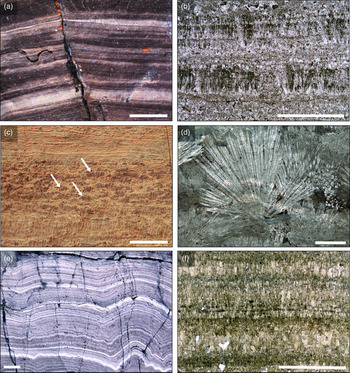
Seafloor precipitates (also called seafloor cement or tufa; Knoll & Swett, Reference Knoll and Swett1990) are carbonate fabrics that consist of macroscopic crystalline carbonate that nucleates at or near the sediment/water interface and grows upward into the overlying water column (Fig. 1). Seafloor precipitates form a variety of fans, splays botryoids, and microdigitate stromatolites (cf. Grotzinger & Knoll, Reference Grotzinger and Knoll1999) when crystallization proceeds from discrete nucleation points, and form isopachous layers when nucleation is continuous along the sediment-water interface. Seafloor precipitates are commonly acicular, consistent with an aragonitic precursor mineralogy (Grotzinger & Reed, Reference Grotzinger and Reed1983; Sumner & Grotzinger, Reference Sumner, Grotzinger, Grotzinger and James2000; Hood & Wallace, Reference Hood and Wallace2018), but also occur as bladed morphologies whose original mineralogy is uncertain (Sami & James, Reference Sami and James1996; Hood & Wallace, Reference Hood and Wallace2018) and as microlaminated features (Bartley et al. Reference Bartley, Knoll, Grotzinger, Sergeev, Grotzinger and James2000; Sharma & Pandey, Reference Sharma and Pandey2012).
Late Mesoproterozoic seafloor precipitate fabrics. (a) Seafloor precipitates from the Dismal Lakes Group (Greenhorn Formation), showing sub-millimetre isopachous laminae (brown) and micritic drapes (white). (b) Fine-scale preservation of acicular seafloor precipitates in dolomite of the Dismal Lakes Group. (c) Seafloor precipitates from the Atar Group (Oued Tarioufet Formation), showing millimetre-scale botryoids within microbial laminae. (d) Preservation of neomorphically recrystallized acicular botryoids in limestone of the Atar Group (Gouamir Formation). (e) Seafloor precipitates from the Bylot Supergroup (Angmaat Formation), showing persistent sub-millimetre isopachous laminae (grey) and micritic drapes (white). (f) Preservation of acicular seafloor precipitates and organic inclusions in dolomite of the Bylot Supergroup. Scale bar is 1 cm in (a), (c) and (e); and 500 μm in (b), (d) and (f).

Seafloor precipitates are distinctive features of Archaean and Palaeoproterozoic carbonate platforms (Grotzinger, Reference Grotzinger, Crevello, Wilson, Sans and Read1989; Sami & James, Reference Sami and James1996; Sumner, Reference Sumner1997 b; Pope & Grotzinger, Reference Pope, Grotzinger, Grotzinger and James2000; Sumner & Grotzinger, Reference Sumner, Grotzinger, Grotzinger and James2000; Winefield, Reference Winefield, Grotzinger and James2000). Although micritic and microsparitic carbonate were present on these platforms, the overall depositional style is characterized by the widespread presence of seafloor precipitates. By the Mesoproterozoic Era, this style of carbonate had become increasingly rare in open-water settings (Bertrand-Sarfati & Moussine-Pouchkine, Reference Bertrand-Sarfati and Moussine-Pouchkine1985; Kerans & Donaldson, Reference Kerans, Donaldson, Geldsetzer, James and Tebbut1989) but remained common in restricted, peritidal environments (Kah & Knoll, Reference Kah and Knoll1996; Xiao et al. Reference Xiao, Knoll, Kaufman, Yin and Zhang1997; Bartley et al. Reference Bartley, Knoll, Grotzinger, Sergeev, Grotzinger and James2000; Seong-Joo et al. Reference Seong-Joo, Browne, Golubic, Riding and Awramik2000). By the later Neoproterozoic Era (<850 Ma) seafloor precipitates are generally scarce (Grotzinger, Reference Grotzinger1990; Knoll & Swett, Reference Knoll and Swett1990), except where associated with post-glacial ‘cap carbonate’ facies (Corsetti & Lorentz, Reference Corsetti, Lorentz, Xiao and Kaufman2006; Hood & Wallace, Reference Hood and Wallace2018). Together, this distribution has been used to infer a directional change in either marine inorganic carbon concentration (Grotzinger, Reference Grotzinger1990; Kah & Knoll, Reference Kah and Knoll1996; Grotzinger & Knoll, Reference Grotzinger and Knoll1999) or in redox state (Cantine et al. Reference Cantine, Knoll and Bergmann2019) as a first-order control over carbonate saturation.
2.b. Herringbone carbonate
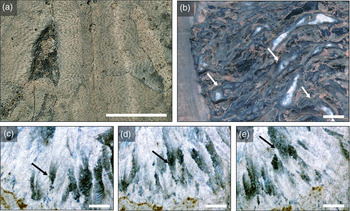
Herringbone cement (Fig. 2) is an unusual calcite morphology, consisting of elongate crystals that grow perpendicular to the substrate and within which the c-axis rotates from parallel to perpendicular to crystal elongation direction (Sumner & Grotzinger, Reference Sumner and Grotzinger1996 b). In outcrop, changes in the orientation of the c-axis result in a distinct texture of irregularly alternating, light and dark crystalline patches. In thin-section, changes in the orientation of the c-axis produce a pattern of sweeping extinction that proceeds along the long axis of crystal growth (Sumner & Grotzinger, Reference Sumner and Grotzinger1996 b; Kah et al. Reference Kah, Bartley and Stagner2009). This unusual mode of crystal growth occurs most often as a seafloor precipitate (Sumner & Grotzinger, Reference Sumner and Grotzinger1996 b), as a first-generation marine cement encrusting microbial substrates or as a syn-sedimentary void-filling cement (Sumner, Reference Sumner1997 a; Kah et al. Reference Kah, Bartley and Stagner2009; Bartley et al. Reference Bartley, Kah, Frank and Lyons2015; Barlow et al. Reference Barlow, Van Kranendonk, Yamaguchi, Ikehara and Lepland2016).
Late Mesoproterozoic herringbone carbonate fabrics. (a) Herringbone carbonate from the Dismal Lakes Group (Sulky Formation), showing characteristic mm-scale light and dark alternations, and occurring as a marine cement associated with cuspate microbialites (Bartley et al. Reference Bartley, Kah, Frank and Lyons2015). (b) Herringbone carbonate from the Atar Group (Atar Formation), occurring as a syn-depositional marine cement and first-generation void fill within intraclastic, contorted stromatolitic debris. (c–e) Petrographic view of herringbone carbonate from the Mesoproterozoic Atar Group (Atar Formation) showing sweeping extinction up the long axis of the crystal, with progressive rotation of the polarizer from 0° to 30° to 60°. Scale bar is 5 mm in (a); 1 cm in (b); and 250 μm in (c), (d) and (e).

Herringbone cement was first recognized within carbonate facies of the Archaean Transvaal Supergroup (Sumner & Grotzinger, Reference Sumner and Grotzinger1996 b; Sumner, Reference Sumner1997 a), where it occurs as a primary cement morphology associated with shelf-to-slope carbonate deposits. Since its initial description, herringbone carbonate has been described as both seafloor and void-filling cement in Palaeoproterozoic (Barlow et al. Reference Barlow, Van Kranendonk, Yamaguchi, Ikehara and Lepland2016) and Mesoproterozoic (Kah et al. Reference Kah, Bartley, Frank and Lyons2006, Reference Kah, Bartley and Stagner2009; Bartley et al. Reference Bartley, Kah, Frank and Lyons2015) successions, and has been noted in Cambrian (de Wet et al. Reference de Wet, Dickson, Wood, Gaswirth and Frey1999, Reference de Wet, Frey, Gaswirth, Mora, Rahnis and Bruno2004) and Ordovician (Kah, unpublished data) successions and, rarely, younger non-marine strata (SA Tourre, unpub. MS thesis, University of California, Davis, 2000; Tourre & Sumner, Reference Tourre and Sumner2000). Although the origin of herringbone carbonate is uncertain, it is generally believed to represent neomorphic recrystallization after rapidly precipitated, spherulitic carbonate (Sumner & Grotzinger, Reference Sumner and Grotzinger1996 b). Formation of herringbone carbonate has generally been attributed to marine environments that are both strongly oversaturated with respect to calcium carbonate and that may experience further local enhancement of saturation state via inhibition by ferrous iron under conditions of regional anoxia (Sumner & Grotzinger, Reference Sumner and Grotzinger1996 a), carbonate concentration near a marine chemocline (Bartley et al. Reference Bartley, Kah, Frank and Lyons2015), or local remineralization of organic matter enhancing local dissolved inorganic carbon (DIC) (SA Tourre, unpub. MS thesis, University of California, Davis, 2000; Tourre & Sumner, Reference Tourre and Sumner2000).
2c. Molar-tooth carbonate
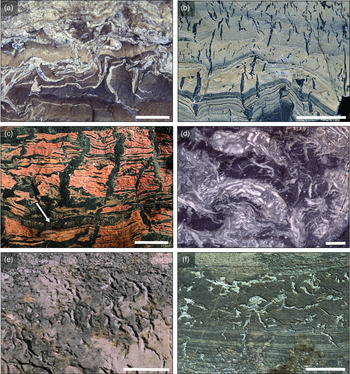
Molar-tooth fabric (MT) is an unusual carbonate texture that consists of a range of isolated to interconnected voids, spindle-shaped cracks and ptygmatically folded sheets that are filled with a uniform carbonate microspar (reviewed in Pratt, Reference Pratt, Reitner and Thiel2011; Kuang & Hu, Reference Kuang and Hu2014). In outcrop, MT structures are readily visible on weathered surfaces, where they appear as sharply bounded, light- to dark-grey features surrounded by matrix material (Fig. 3). Molar-tooth cracks occur predominantly within mechanically or microbially laminated, fine-grained, often clay-bearing carbonate rocks; structures are generally rare in siltstone and sandstone. In thin-section, MT structures are filled with a petrographically distinctive carbonate microspar, composed of uniform, equant crystals 5–15 µm in diameter, which typically continues, without break, through interconnected voids (Furniss et al. Reference Furniss, Rittel and Winston1998; Bishop & Sumner, Reference Bishop and Sumner2006; Pollock et al. Reference Pollock, Kah and Bartley2006).
Late Mesoproterozoic molar-tooth carbonate. (a) Molar-tooth structures from the Yurmatau Group (Avzyan Formation), showing changes in cracks behaviour in proximity to compositional changes in host dolomite. (b) Molar-tooth structures from the Yurmatau Group (Avzyan Formation), showing compactional deformation of host dolomite around rigid cement-filled cracks. (c) Network of interconnected vertically and horizontally oriented molar-tooth cracks in microbially laminated dolomite of the Atar Group (Atar Formation); arrow highlights a thin storm breccia consisting of sub-mm clasts of molar-tooth microspar, emphasizing synsedimentary timing of formation. (d) Deformed molar-tooth structures in the Atar Group (Tawaz Formation), showing brittle fracture and ductile deformation of distinct generations of molar tooth during fluidization of matrix components (Kah et al. Reference Kah, Bartley and Teal2012). (e) Molar-tooth structures within massive dolomite of the Bylot Supergroup (Angmaat Formation). (f) Molar-tooth structures within well-laminated dolomite of the Bylot Supergroup (Angmaat Formation). Scale bar is 2 cm in all images.

With rare exception (Bishop & Sumner, Reference Bishop and Sumner2006; Bishop et al. Reference Bishop, Sumner and Huerta2006; Hodgskiss et al. Reference Hodgskiss, Kunzmann, Poirier and Halverson2018), molar-tooth structures are restricted spatially to shallow marine environments and temporally to Mesoproterozoic and early Neoproterozoic successions (James et al. Reference James, Narbonne and Sherman1998; Shields, Reference Shields2002; Hodgskiss et al. Reference Hodgskiss, Kunzmann, Poirier and Halverson2018), reaching an apex of abundance in the early Neoproterozoic (Cantine et al. Reference Cantine, Knoll and Bergmann2019), and vanishing as an important carbonate feature by the mid-Neoproterozoic (Fairchild et al. Reference Fairchild, Spencer, Ali, Anderson, Anderton, Boomer, Dove, Evans, Hambrey and Howe2018). Although MT genesis is not understood in detail, field and experimental evidence suggest crack formation in a partially lithified but ductile matrix and lithification of voids pre-compaction via rapid precipitation of carbonate microspar (Fairchild et al. Reference Fairchild, Einsel and Song1997; Furniss et al. Reference Furniss, Rittel and Winston1998; Pope et al. Reference Pope, Bartley, Knoll and Petrov2003; Pollock et al. Reference Pollock, Kah and Bartley2006; Shen et al. Reference Shen, Dong, Xiao, Lang, Huang, Peng, Zhou, Ke and Liu2016). Because the distribution of preserved molar-tooth structures is therefore governed first by the formation of cracks and voids within a moderately unlithified substrate, and second by the rapid precipitation of carbonate microspar within these voids, molar-tooth structures are unlikely to form either when substrates are lithified prior to crack generation, or when conditions do not permit rapid lithification by carbonate microspar. Thus, the apparent enigma of molar-tooth development, as well as its distribution in time and space, has been suggested to reflect a critical threshold of carbonate saturation in an evolving world ocean (Pollock et al. Reference Pollock, Kah and Bartley2006; Cantine et al. Reference Cantine, Knoll and Bergmann2019).
2.d. Ooids and intraclasts
The distribution and abundance of a variety of other, more mundane carbonate elements have also been inferred to vary over time, including ooids and carbonate intraclasts (Cantine et al. Reference Cantine, Knoll and Bergmann2019). Ooids – concentrically laminated carbonate grains – occur throughout the geologic record but have been particularly noted in the Neoproterozoic (Zempolich et al. Reference Zempolich, Wilkinson and Lohmann1988; Knoll & Swett, Reference Knoll and Swett1990; Sumner & Grotzinger, Reference Sumner and Grotzinger1993; Trower & Grotzinger, Reference Trower and Grotzinger2010; Thorie et al. Reference Thorie, Mukhopadhyay, Banerjee and Mazumdar2018), where a number of ooid-bearing successions record ‘giant’ ooids (i.e. marine ooids with an enhanced cortex, resulting in diameters greater than 2 mm; Trower, Reference Trower2020). Because ooid growth occurs within the water column during periods of either suspension or traction, they plausibly record conditions in the water column that favour the abundance of suitable nuclei and a carbonate saturation state favourable for precipitation (Sumner & Grotzinger, Reference Sumner and Grotzinger1993). Similarly, it has been suggested that ooids are less likely to form in environments where available nuclei may be immobilized by rapid lithification at the seafloor (Cantine et al. Reference Cantine, Knoll and Bergmann2019).
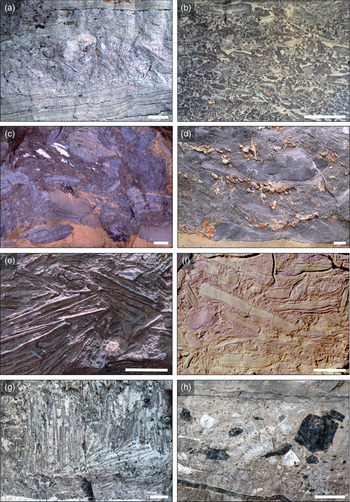
Similarly, carbonate intraclasts are sedimentary features that occur throughout the geologic record. Intraclasts are remobilized, partially to fully lithified fragments of the local sedimentary substrate (Fig. 4). Although remobilization can occur within a variety of environments, intraclasts are most commonly associated with subaerial exposure (Vousdoukas et al. Reference Vousdoukas, Velegrakis and Plomaritis2007; Lokier & Steuber, Reference Lokier and Steuber2009), high-energy events on marine shelves (Markello & Read, Reference Markello and Read1981; Mount & Kidder, Reference Mount and Kidder1993; Pratt, Reference Pratt2002; Kah et al. Reference Kah, Bartley and Stagner2009; Patranabis-Deb et al. Reference Patranabis-Deb, Majumder and Khan2018), low levels of infaunal activity (Sepkoski, Reference Sepkoski, Einsele and Seilacher1982; Smith et al. Reference Smith, Ingalls, Trower, Lingappa, Present, Magyar and Fischer2020) and deep shelf gravitational slumping (Hubert et al. Reference Hubert, Suchecki, Callahan, Cook and Enos1977; Hiscott & James, Reference Hiscott and James1985). Recent analysis by Cantine et al. (Reference Cantine, Knoll and Bergmann2019) specifically notes that the abundance of intraclasts appears to increase through the Precambrian, reaching an apex in the Mesoproterozoic Era before declining again in the Neoproterozoic Era; a pattern inferred to reflect changes in the degree of substrate lithification at or near the sediment/water interface.
Late Mesoproterozoic intraclastic breccias. (a) Intraclastic breccia in the Dismal Lakes Group (Kendall River Formation) showing partially imbricated angular clasts with a high length-to-width ratio. (b) Intraclastic breccia in the Dismal Lakes Group (Greenhorn Formation) containing a variety of rounded, intraclastic and coated grains. (c, d) Intraclastic breccia in the Yurmatau Group (Avzyan Formation) containing large, variously deformed carbonate intraclasts. (e, f) Intraclastic breccia in the Atar Group (Oued Tarioufet and Aouinet Ould Bou Derbala formations, respectively) containing imbricated, angular clasts with a high length-to-width ratio. (g) Intraclastic breccia in the Bylot Supergroup (Angmaat Formation) containing imbricated, angular clasts with a high length-to-width ratio. (h) Intraclastic breccia in the Bylot Supergroup (Angmaat Formation) recording remobilization of micrite (white), microspar (grey) and chert (black) from the local substrate. Scale bar is 2 cm in all images.

2.e. Stromatolites
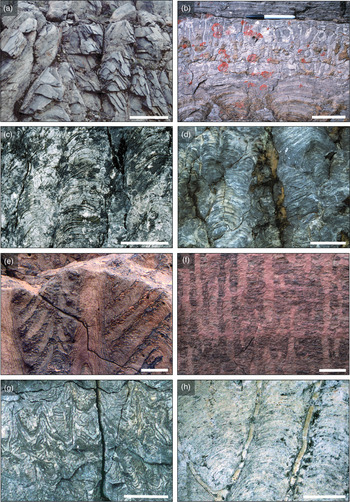
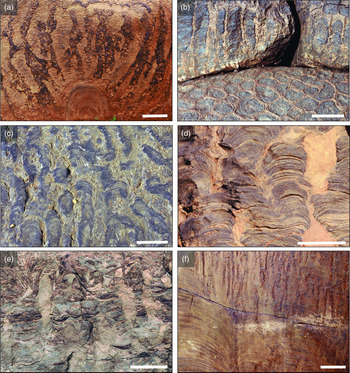
Stromatolites are laminated organosedimentary structures produced by the interaction of microbial communities, detrital sediment and autochthonous carbonate precipitation (see Grey & Awramik, Reference Grey and Awramik2020 for a detailed discussion). Analysis of stromatolite diversity typically focuses on morphology, or macroscopic structure, of individual stromatolitic forms (Bertrand-Sarfati & Moussine-Pouchkine, Reference Bertrand-Sarfati and Moussine-Pouchkine1985; Bertrand-Sarfati & Awramik, Reference Bertrand-Sarfati and Awramik1992; Grey & Awramik, Reference Grey and Awramik2020), often with only secondary focus on mesoscopic elements, such as laminae structure (Kah et al. Reference Kah, Bartley, Frank and Lyons2006, Reference Kah, Bartley and Stagner2009; Bartley et al. Reference Bartley, Kah, Frank and Lyons2015), or the microscopic elements that comprise laminae (Bertrand-Sarfati, Reference Bertrand-Sarfati and Walter1976; Turner et al. Reference Turner, Narbonne and James1993; Knoll & Semikhatov, Reference Knoll and Semikhatov1998; Bartley et al. Reference Bartley, Knoll, Grotzinger, Sergeev, Grotzinger and James2000; Riding, Reference Riding2008). Here, we examine both synoptic relief and inheritance (Hofmann, Reference Hofmann1969; Grey & Awramik, Reference Grey and Awramik2020) as comprising macroscopic morphology (i.e. columnar, branching, conical shapes) of stromatolitic forms (Fig. 5). Synoptic relief is the vertical relief of individual laminae in a stromatolite (Hofmann, Reference Hofmann1969; Donaldson, Reference Donaldson and Walter1976). Because stromatolite laminae represent the active growth surface of the mat at the time of deposition and therefore record the topography of the depositional surface, synoptic relief – which reflects the interactions between the emergent microbialite and its environment – is a critical parameter in understanding stromatolite morphology. Inheritance describes the degree to which successive laminae inherit pre-existing morphology, a parameter interpretable in terms of sedimentary process (Cloud & Semikhatov, Reference Cloud and Semikhatov1969; Grotzinger & Rothman, Reference Grotzinger and Rothman1996; Grotzinger & Knoll, Reference Grotzinger and Knoll1999; Dupraz et al. Reference Dupraz, Pattisina and Verrecchia2006, Reference Dupraz, Reid, Braissant, Decho, Norman and Visscher2009). Macroscopic stromatolite morphology is thus understood as a combination of lamina morphology (synoptic relief), expressed over time (inheritance).
Late Mesoproterozoic stromatolites. (a) Conical stromatolites within the Dismal Lakes Group (Sulky Formation) showing high synoptic relief and high inheritance of individual laminae (see also Kah et al. Reference Kah, Bartley, Frank and Lyons2006). (b) Composite stromatolites within the Dismal Lakes Group (Greenhorn Formation), showing low synoptic relief and a transition between domal and branching columnar morphologies. (c) Columnar stromatolites of the Yurmatau Group (Avzyan Formation) with overlapping laminae forming walled column edges. (d) Irregular stromatolites of the Yurmatau Group (Avzyan Formation) that display changes in both synoptic relief, and laminae shape and inheritance. (e) Composite stromatolite of the Atar Group (Atar Formation) where columnar morphologies are superposed upon coniform laminae (see also Kah et al. Reference Kah, Bartley and Stagner2009). (f) Columnar stromatolites of the Atar Group (Oued Tarioufet Formation) displaying both low synoptic relief and high inheritance. (g) Irregular coniform, or tufted stromatolites in the Bylot Supergroup (Angmaat Formation). (h) Highly regular branching columnar stromatolites in the Bylot Supergroup (Angmaat Formation). Scale bar is 40 cm in (a); 10 cm in (b), (d), (e) and (f); and 5 cm in (c), (g) and (h).

Stromatolite form and diversity have been repeatedly recognized to display patterns of stratigraphic succession at the broadest scale (Cloud & Semikhatov, Reference Cloud and Semikhatov1969; Bertrand-Sarfati & Trompette, Reference Bertrand-Sarfati, Trompette and Walter1976; Bertrand-Sarfati & Walter, Reference Bertrand-Sarfati and Walter1981). Despite the failure of efforts to use stromatolites as globally reliable biostratigraphic indices, the striking spatial–temporal patterns observed across multiple basins throughout the Precambrian suggest that stromatolite morphology and diversity do indeed change through time and may be linked to broad patterns of environmental evolution. Unlike other time-sensitive carbonate elements that increase or decrease in abundance and environmental range through time, stromatolite diversity and abundance reach an apex during the latter portion of the Mesoproterozoic Era (Awramik, Reference Awramik1971; Hofmann, Reference Hofmann1973; Awramik & Sprinkle, Reference Awramik and Sprinkle1999) and decline in abundance and diversity during the Neoproterozoic (Walter & Heys, Reference Walter and Heys1985; Awramik & Sprinkle, Reference Awramik and Sprinkle1999; Peters et al. Reference Peters, Husson and Wilcots2017). In their recent analysis, Cantine et al. (Reference Cantine, Knoll and Bergmann2019) confirm previously documented patterns and conclude that Mesoproterozoic carbonate platforms possessed the highest abundance and diversity of stromatolite forms in the Precambrian, although the coarse temporal scale and formation-level analysis does not reveal details of this trend.
3. Snapshot of the late Mesoproterozoic Era
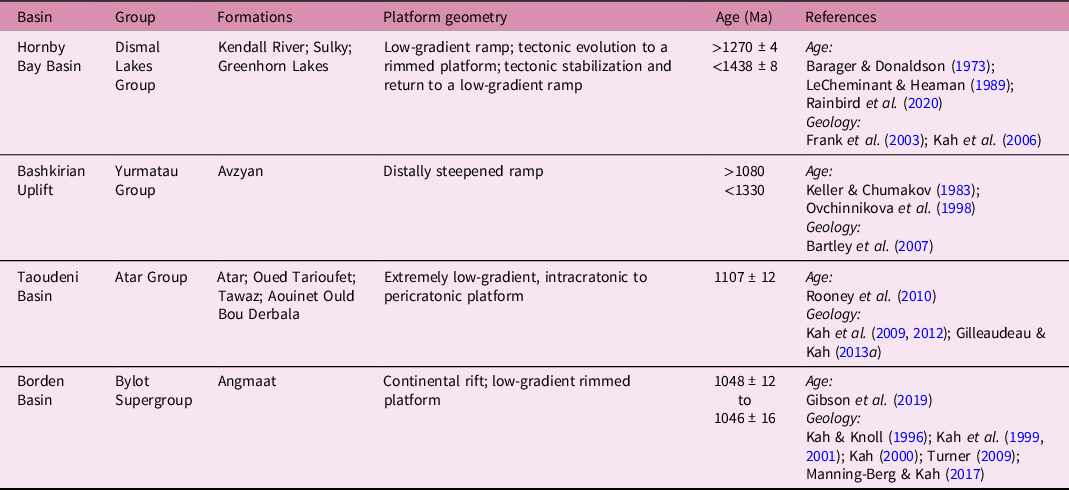
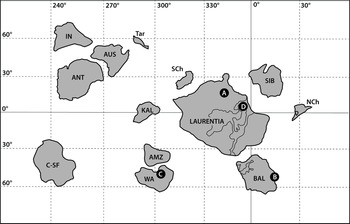
For this exploration of the evolution of carbonate fabrics, we specifically focus on four late Mesoproterozoic (˜1.3 to 1.0 Ga) carbonate-bearing successions (Table 1; Fig. 6), specifically strata from the Dismal Lakes Group (arctic Canada), the Yurmatau Group (Russia), the Atar Group (West Africa) and the Bylot Supergroup (arctic Canada). We posit that late Mesoproterozoic sedimentary successions record an identifiable interval in Earth history that is distinct from both older and younger strata.
Late Mesoproterozoic successions examined in this study

Late Mesoproterozoic palaeogeography. Plate configuration in the late Mesoproterozoic Era remains poorly constrained and is characterized by continental movement associated with the transition from the Columbia to Rodinia supercontinents. Figure shows a possible configuration near 1050 Ma (after Li et al. Reference Li, Bogdanova, Collins, Davidson, De Waele, Ernst, Fitzsimons, Fuck, Gladkochub and Jacobs2008). Basins surveyed in this work include (A) the Coppermine Homocline (Dismal Lakes Group), (B) the Bashkirian Uplift (Yurmatau Group, Avzyan Formation), (C) the Taoudeni Basin (Atar Group) and (D) the Borden and Bylot Basins (Bylot Supergroup, Angmaat Formation). Abbreviations: AMZ: Amazonia; ANT: Antarctica; AUS: Australia; BAL: Baltica; C-SF: Congo–São Francisco; IN: India; KAL: Kalahari; NCh: North China; SCh: South China; SIB: Siberia; Tar: Tarim; WA: West Africa.

The c. 300 million years of the late Mesoproterozoic Era was a time of transition. It is an interval that incorporates widespread intracratonic rifting (Chaudhuri et al. Reference Chaudhuri, Saha, Deb, Patranabis Deb, Mukherjee and Ghosh2002; Timmons et al. Reference Timmons, Karlstrom, Heizler, Bowring, Gehrels and Crossey2005; Turner et al. Reference Turner, Long, Rainbird, Petrus and Rayner2016; Hinze & Chandler, Reference Hinze and Chandler2020), emplacement of large igneous provinces (Ernst et al. Reference Ernst, Wingate, Buchan and Li2008), reorganization of the Columbia supercontinent (Rogers & Santosh, Reference Rogers and Santosh2002; Zhao et al. Reference Zhao, Sun, Wilde and Li2004; Pesonen et al. Reference Pesonen, Mertanen and Veikkolainen2012; Evans, Reference Evans2013; Meert & Santosh, Reference Meert and Santosh2017) and much of the amalgamation of the supercontinent Rodinia (Weil et al. Reference Weil, Van der Voo, Mac Niocaill and Meert1998; Pisarevsky et al. Reference Pisarevsky, Wingate, Powell, Johnson, Evans, Yoshida, Windley and Dasgupta2003; Li et al. Reference Li, Bogdanova, Collins, Davidson, De Waele, Ernst, Fitzsimons, Fuck, Gladkochub and Jacobs2008). This interval is further marked by an absence of evidence for glacial activity (Young, Reference Young2013) and globally high sea level that resulted in the widespread flooding of continents and marine deposition in these high-continentality, pericratonic and epicratonic regions.
The late Mesoproterozoic Era is also distinct in terms of the preserved signals of ocean chemistry. Marine carbon isotopes record moderate variation between +2 and +4‰, with a relatively few negative excursions that do not generally exceed δ13C values of −2‰ (Kah et al. Reference Kah, Sherman, Narbonne, Knoll and Kaufman1999, Reference Kah, Bartley and Teal2012; Bartley et al. Reference Bartley, Semikhatov, Kaufman, Knoll, Pope and Jacobsen2001; Santos et al. Reference Santos, de Alvarenga, Babinski, Ramos, Cukrov, Fonseca, da Nóbrega Sial, Dardenne and Noce2004). This record of moderate variability is fundamentally distinct from both the limited isotopic variability (0.0 ± 1.5‰; Buick et al. Reference Buick, Des Marais and Knoll1995; Brasier & Lindsay, Reference Brasier and Lindsay1998; Guo et al. Reference Guo, Du, Kah, Huang, Hu, Huang and Yu2013; Tan et al. Reference Tan, Lu, Li, Song, Lv, Ma, Fan and Deng2020) recorded in Mesoproterozoic strata older than 1.3 Ga, and the strong isotopic variability (−5 to +8‰; Kaufman & Knoll, Reference Kaufman and Knoll1995; Halverson et al. Reference Halverson, Hoffman, Schrag, Maloof and Rice2005, Reference Halverson, Wade, Hurtgen and Barovich2010) recorded in Neoproterozoic strata younger than 900 Ma. The origins of these long-term, global-scale changes in carbon isotope behaviour through the Proterozoic remain uncertain, but have been hypothesized to reflect the increased sensitivity of the marine system to carbon cycle perturbations (Bartley & Kah, Reference Bartley and Kah2004) as a result of global decrease in DIC (Kasting, Reference Kasting1993; Bartley & Kah, Reference Bartley and Kah2004; Kah & Riding, Reference Kah and Riding2007), combined with a secular increase in organic carbon burial resulting, at least in part, from the increasingly refractory nature of organic matter associated with the diversification of eukaryotic plankton (e.g. Javaux et al. Reference Javaux, Knoll and Walter2001, Reference Javaux, Knoll and Walter2004; Knoll, Reference Knoll2014; Javaux & Knoll, Reference Javaux and Knoll2017) and shifting redox conditions (cf. Kah & Bartley, Reference Kah and Bartley2011).
In turn, increase in the relative degree of organic carbon burial (Des Marais et al. Reference Des Marais, Strauss, Summons and Hayes1992; Des Marais, Reference Des Marais1997; Daines et al. Reference Daines, Mills and Lenton2017) would be expected to result in increased oxygenation in surface environments (Parnell et al. Reference Parnell, Boyce, Mark, Bowden and Spinks2010). Although iron speciation (Sperling et al. Reference Sperling, Rooney, Hays, Sergeev, Vorob’eva, Sergeeva, Selby, Johnston and Knoll2014; Gilleaudeau & Kah, Reference Gilleaudeau and Kah2015; Beghin et al. Reference Beghin, Guilbaud, Poulton, Gueneli, Brocks, Storme, Blanpied and Javaux2017), redox-sensitive isotope systems (Arnold et al. Reference Arnold, Anbar, Barling and Lyons2004; Gilleaudeau et al. Reference Gilleaudeau, Frei, Kaufman, Kah, Azmy, Bartley, Chernyavskiy and Knoll2016; Koehler et al. Reference Koehler, Stüeken, Kipp, Buick and Knoll2017; Canfield et al. Reference Canfield, Zhang, Frank, Wang, Wang, Su, Ye and Frei2018) and incorporation of redox-sensitive trace elements (Gilleaudeau & Kah, Reference Gilleaudeau and Kah2013 a; Sperling et al. Reference Sperling, Rooney, Hays, Sergeev, Vorob’eva, Sergeeva, Selby, Johnston and Knoll2014; Liu et al. Reference Liu, Kah, Knoll, Cui, Kaufman, Shahar and Hazen2015; Parnell et al. Reference Parnell, Spinks and Brolly2018; Ansari et al. Reference Ansari, Ahmad, Govil, Agrawal and Mathews2020) all indicate that late Mesoproterozoic marine systems were dominated by low-oxygen conditions, stratigraphic evidence suggests that oxygen depauperate conditions were most prevalent in, and potentially restricted to, quiet water conditions below fair-weather wave base (Gilleaudeau & Kah, Reference Gilleaudeau and Kah2013 b, Reference Gilleaudeau and Kah2015; Hardisty et al. Reference Hardisty, Lu, Bekker, Diamond, Gill, Jiang, Kah, Knoll, Loyd and Osburn2017), indicating a stratified water column. By contrast, increased oxygenation in well-mixed surface waters is supported by the onset of participation by oxic sulphur-oxidizing bacteria (Johnston et al. Reference Johnston, Wing, Farquhar, Kaufman, Strauss, Lyons, Kah and Canfield2005), by the evolution and diversification of eukaryotes and, in particular, multicellular eukaryotes (Anbar & Knoll, Reference Anbar and Knoll2002; Butterfield, Reference Butterfield2009, Reference Butterfield2015; Zhang et al. Reference Zhang, Zhu, Wood, Shi, Gao and Poulton2018), and by the deposition of the first widespread marine evaporites (Whelan et al. Reference Whelan, Rye, Delorraine and Ohmoto1990; Kah et al. Reference Kah, Lyons and Chesley2001; Manning-Berg & Kah, Reference Manning-Berg and Kah2013).
4. Data collection and analysis
To better understand patterns of carbonate deposition during the Mesoproterozoic Era, we apply a database approach to the examination of field-scale observations of four late Mesoproterozoic basins (Table 1). Unlike previous database approaches (Peters et al. Reference Peters, Husson and Wilcots2017; Cantine et al. Reference Cantine, Knoll and Bergmann2019), we concentrate our efforts at a sub-formation scale, in order to explore patterns of carbonate formation more thoroughly and to relate documented carbonate features and their temporal–spatial distribution to the factors that controlled carbonate genesis in the Mesoproterozoic Era.
4.a. Data collection and statistics
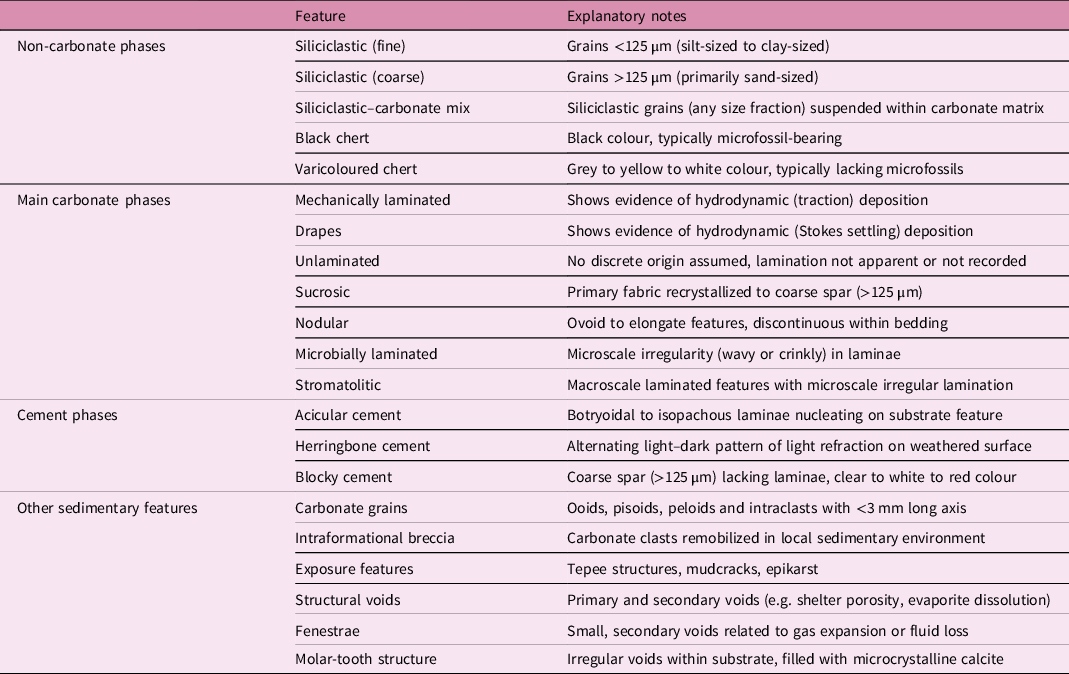
For this study, original field notes were used to compile data from our most stratigraphically complete, single measured sections through the strata of interest, with additional sections added to represent palaeogeographically or palaeoenvironmentally distinct regions of each basin, when possible. Field notes were evaluated to derive 21 unique descriptors that would most fully characterize the range of sedimentologic features observed in the measured sections and include a range of non-carbonate associated phases, primary carbonate phases, cement phases and other sedimentary features (Table 2). Using the original field notes, descriptive features were coded as present or absent within each 5 m interval of the measured section. Five-metre intervals were chosen to standardize analysis across datasets collected in different years and with different scientific goals. Although we recognized that this interval would not readily differentiate changes in depositional environment within 1–3 m thick parasequences, 5 m intervals, which result in c. 150 analysis points per basin, were sufficient to capture both common features and rare features. The presence–absence data cannot be used as a direct proxy for rock volume abundance or frequency data, however, and rare features (i.e. features that form only a small percentage of the total rock volume, and which may be present in units much thinner than 5 m) will be overrepresented in the dataset.
Tabulated sedimentary features

Coding the presence and absence of features within each 5 m interval allows us to evaluate associations of features within these intervals, identifying associations that occur more frequently or less frequently than predicted by a random model. In addition, we documented co-occurrences, defined as multiple features recorded within single, discrete beds (e.g. intraformational breccias co-occurring with stromatolites or tepee cracks, or black chert within microbially laminated strata). Such co-occurrences provide additional insight into specific depositional environments, whereas 5 m interval associations may record relationships between several distinct, yet closely related, environments. In such a scenario, features may be associated within a single 5 m interval of related facies that do not represent bed-level co-occurrence within a single depositional environment.
Data were also collected to provide additional details about specific features such as intraformational breccias and microbialites (i.e. microbial laminae and stromatolites). Intraformational breccias were characterized in terms of clast size (long axis, aspect ratio), clast shape (rounded, angular, deformed) and clast composition. Microbialites were characterized in terms of morphology, which focused on laminae morphology (flat, irregular to wavy, tufted), laminated materials and overall morphology (domal or bulbous, columnar, conical, branching, composite) for stromatolites. Microbialite features were also characterized in terms of synoptic relief, defined as the vertical relief as measured on a single lamina, a record of the growth morphology of the microbialite.
4.b. Statistical analyses
Presence–absence data were then evaluated using a probabilistic species co-occurrence model. This model, the R package co-occur (Griffith et al. Reference Griffith, Veech and Marsh2016), was derived from a model to evaluate co-occurrence of species in ecological studies (Veech, Reference Veech2013) and evaluates whether a pair of objects (e.g. biological species, textural features) occur together more frequently or less frequently (e.g. on an island or in a 5 m interval) than would be predicted by random chance, given the overall frequency of that object in the dataset. The Cooccur package uses random sampling with replacement to develop a hypergeometric model of expected associations (Griffith et al. Reference Griffith, Veech and Marsh2016), then compares expected to observed associations. A similar approach was used by Cantine et al. (Reference Cantine, Knoll and Bergmann2019) to evaluate the formation-level co-occurrence of features, where they reported the ratio of observed to expected (i.e. random) occurrences for each pair. Our analysis follows Griffith et al. (Reference Griffith, Veech and Marsh2016) and evaluates whether departures from expected occurrences are significant, given the frequency of each feature. For each 5 m interval, the presence (1) or absence (0) of each of the 21 unique descriptors was established and the resultant matrix was evaluated using the cooccur package. The package returns the expected number of associations for each feature pair and computes the observed number of such associations. The observed distribution of features is assigned a probability and classified as significantly (p ≤ 0.05) greater than expected (positive), less than expected (negative), or indistinguishable from (p > 0.05) random (Table 3).
Statistical results of occurrence data

* Intervals represent only rock-bearing strata; covered intervals were excluded from analyses.
5. Results and interpretation
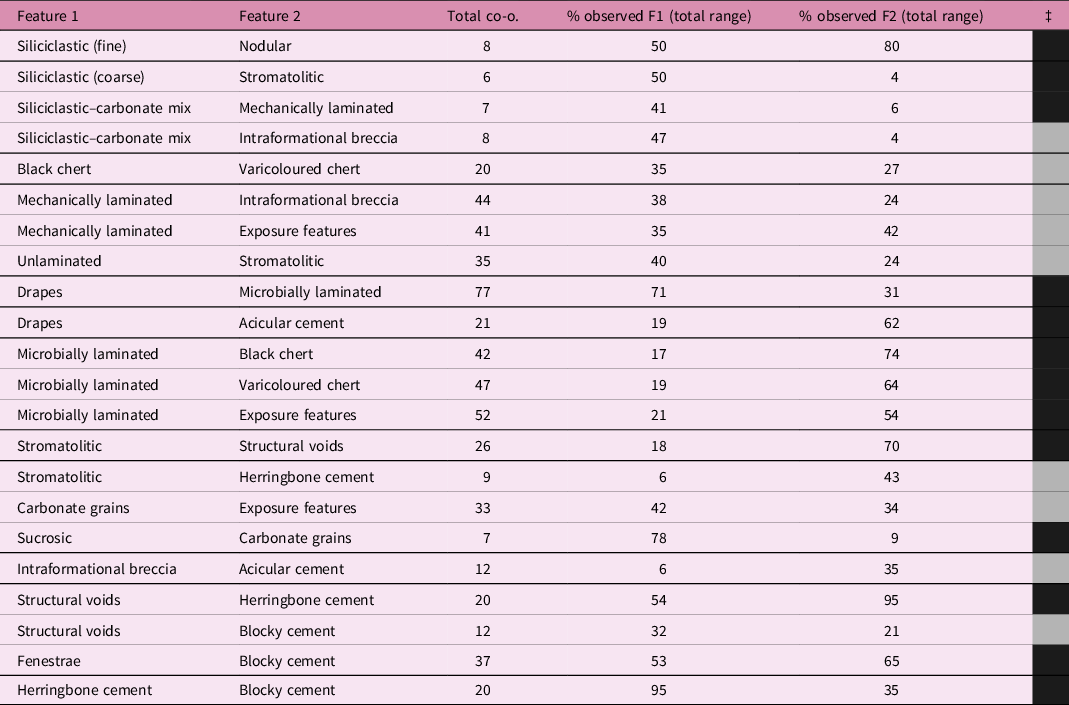
Tabulation of results and statistical analyses are summarized in Tables 3 and 4, and in Figures 7, 8, 9 and 10.
Important co-occurring features (all basins, see Fig. 8a)

‡ Grey denotes co-occurrence at 30–50 % of observed co-occurrences of at least one of the features; black denotes co-occurrence at >50 % of observed co-occurrences of at least one of the features.
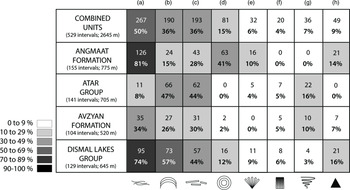
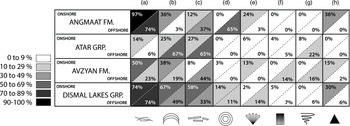
Abundance of time-sensitive carbonate elements in late Mesoproterozoic strata. Simple presence–absence data showing the number of 5 m intervals in which a specific depositional feature occurs. (a) Microbial laminae; (b) stromatolites; (c) intraformational conglomerates; (d) ooids, pisoids or other coated grains; (e) acicular seafloor cement; (f) herringbone cement; (g) molar-tooth structure; (h) black chert.

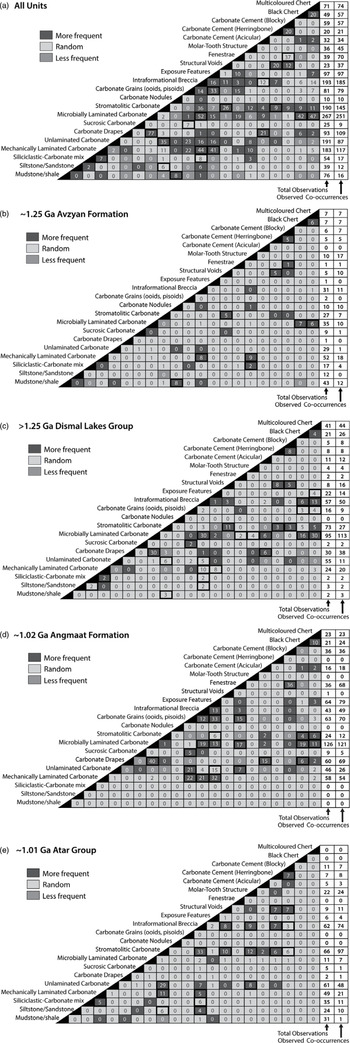
Cross-plot of statistical pair associations. Individual features are arrayed horizontally and vertically, creating 121 potential feature pairings. Box shading represents the results of statistical analyses that highlight associations within 5 m thick intervals, including associations that occur significantly more frequently than random, associations that occur significantly less frequently than random, and associations that occur at a frequency indistinguishable from random. Numbers indicate the actual observed co-occurrence of these pair associations on the scale of individual beds; outlined boxes indicate observed co-occurrences in which at least one of the paired features represents more than 30 % of the total co-occurrences of that feature. (a) Combined data from all late Mesoproterozoic basins; (b) data from the Yurmatau Group (Avzyan Formation); (c) data from the Dismal Lakes Group; (d) data from the Bylot Supergroup (Angmaat Formation); (e) data from the Atar Group.

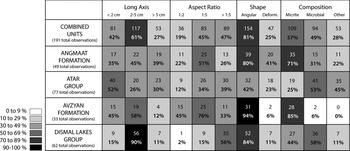
Summary of intraformational breccias in late Mesoproterozoic strata. Intraformational breccias typically contain dominantly angular clasts with a long axis less than 5 cm, and an aspect ratio of greater than or equal to 1:5. Most clasts are either micritic (i.e. finely crystalline, with no indication of microbial laminae) or microbial (i.e. finely crystalline, dominated by microbial laminae) in composition; micritic clasts comprise 51 % (79 of 154 observations) of angular clasts, and microbial clasts comprise 77 % (36 of 47 observations) of deformed clasts.

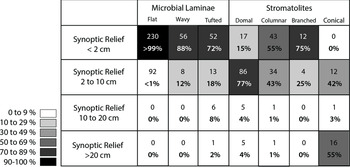
Summary of microbial morphologies showing the distribution of synoptic relief observed among microbial laminae and stromatolites. For each synoptic relief, we provide the number of observations, as well as the percentage of the total number of observations of that feature.

5.a. Number of observations
Presence–absence data (i.e. occurrence data) were collected for a total of 529 5 m intervals, representing a total of 2645 m of measured rock-bearing stratigraphy across the four basins (Table 3); fully covered intervals were omitted from analyses. A feature was recorded as present if it occurred within a given 5 m interval, regardless of how many times the feature was recorded in field notes within that interval. This resulted in a total of 1827 observations of features as ‘present’. This dataset provides the basic information upon which the database and statistical analysis was built.
The most common features in this dataset are those that describe basic lithology and texture (Figs 7 and 8), with 267 intervals containing microbially laminated carbonate (50 % of intervals), 190 intervals containing unlaminated carbonate (36 %), 190 intervals containing stromatolitic carbonate (36 %) and 183 intervals containing mechanically laminated carbonate (35 %). The only additional feature that occurred in abundance was intraformational breccia, which was recorded in 193 intervals (36 %). Other potentially time-sensitive facies (sensu Cantine et al. Reference Cantine, Knoll and Bergmann2019), such as coated grains (15 %), molar-tooth structure (7 %), acicular cement (6 %), herringbone cement (4 %) and black chert (9 %), make up a much smaller proportion of rock-bearing intervals.
By itself, the number of occurrences of a lithologic feature reveals little (Fig. 7). The frequency of a feature neither represents its stratigraphic thickness, nor its importance, as rare features within a 5 m interval receive the same coding as features comprising the bulk of an interval. A database approach, therefore, highlights the importance of rare features. For example, herringbone cement occurs in only 4 % of rock-bearing intervals, and never comprises more than 6 % of the intervals in any given basin. When herringbone carbonate occurs, though, it can be conspicuous within the strata, as it is in the reef facies of the Atar Group (Atar and Touirist formations; Kah et al. Reference Kah, Bartley and Stagner2009) and deep-water microbialite facies of the Dismal Lakes Group (Sulky Formation; Bartley et al. Reference Bartley, Kah, Frank and Lyons2015). Conversely, intraformational breccia occurs frequently – appearing in 28–44 % of rock-bearing intervals (Fig. 7) – but, because the vast majority of intraformational breccia occurs as thin (0.5–5 cm) beds of clasts, its abundance in Mesoproterozoic carbonate platforms can easily be overlooked.
Despite its shortcomings, such analysis provides a better gauge of relative stratigraphic abundance than previous approaches (Peters et al. Reference Peters, Husson and Wilcots2017; Cantine et al. Reference Cantine, Knoll and Bergmann2019), which identify occurrences at the formation level. Because Proterozoic formations are highly variable in lithologic diversity, stratigraphic thickness and geologic duration, formation-level analysis is both coarse and inconsistent across units. Examination of occurrences at the 5 m scale provides a consistent basis for comparison across geologic units. Even at this moderate scale, patterns begin to emerge. For example, stratiform microbial laminae occur in 81 % of the rock-bearing intervals in the Angmaat Formation, but in only 8 % of intervals in the Atar Group (Fig. 7). By contrast, stromatolites are much more frequent (47 % of intervals) in the Atar Group than in the Angmaat Formation (15 %). These differences persist for several potentially time-sensitive indicators, despite the two units being broadly similar in both depositional environment and age.
At this scale, occurrence data can also reveal something about the stratigraphic variability of a unit. For example, a unit with low variability at the 5 m scale, and hence monotonous features, would display a pattern where only a few features dominate each interval. By contrast, a unit with 1–5 m scale variability would display a pattern wherein more features occur within each interval, resulting in higher overall occurrence frequency. For this reason, examining the association of features within each 5 m interval can provide additional insight into environmental variability or stability within a basin.
5.b. Association of features
Pairings of features that occur within a 5 m interval, here termed associations, are summarized in Figure 8. Evaluation of associations permits analysis of time-sensitive features that persistently occur together within a 5 m interval or, conversely, rarely occur together. Because random association is also expected, we evaluate the frequency of association compared to a null hypothesis of random association, using statistics more commonly applied in population ecology (Griffith et al. Reference Griffith, Veech and Marsh2016). In the analysis of all basins together, 45 % of paired features were non-random in their association (Table 3; Fig. 8), with 62 pairs occurring statistically more frequently than random (positive association), and 32 pairs occurring statistically less frequently than random (negative association). Within individual basins, non-random associations comprise between 15 % and 62 % of possible pairs (Table 3).
In the combined dataset (Fig. 8), half of negative pair associations (16 of 32) include the presence of detrital siliciclastic material. Stromatolitic and microbially laminated carbonate are involved in 34 % of negative associations (11 of 32 associations, 4 of which are with siliciclastic features). By contrast, siliciclastic features are most commonly positively associated with each other (e.g. shale associated with siltstone/sandstone) or with nodules, sucrosic carbonate and intraformational breccia. Stromatolitic and microbially laminated carbonate are involved in 53 % of positive associations (17 of 32), and intraformational breccia occurs in 47 % of positive associations (15 of 32). Other features are involved in 8 or fewer positive associations.
Interpretation of these statistics provides refined insight into the nature of the measured parameters. Walther’s law of facies states that the vertical succession of facies reflects lateral changes in environment. Therefore, the association of features within a short stratigraphic distance, or in adjacent beds (i.e. a 5 m interval), implies deposition within similar or closely related environments. Thus, positive associations will define facies associations (i.e. a suite of features used to define a particular sedimentary environment), and negative associations will highlight features that define distinctly different environments. Because our 5 m sample interval is similar in stratigraphic thickness to parasequence-scale packaging, pair associations are expected to highlight facies associations at the parasequence scale. In this scenario, spatial and temporal stability of the depositional environment will be reflected in similarity of pair associations, and departure from discrete depositional environments will be marked by distinct pair associations.
Individual features whose genesis is well understood provide additional insight into the driving mechanisms behind positive or negative associations. For example, because subaerial exposure has no genetic linkage to any specific host material, but rather represents a specific environmental condition, features positively associated with subaerial exposure features can be inferred to represent deposition in shallow-water environments. Within our dataset, exposure features typically have positive associations with intraformational breccia, microbially laminated carbonate, mechanically laminated carbonate and unlaminated carbonate. By contrast, exposure features are negatively associated with stromatolitic carbonate and both fine- and coarse-grained detrital siliciclastic material, suggesting that these features are either not associated with the shallowest-water environments or that exposure features are less preservable in these lithologies. Notably, mudstone/shale in the Atar Group, by contrast to the other basins surveyed, is positively associated with exposure features, suggesting an environment of deposition for fine-grained clastic material that is distinct from the other basins.
In other cases, associations can provide support for or against hypothesized formation mechanisms. For example, a positive association between black chert and microbially laminated and stromatolitic carbonate is consistent with hypotheses that both specific depositional environments and the presence of organic matter may be important in the silicification process (cf. Bennett & Siegel, Reference Bennett and Siegel1987; Coradin & Lopez, Reference Coradin and Lopez2003). Similarly, negative associations between microbially laminated carbonate and detrital sediment are consistent with the interpretation that persistent to episodic hydrodynamically active environments impede colonization and growth of microbial mats (cf. Schieber, Reference Schieber, Schieber, Bose, Eriksson, Banerjee, Sarkar, Altermann and Catuneanu2007).
Evaluation of lithologic associations by this method can also help resolve complex or ambiguous facies relationships. For example, intraformational breccias are one of the most prominent features of these successions and have been called out as a temporally distinctive feature in the Mesoproterozoic Era (Cantine et al. Reference Cantine, Knoll and Bergmann2019). In our dataset, intraformational breccia records a large number of positive associations, in both individual basins and in the combined dataset, where this feature shows positive relationships with 70 % (14 of 20) of the other depositional features. Intraformational breccia is superficially similar throughout these units (Fig. 9), displaying predominantly angular clasts with a high aspect ratio, comprised largely of micritic and microbially laminated carbonate. Notably, intraformational breccia is positively associated with fine-grained siliciclastic material, as well as mechanically laminated carbonate and nodular carbonate, both of which also have positive associations with fine-grained siliciclastic material. By contrast, intraformational breccia also shows positive associations with microbially laminated and stromatolitic carbonate, carbonate grains and fenestrae, each of which has a negative association with fine-grained siliciclastic material. These seemingly antithetical associations suggest that intraformational breccia does not define a single set of environmental conditions, but rather represents a feature whose conditions for formation are met through distinct pathways within different environments. For instance, a broad range of clast shape in intraformational breccia within the Avzyan Formation (Figs 4c, d and 9), as well as a positive association with fine-grained siliciclastic material (Fig. 8), may reflect gravitational slumping along this distally steepened ramp whereas imbricated clasts with a high aspect ratio likely reflect storm or tidal reworking in peritidal environments. Additionally, although most clasts are finely crystalline in composition, micritic clasts comprise 51 % (79 of 154 observations) of angular clasts, and microbial clasts comprise 77 % (36 of 47 observations) of deformed clasts, suggesting a rheological difference between microbial and purely micrite substrates.
The association patterns of microbially laminated and stromatolitic carbonate provide similar insight into the environmental distribution of these two time-sensitive features. As noted above, each of these features displays a high number of non-random associations, both in the composite dataset and in each individual basin. Within the combined dataset, microbial laminae and stromatolites share a large number of positive associations, whereas negative associations are distinct. Specifically, three features – fenestrae, ooids and subaerial exposure – occur as positive associations with microbial laminae, and negative associations with stromatolitic carbonate, and an additional three features – structural voids, molar tooth and herringbone cement – occur as positive associations with stromatolites and negative associations with microbially laminated carbonate. The observed pattern of positive and negative associations supports long-standing interpretations that microbially laminated and stromatolitic carbonate facies occur within a range of overlapping environments, with microbially laminated carbonate favoured in shallower-water settings and stromatolitic carbonate favoured in deeper-water environments that span energy realms. Within individual basins, however, microbial laminae and stromatolites share almost no positive associations (Fig. 8), suggesting that in any given basin, microbial laminae and stromatolites occupy distinct depositional environments.
Similarly, acicular and herringbone cement show a pattern of associations consistent with formation in distinct environments (Fig. 8). Although both cement styles can be associated with stromatolitic carbonate, acicular cements are most commonly positively associated with microbially laminated carbonate and chert, supporting formation in shallow-water, intermittent-energy environments with potentially enhanced salinity (as evidenced by association with chert; Manning-Berg & Kah, Reference Manning-Berg and Kah2017). By contrast, herringbone carbonate is strongly positively associated with stromatolitic carbonate and typically negatively associated with microbial laminae, indicating an offshore, deeper-water origin for this feature that is consistent with previous observations (Kah et al. Reference Kah, Bartley and Teal2012; Bartley et al. Reference Bartley, Kah, Frank and Lyons2015).
Interestingly, molar-tooth carbonate, which has long been argued to be a diagnostic indicator of late Mesoproterozoic to early Neoproterozoic carbonate platforms, shows positive association with a variety of elements that – via association with indices indicative of exposure, as well as hydrologically active subtidal environments – suggest that molar-tooth carbonate may occupy a broad environmental realm that is unable to be discretely resolved by this dataset.
5.c. Co-occurrence of features
As noted above, association of features within 5 m intervals provides an assessment, based on Walther’s law of facies, of the similarity in depositional environment within which features occur. In this way, examination of associations improves upon previous formation-level analysis of features (Cantine et al. Reference Cantine, Knoll and Bergmann2019). In building the database for this study, however, we were additionally able to enumerate observed bed-level co-occurrences (subsequently referred to as co-occurrences), which are defined as the association of features on the scale of a single bed. These bed-level co-occurrences provide information about the suite of features that are co-produced within a single environment. In the present usage, we consider these features as facies elements. As noted above, some of the features coded in this analysis might occur across a range of depositional environments; such features would have limited utility in defining or describing single facies. Features that persistently occur together, to the exclusion of other features, however, would define distinct facies.
Figure 8 also provides the absolute number of observed co-occurrences for each pair of carbonate elements. In the combined dataset (Fig. 8a), 80 of the 121 observed pair associations (66 %) are also represented as co-occurrences. Of these, however, only 22 (18 %) record co-occurrences in which at least one of the paired features represents more than 30 % of the total number of observed co-occurrences of that feature (Table 4). For example, in the combined dataset, the association between fine-grained siliciclastic material and nodular carbonate occurs statistically more frequently than random given the number of occurrences of each facies element. These two features are also observed to directly co-occur eight times, which represents 50 % of the total number of observed co-occurrences of fine-grained siliciclastic material, and 80 % of the observed co-occurrences of nodular carbonate. In another example, the association between structural voids and herringbone cement occurs statistically more frequently than random given the number of occurrences of each facies element. These two features are also observed to co-occur 20 times, which represents 54 % of the total number of observed co-occurrences of structural voids, and 95 % of the total observed occurrences of herringbone cement. Such data provide a clear measure of the extent to which statistical pair associations reflect discrete depositional environments. Within the combined dataset, 73 % of observed co-occurrences in which at least one of the paired features represents more than 30 % of the total number of observed co-occurrences of that feature occur in feature pairs with positive associations, suggesting that positive associations on this scale are largely sufficient to define facies. A few high-frequency co-occurrences occur between pairs with statistically random association frequency; these can logically be ascribed to either discrete depositional or diagenetic conditions. For instance, co-occurrence of intraformational breccia and mixed siliciclastic–carbonate detritus (observed 7 times) may represent mixture of facies during subaerial exposure, and the co-occurrence of intraformational breccia and acicular carbonate cement (observed 12 times) may indicate enhanced evaporation upon exposure. Similarly, co-occurrence of fenestrae with blocky cement (observed 37 times) may represent early diagenetic infill of fenestrae by meteoric phreatic fluids, and co-occurrence of sucrosic carbonate with oolitic/grainy carbonate facies may reflect an inherent porosity of grainstone lithologies and susceptibility to diagenetic recrystallization. Finally, the absence of observed co-occurrences within statistical pairings that show a positive association are interpreted as features that occupy adjacent environmental niches and thus are commonly found within the same 5 m interval of stratigraphy, but which have distinct modes of formation.
5d. Microbialite patterns
Microbialite form and diversity is a hallmark of Proterozoic carbonate platform evolution. To further explore the patterns of microbialite form during the Mesoproterozoic Era, we examined the relationship between outcrop-scale stromatolite morphology and synoptic relief. Synoptic relief is defined as the height of a single lamina, measured from lowest to highest point along a lamina. Synoptic relief thus describes the expressed relief of a microbialite structure on the seafloor, at the time of growth, and is typically measured on the millimetre to centimetre scale. By contrast, morphology is the overall shape of accumulated laminae, over the growth interval of the stromatolite, and is typically measured on the centimeter to decimeter scale. The relationship between synoptic relief and morphology helps to describe the range of environmental conditions experienced by microbialites across a carbonate platform. Figure 10 summarizes the relationships between morphology and synoptic relief across the four basins of this study. In total, 619 microbialite occurrences (i.e. stratiform microbial laminae and stromatolites) were documented. Of these, approximately two-thirds (411) had a synoptic relief less than 2 cm and thus would have appeared nearly flat while growing on the seafloor. Notably, all morphologies save conical forms have substantial fractions that are low synoptic relief, despite the overall size of the structures in outcrop (e.g. Fig. 5f, h). Nearly all the remaining stromatolites (167 of 619) have modest synoptic relief (2–10 cm), including nearly half (41 %) of conical forms. These stromatolites would have expressed noticeable relief above the seafloor during growth (Fig. 5a, e). Stromatolites with high synoptic relief are relatively rare, comprising 41 total occurrences with synoptic relief greater than 10 cm. More than half of conical stromatolites (59 %) and about one-third of composite stromatolites (33 %), most of which have a domal or conical component, are high-relief. High synoptic relief is rare for other morphologies.
The observed pattern underscores the unique nature of conical and composite stromatolite forms. Not only do these forms produce a striking outcrop pattern, but they also exhibit a strikingly different growth habit, with significant height above the seafloor. Penecontemporaneous cementation would have been crucial for these forms to achieve and maintain relief during growth, and the relief of tall conical morphologies means that these stromatolites experience substantial interaction with physical and chemical properties of the water column. The individual basins show overall similar relationships between relief and morphology, although the pattern of high-relief stromatolites differs regionally. For instance, the Dismal Lakes and Atar groups have the highest proportion of high-relief conical stromatolites (11 % and 7 %, respectively); by contrast, the Angmaat Formation contains a substantial fraction (17 %) of stromatolites with synoptic relief greater than 10 cm, but these dominantly record a tufted morphology. Notably, the sections measured in the Avzyan Formation lack high-relief stromatolites.
6. Discussion
6.a. Understanding Mesoproterozoic facies associations
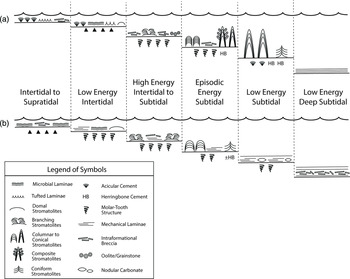
The database analysis of carbonate platform elements, combined with previous field, petrographic and analytical work in these four late Mesoproterozoic basins, allows us to refine interpretations of Mesoproterozoic carbonate facies. Figure 11 relates depositional energy, allochthonous sediment deposition and marine geochemistry to environmental distributions of the carbonate elements described in this paper, to develop a facies model framework for the late Mesoproterozoic Era. The spatial distribution and stratigraphic association of time-sensitive carbonate elements provides the basic insight that rapid lithification of the sedimentary substrate was a key feature of Mesoproterozoic carbonate platforms, and that the spatial distribution of time-sensitive elements – specifically, intraformational breccia and microbial morphology – records the interplay between substrate lithification and hydrodynamic conditions.
Summary of Mesoproterozoic carbonate facies. (a) Distribution of carbonate facies in environments with low allochthonous micrite production; (b) distribution of carbonate facies in environments with high allochthonous micrite production, and high detrital input. In most cases, early diagenetic chert is restricted to intertidal to supratidal facies, molar-tooth structure occurs throughout intertidal and subtidal environments, and herringbone carbonate is restricted to deepest-water carbonate environments. Stromatolite morphology largely reflects hydrodynamic influence on lamina inheritance. Intraformational breccias record multiple formation mechanisms related to exposure, high hydrodynamic energy, and gravitational slumping.

6.a.1. Intraformational breccia
The genesis of intraformational breccia requires that three environmental conditions be met. First, a subset of substrate materials must experience rapid lithification to produce the rigid or semi-rigid material that will become clasts. Second, an interbedded or interlaminated subset of substrate materials must remain more poorly lithified to produce a zone of weakness that is susceptible to disruption. Third, there must occur an event – for example, desiccation, hydrodynamic energy or gravitational slumping – to disrupt and locally transport clasts. Each of these mechanisms of intraformational clast genesis would predict a distinct relationship with other platform elements. For example, brecciation associated with desiccation would result in co-occurrence of intraformational breccia and evidence of exposure. Examination of the combined dataset indicates positive association of intraformational breccia and exposure, as well as bed-level co-occurrences. Most of these co-occurrences (13 of 14) occur in the Angmaat Formation (Fig. 8d) and relate platy breccia clasts to tepee cracks in a mid-ramp shoal (Kah, Reference Kah, Grotzinger and James2000), although intertidal to supratidal microbial laminae, micrite and acicular seafloor cement are also associated with intraformational breccia (Fig. 4a, e, f, g). By contrast, intraformational breccia in the Atar Group is positively associated with stromatolitic carbonate (Fig. 8e). Of the 36 co-occurrences of stromatolitic carbonate and intraformational breccia across all basins (Fig. 8a), 33 appear in the Atar Group. In these cases, stromatolitic material comprises the majority of intraformational clasts, and clasts are commonly contorted (Fig. 2b); these ductile but cohesive clasts were ripped from stromatolite surfaces by wave energy or storms, producing a microbial-clast breccia (Fairchild et al. Reference Fairchild, Marshall and Bertrand-Sarfati1990; Kah et al. Reference Kah, Bartley and Stagner2009). In the Avzyan Formation, intraformational breccia preserves an entirely different set of associations. Here, intraformational breccia is associated with carbonate nodules, fine-grained siliciclastic material and unlaminated or mechanically laminated carbonates (Fig. 8b). In addition, clast shape is more variable (Figs 10, 4c, d). Together, these facies associations are consistent with gravitational slumping of offshore environments dominated by interbedded carbonate and siliciclastic shale/mud.
6.a.2. Microbialites
It has long been recognized that stromatolite morphology represents a balance among microbial growth and decomposition, carbonate precipitation and external sedimentation, within a framework of the hydrodynamic environment. Microbial growth, for example, is likely the principal mechanism of upward growth and stromatolite inheritance (the tendency of a new layer to replicate the position and shape of the layer beneath it), and biochemical processes associated with growth and decomposition of a microbial mat control local geochemical conditions, either inhibiting or promoting conditions for carbonate precipitation (Dupraz & Visscher, Reference Dupraz and Visscher2005). Carbonate precipitation then acts to stabilize a stromatolite, imparting a mechanical stability that permits the structure to stand above the seafloor as well as providing a firm substrate for subsequent growth. In this way, upward growth and stabilization is controlled by the interaction of microbial processes and carbonate precipitation. External sedimentation, either by allochthonous carbonate sediment or siliciclastic material, serves to dampen upward growth of stromatolites by depositing material on their surfaces and filling spaces between stromatolites (Grotzinger & Knoll, Reference Grotzinger and Knoll1999). External sedimentation also links stromatolites to their hydrodynamic regime, which can deposit sediment across the stromatolite, scour substrate between stromatolites and erode or sculpt the stromatolites themselves (Bosak et al. Reference Bosak, Knoll and Petroff2013).
Within this genetic framework for stromatolite development, stromatolite laminae represent the most fundamental aspect of stromatolite morphology, wherein individual laminae record the growth behaviour of the surficial microbial community, the interaction between microbial growth and the environment, and changes in this interaction through time (i.e. through successive accretion of laminae). Laminae are, themselves, variable in morphology and reflect behaviour of often highly diverse microbial populations (Mlewski et al. Reference Mlewski, Pisapia, Gomez, Lecourt, Soto Rueda, Benzerara, Ménez, Borensztajn, Jamme and Refregiers2018), with motile filaments generally forming smooth to tufted laminae and non-motile coccoidal communities providing a basis for more irregular, pustular laminae (Knoll et al. Reference Knoll, Wörndle and Kah2013; Suosaari et al. Reference Suosaari, Reid, Playford, Foster, Stolz, Casaburi, Hagan, Chirayath, Macintyre and Planavsky2016, Reference Suosaari, Awramik, Reid, Stolz and Grey2018). Preservation of tufted and irregular laminae requires rapid stabilization via carbonate precipitation prior to either decomposition or burial of the microbial surface, whereas smooth laminae may, in part, represent slower lithification.
It is important to note that lamina morphology need not directly reflect macroscale stromatolite morphology, because stromatolite morphology is, fundamentally, a function of the synoptic relief (i.e. the average vertical relief of an individual lamina) and inheritance (i.e. the degree to which microbial laminae replicate the position and shape of underlying laminae) of laminae during accretionary growth. Although the maximum synoptic relief of a stromatolite is limited by water depth, below that height, synoptic relief is governed by the interplay of accretionary growth and allochthonous sediment deposition. High synoptic relief structures require that accretionary growth and mechanical stabilization, via carbonate precipitation, exceed the potential for local hydrodynamic modification via erosion, scouring or sediment smoothing. Furthermore, the high inheritance of such forms requires that these relationships be sustained over time. By contrast, low synoptic relief structures can show either high or low inheritance, suggesting a more intimate relationship between lamina accretion, allochthonous sediment deposition and hydrodynamic modification; furthermore, that relationship can vary over time, producing changes in stromatolite morphology, such as branching, steepening, flattening or anastomosing.
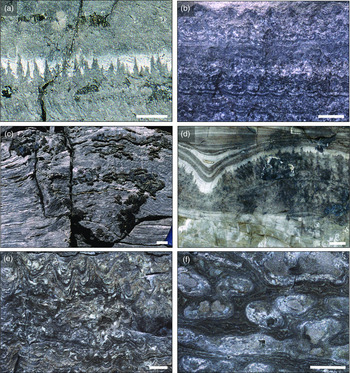
Mesoproterozoic carbonate platforms stand out because of their high diversity of stromatolite morphologies and, in particular, their noted occurrence of tufted laminae (Knoll et al. Reference Knoll, Wörndle and Kah2013) and macroscale conical forms (Fig. 5a, e, g; Komar et al. Reference Komar, Raaben and Semikhatov1965; Hofmann, Reference Hofmann1973; Kah et al. Reference Kah, Bartley, Frank and Lyons2006, Reference Kah, Bartley and Stagner2009; Bosak et al. Reference Bosak, Knoll and Petroff2013). The Angmaat Formation preserves perhaps the greatest diversity of tufted microbial forms. Tufted laminae (Fig. 12a, b) are typically laterally continuous, interlaminated with either micritic drapes or acicular seafloor cement and often associated with early diagenetic chert (cf. Knoll et al. Reference Knoll, Wörndle and Kah2013; Manning-Berg & Kah, Reference Manning-Berg and Kah2017). Preservation of mm- to cm-scale tufts additionally requires rapid lithification, generally by microspar precipitated within the mat structure, and thus the ubiquity of these textures in Mesoproterozoic stromatolites is a hallmark of rapid precipitation at or near the sediment/water interface. Occasionally, tufted laminae are incorporated into domal stromatolites, and such examples provide clear evidence of the effect of variable sediment infill on stromatolite morphology (Fig. 12c, d). More rarely, tufted microbial mats within persistently subaqueous environments record enhanced upward growth and form isolated and laterally linked coniform stromatolites with up to 10 cm of synoptic relief (Fig. 12e, f; see also Bartley et al. Reference Bartley, Kah, Frank and Lyons2015). Enhanced synoptic relief in persistently subaqueous environments is, similarly, a hallmark of more traditional conical stromatolite forms, that typically record synoptic relief of decimetres to metres (Fig. 5e; see also Kah et al. Reference Kah, Bartley, Frank and Lyons2006, Reference Kah, Bartley and Stagner2009). Rapid lithification is clearly required for the preservation of cones with high synoptic relief and occurs as both precipitation of acicular marine cement that stabilized the microbialite surface (cf. Kah et al. Reference Kah, Bartley, Frank and Lyons2006) and as precipitation within the microbial substrate (cf. Kah et al. Reference Kah, Bartley and Teal2012). Notably, in the latter case, where evidence occurs of abrupt changes in hydrodynamic energy (Kah et al. Reference Kah, Bartley and Stagner2009), it is often the outermost laminae of conical microbialites that appear most susceptible to delamination, indicating incomplete cementation of these microbialites.
Tufted microbialites within the late Mesoproterozoic Angmaat Formation. (a) Single lamina of cm-scale tufts highlighted by a micrite drape; (b) stacked laminae of mm- to cm-scale tufted microbial mats; (c) inheritance of tufts within laterally discontinuous tufted microbial mats results in a low synoptic relief domal stromatolite; (d) domal stromatolite formed by the stacking of tufted microbial mats, with synoptic relief highlighted by a white micrite drape; (e) laterally linked, high synoptic relief tufted mats form irregular coniform stromatolites; (f) plan view of linear lined form of irregular coniform stromatolites.

Stromatolites and laminae with relatively high synoptic relief (e.g. Figs 5a, e, 13a) however, represent only a small portion of the morphological diversity observed in Mesoproterozoic microbialites (Figs 5 and 13). The vast majority of the stromatolites examined in this study (cf. Fig. 10) have a synoptic relief less than 10 cm, and the majority of more complex columnar and branching forms have a synoptic relief of <2 cm. Low synoptic relief of these forms indicates that microbial growth in most environments kept pace with external sedimentation. Within such environments, increasing morphological complexity from uniform columns (Figs 5f, h and 13b), to irregular columns (Figs 5c, d and 13c) to branching columns (Figs 5b and 13d) reflects a progressive decrease in the degree of inheritance of successive laminae. Such variability in inheritance in turn reflects a combination of hydrodynamic energy, wherein more active-water environments act to disrupt microbial growth, and a substrate lithification contrast that makes substrate regions differentially susceptible to disruption. As with high synoptic relief forms, patterns of lithification in low-relief microbial structures are also variable. Lamina deformation is common in irregular and branching forms associated with micritic inter-column sediment (Fig. 13c, d), suggesting that both the microbialite and the surrounding substrate were susceptible to hydrodynamic disruption. Similarly, low-relief columns surrounded by intraclastic breccia composed of microbial laminae (Fig. 5f) suggest that at least the outer microbialite layers experienced only partial lithification. By contrast, low synoptic relief of columnar stromatolites exhumed prior to deposition of intraclastic breccia (Fig. 13e) shows evidence of microbialite rigidity in the face of substantial hydrodynamic energy, suggesting continued lithification of microbialites in the shallow substrate.
Morphological diversity of stromatolites within the late Mesoproterozoic Atar Group. (a) Irregular, low synoptic relief branching columns growing from the upper portions of a high synoptic relief conical stromatolite; (b) close-packed, regular columns with low synoptic relief; (c, d) irregular columns and branching columns with low synoptic relief and micritic intrastromatolitic sediment; (e) irregular stromatolitic columns exhumed by erosion and buried by intraclastic conglomerate; (f) large domal stromatolites showing an abrupt transition to regular columns.

The high diversity of stromatolite forms during the Mesoproterozoic Era is unusual in the context of Precambrian time. Their close spatial and stratigraphic proximity, and the variable representation of lithification within microbialites further suggests that diversity in microbialite form may represent only small changes in local hydrodynamic or chemical conditions across the carbonate platform. Such an interpretation is consistent with earlier work that showed, at the broadest scale, peaks in stromatolite abundance during intervals of high sea level and development of epicontinental seas (Peters et al. Reference Peters, Husson and Wilcots2017).
6.a.3. Palaeogeographic controls
With globally high sea level and concomitant craton inundation, Mesoproterozoic carbonate platforms provide the opportunity to examine the diversity of time-sensitive carbonate elements within the context of platform geometry. The late Mesoproterozoic basins examined here each represent distinct palaeogeographic models (Table 1). Strata of the Bylot Supergroup represent aggradational deposition on a low-gradient cratonal platform with an offshore ooid barrier shoal and onshore evaporitic lagoon (Kah, Reference Kah, Grotzinger and James2000); strata of the Atar Group represent deposition in cratonal to pericratonal environments in which small changes in sea level result in abrupt changes in the degree of craton exposure and siliciclastic influx (Bertrand-Sarfati & Moussine-Pouchkine, Reference Bertrand-Sarfati and Moussine-Pouchkine1988; Bertrand-Sarfati et al. Reference Bertrand-Sarfati, Moussine-Pouchkine, Affaton, Trompette, Bellion, Dallmeyer and Lecorche1991; Kah et al. Reference Kah, Bartley and Teal2012; Gilleaudeau & Kah, Reference Gilleaudeau and Kah2013 a); and strata of the Yurmatau Group record deposition on a siliciclastic- and volcanic-influenced, distally steepened carbonate shelf (Maslov et al. Reference Maslov, Erdtmann, Ivanov, Ivanov and Krupenin1997; Maslov, Reference Maslov2002). Finally, strata of the Dismal Lakes Group record progressive basin evolution from deep-water deposition on a tectonically influenced carbonate shelf to a low-gradient peritidal carbonate ramp (Kerans et al. Reference Kerans, Ross, Donaldson, Geldsetzer and Campbell1981; Horodyski & Donaldson, Reference Horodyski and Donaldson1983; Kerans & Donaldson, Reference Kerans, Donaldson, James and Choquette1988). Examination of carbonate fabrics in terms of spatially ‘onshore’ and ‘offshore’ localities further differentiates among potential mechanisms that might drive the formation of time-sensitive carbonate facies (Figs 11 and 14).
Abundance of time-sensitive elements in late Mesoproterozoic strata. Simple presence–absence data showing the number of 5 m intervals in which a specific depositional feature occurs. Here, ‘onshore’ and ‘offshore’ specifically refer to measured sections in different physical locations of the basin that are more proximal or less proximal to the palaeoshoreline of the basin. In this scenario, basin geometry (Table 1) guides the inference of depositional environment in these localities. (a) Microbial laminae; (b) stromatolites; (c) intraformational conglomerates; (d) ooids, pisoids or other coated grains; (e) acicular seafloor cement; (f) herringbone cement; (g) molar-tooth structure; (h) black chert.

In all four basins, microbialites (as either flat-lying microbial mats or stromatolites) represent the most common carbonate element within measured strata. Flat-lying microbial mats are most prevalent in ‘onshore’ localities, where they are present in 14–97 % of measured stratigraphic intervals (Fig. 14). ‘Offshore’ occurrence of flat-lying microbial mats is common only in the peritidal Bylot Supergroup (Angmaat Formation), where ‘offshore’ localities regularly experienced subaerial exposure (Kah, Reference Kah, Grotzinger and James2000), and in the late stages of evolution of the Dismal Lakes Group where deposition occurred on a low-gradient, peritidal ramp. Together, these observations suggest that continental flooding in the Mesoproterozoic Era provided extensive regions of shallow, hydrodynamically quiescent environments favoured by flat-lying microbialites. By contrast, the distribution of stromatolites is quite variable, and represents a mix of ‘onshore’ and ‘offshore’ localities, where they are present in 3–67 % of measured stratigraphic intervals (Fig. 14). With the exception of conical forms associated with deeper-water environments (Fig. 11; Kerans & Donaldson, Reference Kerans, Donaldson, Geldsetzer, James and Tebbut1989; Kah et al. Reference Kah, Bartley, Frank and Lyons2006, Reference Kah, Bartley and Stagner2009; Bartley et al. Reference Bartley, Kah, Frank and Lyons2015), these forms represent stromatolites with low synoptic relief and varying degrees of lamina inheritance. We suggest that the abundance and diversity of stromatolites in these late Mesoproterozoic platforms is also, at least in part, a consequence of continental flooding (cf. Peters et al. Reference Peters, Husson and Wilcots2017), wherein highly variably stromatolite morphologies represent small changes in accommodation space and hydrodynamic energy across topographically variable shallow subtidal platforms.
Intraclastic breccias are similarly abundant, (i.e. present in up 8–65 % of measured intervals), and occur in a mix of ‘onshore’ and ‘offshore’ localities (Fig. 14). As noted in the examination of feature associations, such variable distribution most likely reflects a range of environments conducive to breccia formation. For instance, whereas ‘onshore’ breccias (occurring in 12 % of measured intervals) in the Bylot Supergroup reflect episodic, high-energy events in otherwise quiescent lagoonal environments, ‘offshore’ breccias (37 % of measured intervals) consist almost entirely of early lithified, tepee-cracked exposure intervals within the mid-ramp oolitic shoal. By contrast, ‘onshore’ breccias within the Atar Group (27 % of measured intervals) consist dominantly of micritic clasts and represent episodic to persistent hydrodynamic energy on a shallow-water shelf; whereas ‘offshore’ breccias (65 % of measured intervals) are associated with episodic hydrodynamic energy in deeper-water environments that delaminates stromatolites. Intraformational breccia within the Yurmatau Group is similarly concentrated in ‘offshore’ localities (44 % of measured intervals), where it is associated with deep-water siliciclastic facies, suggesting gravitationally driven reorganization as the primary formation mechanism. Finally, in the Dismal Lakes Group, ‘onshore’ breccia (58 % of measured intervals) is most commonly associated with episodic high-energy events in peritidal ramp deposits of the Greenhorn Formation, whereas ‘offshore’ breccia (33 % of measured intervals) represents a combination of gravitational collapse of deep-water microbialite forms of the Sulky Formation (Bartley et al. Reference Bartley, Kah, Frank and Lyons2015) and episodic high-energy events in peritidal ramp environments of the Greenhorn Formation. Despite varied formation mechanisms, the wide distribution of these features provides support for enhanced carbonate saturation and early lithification across multiple environments on late Mesoproterozoic carbonate platforms.
The distribution of precipitated carbonate, such as ooids and marine cements, provides additional insight into carbonate-producing environments. As noted in Cantine et al. (Reference Cantine, Knoll and Bergmann2019), ooids are relatively rare in these Mesoproterozoic carbonate successions. Ooids are most abundant in ‘offshore’ (i.e. mid-ramp; Turner, Reference Turner2009) environments of the Bylot Supergroup (65 % of measured intervals), which records a spatially restricted yet depositionally persistent ooid shoal (Kah, Reference Kah, Grotzinger and James2000). Even here, the presence of barchan dune forms (LC Kah, unpub. PhD thesis, Harvard Univ., 1997) and evidence for early lithification and brecciation upon subaerial exposure suggest that, although hydrodynamic energy and water-column carbonate saturation state was sufficient to form ooids, rapid lithification may have inhibited their persistence in the water column.
Acicular seafloor precipitates, although not abundant (occurring in 6–24 % of measured intervals), are overwhelmingly associated with shallow water environments in both ‘onshore’ and ‘offshore’ localities and commonly share this environmental association with early diagenetic chert (Fig. 14), which has been independently argued to occur primarily under shallow, evaporitic environmental conditions (Kah et al. Reference Kah, Lyons and Chesley2001; Manning-Berg & Kah, Reference Manning-Berg and Kah2017). Together, these observations suggest that evaporitic concentration of carbonate-saturated waters within a shallow water column may be critical to overcoming energy barriers to nucleation, thereby triggering seafloor precipitation of acicular carbonate. By contrast, precipitation of herringbone carbonate (Fig. 14), where present, is linked to deep-water environments in ‘offshore’ localities (Bartley et al. Reference Bartley, Kah, Frank and Lyons2015), and to local flooding surfaces in ‘onshore’ localities (Kah et al. Reference Kah, Bartley, Frank and Lyons2006, Reference Kah, Bartley and Teal2012). The spatial separation between acicular seafloor precipitates and herringbone carbonate provides evidence that, although carbonate saturation was elevated across late Mesoproterozoic platforms, saturation remained insufficient, in many cases, to overcome barriers to precipitation without a triggering mechanism. The occurrence of a wide variety of carbonate features across these environments furthermore suggests that the carbonate saturation state of late Mesoproterozoic oceans was at a threshold from which multiple environmental triggers could affect precipitation.
The prevalence of molar-tooth carbonate in late Mesoproterozoic environments is consistent with an ocean in which carbonate saturation states were elevated, yet oftentimes insufficient to overcome the energetic barriers associated with carbonate nucleation. Within this suite of late Mesoproterozoic carbonate successions, molar-tooth structure occupies predominantly ‘offshore’ localities (where present, occurring in 6–22 % of measured intervals), within an environmental realm also marked by stromatolites and intraformational breccia that indicate at least episodic hydrodynamic energy. Molar-tooth structures reflect an unusual combination of environmental factors, in which the formation of cracks and voids required that the substrate be only partially lithified and the rapid precipitation of carbonate microspar within these voids represents one or more discrete episodes of near instantaneous precipitation of carbonate (Pollock et al. Reference Pollock, Kah and Bartley2006). This enigmatic relationship between more and less lithified materials clearly supports a scenario in which enhanced carbonate production could be easily triggered within the carbonate system.
6.b. Deciphering drivers of carbonate formation
Unlike hydrodynamic effects, which can easily be reconstructed via traditional facies mapping, it is more difficult to constrain environmental parameters critical to early lithification. We have shown that time-sensitive carbonate elements examined in this study can help constrain the role of lithification in producing facies patterns in the Mesoproterozoic Era. Specifically, we suggest that the widespread occurrence of intraformational breccia, despite different direct causal mechanisms, demands that carbonate saturation state across late Mesoproterozoic environments was sufficient to permit rapid lithification of the substrate. The lithological character of the substrate (i.e. micritic vs microbial) then resulted in different degrees of lithification, wherein breccia clasts were more likely to be ductile, or incompletely lithified, when associated with microbial or stromatolitic carbonate (Fig. 2b) and more likely to be brittle, or fully lithified, when associated with mechanically laminated or unlaminated carbonate from the seafloor (Fig. 4). Spatial distributions of specific time-sensitive features – notably acicular precipitates, herringbone carbonate precipitates and molar-tooth structure – further indicate that carbonate saturation state, although likely elevated compared to that of the modern ocean (Grotzinger & Kasting, Reference Grotzinger and Kasting1993; Bartley & Kah, Reference Bartley and Kah2004; Kah & Riding, Reference Kah and Riding2007), may have lain at a threshold that required additional modification to overcome energy barriers to nucleation and precipitation of carbonate.
Although these elements do not occur in high volumes in any of the studied basins, each provides important constraints on the timing of lithification. Acicular seafloor precipitates nucleated predominantly at the sediment/water interface (only rarely nucleating within the sediment column; Bartley et al. Reference Bartley, Knoll, Grotzinger, Sergeev, Grotzinger and James2000). Herringbone cement also nucleated primarily at the seafloor or within macroscale voids and pores inferred to be in contact with ambient seawater (Kah et al. Reference Kah, Bartley and Stagner2009; Bartley et al. Reference Bartley, Kah, Frank and Lyons2015). By contrast, molar-tooth carbonate represents the direct juxtaposition of lithification styles, wherein rapidly formed molar-tooth microspar occurred within cracks that themselves formed within a ductile matrix. Perhaps most importantly, acicular precipitates, herringbone carbonate and molar-tooth structure do not co-occur with each other (Fig. 8), suggesting that they also do not share a common driver of precipitation.
Taken together, it is clear that the Mesoproterozoic ocean had high carbonate saturation compared to the modern ocean, consistent with previous conclusions about Proterozoic carbonate saturation. It is also clear that ambient carbonate saturation alone did not drive carbonate precipitation on Mesoproterozoic platforms, and that the spatial distribution of specific carbonate features suggests multiple environmental controls on the timing of lithification. Previous work suggests either a secular decrease in carbonate saturation (Bartley & Kah, Reference Bartley and Kah2004) or global change increase in marine oxygenation (Cantine et al. Reference Cantine, Knoll and Bergmann2019) as the primary drivers for changing patterns of carbonate precipitation through the Proterozoic Eon. Here we suggest that, while both mechanisms are likely important at the broadest timescale, patterns of carbonate precipitation within the late Mesoproterozoic Era most likely were driven by a complex interplay between ambient marine carbonate saturation, and local environmental variation in the factors that influence carbonate nucleation and precipitation, including alkalinity, Ca2+ availability, pH and the presence of carbonate inhibitors.
A combination of field, laboratory and modelling studies, for instance, has demonstrated the role of redox structure in carbonate precipitation, wherein aerobic respiration processes decrease carbonate saturation (Dupraz & Visscher, Reference Dupraz and Visscher2005; Soetaert et al. Reference Soetaert, Hofmann, Middelburg, Meysman and Greenwood2007), while both photosynthesis and several anaerobic processes may locally increase pH, alkalinity and/or carbonate saturation (Visscher & Stolz, Reference Visscher and Stolz2005; Soetaert et al. Reference Soetaert, Hofmann, Middelburg, Meysman and Greenwood2007; Dupraz et al. Reference Dupraz, Reid, Braissant, Decho, Norman and Visscher2009; Bergmann et al. Reference Bergmann, Grotzinger and Fischer2013; Zhu & Dittrich, Reference Zhu and Dittrich2016). The end result of such microbial reactions, however, depends strongly on the behaviour of the microbial system (i.e. the relative proportion of different metabolisms within the local community) and the chemistry of the ambient (i.e. surface or pore) fluids (Dupraz & Visscher, Reference Dupraz and Visscher2005; Dupraz et al. Reference Dupraz, Reid, Braissant, Decho, Norman and Visscher2009; Gallagher et al. Reference Gallagher, Dupraz and Visscher2014; Zhu & Dittrich, Reference Zhu and Dittrich2016).
Under conditions of moderately elevated carbonate oversaturation, as has been proposed for the Mesoproterozoic Era, even modest spatial variability in alkalinity, Ca2+ availability or redox state may have dramatically influenced carbonate production. In the shallowest-water environments, evaporation appears to have been sufficient to raise carbonate saturation states such that carbonate precipitation occurred at both the sediment/water interface (e.g. acicular precipitates) and in the shallow subsurface (e.g. micritic and microbial intraclasts), wherever suitable nucleation sites were present. In more well-mixed, open marine environments, local redox state may have been the most profound influence on carbonate lithification. Specifically, metabolically active microbial mats would either inhibit or promote carbonate precipitation, depending on whether aerobic or anaerobic processes dominated. Even in a modern well-oxygenated ocean, microbial mats experience a daily recharge of O2, and an expansion of anaerobic processes at night. Mesoproterozoic microbial communities would be expected to have similar patterns, producing conditions that were alternatively more or less favourable for carbonate lithification. By contrast, areas of the seafloor not associated with intense biochemical activity and not experiencing active recharge from oxic waters (e.g. at depth within the sedimentary substrate) would likely experience an elevated response to anaerobic processes conducive to rapid lithification. Such variability in response is best illustrated by the preferential lithification of the inner regions of stromatolites, while the outermost stromatolitic laminae remain only partially lithified, and the precipitation of molar-tooth microspar within voids in unlithified substrate. Finally, deeper-water environments that lay beneath the marine chemocline and remained isolated from overlying, well-mixed surface waters would be expected to evolve toward compositions characterized by excess DIC and reduced alkalinity. Such environments would not be conducive to carbonate precipitation but would favour rapid increase in saturation state upon mixing with higher-alkalinity surface waters; this is supported by the occurrence of herringbone carbonate in deep-water reducing environments and at marine flooding surfaces.
7. Conclusions
Mesoproterozoic carbonate platforms contain a diverse array of co-occurring carbonate elements, including specific facies that are more broadly identified as varying systematically in abundance through geologic time, and which are often considered characteristic of either older or younger Proterozoic carbonate successions (Cantine et al. Reference Cantine, Knoll and Bergmann2019). Defining secular trends in carbonate facies, however, is not straightforward. By utilizing a high stratigraphic resolution database approach, focused on a suite of late Mesoproterozoic (1.3–1.0 Ga) basins, we are able to better define the diversity and abundance of time-sensitive carbonate facies for this critical time in Earth history. Detailed observations presented here demonstrate a diversity of carbonate fabrics that is unmatched in the geologic record. Furthermore, although data indicate that time-sensitive facies (specifically a combination of acicular seafloor precipitates, herringbone carbonate and molar-tooth carbonate) are rarely abundant in any setting, their patterns of distribution across carbonate platforms suggest potentially distinct drivers for carbonate precipitation.
Combined, these observations refute the idea that the Mesoproterozoic Era represents merely a midpoint in chemical state (either in carbonate saturation or redox structure) between Palaeoproterozoic and Neoproterozoic carbonate-producing environments. Rather, evidence presented here serves to underscore a recurrent theme: that carbonate saturation state in the Mesoproterozoic Era (and likely the early Neoproterozoic Era) lay at a critical threshold with respect to the kinetic ease of carbonate nucleation and precipitation. At this threshold, local evaporative concentration or dilution of marine waters, local redox conditions, and biological activity act both individually and in concert to control the timing and style of synsedimentary lithification. The consequence of this critical threshold was a marine system in which relatively minor modification of the physiochemical environment resulted in subtle changes in carbonate fabric. This heterogeneous, mosaic nature of environments appears to be a hallmark of Mesoproterozoic carbonate platforms, and stands in contrast to earlier and later intervals, when the style and timing of carbonate lithification was more homogeneous across a platform. We envision that heterogeneity of environments was enhanced by globally high sea level and widespread flooding of the continents in the presence of a low-oxygen, stratified water column. Continued evaluation of carbonate facies across different basins of different ages will help us build a more complete understanding of the diversity of environments and the drivers of environmental change through time.
Acknowledgements
This study utilizes original observations from a number of past field seasons, for which we gratefully acknowledge funding from the National Science Foundation Sedimentary Geology and Paleontology division (in 1998, 2002 and 2008), NASA Exobiology division (in 2001) and the National Geographic Society (in 1994, 1997, 2000 and 2008). This publication was prepared with support from the Kenneth R. Walker Endowment (to L.C.K.). We would like to thank M Cantine for advice in applying this database approach. DM Griffith is gratefully acknowledged for providing technical help with the cooccur R package. We thank two anonymous reviewers for their helpful suggestions and careful review of the manuscript.
Conflict of interest
None.