Introduction
Nesidiocoris tenuis Reuter 1985 (Hemiptera: Miridae) is a common predatory mirid bug widely distributed in the Mediterranean region and in other areas with a similar climate (Castañé et al., Reference Castañé, Arnó, Gabarra and Alomar2011). This mirid occurs spontaneously and colonizes horticultural crops (e.g. tomatoes), both in greenhouses and outdoors, which are not heavily sprayed with insecticides (Arnó & Gabarra, Reference Arnó and Gabarra2011).
N. tenuis makes significant contributions to the control of important horticultural and ornamental pests such as whitefly Bemisia tabaci Gennadius (Homoptera: Aleyrodidae), the moth Tuta absoluta Meyrick (Lepidoptera: Gelechiidae), thrips Frankliniella occidentalis Pergande (Thysanoptera: Thripidae), aphids and spider mites and is utilized commercially to control these pests (Urbaneja, Reference Urbaneja2003; Calvo, Reference Calvo2009; Castañé et al., Reference Castañé, Arnó, Gabarra and Alomar2011; Moreno-Ripoll et al., Reference Moreno-Ripoll, Gabarra, Symondson, King and Agustí2012; Pérez-Hedo & Urbaneja, Reference Pérez-Hedo and Urbaneja2014). However, N. tenuis is also able to feed on certain host plants (e.g. tomatoes, beans, eggplants and sweet peppers), causing necrotic rings on leaves and flower petioles, or flower abortion (Urbaneja et al., Reference Urbaneja, Tapia and Stansly2005; Arnó et al., Reference Arnó, Castañé, Riudavets, Roig and Gabarra2006; Sánchez, Reference Sánchez2009). The extent of the damage varies depending on the availability of prey or the ratio of prey:control agent (Sánchez, Reference Sánchez2009). This phytophagous characteristic has long been a point of controversy and must be taken into account when using this predator as a biological control agent (Arnó et al., Reference Arnó, Castañé, Riudavets and Gabarra2010).
Many studies demonstrate that temperature plays a crucial role in arthropod development (Marco et al., Reference Marco, Taberner and Castañera1997; García-Ruiz et al., Reference García-Ruiz, Marco and Pérez-Moreno2011; Jafari et al., Reference Jafari, Fathipour and Faraji2012). Developmental rate, survival, reproduction, movement and dynamics of insect pests and their natural enemies are all influenced by temperature (Sharpe & DeMichele, Reference Sharpe and DeMichele1977; Roy et al., Reference Roy, Brodeur and Cloutier2002). Modelling the development of a predator as a function of temperature, offers useful and precise information that is important for optimizing biological control. Moreover, knowledge of the relationship between the development and mortality of N. tenuis as a function of temperature offers valuable information for programming biofactory mass breeding for commercial purposes as has been shown with other natural enemies like Neoseiulus californicus McGregor (Acari: Phytoseiidae) (Kim et al., Reference Kim, Ahn and Lee2013) and Stethorus punctillum (Coleoptera: Coccinellidae) (Roy et al., Reference Roy, Brodeur and Cloutier2002).
Although several studies have reported on the practical application of this mirid (Sánchez, Reference Sánchez2009; Calvo, Reference Calvo, Bolckmans and Belda2012, Moreno-Ripoll et al., Reference Moreno-Ripoll, Gabarra, Symondson, King and Agustí2012), no prior modelling study has been performed. A population model of natural enemies, such as N. tenuis, could be used to optimize the timing of release and enhance their potential in suppressing important pests. Better knowledge of the population dynamics of both prey and predator would allow the development of an optimal control strategy (Kim et al., Reference Kim, Ahn and Lee2013). Previous studies have reported the effect of constant temperature on the life cycle parameters of N. tenuis (Sánchez et al., Reference Sánchez, Lacasa, Arnó, Castañé and Alomar2009). Nevertheless, these studies consider the complete nymph stage of the predator; a separate analysis, however, has yet to be conducted for each one of the nymphal instars (N1–N5) due to the fact that the model for each would be different. Furthermore, in order to establish a valid developmental model, the developmental rate under fluctuating temperatures and a field validation test are also necessary. A variety of linear and nonlinear temperature-dependent functions have been proposed to describe the relationship between temperature and arthropod development (Stinner et al., Reference Stinner, Gutierrez and Butler1974; Logan et al., Reference Logan, Wollkind, Hoyt and Tanigoshi1976; Sharpe & DeMichele, Reference Sharpe and DeMichele1977; Lactin et al., Reference Lactin, Holliday, Johnson and Craigen1995; Brière et al., Reference Brière, Pracros, Le Roux and Pierre1999). The linear model is simple and allows for easy estimation of the lower temperature threshold and thermal constant, but an optimal temperature (when development rate is at a maximum) cannot be estimated. In the Mediterranean and in other places with a similar climate, especially in greenhouses, the optimal temperature is frequently exceeded, causing a decrease in accuracy of the linear model. Nonlinear models more accurately describe the rate of development over a broad temperature range (Gilbert & Raworth, Reference Gilbert and Raworth1996); they can also estimate upper and lower temperature thresholds and optimal temperatures for all life stages (Roy et al., Reference Roy, Brodeur and Cloutier2002).
Under natural climatic conditions, arthropods are exposed to frequent temperature fluctuations (thermoperiods), and may influence poikilotherm development differently from constant temperatures (Beck, Reference Beck1983). Some authors have already described a great number of species with different developmental rates in constant and alternating temperature regimes (Hagstrum & Milliken, Reference Hagstrum and Milliken1991; Mironidis & Savopoulou-Soultani, Reference Mironidis and Savopoulou-Soultani2008; García-Ruiz et al., Reference García-Ruiz, Marco and Pérez-Moreno2011).
This study investigated the developmental rate and survival of all stages of N. tenuis, at different constant and alternating temperatures, in order to establish a complete and valid developmental model for this important biological control agent. This information will improve the management of N. tenuis as an agent utilized in inundative biological control (especially in natural enemy establishment in nursery seedlings) and conservation strategies and improve programming in mass rearing biofactories.
Materials and methods
Insects
A stock colony of N. tenuis was established in 2012 in the Laboratory of Crop Protection at the University of La Rioja from a population provided by Biobest, BE (Wasterlo, Belgium). To rear the insects, prismatic methacrylate cages (235 × 215 × 55 mm3), with four 21 mm diameter holes in the cover, were utilized. The holes were covered by filter paper, which permitted the exchange of gases, avoided excess humidity and prevented the mirids from escaping. A zig-zag filter paper was also placed on the bottom of the cage to absorb any free water and provide shelter for the insects. Commercial sterilized eggs of Ephestia kuehniella Zeller (Lepidoptera: Pyralidae; Nutrimac®) provided by Biobest were supplied twice a week to feed the insects ad libitum. Subsequently, common bean (Phaseolus vulgaris L.) pods were also provided so that adult females could lay their eggs inside the plant tissue, which provided a necessary water source. The plant choice was based on management simplicity. It is important to note that the eggs are non-visible under a stereomicroscope due to its location inside the plant.
The stock colony was maintained in a growth chamber (Sanyo MLR- 350H®, Sanyo, Japan) at 24 ± 1°C, 60 ± 5% relative humidity (RH) and a 16:8 L:D photoperiod.
In order to obtain the insects needed for the experiments, new bean pods were introduced in the methacrylate cages of the stock colony. Twenty-four hours later, the bean pods were transferred to a new empty cage with the same characteristics as those used in mass rearing. Bean pods were observed under a stereomicroscope (×10) every 24 h to view the newly emerged N. tenuis nymphs that would be used in the bioassays. The entire process was performed at each of the assayed temperatures, 60 ± 5% RH and 16:8 L:D photoperiod.
Laboratory bioassays
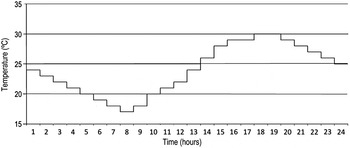
The development of N. tenuis eggs and nymphs was monitored at ten constant temperatures: 12, 15, 18, 21, 24, 27, 30, 33, 35 and 36 ± 1°C. With the aim of establishing possible differences in mean developmental time between constant and variable temperatures, one type-day was constructed simulating a typical Mediterranean summer day. The temperature varied in hourly steps with a minimum of 17°C, a maximum of 31°C and a mean of 24°C (fig. 1).
Type-day constructed for immature stage temperature-dependent development monitoring at mean 24°C alternating temperatures.

Bean pods were incorporated into rearing cages for 24 h as oviposition substrates and then isolated to await egg hatch. Between 50 and 60 newly emerged N. tenuis nymphs were removed with a fine brush and individually introduced into cylindrical plastic cages (16 mm height × 30 mm diameter). Every 2 days, a small piece of bean pod (5 × 5 mm2) was incorporated as a host plant. E. kuehniella eggs were supplied as an ad libitum feed. Each cage lid had a hole with a diameter of 8 mm covered with filter paper for ventilation and to prevent mirids from escaping. The cages were maintained in the growth chamber at the corresponding temperature and at the same RH and photoperiod conditions as those used in rearing.
Daily determinations of insect development and survival were made by observing eggs for hatching and the presence of exuviae until adults emerged. To estimate the sex ratio, adults were sexed by observing the ovipositor in females. Due to the difficulty of observing eggs inside plant tissue, egg mortality was not quantified.
Mathematical models
The relationship between temperature (T) and developmental rate (r = 1/d, where d is the mean developmental time in days), under constant and alternating temperatures, was determined by both linear and nonlinear regression models (Logan type III, Lactin and Brière). The empirical nonlinear models were selected due to their quantitative superiority at both high and low temperatures as compared with the traditional degree-day model; and unlike other nonlinear models, such as catenary (Janisch, Reference Janisch1932), exponential (Belehrádek, Reference Belehrádek1935) or logistic (Davidson, Reference Davidson1944), these models can predict the lower (LT)- and upper (UT)-temperature threshold for development (Logan et al., Reference Logan, Wollkind, Hoyt and Tanigoshi1976; Lactin et al., Reference Lactin, Holliday, Johnson and Craigen1995; Brière et al., Reference Brière, Pracros, Le Roux and Pierre1999).
Linear model
The relationship between T and r was predicted by a regression analysis where r = a + bT; a and b were estimated by least-squares regression. The lower developmental threshold (T 0) and the degree-day requirements (DD) were estimated by the equations T 0 = −a/b and DD = 1/b.
Logan type III model
The mathematical expression of this model is a combination of two functions (Hilbert & Logan, Reference Hilbert and Logan1983). The first function (representing the ascending rate of development with the increasing temperatures) is sigmoid. The second function, developed by Logan et al. (Reference Logan, Wollkind, Hoyt and Tanigoshi1976), represents the descending portion of developmental rate with increasing temperatures. The expression of the model is:
 $$r(T) = {\rm \psi }(({(T - {T_b})^2}/({(T - {T_b})^2} + {D^2})) -e^{-{((Tm-(T - Tb))} / {\Delta T})})$$
where T is the temperature; r(T) is the developmental rate at T temperature; T b is the base temperature (for temperatures below T b , the rate of development presumably equals 0); T m is the lethal maximum temperature threshold (°C above T b ); ΔT is the width of the high-temperature boundary area; ψ and D are empirical constants (Logan et al., Reference Logan, Wollkind, Hoyt and Tanigoshi1976).
Lactin model
Lactin et al. (Reference Lactin, Holliday, Johnson and Craigen1995) modified the nonlinear model proposed by Logan et al. (Reference Logan, Wollkind, Hoyt and Tanigoshi1976) to obtain another model capable of estimating the upper temperature threshold. To do so the ψ parameter is suppressed and a new one (λ) that permits this estimation is introduced:
 $$r(T) = e^{{\rm \rho} T} -e^{( {{\rm \rho} T_{max} - (T_{max} -T)/\Delta )}} + {\rm \lambda} $$
where T is the temperature; r(T) is the developmental rate at T temperature; T max is the supraoptimal temperature at which r (T) = λ; Δ is the range of temperature between T max and the temperature at which r(T) is maximum; ρ describes the acceleration of the function from the LT to optimal temperature and λ is a parameter that allows the curve to intersect the abscissa at suboptimal temperatures, making the estimation of the lower developmental threshold (LT) possible. This parameter represents the asymptote to which the function tends at low temperatures.
Brière model
With the objective of obtaining a more simplified developmental model, Brière et al. (Reference Brière, Pracros, Le Roux and Pierre1999) developed a model with only three parameters:
 $$r(T) = aT(T-{T_0}){({T_L}-T)^{1/2}}\;for\;{T_0} \lt T \lt {T_L}$$
where T is the temperature; r(T) is the developmental rate at T temperature with a value of 0 for temperatures T < T 0 and T > T L ; T 0 is the lower developmental threshold; T L is the upper developmental threshold and a an empirical constant (Brière et al., Reference Brière, Pracros, Le Roux and Pierre1999).
Field validation
To validate the models estimated at constant temperature, field measurements were recorded of embryonic development and of nymphal development and survival. After hatching, 50 newly emerged nymphs were isolated in laboratory bioassays. The bioassay was developed under field conditions inside a covered structure to protect them from rain and direct insolation. The ambient temperature was recorded at 30 min intervals, using a data-logger (Testostor 175). Insect development and mortality were recorded every 24 h.
To compare the observed and the predicted developmental time, the sum of the increments in development at 30 min intervals within the lower and upper developmental temperature limits given by each model was used. The percentage fit of the models to the field development was calculated by dividing the developmental time predicted in each model by the mean field developmental time.
Statistical analyses
The developmental time of female and male N. tenuis and developmental time between temperature regimes (at a constant temperature of 24°C and at a fluctuating temperature with a mean of 24°C) were compared using Student's t-test. Nymphal survival percentages were analyzed using a one-way analysis of variance. Five subpopulations of ten individuals for each temperature regime (constant, alternating and field temperatures) were established to obtain the mean mortality values and its standard errors. A significance level of 5% (α = 0.05) and SPSS (version 20.0; SPSS Inc., Chicago, IL, USA) were utilized in all cases.
The fit of the linear and nonlinear models and the estimation of the different associated parameter values were established with the help of the Tablecurve 2D program (Jandel Scientific, 1994). The initial parameter estimation for the nonlinear Logan type III and Lactin models was developed according to the suggestions of Logan (Reference Logan1988).
Results
Survivorship
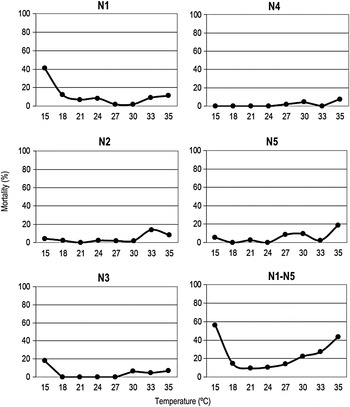
There was no egg survival at the lower and upper tested temperatures (12 and 36°C). N. tenuis achieved complete development from egg to adult at constant temperatures between 15 and 35°C. Throughout this range, the percentage mortality for each nymphal instar showed three different patterns (fig. 2): a backward J-shape was characteristic for N1; the low mortality range of a U-shape for N2–N5; and a U-shape for total nymphal development. The lowest N1–N5 cumulative survival rates of 56.41 and 43.40% were recorded at 15 and 35°C, respectively.
Percentage mortality of Nesidiocoris tenuis nymphal instars at constant temperatures (°C).

There were no significant differences among the percentage of mortality of N. tenuis nymphs developed under constant, alternating and field temperatures: 16.0 ± 5.10; 18.0 ± 3.74; and 10.0 ± 3.16, respectively (P > 0.05).
Developmental time
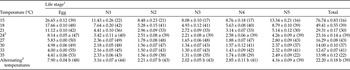
The developmental time of the immature stages of N. tenuis at each experimental temperature between 15 and 35°C are presented in table 1. Embryonic developmental time was notably higher than those of the nymphal stages. The developmental time of N1 and N5 was longer than N2, N3 and N4. The mean total developmental time for immature N. tenuis progressively decreased from 76.74 ± 0.83 d at 15°C, until reaching the lowest value (12.67 ± 0.07 d) at 33°C. Thereafter, an increase in temperature was associated with an increase in developmental time (13.98 ± 0.12 d at 35°C).
Mean developmental time (days ± SE) of immature stages of Nesidiocoris tenuis at constant and alternating temperatures (mean of 24°C).

1 (n), number of individuals used to obtain the developmental time at each temperature treatment.
2 means followed by the same letter show significant differences: egg (t = 3.84; P < 0.01); N1 (t = 1.99; P = 0.05); N2 (t = 2.75; P < 0.01); N3 (t = 2.10; P = 0.04); N4 (t = −2.16; P = 0.03); N5 (t = 0.79; P = 0.43); total (t = 4.28; P < 0.01).
Table 1 also shows the developmental time resulting from the mean 24°C alternating temperature assay.
No differences were observed between total developmental time of males and females at all constant, alternating and field test temperatures (P > 0.05) (table 2).
Mean developmental time (days ± SE) of female and male Nesidiocoris tenuis immature stages at constant, mean 24°C alternating and field temperatures.

1 Means followed by the same letter within the same temperature were not significantly different (Student's t-test).
2 (n) number of individuals.
Model description
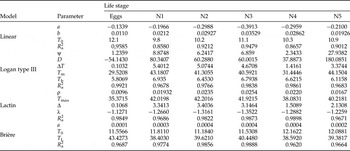
The adjusted coefficients of determination for all nonlinear models were high (R a 2 > 0.96), slightly higher than those of the linear model (R a 2 > 0.86) (table 3).
Estimated parameters and coefficients of determination for linear and nonlinear models describing the relationships between temperature (°C) and developmental rate (r) for immature stages of Nesidiocoris tenuis.

R a 2 is the adjusted coefficient of determination.
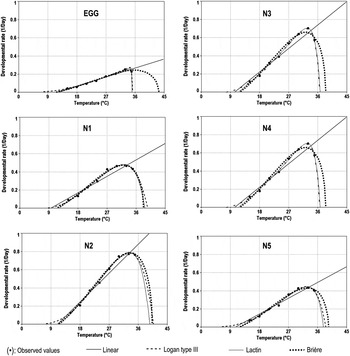
The upper and lower thresholds and the optimal temperatures (T max, T 0 and T opt, respectively) for the different models are presented in table 4. T max, and T opt were not estimated by the linear model. T 0 ranged between 5.9 and 12.5°C, T opt was estimated to be between 31.9 and 35.6°C and T max varied between 35.1 and 43.4°C. The values of T 0 estimated by the Logan type III model were lower than those estimated by other models due to its equation approaching zero asymptotically for temperatures close to T 0 (fig. 3).
Predicted rate of development of Nesidiocoris tenuis as a function of temperature (°C).

Upper and lower thresholds and optimal temperatures (°C) estimated by linear and nonlinear models for the development of Nesidiocoris tenuis immature stages.

Model evaluation
The duration of life stage development obtained under field conditions and the values estimated by the different models are detailed in table 5. All the aforementioned models present an acceptable fit both for each stage and for the total of all immature stages, the most accurate being the nonlinear models Logan type III and Lactin. The lowest percentages of fit were obtained for the egg stage with the linear model (77.2%) and the Brière model (74.2%).
Days necessary for the development of immature stages of Nesidiocoris tenuis under field conditions and the model estimates for constant temperatures.

1 (n), number of individuals used to obtain the developmental time under field conditions.
2 (%), percentage fit: ratio between the lower value by the greater of ‘predicted development time’ and ‘mean field development time’.
Discussion
The U-shaped curve of N. tenuis mortality versus constant temperatures observed in our study is common for insects, with low and nearly constant mortality at favourable temperatures and high mortality beyond certain critical constant temperatures (Wagner et al., Reference Wagner, Wu, Sharpe, Schoolfield and Coulson1984; Fornasari, Reference Fornasari1995; Lamana & Miller, Reference Lamana and Miller1995; Smith & Ward, Reference Smith and Ward1995). However, the range within which minimum mortality takes place is species-specific (Li, Reference Li1995).
The percentage of N. tenuis N1 mortality indicated that it was more sensitive only to the lower tested constant temperature (41.03% of mortality at 15°C). Furthermore, the temperature-dependent mortality of N2–N5 was low (<20%) at all tested temperatures. Moreover, total mortality was also low under alternating temperatures and field conditions. N. tenuis is primarily used as a biological control agent in horticultural crops, especially greenhouse eggplants and tomatoes (Castañé et al., Reference Castañé, Arnó, Beitia, Gabarra, Jacas and Urbaneja2008). These results demonstrate optimal behaviour under these optimum crop temperature conditions.
N. tenuis was able to complete its development between 15 and 35°C. This result concurs with results previously obtained by Hughes et al. (Reference Hughes, Bale and Sterk2009) and Sánchez et al. (Reference Sánchez, Lacasa, Arnó, Castañé and Alomar2009). This temperature range is common in Mediterranean climate spring and summer days.
The developmental time at constant temperatures obtained in our study were similar to those previously reported by Hughes et al. (Reference Hughes, Bale and Sterk2009) and Sánchez et al. (Reference Sánchez, Lacasa, Arnó, Castañé and Alomar2009), except for the lower assayed temperatures (63.4 d against 93.0 d at 15.5°C and 86.7 d at 15°C, respectively). Potential inter-population differences or host plant, beans versus tobacco (Nicotiana tabacum L.) and tomato, respectively, could explain the differences in developmental rates, especially those observed at low temperatures where the developmental time is considerably slower.
Total developmental time for males and females were always the same. Urbaneja et al. (Reference Urbaneja, Tapia and Stansly2005) obtained similar results considering only nymphal development and using three different host plants at 25°C.
In accordance with the obtained data for developmental rate at constant temperatures, linear and nonlinear models were established. The adjusted coefficients were high for all cases (table 3), and better for nonlinear models (R a 2 > 0.96) than for the linear model (R a 2 > 0.86). This result may be expected, because the linear model does not predict the developmental rate for the lower temperatures to approach zero asymptotically, and it is not possible to determine the T 0 and T max (Wagner et al., Reference Wagner, Wu, Sharpe, Schoolfield and Coulson1984). However, a linear model may be interesting in certain cases because of its simplicity and high prediction capacity in the linear portion of the function temperature-developmental rate (Fan, Reference Fan1992).
Lower thermal thresholds obtained in our study ranged from 5.9°C (Logan type III) to 12.5°C (Lactin) for eggs, and 6.2°C (Logan type III) to 12.2°C (Lactin) for nymphal stages (table 4). Sánchez et al. (Reference Sánchez, Lacasa, Arnó, Castañé and Alomar2009) reported values for the tomato host of 10.3°C and 11.7°C, for eggs and total nymphal stage, respectively, while the developmental threshold on tobacco plants was estimated to be 12.9°C for each immature stage (Hughes et al., Reference Hughes, Bale and Sterk2009), both predicted by a linear regression analysis.
In the present study, T max and T 0 were first observed in the different developmental stages of N. tenuis. The upper thresholds obtained ranged from 35.1°C (Logan type III) to 43.3°C (Brière) at the egg stage, and 36.3°C (Logan type III) to 40.5°C (Brière) at the nymphal stage. The high value obtained in the Brière model for the egg stage was, unlike the other cases, due to the fact that the fall in the developmental rate beyond the T 0 was not as marked. A similar trend was observed for the Lactin and Brière models setting for A. bipunctata L. (Coleoptera: Coccinellidae) by Jalali et al. (Reference Jalali, Tirry, Arbab and Clercq2010). T 0 ranged from 31.9°C (Logan type III and Brière for N1 in both cases) to 35.6°C (Brière for egg stage); these optimum temperatures only indicated the temperature at which the development rate was maximum, but were also associated with high mortality rates. Therefore, the most suitable temperature range for N. tenuis, considering developmental rates and mortality, was determined as approximately 27–30°C.
Campbell et al. (Reference Campbell, Frazer, Gilbert, Gutierrez and Mackauer1974) stated that the developmental rate under variable temperatures should not significantly differ from that observed with constant temperature regimes. However, some authors suggest that alternating temperatures play an important role in the development of several insect species (Hagstrum & Milliken, Reference Hagstrum and Milliken1991; Fornasari, Reference Fornasari1995; García-Ruiz et al., Reference García-Ruiz, Marco and Pérez-Moreno2011). Developmental time results were significantly different at 24°C constant temperature, and alternating (mean 24°C) for egg, N2, N3, N4 and total stages. Nevertheless, by observing the results it can be appreciated that the differences between means were very low (less than the elapsed time between observations in all cases). In addition, standard errors reached particularly low values due to the low intrinsic variability of developmental time; this reduced variability within each treatment makes very similar mean results appear different under statistical analysis. Considering both of these reasons, it can be assumed that these differences are due to natural variability between individuals from the same population rather than to the effect of intraday temperature variations. In fact, the percentage fit between developmental time for all immature stages under constant and alternating regimes ranged from 88.1 to 97.7%, which is approximate to the best adjustment percentages provided by the models for developmental time obtained under field conditions (82.2–98.5% for type III Logan and 81.4–100.0% for Lactin).
The field validation (key aspect for the applicability of the models) established that the nonlinear models with the best prediction of N. tenuis developmental time and with high percentages of fit were Logan type III and Lactin.
The success of N. tenuis as a biological control agent using an inundative strategy depends heavily on effectively planning its mass rearing, adequate storage and shipping and optimizing the timing of release. The present results can serve as a useful tool for achieving these objectives. Thus, the most suitable temperature range (27–30°C) for both developmental rate and survival of each instar represents fundamental information for optimizing the growth chamber conditions used in mass rearing for inundative strategies. Conversely, temperatures outside the thermal operative range should be avoided. Furthermore, these data can be used to determine the optimum temperature for N. tenuis storage and shipping. A suitable temperature is 18°C, at which both mortality and developmental rate are very low. Finally, timing of harvest in the rearing system for field releases can be managed by adjusting the temperature according to the target pest population levels, field environmental conditions or agricultural practices such as pesticide applications with toxicological side-effects.
The established models are useful to predict N. tenuis phenology in the field. Also, they make it possible to establish an accurate biofix (an easy to establish event when the forecast starts) associated with an early pre-plant release in the nursery, usually implemented for controlling of T. absoluta and B. tabaci in greenhouse tomato crops. A different biofix should be used if a subsequent release of N. tenuis adults in the greenhouse is necessary due to high population densities of one of the target pests (Calvo et al., Reference Calvo, Bolckmans and Belda2012). The findings in this study, along with the environmental conditions in each region, may also be useful for predicting the potential establishment of N. tenuis in exotic regions and to evaluate possible changes in its distribution and abundance as a consequence of global warming. Therefore, this study will contribute to improving the use of N. tenuis as a biological control agent of important agricultural pests.
ACKNOWLEDGEMENTS
The authors would like to express their gratitude to Dr Eduardo Sáenz de Cabezón (Universidad de La Rioja) for assisting with the mathematical and statistical analyses.