Introduction
Late-life depression is classified as a mood disorder, yet abnormalities in various executive functions often occur during depressive episodes (Elliott et al. Reference Elliott, Sahakian, Michael, Paykel and Dolan1998; Eshel & Roiser, Reference Eshel and Roiser2010; Vrieze et al. Reference Vrieze, Pizzagalli, Demyttenaere, Hompes, Sienaert, de Boer, Schmidt and Claes2013). A large body of literature suggests that executive processes consist of two distinct sets of cognitive functions: one concerned with cognitive control and the other with reward-related decision making (Glascher et al. Reference Glascher, Adolphs, Damasio, Bechara, Rudrauf, Calamia, Paul and Tranel2012; Roiser & Sahakian, Reference Roiser and Sahakian2013). Cognitive control processes include response inhibition, planning, problem solving, and working memory. Reward-related decision-making processes include valuation, reward learning, and decision making. Cognitive control and reward-related decision making are instantiated in distinct neuroanatomical circuits, which interact to generate adaptive behavior. Abnormalities in both cognitive control and reward-related decision-making tasks (Elliott et al. Reference Elliott, Sahakian, Michael, Paykel and Dolan1998; Eshel & Roiser, Reference Eshel and Roiser2010; Vrieze et al. Reference Vrieze, Pizzagalli, Demyttenaere, Hompes, Sienaert, de Boer, Schmidt and Claes2013) have been reported in depression. Determining which of these functions is central to perpetuating the syndrome of late-life depression is an important heuristic and clinical question.
Impairment in some cognitive control functions has been associated with poor outcomes of late-life depression when treated with antidepressants. In particular, tests of initiation/perseveration, cognitive inhibition, and semantic clustering have been associated with poor or slow improvement of late-life depression to antidepressants (Alexopoulos et al. Reference Alexopoulos, Kiosses, Heo, Murphy, Shanmugham and Gunning-Dixon2005; Sneed et al. Reference Sneed, Culang, Keilp, Rutherford, Devanand and Roose2010; Morimoto et al. Reference Morimoto, Gunning, Murphy, Kanellopoulos, Kelly and Alexopoulos2011, Reference Morimoto, Gunning, Kanellopoulos, Murphy, Klimstra, Kelly and Alexopoulos2012, Pimontel et al. Reference Pimontel, Culang-Reinlieb, Morimoto and Sneed2012). Performance in these tests requires integrity of the anterior cingulate cortex (ACC) and the dorsolateral prefrontal cortices (DLPFC) (Elliott et al. Reference Elliott, Baker, Rogers, O'Leary, Paykel, Frith, Dolan and Sahakian1997; Dagher et al. Reference Dagher, Owen, Boecker and Brooks1999; MacDonald et al. Reference MacDonald, Cohen, Stenger and Carter2000; Beauchamp et al. Reference Beauchamp, Dagher, Aston and Doyon2003; van den Heuvel et al. Reference van den Heuvel, Groenewegen, Barkhof, Lazeron, van Dyck and Veltman2003; Goethals et al. Reference Goethals, Audenaert, Jacobs, Van de Wiele, Pyck, Ham, Vandierendonck, van Heeringen and Dierckx2004; Ruocco et al. Reference Ruocco, Rodrigo, Lam, Di Domenico, Graves and Ayaz2014). These neuropsychological findings parallel structural and functional neuroanatomical changes associated both with cognitive control dysfunction and with poor outcomes of late-life depression treated with antidepressants. These include white-matter hyperintensities (Gunning-Dixon et al. Reference Gunning-Dixon, Walton, Cheng, Acuna, Klimstra, Zimmerman, Brickman, Hoptman, Young and Alexopoulos2010), microstructural white-matter changes (Alexopoulos et al. Reference Alexopoulos, Murphy, Gunning-Dixon, Latoussakis, Kanellopoulos, Klimstra, Lim and Hoptman2008), low volume of the anterior cingulate (Gunning et al. Reference Gunning, Cheng, Murphy, Kanellopoulos, Acuna, Hoptman, Klimstra, Morimoto, Weinberg and Alexopoulos2009), hypoactivation of the cognitive control network in response to a cognitive control challenge (Aizenstein et al. Reference Aizenstein, Butters, Figurski, Stenger, Reynolds and Carter2005), and reduced resting functional connectivity of the cognitive control network (Alexopoulos et al. Reference Alexopoulos, Hoptman, Kanellopoulos, Murphy, Lim and Gunning2012). Taken together, these findings lend support to the hypothesis that depression with cognitive control dysfunction is a distinct syndrome of late-life depression (Alexopoulos, Reference Alexopoulos2001) with poor outcomes following treatment with antidepressants.
In addition to cognitive control dysfunction, abnormal performance in reward-related decision-making tasks has been reported in depression (Eshel & Roiser, Reference Eshel and Roiser2010; Vrieze et al. Reference Vrieze, Pizzagalli, Demyttenaere, Hompes, Sienaert, de Boer, Schmidt and Claes2013). Performance in such tasks requires integrity of the ventromedial prefrontal cortex (VMPFC) (Rogalsky et al. Reference Rogalsky, Vidal, Li and Damasio2012). Neuroimaging, neuropathologic, and lesion analysis findings implicate the VMPFC in the pathophysiology of major depression (Drevets, Reference Drevets2007). Severity of depression is inversely correlated with physiological activity in parts of the posterior lateral and medial orbitofrontal cortex and cerebrovascular lesions in this region predispose to depression. Posterior lateral and medial orbitofrontal cortex function may also be impaired in mood disorders, as these patients have low gray-matter volume, histopathologic abnormalities, and altered hemodynamic responses to emotionally valenced stimuli, probabilistic reversal learning, and reward processing. Impairment in reward-related decision making is mediated by the VMPFC and in late-life depression is associated with critical clinical outcomes including functional impairment and suicidality (Jollant et al. Reference Jollant, Bellivier, Leboyer, Astruc, Torres, Verdier, Castelnau, Malafosse and Courtet2005, Reference Jollant, Lawrence, Olie, O'Daly, Malafosse, Courtet and Phillips2010; Dombrovski et al. Reference Dombrovski, Siegle, Szanto, Clark, Reynolds and Aizenstein2012). Despite these findings, it is unknown whether abnormal performance in tasks requiring integrity of the VMPFC is linked to change of late-life depression during treatment with antidepressants.
The goal of this study was to examine whether performance in cognitive control and reward-related decision-making tasks predicts change of symptoms and signs of late-life major depression during treatment with a selective serotonin reuptake inhibitor (SSRI). To this end, we used a set of cognitive control tasks [Stroop Color-Word, Tower of London (ToL), and Dementia Rating Scale – Initiation/Perseveration domain (DRS-IP)] and a reward-related decision-making task [Iowa Gambling Test (IGT)]. Based on earlier literature (Alexopoulos et al. Reference Alexopoulos, Kiosses, Heo, Murphy, Shanmugham and Gunning-Dixon2005; Sneed et al. Reference Sneed, Culang, Keilp, Rutherford, Devanand and Roose2010; Morimoto et al. Reference Morimoto, Gunning, Murphy, Kanellopoulos, Kelly and Alexopoulos2011, Reference Morimoto, Gunning, Kanellopoulos, Murphy, Klimstra, Kelly and Alexopoulos2012; Pimontel et al. Reference Pimontel, Culang-Reinlieb, Morimoto and Sneed2012), we hypothesized that depressed older patients with abnormal performance in cognitive control tasks constitute a group with poor outcomes (decline in depressive symptoms and probability of remission) to treatment with the SSRI escitalopram, while patients with abnormal performance in a reward-related decision-making task, but relatively unimpaired cognitive control performance, will have outcomes similar to those of patients with unimpaired executive functions (null hypothesis).
Method
Subjects
The subjects were consecutively recruited older adults with major depression and non-depressed comparison subjects who had completed the following four executive function tests during their baseline assessment: IGT (Bechara, Reference Bechara2007), Stroop Color-Word test (Golden, Reference Golden1978), ToL (Culbertson & Zillmer, Reference Culbertson and Zillmer2001), and DRS-IP (Mattis, Reference Mattis1989). Additional inclusion criteria for the depressed subjects were: (1) age ⩾ 60 years; (2) unipolar, non-psychotic major depression by SCID (First et al. Reference First, Spitzer, Williams and Gibbon1995; DSM-IV); (3) Mini-Mental State Examination (MMSE; Folstein et al. Reference Folstein, Folstein and McHugh1975) ⩾ 24; (4) capacity to consent. Exclusion criteria were: (1) intent or plan to attempt suicide in the near future; (2) history or presence of psychiatric diagnoses other than unipolar, non-psychotic major depression or generalized anxiety disorder; and (3) use of psychotropic drugs or cholinesterase inhibitors other than mild doses of benzodiazepines. The inclusion criteria for the non-depressed comparison group were: (1) age ⩾ 60 years; (2) absence of presence or history of psychiatric disorders; and (3) use of psychotropic agents. The study was approved by the Weill Cornell Medical College Institutional Review Board.
Treatment
Depressed subjects had a single-blind, 2-week drug-washout phase during which they received placebo identical to escitalopram tablets. This phase was followed by treatment with 10 mg/day escitalopram for 1 week followed by an increase to the target dose of 20 mg/day. Subjects who were unable to tolerate 20 mg/day received 15 mg or 10 mg/day. Subjects unable to tolerate 10 mg exited the study. The primary treatment outcome was severity of depression assessed with the 24-item Hamilton Depression Rating Scale (HAMD; Hamilton, Reference Hamilton1960).
Assessment of executive functions
Stroop Color-Word
Response inhibition was tested with the Stroop Color-Word test. Subjects are presented with a list of the words ‘red’, ‘blue’, and ‘green’ printed with an incongruent ink color, e.g. the word ‘red’ printed with blue ink. Subjects were instructed to name the ink color of each word and inhibit the prepotent competing response of reading the word. Scores represent the total number of responses in 45 s. We used the Stroop Interference score, which takes into consideration processing speed (Golden, Reference Golden1978). To this end, we first calculated the Predicted Color-Word score (Color score × Word score/Color score + Word score). The Interference score consists of the Color-Word score minus the Predicted Color-Word score. Functional neuroimaging studies have shown ACC activation during Stroop performance (MacDonald et al. Reference MacDonald, Cohen, Stenger and Carter2000). Abnormal Stroop-induced ACC activation has been reported in fMRI studies of depressed individuals (Liotti & Mayberg, Reference Liotti and Mayberg2001; Kikuchi et al. Reference Kikuchi, Miller, Schneck, Oquendo, Mann, Parsey and Keilp2012).
ToL
Planning was tested with the ToL, 2nd edn (Culbertson & Zillmer, Reference Culbertson and Zillmer2001). The test consists of two pegboards with three pegs of different lengths. Each pegboard has three beads of different colors (red, green, blue), and subjects are asked to move their beads one at a time to replicate the bead pattern on the examiner's board. After a demonstration and two practice trials, subjects conduct 10 trials replicating increasingly difficult bead configurations. The score for each trial consists of moves made above the minimum required to replicate that bead configuration. The total moves for each of the 10 trials are summed for the total reported score. Performance in the ToL task activates the DLPFC and caudate nucleus (Elliott et al. Reference Elliott, Baker, Rogers, O'Leary, Paykel, Frith, Dolan and Sahakian1997; Dagher et al. Reference Dagher, Owen, Boecker and Brooks1999; Beauchamp et al. Reference Beauchamp, Dagher, Aston and Doyon2003; van den Heuvel et al. Reference van den Heuvel, Groenewegen, Barkhof, Lazeron, van Dyck and Veltman2003; Goethals et al. Reference Goethals, Audenaert, Jacobs, Van de Wiele, Pyck, Ham, Vandierendonck, van Heeringen and Dierckx2004; Ruocco et al. Reference Ruocco, Rodrigo, Lam, Di Domenico, Graves and Ayaz2014).
DRS-IP
The IP domain tests: (1) verbal initiation/perseveration, i.e. naming of all things one can buy in a supermarket over 1 min; (2) alternating hand movements; and (3) graphomotor design, e.g. reproduce XOXO. The IP has high criterion validity against standard neuropsychological measures of verbal initiation and perseveration (Marson et al. Reference Marson, Dymek, Duke and Harrell1997). Functional neuroimaging studies suggest that functions tested by the IP subscale require integrity of circuitry including the ACC and the DLPFC (Jueptner et al. Reference Jueptner, Stephan, Frith, Brooks, Frackowiak and Passingham1997; Sakai et al. Reference Sakai, Hikosaka, Miyauchi, Takino, Sasaki and Putz1998).
IGT
This test consists of 100 playing cards from four decks (A, B, C, D) (Bechara, Reference Bechara2007). Some cards are followed by reward (monetary gain), whereas others are followed by punishment (monetary loss). Subjects are instructed to choose cards from one of the four decks with the aim to win as much money as possible. Decks with higher immediate reward (A and B) have higher long-term punishment, yielding an overall net loss. Decks (C and D) with lower immediate gain have lower long-term punishment, yielding an overall net gain (advantageous decks). A performance score is calculated by subtracting the number of risky deck choices (A and B) from the number of conservative deck choices (C and D), i.e. [(C + D) − (A + B)]. Performance in the IGT predicts performance on other decision-making tasks such as temporal discounting (Halfmann et al. Reference Halfmann, Hedgcock, Bechara and Denburg2014) and consumer decision making (Denburg et al. Reference Denburg, Cole, Hernandez, Yamada, Tranel, Bechara and Wallace2007). Human lesion (Glascher et al. Reference Glascher, Adolphs, Damasio, Bechara, Rudrauf, Calamia, Paul and Tranel2012) and neuroimaging studies (Rogalsky et al. Reference Rogalsky, Vidal, Li and Damasio2012) have shown that performance in the IGT requires integrity of the VMPFC.
In addition to executive function tests, overall cognitive impairment was assessed with the Mini-Mental State Examination (MMSE; Folstein et al. Reference Folstein, Folstein and McHugh1975) and memory was assessed with the Hopkins Verbal Learning Test – Revised (HVLT; Benedict et al. Reference Benedict, Schretlen, Groninger and Brandt1998).
Assessment of psychopathology, medical burden, and disability
Diagnosis was assigned in research conferences by agreement of two clinician investigators after review of history and the SCID-R (First et al. Reference First, Spitzer, Williams and Gibbon1995). Age at onset of first episode of major depression was derived from the SCID-R. All other research data were obtained by interviewers trained by the Weill Cornell Institute of Geriatric Psychiatry.
Anxiety was assessed with the Clinical Anxiety Scale (CAS; Snaith et al. Reference Snaith, Baugh, Clayden, Husain and Sipple1982), hopelessness with the Beck Hopelessness Scale (BHS; Beck et al. Reference Beck, Weissman, Lester and Trexler1974), neuroticism with the 12-item subscale of the NEO (Costa & McCrae, Reference Costa and McCrae1992), and life satisfaction with the 13-item Life Satisfaction Index (Wood et al. Reference Wood, Wylie and Sheafor1969). Disability was quantified by the interviewer-administered 12-item World Health Organization Disability Assessment Schedule II (WHODAS) (Epping-Jordan & Ustun, Reference Epping-Jordan and Ustun2000). The WHODAS yields a composite score of disability after assessing the domains of: understanding and communicating, getting around, self-care, getting along with others, household and work activities, and participation in society. Medical burden was quantified with the Charlson Comorbidity index (CCI) (Charlson et al. Reference Charlson, Pompei, Ales and MacKenzie1987).
After baseline assessment, the HAMD was assessed weekly for 4 weeks then every other week until week 12. Payment for transportation or transportation arrangements were provided to all meetings. Compensation was offered for time spent in assessments.
Data analysis
We conducted agglomerative hierarchical cluster analysis using Ward's method (Ward, Reference Ward1963) with squared Euclidean distance to identify clusters based on performance on four tests of executive function; all subjects had data on the variables used in the cluster analysis. This method classifies subjects into clusters and aims to increase within-cluster homogeneity and between-cluster heterogeneity, i.e. within each cluster subjects have similar test performance but clusters are distinct from each other. The choice of the number of clusters was based on maximizing the Calinski–Harabasz index (CH index; Calinski & Harabasz, Reference Calinski and Harabasz1974), a ratio of between-cluster to within-cluster variation, size of each cluster (⩾10) and clinical judgment. Group comparisons (depressed v. non-depressed and comparisons among the three clusters) of demographic and clinical characteristics was performed with analysis of variance (ANOVA). Age and education were used as covariates in all comparisons of cognitive performance tests.
We used mixed-effects linear regression analyses (Laird & Ware, Reference Laird and Ware1982) to compare HAMD scores among the resultant clusters over a period of 12 weeks. The model included random effects for intercept and slope and fixed effects for cluster, time trend parameter(s) and time × cluster interaction. We examined a model which included a cluster-specific random intercept and nested random intercept for patients within clusters, but the estimate for cluster-specific random intercept was zero and this model was not selected.
To evaluate remission of depression (HAMD ⩽ 10), we used a mixed-effects logistic regression model to analyze the longitudinal trajectory of the probability of remission. HAMD ⩽ 10 is commonly used to define remission of late-life depression (Lecrubier, Reference Lecrubier2002). Age and gender were included as covariates in all analyses and retained in the model if significant or improved model fit.
Results
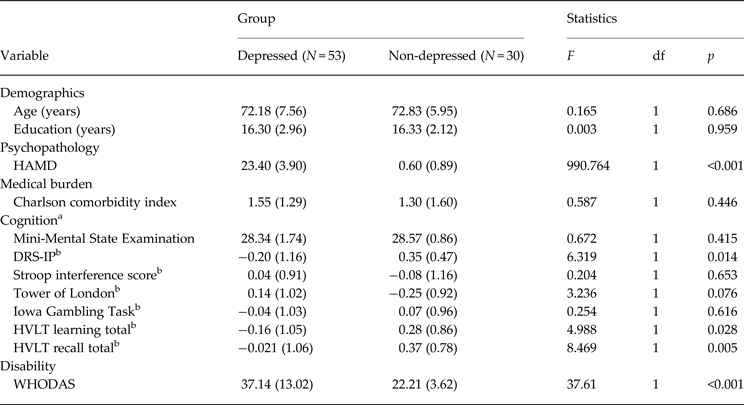
A total of 83 subjects met criteria for this analysis. Of these, 53 met criteria for major depression and 30 had no psychopathology. The depressed subjects had greater severity of depression and disability and worse performance in the memory task (HVLT) and in one of the executive function tasks (DRS-IP) than non-depressed subjects (Table 1). However, there were no differences between depressed and non-depressed subjects in demographics, medical burden, and overall cognitive impairment (MMSE).
Clinical and cognitive functioning characteristics of 53 participants with major depression and 30 non-depressed participants

HAMD, 24-item Hamilton Depression Rating Scale; DRS-IP, Dementia Rating Scale – Initiation/Perseveration domain; HVLT, Hopkins Verbal Learning Test; WHODAS, World Health Organization Disability Assessment Scale II.
a Controlled for age and education.
b Z scores.
Exploratory cluster analysis
We used exploratory hierarchical cluster analysis to classify the depressed subjects according to their performance on four executive function tests, i.e. the Stroop Color-Word, the ToL, the DRS-IP, and the IGT. Based on a CH index (30.9) and clinical/biological relevance, a three-cluster solution was chosen: a Cognitive Control cluster (abnormal Stroop, ToL, DRS-IP), a Reward-Related cluster (abnormal IGT), and an Executively Unimpaired cluster. A two-cluster solution (Cognitive Control v. Combined Reward-Related and the Executively Unimpaired clusters combined into one) had a slightly higher CH index (31.4) but the three-cluster solution was chosen because the Reward-Related cluster and Executively Unimpaired cluster represent heuristically distinct groups.
Clinical profile
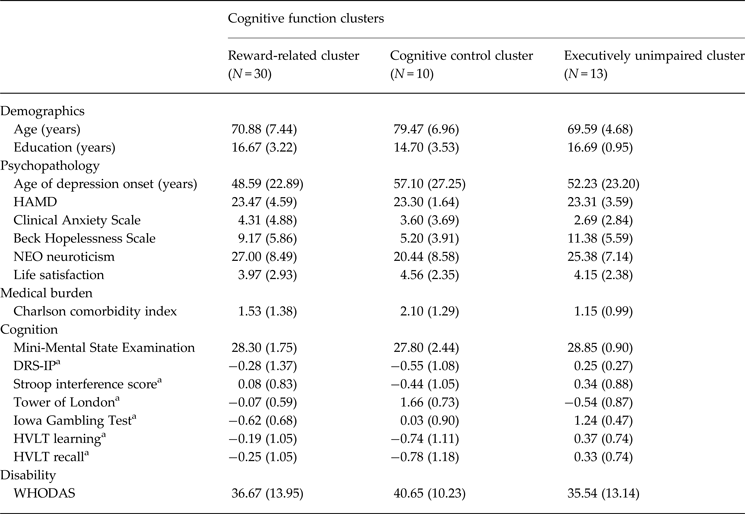
Subjects in the three clusters had similar age and education (Table 2). Age at depression onset, severity of depression (HAMD), severity of anxiety (CAS), medical burden (CCI), overall cognitive impairment (MMSE), and disability (WHODAS) were similarly distributed across the three clusters. The Cognitive Control cluster had lower hopelessness (BHS) scores than the Reward-Related cluster and the Cognitively Unimpaired cluster (F = 3.64, df = 2, p < 0.034).
Clinical characteristics in three clusters of executive functions of 53 older patients with major depression

HAMD, 24-item Hamilton Depression Rating Scale; DRS-IP, Dementia Rating Scale – Initiation/Perseveration domain; HVLT, Hopkins Verbal Learning Test; WHODAS, World Health Organization Disability Assessment Scale II.
a Z scores.
Treatment
Of the 53 depressed subjects who participated in this analysis, one exited the study prior to receiving any treatment. The remaining subjects were treated with escitalopram. Of the 52 treated subjects, 88% (46/52) received the target dose of 20 mg/day, 4% (2/52) received 15 mg/day and 8% (4/52), received 10 mg/day. Both dosages and duration of treatment were similarly distributed across the three clusters. Specifically, subjects within the Cognitive Control cluster received a mean daily dose of 19.00 mg (s.d. = 3.16), subjects within the Reward-Related cluster 18.97 mg (s.d. = 2.80), and subjects within the Executively Unimpaired cluster 19.23 mg (s.d. = 2.77). The corresponding means of duration of escitalopram treatment were 11.80 weeks (s.d. = 0.63), 10.38 weeks (s.d. = 3.62), and 12.00 weeks (s.d. = 0).
Treatment outcomes
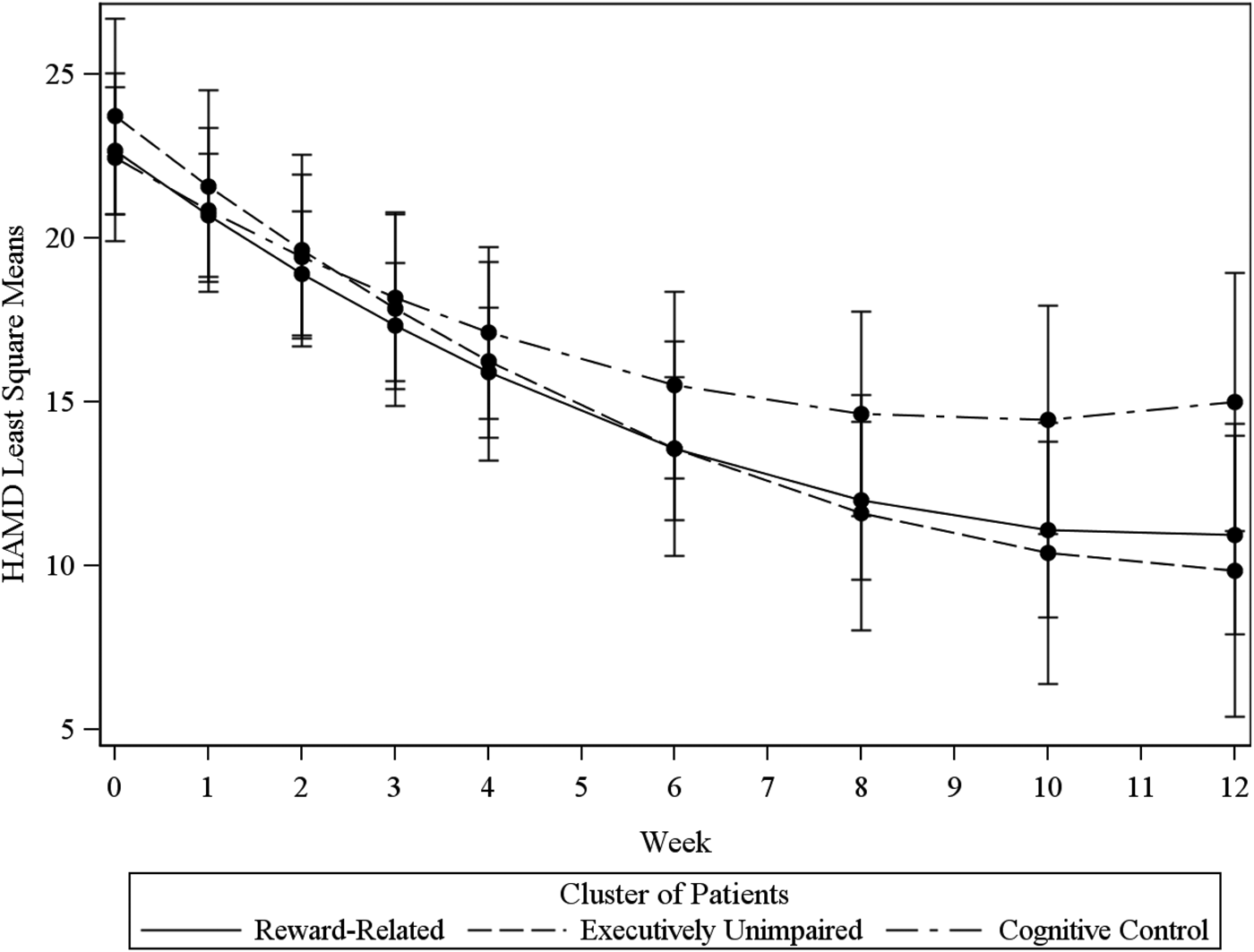
We compared the trajectory of depression severity (HAMD) of the three clusters with a linear mixed model with fixed effects for linear week, quadratic week and week × cluster interaction and subject-specific random effects for intercept and slope. Week and quadratic week were significantly different from zero indicating that all clusters had a reduction in HAMD over time. The week × cluster interaction was significantly different (F 2, 331 = 3.03, p = 0.0497) indicating different HAMD progression in the paths of each cluster (Fig. 1). The decline in severity of depression (HAMD) was greater in the Executively Unimpaired cluster (t = −2.09, df = 331, p = 0.0375) and the Reward-Related cluster (t = −2.33, df = 331, p = 0.0202) than in the Cognitive Control cluster.
Trajectory of 24-item Hamilton Depression Rating Scale (HAMD) scores in three clusters of older patients with major depression (N = 53) treated with escitalopram.

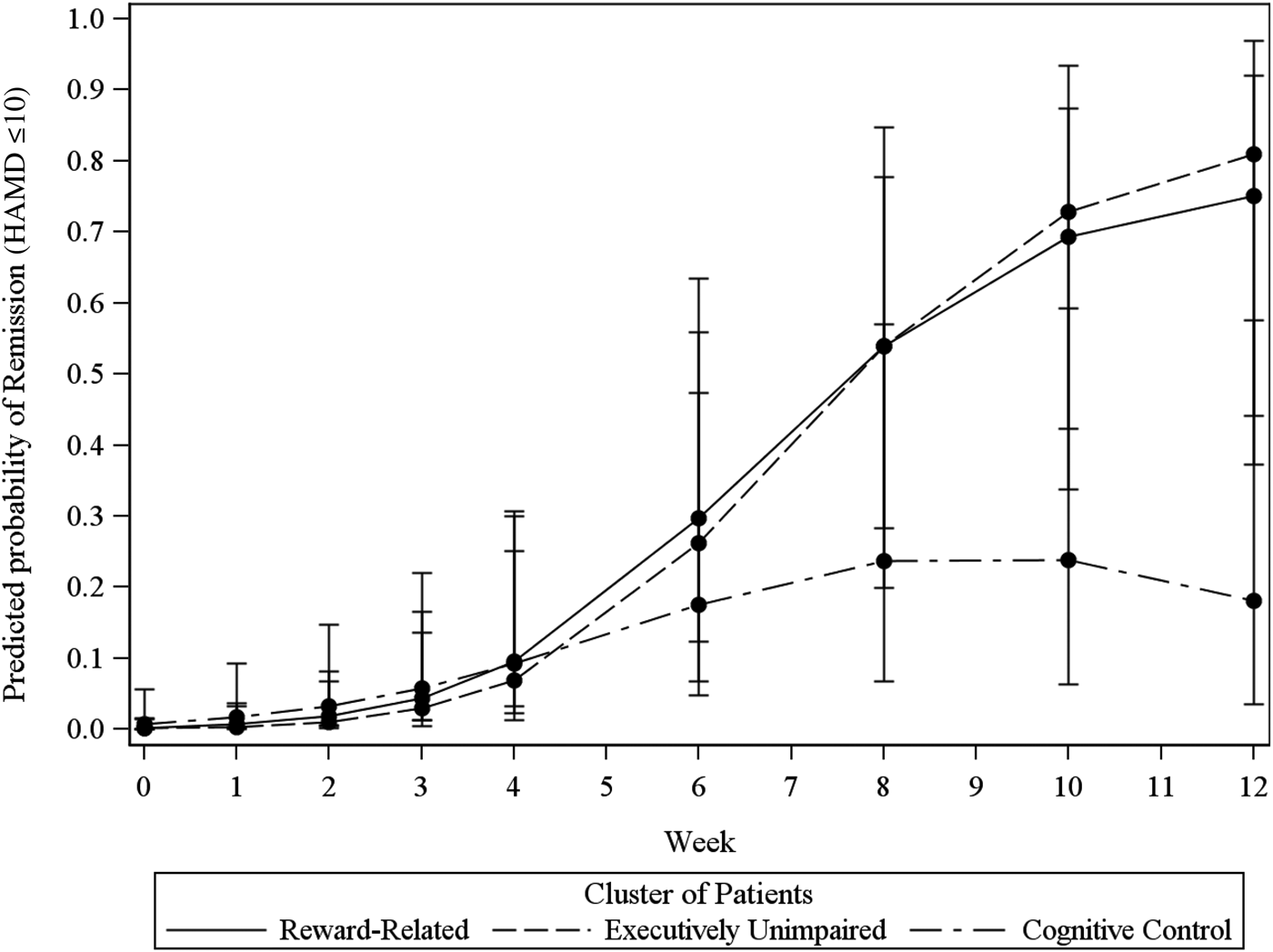
Remission was achieved in one (out of 10) subjects in the Cognitive Control cluster, 18 (out of 30) in the Reward-Related cluster, and eight (out of 13) in the Executively Unimpaired cluster. A mixed-effects analysis of depression remission (HAM-D ⩽ 10) trajectory as a binary outcome was performed with fixed effects for linear week, quadratic week, cluster, and cluster × week interaction and a subject-specific random intercept. There was a week × cluster interaction (F 2, 331 = 4.31, p = 0.0648). The Cognitive Control cluster had a lower probability of remission than the Executively Unimpaired cluster (t = 2.17, df = 331, p = 0.03) and the Reward-Related cluster (t = 2.03, df = 331, p = 0.0433) (Fig. 2).
Longitudinal trajectory of the probability of remission (HAMD ⩽ 10) in three clusters of older patients with major depression (N = 53) treated with escitalopram. HAMD, Hamilton Depression Rating Scale.

Discussion
The principal finding of this study is that older adults with major depression and abnormal performance in cognitive control tasks had less decline of depressive symptoms during treatment with escitalopram than depressed subjects with abnormal reward-related decision making or executively unimpaired patients. Moreover, subjects of the abnormal cognitive control cluster had lower probability of remission during the 12-week escitalopram treatment period.
To our knowledge, this is the first study to observe that abnormality in tasks of cognitive control, but not in reward-related decision making, influence the trajectory of symptoms and the attainment of remission of late-life depression during treatment with an antidepressant. This observation is consistent with neurobiological findings suggesting that these two sets of functions rely on distinct brain networks. Cognitive control functions, such as those tested by the Stroop Color-Word, the ToL and the DRS-IP, are mediated by a rostro-caudal hierarchy of structures organized for behavioral control and planning (Glascher et al. Reference Glascher, Adolphs, Damasio, Bechara, Rudrauf, Calamia, Paul and Tranel2012). This hierarchy includes the DLPFC and its connections to posterior cortical areas in the parietal lobe. The rostral ACC has been found to be activated by cognitive control tasks of set shifting and error detection in fMRI studies (Braver et al. Reference Braver, Barch, Gray, Molfese and Snyder2001; Lie et al. Reference Lie, Specht, Marshall and Fink2006) and lesions in the anterior sectors of ACC impair rule-switching in primates (Buckley et al. Reference Buckley, Mansouri, Hoda, Mahboubi, Browning, Kwok, Phillips and Tanaka2009). More posterior regions within the dorsal ACC and the DLPFC may be recruited during error detection (Braver et al. Reference Braver, Barch, Gray, Molfese and Snyder2001) and conflict monitoring (MacDonald et al. Reference MacDonald, Cohen, Stenger and Carter2000; Botvinick et al. Reference Botvinick, Braver, Barch, Carter and Cohen2001), while parietal regions are responsible for selective attention (Roberts & Hall, Reference Roberts and Hall2008). Reward-related decision making, such as that tested by the IGT, is mainly mediated by ventromedial structures of the prefrontal cortex and has strong connections to the limbic system. Lesion studies have shown that damage of the VMPFC impairs performance in the IGT but spares performance in cognitive control tasks (Stuss et al. Reference Stuss, Levine, Alexander, Hong, Palumbo, Hamer, Murphy and Izukawa2000; Glascher et al. Reference Glascher, Adolphs, Damasio, Bechara, Rudrauf, Calamia, Paul and Tranel2012). Both the cognitive control and the reward-related networks converge at the ACC, which serves as the point for their interaction (Glascher et al. Reference Glascher, Adolphs, Damasio, Bechara, Rudrauf, Calamia, Paul and Tranel2012) and plays a role in symptom change during treatment with antidepressants (Seminowicz et al. Reference Seminowicz, Mayberg, McIntosh, Goldapple, Kennedy, Segal and Rafi-Tari2004; Drevets et al. Reference Drevets, Savitz and Trimble2008; Liston et al. Reference Liston, Chen, Zebley, Drysdale, Gordon, Leuchter, Voss, Casey, Etkin and Dubin2014; McGrath et al. Reference McGrath, Kelley, Dunlop, Holtzheimer, Craighead and Mayberg2014). It is tempting to speculate that facilitation of decline in symptoms of depression during treatment with antidepressants is mediated by input of cognitive control structures to the ACC, which in turn exerts control over limbic structures. Input of VMPFC structures to ACC, although important for reward-related decision making, may not be related to outcomes of antidepressant drug treatment.
Our findings are consistent with reports that impairment on some cognitive control tasks predicts little change in symptoms of late-life depression during treatment with antidepressant drugs (Alexopoulos et al. Reference Alexopoulos, Kiosses, Murphy and Heo2004, Reference Alexopoulos, Kiosses, Heo, Murphy, Shanmugham and Gunning-Dixon2005; Morimoto et al. Reference Morimoto, Gunning, Murphy, Kanellopoulos, Kelly and Alexopoulos2011). It has been suggested that this relationship is rather specific to cognitive control tasks. A study of old-old patients with major depression treated with citalopram found that performance on the Stroop Color/Word task – but not overall cognitive impairment or poor performance in choice reaction time, spatial judgment, or selective reminding – influences antidepressant response (Sneed et al. Reference Sneed, Keilp, Brickman and Roose2008). Our findings further support the specificity of the relationship between cognitive control abnormalities on the one hand and change in depressive symptoms and remission rate during treatment with escitalopram.
The findings of this study should be viewed in the context of its limitations. These include the small sample, the uncertainty of hierarchical clustering in identifying clusters, the limited number of neuropsychological tests, and the effect of processing speed on these tests. Processing speed moderates performance on other neuropsychological instruments (Butters et al. Reference Butters, Whyte, Nebes, Begley, Dew, Mulsant, Zmuda, Bhalla, Meltzer, Pollock, Reynolds and Becker2004). Therefore, we cannot exclude that slow processing did not influence the relationship of cognitive control abnormalities to change in depressive symptoms during escitalopram treatment. Other limitations include the absence of a placebo-treated group, and the use of a single antidepressant. However, testing of depressed subjects occurred after a 2-week placebo/washout phase that might have reduced the influence of prior psychotropic treatment on test performance and the inclusion of placebo responders. Further, most of our subjects tolerated high dosages of escitalopram, and there were no significant dosage and length of drug treatment differences among the three clusters. Finally, there was high retention of subjects in all three groups. Therefore, differences in change in depressive symptoms and in time in remission may not be attributed to under-dosage, unequal intensity or length of treatment, or selective drop-out. Nonetheless, replication of this study is necessary.
The clinical significance of this study's findings is their potential use for treatment selection. While a convergence of findings suggests that poor performance in cognitive control tasks is a rather specific predictor of poor outcome to treatment with at least some antidepressants (Alexopoulos et al. Reference Alexopoulos, Kiosses, Murphy and Heo2004, Reference Alexopoulos, Kiosses, Heo, Murphy, Shanmugham and Gunning-Dixon2005; Sneed et al. Reference Sneed, Keilp, Brickman and Roose2008; Morimoto et al. Reference Morimoto, Gunning, Murphy, Kanellopoulos, Kelly and Alexopoulos2011), it is possible that such patients may do well with other antidepressant strategies, e.g. other psychotropic agents, transcranial magnetic stimulation, other psychotherapies. In fact, problem-solving therapy improved depression (Arean et al. Reference Arean, Raue, Mackin, Kanellopoulos, McCulloch and Alexopoulos2010) and disability (Alexopoulos et al. Reference Alexopoulos, Raue, Kiosses, Mackin, Kanellopoulos, McCulloch and Arean2011) in older adults with major depression and cognitive control dysfunction more than supportive therapy even though performance in a cognitive control tests improved equally in the two treatment groups (Mackin et al. Reference Mackin, Nelson, Delucchi, Raue, Byers, Barnes, Satre, Yaffe, Alexopoulos and Arean2013).
In sum, impairment in cognitive control functions, but not in reward-related decision making, appears to adversely influence outcomes of geriatric depression to escitalopram. The theoretical significance of this finding is that it provides a target for neuroimaging studies of outcomes of antidepressants focusing on the structural and functional connectivity of cognitive control structures to rostral ACC and to limbic structures. In addition to its theoretical significance, if our finding is replicated, simple to administer cognitive control tests may be used to select depressed older patients at risk for poor outcomes with some SSRI antidepressants who may require a structured, learning-based therapy.
Acknowledgements
Personnel cost for this work was supported by NIMH grants R01 MH065653, R01 MH079414, T32 MH019132 and the Sanchez Foundation. Escitalopram and placebo were provided free of cost by Forest Pharmaceuticals, Inc.
Declaration of Interest
None.