Introduction
Increased life expectancy has led to the rapid aging of the population, such that the proportion of the world’s population over 60 years old will reach a total of 2 billion in 2050 (World Health Organization, 2018). It has been well established that the normal aging process is associated with a decline in cognitive functioning (Harada et al., Reference Harada, Natelson Love and Triebel2013). In some cases, the cognitive change may exceed what would be expected due to age, progressing to dementia, which affects around 50 million people worldwide (World Health Organization, 2019). Consequently, there is a need to identify modifiable vulnerability and protection factors in the cognitive decline of older adults.
Depressive symptoms have been proposed as a modifiable risk factor for cognitive decline (Deckers et al., Reference Deckers2015) because both depressive symptoms and cognitive dysfunction are related to white matter hyper-intensity (Respino et al., Reference Respino2019) and hippocampal atrophy (Elbejjani et al., Reference Elbejjani2015). Some studies have found a relationship between depressive symptoms and poor cognitive functioning (Kim et al., Reference Kim, Liu, Nakaoka, Jang and Browne2018), whereas others have indicated a lack of association (Becker et al., Reference Becker2009) or suggested that depressive symptoms do not necessarily precede poor cognitive functioning (Richard et al., Reference Richard2013).
Depressive symptoms are very heterogeneous in their origin, clinical manifestations, and response to treatment (Korczyn and Halperin, Reference Korczyn and Halperin2009), so it is not surprising that the inter-relationships between depressive symptoms and cognitive decline are complex, and that not all individuals would be affected by depressive symptoms in the same way. One of the constructs that may modulate the influence of depressive symptoms on cognitive functioning is cognitive reserve, which refers to aspects of the brain structure and function that may act as protective mechanisms to compensate for damage by promoting alternative neural networks (Siedlecki et al., Reference Siedlecki, Stern, Reuben, Sacco, Elkind and Wright2009). Cognitive reserve theory establishes that individuals may differ in their resilience to age-related brain changes and pathologies (Stern, Reference Stern2012). Thus, cognitive reserve may be a moderator factor between pathology and clinical outcomes (Stern, Reference Stern2012), accounting for differences in trajectories of late-life cognition (Siedlecki et al., Reference Siedlecki, Stern, Reuben, Sacco, Elkind and Wright2009).
An individual’s educational level can contribute to his/her cognitive reserve (Shankar et al., Reference Shankar, Hamer, McMunn and Steptoe2013). Therefore, it is reasonable to expect that the effects of depressive symptoms on cognitive functioning may be more pronounced in individuals with lower educational levels. However, preliminary studies on this issue have shown mixed results. The possible moderation effect of educational level in the relationship between depressive symptoms and cognitive functioning has been studied using two strategies: (i) comparing groups with different educational levels or (ii) predicting cognitive performance based on educational level as a continuous variable using regression analysis. Group studies have shown that patients with a low educational level are more likely to experience both depressive symptoms and cognitive impairment than those with a high educational level (Fuhrer et al., Reference Fuhrer, Antonucci and Dartigues1992; Avila et al., Reference Avila, Moscoso, Ribeiz, Arrais, Jaluul and Bottino2009) or that depressive symptoms and cognitive functioning are related only in participants with a low educational level (Pálsson et al., Reference Pálsson, Aevarsson and Skoog1999, Reference Pálsson2001). However, other studies have reported no differences in the effect of depressive symptoms on cognitive performance between low and high educational levels (Bhalla et al., Reference Bhalla2005), and higher correlations have been found between depressive symptoms and cognitive functioning in groups with a high educational level (Geerlings et al., Reference Geerlings2000; Santos et al., Reference Santos2014). Studies that have considered educational level as a continuous variable that could moderate the relationship between depressive symptoms and cognitive functioning have also shown inconsistent results. Wight et al. (Reference Wight, Aneshensel and Seeman2002) found that the negative association between depressive symptoms and cognitive functioning was significant only at lower educational levels. By contrast, O’Shea et al. (Reference O’Shea, Fieo, Hamilton, Zahodne, Manly and Stern2015) found that participants with higher educational levels showed greater cognitive impairment than those with lower levels as depressive symptoms increased, whereas other studies found no moderation effect of educational level (Opdebeeck et al., Reference Opdebeeck, Matthews, Wu, Woods, Brayne and Clare2017; Wilson et al., Reference Wilson, De Leon, Bennett, Bienias and Evans2004).
More research is needed to investigate whether the educational level moderates the association between depressive symptoms and cognitive functioning later in life (Opdebeeck et al., Reference Opdebeeck, Quinn, Nelis and Clare2015). No studies have addressed this issue in a large sample from a longitudinal perspective and considering its relationship with functional independence in activities of daily living (ADL). This issue is especially relevant because cognition may be critical for maintaining functional independence in ADL (Giebel et al., Reference Giebel2014), and impaired ADL function is the main reason for an increased need for care or institutionalization (Katz, Reference Katz1983). Based on the above, this study aims to examine the pathways through which depressive symptoms and educational level at baseline affect cognitive functioning at 5- and 10-year follow-ups and the effect on independence in ADL in a nationally representative sample of community-dwelling older adults. With this aim, we will test a model, hypothesizing that the effects of depressive symptoms at baseline on cognitive functioning after 5 and 10 years will be moderated by educational level, such that the effects will be stronger in participants with a lower educational level, and cognitive functioning will predict difficulty with ADL after 5 and 10 years.
Methods
Participants
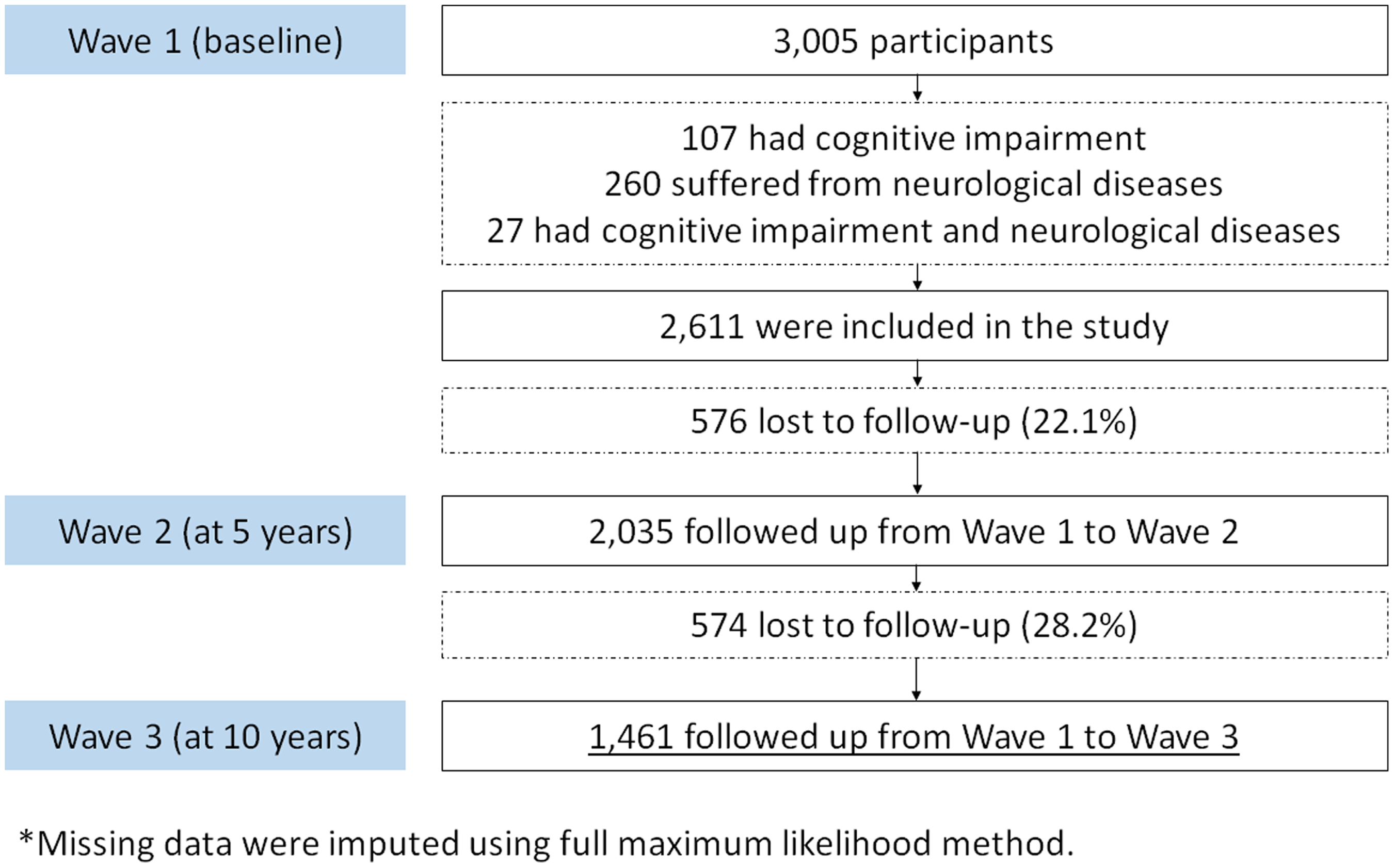
This study uses data from The National Social Life, Health, and Aging Project (NSHAP; Waite et al., Reference Waite, Laumann, Levinson, Lindau and O’Muircheartaigh2019a, Reference Waite2019b, Reference Waite2019c), a nationally representative study of older adults from households across the USA, with three waves: Wave 1 (2005/2006), Wave 2 (2010/2011), and Wave 3 (2015/2016). The inclusion criteria of our study comprised: a) participants who had been evaluated in all three waves and b) an intact cognitive functioning at baseline in the Short Portable Mental Status Questionnaire (SPMSQ; Pfeiffer, Reference Pfeiffer1975). Excluded were participants who suffered from neurological diseases (i.e., dementia or stroke). Considering these criteria, 2,611 out of 3,005 participants from Wave 1 were selected, and 1,461 participants were followed up from Wave 1 to Wave 3 (Figure 1).
Flowchart of the study sample.

Procedure
The protocol was approved by the Institutional Review Boards of Northeastern University and the NORC at the University of Chicago. All participants provided written informed consent. Demographic characteristics and depressive symptoms were assessed at baseline (Wave 1). Specifically, the following demographic characteristics were registered: age, sex, ethnic group, educational level, marital status, employment status, subjective socioeconomic status (SES) rating on a five-point scale (1 = far below average, 5 = far above average), health conditions, NSHAP Comorbidity Index (NCI; Vasilopoulos et al., Reference Vasilopoulos, Kotwal, Huisingh-Scheetz, Waite, McClintock and Dale2014) – a broad index that includes conditions related to overall morbidity and function, central nervous system (CNS) medication use – including CNS and psychotherapeutic agents detailed in the Multum Drug Category Hierarchy (i.e., analgesics, antidepressants, anxiolytics), and total number of medications. Cognitive functioning and difficulty with ADL were assessed at baseline (Wave 1) and at 5 (Wave 2) and 10 years (Wave 3).
Measures
Depressive symptoms
The Center for Epidemiological Studies-Depression Scale (CESD-11; Kohout et al., Reference Kohout, Berkman, Evans and Cornoni-Huntley1993) was used to evaluate the level of depressive symptomatology at baseline. It is composed of 11 items that ask participants to report the frequency of their feelings during the previous week on a four-point scale (0 = rarely or none of the time; 1 = some of the time; 2 = occasionally; 3 = most of the time). The inverse items were reverse coded before summation. A total score was computed by adding up the scores on all the items; it ranged from 0 to 33 points, with higher scores indicating more severe depressive symptoms. A score ≥ 9 is indicative of moderate-to-severe depressive symptoms (Kohout et al., Reference Kohout, Berkman, Evans and Cornoni-Huntley1993). Cronbach’s alpha was 0.80 for this sample.
Cognitive functioning
The Montreal Cognitive Assessment survey adaptation (MoCA-SA; Shega et al., Reference Shega2014) was used to evaluate cognitive functioning at 5 (Wave 2) and 10 years (Wave 3). It is composed of 18 items that evaluate: a) orientation (2 points); b) executive function: (2 points); c) visuospatial skills (3 points); d) memory (5 points); e) attention (5 points); and f) language (3 points). A total score was computed, ranging from 0 to 20, with higher scores indicating better cognitive functioning. Cronbach’s alpha was 0.70 for this sample at Wave 2 and 0.71 at Wave 3. Note that in Wave 1, the SPMSQ (Pfeiffer, Reference Pfeiffer1975) was used to evaluate cognitive impairment at baseline. It is a screening test composed of 10 items that evaluate cognitive functioning across multiple domains, such as orientation (items 1–3 and 5–8), memory-related capacity for self-care, remote memory, and serial mental operations. The number of errors was computed, ranging from 0 to 10, with higher scores indicating higher cognitive impairment. Due to the poor sensitivity of this instrument, this score was controlled in the model, but it was not included as an endogenous variable (Tallon et al., Reference Tallon, Manjourides, Pun, Salhi and Suh2017). Cutting scores were 0–2 for intact cognitive functioning, 3–4 for mild cognitive impairment, 5–7 for moderate cognitive impairment, and 8–10 for severe cognitive impairment.
Difficulty with ADL
Participants were asked to report the degree of difficulty with the following ADL: walking one block, walking across a room, dressing, bathing, or showering, eating, getting in or out of bed, and using the toilet. Items were rated on a four-point scale (0 = no difficulty; 1 = some difficulty; 2 = much difficulty; 3 = unable to do). A total score was computed by adding the scores on all items; it ranged from 0 to 21 points, with a higher score indicating greater difficulty with ADL. Cronbach’s alpha was 0.86 for this sample at Waves 1 and 2 and 0.84 at Wave 3.
Statistical analyses
Univariate ANOVAs were performed to analyze differences in cognitive functioning and difficulty with ADL at baseline, 5 and 10 years, depending on demographic characteristics. When a factor was significant in these ANOVAs, Bonferroni tests were performed. When significant differences in these variables were found, they were included as covariates in the path analysis. Additionally, relationships between variables were calculated using Pearson correlations. To describe the cognitive evolution from 5 to 10 years, meaningful cognitive changes were evaluated with the reliable change index (RCI) (Jacobson and Truax, Reference Jacobson and Truax1991). This index was derived from the SD and reliability data for the MoCA-SA (test–retest reliability was 0.70, and SD was 3.38), and the reliable change criterion to exceed the 95th centile of the RCI was ± 5.13. We computed the frequency of reliable decline or improvement, or no reliable change. These statistical analyses were carried out using SPSS 22.0, and two-tailed tests with p established as 0.05 were considered significant.
To examine the relationships among depressive symptoms, educational level, cognitive functioning, and difficulty with ADL, a path analysis was performed in RStudio (https://www.r-project.org/, version 3.5.1, R Core Team, 2016), using the lavaan (version 0.6-5) package (Rosseel, Reference Rosseel2012). The estimation method for missing values was full information maximum likelihood. This imputation method does not replace a missing value directly, but rather it uses available information to estimate population parameters without bias. It is appropriate for imputing missing longitudinal data, provides less biased estimates than listwise deletion or mean substitution (Dong and Peng, Reference Dong and Peng2013), and has adequate results with missing data percentages up to 32% (Olinsky et al., Reference Olinsky, Chen and Harlow2003). Before the path analysis, all continuous and ordinal variables were standardized, whereas unstandardized categorical variables were converted into dummy variables (coded as 1 = yes, 0 = no). The interaction term was created by multiplying the predictor (depressive symptoms) and the moderator (educational level) (Aiken and West, Reference Aiken and West1991). The interaction term is thus ‘depressive symptoms x educational level’. The model included depressive symptoms, educational level, and ‘depressive symptoms x educational level’ as endogenous variables. Cognitive functioning at 5 and 10 years and difficulty with ADL at 5 and 10 years were included as exogenous variables. Cognitive functioning at 5 years was also set as a predictor of difficulty with ADL at 5 years and cognitive functioning at 10 years. Cognitive functioning at 10 years was also set as a predictor of difficulty with ADL at 10 years. Age, sex, ethnic group, marital status, employment status, subjective SES, NCI, CNS medication use, total number of medications, cognitive functioning at baseline, and difficulty with ADL at baseline were included as covariates. A bootstrapping method (5,000 bootstraps) was used to test the significance level of the indirect (mediated) effects. A moderation effect exists when the regression coefficient for the interaction variable (e.g., ‘depressive symptoms x educational level’) in predicting the dependent variable (e.g., cognitive functioning) is significant. We used the Johnson-Neyman (Reference Johnson and Neyman1936) technique, which identifies for each value of the moderator whether the predictor significantly predicts the criterion and does not require to pick values of the moderator before estimating the conditional effect of X on Y. Based on this technique, simple slopes were plotted for specific conditional values of the moderator (i.e., specific educational levels) to estimate the regression of depressive symptoms on cognitive functioning using the computational tool designed by Preacher et al. (Reference Preacher, Curran and Bauer2006). Excellent model fit was indicated by a comparative fit index (CFI) > 0.95, a root mean square error of approximation (RMSEA) < 0.06, a standardized root mean square residual (SRMR) < 0.08, and a nonsignificant χ2 statistic (Hu and Bentler, Reference Hu and Bentler1998). Additionally, to quantify the contribution of each predictor to the exogenous variables, Cohen’s f 2 was calculated as a local effect size measure, with values near 0.02, 0.15, and 0.35 representing small, medium, and large effect sizes, respectively (Cohen, Reference Cohen1988). To estimate the effect sizes of significant indirect effects, we used the Completely Standardized Indirect Effect (abcs) index (Preacher and Kelley, Reference Preacher and Kelley2011).
Results
Preliminary analyses
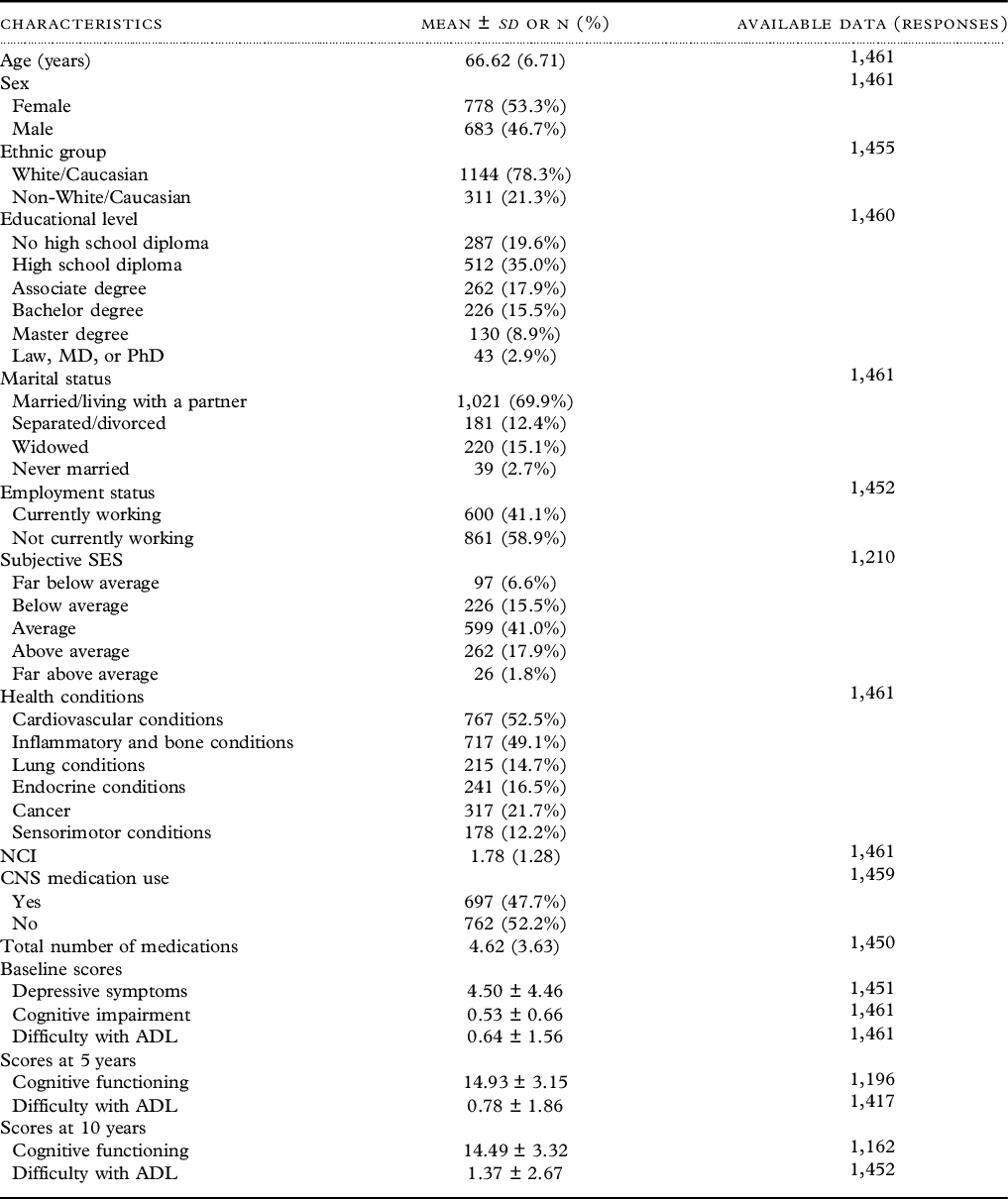
Participants characteristics are shown in Table 1. Age was negatively associated with cognitive functioning at 5 and 10 years and positively related to difficulty with ADL at baseline, 5 and 10 years (for all, p < 0.001). Cognitive functioning and difficulty with ADL differed depending on sex, ethnic group, educational level, marital status, employment status, subjective SES, health conditions, and CNS medication use (for all, p < 0.03).
Demographic characteristics and depressive symptoms, cognitive functioning, and difficulty with ADL scores (N = 1,461)

CNS: Central nervous system; NCI: NSHAP Comorbidity Index; SES: socioeconomic status.
With regard to sex, women showed greater cognitive impairment at baseline (p = 0.015) and greater difficulty with ADL than men at baseline, 5 and 10 years (for all, p < 0.012).
Regarding the ethnic group, White/Caucasian participants showed better cognitive functioning and less difficulty with ADL than non-White/Caucasians (for all time points, p < 0.02).
In the case of educational level, participants without a high school diploma had poorer cognitive functioning and greater difficulty with ADL at baseline, 5 and 10 years than the other groups (for all, p < 0.02). Participants with a high school diploma had poorer cognitive functioning at baseline than those with a master’s degree, and those with a high school diploma or an associate degree also had poorer cognitive functioning at 5 and 10 years than those with a bachelor’s degree, a master’s degree, or a law degree, MD, or PhD (for all, p < 0.003).
Regarding marital status, participants who were married or living with a partner had better cognitive functioning and less difficulty with ADL at baseline, 5 and 10 years than those widowed (for all, p < 0.001), as well as less difficulty with ADL at baseline and 5 years than those separated/divorced or never married (for all, p < 0.05). Moreover, separated/divorced participants had less difficulty with ADL at 10 years than widowed participants (p < 0.0001).
With regard to employment status, participants currently working had better cognitive functioning and less difficulty with ADL than the other group (for all time points, p < 0.017).
Regarding subjective SES, participants with an above-average SES had better cognitive functioning and less difficulty with ADL than those with a far below or below average SES (for all time points, p < 0.04), as well as better cognitive functioning at 5 years than participants with an average SES (p = 0.017). Participants with an average SES had better cognitive functioning and less difficulty with ADL at baseline than participants with a far below average SES, and those with a far above average or below-average SES had better cognitive functioning and less difficulty with ADL at 5 years than participants with a far below average SES (for all, p < 0.03).
Concerning health conditions, participants with cardiovascular conditions had poorer cognitive functioning and greater difficulty with ADL than those without these conditions (for all time points, p < 0.005). Participants with inflammatory/bone or endocrine conditions had poorer cognitive functioning at baseline and 10 years and greater difficulty with ADL at baseline and 5 years than those without these conditions (for all, p < 0.04). Participants with lung conditions had greater difficulty with ADL than those without these conditions (for all time points, p < 0.0001). The NCI was related to poorer cognitive functioning at baseline and 10 years and greater difficulty with ADL at baseline, 5 and 10 years (for all, p < 0.018).
Regarding medication use, participants who were taking CNS medication had greater difficulty with ADL than those without CNS medication (for all time points, p < 0.0001). Additionally, the total number of medications was positively related to difficulty with ADL (for all time points, p < 0.0001).
No other significant differences or associations were found.
Factors related to cognitive performance and difficulty with ADL at 5 and 10 years
Two hundred and thirty-five participants (16.2%) had moderate-to-severe depressive symptoms and 1,216 (83.8%) had subclinical depression scores. Considering that RCI describes the cognitive evolution from 5 to 10 years, 8 (0.8%) participants experienced a reliable improvement at 10 years, 970 (94.7%) had no change, and 46 (4.5%) experienced a reliable decline.
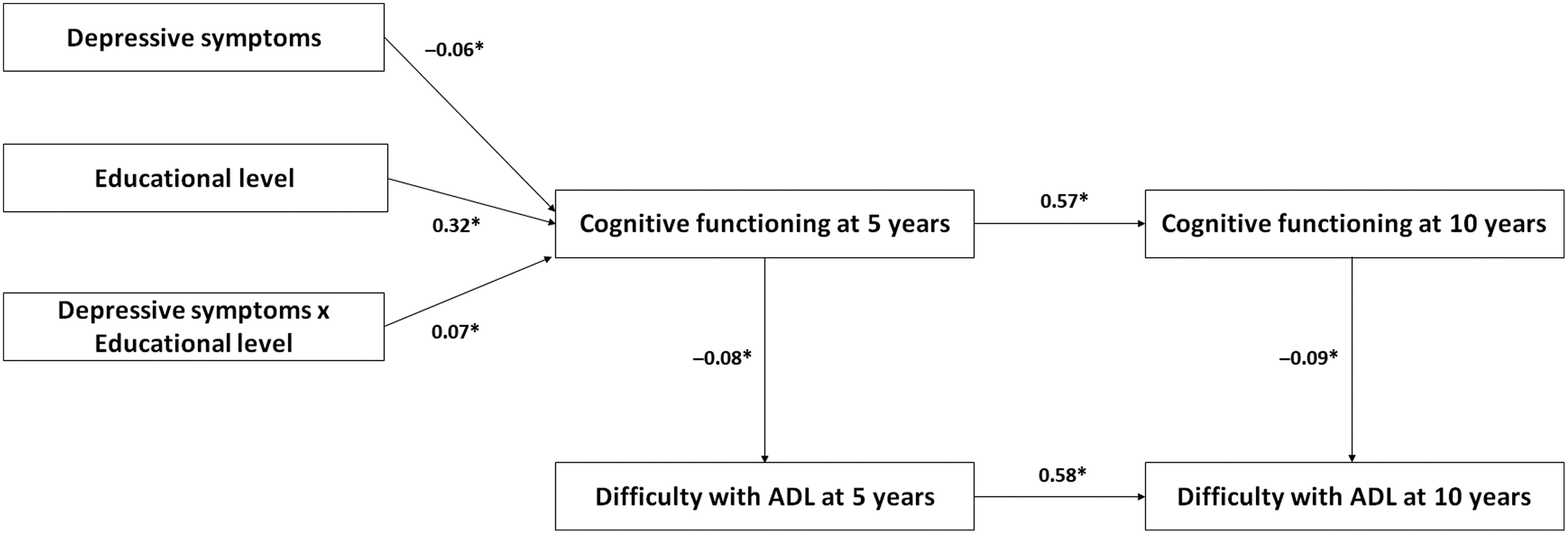
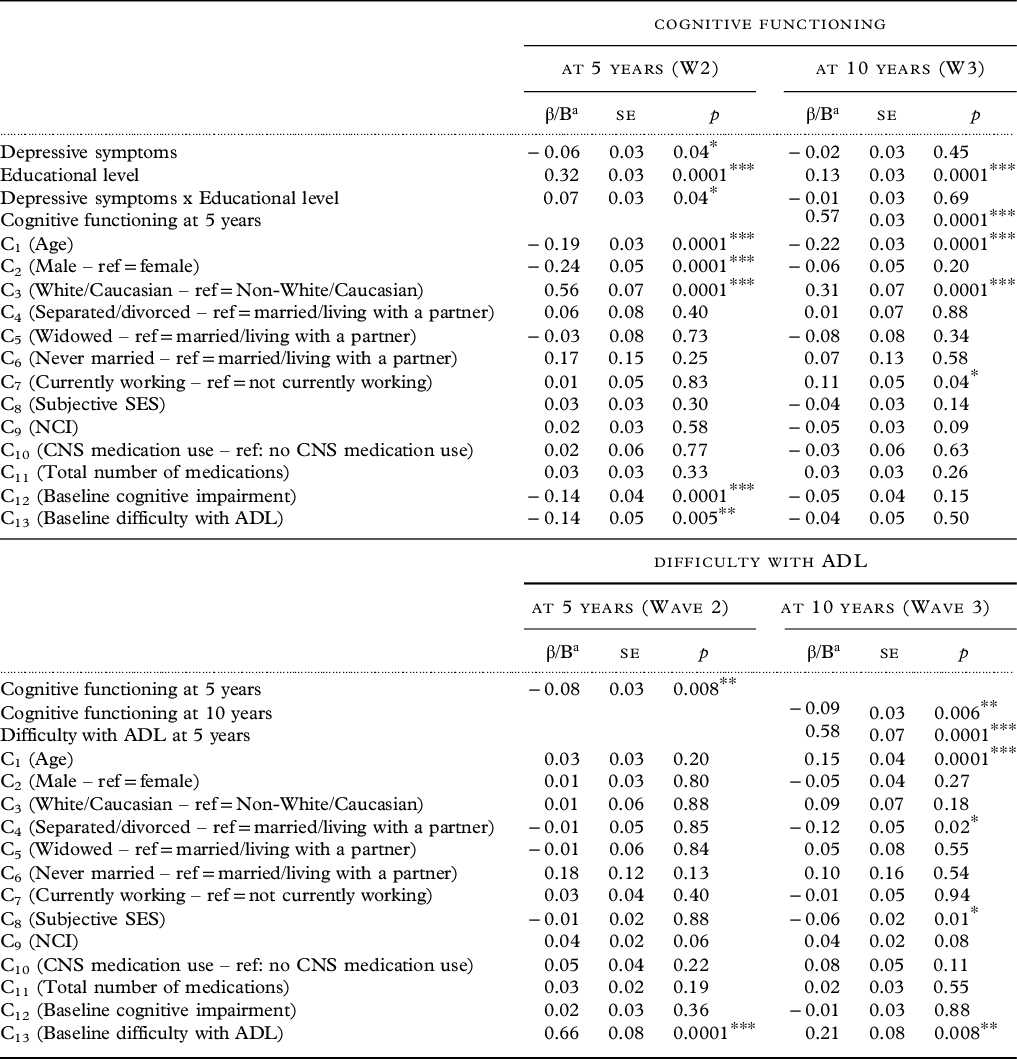
The proposed model yielded an excellent model fit (CFI = 1.00, RMSEA = 0.0001, 90% CI 0.0001–0.03, SRMR = 0.004, and χ2(8) = 7.16, p = 0.52) (Figure 2 and Table 2).
Model assessing associations among depressive symptoms, educational level, depressive symptoms x educational level, cognitive performance, and difficulty with ADL at 5 and 10 years, adjusted for age, sex, ethnic group, marital status, employment status, subjective SES, NCI, CNS medication use, total number of medications, cognitive functioning at baseline, and difficulty with ADL at baseline. For clarity, only the paths between contiguous variables are displayed here. The numerical values correspond to the standardized regression coefficients (β) (*p < 0.05).

Parameter estimates from the path analysis

a Standardized slopes (β) are shown for all variables excepting for dummy variables (male, white/caucasian, separated/divorced, widowed, never married, currently working, and CNS medication use), for which unstandardized slopes (B) are shown. C = covariate; ref = reference; W1 = Wave 1; W2 = Wave 2; W3 = Wave 3; Model fit statistics: CFI = 1.00, RMSEA = 0.0001, 90% CI 0.0001–0.03, SRMR = 0.004, and χ2(8) = 7.16, p = 0.52. * p < .05; **p < .01; ***p < .001.
Depressive symptoms at baseline were associated with poorer cognitive functioning at 5 years (β = −0.06, SE = 0.03, p = 0.04, Cohen’s f 2 = 0.01), whereas a higher educational level was related to better cognitive functioning at 5 years (β = 0.32, SE = 0.03, p < 0.0001, Cohen’s f 2 = 0.15). The interaction between depressive symptoms and educational level predicted cognitive functioning at 5 years (β = 0.07, SE = 0.03, p = 0.04, Cohen’s f 2 = 0.02). Johnson–Neyman analyses revealed that depressive symptoms were significantly associated with poor cognitive functioning at 5 years only for educational level z scores < −0.29 (corresponding to low education: no high school diploma and high school diploma) (p < 0.05), but not for higher educational levels (Figure 3). The model explained 33% of the variance in cognitive functioning at 5 years.
A) Relationship between depressive symptoms and cognitive functioning at 5 years at specific educational levels, adjusted by covariates. B) Regions of significance plot of the conditional effect of depressive symptoms on cognitive functioning at 5 years at values of educational level, adjusted by covariates. Red lines represent 95% confidence intervals for the effect of depressive symptoms as a function of educational level. The blue vertical line represents the limit of the region of significance. The point of transition (value of educational level) that demarcates the regions where the interaction effects are significant is −0.29 (z score). For z scores < −0.29 (corresponding to no high school diploma and high school diploma), the interaction is significant (i.e., the 95% confidence intervals do not include zero). For higher educational levels (i.e., associate degree), the interaction is not significant (i.e., the 95% confidence intervals include zero).

Better cognitive functioning at 5 years and a higher educational level were related to better cognitive functioning at 10 years (β = 0.57, SE = 0.03, p < 0.0001, Cohen’s f 2 = 0.46; and β = 0.13, SE = 0.03, p < 0.0001, Cohen’s f 2 = 0.03, respectively). Neither depressive symptoms nor the interaction between depressive symptoms and educational level directly predicted cognitive functioning at 10 years (for all, p > 0.45). The indirect pathways showed that depressive symptoms, educational level, and the interaction between them had an effect on cognitive functioning at 10 years through cognitive functioning at 5 years (β = −0.04, SE = 0.02, p = 0.04, abcs = −0.04; β = 0.19, SE = 0.02, p < 0.0001, abcs = 0.21; and β = 0.04, SE = 0.02, p = 0.04, abcs = 0.04). However, Johnson–Neyman analyses revealed no regions of significance of the conditional indirect effect of depressive symptoms on cognitive functioning at 10 years across the range of educational level. Additionally, significant total effects of depressive symptoms, educational level and the interaction between them on cognitive functioning at 10 years were found (β = 0.59, SE = 0.24, p = 0.02; β = 0.81, SE = 0.24, p < 0.001; and β = 0.67, SE = 0.24, p = 0.006, respectively). The model explained 54% of the variance in cognitive functioning at 10 years.
Better cognitive functioning at 5 years was related to less difficulty with ADL at 5 years (β = −0.08, SE = 0.03, p = 0.008, Cohen’s f 2 = 0.01). There were significant indirect effects of educational level on difficulty with ADL at 5 years through cognitive functioning at 5 years (β = −0.03, SE = 0.01, p = 0.01, abcs = −0.04), with a significant total effect (β = 0.93, SE = 0.18, p < 0.0001). Other potential indirect pathways were tested but failed to reach significance. The model explained 38% of the variance in difficulty with ADL at 5 years.
Greater difficulty with ADL at 5 years was related to greater difficulty with ADL at 10 years (β = 0.58, SE = 0.07, p < 0.0001, Cohen’s f 2 = 0.19), whereas better cognitive functioning at 10 years was associated with less difficulty with ADL at 10 years (β = −0.09, SE = 0.03, p = 0.006, Cohen’s f 2 = 0.02). When indirect pathways were tested, results showed that the educational level has an effect on difficulty with ADL at 10 years through several indirect pathways. There were significant indirect effects from educational level to difficulty with ADL at 10 years through cognitive functioning at 5 years and difficulty with ADL at 5 years (β = −0.02, SE = 0.01, p = 0.04, abcs = −0.02) and through cognitive functioning at 5 years and cognitive functioning at 10 years (β = −0.02, SE = 0.01, p = 0.009, abcs = −0.02). Moreover, a significant total effect of educational level on difficulty with ADL at 10 years was found (β = 0.98, SE = 0.25, p < 0.0001). No other significant indirect effects were found. The model explained 40% of the variance in difficulty with ADL at 10 years.
Discussion
The results of the current study indicate that the educational level moderates the relationship between baseline depressive symptoms and cognitive functioning at 5 years in older adults, with depressive symptoms being related to poor cognitive functioning only at low educational levels. Additionally, cognitive functioning predicts difficulty with ADL at 5 and 10 years.
Most of the participants (94.7%) did not experience meaningful cognitive change over time, this percentage being higher than the one found by Josefsson et al. (Reference Josefsson, de Luna, Pudas, Nilsson and Nyberg2012), who employed a 15-year follow-up period, which could explain these differences. According to previous studies, cognitive functioning and difficulty with ADL differed depending on sex, ethnic group, subjective SES, health conditions (Zahodne et al., Reference Zahodne, Kraal, Zaheed and Sol2018), marital status (Liu et al., Reference Liu, Zhang, Burgard and Needham2019), employment status (Alvarado-Esquivel et al., Reference Alvarado-Esquivel, Hernández-Alvarado, Tapia-Rodríguez, Guerrero-Iturbe, Rodríguez-Corral and Martínez2004), age, and medication use (Fonseca et al., Reference Fonseca2015), so these variables were included as covariates in the path analysis. Differences among ethnic groups may arise from influences that transcend ethno-racial characteristics, such as fewer financial resources and less access to education in minorities (Glymour and Manly, Reference Glymour and Manly2008).
The proposed model in the path analysis yielded an excellent fit (Hu and Bentler, Reference Hu and Bentler1998). Depressive symptoms were related to poor cognitive functioning at 5 years, but their effect size was small. At 10 years, cognitive functioning decreases by 0.04 standard deviations for every 1SD increase in depressive symptoms indirectly via cognitive functioning at 5 years. Previous research has found that individuals with depressive symptoms are more likely to experience poor concentration (Kim et al., Reference Kim, Liu, Nakaoka, Jang and Browne2018), and they may misinterpret life events or overreact to them (Blazer and Hybels, Reference Blazer and Hybels2005). Dealing with depressive symptoms along with the usual stressors in daily life could have a price in terms of cognitive functioning. McEwen et al. (Reference McEwen1998) proposed the term “allostatic load” to define the price an individual pays for being forced to adapt to daily life stressors, linking repeated exposure to stressors to disease through wear on the neuroendocrine system. Thus, depressive symptoms may compromise the neural systems that regulate the hypothalamic–pituitary–adrenal stress axis (Sapolsky, Reference Sapolsky2001), reducing the efficiency of functions mediated by these areas and making them more vulnerable to neurodegenerative changes.
It should be highlighted that most of the participants (83.8%) in our study had subclinical depression scores because the mean score for CESD-11 was 4.50, and the cutoff for moderate-to-severe depressive symptoms has been established at nine points (Kohout et al., Reference Kohout, Berkman, Evans and Cornoni-Huntley1993). Detecting certain susceptibilities to clinical disorders could be useful for the prevention of cognitive impairment in older adults.
Educational level was related to better cognitive functioning at 5 and 10 years, with small-to-medium effect sizes. Additionally, educational level appeared to be a protective factor against the influence of depressive symptoms on cognitive function at 5 years because depressive symptoms were related to poor cognitive functioning only at low educational levels. This interaction between depressive symptoms and educational level also predicted cognitive functioning at 10 years through its relationship with cognitive functioning at 5 years. However, no regions of significance of the conditional indirect effect of depressive symptoms on cognitive functioning at 10 years across the range of educational level were identified, suggesting that this moderation effect weakens over time. Our findings indicate that not all older adults are affected by depressive symptoms in the same way at 5 years, explaining the complex relationships found between depressive symptoms and cognitive functioning in previous studies (Becker et al., Reference Becker2009; Kim et al., Reference Kim, Liu, Nakaoka, Jang and Browne2018; Richard et al., Reference Richard2013). The lack of relationship between depressive symptoms and poor cognitive functioning in the highly educated participants suggests that one of the benefits of education may be that it provides skills that enable individuals to function even in conditions of emotional distress (Wight et al., Reference Wight, Aneshensel and Seeman2002). Our findings agree with the cognitive reserve theory (Stern, Reference Stern2012), which states that less cognitive impairment occurs in individuals with higher cognitive reserve because they utilize old and new neural networks more efficiently (Siedlecki et al., Reference Siedlecki, Stern, Reuben, Sacco, Elkind and Wright2009).
Although some studies have addressed this moderation effect, they were carried out from a cross-sectional perspective, showing mixed results; some of them agree our results (Avila et al., Reference Avila, Moscoso, Ribeiz, Arrais, Jaluul and Bottino2009; Fuhrer et al., Reference Fuhrer, Antonucci and Dartigues1992; Pálsson et al., Reference Pálsson, Aevarsson and Skoog1999, Reference Pálsson2001), whereas others show the opposite moderation effect of educational level (O’Shea et al., Reference O’Shea, Fieo, Hamilton, Zahodne, Manly and Stern2015; Santos et al., Reference Santos2014) or no moderation effect (Bhalla et al., Reference Bhalla2005; Opdebeeck et al., Reference Opdebeeck, Matthews, Wu, Woods, Brayne and Clare2017). To the best of our knowledge, only the Geerlings et al. (Reference Geerlings2000) and Wilson et al. (Reference Wilson, De Leon, Bennett, Bienias and Evans2004) studies included longitudinal measures of cognition, although without considering the impact of cognitive functioning on functional independence. Whereas Geerlings et al. (Reference Geerlings2000) found higher associations between depressive symptoms and cognitive functioning at high educational levels than at low educational levels, Wilson et al. (Reference Wilson, De Leon, Bennett, Bienias and Evans2004) found no moderation effects. Differences between our results and those of these studies may be due to the cognitive test used – MoCA-SA in our study and the Mini-Mental State Examination (Folstein et al., Reference Folstein, Folstein and McHugh1975) in these studies, since MoCA is a more sensitive tool for the early detection of cognitive impairment (Ciesielska et al., Reference Ciesielska, Sokolowski, Mazur, Podhorecka, Polak-Szabela and Kedziora-Kornatowska2016).
Our results showed that cognitive functioning, modulated by depressive symptoms and educational level, had a significant impact on the functional independence of older adults over time, although its effect size was small. This relationship between cognitive functioning and difficulty with ADL is consistent with previous studies (Giebel et al., Reference Giebel2014). Educational level also had an indirect effect on difficulty with ADL through its relationship with cognitive functioning, based on cognitive reserve theory (Stern, Reference Stern2012). Mograbi et al. (Reference Mograbi, de Assis Faria, Fichman, Paradela and Lourenço2014) found that educational level itself was not a significant predictor of difficulty with ADL, but they showed a moderate association with cognitive functioning, which was, in turn, related to difficulty with ADL, in line with our findings. Functional limitations can lead to poorer quality of life (Thompson et al., Reference Thompson, Zack, Krahn, Andresen and Barile2012), increased healthcare costs, and greater mortality (Freedman et al., Reference Freedman, Martin and Schoeni2002), so they are among the most important challenges facing healthcare providers who work with older adults (Katz, Reference Katz1983).
The strengths of the study include the large sample size, the use of nationally representative data, the prospective design, and the consideration of the influence of cognitive function on difficulty with ADL, along with the moderation effect of educational level in the relationship between depressive symptoms and cognition in a path model, so it represents an advance over previous studies. Despite these strengths, some limitations should be considered. First, although CESD is a widely used screening tool for the current level of depressive symptom severity, it is not a clinical diagnostic instrument. Second, the sample was drawn from community-dwelling older adults and no information about psychiatric diagnoses was available. Although people unable to understand the consent process were not included, it is likely that some participants with a psychiatric diagnosis able to consent to the interview were included, and this could have influenced the results. Third, cognitive functioning was measured differently at baseline than at 5 and 10 years. Although baseline cognitive functioning was included as a covariate in the model, it would have been more appropriate to use the same test. Fourth, we used a global measure of cognitive functioning, but some studies have suggested that depressive symptoms may be more strongly associated with specific cognitive processes (Comijs et al., Reference Comijs, Jonker, Beekman and Deeg2001), so it is likely that we have underestimated the magnitude of the relationships. Finally, confounding by unmeasured covariates is possible. Nevertheless, adjustment for several known confounding variables did not eliminate the significant associations found.
In conclusion, this study proposes a model that shows, in a large sample, that educational level is an important factor in understanding the relationship between depressive symptoms and poor cognition at 5 years in older adults, considering the influence of cognitive functioning on functional independence at 5- and 10-year follow-ups. Despite the model explained a substantial proportion of variance of cognitive functioning and difficulty with ADL (between 33 and 54%) (Cohen, Reference Cohen1988), the presence of small-to-medium effect sizes of individual predictors may suggest a finding that is of potential theoretical interest as opposed to one that is clinically meaningful. The rapid aging of the population will have a great societal impact with a high economic burden on health care (Winblad et al., Reference Winblad2016). Therefore, the World Health Organization emphasizes carrying out global actions against cognitive decline and improving healthcare services (World Health Organization, 2018). A better understanding of factors associated with cognitive decline and functional independence represents a first step in using this knowledge to detect at-risk individuals and for future health service planning.
Funding
Authors were supported by the Generalitat Valenciana (Valencian Government) [grant number GV/2019/055].
Conflict of interest
None.
Description of authors’ roles
I.C. formulated the research question, designed the study, carried out statistical analyses, and wrote the paper. M.A., A.D., P.M., M.A., M.J.G., and S.P. assisted with writing the paper, supervised the statistical analyses, and revised the paper.
Acknowledgments
The National Social Life, Health, and Aging Project is supported by the National Institute on Aging (R37AG030481, R01AG033903, R01AG043538, R01AG048511); the Office of Women’s Health Research, the Office of AIDS Research, and the Office of Behavioral and Social Sciences Research (R01AG021487); and by National Opinion Research Center (NORC) which was responsible for the data collection. The content is solely the responsibility of the authors and does not necessarily represent the official views of the National Institutes of Health or NORC. The authors are grateful to Ms. Cindy DePoy for the revision of English style and grammar.