





1 Introduction
Originally formulated by Kerr and Li in their 2021 paper [Reference Kerr and Li9], Shannon orbit equivalence adds a restriction to the combinatorial complexity of the mappings that an orbit equivalence implements between orbits. In turn, this added condition means that this is the condition between two free probability-measure-preserving (p.m.p.) actions of (possibly different) finitely generated virtually Abelian groups that preserves entropy, as proved by Kerr and Li in [Reference Kerr and Li10]. Thus, while Shannon orbit equivalence does preserve entropy between transformations, we show, using techniques from Fieldsteel and Friedman’s paper [Reference Fieldsteel and Friedman7], that Shannon orbit equivalence does not preserve weak mixing between integer transformations in a rather strong sense: we can always find a weakly mixing transformation that is Shannon orbit equivalent to a given ergodic transformation. Before we introduce Shannon orbit equivalence, which we do in §2, we give some background definitions and results from the theory of orbit equivalence.
Definition 1.1. Let
$(X,\mathscr {A},\mu )$
 be a probability space, G a countable discrete group, and
$G\curvearrowright ^{S}(X,\mu )$
 a p.m.p. action. Given an
$x\in X$
 , we call the set

the S-orbit of x. Suppose we have a second probability space
$(Y,\mathscr {B},\nu )$
 , a second group H, and a second p.m.p. action
$H\curvearrowright ^{T}(Y,\nu )$
 . We say S and T are orbit equivalent if there exists a bimeasurable, measure-preserving bijection
$\phi :X\to Y$
 such that, for almost every
$x\in X$
 ,
$\phi $
 maps the S-orbit of x bijectively onto the T-orbit of
$\phi (x)$
 .
For the rest of this paper, our probability spaces are atomless and Lebesgue.
Remark 1.2. We use the following more convenient characterization of orbit equivalence since it will reduce some technical baggage. Two p.m.p. actions
$G\curvearrowright ^{S}(X,\mu )$
 and
$H\curvearrowright ^{T}(Y,\nu )$
 are orbit equivalent if and only if there is a third action
$H\curvearrowright ^{R}(X,\mu )$
 that is conjugate to T such that, for almost every
$x\in X$
 , we have that
$O_{R}(x)=O_{S}(x)$
 .
The next theorem, due to Dye [Reference Dye6], implies that, for ergodic transformations, orbit equivalence erases their dynamical properties.
Theorem 1.3. If
$S:X\to X$
 and
$T:Y\to Y$
 are ergodic p.m.p. transformations such that S and T are free or X and Y are atomless, then S and T are orbit equivalent.
To turn orbit equivalence into an interesting equivalence relation, we must place some restrictions upon it. The way this is normally accomplished is by requiring additional properties for the cocycles of the orbit equivalence, which we define now.
Definition 1.4. Given two orbit equivalent free p.m.p. actions
$G\curvearrowright ^{S}(X,\mu )$
 and
$H\curvearrowright ^{T}(X,\mu )$
 , we can find measurable functions
$\kappa :X\times G\to H$
 and
$\unicode{x3bb} :X\times H\to G$
 , where
$\kappa $
 is given by the formula
$T^{\kappa (x,g)}(x)=S^{g}(x)$
 for all
$g\in G$
 and for almost every (a.e.)
$x\in X$
 , and
$\unicode{x3bb} $
 is given by the relationship
$S^{\unicode{x3bb} (x,h)}(x)=T^{h}(x)$
 for all
$h\in H$
 and for a.e.
$x\in X$
 . We call these the orbit equivalence cocycles between T and S. In general, a cocycle will be any map
$\alpha :X\times G\to H$
 that satisfies the following two conditions:
-
(1) $\alpha (x,\cdot ):G\to H$
 is a bijection for a.e.
$x\in X$
;
-
(2) $\alpha (x, g_{1}g_{2})=\alpha (S^{g_{2}}x,g_{1})\alpha (x,g_{2})$
for all
$g_{1},g_{2}\in G$
and a.e.
$x\in X$
.


Remark 1.5. Note that while the essential property of a cocycle is captured by the second condition, the first condition is useful to assume because we want all of our cocycles to be invertible given a fixed point from the probability space.
Remark 1.6. Given a cocycle
$\alpha $
 of the action
$G\curvearrowright ^{T} (X,\mu )$
 , we can define a second action
$G\curvearrowright ^{S} (X,\mu )$
 that is orbit equivalent to T as follows. We first define a function
${\alpha ^{-1}:X\times G \to G}$
 given by the formula

for every
$g\in G$
 and a.e.
$x\in X$
 , and then defining S by the formula

so that
$\alpha $
 is a cocycle for the equivalence relation between T and S.
Perhaps the two most natural types of restricted orbit equivalence are bounded and integrable orbit equivalence, which we now define.
Definition 1.7. Let
$G\curvearrowright ^{S}(X,\mu )$
 and
$H\curvearrowright ^{T}(X,\mu )$
 be orbit equivalent p.m.p. actions with cocycles
$\kappa :X\times G\to H$
 and
$\unicode{x3bb} :X\times H\to G$
 . We say S and T are boundedly orbit equivalent if, for every
$g\in G$
 and
$h\in H$
 , the sets
$\{\kappa (x,g)\mid x\in X\}$
 and
$\{\unicode{x3bb} (x,h)\mid x\in X\}$
 are finite.
Definition 1.8. Let
$\mathbb {Z}\curvearrowright ^{S}(X,\mu )$
 and
$\mathbb {Z}\curvearrowright ^{T}(X,\mu )$
 be orbit equivalent p.m.p. transformations with cocycles
$\kappa $
 and
$\unicode{x3bb} $
 . We say S and T are integrably orbit equivalent if we have that

for all
$m\in \mathbb {Z}$
 and

for all
$m\in \mathbb {Z}$
 .
Remark 1.9. Note that an orbit equivalence between transformations being bounded also implies that it is integrable.
The premier result related to integrable orbit equivalence is the following theorem from 1968 due to Belinskaya [Reference Belinskaya2].
Theorem 1.10. Two ergodic measure-preserving transformations S and T are integrably orbit equivalent if and only if they are flip-conjugate. That is, either S is conjugate to T or S is conjugate to
$T^{-1}$
 .
One of the first lines of investigation to follow for restrictive orbit equivalences is to understand where they lie on the spectrum between unrestricted orbit equivalence, which erases the dynamics of ergodic actions, and conjugation. One way to accomplish this is to see if a given type of restricted orbit equivalence preserves dynamical properties that are known conjugation invariants. One such property is mixing. One of the primordial results in this direction is the following result due to Friedman and Ornstein [Reference Friedman and Ornstein8] in the realm of Kakutani equivalence.
Theorem 1.11. If
$T:X\to X$
 is an ergodic transformation, then there is a mixing transformation
$S:X\to X$
 such that T is Kakutani equivalent to S.
The construction of the mixing transformation of Friedman and Ornstein highlights the critical technique that underpins the construction of the actions in the upcoming theorems: manipulating the columns of a sequence of Rokhlin towers to define the orbits of the resulting action.
In general, Kakutani equivalence does not imply orbit equivalence. However, del Junco and Rudolph in [Reference del Junco and Rudolph4] noticed the following relationship between even Kakutani and restricted orbit equivalence showcased in the following theorem.
Theorem 1.12. Ergodic transformations S and T are evenly Kakutani equivalent if and only if there is an orbit equivalence between S and T with cocycle
$\alpha $
 such that, for almost every x, there is an
$I(x)\subset \mathbb {Z}$
 of density 1 such that

Using the above theorem as a model, Fieldsteel and Friedman [Reference Fieldsteel and Friedman7] defined the following type of restricted orbit equivalence for
$\mathbb {Z}^{d}$
 (
$d>1$
 ).
Definition 1.13. Ergodic
$\mathbb {Z}^{d}$
 -actions S and T are
$id$
 -Kakutani equivalent if there is an orbit equivalence from S to T with cocycle
$\alpha $
 such that, for almost every
$x\in X$
 , there is a set
$I(x)\subset \mathbb {Z}^{d}$
 of density 1 satisfying

Spurred by this definition, Fieldsteel and Friedman asked if results related to Kakutani equivalence of
$\mathbb {Z}$
 actions can be lifted to the types of restricted orbit equivalence of
$\mathbb {Z}^{d}$
 modeled above. As Fieldsteel and Friedman show in [Reference Fieldsteel and Friedman7], the Friedman–Ornstein result does transfer to this case. The varieties of restricted orbit equivalence for which the Friedman–Ornstein result holds are described as follows.
Definition 1.14. A family of sets
$\{I(x)\subset \mathbb {Z}^{d}\}_{x\in X}$
 is called a sequence of measurable full density if there exist an increasing sequence of measurable sets
$A_{i}\subset X$
 and a sequence of integers
$M_{i}$
 such that
$\lim _{i\to \infty }\mu (A_{i})=1$
 and for all
$x\in X$
 ,
$I(x)=\bigcup _{i=1}^{\infty }\{v\in \mathbb {Z}^{d}\mid |v|_{\infty }>M_{i}\text { and } T^{v}(x)\in A_{i}\}$
 . For
$a>1$
 , we say there is a weak-a-equivalence between T and S if there is an orbit equivalence between S and T such that for the corresponding cocycle
$\alpha $
 , there is a sequence
$\{I(x)\}_{x\in X}$
 of measurable full density such that for almost every x,

The second variant for which Fieldsteel and Friedman show that the Friedman–Ornstein result holds is detailed below.
Definition 1.15. Let b be a real number such that
$0<b<1$
 . We say that ergodic
$\mathbb {Z}^{d}$
 -actions S and T of
$(X,\mu )$
 are strong-b-equivalent if there is an orbit equivalence between S and T such that the cocycle
$\alpha $
 satisfies

Equipped with these definitions, Fieldsteel and Friedman in [Reference Fieldsteel and Friedman7] prove the following theorem.
Theorem 1.16. Let T be a p.m.p. ergodic
$\mathbb {Z}^{d}$
 -action on
$(X,\mu )$
 for some
$d\geq 1$
 . There is a cocycle
$\alpha $
 for T producing a mixing action
$S=T^{\alpha ^{-1}}$
 such that the corresponding orbit equivalence between T and S is, for all
$a\geq 1$
 , a weak-a-equivalence and, for all
$b\in (0,1)$
 , a strong-b-equivalence.
Fieldsteel and Friedman also use the same framework for this construction to get a similar result for the bounded orbit equivalence case. This appears as in their paper Theorem 3 [Reference Fieldsteel and Friedman7, Theorem 3].
Theorem 1.17. If T is an ergodic
$\mathbb {Z}^{d}$
 -action with
$d\geq 2$
 , then there is a cocycle
$\alpha $
 of T that gives a mixing
$T^{\alpha ^{-1}}$
 such that the orbit equivalence between them is bounded.
The construction involved in this theorem, as well as the main theorem in the latter half of this paper, hinges on the fact that we can create orbit equivalence cocycles by manipulating a sequence of towers. Indeed, let
$(F,B)$
 be a Rokhlin tower of the action
$\mathbb {Z}^{d}\curvearrowright ^{T}(X,\mu )$
 and let
$\mathscr {A}$
 be a partition of B. For each
$A\in \mathscr {A}$
 , let
$\sigma _{A}:F\to F$
 be a bijection. We can define a cocycle
$\alpha :X\times \mathbb {Z}^{d}\to Z^{d}$
 by setting

One key component to making this construction work is that a given sequence of cocycles begets another cocycle when a certain limit is taken. This is the cocycle for our desired action. This requires a condition for which the cocycle value for a given point in the space is fixed for a tail of the sequence. We also require certain types of 0–1 laws to guarantee that such a condition holds for almost every point in the space. The other key component is that Fieldsteel and Friedman get this sequence of cocycles by permuting columns of corresponding Rokhlin towers by independent random translations inside disjoint blocks, thereby introducing approximate independence at each stage of the construction, which will produce mixing after the limit is taken.
With this context from restricted orbit equivalence theory in mind, we are ready to introduce Shannon orbit equivalence.
2 Shannon orbit equivalence
While Theorem 1.17 tells us that mixing is not a bounded orbit equivalence invariant for ergodic
$\mathbb {Z}^{d}$
 -actions when
$d\geq 2$
 , entropy is an invariant of bounded orbit equivalence for these actions. Indeed, Austin shows in his 2016 paper [Reference Austin1] an even stronger result: entropy is an invariant for integrable orbit equivalence of actions of finitely generated amenable groups. Thus, to what extent can we generalize integrable orbit equivalence so that entropy is still an invariant for a sufficiently rich class of group actions? Perhaps the most natural generalization to look at is Shannon orbit equivalence. Shannon orbit equivalence was introduced by Kerr and Li in [Reference Kerr and Li9] as a generalization of both integrable orbit equivalence and bounded orbit equivalence. In that paper, the authors prove that entropy is an invariant for Shannon orbit equivalences between actions over certain classes of groups which exclude
$\mathbb {Z}$
 . In a subsequent paper [Reference Kerr and Li10], Kerr and Li extend the aforementioned result to actions of the integers.
Thus, the natural question is the following: does a version of Belinskaya’s theorem (stated above as Theorem 1.10) hold for Shannon orbit equivalences between ergodic actions over the integers? This was answered in the negative in a paper by Carderi et al [Reference Carderi, Joseph, Le Maître and Tessera3]. Indeed, the authors craft examples of ergodic transformations which satisfy a weaker type of integrable orbit equivalence, which also implies Shannon orbit equivalence, but are not flip conjugate. Thus, if Shannon orbit equivalence between ergodic transformations does not imply flip conjugacy, yet it still preserves entropy, what other properties does Shannon orbit equivalence preserve between ergodic transformations? Turning back to Fieldsteel and Friedman, can their method of constructing cocycles be adapted to the Shannon orbit equivalence setting to produce a mixing action which is equivalent to a given ergodic action, similar to Theorem 1.16? In this paper, we show that a weaker version of the result of Fieldsteel and Friedman does hold in the Shannon orbit equivalence setting. Namely, we would like to prove the following theorem.
Theorem 7.19. If T is an ergodic
$\mathbb {Z}$
 -action, then there is a cocycle
$\alpha $
 of T such that
$\alpha $
 is Shannon and
$T^{\alpha ^{-1}}$
 is weakly mixing.
While there is inherent tension between the methods used to guarantee mixing by Fieldsteel and Friedman, and the finite entropy bounds for the cocycle partitions required by Shannon orbit equivalence, we can finesse the introduction of asymptotic independence to produce weak mixing. In particular, while our method for obtaining Shannon orbit equivalence places a bound on the number of permutations of the orbits we introduce at each stage of the construction, mixing in the Fieldsteel–Friedman construction requires unbounded growth of the number of permutations we introduce at each stage. However, we show that we can stagger our introduction of relative mixing phenomena at each stage of the construction to guarantee weak mixing while still controlling the number of permutations we introduce at each stage to guarantee Shannon orbit equivalence.
In addition to proving our main theorem, Theorem 7.19, we also wish to show that we can leverage the same tower and tiling techniques from Fieldsteel and Friedman to devise a method for constructing actions of
$\mathbb {Z}^{2}$
 that are Shannon orbit equivalent to a given ergodic action of
$\mathbb {Z}$
 (Theorem 4.8). One of the first explicit examples of actions for two different groups that are Shannon orbit equivalent comes from Kerr and Li [Reference Kerr and Li10, Remark 4.1], where they show that the odometer action
$\mathbb {Z}\curvearrowright \{0,1,2,3\}^{\mathbb {N}}$
 and the action
$\mathbb {Z}^{2}\curvearrowright \{0,1\}^{\mathbb {N}}\times \{0,1\}^{\mathbb {N}}$
 , where the canonical generators of
$Z^{2}$
 act as an odometer on one factor in the product and the identity on the other, are Shannon orbit equivalent. In fact, this is an example of actions that are Shannon orbit equivalent but not integrably orbit equivalent. The other source of examples outside of odometer actions comes from constructing actions between pairs of amenable groups on a model space constructed from Følner sequences from each group, as done by Delabie et al in [Reference Delabie, Koivisto, Le Maître and Tessera5]. Against this background, Theorem 4.8 occupies a different niche: rather than producing an isolated example or a coupling for a prescribed pair of groups, it provides a general procedure that begins with an arbitrary ergodic
$\mathbb {Z}$
 -action and constructs a Shannon-orbit-equivalent action of
$\mathbb {Z}^{2}$
 . The other advantage of this construction is that it is quite flexible. Indeed, we replace the block translations of Fieldsteel and Friedman by more general column permutations called column-to-tile maps that encode columns of a tower of an integer action onto squares inside
$\mathbb {Z}^{2}$
 in a way that preserves the structure of the column permutations from the previous stage. In turn, a sequence of column-to-tile maps will produce an action of
$\mathbb {Z}^{2}$
 that is Shannon orbit equivalent to the original action, as long as the growth of the heights of the towers associated to each column-to-tile map is sufficiently controlled. We believe that through careful choice of column-to-tile maps, we can produce actions of
$\mathbb {Z}^{2}$
 , or perhaps actions of any discrete countable group that can be monotiled, which satisfy a particular mixing condition and are Shannon orbit equivalent to a given ergodic transformation.
Definition 2.1. Let
$(X,\mathscr {A},\mu )$
 be a probability space and let
$\mathscr {P}\subset \mathscr {A} $
 be a countable partition of X. The Shannon entropy of P is the sum
$\sum _{P\in \mathscr {P}}-\mu (P)\log \mu (P)$
 . Given a cocycle
$\alpha :X\times G\to H$
 and a
$g\in G$
 , there is a natural partition
$\mathscr {P}_{\alpha ,g}=\{P_{g,h}\mid h\in H\}$
 , where
$P_{g,h}=\{x\in X\mid \alpha (x,g)=h\}$
 . We call these the cocycle partitions of
$\alpha $
 . We say an orbit equivalence between free p.m.p. actions T and S with cocycles
$\kappa $
 and
$\unicode{x3bb} $
 is Shannon if the cocycle partitions
$\mathscr {P}_{\kappa ,g}$
 and
$\mathscr {P}_{\unicode{x3bb} ,h}$
 have finite Shannon entropy for all
$g\in G$
 and all
$h\in H$
 .
The following proposition expresses the main criteria we use to guarantee Shannon orbit equivalence.
Proposition 2.2. Let
$G\curvearrowright ^{S}(X,\mu )$
 and
$H\curvearrowright ^{T}(X,\mu )$
 be free p.m.p. actions and
$\alpha : X\times G \to H$
 a cocycle between them. Fix a
$g\in G$
 . If the cocycle partition
$\mathscr {P}_{\alpha ,g}$
 has the property that for every
$h\in H$
 , there is a partition
$\{D_{n}^{h}\}_{n\in \mathbb {N}}$
 of
$P_{g,h}$
 such that for every n, there is a finite set
$F_{n}\subset H$
 with
$D_{n}^{h}=\varnothing $
 for
$h\notin F_{n}$
 and we have that
$\sum _{n=1}^{\infty }-\mu (\bigcup _{h\in F_{n}}D_{n}^{h})\log ({\mu (\bigcup _{h\in F_{n}}D_{n}^{h})}/{|F_{n}|})<\infty $
 , then
$\mathscr {P}_{\alpha ,g}$
 has finite Shannon entropy.
Proof. Assume we have a
$g\in G$
 such that the cocycle partition
$\mathscr {P}_{\alpha ,g}$
 has the property that for every
$h\in H$
 , there is a partition
$\{D_{n}^{h}\}_{n\in \mathbb {N}}$
 of
$P_{g,h}$
 such that for every n, there is a finite set
$F_{n}\subset H$
 such that
$D_{n}^{h}=\varnothing $
 for
$h\notin F_{n}$
 and we have that
$\sum _{n=1}^{\infty }-\mu (\bigcup _{h\in F_{n}}D_{n}^{h})\log ({\mu (\bigcup _{h\in F_{n}}D_{n}^{h})}/{|F_{n}|})<\infty $
 . Since
$\{D_{n}^{h}\}_{n\in \mathbb {N},h\in H}$
 is a refinement of
$\mathscr {P}_{\alpha ,g}$
 and entropy increases under refinements, we get the following inequality:

Note that the equipartition of a set maximizes entropy relative to any other partition of the same size. Thus, we can conclude that

Thus, working backwards, we can see that
$\sum _{h\in H}-\mu (P_{g,h})\log \mu (P_{g,h})<\infty $
 .
Remark 2.3. While so far we have worked in the language of countable group actions because Shannon orbit equivalence is naturally defined there and because §4 gives a cross-group
$\mathbb {Z}$
 -to-
$Z^{2}$
 construction, the principal theorem of the paper concerns ergodic
$\mathbb {Z}$
 -actions.
3 Column permutations of towers
Let
$(X,\mu )$
 be a standard atomless probability space and
$\mathbb {Z}\curvearrowright ^{S} (X,\mu )$
 be an ergodic (free) p.m.p. action.
Definition 3.1. We call a pair
$(\mathcal {T},B)$
 consisting of a finite set
$\mathcal {T}\subset \mathbb {Z}$
 and a measurable set
$B\subset X$
 a tower of S if the sets in the collection
$\{S^{n}B\}_{n\in \mathcal {T}}$
 are pairwise disjoint. Moreover, if
$(\mathcal {T},B)$
 is a tower such that
$\mu (X\setminus (S^{\mathcal {T}}B))<\epsilon $
 for some
$\epsilon>0$
 , we say that
$(\mathcal {T},B)$
 is an
$\epsilon $
 -tower. Given an
$\epsilon $
 -tower
$(\mathcal {T},B)$
 and a partition
$\mathscr {A}$
 of B, we call the collection
$\{S^{n}A\}_{n\in \mathcal {T}}$
 the column over
$A\in \mathscr {A}$
 in
$(\mathcal {T},B)$
 and the set
$S^{n}A$
 for some
$n\in \mathcal {T}$
 a column level in
$\{S^{n}A\}_{n\in \mathcal {T}}$
 .
Definition 3.2. Let
$\epsilon>0$
 be given and let
$(\mathcal {T},B)$
 be an
$\epsilon $
 -tower of S. In addition, assume we are given an ordered partition
$\mathscr {P}=\{P_{1},\ldots ,P_{n}\}$
 of X. We define the pure partition
$\mathscr {A}_{\mathscr {P}}$
 of B relative to
$\mathscr {P}$
 to be the coarsest partition of B such that, for every
$A\in \mathscr {A}_{\mathscr {P}}$
 , each column level in the column over A is contained in some element of
$\mathscr {P}$
 . We also define the
$(\mathscr {P},\mathcal {T})$
 -name of an atom
$A\in \mathscr {A}_{\mathscr {P}}$
 to be the indexed set
$\{i_{t}\}_{t\in \mathcal {T}}\subset \{1,\ldots ,n\}$
 such that
$S^{t}A\in P_{i_{t}}$
 .
Definition 3.3. Let
$(\mathcal {T},B)$
 be an
$\epsilon $
 -tower of S. Let G be a countable discrete group and let
$F\subset G$
 be such that
$|F|=|\mathcal {T}|$
 . Suppose we are given some finite set I and a bijection
${\phi _{i}:\mathcal {T}\to F}$
 for each
$i\in I$
 . Let
$\mathscr {A}$
 be a partition of B such that
$|\mathscr {A}|>|I|$
 and let
${\sigma :\mathscr {A}\to I}$
 be a surjection. We define a map
$\alpha : B\times \mathcal {T}\to F$
 in the following way: given
$A\in \mathscr {A}$
 , we set
$\alpha (x,n)=\phi _{\sigma (A)}(n)$
 for each
$x\in A$
 . We call the map
$\alpha $
 a column-to-tile map of the tower
$(\mathcal {T},B)$
 to F. We say
$\alpha $
 is pure with respect to a partition
$\mathscr {P}$
 of X if
$\mathscr {A}$
 is a refinement of the pure partition of B relative to
$\mathscr {P}$
 .
A column-to-tile map as defined in Definition 3.3. (Color online.)

Figure 1 Long description
The diagram is divided into two main sections.
On the left is the Tower (T, B). It consists of three vertical columns labeled A sub 1 (blue), A sub 2 (green), and A sub 3 (orange). Each column is divided into six vertical levels labeled t sub 1 at the bottom through t sub 6 at the top, indicated by an upward-pointing arrow on the far left. A caption below states that the set A = {A sub 1, A sub 2, A sub 3} partitions the base B.
In the center, three arrows point from the columns toward the right. Each arrow is associated with a mathematical function:
* phi sub sigma (A sub 1) : T yields F
* phi sub sigma (A sub 2) : T yields F
* phi sub sigma (A sub 3) : T yields F
On the right is the section titled Chosen bijections onto the tile F subset of Z super 2. This section contains three square tiles corresponding to the colors of the columns:
* The top blue tile contains a 2 by 3 grid of blue dots.
* The middle green tile contains a 2 by 3 grid of green dots.
* The bottom orange tile contains a 2 by 3 grid of orange dots.
Each tile represents the mapping of the respective tower column into a two-dimensional integer coordinate space.
4 Actions of
$\mathbb {Z}^{2}$
induced by a sequence of column-to-tile maps

Let
$(X,\mu )$
 be a standard probability space and
$\mathbb {Z}\curvearrowright ^{S} (X,\mu )$
 be an ergodic p.m.p. action. We show how to create an action
$\mathbb {Z}^{2}\curvearrowright ^{R}(X,\mu )$
 from a sequence of column-to-tile maps of towers of S that satisfy a few requirements. Note that any reference to a generator of
$\mathbb {Z}^{2}$
 refers to either element from the pair of conventional generators
$(1,0)$
 and
$(0,1)$
 of
$\mathbb {Z}^{2}$
 .
First, suppose we are given a sequence
$\{\epsilon _{n}\}_{n\in \mathbb {N}}$
 such that
$\epsilon _{n}<2^{-n}$
 for all
$n\in \mathbb {N}$
 . Assume for every
$n\in \mathbb {N}$
 , we have an
$\epsilon _{n}$
 -tower
$(\mathcal {T}_{n},B_{n})$
 of S such that
$({|\mathcal {T}_{n}|}/{|\mathcal {T}_{n+1}|})<\epsilon _{n+1}$
 and
$\mathcal {T}_{n}$
 is an interval of non-negative integers that contains
$0$
 . We also assume that there is some
$N\in \mathbb {N}$
 such that
$|\mathcal {T}_{n}|<2^{n^{3}}$
 for all
$n>N$
 . In addition, assume that there is a sequence
$\{F_{n}\}_{n\in \mathbb {N}}$
 of squares centered at the origin in
$\mathbb {Z}^{2}$
 such that
$|F_{n}|=|\mathcal {T}_{n}|$
 and
$|(F_{n}+F_{n+1})\setminus F_{n+1}|<\epsilon _{n+1}|F_{n+1}|$
 for every
$n\in \mathbb {N}$
 . Now, for each
$n\in \mathbb {N}$
 , let
$\alpha _{n}$
 be a column-to-tile map of
$(\mathcal {T}_{n},B_{n})$
 to
$F_{n}\subset \mathbb {Z}^{2}$
 with associated partition
$\mathscr {A}_{n}$
 of
$B_{n}$
 .
Now, assume our column-to-tile maps satisfy the following properties. For every
${n\in \mathbb {N}}$
 , assume there is a finite set
$C_{n}\subset \mathbb {Z}^{2}$
 such that the tiles
$\{F_{n}+c\}_{c\in C_{n}}$
 are disjoint and
$\bigsqcup _{c\in C_{n}}(F_{n}+c)= F_{n+1}$
 . We define, for every
$n>1$
 , a function
$\ell _{n}: B_{n}\to \{0,1\}^{\mathcal {T}_{n}}$
 given by

for
$b\in B_{n}$
 and
$m\in \mathcal {\mathcal {T}}_{n}$
 . We make the assumption that if
$A\in \mathscr {A}_{n}$
 , we have for every
${b,b'\in A}$
 that
$\ell _{n}(b)=\ell _{n}(b')$
 . In addition, for every
$n\in \mathbb {N}$
 and a given
$A\in \mathscr {A}_{n+1}$
 , we let
$\bar {\mathcal {T}}_{n+1}\subset \mathcal {T}_{n+1}$
 be the largest subset such that
$S^{\bar {\mathcal {T}}_{n+1}}A\in B_{n}$
 and
$S^{\mathcal {T}_{n}+\bar {\mathcal {T}}_{n+1}}A\subset S^{\mathcal {T}_{n+1}}B_{n+1}$
 . So assume that, given
$b\in A$
 , we have a distinct
$c\in C_{n}$
 for each
$i\in \bar {\mathcal {T}}_{n+1}$
 so that
$\alpha _{n+1}(b,i+j)=\alpha _{n}(S^{i}b,j)+c$
 for all
$j\in \mathcal {T}_{n}$
 .
Proposition 4.1. Let
$\mathbb {Z}\curvearrowright ^{S} (X,\mu )$
 be an ergodic p.m.p. action and, given a sequence
$\{\epsilon _{n}\}_{n\in \mathbb {N}}$
 such that
$\epsilon _{n}<2^{-n}$
 for all
$n\in \mathbb {N}$
 , assume that we have sequences of towers
$\{(\mathcal {T}_{n},B_{n})\}_{n\in \mathbb {N}}$
 , sets
$\{F_{n}\}_{n\in \mathbb {N}}\subset \mathbb {Z}^{2}$
 , and column-to-tile maps
$\{\alpha _{n}\}_{n\in \mathbb {N}}$
 as described previously. If for some
$x\in X$
 and
$i,k\in \mathbb {N}$
 ,
$i<k$
 , we have that
$x\in S^{\mathcal {T}_{j}}B_{j}$
 , so that
${x=S^{m_{j}}b_{j}}$
 for some
$m_{j}\in \mathcal {T}_{j}$
 and
$b_{j}\in B_{j}$
 , and there exists a
$y\in B_{j}\cap S^{\mathcal {T}_{j+1}}B_{j+1}$
 such that
${x\in S^{\mathcal {T}_{j}}y\subset S^{\mathcal {T}_{j+1}}B_{j+1}}$
 whenever
$i\leq j\leq k$
 , then we can write
$F_{k}$
 as a disjoint union of translates of
$F_{i}$
 so that there is some
$c\in \mathbb {Z}^{2}$
 such that
$\alpha _{k}(b_{k},m_{k})= \alpha _{i}(b_{i},m_{i})+c$
 .
Proof. Let
$x\in X$
 and
$i,k\in \mathbb {N}$
 be given such that
$x\in S^{\mathcal {T}_{j}}B_{j}$
 , so that
${x=S^{m_{j}}b_{j}}$
 for some
$m_{j}\in \mathcal {T}_{j}$
 and
$b_{j}\in B_{j}$
 , and there exists a
$y_{j}\in B_{j}\cap S^{\mathcal {T}_{j+1}}B_{j+1}$
 such that
$x\in S^{\mathcal {T}_{j}}\{y_{j}\}\subset S^{\mathcal {T}_{j+1}}B_{j+1}$
 whenever
$i\leq j\leq k$
 . Thus, for every
$j\in \{i,\ldots ,k\}$
 , there is an
$n_{j+1}\in \mathcal {T}_{j+1}$
 such that
$b_{j}=S^{n_{j+1}}b_{j+1}$
 . Thus, for every
$j\in \{i,\ldots ,k\}$
 , there is a
$c_{j}\in \mathbb{Z}^{2} $
 so that, by construction, we have that

If we set
$c=\sum _{j=i}^{k-1} c_{j}$
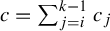 , we can see that recursively applying the above formula yields
$\alpha _{k}(b_{k},m_{k})= \alpha _{i}(b_{i},m_{i})+c$
 .
Proposition 4.2. Let
$\mathbb {Z}\curvearrowright ^{S} (X,\mu )$
 be an ergodic p.m.p. action and, given a sequence
$\{\epsilon _{n}\}_{n\in \mathbb {N}}$
 such that
$\epsilon _{n}<2^{-n}$
 for all
$n\in \mathbb {N}$
 , assume that we have sequences of towers
$\{(\mathcal {T}_{n},B_{n})\}_{n\in \mathbb {N}}$
 , sets
$\{F_{n}\}_{n\in \mathbb {N}}\subset \mathbb {Z}^{2}$
 , and column-to-tile maps
$\{\alpha _{n}\}_{n\in \mathbb {N}}$
 as described at the beginning of this section. In addition, let
$s\in \{(1,0),(0,1)\}$
 , one of the generators of
$\mathbb {Z}^{2}$
 . For a.e.
$x\in X$
 , there is an
$N\in \mathbb {N}$
 such that for all
$n\geq N$
 , the following conditions hold:
-
(1) $x\in S^{\mathcal {T}_{n}}B_{n}$
; -
(2) there exists a $y\in B_{n}\cap S^{\mathcal {T}_{n+1}}B_{n+1}$
such that
$x\in S^{\mathcal {T}_{n}}\{y\}\subset S^{\mathcal {T}_{n+1}}B_{n+1}$
; and -
(3) when x is expressed as $x=S^{m_{1}}b$
, where
$m_{1}\in T_{n}$
and
$b\in B_{n}$
, we have an
$m_{2}\in T_{n}$
such that
$\alpha _{n}(b,m_{2})-\alpha _{n}(b,m_{1})=s$
.


Proof. Let
$s\in \mathbb {Z}^{2}$
 be a given generator and let
$\mathscr {A}_{k}$
 be the partition given above for every
$k\in \mathbb {N}$
 . Let
$S_{k}$
 be the union of the top
$|\mathcal {T}_{k-1}|-1$
 and bottom
$|\mathcal {T}_{k-1}|-1$
 tower levels of
$(\mathcal {T}_{k},B_{k})$
 . Set

The proof follows if we can show that
$\mu (\bigcap _{n=1}^{\infty }\bigcup _{k=n}^{\infty }E_{k})=0$
 . This can be accomplished by showing that
$\sum \mu (E_{k})<\infty $
 and then applying the Borel–Cantelli lemma. First, since
$S^{\mathcal {T}_{n}}B_{n}$
 is an
$\epsilon _{n}$
 -tower for every
$n\in \mathbb {N}$
 , we have that
$\mu (X\setminus S^{\mathcal {T}_{k}}B_{k})<\epsilon _{k}$
 . Similarly, we have
$\mu (X\setminus S^{\mathcal {T}_{k-1}}B_{k-1})<\epsilon _{k-1}$
 . In addition, by construction, we have that
$\mu (S_{k})<({2|\mathcal {T}_{k-1}|}/{|\mathcal {T}_{k}|})<2\epsilon _{k}$
 and
$\mu (\{S^{t}b\in S^{\mathcal {T}_{k}}B_{k}\mid s+\alpha _{k}(t,b)\notin F_{k}\})<\epsilon _{k}$
 . Thus, we have that
$\mu (E_{k})< 4\epsilon _{k}+\epsilon _{k-1}$
 so that
$\sum \mu (E_{k})<\infty $
 since we chose
$\{\epsilon _{k}\}_{k\in \mathbb {N}}$
 to be summable.
In essence, we want to define our action of
$\mathbb {Z}^{2}$
 in such a way that its action is defined by moving the point x on the tower of
$\mathbb {Z}$
 according to the column-to-tile map
$\alpha _{n}$
 . Proposition 4.2 says that this procedure is well defined on some tail of our sequence of column-to-tile maps. Proposition 4.3 says that this procedure is consistent across these towers in the tail. (Color online.)

Figure 2 Long description
The diagram consists of two main components connected by a central horizontal arrow labeled alpha sub n.
On the left is a vertical column labeled Tower (T sub n, B sub n). The column is divided into stacked rectangular cells. The central cells are shaded light blue, while the top and bottom cells are gray. Inside the blue section, two blue dots are connected by an upward-pointing blue arrow. The lower dot is labeled x = S super m sub 1 b, and the upper dot is labeled sigma sub (1,0),n (x) = S super m sub 2 b. The entire blue region is labeled T sub n.
On the right is a rectangular box labeled Tile F sub n subset Z super 2. Inside this box is a grid of dots. Most dots are gray, but a central vertical subset of dots is blue. Within this blue subset, two larger blue dots are connected by an upward-pointing blue arrow. The lower large dot is labeled alpha sub n (b, m sub 1), and the upper large dot is labeled alpha sub n (b, m sub 1) + (1, 0).
Let
$s\in \mathbb {Z}^{2}$
 be a standard generator. For all
$n\in \mathbb {N}$
 , we can define a sequence of partial maps
$\sigma _{s,n}: S^{\mathcal {T}_{n}}B_{n}\to S^{\mathcal {T}_{n}}B_{n}$
 in the following way: given some
$t\in \mathcal {T}_{n}$
 and
$b\in B_{n}$
 such that there is some
$t'\in \mathcal {T}_{n}$
 such that
$\alpha _{n}(b,t')-\alpha _{n}(b,t)= s$
 , set
$\sigma _{s,n}(S^{t}b)=S^{t'}b$
 .
Proposition 4.3. Let
$\mathbb {Z}\curvearrowright ^{S} (X,\mu )$
 be an ergodic p.m.p. action and, given a sequence
$\{\epsilon _{n}\}_{n\in \mathbb {N}}$
 such that
$\epsilon _{n}<2^{-n}$
 for all
$n\in \mathbb {N}$
 , assume that we have sequences of towers
$\{(\mathcal {T}_{n},B_{n})\}_{n\in \mathbb {N}}$
 , sets
$\{F_{n}\}_{n\in \mathbb {N}}\subset \mathbb {Z}^{2}$
 , and column-to-tile maps
$\{\alpha _{n}\}_{n\in \mathbb {N}}$
 as described at the beginning of this section. In addition, let
$s\in \mathbb {Z}^{2}$
 be a standard generator and
$x\in X$
 . There is an
$N\in \mathbb {N}$
 such that, for all
$n_{1},n_{2}>N$
 , we have that
$x\in S^{\mathcal {T}_{n_{1}}}B_{n_{1}}\cap S^{\mathcal {T}_{n_{2}}}B_{n_{2}}$
 and
$\sigma _{s,n_{1}}(x)=\sigma _{s,n_{2}}(x)$
 .
Proof. Let a standard generator
$s\in \mathbb {Z}^{2}$
 and
$x\in X$
 be given, and let
$N\in \mathbb {N}$
 be given so that the property from Proposition 4.2 holds. Let
$n_{2}>n_{1}>N$
 be given. Thus, we have
${t_{1}\in \mathcal {T}_{n_{1}}}$
 ,
$b_{1}\in B_{n_{1}}$
 ,
$t_{2}\in \mathcal {T}_{n_{2}}$
 , and
$b_{2}\in B_{n_{2}}$
 such that
$x=S^{t_{1}}b_{1}=S^{t_{2}}b_{2}$
 , and we have
${t_{1}'\in \mathcal {T}_{n_{1}}}$
 and
$t_{2}'\in \mathcal {T}_{n_{2}}$
 such that
$\alpha _{n_{1}}(b_{1},t_{1}')=s+\alpha _{n_{1}}(b_{1},t_{1})$
 and
$\alpha _{n_{2}}(b_{2},t_{2}')=s+\alpha _{n_{2}}(b_{2},t_{2})$
 . We must show that
$S^{t_{1}'}b_{1}=S^{t_{2}'}b_{2}$
 . Since
$S^{t_{1}}b_{1}=x\in S^{\mathcal {T}_{n_{2}}}B_{n_{2}}$
 , we can find a
$t_{3}\in \mathcal {T}_{n_{2}}$
 such that
$S^{t_{1}'}b_{1}=S^{t_{3}}b_{2}$
 . By Proposition 4.1, we have that
$F_{n_{2}}$
 can be written as a disjoint union of translates of
$F_{n_{1}}$
 so that there is some
$c\in \mathbb {Z}^{2}$
 such that

and

so that

Since
$\alpha _{n_{2}}(b_{2},\cdot )$
 is a bijection, we have that
$t_{2}'=t_{3}$
 so that
$S^{t_{2}'}b_{2}=S^{t_{3}}b_{2}=S^{t_{1}'}b_{1}$
 .
Now, we are ready to define the action
$\mathbb {Z}^{2}\curvearrowright X$
 . Let
$s\in \mathbb {Z}^{2}$
 be a standard generator and
$x\in X$
 . Thus, we can find an
$N\in \mathbb {N}$
 such that, for all
$n,m>N$
 , we have that
${x\in S^{\mathcal {T}_{m}}B_{m}\cap S^{\mathcal {T}_{n}}B_{n}}$
 and
$\sigma _{s,m}(x)=\sigma _{s,n}(x)$
 . Thus, the action is defined by setting
${sx=\sigma _{s,n}(x)}$
 for some
$n>N$
 .
Proposition 4.4. The action of
$\mathbb {Z}^{2}\curvearrowright ^{R} X$
 defined above is orbit equivalent to
$\mathbb {Z}\curvearrowright ^{S} X$
 .
Proof. Let
$x\in X$
 be given such that there is an
$N\in \mathbb {N}$
 such that for all
$m,n>N$
 , we have that
$\sigma _{s,m}(x)=\sigma _{s,n}(x)$
 for any standard generator
$s\in \mathbb {Z}^{2}$
 . Thus, for all
$m,n>N$
 , there is a
$t_{m}\in \mathcal {T}_{m}$
 , a
$t_{n}\in \mathcal {T}_{n}$
 , a
$b_{m}\in B_{m}$
 , and a
$b_{n}\in B_{n}$
 such that
$x=S^{t_{m}}b_{m}=S^{t_{n}}b_{n}$
 , and
$g,h\in \mathbb {Z}^{2}$
 such that
$g=\alpha _{n}(b_{n},1+t_{n})-\alpha _{n}(b_{n},t_{n})= \alpha _{m}(b_{m},1+t_{m})-\alpha _{m}(b_{m},t_{m})$
 and
$h=\alpha _{n}(b_{n},-1+t_{n})-\alpha _{n}(b_{n},t_{n})= \alpha _{m}(b_{m},-1+t_{m})-\alpha _{m}(b_{m},t_{m})$
 . Thus,
${R^{g}x=S^{1}x}$
 and
${R^{h}x=S^{-1}x}$
 . This means that for all
$\ell \in \mathbb {Z}$
 , we have that there is a
$v\in \mathbb {Z}^{2}$
 such that
$R^{v}x=S^{\ell }x$
 . Now, suppose for some
$w\in \mathbb {Z}^{2}$
 that
$R^{w}x=S^{\ell }x$
 also. Thus, for some
$N\in \mathbb {N}$
 , we have that for all
$m,n>N$
 , there is a
$t_{m}\in \mathcal {T}_{m}$
 , a
$t_{n}\in T_{n}$
 , a
$b_{m}\in B_{m}$
 , and a
$b_{n}\in B_{n}$
 such that
$x=S^{t_{m}}b_{m}=S^{t_{n}}b_{n}$
 such that
$v=\alpha _{n}(b_{n},1+t_{n})-\alpha _{n}(b_{n},t_{n})= \alpha _{m}(b_{m},1+t_{m})-\alpha _{m}(b_{m},t_{m})=w$
 .
Similarly, for a standard generator
$s\in \mathbb {Z}^{2}$
 , we can find an
$N\in \mathbb {N}$
 where, for every
${n>N}$
 , we have a
$v\in \mathbb {Z}$
 so that, whenever
$x=S^{t}b\in S^{\mathcal {T}_{n}}B_{n}$
 , we have a
$t'\in \mathcal {T}_{n}$
 such that
$t-t'=v$
 and
$\alpha _{n}(b,t')-\alpha _{n}(b,t) =s$
 . Thus,
$R^{s}x=S^{v}x$
 . The fact that we bijectively map onto the orbit of x follows similarly to the first case.
Let
$\unicode{x3bb} : X\times \mathbb {Z}\to \mathbb {Z}^{2} $
 and
$\kappa : X\times \mathbb {Z}^{2}\to \mathbb {Z}$
 be the cocycles induced by the orbit equivalence between
$\mathbb {Z}\curvearrowright ^{S} (X,\mu )$
 and
$\mathbb {Z}^{2}\curvearrowright ^{R} (X,\mu )$
 . Let
$x\in X$
 . We can express
$\unicode{x3bb} $
 in the following way: given an
$n\in \mathbb {Z}$
 , we can find an
$N\in \mathbb {N}$
 such that for all
$k>N$
 , we have that
$x\in S^{\mathcal {T}_{k}}B_{k}$
 and, when x is expressed as
$x=S^{t}b$
 , where
$t\in \mathcal {T}_{k}$
 and
$b\in B_{k}$
 , we have that
$n+t\in \mathcal {T}_{k}$
 and
$\unicode{x3bb} (x,n)=\alpha _{k}(b,n+t)-\alpha _{k}(b,t)$
 . For
$\kappa $
 , given a
$g\in \mathbb {Z}^{2}$
 , we can find an
$N\in \mathbb {N}$
 such that
$x\in S^{\mathcal {T}_{N}}B_{N}$
 and, when x is expressed as
$x=S^{t}b$
 , where
$t\in \mathcal {T}_{N}$
 and
$b\in B_{N}$
 , we have that there is a
$t'\in \mathcal {T}_{N}$
 such that
$\alpha _{N}(b,t')-\alpha _{N}(b,t)=g$
 , so we get that
$\kappa (x,g)=t'-t$
 .
It will be useful for us later to have an estimate on the measure of the set of points whose
$\unicode{x3bb} $
 cocycle value for some element in
$\mathbb {Z}$
 is fixed at a given stage in the construction. Thus, we introduce the following definition.
Definition 4.5. We say a point
$x\in X$
 has its
$\unicode{x3bb} $
 cocycle value fixed for
$k\in \mathbb {Z}$
 at stage N if N is the smallest natural number such that for all
$n\geq N$
 , there exists a
$t\in \mathcal {T}_{n}$
 and a
$b\in B_{n}$
 such that
$x=S^{t}b$
 and
$\unicode{x3bb} (x,k)=\alpha _{n}(b,k+t)-\alpha _{n}(b,t)$
 .
Lemma 4.6. Let
$\unicode{x3bb} : X\times \mathbb {Z}\to \mathbb {Z}^{2}$
 be the cocycle induced by the orbit equivalence constructed above between
$\mathbb {Z}\curvearrowright ^{S} (X,\mu )$
 and
$\mathbb {Z}^{2}\curvearrowright ^{R} (X,\mu )$
 , and let
$k\in \mathbb {Z}$
 be given. Let
$D^{k}_{n}$
 be the set of points whose
$\unicode{x3bb} $
 cocycle value for k is fixed at stage n. Then, for
$n\geq 2$
 , we have that

Proof. We only need to show that the following bounds for
$\mu (D_{n}^{k})$
 for all
$n\geq 2$
 :

Indeed, assuming these hold, we have

First, the upper bound simply follows from the fact that
$\bigsqcup _{i=1}^{n}D^{k}_{i}\subset S^{\mathcal {T}_{n}}B_{n} $
 . For the lower bound, note that a point
$x\in S^{\mathcal {T}_{n}}B_{n}$
 , which we represent as
$x=S^{t}b$
 where
$t\in \mathcal {T}_{n}$
 and
$b\in B_{n}$
 , is an element of
$D_{n}^{k}$
 if and only if the following conditions hold:
-
(1) $x\in S^{\mathcal {T}_{i}}B_{i}$
for every
$i\geq n$
; -
(2) $t\in \mathcal {T}_{i}\cap (-k+\mathcal {T}_{i})$
for every
$i\geq n$
; -
(3) x is not in the top or bottom $|\mathcal {T}_{i}|$
levels of the tower
$(\mathcal {T}_{i+1},B_{i+1})$
for every
$i\geq n$
; -
(4) $x\notin \bigcup _{i=1}^{n-1}D^{k}_{i}$


for every
$n\in \mathbb {N}$
 . Thus, for
$n>1$
 ,

Now, we show a similar result for the set of points whose
$\kappa $
 cocycle value for a given element of
$\mathbb {Z}^{2}$
 is fixed at a given stage n.
Lemma 4.7. Let
$\kappa : X\times \mathbb {Z}^{2}\to \mathbb {Z}$
 be the cocycle induced by the orbit equivalence constructed above between
$\mathbb {Z}\curvearrowright ^{S} (X,\mu )$
 and
$\mathbb {Z}^{2}\curvearrowright ^{R} (X,\mu )$
 , and let
$g\in \mathbb {Z}^{2}$
 be given. Let
$E^{g}_{n}$
 be the set of points whose
$\kappa $
 cocycle value for g is fixed at stage n. Then, for
$n\geq 2$
 , we have that

Proof. Similar to the proof of Lemma 4.6, we need to show that

since

The upper bound simply follows from the fact that
$\bigsqcup _{i=1}^{n}E^{g}_{i}\subset S^{\mathcal {T}_{n}}B_{n} $
 . For the lower bound, note that a point
$x\in S^{\mathcal {T}_{n}}B_{n}$
 , representing x as
$x=S^{t}b$
 where
$t\in \mathcal {T}_{n}$
 and
$b\in B_{n}$
 , is also an element of
$E_{n}^{g}$
 if and only if:
-
(1) $x\in S^{\mathcal {T}_{i}}B_{i}$
for every
$i\geq n$
; -
(2) $\alpha _{i}(b,t)\in F_{i}\cap (-g+F_{i})$
for every
$i\geq n$
; -
(3) x is not in the top or bottom $|\mathcal {T}_{i}|$
levels of the tower
$S^{\mathcal {T}_{i+1}}B_{i+1}$
for every
$i\geq n$
; -
(4) $x\notin \bigcup _{i=1}^{n-1}E^{g}_{i}$


for every
$n\in \mathbb {N}$
 . Thus, for
$n>1$
 ,

Now, we are ready to prove our main theorem of this section, which is to show that the orbit equivalence we constructed is Shannon. We also summarize the sufficient conditions needed to guarantee Shannon orbit equivalence and highlight the flexibility outside of these conditions.
Theorem 4.8. Let
$\mathbb {Z}\curvearrowright ^{S} (X,\mu )$
 be an ergodic p.m.p. action and, given a sequence
$\{\epsilon _{n}\}_{n\in \mathbb {N}}$
 such that
$\epsilon _{n}<2^{-n}$
 for all
$n\in \mathbb {N}$
 , assume that we have a sequence of towers
$\{(\mathcal {T}_{n},B_{n})\}_{n\in \mathbb {N}}$
 such that:
-
(1) $(\mathcal {T}_{n},B_{n})$
is an
$\epsilon _{n}$
-tower of S for every
$n\in \mathbb {N}$
; -
(2) $({|\mathcal {T}_{n}|}/{|\mathcal {T}_{n+1}|})<\epsilon _{n+1}$
for every
$n\in \mathbb {N}$
; -
(3) $\mathcal {T}_{n}$
is an interval of non-negative integers that contains
$0$
for every
$n\in \mathbb {N}$
; -
(4) there is some $N\in \mathbb {N}$
such that
$|\mathcal {T}_{n}|<2^{n^{3}}$
for all
$n>N$
;


a sequence of sets
$\{F_{n}\}_{n\in \mathbb {N}}\subset \mathbb {Z}^{2}$
 such that:
-
(1) $F_{n}\subset \mathbb {Z}^{2}$
is a square centered at the origin for every
$n\in \mathbb {N}$
; -
(2) $|F_{n}|=|\mathcal {T}_{n}|$
for every
$n\in \mathbb {N}$
; -
(3) $|(F_{n}+F_{n+1})\setminus F_{n+1}|<\epsilon _{n+1}|F_{n+1}|$
for every
$n\in \mathbb {N}$
;


and a sequence of column-to-tile maps
$\{\alpha _{n}\}_{n\in \mathbb {N}}$
 such that:
-
(1) $\alpha _{n}$
is a column-to-tile map from
$(\mathcal {T}_{n},B_{n})$
to
$F_{n}$
with associated partition
$\mathscr {A}_{n}$
of
$B_{n}$
for every
$n\in \mathbb {N}$
; -
(2) there is a finite set $C_{n}\subset \mathbb {Z}^{2}$
such that the tiles
$\{F_{n}+c\}_{c\in C_{n}}$
are disjoint and
$\bigsqcup _{c\in C_{n}}(F_{n}+c)= F_{n+1}$
; -
(3) we have a distinct $c\in C_{n}$
for each
$i\in \bar {\mathcal {T}}_{n+1}$
so that
$\alpha _{n+1}(b,i+j)=\alpha _{n}(S^{i}b,j)+c$
for all
$j\in \mathcal {T}_{n}$
, where
$\bar {\mathcal {T}}_{n+1}\subset \mathcal {T}_{n+1}$
is the largest subset such that
$S^{\bar {\mathcal {T}}_{n+1}}A\in B_{n}$
and
$S^{\mathcal {T}_{n}+\bar {\mathcal {T}}_{n+1}}A\subset S^{\mathcal {T}_{n+1}}B_{n+1}$
for every
$n\in \mathbb {N}$
.


Recall that we defined a sequence of partial maps
$\sigma _{s,n}: S^{\mathcal {T}_{n}}B_{n}\to S^{\mathcal {T}_{n}}B_{n}$
 in the following way: given some
$t\in \mathcal {T}_{n}$
 and
$b\in B_{n}$
 such that there is some
$t'\in \mathcal {T}_{n}$
 such that
$\alpha _{n}(b,t')-\alpha _{n}(b,t)= s$
 , set
$\sigma _{s,n}(S^{t}b)=S^{t'}b$
 . Now, let
$\mathbb {Z}^{2}\curvearrowright ^{R}X$
 be the action defined, for a generator
$s\in \mathbb {Z}^{2}$
 and an
$x\in X$
 , by setting
$sx=\sigma _{s,n}(x)$
 for some
$n>N$
 . Then, the orbit equivalence between
$\mathbb {Z}\curvearrowright X$
 and
$\mathbb {Z}^{2}\curvearrowright X$
 is Shannon.
Proof. Let
$k\in \mathbb {Z}$
 be given. First, we show that the cocycle partition of
$\unicode{x3bb} :X\times \mathbb {Z}\to \mathbb {Z}^{2}$
 for k has finite Shannon entropy. For a given
$g\in \mathbb {Z}^{2}$
 , let
$P_{g}=\{x\in X\mid \unicode{x3bb} (x,k)=g\}$
 and let
$\mathscr {P}=\{P_{g}\mid g\in \mathbb {Z}^{2}\}$
 . For every
$n\in \mathbb {N}$
 and
$g\in \mathbb {Z}^{2}$
 , set
$D^{k,g}_{n}=D^{k}_{n}\cap P_{g}$
 , where
$D^{k}_{n}$
 is the set of points whose
$\unicode{x3bb} $
 cocycle value for k is fixed at stage n. Thus, for every
$g\in \mathbb {Z}^{2}$
 ,
$\{D^{k,g}_{n}\}_{n\in \mathbb {N}}$
 is a partition of
$P_{g}$
 . Recall that, for every
$n\in \mathbb {N}$
 ,
$F_{n}\subset \mathbb {Z}^{2}$
 is the set that corresponds to the column-to-tile map
$\alpha _{n}$
 and let
$\bar {F}_{n}=F_{n}-F_{n}$
 . Note that
$D^{k,g}_{n}=\varnothing $
 if
$g\notin \bar {F}_{n}$
 . Thus, to apply Proposition 2.2, the only property left for us to show is that
$\sum _{n=1}^{\infty }\mu (D_{n}^{k})\log ({\mu (D_{n}^{k})}/{|\bar {F}_{n}|})<\infty $
 since
$D_{n}^{k}=\bigcup _{g\in \mathbb {Z}^{2}}D_{n}^{k,g}$
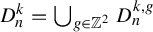 .
By Lemma 4.6, we have that
$\mu (D_{n}^{k})< \epsilon _{n-1}+3\sum _{i=n}^{\infty }\epsilon _{i}+|k|\sum _{i=n}^{\infty }({1}/{|\mathcal {T}_{i-1}|})$
 . By choosing
$\epsilon _{n}<2^{-n}$
 in our construction, which also implies that
$2^{i}<|\mathcal {T}_{i}|$
 for all
$i>1$
 , we have that
$\mu (D_{n}^{k})< 2^{-(n-1)}+3(2^{-n+1})+|k|(2^{-n+2})$
 for all n. Thus, there is an
$N\in \mathbb {N}$
 such that for all
$n>N$
 , we have
$\mu (D_{n}^{k})<2^{-n/2}$
 . By construction, we have
$|F_{n}|<2^{n^{2}}$
 for
$n>N$
 and
$|\bar {F}_{n}| \leq4|F_{n}|$
 . Thus, this implies that

Thus, we can apply Proposition 2.2 to conclude that
$\mathscr {P}$
 has finite Shannon entropy.
Now, we show that the Shannon entropy of each partition associated to
$\kappa : X\times \mathbb {Z}^{2}\to \mathbb {Z}$
 is finite. Fix
$g\in \mathbb {Z}^{2}$
 . Let
$P_{k}=\{x\in X\mid \kappa (x,g)=k\}$
 for every
$k\in \mathbb {Z}$
 . For every
$n\in \mathbb {N}$
 and
$k\in \mathbb {Z}$
 , set
$E^{g,k}_{n}=E^{g}_{n}\cap P_{k}$
 . Thus, for every
$k\in \mathbb {Z}$
 , we have that
$\{E^{g,k}_{n}\}_{n\in \mathbb {N}}$
 is a partition of
$P_{k}$
 . Just like the
$\unicode{x3bb} $
 cocycle case, we have that
$E^{g,k}_{n}=\varnothing $
 if
$k\notin \bar {\mathcal {T}}_{n}$
 , where
$\bar {\mathcal {T}}_{n}=\mathcal {T}_{n}-\mathcal {T}_{n}$
 . Lemma 4.7 gives us that

Note that we can find an
$N\in \mathbb {N}$
 such that for all
$n>N$
 , we have that
$\sum _{i=n}^{\infty }({|F_{i-1}\setminus (g+F_{i-1})|}\, /{|F_{i-1}|})<2^{-n/4}$
 since
$2^{i-1}<|F_{i-1}|$
 and
$(|F_{i-1}\setminus (g+F_{i-1})|)/{|F_{i-1}|}$
 is approximately
${1}/{\sqrt {|F_{i-1}|}}$
 . Thus, there is an
$N\in \mathbb {N}$
 such that, for all
$n>N$
 ,
$\sum _{i=n}^{\infty }({|F_{i-1}\setminus (g+F_{i-1})|}/{|F_{i-1}|})\, <2^{-n/4}$
 and
$\epsilon _{n}<({1}/{2^{n}})$
 so that we have
$\mu (E^{g}_{n})<2^{-n/8}$
 for all
$n>N$
 . By taking
$|\mathcal {T}_{n}|<2^{n^{2}}$
 for
$n>N$
 and noting that
$|\bar {\mathcal {T}}_{n}| \leq 2|\mathcal {T}_{n}|$
 , we have that

Since we have that

we can apply Proposition 2.2 to conclude that the Shannon entropy of each partition associated to
$\kappa $
 is finite.
5 Summary of the construction from Fieldsteel and Friedman
Now, we summarize the construction proposed by Fieldsteel and Friedman. Later, we show how this construction can be modified to produce a theorem similar to Theorem 1.16 for Shannon orbit equivalence.
Remark 5.1. If
$L\in \mathbb {N}$
 , we use the following notation to represent a d-cube in
$\mathbb {N}^{d}$
 :

and the following notation to represent the d-cube centered at the origin of side length
$2L+1$
 in
$\mathbb {Z}^{d}$
 :

Definition 5.2. Let
$J,K,L\in N$
 . We say a permutation
$\pi $
 of
$C_{L}$
 is a
$(J,K,L)$
 -permutation if there exists a
$u\in \mathbb {Z}^{d}$
 and
$v\in \bar {C}_{K}$
 such that for all
$w\in C_{J}+u$
 , we have that
$\pi (w)=w+v$
 . The vector v is called the translation vector of
$\pi $
 and is denoted by
$tv(\pi )$
 . We also call a permutation
$\pi $
 of
$C_{L}+w$
 for some
$w\in \mathbb {Z}^{d}$
 a
$(J,K,L)$
 -permutation if it is a
$(J,K,L)$
 -permutation of
$C_{L}$
 up to translation by w. Moreover, a bijection
$\pi $
 of
$\mathbb {Z}^{d}$
 is called a
$(J,K,L)$
 -blocked bijection if there is a collection
$\{C_{L}+w_{i}\}_{i\in I}$
 of disjoint translates of
$C_{L}$
 for which
$\pi $
 acts on each
$C_{L}+w_{i}$
 by a
$(J,K,L)$
 -permutation and acts as the identity on the rest of
$\mathbb {Z}^{d}$
 . If
$C_{J}+u_{i}+w_{i}$
 is the subset of
$C_{L}+w_{i}$
 on which
$\pi $
 acts by translation, then we call the sets
$C_{L}+w_{i}$
 the blocks of
$\pi $
 , the sets
$C_{J}+u_{i}+w_{i}$
 the rigid blocks of
$\pi $
 , and the sets
$C_{L}+w_{i}\setminus C_{J}+u_{i}+w_{i}$
 filler sets of
$\pi $
 .
Now, we say a cocycle
$\alpha $
 for a p.m.p.
$\mathbb {Z}^{d}$
 -action S of the probability space
$(X,\mu )$
 is a
$(J,K,L)$
 -blocked cocycle if, for a.e.
$x\in X$
 , there is a
$(J,K,L)$
 -blocked bijection
$\pi _{x}$
 of
$\mathbb {Z}^{d}$
 such that
$\alpha (x,\cdot )=\pi _{x}(\cdot )-\pi _{x}(0)$
 , and the blocks, rigid blocks, and the permutations on them are measurably selected. If
$x\in X$
 and
$C_{L}+w_{i}$
 is a block of
$\pi _{x}$
 , we call the set
$S^{C_{L}+w_{i}}(x)$
 a block of
$\alpha $
 . We make a similar definition for rigid blocks and filler sets. In addition to being a
$(J,K,L)$
 -blocked cocycle, we say
$\alpha $
 is a
$(J,K,L,\epsilon )$
 -blocked cocycle of S if the measure of points in X which are not in a block of
$\alpha $
 is less than
$\epsilon $
 .
Remark 5.3. Given a sequence of cocycles
$\{\alpha _{i}\}_{i\in \mathbb {N}}$
 of an action
$\mathbb {Z}^{d}\curvearrowright (X,\mu )$
 , we say that
$\{\alpha _{i}\}_{i\in \mathbb {N}}$
 converges to a cocycle
$\alpha $
 if, for almost every
$x\in X$
 and every
$v\in \mathbb {Z}^{d}$
 , we have that
$\lim _{i\to \infty }\alpha _{i}(x,v)=\alpha (x,v)$
 .
Lemma 1 of Fieldsteel and Friedman shows that, given a summable sequence
$\{\epsilon _{i}\}_{i\in \mathbb {N}}$
 in
$(0,1)$
 and an arbitrary sequence
$\{K_{i}\}_{i\in \mathbb {N}}$
 of positive integers, then, given a sequence of positive integers
$\{J_{i}\}_{i\in \mathbb {N}}$
 that grow at a sufficiently fast rate and a sequence of positive integers
$\{L_{i}\}_{i\in \mathbb {N}}$
 such that each
$L_{i}$
 is sufficiently close to
$J_{i}$
 , we can find a sequence of cocycles
$\{\alpha _{i}\}_{i\in \mathbb {N}}$
 of an action
$\mathbb {Z}^{d}\curvearrowright ^{T}(X,\mu )$
 that converges to a cocycle
$\alpha $
 such that the corresponding orbit equivalence between T and
$T^{\alpha ^{-1}}$
 is, for all
$a\geq 1$
 , a weak-a-equivalence and, for all
$b\in (0,1)$
 , a strong-b-equivalence.
To get mixing, Fieldsteel and Friedman construct a sequence of blocked cocycles by choosing parameters so that the ergodic theorem and the Rokhlin lemma guarantee a relative mixing condition for each cocycle. In turn, this gives mixing once we pass to the limit, guaranteed by Lemma 1, of our sequence of blocked cocycles.
6 Fieldsteel–Friedman orbit equivalence is Shannon
For the rest of this section, let
$\mathbb {Z}\curvearrowright ^{S} (X,\mu )$
 be an ergodic p.m.p. action. In addition, let
$\{K_{n}\}_{n\in \mathbb {N}}$
 and
$\{L_{n}\}_{n\in \mathbb {N}}$
 be sequences of positive integers, and let
$\{\epsilon _{n}\}_{n\in \mathbb {N}}$
 be a sequence such that
$\epsilon _{n}<2^{-n}$
 for every
$n\in N$
 . Assume we have a sequence of cocycles
$\{\alpha _{n}\}_{n\in \mathbb {N}}$
 of S taking values in
$\mathbb {Z}$
 such that
$\beta _{n}=\alpha _{n}\circ \alpha _{n-1}^{-1}$
 is a
$(L_{n}-K_{n}, K_{n},L_{n},\epsilon _{n})$
 -blocked cocycle. For every
$n\in \mathbb {N}$
 , we set
$S_{n}=S^{\alpha _{n}^{-1}}$
 and
$B_{n}=2(\sum _{j=1}^{n}L_{j})$
 . In addition, assume that for every
$n\in \mathbb {N}$
 , we have that
$({K_{n}}/{L_{n}})<\epsilon _{n}$
 ,
$({n+B_{n}})/({L_{n+1}-K_{n+1}})<\epsilon _{n+1}$
 , and, for large enough n,
$K_{n}<2^{n^{3}}$
 .
Proposition 6.1. The sequence of cocycles
$\{\alpha _{i}\}_{i\in \mathbb {N}}$
 for the action
$\mathbb {Z}\curvearrowright ^{S} (X,\mu )$
 as described above converges to a cocycle
$\alpha $
 given, for every
$n\in \mathbb {Z}$
 and almost every
$x\in X$
 , by the formula
$\lim _{i\to \infty }\alpha _{i}(x,n)=\alpha (x,n)$
 .
The proof of this proposition is an adaption of [Reference Fieldsteel and Friedman7, proof of Lemma 1] from Fieldsteel and Friedman.
Proof. First, set

We first show that
$\mu (\bigcup _{i=1}^{\infty }\bigcap _{j=i}^{\infty }F_{j})=1$
 , which we can accomplish by showing that
$\sum _{j=1}^{\infty }\mu (X\setminus F_{j})<\infty $
 and applying Borel–Cantelli. To show this, note that
$x\notin F_{j}$
 in three possible cases:
-
(1) x is not in a block of $\beta _{j+1}$
; -
(2) x is in a block of $\beta _{j+1}$
, but not a rigid block; or -
(3) x is in a rigid block of $\beta _{j+1}$
, but not all of
$S_{j}^{\bar {C}_{j+B_{j}}}(x)$
.


Note that the measure of the set of points that satisfy case (1) is
$<\epsilon _{j+1}$
 , that satisfy case (2) is
$({K_{j+1}}/{L_{j+1}})<\epsilon _{j+1}$
 , and that satisfy case (3) is
$(({2(j+B_{j})})/({L_{j+1}-K_{j+1}}))<2\epsilon _{j+1}$
 . Thus,
$\sum _{j=1}^{\infty }\mu (X\setminus F_{j})<\sum _{j=1}^{\infty }4\epsilon _{j+1}<\infty $
 since for every
$j\in \mathbb {N}$
 , we have that
$\epsilon _{j}<2^{-j}$
 . Let
$x\in \bigcup _{i=1}^{\infty }\bigcap _{j=i}^{\infty }F_{j}$
 and
$n\in \mathbb {Z}$
 . Thus, we can find an i so that
$|n|<i$
 and
$x\in \bigcap _{j=i}^{\infty }F_{j}$
 . For all
$j\geq i$
 , we have

Hence,
$\alpha $
 is a well-defined function.
We also have that
$\alpha $
 satisfies the cocycle identity since, given almost any
$x\in X$
 and given
$m,n\in \mathbb {Z}$
 , we can find an
$i\in \mathbb {N}$
 such that
$\alpha (x,n+m)=\alpha _{i}(x,n+m)$
 ,
$\alpha (x,m)=\alpha _{i}(x,m)$
 , and
$\alpha (S^{m}x,n)=\alpha _{i}(S^{m}x,n)$
 so that

A very similar argument shows that for almost every
$x\in X$
 , we have that
$\alpha (x,\cdot )$
 is injective. Now, we just need to show that, for almost every
$x\in X$
 , the function
$\alpha (x,\cdot )$
 is surjective. Let
$x\in \bigcup _{i=1}^{\infty }\bigcap _{j=i}^{\infty }F_{j}$
 and
$n\in \mathbb {Z}$
 . Then, we can find an
$i\in \mathbb {N}$
 such that
$x\in \bigcap _{j=i}^{\infty }F_{j}$
 . This implies that we can find a
$j\in \mathbb {N}$
 such that
$j+B_{j}>|n|$
 . Since
$\alpha _{j}(x,\cdot )$
 is bijective, we can find an
$m\in \mathbb {Z}$
 such that
$\alpha _{j}(x,m)=n$
 . Hence, we have that
$\alpha (x,m)=n$
 since
$\alpha _{j}(x,m)=\alpha _{k}(x,m)$
 for every
$k\geq j$
 .
Definition 6.2. Let
$\alpha $
 be a cocycle that is a limit of the cocycles
$\{\alpha _{n}\}_{n\in \mathbb {N}}$
 and fix a
$k\in \mathbb {Z}$
 . We say a point
$x\in X$
 has its
$\alpha $
 cocycle value for k fixed at stage N if N is the smallest natural number such that
$\alpha _{N}(x,k)=\alpha (x,k)$
 . Recall that this implies that, for every
$n\geq N$
 ,
$\alpha _{n}(x,k)=\alpha (x,k)$
 . We let
$D^{k}_{N}$
 denote the set of all points whose cocycle value for k is fixed at stage N.
Lemma 6.3. For the cocycle
$\alpha $
 of the action
$\mathbb {Z}\curvearrowright ^{S} (X,\mu )$
 , which is the limit of the cocycles
$\{\alpha _{i}\}_{i\in \mathbb {N}}$
 as described at the beginning of this section, we have for a given
$k\in \mathbb {Z}$
 and
$n>1$
 that the set
$D_{n}^{k}$
 of all points whose cocycle value for k is fixed at stage n satisfies

Proof. To prove this lemma, it is sufficient to show that the following inequality holds:

Indeed, assuming the above inequality holds, we have that

Note that we simply get the upper bound for
$\mu (D^{k}_{n})$
 by noticing that
$D^{k}_{n}\subset X\setminus (\bigcup _{i=1}^{n-1}D_{i}^{k})$
 . For the lower bound, we first notice that
$x\in X$
 is guaranteed to be in
$D^{k}_{n}$
 if both x and
$S_{i-1}^{\alpha _{n-1}(x,k)}(x)$
 are in the same rigid block of the cocycle
$\beta _{i}$
 for all
$i\geq n$
 . Thus, a point
$x\in X$
 may not be in
$D^{k}_{n}$
 if it satisfies at least one of the following four conditions:
-
(1) $x\in \bigcup _{i=1}^{n-1}D_{i}^{k}$
; -
(2) there is an $i\geq n$
such that
$x\notin S_{i-1}^{C_{M_{i}}}B_{i}$
; -
(3) there is an $i\geq n$
such that x is in a block, but not a rigid block, of
$\beta _{i}$
; or -
(4) there is an $i\geq n$
such that x is in a rigid block of
$\beta _{i}$
, but
$S_{i-1}^{\alpha _{n-1}(x,k)}(x)$
is not.


Thus, the measure of the set of points that satisfy each particular condition is bounded above by the expressions
$\sum _{i=1}^{n-1}\mu (D^{k}_{i})$
 ,
$\sum _{i=n}^{\infty }\mu (X\setminus S_{i-1}^{C_{M_{i}}}B_{i})$
 ,
$\sum _{i=n}^{\infty }({K_{i}}/{L_{i}})$
 , and
$\sum _{i=n}^{\infty } (({|k|+ B_{n-1}})/({L_{i}-K_{i}}))$
 , respectively.
Now, we wish to show that we can make similar estimates for
$\alpha ^{-1}$
 . First, we must show that
$\alpha ^{-1}$
 can be written as a sequence of cocycles.
Lemma 6.4. If
$\{\alpha _{n}\}_{n\in \mathbb {N}}$
 is our sequence of cocycles for the action
$\mathbb {Z}\curvearrowright ^{S} (X,\mu )$
 , as detailed at the beginning of this section, and
$\alpha $
 is the limit guaranteed by Proposition 6.1, then
$\alpha ^{-1}=\lim _{n\to \infty }\alpha _{n}^{-1}$
 .
Proof. For almost every
$x\in X$
 and every
$n\in \mathbb {Z}$
 , we can find an
$i\in \mathbb {N}$
 such that for all
$j \geq i$
 ,
$\alpha (x,n)=\alpha _{j}(x,n)$
 following Proposition 6.1 so that
$\alpha (x,\alpha _{j}^{-1}(x,n))=\alpha _{j}(x,\alpha _{j}^{-1}(x,n))=n$
 , which implies that
$\alpha ^{-1}(x,n)=\alpha _{j}^{-1}(x,n)$
 for all
$j\geq i$
 . Hence, we have that
$\alpha ^{-1}=\lim _{n\to \infty }\alpha _{n}^{-1}$
 .
With Lemma 6.4 in hand, we can make the following definition, which is the analog of
$D_{n}^{k}$
 for
$\alpha ^{-1}$
 .
Definition 6.5. We say a point
$x\in X$
 has its
$\alpha ^{-1}$
 cocycle value for
$\ell $
 fixed at stage N if N is the smallest natural number such that
$\alpha _{N}^{-1}(x,\ell )=\alpha ^{-1}(x,\ell )$
 . We let
$E^{\ell }_{N}$
 denote the set of all points whose cocycle value for
$\ell $
 is fixed at stage N.
We can also bound the measure of
$E_{n}^{\ell }$
 above by a bound similar to the one used for the corresponding sets for
$\alpha $
 in Lemma 6.3.
Lemma 6.6. For the cocycle
$\alpha $
 of the action
$\mathbb {Z}\curvearrowright ^{S} (X,\mu )$
 , which is the limit of the cocycles
$\{\alpha _{i}\}_{i\in \mathbb {N}}$
 as described at the beginning of this section, we have for a given
$\ell \in \mathbb {Z}$
 and
$n>1$
 that the set
$E_{n}^{\ell }$
 satisfies

Proof. Let
$\ell \in \mathbb {Z}$
 and
$n>1$
 be given. Analogous to the proof of Lemma 6.3, the desired inequality holds if we can show that the following inequality holds:

First, we can see that the upper bound for
$\mu (E^{\ell }_{n})$
 holds by noting that
$E_{n}^{\ell }\subset X\setminus (\bigcup _{i=1}^{n-1}E_{i}^{\ell })$
 . For the lower bound, note that
$x\in X$
 may not be in
$E_{n}^{\ell }$
 if x satisfies at least one of the following four conditions:
-
(1) $x\in \bigcup _{i=1}^{n-1}E_{i}^{\ell }$
; -
(2) there is an $i\geq n$
such that
$x\notin S_{i-1}^{C_{M_{i}}}B_{i}$
; -
(3) there is an $i\geq n$
such that x is in a block, but not a rigid block, of
$\beta _{i}$
; or -
(4) there is an $i\geq n$
such that x is in a rigid block of
$\beta _{i}$
, but
$S_{i-1}^{\ell }(x)$
is not.


Thus, the measure of the set of points that satisfy each particular condition is bounded above by
$\sum _{i=1}^{n-1}\mu (E^{\ell }_{i})$
 ,
$\sum _{i=n}^{\infty }\mu (X\setminus S_{i-1}^{C_{M_{i}}}B_{i})$
 ,
$\sum _{i=n}^{\infty }({K_{i}}/{L_{i}})$
 , and
$\sum _{i=n}^{\infty }({|\ell| }/{(L_{i}-K_{i})})$
 , respectively.
Proposition 6.7. Let
$\alpha $
 be the cocycle of the action
$\mathbb {Z}\curvearrowright ^{S} (X,\mu )$
 , which is the limit of the cocycles
$\{\alpha _{i}\}_{i\in \mathbb {N}}$
 as described at the beginning of this section. The orbit equivalence between S and
$S^{\alpha ^{-1}}$
 given by the cocycle
$\alpha $
 is Shannon.
Proof. First, we show that the Shannon partitions of the cocycle
$\alpha $
 have finite Shannon entropy. Let
$k\in \mathbb {Z}$
 be given. For a given
$\ell \in \mathbb {Z}$
 , let
$P_{\ell }=\{x\in X\mid \alpha (x,k)=\ell \}$
 and let
$\mathscr {P}=\{P_{\ell }\mid \ell \in \mathbb {Z}\}$
 . For every
$n\in \mathbb {N}$
 and
$\ell \in \mathbb {Z}$
 , set
$D^{k,\ell }_{n}=D^{k}_{n}\cap P_{\ell }$
 , where
$D^{k}_{n}$
 is the set of points whose
$\alpha $
 cocycle value for k is fixed at stage n. Now, note that for every
$\ell \in \mathbb {Z}$
 , we have that
$\{D^{k,\ell }_{n}\}_{n\in \mathbb {N}}$
 is a partition of
$P_{\ell }$
 . Setting
$F_{n}=\{\alpha _{n}(x,k)\mid x\in X\}$
 , we can see that
$D^{k,\ell }_{n}=\varnothing $
 if
$\ell \notin F_{n}$
 . Now, by Proposition 2.2, the Shannon entropy of
$\mathscr {P}$
 will be finite if we show that
$\sum -\mu (D_{n}^{k})\log ({\mu (D_{n}^{k})}/{|F_{n}|})<\infty $
 . By Lemma 6.3, we have that

for large enough n. By our choice of
$\epsilon _{n}<2^{-n}$
 in our construction, there is an N such that, for all
$n>N$
 , we have that
$\mu (D_{n}^{k})<2^{-n+4}$
 and
$|F_{n}|=K_{n}<2^{n^{3}}$
 . Thus, this implies that

Hence, Proposition 2.2 implies that
$\sum _{\ell \in \mathbb {Z}}-\mu (P_{\ell })\log \mu (P_{\ell })<\infty $
 .
Next, we show that the same is true for Shannon partitions of
$\alpha ^{-1}$
 . Let
$\ell \in \mathbb {Z}$
 be given. For a given
$k \in \mathbb {Z}$
 , let
$Q_{k}=\{x\in X\mid \alpha ^{-1}(x,\ell )=k\}$
 and let
$\mathscr {Q}=\{Q_{k}\mid k\in \mathbb {Z}\}$
 . For every
$n\in \mathbb {N}$
 and
$k\in \mathbb {Z}$
 , set
$E^{\ell , k}_{n}=E^{\ell }_{n}\cap Q_{k}$
 , where
$E^{\ell }_{n}$
 is the set of points whose
$\alpha ^{-1}$
 cocycle value for
$\ell $
 is fixed at stage n. Again, we wish to use Proposition 2.2. First, we see that for every
$k\in \mathbb {Z}$
 , we have
$\{E^{\ell , k}_{n}\}_{n\in \mathbb {N}}$
 is a partition of
$Q_{k}$
 . Setting
$F_{n}=\{\alpha ^{-1}_{n}(x,\ell )\mid x\in X\}$
 , we can see that
$E^{\ell ,k}_{n}=\varnothing $
 if
$k \notin F_{n}$
 . Thus, we only need to show that
$\sum -\mu (E_{n}^{\ell })\log ({\mu (E_{n}^{\ell })}/{|F_{n}|})<\infty $
 . By Lemma 6.6, we have that

for large enough n. By our choice of
$\epsilon _{n}<2^{-n}$
 in our construction, there is an N such that, for all
$n>N$
 , we have that
$\mu (E_{n}^{\ell })<2^{-n+4}$
 and
$|F_{n}|=K_{n}<2^{n^{3}}$
 . Thus, this implies that

Thus, by Proposition 2.2, we can conclude that
$\sum _{k\in \mathbb {Z}}-\mu (Q_{k})\log \mu (Q_{k})<\infty $
 .
7 Weak mixing
In this section, we find sequences of natural numbers
$\{K_{n}\}_{n\in \mathbb {N}}$
 and
$\{L_{n}\}_{n\in \mathbb {N}}$
 , and a sequence of real numbers
$\{\epsilon _{n}\}_{n\in \mathbb {N}}$
 so that we can construct a sequence of cocycles
$\{\beta _{n}\}_{n\in \mathbb {N}}$
 of the action
$\mathbb {Z}\curvearrowright ^{S}(X,\mu )$
 such that
$\beta _{n}$
 is an
$(L_{n}-K_{n}, K_{n},L_{n},\epsilon _{n})$
 -blocked cocycle and, setting
$\alpha _{n}=\beta _{n}\circ \beta _{n-1}\circ \cdots \circ\beta _{1}$
 for every
$n\in \mathbb {N}$
 , the limit
$\alpha (x)=\lim _{n\to \infty }\alpha _{n}(x)$
 exists and the action
$T=S^{\alpha ^{-1}}$
 is weakly mixing. These parameters are also chosen in a way such that
$\alpha $
 is a Shannon orbit equivalence between S and T.
Definition 7.1. Let G be a countable infinite group and
$(X,\mathscr {B},\mu )$
 be a probability space. We say an action
$G\curvearrowright ^{S} X$
 is weak mixing if for all finite sets
$\mathscr {F}\subset \mathscr {B}$
 , we have that

The following characterization of weak mixing is the one we use.
Proposition 7.2. Let G be a group and let
$G\curvearrowright ^{S} X$
 be an action over the probability space
$(X,\mathscr {B},\mu )$
 . If there is a sequence
$\{g_{n}\}_{n\in \mathbb {N}}\subset G$
 such that

for all pairs of measurable sets
$A,B\in X$
 , then S is weakly mixing.
Proof. Let
$\{g_{n}\}_{n\in \mathbb {N}}\subset G$
 such that

for all pairs of measurable sets
$A,B\in X$
 . In addition, let a finite set
$\mathscr {F}\subset \mathscr {B}$
 and an
$\epsilon>0$
 be given. Let
$E\subset G$
 be a finite set. Let L be a lower bound of the set

Following the hypothesis, we can find an
$N\in \mathbb {N}$
 such that for all
$n>N$
 , we have that

for each pair
$A,B\in \mathscr {F}$
 and
$g_{n}\in G\setminus E$
 . Thus, we have for all
$n>N$
 ,

which implies that
$L<\epsilon $
 . Thus,

Since E and
$\epsilon $
 were arbitrary, we have that

7.1 Construction of the cocycle sequence
Let
$\{\mathscr {P}_{n}\}_{n\in \mathbb {N}}$
 be a sequence of measurable partitions of X such that
$\mathscr {P}_{n+1}$
 refines
$\mathscr {P}_{n}$
 for every
$n\geq 1$
 that generate the sigma algebra of X mod null sets and let
$\{\epsilon _{n}\}_{n\in \mathbb {N}}$
 be a strictly decreasing sequence of real numbers such that
$\epsilon _{n}<({1}/{2^{n}})$
 for every
$n\in \mathbb {N}$
 . We now proceed with the construction of our sequence of cocycles
$\{\beta _{n}\}_{n\in \mathbb {N}}$
 by recursively finding appropriate parameters
$K_{n}$
 ,
$L_{n}$
 , and
$M_{n}$
 at the nth stage so that we can build a Rokhlin tower of height
$M_{n}$
 whose levels over points in the base are the blocks for the
$(L_{n}-K_{n}, K_{n}, L_{n},\epsilon _{n})$
 -cocycle
$\beta _{n}$
 .
Diagram showing how we define our cocycles
$\{\beta _{n}\}_{n\in \mathbb {N}}$
 . (Color online.)

Figure 3 Long description
The diagram consists of two panels.
Left Panel: Titled beta sub n (x, dot) is a blocked bijection on disjoint L sub n-blocks. It shows a horizontal sequence of three rectangular blocks connected by a line. Each block is divided into three segments: a light blue outer segment, a darker blue middle segment, and another light blue outer segment.
* Above the first block is the label C sub L sub n + w sub 1 with a blue arrow v sub 1 pointing right. Below it is C sub L sub n minus K sub n + u sub 1 + w sub 1.
* Above the second block is C sub L sub n + w sub 2 with a green arrow v sub 2 pointing right. Below it is C sub L sub n minus K sub n + u sub 2 + w sub 2.
* Above the third block is C sub L sub n + w sub 3 with an orange arrow v sub 3 pointing right. Below it is C sub L sub n minus K sub n + u sub 3 + w sub 3.
* At the bottom of the left panel is the text: v sub i is an element of C bar sub K sub n on each rigid subblock.
Right Panel: Titled Zooming in on a single (L sub n minus K sub n, K sub n, L sub n)-block. It shows a vertical transformation between two identical rectangular blocks.
* The top block is labeled C sub L sub n + w sub i. It has horizontal bars above the light blue outer segments.
* A blue arrow labeled v sub i points downward from the top block to the bottom block.
* The text C sub L sub n minus K sub n + u sub i + w sub i is positioned next to the arrow.
* The bottom block is identical in structure to the top one.
* Below the bottom block is the label beta sub n (x, dot) (C sub L sub n minus K sub n + u sub i + w sub i).
Before we describe the rest of the idea of the construction, we need the following definitions.
Definition 7.3. Let a p.m.p. action
$\mathbb {Z}\curvearrowright ^{S}(X,\mu )$
 , a measurable ordered partition
$\mathscr {P}=\{P_{i}\}_{i\in I}$
 of X, and a finite subset
$F\subset \mathbb{Z}$
 be given. If
$x\in X$
 , the
$(S,\mathscr {P},F)$
 -name of x is the indexed set
$\{i_{k}\}_{k\in F}\subset I$
 such that
$S^{k}(x)\in P_{i_{k}}$
 . If
$A\subset X$
 such that for every
$k\in F$
 , there is an
$i_{k}\in I$
 such that
$S^{k}A\subset P_{i_{k}}$
 , we say the
$(S,\mathscr {P},F)$
 -name of A is the indexed set
$\{i_{k}\}_{k\in F}\subset I$
 .
In addition, given a set
$A\subset X$
 , we define the distribution function of
$\mathscr {P}$
 over A to be the function
$\mathrm {dist}_{A}(\mathscr {P}): I\to [0,1]$
 defined by

Note that we drop the subscript of the distribution function if we are looking at the distribution over X.
Remark 7.4. Let
$A\subset X$
 , an ordered measurable partition
$\mathscr {P}=\{P_{i}\}_{i\in I}$
 of X for some set I, and a set
$\{p_{i}\}_{i\in I}\subset [0,1]$
 be given. We define a distance function in the following way:

We also guarantee that there is a sequence
$\{\ell _{n}\}_{n\in \mathbb {N}}$
 of integers such that a certain subsequence of our actions satisfy a progressively stronger, with respect to the sequence, version of the following approximate mixing condition.
Definition 7.5. If
$\delta>0$
 ,
$\mathscr {P}$
 is a partition of X, and
$\ell \in \mathbb {N}$
 , we say that an action S is
$\delta $
 -mixing relative to
$(\ell ,\mathscr {P})$
 if we have that

We also need the following definition.
Definition 7.6. Let a p.m.p. action
$\mathbb {Z}\curvearrowright ^{S}(X,\mu )$
 , measurable ordered partitions
$\mathscr {P}=\{P_{i}\}_{i\in I}$
 and
$\mathscr {Q}=\{Q_{i}\}_{i\in I}$
 of X over the same indexing set I, a finite subset
$F\subset \mathbb{Z}$
 , and an
$\epsilon>0$
 be given. For an
$x\in X$
 and an
$i\in I$
 , let
$a_{i}=({|\{k\in F\mid S^{k}(x)\in P_{i}\}|}/{|F|})$
 . We say that the
$\mathscr {P}$
 -distribution of the
$(S,\mathscr {P},F)$
 -name of x is within
$\epsilon $
 of the distribution of
$\mathscr {Q}$
 if

We first construct the tower
$S^{C_{M_{1}}}B_{1}$
 and the cocycle
$\beta _{1}$
 . First, choose a positive integer
$K_{1}$
 so that all x in a set
$E_{1}\subset X$
 ,
$\mu (X\setminus E_{1})<\epsilon _{1}$
 , have that the
$\mathscr {P}_{1}$
 -distribution of their
$(S, \mathscr {P}_{1}, C_{K_{1}})$
 -name is within
$\epsilon _{1}$
 of the distribution of
$\mathscr {P}_{1}$
 . In addition, choose
$L_{1}>({K_{1}}/{\epsilon _{1}})$
 and
$M_{1}>({L_{1}}/{\epsilon _{1}})$
 such that
$M_{1}$
 is a multiple of
$L_{1}$
 . Using the strong form of the Rokhlin lemma, we can find a set
$B_{1}\subset X$
 such that
$S^{C_{M_{1}}}B_{1}$
 is an
$\epsilon _{1}$
 -tower of S and for all
$b\in B_{1}$
 , we have an
$F\subset C_{M_{1}}$
 such that
$|F|>(1-\epsilon _{1})|C_{M_{1}}|$
 and for every
$n\in F$
 , we have
$S^{n}b\in E_{1}$
 . Since
$L_{1}$
 is a divisor of
$M_{1}$
 , we can write
$S^{C_{M_{1}}}B_{1}$
 as a disjoint union of the sets
$S^{C_{L_{1}}+m}(b)$
 for each
$b\in B_{1}$
 and
$m\in L_{1}C_{{M_{1}}/{L_{1}}}$
 . These will be the blocks for the cocycle
$\beta _{1}$
 .
Now, we associate a permutation to each one of these blocks, which we do in the same exact manner as Fieldsteel and Friedman. First, for every
$k\in K_{1}$
 , we choose an
$(L_{1}-K_{1},K_{1},L_{1})$
 -permutation
$\pi _{k}$
 of
$C_{L_{1}}$
 that translates
$C_{L_{1}-K_{1}}$
 by k. Next, we construct a family
$\Sigma _{1}$
 of permutations of
$C_{M_{1}}$
 by choosing in every possible way a
$k\in K_{1}$
 for each
$m\in L_{1}C_{{M_{1}}/{L_{1}}}$
 so that
$\pi _{k}$
 acts on
$C_{m+L_{1}}$
 . Finally, we select a measurable function
$\sigma _{1}: B_{1}\to \Sigma _{1}$
 so that, for each atom A that belongs to the pure partition of
$B_{1}$
 with respect to
$\mathscr {P}_{1}$
 , we have that
$\sigma _{1}|_{A}$
 is uniformly distributed on
$\Sigma _{1}$
 . Now that
$\sigma _{1}$
 specifies a permutation for each block, we have produced a cocycle
$\beta _{1}$
 and an action
$S_{1}=S^{\beta _{1}^{-1}}$
 .
Now, to define the rest of the cocycles in the sequence, we first define the sequence
$\{K_{n}\}_{n\in \mathbb {N}}$
 by the formula
$K_{n+1}=K_{n}+1$
 for
$n\geq 1$
 . Assume that we have constructed cocycles
$\{\beta _{i}\}_{1\leq i\leq n}$
 and
$\{\alpha _{i}\}_{1\leq i\leq n}$
 , which are defined by the formula
$\alpha _{i}=\beta _{i}\circ \beta _{i-1}\circ \cdots \circ \beta _{1}$
 , and actions
$S_{i}=S^{\alpha _{i}^{-1}}$
 whenever
$1\leq i\leq n$
 so that each
$\beta _{i}$
 is an
$(L_{i}-K_{i},K_{i},L_{i},\epsilon _{i})$
 -blocked cocycle between
$S_{i-1}$
 and
$S_{i}$
 for some
$L_{i}$
 . We also create a subsequence
$\{K_{n_{i}}\}_{i\in \mathbb {N}}$
 of the
$\{K_{n}\}_{n\in \mathbb {N}}$
 such that
$K_{n_{1}}=K_{1}$
 with specific properties that we detail below. We now describe how to create
$\beta _{n+1}$
 . Let
$K_{n_{j}}$
 be the largest value in
$\{K_{1},\ldots , K_{n}\}$
 within our designated subsequence
$\{K_{n_{i}}\}_{i\in \mathbb {N}}$
 . Set
$n_{j+1}$
 to be the smallest value greater than
$n_{j}$
 such that, by the ergodic theorem, we can guarantee that there is a set
$E_{j+1}$
 with
$\mu (X\setminus E_{j+1})<\epsilon _{j+1}$
 such that the
$\mathscr {P}_{j+1}$
 -distribution of the
$(S_{n_{j}},\mathscr {P}_{j+1},-C_{K_{n_{j+1}}})$
 -name of each point in
$E_{j+1}$
 is within
$\epsilon _{j+1}$
 of the distribution of
$\mathscr {P}_{j+1}$
 . We choose our parameters
$L_{n+1}$
 and
$M_{n+1}$
 , and the base
$B_{n+1}$
 for our tower depending on the following two cases.
Case 1:
$n+1=n_{j+1}$
 . First, we choose an
$L_{n+1}$
 large enough such that
$({K_{n+1}^{3}}/{L_{n+1}})<\epsilon _{n+1}$
 and
$(n+\sum _{i=1}^{n}\, L_{i}/{(L_{n+1}-K_{n+1})})<\epsilon _{n+1}$
 . Now, we choose an
$M_{n+1}$
 such that
$M_{n+1}>({L_{n+1}}/{\epsilon _{n+1}})$
 and
$M_{n+1}>M_{n}$
 ,
$M_{n+1}$
 is a multiple of
$L_{n+1}$
 , and, using the strong form of the Rokhlin lemma and the ergodic theorem, we can find a
$B_{n+1}\subset X$
 such that:
-
(1) $(C_{M_{n+1}},B_{n+1})$
forms an
${\epsilon _{n+1}}/{K_{n+1}^{2}}$
-tower of
$S_{n}$
; -
(2) for all $b\in B_{n+1}$
, there is a set
$F\subset C_{M_{n+1}}$
such that
$|F|>(1-\epsilon _{n+1})|C_{M_{n+1}}|$
and for every
$k\in F$
, we have
$S_{n}^{k}b\in E_{j+1}$
; and -
(3) setting $O_{j}=\{x\mid S_{n_{j}}(x)=S_{n}(x)\}$
, we have that the
$\{O_{j},X\setminus O_{j}\}$
-distribution of each
$(S_{n}, \{O_{j},X\setminus O_{j}\}, C_{M_{n+1}})$
-name for points in
$B_{n+1}$
are within
${(\epsilon _{n+1}/K_{n+1})}$
of the distribution of
$\{O_{j},X\setminus O_{j}\}$
.


Case 2:
$n+1\neq n_{j+1}$
 . For this case, we choose an
$L_{n+1}$
 large enough so that
$({K_{n_{j+1}}^{3}}/{L_{n+1}})<\epsilon _{n+1}$
 and
$({n+\sum _{i=1}^{n}L_{i}}/{(L_{n+1}-K_{n+1})})<\epsilon _{n+1}$
 . Next, we choose an
$M_{n+1}$
 such that
$M_{n+1}>({L_{n+1}}/{\epsilon _{n+1}})$
 , and
$M_{n+1}>M_{n}$
 , and
$M_{n+1}$
 is a multiple of
$L_{n+1}$
 . We can find a
$B_{n+1}\subset X$
 such that
$(C_{M_{n+1}},B_{n+1})$
 forms an
${(\epsilon _{n+1}/K_{n_{j+1}}^{2})}$
 -tower of
$S_{n}$
 .
In either case, we choose our blocks and blocked permutations to define
$\beta _{n+1}$
 in exactly the same way. Since
$L_{n+1}$
 is a divisor of
$M_{n+1}$
 , we can write
$S^{C_{M_{n+1}}}B_{n+1}$
 as a disjoint union of the sets
$S^{C_{L_{n+1}}+m}(b)$
 for each
$b\in B_{n+1}$
 and
$m\in L_{n+1}C_{{M_{n+1}}/{L_{n+1}}}$
 . These will be the blocks for the cocycle
$\beta _{n+1}$
 . Now, we associate a permutation to each one of these blocks, which we do in a manner that is analogous to the construction of
$\beta _{1}$
 . First, for every
$k\in K_{n+1}$
 , we choose an
$(L_{n+1}-K_{n+1},K_{n+1},L_{n+1})$
 -permutation
$\pi _{k}$
 of
$C_{L_{n+1}}$
 , which translates
$C_{L_{n+1}-K_{n+1}}$
 by k. Next, we construct a family
$\Sigma _{n+1}$
 of permutations of
$C_{M_{n+1}}$
 by choosing in every possible way a
$k\in K_{n+1}$
 for each
$m\in L_{n+1}C_{{M_{n+1}}/{L_{n+1}}}$
 so that
$\pi _{k}$
 acts on
$C_{m+L_{n+1}}$
 . Finally, if
$n+1=n_{j+1}$
 , we select a measurable function
$\sigma _{n+1}: B_{n+1}\to \Sigma _{n+1}$
 so that, for each atom A that belongs to the pure partition of
$B_{n+1}$
 with respect to
$\mathscr {P}_{j+1}\vee \{O_{j},X\setminus O_{j}\}$
 , we have that
$\sigma _{n+1}|_{A}$
 is uniformly distributed on
$\Sigma _{n+1}$
 . Now that
$\sigma _{n+1}$
 specifies a permutation for each block, we have produced a cocycle
$\beta _{n+1}$
 and an action
$S_{n+1}=S_{n}^{\beta _{n+1}^{-1}}$
 .
We now show how to get our relative weak mixing property to hold for each
$S_{n_{i}}$
 .
Remark 7.7. If
$j\in \mathbb {N}$
 , we have that, by our choice of
$\beta _{n_{j}}$
 , the column levels over each atom A of the pure partition of
$B_{n_{j}}$
 with respect to
$\mathscr {P}_{j}\vee \{O_{j-1},X\setminus O_{j-1}\}$
 are permuted according to the block permutations of
$\beta _{n_{j}}$
 to produce a tower
$S_{n_{j}}^{C_{M_{n_{j}}}}\bar {B}_{n_{j}}$
 , where

We let
$\bar {A}$
 be the subset of
$\bar {B}_{n_{j}}$
 , which corresponds to the atom A of
$B_{n_{j}}$
 .
First, we need the following measure theory trick.
Lemma 7.8. Let
$\epsilon>0$
 and a probability space
$(X,\mu )$
 be given. Given measurable sets
$A\subset X$
 and
$B\subset X$
 of non-zero measure, we can find
$\delta _{1},\delta _{2}>0$
 such that
$\delta _{1},\delta _{2}<\epsilon $
 and we can find a finite measurable partition
$\mathscr {A}$
 of a set
$A'\subset A$
 such that
$\mu (A\setminus A')<\delta _{1}$
 and finite measurable partition of
$\mathscr {B}$
 of a set
$B'\subset B$
 such that
$\mu (B\setminus B')<\delta _{2}$
 such that all sets from both partitions have the same measure.
Proof. First, we choose
$\delta _{1},\delta _{2}$
 such that
$0< \delta _{1},\delta _{2}<\min (\epsilon ,\mu (A),\mu (B))$
 and
$({\mu (A)-\delta _{1}})\, /({\mu (B)-\delta _{2}})$
 is a rational number. Thus, we can find positive integers n and m such that

Hence, if we partition all but
$\delta _{1}$
 of A uniformly into m many sets and all but
$\delta _{2}$
 of B uniformly into n many sets, we have produced two partitions from which any set from either partition will have the same measure.
Lemma 7.9. Let a p.m.p. action
$\mathbb {Z}\curvearrowright ^{S}(X,\mu )$
 , a measurable ordered partition
$\mathscr {P}=\{P_{i}\}_{i\in I}$
 of X, and a finite subset
$F\subset X$
 be given. If there are disjoint
$A,B\subset X$
 and an
$\epsilon>0$
 such that
$\mu (A)=\mu (B)$
 and we have that, for some
$\{r_{i}\}_{i\in I}$
 ,

and

then

Proof. Let
$i\in I$
 be given. Then, we have that

Thus,

Since this holds for every
$i\in I$
 , we have that

Now, we can use these lemmas to prove the following fact.
Lemma 7.10. Let
$\{\alpha _{n}\}_{n\in \mathbb {N}}$
 be the sequence of cocycles of an action
$\mathbb {Z}\curvearrowright ^{S} (X,\mu )$
 we constructed in §7.1 with corresponding actions
$S_{n}=S^{\alpha _{n}^{-1}}$
 for every n, and recall the chosen subsequence
$\{S_{n_{i}}\}_{i\in \mathbb {N}}$
 . In addition, recall that
$O_{j}=\{x\mid S_{n_{j}}(x)=S_{n}(x)\}$
 for every
$j\in \mathbb {N}$
 and that for every
$n\in \mathbb {N}$
 , the set
$B_{n}\subset X$
 is the base of the tower used to define the cocycle
$\beta _{n}$
 . Now, let
$i\in \mathbb {N}$
 and
$\ell \in \mathbb {Z}$
 be given. If there is an
$\epsilon>0$
 such that for every atom A of
$B_{n_{i}}$
 of the pure partition with respect to
$\mathscr {P}_{i}\vee \{O_{j-1},X\setminus O_{j-1}\}$
 , we have that

then

Proof. Suppose we are given two atoms A and
$A'$
 in
$B_{n_{i}}$
 , and a
$\delta>0$
 . Recall our definition of
$\bar {A}$
 and
$\bar {A}'$
 from Remark 7.7. By Lemmas 7.8 and 7.9, we see that

Since
$\delta $
 was given arbitrarily,

applying this inequality to every pair of atoms of
$B_{n_{i}}$
 , we have that

Finally, since
$\mu (S_{n_{i}-1}^{C_{M_{i}}}B_{n_{i}})>1-\epsilon _{n_{i}}$
 ,

We also need the following lemma.
Lemma 7.11. Given the sequence of actions
$\{S_{n}\}_{n\in \mathbb {N}}$
 defined by
$S_{n+1}=S^{\beta ^{-1}_{n+1}}_{n}$
 , the subsequence
$\{K_{n_{j}}\}_{j\in \mathbb {N}}$
 of
$\{K_{n}\}_{n\in \mathbb {N}}$
 , and an
$\ell \in \mathbb {Z}$
 , then, for all
$j\in \mathbb {N}$
 and
$m\in \{n_{j}+1,\ldots ,n_{j+1}\}$
 ,

Proof. Let
$j\in \mathbb {N}$
 and
$m\in \{n_{j}+1,\ldots ,n_{j+1}\}$
 be given. Setting
$\beta =\beta _{m}\circ \beta _{m-1}\circ \cdots \circ \beta _{n_{j}+1}$
 , we notice that
$S_{m}=S_{n_{j}}^{\beta ^{-1}}$
 . Thus, if
$x\in X$
 such that
$S^{\ell }_{m}(x)=S^{\ell }_{n_{j}}(x)$
 , we must have that

Thus, we must have that
$\beta (x,\ell )=\ell $
 . Note that this equality may not hold for an
$x\in X$
 if there is an
$i\in \mathbb {N}$
 such that
$n_{j}+1\leq i\leq m$
 and at least one of the following properties holds:
-
(1) $x\in X\setminus S_{i-1}^{M_{i}}B_{i}$
; -
(2) x is in the filler set of a block; or
-
(3) x is in a rigid block, but $S_{i-1}^{\ell }(x)$
is not.


We have that, for each i between
$n_{j}+1$
 and m inclusive, the set of points which satisfy each condition is less than
${\epsilon _{i}}/{K_{n_{j+1}}^{2}}$
 ,
${K_{i}}/{L_{i}}$
 , and
${|\ell |}/{L_{i}}$
 , respectively. Thus, removing these sets for every i between
$n_{j}+1$
 and m yields

Lemma 7.12. Recall that, for every
$n\in \mathbb {N}$
 , the action
$S_{n}$
 is constructed from a cocycle
$\beta _{n}$
 on
$S_{n-1}$
 whose permutations are determined by a Rokhlin tower over a base
$B_{n}$
 . For every
$i\in \mathbb {N}$
 , if A is an atom of the pure partition of
$B_{n_{i}}$
 with respect to
$\mathscr {P}_{i}\vee \{O_{i-1},X\setminus O_{i-1}\}$
 , then for every
$b\in A$
 , all but a proportion of at most
$4\epsilon _{n_{i-1}}$
 of the
$m\in M_{n_{i}}$
 have that the
$(S_{n_{i}-1}, \mathscr {P}_{i}, -C_{K_{n_{i}}})$
 -name of
$S^{m}_{n_{i}-1}(b)$
 agrees with its
$(S_{n_{i-1}}, \mathscr {P}_{i}, -C_{K_{n_{i}}})$
 -name.
Proof. Let an atom A of
$B_{n_{i}}$
 and a
$b\in A$
 be given. By Lemma 7.11,

Recall that we chose our tower
$S_{n_{i}-1}^{C_{M_{n_{i}}}}B_{n_{i}}$
 so that for every
$b\in A$
 , we have that the distribution of the
$(S_{n_{i}-1},\{O_{i-1},X\setminus O_{i-1}\}, C_{M_{n_{i}}})$
 -name of b is within
${\epsilon _{n_{i}}}/{K_{n_{i}}}$
 of the distribution of
$\{O_{i-1},X\setminus O_{i-1}\}$
 . Thus, for all
$b\in A$
 , we have, for all but at most a proportion
$\sum _{j=n_{i-1}+1}^{n_{i}-1}(({\epsilon _{j}}/{K_{n_{i}}^{2}})+({K_{j}}/{L_{j}})+({1}/{L_{j}}))+({\epsilon _{n_{i}}}/{K_{n_{i}}})$
 of the
$m\in M_{n_{i}}$
 , that
$S^{m}_{n_{i}-1}(b)=S^{m}_{n_{i-1}}(b)$
 . Thus, for all
$b\in A$
 , we have that all but at most a fraction
$4\epsilon _{n_{i-1}}$
 of the
$m\in M_{n_{i}}$
 have that the
$(S_{n_{i}-1}, \mathscr {P}_{i}, -C_{K_{n_{i}}})$
 -name of
$S^{m}_{n_{i}-1}(b)$
 agrees with its
$(S_{n_{i-1}}, \mathscr {P}_{i}, -C_{K_{n_{i}}})$
 -name since

Remark 7.13. For every
$i\in \mathbb {N}$
 , set
$\ell _{i}=L_{n_{i}}$
 . We verify our approximate mixing condition for each
$S_{n_{i}}$
 relative to
$\ell _{i}$
 .
Definition 7.14. Let
$i\in \mathbb {N}$
 and A be an atom of the pure partition of
$B_{n_{i}}$
 with respect to
$\mathscr {P}_{i}\vee \{O_{i-1},X\setminus O_{i-1}\}$
 . We say that an element
$m\in C_{M_{n_{i}}}$
 is a good position for A if for all
$b\in A$
 , we have that both
$S_{n_{i}-1}^{m-C_{K_{n_{i}}}}(b)$
 and
$S_{n_{i}-1}^{m+\ell _{i}-C_{K_{n_{i}}}}(b)$
 are in rigid blocks of
$\beta _{n_{i}}$
 , and

and

both hold.
Lemma 7.15. Let
$i\in \mathbb {N}$
 and A be an atom of the pure partition of
$B_{n_{i}}$
 with respect to
$\mathscr {P}_{i}\vee \{O_{i-1},X\setminus O_{i-1}\}$
 . If
$m\in C_{M_{n_{i}}}$
 is a good position for A, then

Proof. Let
$i\in \mathbb {N}$
 and an atom A in
$B_{n_{i}}$
 be given. Note that we have that
$S_{n_{i}-1}^{m-C_{K_{n_{i}}}}A$
 and
$S_{n_{i}-1}^{m+\ell _{i}-C_{K_{n_{i}}}}A$
 are in different rigid blocks since we chose
$\ell _{i}=L_{n_{i}}$
 . First, by the facts that we chose our permutations of
$C_{M_{i}}$
 to define the block permutations of
$\beta _{n_{i}}$
 to be uniformly distributed on A and each permutation of a point in a rigid block is just translation by some
$k\in K_{n_{i}}$
 , we can see, setting for
$k,k'\in K_{n_{i}}$
 ,

that
$\{Q_{k,k'}\}_{k,k'\in K_{n_{i}}}$
 is a partition of
$\bar {A}$
 into sets of uniform measure
${\mu (\bar {A})}/{K_{n_{i}}^{2}}$
 . Now, fix
$P,P'\in \mathscr {P}_{i}$
 . We have that
$\mu (S_{n_{i}}^{-m}P\cap S_{n_{i}}^{-(m+\ell _{i})}P'\cap Q_{k,k'})=\mu (Q_{k,k'})$
 precisely when
$S_{n_{i}-1}^{m-k}A\subset P$
 and
$S_{n_{i}-1}^{m+\ell _{i}-k'}A\subset P'$
 . Otherwise,
$\mu (S_{n_{i}}^{-m}P\cap S_{n_{i}}^{-(m+\ell _{i})}P'\cap Q_{k,k'})=0$
 . Thus,

Since m is a good position for A, we recall that

and

both hold. Hence, we get that

Since our choices of P and
$P'$
 were arbitrary, we have

Lemma 7.16. Let
$i\in \mathbb {N}$
 and A be an atom of the pure partition of
$B_{n_{i}}$
 with respect to
$\mathscr {P}_{i}\vee \{O_{i-1},X\setminus O_{i-1}\}$
 . Then, all but a fraction at most
$8\epsilon _{n_{i-1}}+4\epsilon _{n_{i}}$
 of the
$m\in C_{M_{n_{i}}}$
 are good positions for A.
Proof. Let
$i\in \mathbb {N}$
 and the atom A be given. First, recall that we created a set
$E_{i}$
 such that
$\mu (X\setminus E_{i})<\epsilon _{n_{i}}$
 and that
$x\in E_{i}$
 implies that the
$(S_{n_{i-1}},\mathscr {P}_{i}, -C_{K_{n_{i}}})$
 -name of x has distribution within
$\epsilon _{n_{i}}$
 of the distribution of
$\mathscr {P}_{i}$
 . In addition, we chose our base
$B_{n_{i}}$
 so that for all
$b\in B_{n_{i}}$
 , there is a set
$F\subset C_{M_{i}}$
 such that
$|F|>(1-\epsilon _{n_{i}})|C_{M_{n_{i}}}|$
 and for every
$k\in F$
 , we have that
$S_{n_{i}-1}^{k}(b)\in E_{i}$
 . Thus, since every element of
$b\in A$
 has the same
$(S_{n_{i-1}},\mathscr {P}_{i}, -C_{M_{n_{i}}})$
 -name, all but at most a fraction
$\epsilon _{n_{i}}$
 of the
$m\in C_{M_{i}}$
 have that

Lemma 7.12 implies that all but a proportion of at most
$4\epsilon _{n_{i-1}}+\epsilon _{n_{i}}$
 of the
$m\in C_{M_{i}}$
 have that

Thus, the proportion of
$m\in C_{M_{i}}$
 that fail to satisfy both

and

is at most
$8\epsilon _{n_{i-1}}+2\epsilon _{n_{i}}$
 . Now, note that, since we set
$\ell _{i}=L_{n_{i}}$
 to be exactly one block length, for all
$b\in A$
 ,
$S_{n_{i}-1}^{m-C_{K_{n_{i}}}}(b)$
 is not in a rigid block of
$\beta _{n_{i}}$
 or
$S_{n_{i}-1}^{m+\ell _{i}-C_{K_{n_{i}}}}(b)$
 is not in a rigid block of
$\beta _{n_{i}}$
 precisely when
$S_{n_{i}-1}^{m}(b)$
 occupies one of the first
$K_{n_{i}}$
 levels of a rigid block or
$S_{n_{i}-1}^{m}(b)$
 is in the top block of the tower. This accounts for at most a fraction
$(({K_{n_{i}}}/{L_{n_{i}}}\hspace{-0.5pt})+({L_{n_{i}}}/{M_{n_{i}}}\hspace{-0.5pt}))<2\epsilon _{n_{i}}$
 of the
$m\in C_{M_{i}}$
 . Combining this with our previous estimate yields that at least a fraction
$1-(8\epsilon _{n_{i-1}}+4\epsilon _{n_{i}}\hspace{-0.5pt})$
 of the
$m\in M_{n_{i}}$
 are good positions for A.
Proposition 7.17. Let
$\{S_{n_{i}}\}_{i\in \mathbb {N}}$
 be the subsequence of actions of
$\{S_{n}\}_{n\in \mathbb {N}}$
 constructed in §7.1. Recall that
$\ell _{i}=L_{n_{i}}$
 for every
$i\in \mathbb {N}$
 . There is a sequence
$\{\delta _{i}\}_{i\in \mathbb {N}}$
 of non-negative real numbers such that
$\lim _{i\to \infty }\delta _{i}=0$
 and, for every
$i>1$
 and for every
$j\geq i$
 , the action
$S_{n_{j}}$
 is
$\delta _{i}$
 -mixing relative to
$(\ell _{i},\mathscr {P}_{i})$
 .
Proof. Set
$\delta _{i}=({3}/{2^{n_{i}}})+8\epsilon _{n_{i-1}}+7\epsilon _{n_{i}}$
 . We first show that
$S_{n_{i}}$
 is
$\delta _{i}$
 -mixing relative to
$(\ell _{i},\mathscr {P}_{i})$
 . Let A be an atom of the pure partition of
$B_{n_{i}}$
 with respect to
$\mathscr {P}_{i}\vee \{O_{i-1},X\setminus O_{i-1}\}$
 . By Lemma 7.15, if
$m\in C_{M_{n_{i}}}$
 is a good position for A, then

Combining this with Lemma 7.16 yields that

Now, we can see that Lemma 7.10 implies that

Hence,
$S_{n_{i}}$
 is
$\delta _{i}$
 -mixing relative to
$(\ell _{i},\mathscr {P}_{i})$
 .
Next, we prove for every
$j> i$
 ,
$S_{n_{j}}$
 is
$\delta _{i}$
 -mixing relative to
$(\ell _{i},\mathscr {P}_{i})$
 . Following Lemma 7.11, we have that

Now, let
$P,P'\in \mathscr {P}_{i}$
 . We can see that

Thus, we have that

Thus,

Proposition 7.18. Suppose
$\{\alpha _{n}\}_{n\in \mathbb {N}}$
 is a sequence of cocycles of an action
$\mathbb {Z}\curvearrowright ^{S} (X,\mu )$
 with corresponding actions
$S_{n}=S^{\alpha _{n}^{-1}}$
 for every n which converge to an action T. If there is a sequence
$\{\ell _{n}\}_{n\in \mathbb {N}}\subset \mathbb {Z},$
 a sequence
$\{\delta _{n}\}_{n\in \mathbb {N}}$
 such that
$\lim _{n\to \infty }\delta _{n}=0$
 , and a sequence
$\{\mathscr {P}_{n}\}_{n\in \mathbb {N}}$
 of measurable partitions of
$(X,\mu )$
 which are sequentially refining and generate, modulo null sets, the
$\sigma $
 -algebra of
$(X,\mu )$
 such that, for every
$i\in \mathbb {N}$
 and
$j\geq i$
 ,
$S_{n_{j}}$
 is weakly
$\delta _{i}$
 -mixing relative to
$(\ell _{i},\mathscr {P}_{i})$
 , we have that T is weakly mixing.
Proof. By Proposition 7.2, we only need to show that for every pair
$A,B\subset X$
 of non-null measurable sets, we have

Let non-null measurable sets
$A,B\subset X$
 and an
$\epsilon>0$
 be given. Choose an
$N\in \mathbb {N}$
 such for all
$k>N$
 :
-
(1) we can find $j_{1},j_{2}\in \mathbb {N}$
(depending on k) such that there are sets
$P_{i}\in \mathscr {P}_{k}$
for every
$i\in \{1,\ldots ,j_{1}\}$
and sets
$Q_{i}\in \mathscr {P}_{k}$
for
$i\in \{1,\ldots ,j_{2}\}$
such that
$\mu ((\bigcup _{i=1}^{j_{1}}P_{i})\triangle A)<({\epsilon }/{6})$
and
$\mu ((\bigcup _{i=1}^{j_{2}}Q_{i})\triangle B)<({\epsilon }/{6})$
; -
(2) $\delta _{k}<({\epsilon }/{6})$
.


Fix
$k>N$
 and set
$P=\bigcup _{i=1}^{j_{1}}P_{i}$
 and
$Q=\bigcup _{i=1}^{j_{2}}Q_{i}$
 . First, note that we can find a
$j>k$
 such that

Hence,

Combining this with the fact that, for every
$i\in \mathbb {N}$
 and for every
$j\geq i$
 , the action
$S_{n_{i}}$
 is assumed to be weakly
$\delta _{i}$
 -mixing relative to
$(\ell _{i},\mathscr {P}_{i})$
 and the fact that
$\delta _{k}<({\epsilon }/{6})$
 yields

The following inequality also holds:

Finally, putting everything together, we get the following:

Since
$k>N$
 was arbitrary, we get that T is weakly mixing.
Recall that our main result we would like to prove is the following theorem.
Theorem 7.19. If S is an ergodic
$\mathbb {Z}$
 -action, then there is a cocycle
$\alpha $
 of S such that
$\alpha $
 is Shannon and
$T=S^{\alpha ^{-1}}$
 is weakly mixing.
Proof. Let an ergodic p.m.p. action
$\mathbb {Z}\curvearrowright ^{S}(X,\mu )$
 be given. Choose sequences of positive integers
$\{K_{n}\}_{n\in \mathbb {N}}$
 and
$\{L_{n}\}_{n\in \mathbb {N}}$
 , as well as a sequence of positive real numbers
$\{\epsilon _{n}\}_{n\in \mathbb {N}}$
 such that
$\epsilon _{n}<2^{-n}$
 for every
$n\in N$
 , such that, for every
$n\in \mathbb {N}$
 , we have that
$({K_{n}}/{L_{n}})<\epsilon _{n}$
 ,
$(({n+2(\sum _{j=1}^{n}L_{j})})/({L_{n+1}-K_{n+1}}))<\epsilon _{n+1}$
 , and, for large enough n,
$K_{n}<2^{n^{3}}$
 . Thus, for any sequence of cocycles
$\{\alpha _{n}\}_{n\in \mathbb {N}}$
 of S taking values in
$\mathbb {Z}$
 such that
$\beta _{n}=\alpha _{n}\circ \alpha _{n-1}^{-1}$
 is a
$(L_{n}-K_{n}, K_{n},L_{n},\epsilon _{n})$
 -blocked cocycle, we have that the limit cocycle
$\alpha $
 exists by Proposition 6.1. In addition, the orbit equivalence induced by
$\alpha $
 between S and
$T=S^{\alpha ^{-1}}$
 is Shannon by Proposition 6.7. Furthermore, assume we construct our sequence of cocycles
$\{\beta _{n}\}_{n\in \mathbb {N}}$
 , where each
$\beta _{i}$
 is an
$(L_{i}-K_{i},K_{i},L_{i},\epsilon _{i})$
 -blocked cocycle constructed in accordance with §7.1. Let
$S_{n}$
 be the action that is orbit equivalent to S via
$\alpha _{n}$
 for every
$n\in \mathbb {N}$
 , and let
$\{\mathscr {P}_{n}\}_{n\in \mathbb {N}}$
 be a sequence of measurable partitions of X such that
$\mathscr {P}_{n+1}$
 refines
$\mathscr {P}_{n}$
 for every
$n\geq 1$
 , which generate the
$\sigma $
 -algebra of X mod null sets. Recall that we constructed our sequence of cocycles
$\{\alpha _{n}\}_{n\in \mathbb {N}}$
 in such a way that there is a subsequence
$\{\alpha _{n_{i}}\}_{i\in \mathbb {N}}$
 of
$\{\alpha _{n}\}_{n\in \mathbb {N}}$
 such that, by Proposition 7.17, there is a sequence
$\{\delta _{i}\}_{i\in \mathbb {N}}$
 of non-negative real numbers such that
$\lim _{i\to \infty }\delta _{i}=0$
 and, for every
$i>1$
 and for every
$j\geq i$
 , the action
$S_{n_{j}}=S^{\alpha ^{-1}_{n_{j}}}$
 is
$\delta _{i}$
 -mixing relative to
$(L_{n_{i}},\mathscr {P}_{i})$
 . Finally, Proposition 7.18 implies that T is weakly mixing.
Acknowledgements
The author greatly appreciates the guidance and helpful insights from his PhD advisor David Kerr. The research was partially funded by the Deutsche Forschungsgemeinschaft (DFG, German Research Foundation) under Germany’s Excellence Strategy – EXC 2044 – 390685587, Mathematics Münster – Dynamics–Geometry–Structure; the Deutsche Forschungsgemeinschaft (DFG, German Research Foundation) – Project-ID 427320536 – SFB 1442, and ERC Advanced Grant 834267 – AMAREC.


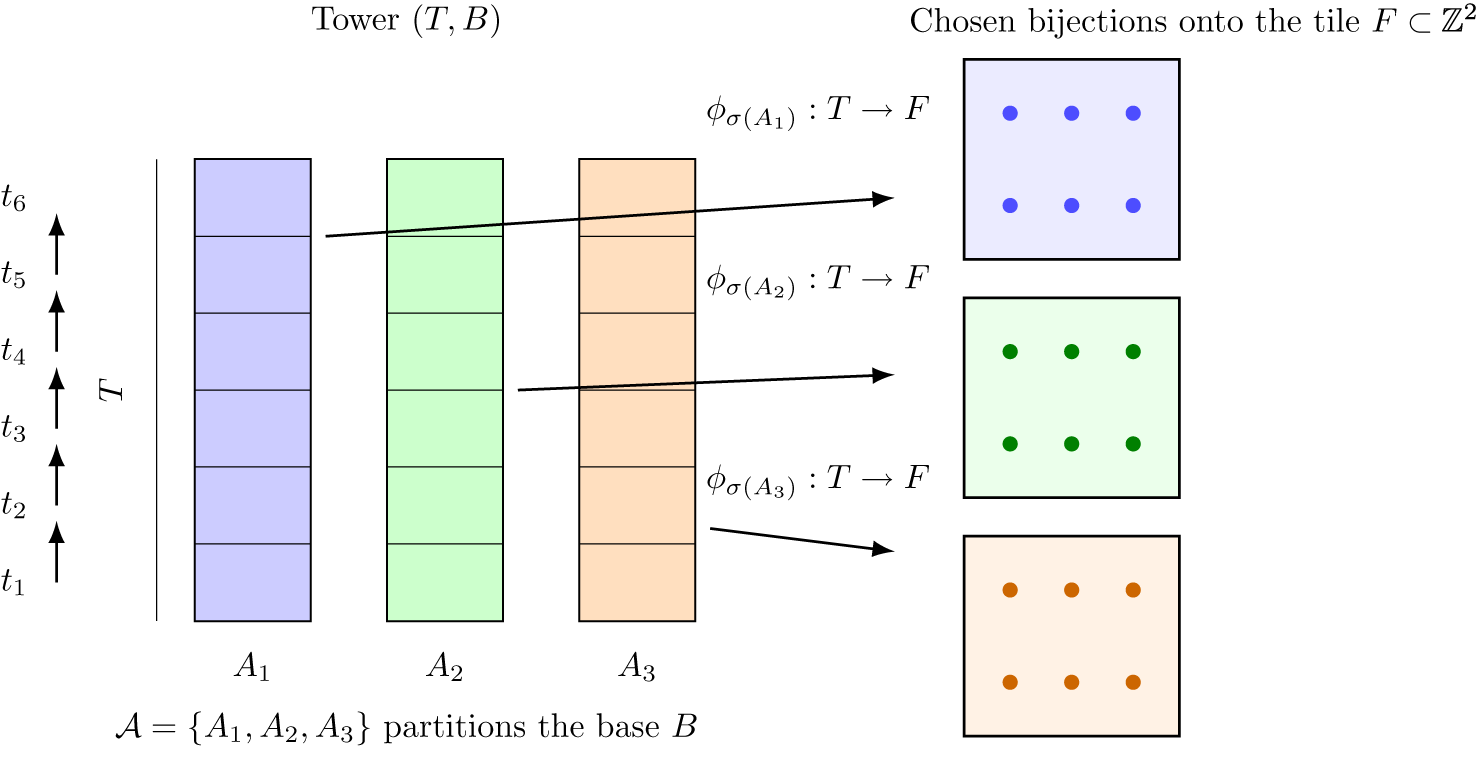
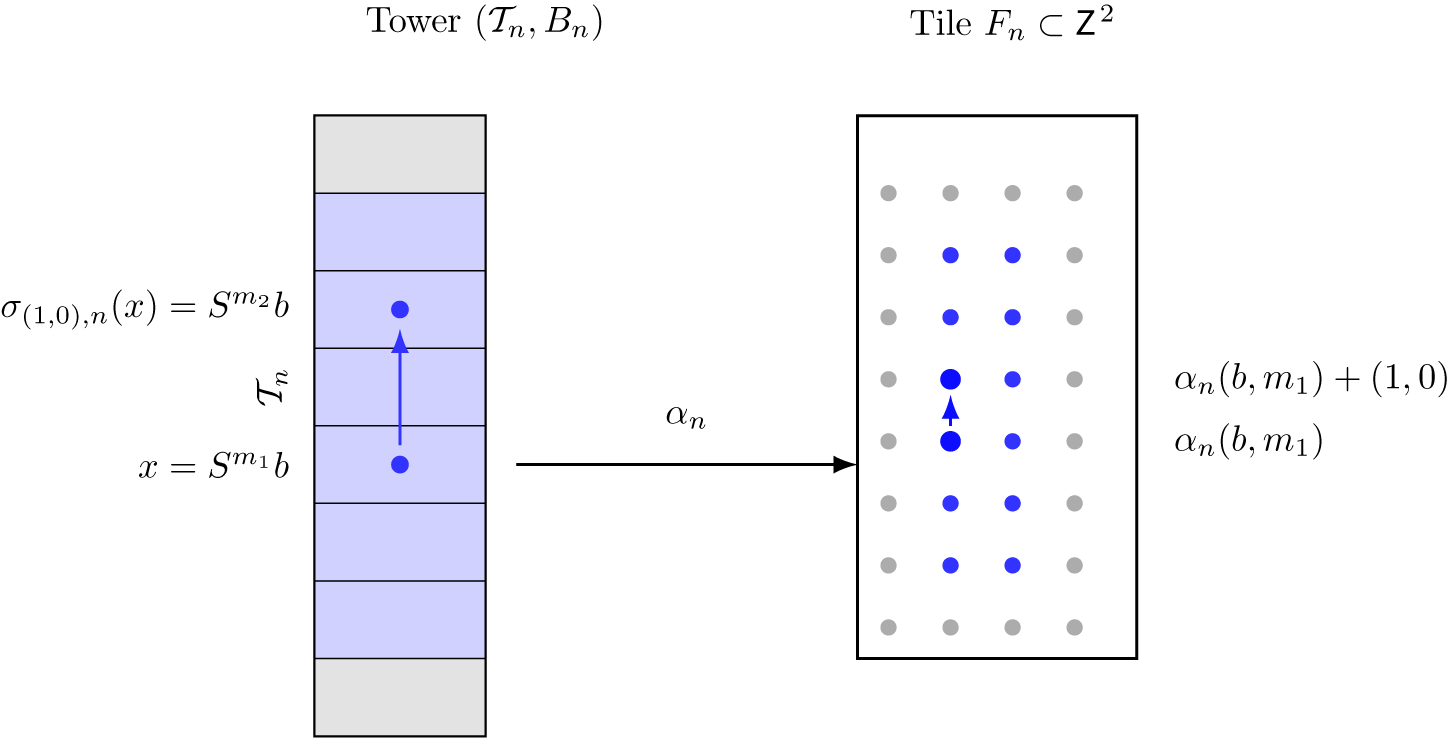


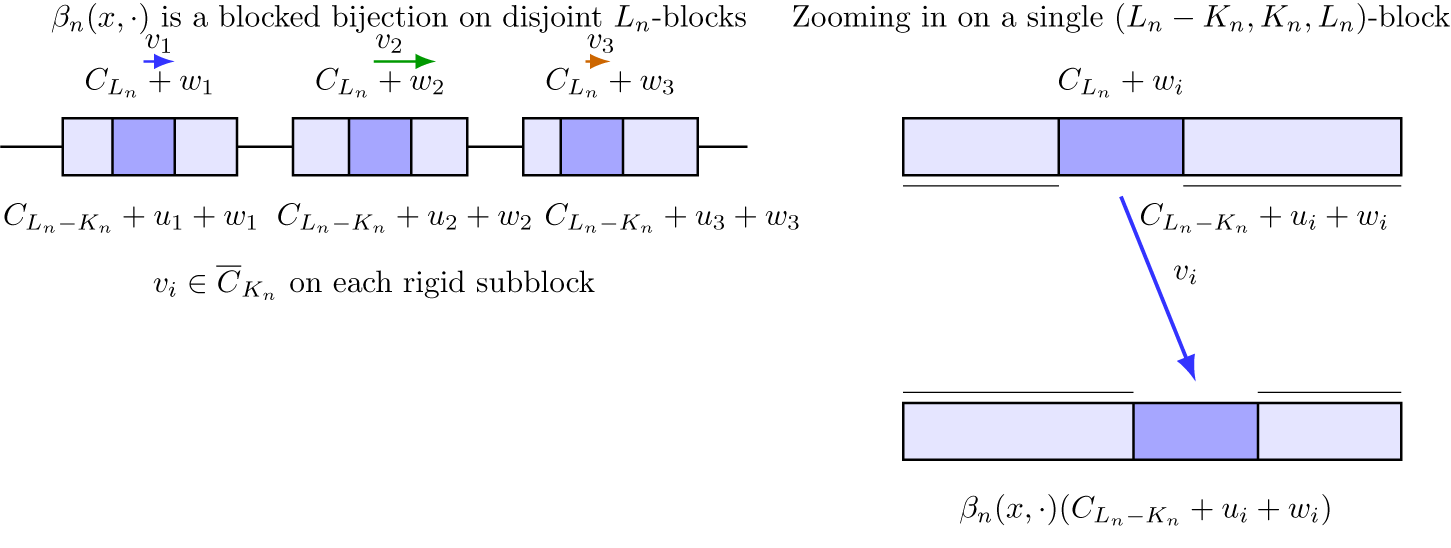


 Open access

