Introduction
With the ageing UK population, the rise of age-related conditions such as osteoporosis is not surprising. Bisphosphonates, acting as potent inhibitors of bone resorption, are commonly prescribed for osteoporosis for extended periods of time. These drugs are also prescribed for cancer-associated hypercalcaemia, bone metastasis and Paget's disease.Reference Froelich, Radeloff, Kohler, Mlynski, Muller and Hagen1 Although not explicitly mentioned in the British National Formulary as known common/very common, uncommon, or rare/very rare side effects of alendronic acid, it was reported in 2015, in the Important Safety Profile by the Medicines and Healthcare products Regulatory Agency and the Commission on Health Medicine, that bisphosphonates can cause osteonecrosis of the mandible and external auditory canal.2
Given the rarity of bisphosphonate-induced chronic otitis externa, its management is not well established, and even some ENT specialists are not aware of this diagnosis.Reference Thorsteinsson, Vestergaard and Eiken3 This case series describes our experience of three elderly patients who were suspected to have bisphosphonate-induced osteonecrosis of the external auditory canal. We also describe the unexpected positive outcome following delays in regular microsuctioning, caused by the cancellation of routine ENT clinics from April to August 2020 associated with the coronavirus disease 2019 (Covid-19) pandemic.
Materials and methods
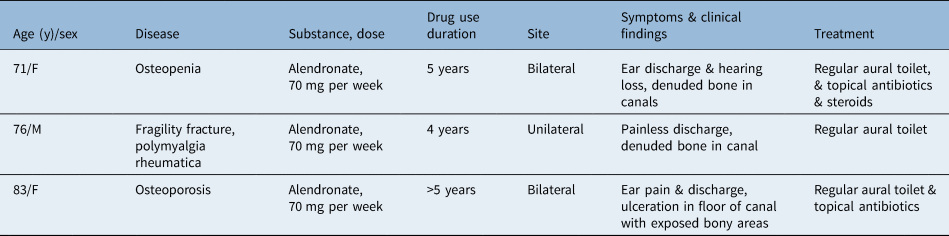
Several elderly patients have been regularly attending the ENT clinic in a district general hospital in West Wales for microsuctioning to address chronic ear conditions. After excluding patients who had previously undergone ear operations, cancer treatment or previous radiotherapy in the head and neck region, and those with diabetes or immunocompromised conditions, three cases were identified with temporal bone osteonecrosis and a history of prolonged bisphosphonate use. Table 1 summarises the symptoms, clinical findings and treatment of the three elderly patients with bisphosphonate-induced osteonecrosis of the external auditory canal.
Summary of symptoms, clinical findings and treatment*

* For the three elderly patients with bisphosphonate-induced osteonecrosis of the external auditory canal. Y = years; F = female; M = male
Case series
Case one
A 71-year-old woman had been attending the ENT clinic regularly for the aural care of bilateral necrotising otitis externa, whereby her ear canals had exposed bony portions. Her main symptoms were ear discharge, pain and hearing loss. She had taken alendronic acid (70 mg per week) for at least five years for osteopenia, and had stopped in 2017. A computed tomography (CT) scan of the temporal bone showed no sinister features. She was being managed conservatively with microsuctioning every four to six weeks, and with intermittent application of topical triamcinolone acetonide, neomycin sulphate, gramicidin and nystatin. This treatment gave her symptomatic relief, especially from pain. The patient was not seen for four months because of the closure of routine clinics. When last seen recently, she was asymptomatic and the exposed bony portion of the auditory canal had re-epithelialised.
Case two
A 76-year-old man had been attending the ENT clinic regularly for persistent, unilateral, painless ear discharge, with areas of denuded bone in the ear canal. He had taken alendronic acid (70 mg per week) for at least four years for fragility fractures and polymyalgia rheumatica, and had stopped in 2018. He was being managed conservatively with microsuctioning every four to six weeks, with the occasional application of topical triamcinolone acetonide, neomycin sulphate, gramicidin and nystatin, which gave him symptomatic relief. The patient was not seen for five months because of the closure of routine clinics. When last seen recently, he was asymptomatic and the exposed bony portion of the auditory canal had re-epithelialised.
Case three
An 83-year-old woman had complained of ear pain and discharge, and had exposed bony portions with granulations in both ear canals. Biopsies and CT scans of the temporal bone showed no sinister features. She had been taking alendronic acid (70 mg per week) for five to six years for osteoporosis, and had stopped in 2016. She was managed conservatively with microsuctioning every four to six weeks, with the intermittent application of topical triamcinolone acetonide, neomycin sulphate, gramicidin and nystatin. The patient was not seen for four months because of the closure of routine clinics. When last seen recently, she was asymptomatic and the exposed bony portion of the auditory canal had re-epithelialised.
Discussion
The British National Formulary describes bisphosphonates being absorbed onto hydroxyapatite crystals in bone, which slows down both their rate of growth and dissolution, and the overall effect is reduction of the rate of bone turnover.2 Furthermore, regarding side effects of alendronic acid, the British National Formulary lists: gastrointestinal disorders, joint swelling and vertigo as common or very common; haemorrhage as uncommon; and femoral stress fracture, oropharyngeal ulceration, photosensitivity reaction and severe cutaneous adverse reactions as rare or very rare. There are no ear-related symptoms listed as side effects. However, in the Important Safety Profile of 2015, the Medicines and Healthcare products Regulatory Agency and the Commission on Health Medicine reported bisphosphonate-induced osteonecrosis of the mandible and external auditory canal, especially bisphosphonates given intravenously, and caution has been advised.
• Bisphosphonates, potent inhibitors of bone resorption, are often prescribed for osteoporosis for extended periods
• Many specialists are unaware that prolonged bisphosphonate use can cause external ear canal osteonecrosis
• Alendronic acid has recognised side effects, but chronic outer-ear infection is not listed as a complication
• Bisphosphonate-induced osteonecrosis of the mandible and external auditory canal has been reported, and caution is advised
• Conservative management of external ear canal osteonecrosis involves debridement, regular microsuctioning, topical antibiotics and steroids
• Excessive, repeated microsuctioning with short intervals may delay re-epithelialisation; prolonging intervals between microsuctioning could aid disease resolution
Marx, in 2003, was the first to report bisphosphonate-induced osteonecrosis, in a case affecting the jaws.Reference Marx4 Since then, several case reports have been published. There have also been reports of bisphosphonate-induced femur fractures.Reference Khosla, Bilezikian, Dempster, Lewiecki, Miller and Neer5 The recent International Classification of Diseases (11th edition), released in June 2018, included bisphosphonate-induced osteonecrosis as a side effect (Mortality and Morbidity Statistics code: FB81.2), although no specific organ was mentioned.6
Bisphosphonates inhibit the resorption of bone, leading to an increase in calcium and mineral deposition, and a decrease in ectopic calcification.Reference Froelich, Radeloff, Kohler, Mlynski, Muller and Hagen1 This occurs via the inactivation and reduced recruitment of osteoclasts, and the induction of osteoclast apoptosis. Bisphosphonates incorporate calcium into the bone matrix, but the impaired bone turnover leads to compromised bone healing, especially when the bone is exposed following trauma or a surgical procedure such as dental extraction. Osteonecrosis is believed to happen when the bone has decreased its ability to cope with the physiological demands associated with the bisphosphonate-induced reduction of bone remodelling and blood flow.Reference McCadden, Leonard and Primrose7
Bisphosphonates could either be nitrogen-containing (i.e. alendronate sodium, pamidronate disodium, zoledronic acid, risedronate sodium) or nitrogen-free (i.e. etidronate disodium, clodronate disodium, tiludronate disodium).Reference Froelich, Radeloff, Kohler, Mlynski, Muller and Hagen1 The presence of nitrogen seems to play an important role in its toxicity; at least 3000 cases of bisphosphonate-induced osteonecrosis of the jaws have been reported related to nitrogen-containing forms, whilst only 10 similar cases have been reported so far for non-nitrogen-containing bisphosphonates.Reference Salzman, Hoza, Perina and Starek8 In a Danish national-register-based cohort study of 131 794 patients, the risk factors associated with osteonecrosis of the jaws included infection, intravenous bisphosphonates, cancer and anti-cancer therapy, glucocorticoids, alcohol and tobacco use, co-morbidities (i.e. malignancy), and dental trauma including extraction.Reference Thorsteinsson, Vestergaard and Eiken3
There are a few reports of bisphosphonate-related osteonecrosis of the ear canal, but this adverse effect is not well recognised in the medication literature. The association of prolonged bisphosphonate use and ear canal osteonecrosis is not widely known; even ENT specialists have confused this diagnosis with ear canal cholesteatoma, malignant otitis externa or temporal bone malignancy.Reference Salzman, Hoza, Perina and Starek8
Management of bisphosphonate-induced ear canal osteonecrosis ranges from drug cessation, topical treatment, to surgical debridement.Reference Thorasteinsson, Lomholt and Eiken9 Oral or intravenous bisphosphonate use as a risk factor for external canal osteonecrosis is dose- and duration-related.Reference Thorsteinsson, Vestergaard and Eiken3
The huge benefits of bisphosphonates in the prevention of fracture and pain control should be recognised, and if complications arise, such as osteonecrosis, a shift to non-nitrogen-containing forms should be considered prior to complete cessation of the medication. It is also important to note that there is limited evidence on the benefits of bisphosphonate use beyond three to five years, and some advocate ‘drug holidays’ with breaks in treatment.Reference Whitaker, Guo, Kehoe and Benson10
In our cases, the disease progression slowed and symptom control was achieved following drug cessation and regular aural toileting with topical antibiotics, although re-epithelialisation of the denuded bony canal was minimal. As regular microsuctioning provided symptomatic relief, we continued to see patients regularly, every four to six weeks. However, it appears that this was not necessary, and may well have caused iatrogenic trauma that hindered the re-epithelialisation process. When the patients’ ears were left for four to five months during the lockdown period (associated with the Covid-19 pandemic) in 2020, they recovered, and the patients remained symptomatically well. We thus conclude that excessive and repeated microsuctioning in bisphosphonate-induced osteonecrosis of the external ear canal can delay re-epithelialisation, and gradually prolonging the intervals between microsuctioning could aid overall resolution of the disease.
In summary, bisphosphonates, acting as potent inhibitors of bone resorption, are commonly prescribed for extended periods of time. Many ENT specialists are unaware that prolonged bisphosphonate use may cause osteonecrosis of the external ear canal. Thus, a full drug history should be taken among elderly patients who present with chronic ear symptoms and an exposed bony ear canal. Rational use of bisphosphonates should be considered. Conservative management of external ear canal osteonecrosis includes debridement, regular microsuctioning, and the application of topical antibiotics and steroids. However, excessive and repeated microsuctioning with short intervals may delay re-epithelialisation.
Acknowledgement
We would like to thank Ms Abigail Thomas of Glangwili General Hospital Library for providing us with all the articles mentioned here.
Competing interests
None declared