Introduction
One definition of resilience is the capacity of individuals to resist development of mental disorders despite exposure to stress (Davydov et al. Reference Davydov, Stewart, Ritchie and Chaudieu2010; Russo et al. Reference Russo, Murrough, Han, Charney and Nestler2012). Adolescence is the period of onset for most high-prevalence mental disorders (McLaughlin et al. Reference McLaughlin, Greif Green, Gruber, Sampson, Zaslavsky and Kessler2012), many being influenced by stress. Little is known about neuroprotective factors underpinning resilience at that age. Throughout adolescence behavioral changes are related to life events and personality profile, as well as to neurobiological processes regulating emotions and cognitive function (Paus, Reference Paus2010, Reference Paus2013). Self-reported measures of life stressors have been used in the general population to predict the onset of psychological disturbance and poor school performance (Shaw et al. Reference Shaw, Dimsdale, Patterson, Rush, First and Blacker2008). Positive affect contributes more than negative affect to build up resilience (Geschwind et al. Reference Geschwind, Peeters, Jacobs, Delespaul, Derom, Thiery, van Os and Wichers2010) implying that negative life events (NLE) are more representative of adversity (Newcomb et al. Reference Newcomb, Huba and Bentler1986). Resilience can thus be operationally defined as a history of NLE with a low probability of mental disorder.
Personality dimensions like Neuroticism build up markedly during adolescence, and might account for resilience in adolescents (Nakaya et al. Reference Nakaya, Oshio and Kaneko2006). Therefore, in a study of resilience, the influence of Neuroticism should be disentangled from an association with neural factors. While Neuroticism may engage widespread functionally related brain regions (Canli, Reference Canli2008), authors have highlighted the association of personality dimensions with the white-matter (WM) microstructure in adults (Xu et al. Reference Xu, Kober, Carroll, Rounsaville, Pearlson and Potenza2012; Bjørnebekk et al. Reference Bjørnebekk, Fjell, Walhovd, Grydeland, Torgersen and Westlye2013), particularly at the level of the corpus callosum (CC), the largest WM fiber bundle, which connects homologous regions of the cerebral hemispheres.
The CC has been implicated in major psychiatric disorders by authors emphasizing abnormal interhemispheric communication in the etiology of mental disease. Most reports have used evidence from conventional structural magnetic resonance imaging (MRI) scans. CC volume has been found reduced in psychopathological conditions as in bipolar adults and adolescents (Lopez-Larson et al. Reference Lopez-Larson, Breeze, Kennedy, Hodge, Tang, Moore, Giuliano, Makris, Caviness and Frazier2010), in treatment-refractory depression and schizophrenia (Sun et al. Reference Sun, Maller, Daskalakis, Furtado and Fitzgerald2009), attention deficit hyperactivity disorder (ADHD; Qiu et al. Reference Qiu, Ye, Li, Liu, Xie and Wang2011) and post-traumatic stress disorder (PTSD; review by Jackowski et al. Reference Jackowski, de Araújo, de Lacerda, Mari and Kaufman2009; Chao et al. Reference Chao, Weiner and Neylan2013). Smaller CC volumes have been reported in stress-related conditions, including early stress in children or adolescents (review in McCrory et al. Reference McCrory, De Brito and Viding2011) and in childhood neglect (Teicher et al. Reference Teicher, Dumont, Ito, Vaituzis, Giedd and Andersen2004). The CC draws its importance from bihemispheric cortical projections, particularly to frontal areas controlling emotions and behaviors in illness and likely resilience (Vink et al. Reference Vink, Derks, Hoogendam, Hillegers and Kahn2014).
Probing microstructure and connectivity of WM tracts in the CC makes diffusion-weighted imaging particularly relevant (Moseley et al. Reference Moseley, Cohen, Kucharczyk, Mintorovitch, Asgari, Wendland, Tsuruda and Norman1990). Using diffusion tensor imaging (DTI), Paul et al. (Reference Paul, Henry, Grieve, Guilmette, Niaura, Bryant, Bruce, Williams, Richard, Cohen and Gordon2008) found that fractional anisotropy (FA) was reduced at the level of the genu of the CC in cases of early life stress even in the absence of symptoms. They suggested that stress during a period of active WM development might compromise WM microstructure without reduction of CC volume. Thus, while vulnerability was addressed in the literature, little is known about neural aspects of resilience (Frodl et al. Reference Frodl, Carballedo, Fagan, Lisiecka, Ferguson and Meaney2012). Reports concerned adults who had suffered stress during childhood, not adolescents whose negative experience was recent. Studies in non-clinical populations have not systematically assessed the risk of psychiatric disorders (Hart & Rubia, Reference Hart and Rubia2012). Hence, a DTI study of resilience in adolescents whose risk of mental disorders could be quantified might provide more straightforward evidence for a neuroanatomical marker of resilience.
We a priori hypothesized that in contrast with pathological and stress-related conditions characterized by lower FA values, resilience in adolescents would be associated with higher FA in the CC compared adolescents at risk of mental disorder and with control adolescents from the same community. These three groups are categories raised on operational criteria, while resilience is likely dimensional. Thus, should the primary hypothesis be confirmed, significant between-group differences in DTI measures were to be investigated to test the secondary hypothesis of a hierarchy of groups according to ‘resilience capacity’, i.e. resilient group>control group>at-risk group. In addition, we aimed to explore the WM cortical projections of the detected CC differences, using tractography. As regards personality traits, we expected that levels of Neuroticism would be lower in resilient youths than in the other two groups.
Method
The participants were 2224 healthy community adolescents (mean age 14.32, s.d. = 1.31 years) from the European IMAGEN cohort (Schumann et al. Reference Schumann, Loth, Banaschewski, Barbot, Barker, Büchel, Conrod, Dalley, Flor, Gallinat, Garavan, Heinz, Itterman, Lathrop, Mallik, Mann, Martinot, Paus, Poline, Robbins, Rietschel, Reed, Smolka, Spanagel, Speiser, Stephens, Ströhle and Struve2010) recruited from secondary schools. Written informed consent was obtained from all participants and from their legal guardians. The protocol was approved by local ethics committees and complied with the Helsinki Declaration. Participants with a medical condition or diagnosed neurodevelopmental disorders were excluded.
The psychometric characterization was partly conducted in participants’ homes using the Psytools software (Delosis, UK). Pubertal status was self-assessed using the Pubertal Development Scale (PDS; Petersen et al. Reference Petersen, Crockett, Richards and Boxer1988).
NLE were identified by adolescents with the Life Event Questionnaire (LEQ; Newcomb et al. Reference Newcomb, Huba and Bentler1981), from a list of lifetime negative, neutral, and positive events. Participants rated each event to indicate how happy or unhappy it made them feel, and indicated whether or not the event had happened to them. Internal consistency of the LEQ is low, as there is no association between the independent events listed (Newcomb et al. Reference Newcomb, Huba and Bentler1986). Since our definition of resilience is based on the capacity to cope with NLE, we selected 16 LEQ items that are usually experienced as negative (see online Supplementary Table S1). A cut-off of four NLE was chosen to define significant exposure to stress, corresponding to the level of stress experienced by 15% of young adults followed since childhood (Caspi et al. Reference Caspi, Sugden, Moffitt, Taylor, Craig, Harrington, McClay, Mill, Martin, Braithwaite and Poulton2003).
Behavioral and emotional disturbances in adolescents were self-reported using the Development and Well-Being Assessment (DAWBA; Goodman et al. Reference Goodman, Ford, Richards, Gatward and Meltzer2000). Definite symptoms were identified by structured questions to child and parent. Diagnoses were generated according to probability bands, i.e. ‘DAWBA’ bands, ranging from low- to high-risk levels. The DAWBA predictions contain specific bands for the diagnostic criteria of ICD-10 and DSM-IV, as well as a general band that gives a global probability of mental illness. Clinical diagnoses were validated by experienced clinicians from the IMAGEN Consortium, after discussion if a decision was questionable.
We chose an operational definition of resilience: the exposure to an important level of lifetime stress (⩾4 NLE) coupled with a low risk (⩽0.5%) of mental disorders (levels 0–1 of DAWBA general and specific bands). To avoid false positives, the records of all resilient adolescents were screened individually by a child psychiatrist from the IMAGEN Consortium. One subject with a body mass index <18, and three with a clinical diagnosis (DSM-IV-TR), were not included after file review. Four participants fulfiling DSM-IV-TR PTSD criteria were excluded from the resilient group.
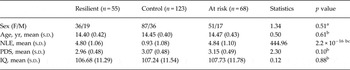
Within the IMAGEN database, 55 resilient adolescents (Table 1) were eligible for analysis. Sixty-eight adolescents at risk were defined by a significant level of stress (⩾4 NLE) coupled with a higher than 15% risk of mental illness (level ⩾3 of DAWBA general band). A control group was constituted from 123 adolescents scoring at DAWBA general band levels <3 and exposed to a low number of NLE (⩽3), randomly selected from the IMAGEN database to match the two other groups for sex, PDS and Intelligence Quotient (IQ) (Table 1).
Sociodemographic characteristics, pubertal status and IQ scores of the three groups

NLE, Negative life events; PDS, Pubertal Development Scale; IQ, Intelligence Quotient.
a χ2 test.
b F test.
c t test (resilient) v. at-risk (non-significant).
Personality profile
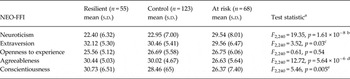
Groups differed on four NEO-FFI factor scores, notably Neuroticism (Table 2). The post-hoc comparison between resilient and at-risk adolescents showed lower scores on Neuroticism (p = 5.6 × 10⁻⁷) and higher scores on Extraversion (p = 0.04), Agreeability (p = 8.6 × 10⁻⁵) and Conscientiousness (p = 0.02) in resilient adolescents. No difference appeared between resilients and controls.
Personality dimensions of resilient, control and at-risk adolescents

NEO-FFI, NEO Five-Factor Inventory.
a ANCOVA with sex, Pubertal Development Scale and IQ covariates.
b Linear effect: p = 8.72 × 10⁻⁷. Pairwise t test: resilient v. control (p = 0.65); resilient v. risk (p = 5.6 × 10⁻⁷); control v. risk (p = 4.7 × 10⁻⁸).
c Linear effect: p = 0.009. Pairwise t test: resilient v. control (p = 0.14); resilient v. risk (p = 0.04); control v. risk (p = 0.30).
d Linear effect: p = 2.56 × 10⁻⁵. Pairwise t test: resilient v. control (p = 0.61); resilient v. risk (p = 8.6 × 10⁻⁵); control v. risk (p = 4.0 × 10⁻⁵).
e Linear effect: p = 0.001. Pairwise t test: resilient v. control (p = 0.09); resilient v. risk (p = 0.02); control v. risk (p = 0.09).
Behavioral assessment
With the French, German and English standardization norms for the respective populations, the Wechsler Abbreviated Scale of Intelligence (WASI; Axelrod, Reference Axelrod2002) provided an estimate of the full-scale IQ based on vocabulary, similarities, block design and matrix reasoning subtests of the WAIS. The IMAGEN database also included neuropsychological assessments with CANTAB (Cambridge Neuropsychological Test Automated Battery) modules (detailed in Schumann et al., Reference Schumann, Loth, Banaschewski, Barbot, Barker, Büchel, Conrod, Dalley, Flor, Gallinat, Garavan, Heinz, Itterman, Lathrop, Mallik, Mann, Martinot, Paus, Poline, Robbins, Rietschel, Reed, Smolka, Spanagel, Speiser, Stephens, Ströhle and Struve2010).
Personality dimensions were assessed with the NEO Five-Factor Inventory (NEO-FFI). This shortened 60-item form of the Revised NEO Personality Inventory (NEO-PI-R; Costa & McCrae, Reference Costa and Mc Crae1992) questionnaire measures five broad personality dimensions (Neuroticism, Extraversion, Openness to Experience, Agreeableness, Conscientiousness).
MRI data acquisition
Diffusion tensor images were obtained on 3 T scanners (Siemens, Philips, General Electric, Bruker). The imaging protocols’ comparability in the different scanners was ensured through a thorough standardization (Schumann et al. Reference Schumann, Loth, Banaschewski, Barbot, Barker, Büchel, Conrod, Dalley, Flor, Gallinat, Garavan, Heinz, Itterman, Lathrop, Mallik, Mann, Martinot, Paus, Poline, Robbins, Rietschel, Reed, Smolka, Spanagel, Speiser, Stephens, Ströhle and Struve2010). All participants were instructed to close their eyes and keep as steady as possible during image acquisition. The diffusion tensor images were acquired using an Echo Planar imaging sequence (four b = 0 and 32 directions with b = 1300 s/mm2; 60 near-axial slices, aligned with the line between the anterior and posterior commissures; echo time ≈104 ms; 128 × 128 matrix; voxel size 2.4 × 2.4 × 2.4 mm), adapted to tensor measurements [e.g. FA, mean diffusivity (MD)] and tractography analysis.
Preprocessing of diffusion data
Diffusion data preprocessing was performed using FMRIB Diffusion Toolbox (FDT) in FSL software (http://www.fmrib.ox.ac.uk/fsl) and consisted of affine registration to the first b = 0 image for head motion and eddy current correction, brain extraction using the brain extraction tool (BET; Smith, Reference Smith2002), and voxel-wise diffusion tensor fitting to obtain FA, MD, axial diffusivity (AD) and radial diffusivity (RD) images. Voxelwise statistical analysis of the FA data was carried out using tract-based spatial statistics (TBSS), part of FSL (Smith et al. Reference Smith, Jenkinson, Johansen-Berg, Rueckert, Nichols, Mackay, Watkins, Ciccarelli, Cader, Matthews and Behrens2006). All participants' FA data were aligned into a common space using the nonlinear registration tool FNIRT (Andersson et al. Reference Andersson, Jenkinson and Smith2007), which uses a b spline representation of the registration warp field (Rueckert et al. Reference Rueckert, Sonoda, Hayes, Hill, Leach and Hawkes1999). Next, the mean FA image was created and thinned to create a mean FA skeleton, which represents the centers of all tracts common to the group. This skeleton was then thresholded to FA > 0.2 to keep only the main tracts. Each adolescent's aligned FA, MD, AD and RD data were then projected onto the skeleton and the resulting data fed into voxelwise cross-individual statistics.
Data quality control and randomization
DTI datasets were discarded in case of head movement, poor tensor computation or defective spatial normalization. Among 96 resilient and 120 at-risk adolescents, 56 and 72 had eligible DTI datasets, respectively. Five participants were discarded because of missing IQ or PDS values (resilient, 1; at-risk, 4). Among 725 potential controls with available DTI, 123 (all of whom had eligible DTI data) were randomly matched by sex, PDS and IQ with participants of the two other groups. Thus, 55 resilient subjects, 68 at-risk subjects and 123 controls were available for TBSS analysis.
Statistical analysis
Statistical analyses for non-voxel-based data were conducted using R software (http://www.R-project.org/). The normality of variable distribution was assessed by the Shapiro-Wilk test. Between-group comparisons were performed using analysis of variance (ANOVA) with sex, PDS, IQ and neuroticism (except for NEO-FFI results) scores as confounding covariates. Post-hoc pairwise comparisons between groups were made using the Student t test. Sex distribution difference between resilient, at-risk and control subjects was tested with the χ2 test.
DTI data analysis
Voxelwise group comparisons on FA, RD, AD and MD maps were tested in the framework of the general linear model (GLM) using a randomization based method (5000 permutations). We included Neuroticism score, PDS and DTI acquisition type (i.e. scanner manufacturers and/or software level) as confounding covariates. Analyses were restricted to voxels on the skeleton within the CC, based on the JHU-ICBM atlas (Mori et al. Reference Mori, Oishi, Jiang, Jiang, Li, Akhter, Hua, Faria, Mahmood, Woods, Toga, Pike, Neto, Evans, Zhang, Huang, Miller, van Zijl and Mazziotta2008). Statistical thresholds were set at p < 0.05 FWE (family-wise error) corrected and threshold-free cluster enhancement-corrected (Smith & Nichols, Reference Smith and Nichols2009). In order to test our secondary hypothesis, analyses on the extracted CC tensor values were performed considering groups as an ordered factor (e.g. resilient>control>at-risk) and searching for significant linear effects.
Tractography
The CC cluster identified in intergroup comparison of FA (see online Supplementary Table S3) was used as a seed mask to perform probabilistic diffusion tractography (PDT; Behrens et al. Reference Behrens, Woolrich, Jenkinson, Johansen-Berg, Nunes, Clare, Matthews, Brady and Smith2003, Reference Behrens, Berg, Jbabdi, Rushworth and Woolrich2007). PDT estimates a probability distribution function of fiber direction and allows modeling multiple fiber orientations of each voxel. The warp fields of nonlinear registration and their inverses were used for the translation between the original space and the MNI 152 standard space. We then generated 5000 samples from each seed voxel to target 45 cortical and 15 subcortical regions based on the Harvard-Oxford atlases (Desikan et al. Reference Desikan, Ségonne, Fischl, Quinn, Dickerson, Blacker, Buckner, Dale, Maguire, Hyman, Albert and Killiany2006). We used the numbers of samples reaching the target region from all seed voxels as a proxy of connectivity between the seed and each target region. For the number of streamlines, we investigated the interaction between group and neuropsychological scores only if between–group differences in neuropsychological scores were significant.
Results
Resilient, at-risk and control adolescents did not differ with respect to age, sex, years of education, PDS, IQ (Table 1), or neuropsychological performance (see online Supplementary Table S2). Controls differed from the other two groups in the number of NLE, but resilient and at-risk subjects had faced the same number of NLE (t = 0.53, p = 0.60).
DTI analyses
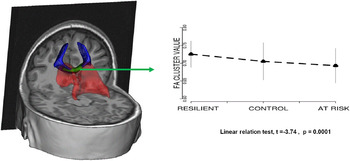
There was a between-group difference in FA within the genu and the anterior body of the CC (F = 10.44, p < 0.02, FWE-corrected for multiple comparisons, cluster size k = 380; peak voxel x = 7, y = 14, z = 21 MNI coordinates) (Fig. 1). Post-hoc pairwise t tests showed higher FA in resilient v. at-risk (t = 4.33, p < 0.05), and in resilient v. control (t = 3.77, p < 0.05) adolescents. All other pairwise comparisons were non-significant.
Fractional anisotropy 3D rendering of between-group difference (F = 10.44, p < 0.02, family-wise error-corrected) denoting a significant cluster (green) within the corpus callosum (red) [FA (mean ± s.e.) in at-risk <FA in control <FA in resilient groups, linear effect, t = −3.74, p = 0.0001] and probabilistic tractography from that cluster [streamlines (in blue) were detected towards frontal and cingulate regions].

Regarding RD, a between-group difference was observed in the same region (F = 8.83, p < 0.05, FWE-corrected, cluster size k = 371; same peak voxel MNI coordinates). Post-hoc pairwise t tests showed higher RD in at-risk v. resilient (t = 3.96, p < 0.05) and in control v. resilient (t = 3.50, p < 0.05) adolescents. All other pairwise comparisons were non-significant.
No between-group differences were found in AD or MD.
Considering the group factor as rank-ordered, a higher mean FA in this region was associated with higher resilience capacity (at-risk<control<resilient groups, linear effect, t = −3.74, p = 0.0001, Fig. 1). Similarly, lower mean RD in this region was associated with higher resilience capacity (at-risk>control>resilient groups, linear relation test, t = 3.327, p = 0.001).
No group per Neuroticism interaction was detected with the FA values extracted from this region (F = 1.62, p < 0.20), nor group per other NEO-FFI dimensions (Extraversion: F = 2.59, p < 0.08; Agreeability: F = 0.38, p < 0.68; Conscientiousness: F = 0.40, p < 0.92).
Tractography
Using the anterior CC cluster as a seed mask for probabilistic tractography, we found a high number of cortical streamlines (sample >1000) targeting the anterior cingulate, middle frontal, frontal pole, superior frontal, and paracingulate regions (Fig. 1). There was no between-group difference in the number of streamlines to any of these regions (see online Supplementary Table S3).
Discussion
In this first neuroimaging study of resilient adolescents, diffusion tensor images of 246 adolescents divided into three groups (resilient, controls, at risk for mental disorders) showed that FA values within the anterior body of the CC and the adjacent part of the genu were significantly higher in the resilient than in the at-risk adolescents and controls. Moreover, in agreement with our secondary hypothesis of linearity, these values increased with resilience capacity. Analysis of DTI parameters showed reduced RD in the same region according to resilience capacity. Tractography evidenced streamlines from this callosal region to anterior cingulate as well as superior and middle frontal gyri.
Due to the lack of neuroimaging studies of resilient adolescents, previous reports from the literature are only relevant for our at-risk group. CC abnormalities have been reported in MRI studies of adults and youths with major psychiatric disorders suggesting they may be present early in the course of illness. In stress-related conditions reflecting the role of life events, volume of medial and posterior, but not anterior, parts of the CC has been found reduced in children and adolescents with PTSD (Jackowski et al. Reference Jackowski, de Araújo, de Lacerda, Mari and Kaufman2009) or childhood neglect (Teicher et al. Reference Teicher, Dumont, Ito, Vaituzis, Giedd and Andersen2004), as well as in adults (Teicher et al. Reference Teicher, Tomoda and Andersen2006).
However, DTI analysis follows a different paradigm and the results may differ from volumetric measures; e.g. TBSS methodology does not depend on local volumetry since it is restricted to assessment within ‘skeletonized’ WM bundles (Smith et al. Reference Smith, Jenkinson, Johansen-Berg, Rueckert, Nichols, Mackay, Watkins, Ciccarelli, Cader, Matthews and Behrens2006). Calculating water diffusivities parallel and perpendicular to axons, several DTI studies have reported CC abnormalities in mental disorders. As in the present at-risk group, lower FA values were observed in the CC of adults and adolescents with bipolar disorder (Barnea-Goraly et al. Reference Barnea-Goraly, Chang, Karchemskiy, Howe and Reiss2009), and lower FA and higher RD in the anterior part of the CC in schizophrenic subjects (Whitford et al. Reference Whitford, Savadjiev, Kubicki, O'Donnell, Terry, Bouix, Westin, Schneiderman, Bobrow, Rausch, Niznikiewicz, Nestor, Pantelis, Wood, McCarley and Shenton2011; Knöchel et al. Reference Knöchel, O'Dwyer, Alves, Reinke, Magerkurth, Rotarska-Jagiela, Prvulovic, Hampel, Linden and Oertel-Knöchel2012). In pediatric ADHD, DTI was characterized by a global FA decrease involving the CC anterior parts as well as other brain structures (Qiu et al. Reference Qiu, Ye, Li, Liu, Xie and Wang2011). Thus both volumetric and DTI studies in pediatric or adult samples with psychiatric conditions report CC alterations consistent with abnormalities detected in the present at-risk adolescents.
Evidence of resilience in adults was indirectly produced by Frodl et al. (Reference Frodl, Carballedo, Fagan, Lisiecka, Ferguson and Meaney2012) in healthy relatives of patients. In line with our resilient participants, they showed higher FA values after exposure to stressful events, albeit in the CC splenium rather than the genu. In non-clinical adults exposed to various early life stressors, Paul and co-workers’ (Reference Paul, Henry, Grieve, Guilmette, Niaura, Bryant, Bruce, Williams, Richard, Cohen and Gordon2008) report of decreasing FA values in the genu of the CC with a growing number of early life stressors is also consistent with our findings, although their subjects were adults, and risk of mental disease was not assessed. The same remarks apply to Teicher et al. (Reference Teicher, Samson, Sheu, Polcari and McGreenery2010), who showed that past peer verbal abuse was associated with increased RD in the body and splenium of the CC and demonstrated a trend for decreased FA in the right corona radiata of normal adults. The present result of higher FA and lower RD in a more anterior part of the CC in 14-year-old resilient adolescents compared with at-risk adolescents is consistent with their suggestion (Andersen et al. Reference Andersen, Tomada, Vincow, Valente, Polcari and Teicher2008) that according to windows of vulnerability life stressors actively impact the maturing brain structures, such as the CC before age 14. DTI studies have shown that the anterior CC intensively develops until age 12, thus promoting cognitive abilities (Snook et al. Reference Snook, Paulson, Roy, Phillips and Beaulieu2005). Moreover in the present sample, tractography from the anterior CC cluster reconstructed a frontal-anterior cingular network, i.e. between regions providing cognitive resources to adolescents.
RD values in the three groups mirrored FA results along the continuum of resilience capacity. RD values reflect several aspects of WM properties (Paus Reference Paus2010; Jones et al. Reference Jones, Knösche and Turner2013) including microstructure of myelin sheaths (Song et al. Reference Song, Sun, Ramsbottom, Chang, Russell and Cross2002) that may provide adaptative advantage if observed in meaningful frontal areas. Faster cognitive processing in aging humans has been correlated with higher myelination in the genu of CC (Lu et al. Reference Lu, Lee, Tishler, Meghpara, Thompson and Bartzokis2013). The CC region identified in our sample projected to cognitive more than emotional areas of the brain: anterior cingulate and paracingulate, middle and superior frontal cortices (Fig. 1, online Supplementary Table S3). These cortices are involved in the executive functions and in the selection of action programs, whereas the anterior cingulate cortex has a fundamental role in relating actions to their consequences, either success or error (Bush et al. Reference Bush, Luu and Posner2000), thus guiding decisions about future actions (Rushworth et al. Reference Rushworth, Walton, Kennerley and Bannerman2004). These cognitive areas are also involved in the reappraisal of negative emotions (Etkin et al. Reference Etkin, Egner and Kalisch2011), which is appropriate when facing NLE.
Scores on four NEO-FFI dimensions including Neuroticism (Table 2) differed between the three groups. A specific personality profile, with high Neuroticism, typified adolescents at risk in this sample, as NEO-FFI scores differentiated at-risk adolescents from the other two groups but not resilient individuals from controls contrary to our expectations. Consistently, Neuroticism has been prospectively linked with risk for depression (Kendler et al. Reference Kendler, Neale, Kessler, Heath and Eaves1993) and other psychiatric disorders (Jylhä et al. Reference Jylhä, Mantere, Melartin, Suominen, Vuorilehto, Arvilommi, Leppämäki, Valtonen, Rytsälä and Isometsä2010; Rosellini & Brown, Reference Rosellini and Brown2011), and associated with functional activity of widespread brain regions (Canli, Reference Canli2008; Wright et al. Reference Wright, Williams, Feczko, Barrett, Dickerson, Schwartz and Wedig2006).
Here, lower levels of Neuroticism did not explain the association of resilience with higher FA in our sample. Indeed the resilient group had higher FA than controls despite comparable Neuroticism scores. Thus, resilience link to anterior CC WM does not appear as a trivial opposite of at-risk personality concomitants.
Limitations
There are some limitations to this study. Lower probability of mental disorder means absence of negative outcome in the context of an adverse environment, and is a common denominator across definitions of resilience (Compas & Reeslund, Reference Compas, Reeslund, Lerner and Steinberg2009). Somatic conditions were not taken into account, although in adults as well as in children they may also result from a stressful environment (Vila et al. Reference Vila, Kramer, Obiols and Garralda2012).
Although questionnaires concerned more recent memories than studies in adults, they were retrospective. Questions were not designed to identify events of early childhood that may also play an important role in mental illness.
The present sample was mostly female (Table 1). Myelination of the CC is an on-going process until adulthood and is influenced by hormonal status (Peper et al. Reference Peper, van den Heuvel, Mandl, Hulshoff Pol and van Honk2011). However, controls were matched for sex and PDS scores, and these variables were used as covariates in between-group comparisons.
Finally, our findings give no insight into a causal relationship between CC microstructure (Assaf & Pasternak, Reference Assaf and Pasternak2008) and resilience. A modification of brain microstructure may be a consequence of overcoming NLE. Myelination, a process often estimated by RD (Song et al. Reference Song, Sun, Ramsbottom, Chang, Russell and Cross2002), has been shown to be sensitive to stress in animals (Carlyle et al. Reference Carlyle, Duque, Kitchen, Bordner, Coman, Doolittle, Papademetris, Hyder, Taylor and Simen2012). At the same time it should be underlined that FA and RD are not measures specific enough to distinguish axon- and myelin-related processes (Paus, Reference Paus2010). Similarly, tractography identifying projections to frontal and cingulate regions cannot fully characterize actual fiber structure of WM (Jones et al. Reference Jones, Knösche and Turner2013).
Conclusion
This study of 123 community adolescents exposed to earlier stressful life events showed higher WM integrity of resilient youths. This CC region projects to frontal and anterior cingulate areas subserving cognitive resources. Resilience when facing negative emotions may depend on properties of the WM connecting those brain regions.
Appendix. IMAGEN Consortium () (other members)
Reed L, Williams S, Lourdusamy A, Costafreda S, Cattrell A, Nymberg C, Topper L, Smith L, Havatzias S, Stueber K, Mallik C, Clarke TK, Stacey D, Peng Wong C, Werts H, Williams S, Andrew C, Desrivieres S, Zewdie S, Häke I, Ivanov N, Klär A, Reuter J, Palafox C, Hohmann C, Schilling C, Lüdemann K, Romanowski A, Ströhle A, Wolff E, Rapp M, Brühl R, Ihlenfeld A, Walaszek B, Schubert F, Connolly C, Jones J, Lalor E, McCabe E, NíShiothcháin A, Whelan R, Spanagel R, Leonardi-Essmann F, Sommer W, Vollstaedt-Klein S, Steiner S, Buehler M, Stolzenburg E, Schmal C, Schirmbeck F, Heym N, Newman C, Huebner T, Ripke S, Mennigen E, Muller K, Ziesch V, Lueken L, Yacubian J, Finsterbusch J, Bordas N, Bricaud Z, Massicotte J, Lalanne C, Thyreau B, Frouin V, Dalley J, Mar A, Subramaniam N, Theobald D, Richmond N, de Rover M, Molander A, Jordan E, Robinson E, Hipolata L, Moreno M, Arroyo M, Stephens D, Ripley T, Crombag H, Pena Y, Lathrop M, Zelenika D, Heath S, Lanzerath D, Heinrichs B, Spranger T, Fuchs B, Speiser C, Resch F, Haffner J, Parzer P, Brunner R, Klaassen A, Klaassen I, Constant P, Mignon X, Thomsen T, Zysset S, Vestboe A, Ireland J, Rogers J.
Supplementary material
For supplementary material accompanying this paper visit http://dx.doi.org/10.1017/S0033291715000239.
Acknowledgements
This work was supported by the European Union-funded FP6 Integrated Project IMAGEN (Reinforcement-related behaviour in normal brain function and psychopathology) (LSHM-CT-2007-037286), the FP7 project IMAGEMEND (IMAging GEnetics for MENtal Disorders), the Innovative Medicine Initiative Project EU-AIMS (115300-2) and Medical Research Council Programme Grant ‘Developmental pathways into adolescent substance abuse’ (93558). This manuscript reflects only the authors’ views and the European Community is not liable for any use that may be made of the information contained therein. Support was provided by the Bundesministerium für Bildung und Forschung (NGFN Plus; FKZ: 01GS08152) and the Deutsche Forschungsgemeinschaft (DFG): Reinhart-Koselleck Award SP 383/5-1. This research was also supported by the German Ministry of Education and Research (BMBF grant no. 01EV0711). Further support was provided by an APHP/INSERM 2011 interface grant, a Paris-Descartes University collaborative-project-2010 grant, an ANR grant (ANR-12-SAMA-0004, ADODEP project), an ERANET-2012 project (AF12-NEUR0008-01-WM2NA), and grants from the Fondation de France, the Mission Interministérielle de Lutte contre la Drogue et la Toxicomanie (MILDT) and the Fondation pour la Recherche Médicale.
Declaration of Interest
R.G. is the owner of Youthinmind, which provides no-cost and low-cost software and websites related to the Development and Well-Being Assessment. The remaining authors declare no conflict of interest.