Introduction
Deinstitutionalization in Spain brought a substantial change in care for mental disorders, from a hospital-centered model of care to community care. Its main achievement has been the development of a network of community mental health and psychosocial rehabilitation services. Nevertheless, substantial deficiencies and inequalities in implementation among communities are still present (Salvador-Carulla et al. Reference Salvador-Carulla, Bulbena, Vazquez-Barquero, Muñoz, Gómez-Beneyto, Torres Gonzalez, Cabasés, Villalbí and Aibar2002, AEN, 2003).
One of the goals of the Mental Health Strategy of Spanish National Health System (Ministerio de Sanidad y Consumo, 2007) is to emphasize organizational systems directed toward reducing the number of hospital admissions of severely mentally ill patients and improve their social functioning and quality of life. This document puts forward two standard models: Assertive Community Treatment (ACT) and Continuity-of-Care Programs (CCP). The CCP of the 3rd Mental Health Area of Madrid, which participated in the present study, was presented in this National Strategy as an example of good practice.
These programs were developed to organize the access to therapeutic resources and treatments available in a territory. They supposedly enhance the results of such treatments since they facilitate optimal usage of such resources. The establishment of a support relationship with the case manager facilitates a more frequent and flexible follow-up than the usual support, which is based solely on the psychiatrist's revisions. This facilitates more frequent symptoms monitoring, interventions to enhance treatment adherence, and training to improve patient coping skills in crisis prevention. Moreover, the CCP team coordinates with the hospital and collaborates on admission and discharge decisions, in a way such that individualized support mechanisms to prevent re-hospitalization can be established (family conflict, lack of residence, continuity of treatment at the community, etc.).
A search in the literature suggests that CCPs are effective in the setting of a community-based mental health-care delivery system (Marshall et al. Reference Marshall, Gray, Lockwood and Green1997; Marshall & Lockwood, Reference Marshall and Lockwood1998; Mueser et al. 1998; Smith & Newton, Reference Smith and Newton2007; Van Os, Reference Van Os2009; Ziguras & Stuart, Reference Ziguras and Stuart2000). Several reviews point out improvements in treatment compliance, reductions in hospital admissions, greater patient satisfaction, and increased quality of life. In Spain, interventions based on psychosocial treatment plus Case Management (CM) or the combination of haloperidol with psychosocial treatment proved to be the most cost-effective strategies in reducing the burden of schizophrenia (Gutierrez-Recacha et al. Reference Gutierrez-Recacha, Chisholm, Haro Abad, Salvador-Carulla and Ayuso-Mateos2006).
There are several models of CCP and a lively debate in the literature about which is more effective and which components of the programs are more relevant. This debate, which can be focused on the question of whether there are any differences in results between more intensive treatments (such as ACT or intensive CM) and less intensive modalities (such as clinical CM as used in the programs of the present study) is still unsettled (Marshall et al. Reference Marshall, Crowther, Almaraz-Serrano, Creed, Sledge, Kluiter, Roberts, Hill, Wiersma, Bond, Huxley and Tyrer2001; Burns, Reference Burns2008; Johnson, Reference Johnson2008; Tansella & Ruggeri, Reference Tansella and Ruggeri2008). This debate manifests itself in the aforementioned National Strategy, which considers two models: ACT or CM initiatives.
The ACT model has the greatest experimental support (Marshall & Lockwood, Reference Marshall and Lockwood1998; Smith & Newton, Reference Smith and Newton2007). Conclusions about the CM model are more disputed. One factor impacting this controversy is the diversity of CM models. In systematic reviews and meta-analyses described in a previous article (Alonso et al. Reference Alonso Suárez, Bravo Ortiz and Fernández Líria2004), a disagreement in studies of efficacy and effectiveness has been noticed. Experimental studies performed in the USA proved the efficacy of ACT and a limited efficacy of CM (Marshall et al. Reference Marshall, Gray, Lockwood and Green1997; Marshall & Lockwood, Reference Marshall and Lockwood1998). However, quasi-experimental and experimental studies performed in the UK (Thornicroft et al. Reference Thornicroft, Strathdee, Phelan, Holloway, Wykes, Dunn, McCrone, Leese, Johnson and Szmukler1998; Burns et al. Reference Burns, Creed, Fahy, Thompson, Tyrer and White1999; Killaspy et al. Reference Killaspy, Bebbington, Blizard, Johnson, Nolan, Pilling and King2006) questioned the need for an intervention such as ACT, where a network of Community Mental Health Teams/Services (CMHS) and integrated resources is in place.
At the time of this study (2003), the application of the CCPs was not common in Madrid or in Spain as a whole. In fact, it remains uncommon to this date although the Regional Mental Health Plan 2003–2008 (Consejería de Sanidad et al. 2002) required the execution of these programs. Until these programs were introduced, there was a lack of CCPs at the majority of Spain's CMHS. The case manager role did not exist and individual care plans were not established. Nonetheless, most interventions were under a psychiatrist's instructions and directed toward medication control, and except in rare occasions, there were no coordinated efforts to exploit the available rehabilitation resources from each area, which could facilitate individual care plans. The patient's evaluation was the sole responsibility of the psychiatrist and commonly would not include an appropriate evaluation of the psychosocial functioning and the patient's quality of life and needs.
The current study assessed the effectiveness of already functioning CCPs integrated within the usual resources in three CMHS in Madrid. They follow a clinical CM model. We assessed the impact of CCPs on hospitalization and emergency room visits in persons with schizophrenia. The current study aims at supporting the case with data showing the effectiveness of three programs that have been functioning in Madrid since 1991 and 1995. To our knowledge, this is the first study on the effectiveness of these programs in Spain based on sample sizes as large as ours.
Methods
Design: Retrospective follow-up study with historical data to assess the impact of enrolling patients in a CCP on hospital use.
Sample: The sample (n = 250) included all subjects with a diagnosis of schizophrenia (10-ICD: F20) that were being treated in 2002 in CCPs in the three CMHS of each participating district (Alcalá [population: 204,642], Torrejón [population: 101,056], and Fuencarral [population: 206,031]).
Features of the intervention: Each CMHS comprised a multidisciplinary team that included psychiatrists, psychologists, nurses, and social workers. Part of this workforce was ascribed to CCPs implemented in 1991 in Alcalá and Torrejón and in 1995 in Fuencarral. Each district had access to short hospital stay beds in the general hospital of the catchment area (8.42 beds for 100,000 inhabitants in 2002), as well as places in Psychosocial Rehabilitation Centers, Job Training and Vocational Rehabilitation Centers, Mini-residencies, and Supervised Apartments. There were also places in Intermediate and Long Stay Psychiatric Units shared with other catchment areas of Madrid.
Each CCP team consisted of two or three nurses and one social worker acting as coordinators of care as well as a head of the team. Each member of the team had a case load of 25–40 patients with schizophrenia (20 more with other diagnoses). The case manager was responsible for the case, although several activities allowed team members to become familiar with the patient, and the social worker made his/her own assessment of every one. The case manager was the direct provider of care, but he/she also ensured the optimal utilization of other psychosocial resources, since a significant proportion of patients make use of them (36.6% of our sample had been referred to a Psychosocial Rehabilitation Center). He/she also linked those resources with each other and with the CMHS. Visiting hours were from 08:00 to 15:00 on weekdays, and emergencies were managed in the general hospital. The case manager usually met the patient at the CMHS, although home visits were also provided. The timetable was flexible, mostly fortnightly, and each contact was usually between 10 and 30 min. Different topics suited to the patient's needs were covered. These mainly included treatment compliance, checking of clinical status, daily living activities, social relationships, and physical health.
The three programs were based on the clinical CM model. The fidelity of these programs to ACT was assessed with Dartmouth Assertive Community Treatment Fidelity Scale (DACTS). As expected, a low score was found (Teague et al. Reference Teague, Bond and Drake1998). On this scale, the score ranges from 1 to 5, the highest value being maximal fidelity to ACT. Our programs were rated between 2.1 and 2.4. CCPs included in the study scored with high fidelity to the ACT model (>3) on the following items: Practicing Team Leader, Continuity of Staffing, Staff Capacity, Psychiatrist on Staff, Intake Rate, Time-Unlimited Services, No Drop-Out Policy, Assertive Engagement Mechanisms, and Dual-Disorders (DD) Model. The CCPs scored with low fidelity (<3) on: Small Caseload, Team Approach, Program Meeting, Substance Abuse Specialist on Staff, Vocational Specialist on Staff, Program Size, Explicit Admission Criteria, Full Responsibility for Treatment Services, Responsibility for Crisis Services, Responsibility for Hospital Admissions, Responsibility for Hospital Discharge Planning, In-Vivo Services, Intensity of Service, Frequency of Contact, Work with Support System, Individualized Substance Abuse Treatment, and Role of Consumers on Treatment Team.
Outcome measures
Endpoint measures (number of admissions, days in hospital, and emergency room visits) were obtained through the Psychiatric Case Register (PCR) of participating centers. Annual periods for each measure of care were counted from the date of inclusion of the patient in CCP. After a complete description of the study to the participants, written-informed consent was obtained.
Statistical analysis
For each variable, the mean, standard deviation, and percentage are shown. Results were compared using Student's t-test for means comparison or chi-square test for proportions comparison.
Results
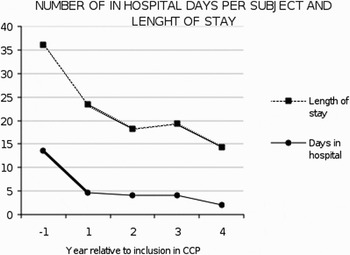
At baseline (CCP inclusion date), subjects were predominantly male (64%) with a mean age of 34 years, mean age of disease onset at 24 years, and mean time of disease duration before CCP referral of 9 years. Hospital use rates in the year prior to their inclusion were 0.37 admissions per subject with a mean hospital stay for each admission of 36 days, mean in-hospital days of 13 days, as well as 0.52 emergency room visits.
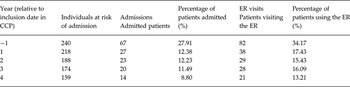
In the year prior to inclusion in CCP, 67 subjects had a total of 90 admissions and 3256 in-hospital days. There were 82 patients who visited the emergency room a total of 125 times (Table 1).
Percentage of subjects admitted in hospital and visiting the emergency room (ER) in the year prior to, and 4 years after, inclusion in CCP (n = 250 )

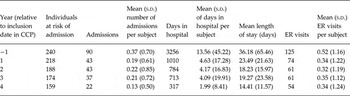
In the year following inclusion in CCP, 27 subjects had a total of 43 admissions and 1010 in-hospital days. Mean length of stay for each admission gradually declined, being as short as 14 days in the fourth year after inclusion. Finally, 38 subjects visited the emergency room a total of 74 times (Table 2).
Number of admissions, days in hospital per subject and per admission, and ER visits per patient in the year prior to, and the years after, inclusion in CC P

The number of subjects who were admitted dropped by 57.7% in the year following inclusion (from 67 to 27 individuals; p = 0.037). The number of admissions was reduced by 52.2% (from 90 to 43; p = 0.003), days in hospital diminished by 69% (from 3256 to 1010; p = 0.005), the number of individuals visiting the emergency room decreased by 53.6% (from 82 to 48; p = 0.04), and the total number of emergency room visits decreased by 40.8%. As to the length of stay of admissions, a drop of 61% was observed between the year before and the year after inclusion in CCP (from 36 to 14 days; p = 0.004). Differences between the year prior to the inclusion and the second and third year after inclusion were still significant (p = 0.016 and 0.035, respectively).
Comparison of mean admissions and days in hospital per individual in the years pre-post of CCP inclusion showed a statistically significant drop of 0.18 admissions per individual (95% CI = 0.06–0.03; p = 0.003), and a 8.93 decrease in in-hospital days per subject (95% CI = 2.74–15.11; p = 0.005). This amounts to 53.8% fewer admissions and a 65.8% reduction of days in hospital per subject.
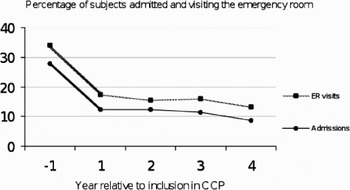
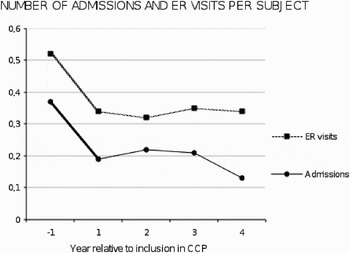
Reduction in hospital use observed in the first year after CCP inclusion was maintained during the subsequent 3 years (Figs. 1–3).
Percentage of subjects admitted to hospital and visiting the emergency room. Significant year-to-year differences (p < 0.05) are depicted with a thicker line between those points in which a difference exists. The difference achieved between (−1) and (1) is sustained in the following years.

Number of admissions and emergency room (ER) visits per subject in the year prior to, and 4 years after, inclusion in CCP. Significant year-to-year differences (p < 0.05) are depicted with a thicker line between those points in which a difference exists. The difference achieved between (−1) and (1) is sustained in the following years.

Number of hospital days and length of stay in the year prior to, and the following 4 years after, inclusion in CCP. Significant year-to-year differences (p < 0.05) are depicted with a thicker line between those points in which a difference exists. The difference achieved between (−1) and (1) is sustained in the following years.

Discussion
Persons with schizophrenia included in our study experienced a drop in hospital use after their inclusion in this program. Generally, these results concur with reviews suggesting that CM programs are effective (Mueser et al. 1998; Ziguras & Stuart, Reference Ziguras and Stuart2000), but do not agree with Marshall's (Marshall et al. Reference Marshall, Gray, Lockwood and Green1997). As not every review shows data on our outcome measures, we address each of these.
Admissions per subject
The reduction in admissions per subject observed in our study is at odds with the review by Ziguras & Stuart Reference Ziguras and Stuart(2000), which states that only those programs with fidelity to ACT are able to reduce admissions, while patients in CM-based programs have more admissions after inclusion. Our results also contradict those of a recent semi-randomized study on clinical CM by the CMHS (akin to the programs of the present study) on revolving door patients, which concluded that Clinical CM did not prove itself superior to standard care in terms of hospital use (Lichtenberg et al. Reference Lichtenberg, Levinson, Sharshevsky, Feldman and Lachman2008).
Different authors suggest that the contradictions stem from the low rates of admissions in CM studies. Ziguras & Stuart Reference Ziguras and Stuart(2000) warn that both types of programs may care for different patient populations, since the number of prior admissions was higher in ACT studies (7.4 admissions) than in Clinical CM studies (4.7 admissions). Commenting on Curtis's study (Curtis et al. Reference Curtis, Millman, Struening and D'Ercole1992), Mueser (Mueser et al. 1998) points out that in low-service users, CM is not effective. A recent study by Burns (Burns et al. Reference Burns, Catty, Dash, Roberts, Lockwood and Marshall2007) concludes that the benefits of intensive CM might be marginal in settings that have already achieved low rates of bed use. According to these authors, low hospitalization rates point to a good use of community resources and to hospital admission only as a last resort.
Our data with CCP based on clinical CM contradict those hypotheses. In our sample, the mean prior admission number was even lower than in those studies (0.37 admissions per subject in previous year), yet a significant reduction of number of admissions per subject was achieved.
In-hospital days
Ziguras & Stuart Reference Ziguras and Stuart(2000) conclude that CM is effective because it reduces total number of hospital days, despite an increase in admissions. Our results show a reduction in mean in-hospital days per year and per admission. This is smaller than in other studies performed in Anglo-Saxon countries but in agreement with the low use of hospitalization in Spain. For instance, subjects in the REACT study (Killaspy et al. Reference Killaspy, Bebbington, Blizard, Johnson, Nolan, Pilling and King2006) had a mean in-patient bed use of 176 days in the year prior to intervention, and patients in the UK700 study (Burns et al. Reference Burns, Creed, Fahy, Thompson, Tyrer and White1999) spent an average of 60 in-hospital days in the two previous years, both far from the 13.56 in-hospital days before CCP inclusion found in our study. Another reference for this comparison is mean days in-hospital after CM intervention in Marshall's review (Marshall et al. Reference Marshall, Gray, Lockwood and Green1997): 25.8 days per year v. 2–5 days in the 4 years after inclusion in intervention for our sample.
Percentage of subjects admitted
Data on the proportion of subjects admitted to hospital led Marshall et al. Reference Marshall, Gray, Lockwood and Green(1997) to the conclusion that CM programs are not effective in terms of hospital use. They rely on the results of six experimental studies: in five of the studies, the group receiving CM had a higher proportion of subjects admitted than did those under standard care. Our results, however, show that after inclusion in CCP the proportion of admitted subjects dropped. The proportion of subjects admitted pre–post-intervention in our study was also smaller than in Anglo-Saxon samples (Table 1). For instance, in the PRISM study (Thornicroft et al. Reference Thornicroft, Strathdee, Phelan, Holloway, Wykes, Dunn, McCrone, Leese, Johnson and Szmukler1998), between 39% and 47% of the subjects had been admitted after 2 years of follow-up. In the six studies reviewed by Marshall, 30.38% of the patients under CM were admitted during follow-up.
Emergency room utilization
In our literature review, we did not find studies on the impact of CCP on emergency room visits in the specific population of persons with psychiatric disorders. The results of the present study show that after inclusion in CCP, both the number of visits to the emergency room per subject and the proportion of subjects turning to the emergency room diminished.
A remarkable finding was that the reduction in hospital use was sustained during the 3 years following inclusion. The program remained available to all individuals during that period, although not necessarily with the same intensity. Follow-up was flexible, and the degree of support by the case manager was tailored to the subject's needs at a certain time. Some patients requiring very intensive intervention at the initial phase did not receive such a high degree of attention in other periods. Therefore, this study agrees with others that found no advantage for continuing intensive and assertive follow-up after the initial phase of intervention over less costly interventions which ensure continued supervision of the patient's needs (Salyers et al. Reference Salyers, Masterton and Fekete1998; Ford et al. Reference Ford, Barnes, Davies, Hardy and Muijen2001). Our results differ from studies that found a rapid loss of achieved improvement when subjects were transferred to less intensive programs (Stein & Test, Reference Stein and Test1980; McRae et al. Reference McRae, Higgins, Lycan and Sherman1990; Audini et al. Reference Audini, Marks, Lawrence, Connolly and Watts1994). It is possible that this difference stems from the fact that all the subjects in those studies were transferred to the less intensive option, whereas in our study, only those individuals judged to be candidates for a less intensive care were changed (i.e., the frequency and intensity of intervention was adjusted to the patient's needs).
Other objectives of the intervention
Other authorities have questioned the relevance of hospitalization as an outcome measure (Van Os, Reference Van Os2009). It should be noted that around 70% of the subjects in our sample of 250 had not been admitted in the hospital in the year prior to inclusion in CCP. These individuals referred to the CCP without previous admissions were transferred with goals other than reducing hospital use. Psychosocial interventions toward improving quality of life and integration in the community of persons with severe mental disorders were performed with these patients, as well as with those who were admitted. Rehabilitation-oriented mental health services are germane to these programs.
Analyzing the role of CCPs exclusively in terms of reduction in hospital use, the only outcome measure in our study, may underestimate the role of these programs in fostering other pending developments for psychiatric reform in the Spanish setting.
Clinical CM v. ACT
In this study, the programs showing efficacy in reducing hospital use follow the Clinical CM model rather than the ACT model. This agrees with findings of other studies such as UK700, PRISM, and REACT (Thornicroft et al. Reference Thornicroft, Strathdee, Phelan, Holloway, Wykes, Dunn, McCrone, Leese, Johnson and Szmukler1998; Burns et al. Reference Burns, Creed, Fahy, Thompson, Tyrer and White1999; Killaspy et al. Reference Killaspy, Bebbington, Blizard, Johnson, Nolan, Pilling and King2006), in which less intensive interventions (standard CM interventions) of their CMHS proved to be as effective as ACT. It should be taken into account that in those studies, the standard, less intensive groups of intervention had already implemented the Care Program Approach, which comprises CM in all CMHS. They also had more professionals, more specialized resources, and more community care (such as home visits) available than we had in our study. In turn, they are far more developed than the usual practice in Spanish CMHS, which lacks CCPs. Therefore, it would be desirable for our CMHS to be closer to what UK studies call the ‘standard’ control groups of their investigations.
The case manager-to-patient ratio illustrates this point. In UK700 and REACT, the ratio in the control group (standard intervention) was, at most, 1:30–35. They did not find any benefit with ratios as high as 1:10–15. The programs participating in our study had a fairly smaller ratio of 1:40–60. Had there been more staff and a closer proportion of standard interventions of the aforementioned studies, results might have been better. At any rate, it should be remembered that every patient requires a highly variable level of intervention and that while some of these 40–60 patients may need very frequent contacts, others may not. As other authors have noted (Bachrach, Reference Bachrach1993; San Emeterio et al. Reference San Emeterio, Aymerich, Faus, Guillamón, Illa, Lalucat, Martínez, Sánchez and Teixidó2003; Thornicroft & Tansella, Reference Thornicroft and Tansella2004), it may be more fruitful to establish other approaches to CM, with different intensity and components, according to the patient's needs.
At present, several protocols tackling this need are being developed in Spain. In Catalonia (Balsera Gómez et al. Reference Balsera Gómez, Rodríguez Medina, Caba Calvet, Vega Prada, Ruiz Ureña, Berruezo Ortiz, Clusa Gironella, Rodríguez Montes and Haro Abad2002), the system is organized at different levels. A Program of Care for Persons with Severe Mental Disorders (TMS) in CMHT, and the Individualized Services Plan (PSI) for TMS, the most intensive level of care.
As stated by Burns (Burns & Perkins, Reference Burns and Perkins2000; Burns et al. Reference Burns, Catty, Dash, Roberts, Lockwood and Marshall2007; Burns, Reference Burns2008; Marshall, Reference Marshall2008), future research might need to avoid competition between interventions with more or less fidelity to ACT. Further research is also needed concerning specific interventions with CM to find out which interventions and specific components within those are best suited to different patients.
Strengths and weaknesses
The goal of this study was to assess the impact of CCP implemented in three CMHS in Madrid on hospital use. This required an evaluation under natural circumstances of operation. The existence of a PCR with highly reliable data on admission and emergencies allowed a retrospective analysis. The inclusion of all subjects being cared for by CCPs in 2002 avoids the threat of selection bias and allows a highly representative sample. Thus, we had the advantage of studying what actually occurred, although the generalization of results is limited.
It is important to note that results of pre–post-studies can be affected by a variety of factors related to the passage of time. Moreover, effective sizes from the uncontrolled one-group pre–post design generally tend to be higher than effect sizes from studies conducted with controls (Lambert et al. Reference Lambert, Doucette and Bickman2001).
We have restricted our study to the effects of these programs on hospital use. This variable has been considerably used in the literature as a result measure of these interventions. However, we should proceed with caution because these measures of service usage are procedure measures that could be related to different results in clinical status, psychosocial functioning, quality of life, or unmet needs. Additionally, hospitalization is influenced by factors such as resource availability or social support. A reduction in hospitalization rates does not indicate an improvement in other clinical or functional variables.
Studies on the impact of these programs on the other endpoint would be interesting. The second part of the IPSE project (Impact of CCP in Schizophrenic Disorders) intends to make progress toward these goals with a prospective design that will include these measurements alongside those of hospital use.
Conclusions
In the first year after inclusion in a CCP a 40–60% reduction in all measures of hospital use was observed (number of admissions, duration of hospital stay, number of patients admitted, total number of days in hospital, proportion of admitted patients, total number of days in hospital, and proportion of patients visiting the emergency room and emergency room visits). This reduction was maintained over the subsequent 3 years. These results encourage the development and implementation of such programs, even though more studies evaluating these programs for other endpoints are needed.
Declaration of Interests
This study is part of the IPSE Research Project (Impacto de Programas de Seguimiento y Cuidados en la Atención a las Personas con Trastornos Esquizofrénicos en la Comunidad, Impact of Programs of Follow-up and Care on Community Care of Persons with Schizophrenic Disorders), with a grant to the La Paz University Hospital (Madrid) by the ‘Fondo de Investigación Sanitaria’ (Number PI020778) in the framework of the ‘Plan Nacional de I + D 2000–2003’ (National R&D Plan 2000–2003)
There are no conflicts of interest for any author.