INTRODUCTION
The discovery of Ghana's Jubilee Oil Field in 2007 was major news for a nation that was seen as a model of good governance and a leading African example of successful transition to democracy. The news of the oil discovery was received with euphoria and high hopes for the development prospects of the resource (Ayelazuno Reference Ayelazuno2014). Yet the well-known experience of Ghana's neighbour Nigeria with the ‘resource curse’ (Karl Reference Karl1997; Watts Reference Watts2004) was also foremost on the minds of many as oil production began in 2010. The Niger Delta has been severely impacted by conflict, insurgency, loss of livelihoods and environmental degradation – outcomes often associated with the extractive industries but experienced there more dramatically than perhaps anywhere else (Ikelegbe Reference Ikelegbe2001; Omeje Reference Omeje2006). Host communities have suffered while national elites and international capital benefit (Ovadia Reference Ovadia2013a, Reference Ovadia2013b). Revenue sharing, special government initiatives to develop the Niger Delta, and corporate social responsibility (CSR) investments by international oil companies (IOCs) have all failed to mitigate negative impacts (Frynas Reference Frynas2005; Idemudia Reference Idemudia2007).
In 2010, just prior to the first oil from the Jubilee Field, a research teamFootnote 1 conducted a pilot study to assess the relationship between oil companies and host communities within the six coastal districtsFootnote 2 of the western region of Ghana. The research findings were organised into four key themes on the state of community-company relations: extremely high community expectations of development benefits; lack of communication and information dissemination with communities; potential negative impacts on livelihoods of traditional fishing communities; and lack of coordination of CSR activities of the Jubilee Partners.
In 2015, follow-up research was done by the authors in the same districts and communities, using the same qualitative methods to assess what had changed in the intervening years and to produce what we believe to be the first longitudinal study of the impacts (real and perceived) of oil and gas production in Ghana. With attention to the loss of livelihoods, failure of oil-backed development initiatives, and negative impact of environmental and social change, we present four updated findings that suggest the Ghanaian government and IOCs operating in the country have not done enough to avoid the pitfalls of Nigeria's historical experience. First, we find that high expectations have given way to disappointment and hopelessness. Second, communities are unsatisfied with oil company engagement and CSR activities. Third, local governments have minimal involvement in oil policy or CSR projects. They bear costs from the industry but do not have significant additional revenues with which to pursue oil-backed development. Finally, communities feel an acute loss of livelihoods and blame IOCs while remaining concerned about elite capture and environmental degradation.
Rather than reinforce the notion of a ‘curse’, these arguments and the analysis below highlight several dimensions of stakeholder agency and opportunities for IOCs and governments to make better policy decisions that contribute more directly to sustainable livelihoods in communities that host oil production. As a relatively recent oil exporter and former darling of the donor community, Ghana's experience with oil and gas is particularly significant for African countries looking to begin petroleum production and its experience with its oil-bearing communities offers insights into what may lie ahead for other countries that are unable to manage the impact of this new industry on host communities. In attempting to avoid the negative economic impacts of oil production on the national economy, the oil-backed development approach taken by Ghana has reproduced the negative socio-political impacts of paying insufficient attention to the local dimension.
Though it is relatively well-governed and better-prepared by donors to address the economic dimension of the resource curse, Ghana has not managed to learn from the experience of its neighbour Nigeria. While it does not necessarily follow that other countries are doomed to similar fates, this longitudinal study does suggest the need to modify the approach the governments, IOCs and donor agencies take to communicating and working with host communities in the early stages of oil exploration and production to mitigate the potential for conflict and upheaval and increase the possibilities for meaningful petro-development.
THE HYDROCARBON INDUSTRY AND SUSTAINABLE LIVELIHOODS
Extractive industries involve the exploitation of natural resources on and under the land and ocean. These are the very natural resources that local communities depend on to reproduce themselves materially and socially. These industries, by their nature, are inherently contradictory to the livelihoods and livelihood strategies of the communities hosting them. As recent work on the Atuabo Gas Project illustrates (Ablo & Asamoah Reference Ablo and Asamoah2018), the sustainable livelihoods approach (SLA) serves as a good prism through which to understand this contradiction and the dashed hopes that have followed the euphoria that accompanied the discovery of oil in Ghana.
Sustainable livelihoods are contestable and not amenable to a universally accepted definition or meaning. However, the seminal definition of Chambers and Conway is often cited in the literature:
A livelihood comprises the capabilities, assets (including both material and social resources) and activities required for a means of living. A livelihood is sustainable when it can cope with and recover from stresses and shocks, maintain or enhance its capabilities and assets, while not undermining the natural resource base (Chambers & Conway Reference Chambers and Conway1991: 7)
Three main concepts – ‘sustainable’, ‘rural’ and ‘livelihoods’ (Scoones Reference Scoones2009: 171–96) – are the pillars of the SLA. The framework has five main elements that may be used to design and analyse rural development policies and projects, and to assess the sustainable livelihood implications of industries sited in rural areas such as the hydrocarbon industry of Ghana under study in this paper. Drawing on Scoones (Reference Scoones1998, Reference Scoones2009) the key elements of the SLA are: context; livelihood resources; livelihood strategies; outcomes; and institutional processes.
1. Context has to do with micro, meso and macro factors affecting the livelihood resources, strategies, outcomes and the institutions which mediate all these; factors such as history, politics, macroeconomic conditions, climate, agroecology and socioeconomic divisions and differentiations;
2. Livelihood resources are the various forms of assets and capitals – natural, economic/finance, social and human – which the populace need to produce and reproduce themselves materially and socially in their ecosystems;
3. Livelihood strategies concern the ways by which people make a living within the overarching context of the resources and capabilities they have, as well as the opportunities and challenges imposed by the contextual factors. In rural areas, the livelihood strategies include, but are not limited to, agricultural intensification/extensification, livelihood diversification and migration.
4. Outcomes are the concrete sustainable livelihoods a person is able to attain such as wellbeing, capability, resources and the resilience of these livelihoods in the face of disaster or shocks.
5. Institutional processes are the formal and informal rules (including policies of the state) governing, for example, access to natural resources or the livelihood strategies of a person or group of persons. Institutions mediate the ability of a person to attain concrete livelihood outcomes and are key to designing interventions which improve sustainable livelihood outcomes (Scoones Reference Scoones1998, Reference Scoones2009; see also Ablo & Asamoah Reference Ablo and Asamoah2018).
SLA is popular with development actors and has been used by the World Bank, the UK Department for International Development (DFID), the United Nations Development Programme (UNDP) and the United Nations Food and Agriculture Programme (FAO). Based on the insights of the SLA, the FAO believes that the poor's access to natural resources such as land, forests, water, fisheries, pastures, and many more is critical to sustainable poverty reduction. It is also critical to the resilience of the livelihood strategies and outcomes for the poor (Cotula Reference Cotula2002). Extractive companies are increasingly drawing on SLA as a guide to the design and implementation of their corporate social responsibility (CSR) projects. They have also appropriated the language of SLA when they provide mining or oil communities with alternative ways of reproducing themselves as compensation for the land or ocean lost to their business. Such interventions are called ‘alternative livelihood projects’ (Hilson & Banchirigah Reference Hilson and Banchirigah2009).
SLA on its own is unable to account for the deterioration in fragmentation caused by both real and perceived harms to livelihoods by resource extraction. We have therefore enriched our SLA analysis with further insights from critical geography on territorialisation of resource control in frontiers. Frontiers in this context are social spaces characterised by contestation over forms of rule, power and accumulation (Rasmussen & Lund Reference Rasmussen and Lund2018; Watts Reference Watts2018). These processes are dynamic and go through cycles of frontier making – where established territorial orders are challenged and fragmented – and territorialisation – where new patterns of spatial control, authority and institutional orders are established.
How the dynamics of high expectations and perceived lack of betterment lead to processes of social change in new resource frontiers is under-studied. Recent work in the field of international forest conservation and development has argued for a ‘more critical engagement with expectations and the embedding of accountability for expectations’ (Masserella et al. Reference Masserella, Sallu, Ensor and Marchant2018: 375). Indeed, in attempting to move beyond the limitations of the resource curse, the field of oil-backed national development, with its focus on economic diversification and structural transformation, pays insufficient attention to the potential negative impacts of unfulfilled expectations at the local level and their relation to processes of change and destabilisation.
In the era of the sustainable development goals (SDGs), our modified sustainable livelihoods approach is highly appropriate for understanding the contradiction between the activities of hydrocarbon companies in Ghana and the lives of the communities in which they operate. SLA is analytically powerful for delineating the dynamics of the contradiction between resource extraction and sustainable livelihoods as well as interventions that may be designed to address it. The relationship between Ghana's hydrocarbon industry and the wellbeing of the host communities involves significant complexity (sometimes called assemblages – see Andrews & Siakwah Reference Andrews and SiakwahForthcoming). For example, there is competition between hydrocarbon companies and the people of these communities for access to natural resources and tendency towards conflict between communities and the companies. In short, SLA provides a solid framework for making sense of the findings of the research reported below, thereby providing solid theoretical and conceptual grounds for investigating these relationships in similar contexts elsewhere in Africa.
AN OVERVIEW OF THE COMMUNITIES AND DATA COLLECTION
The article is based on qualitative data collected in six districts located along the coastline of the Western Region of Ghana in 2010 and 2015. The discovery and commodification of oil off the coast of Ghana's Western Region has linked the local with the global political economy context. External price shocks challenge the ability of countries to cope with the boom and bust cycles of the extractive industries while offshore oil production creates both a physical and economic enclave which may provide few linkages and tangible benefits to the local economy (Ferguson Reference Ferguson2005). Indeed, it is the communities living closest to the sites of resource extraction that often bear the brunt of the environmental and social impacts of oil development and benefit least from government spending and employment opportunities, exacerbating patterns of uneven development (Van Alstine Reference Van Alstine2014).
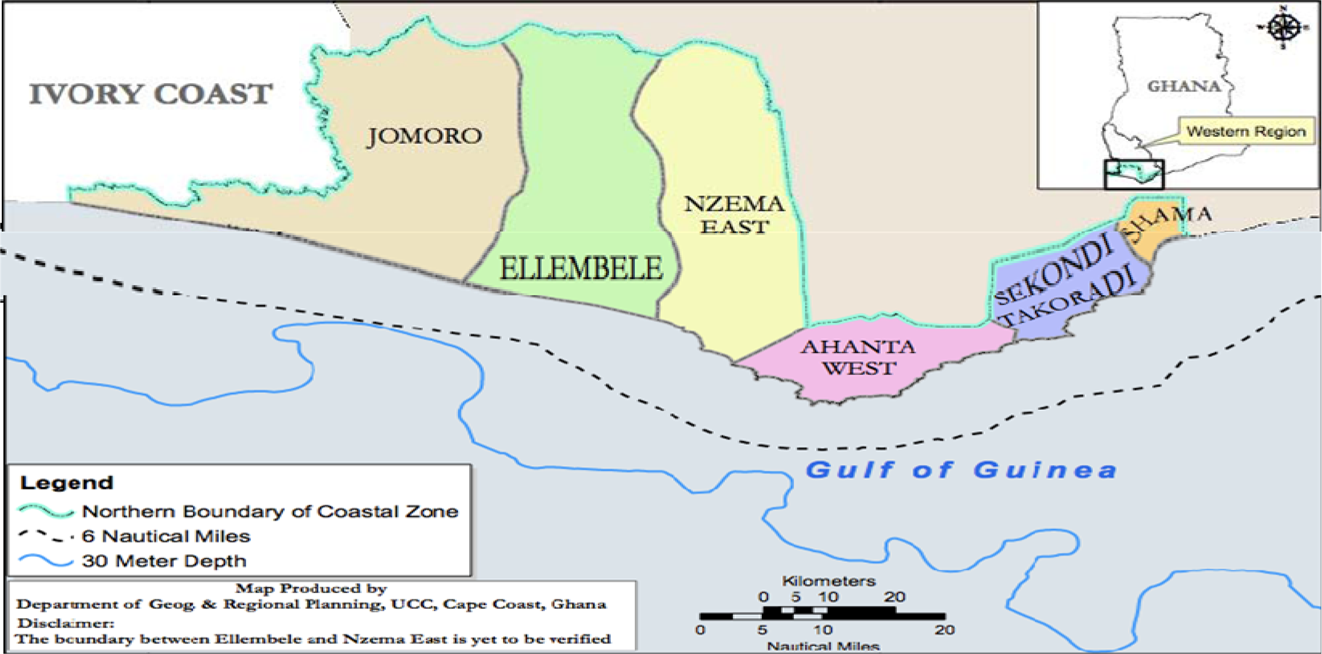
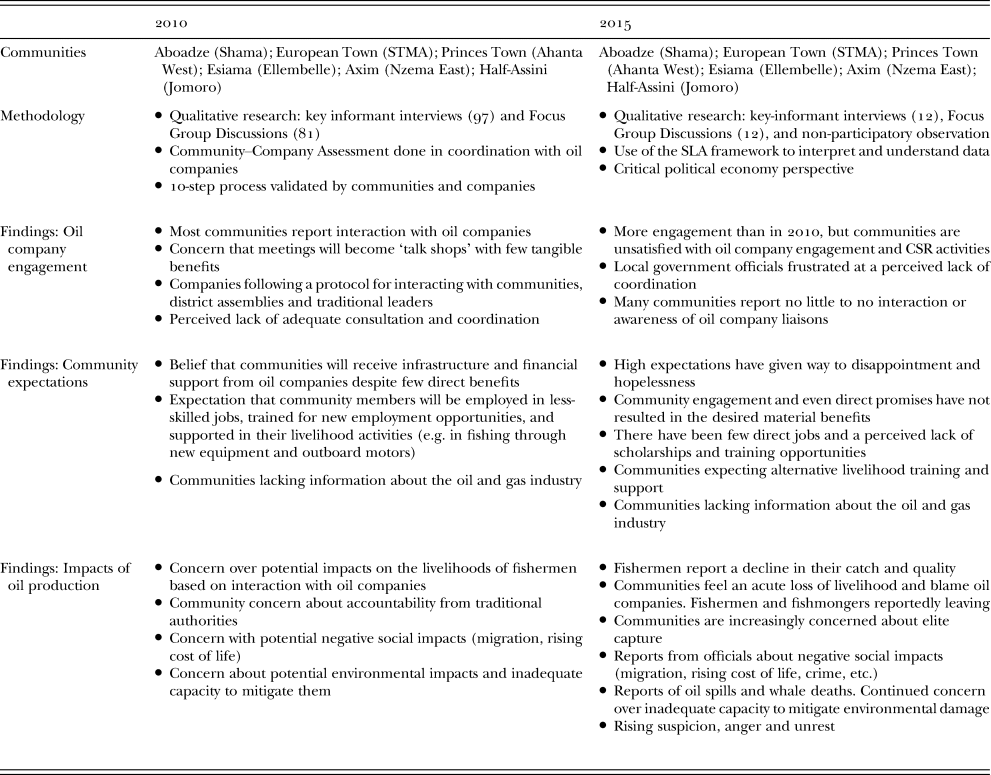
Our methods included focus group discussions (FGDs), key informant interviews (KIIs) and non-participatory observation. In 2010, the larger research team associated with the original project conducted a total of 178 interviews. Of these 81 were FGDs. The follow-up research in 2015 involved interviews with 18 informants and an additional 12 FGDs. As Figure 1 illustrates, the six districts that we did our fieldwork in during 2010 and 2015 are the ones closest to the oil fields mentioned above.
Map of Ghana showing the six coastal districts closest to the offshore oil fields.
Source: University of Cape Coast, Ghana.

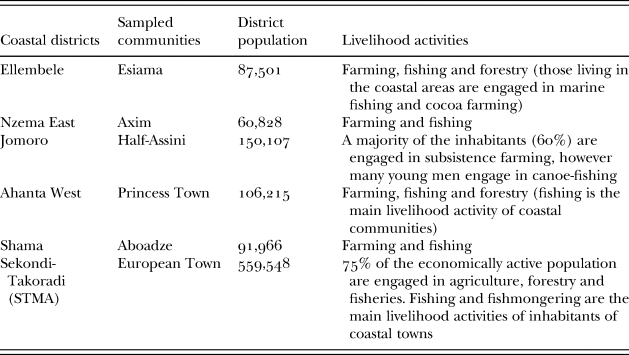
Our qualitative approach was designed to allow us to gain in-depth knowledge about each district from a variety of informants. In each of the districts, a community was purposely selected for the initial fieldwork in 2010 and the same community was used for the fieldwork in 2015 (see Table I). As Table II illustrates, during both the initial and follow-up fieldwork, we held FGDs with a cross-section of the population: fishermen, fishmongers, peasants, youth, men and women. We also interviewed people who by their occupations or status may have expert views or privileged information on the key themes of our research. Thus, key informant interviews were conducted with opinion leaders of the society, such as chiefs and assemblymen, as well as officials of the local government institutions such as Coordinating Directors and high-ranking officials such as District Planning and Development officers. Emphasis was placed on what communities perceived to be the impacts of oil and gas, regardless of whether evidence exists to support causation or even correlation. Research ethics approvals for the 2010 fieldwork were obtained through the University of Leeds Research Ethics Committee and research ethics approvals for the 2015 fieldwork were obtained through the Newcastle University Ethical Review Committee.
Coastal communities in the Western Region.

Source: The Authors, based on data from the Ghana Statistical Service 2014 Population and Housing Census.
Comparison of fieldwork in 2010 and 2015.

DYNAMICS OF CHANGE IN COASTAL COMMUNITIES
Since 2010, the Western Region has been inundated with researchers coming to interview key informants and hold focus groups with coastal communities. In 2015 the Municipal Coordinating Director of Nzema East wearily noted, ‘In Axim what we see is for this research a lot of people have come here.’Footnote 3
Locals are becoming increasingly frustrated at the lack of benefit from the new oil and gas industry. Blame primarily falls on the government and IOCs regardless of competing explanations. In Half-Assini, an elder fisherman explained: ‘If not because you said you are researchers we wouldn't have listened to you because so many people came here from the government and the oil companies to talk to us several times but no support has ever been given to us, we have decided not to grant any more interviews about oil and gas again because no good comes from those meetings.’Footnote 4
In Aboadze, our research assistants were greeted in 2015 with some hostility when they came to do a focus group with locals. Eventually, they were told the community would only do the focus group because the assistants were students. If they were researchers it would mean they are benefiting financially somehow from the research, so they wouldn't do the interview. If they were from a non-governmental organisation (NGO), they told the assistants, they would have ‘locked them up’ and kept them until the IOCs came to pay for their release.Footnote 5
Many of our informants used hyperbolic language to describe their growing frustration. In the sections that follow, we update the research conducted in 2010 with present concerns about livelihoods, development interventions, and environmental and social change. The dynamics of change concerning the livelihood context paint a picture of a situation that, though still far from the disarray of the Niger Delta, is descending into a worsening predicament.
A loss of livelihoods
In 2010, the largest concern from the sampled communities in each of the six coastal districts was the impact of offshore oil production on the livelihoods of fishers. All communities described some level of interaction with IOCs and potential negative impacts on fishing, one of their primary livelihood assets. A number of respondents felt that the meetings had become ‘talk shops’ with few tangible benefits: ‘How are we sure that anything good will come out of all the information we are giving them in all these meetings? We have been waiting for a long time for practical action from the companies’.Footnote 6
As noted above, the discovery and production of oil in Ghana was accompanied by a groundswell of euphoria about the development prospects of the resource. However, the initial euphoria is being buried in the unrealised expectations of inhabitants of the six coastal communities studied in this paper, culminating in conflicts between them and the IOCs (see Adjei & Overå Reference Adjei and Overå2019). Many community members believed they would receive infrastructure and financial support from IOCs. They also expected to get help in the areas of job creation, improved electricity supply and improved social services. Both the government and the IOCs themselves contributed to the development of these expectations through public statements in Ghanaian media and at public meetings in the Western Region. By 2015, fishermen and fishmongers in each of the six coastal districts reported a loss of livelihood that they attribute to the oil and gas industry. It seems clear that there has been a sharp decline in the fish catch – though it is not clear what role oil production may have played.Footnote 7 Alternative explanations include overfishing by locals (using illegal nets or methods such as chemicals and explosives) or foreign trawlers. Communities also report a rise in ocean levels, which they also blame on oil and gas, as unlikely as that may seem, and a proliferation of a type of seaweed known as sargassum.Footnote 8 In general, communities tend to blame IOCs for any negative impacts on their livelihood, whether or not there is any evidence, and perhaps motivated by a desire to claim more of the benefit from an industry that they know produces great wealth but from which they are largely excluded.
In each of the coastal districts, fishermen and fishmongers expressed a similar set of concerns about the declining catch and its impact on their quality of life. At Axim, a fisherman summarised the discontent:
Our fishing activities are being affected and we cannot even pay our children's school fees … whenever we go near the rig they seize our nets and sometimes they threaten to beat us. That is our only source of livelihood and they are gradually taking it away from us. We don't even know the benefits the oil has to this nation and to us the fishermen … Hence we are not in agreement with this oil exploration. If the government wants peace to prevail then they should do something to protect us.Footnote 9
The task of oil-backed development, as will be described in the section below, is to deliver a benefit to all of those impacted by petroleum activities, not just to provide social investment here and there. Ideally, revenues from the oil wealth should be used to improve the wellbeing of all Ghanaians, particularly the subaltern classes in the six coastal district who bear a disproportionate burden of the negative social and ecological effects of its exploitation (Ayelazuno Reference Ayelazuno2014). The declining catch impacts the livelihoods of both (male) fishermen and (female) fishmongers. Explaining what has changed in the five years since oil production began, a fishmonger in Half-Assini remarked, ‘As a result of the reduced catch and small sizes of the fish our businesses have been affected. Now we cannot get the quantity that we want and even what we sell the prices has fallen because of the sizes of the fish. We do not make any profit.’Footnote 10
Comments from fishmongers were not just about the decline in the catch, but also its quality. In Half-Assini, we were told some that species have disappeared, the fish that are caught are smaller in size, and after processing the colour and taste of the fish is now different.Footnote 11 Complaints about lost income and difficulties paying school fees were accompanied by requests for assistance. At Axim, a fishmonger told us, ‘What we would like you to know is that our business is not going on as well as before these oil companies came so we need some kind of support … They should also help us to educate our children and build a hospital for us. These are the things we would want the oil and gas companies to help us with.’Footnote 12
Complaints were also accompanied by claims that women were leaving the business. Asked if any fishmongers had left the trade, a woman in European City answered, ‘Yes, I am a fishmonger but now I am no longer in the business because most of the time you do not even get the fish.’Footnote 13 A fishmonger in Half-Assini added that she was preparing to begin illegal mining if the situation became worse for her,Footnote 14 while a fishmonger in Aboadze told us many in the fish-smoking business had gone to Abidjan and elsewhere ‘because in that place there is no oil so there is good catch there.’Footnote 15 In response to the decline in quantity and quality of the fish catch, some fishmongers adapted their livelihoods by diversifying into other sectors and/or migrating to more economically viable regions. However, most fishermen and fishmongers were either unwilling or unable to adapt their livelihood strategies and requested investment from IOCs and/or government in order to reduce their livelihood vulnerability.
For some fishermen, the best solution would be if oil production simply ceased. A fisherman in European City told us, ‘Now our income levels have reduced drastically, and we the fishermen are praying very hard that the almighty God will take his oil away so that we the fishermen will be free. So we pray hard and hard so that the almighty God will take his oil away. Ever since oil came to Ghana we the fishermen have been suffering and suffering.’Footnote 16 Most fishermen and fishmongers though are looking to oil-backed development and support from the government and/or the IOCs. There are signs that if the loss of livelihood is not addressed, the situation in the coastal regions of the Western Region will further deteriorate, as captured in this response from a fisherman in Axim: ‘What we can say is that fishing is our only job here but the activities of the oil companies are disturbing us so we need help and support. And we have also decided that if they keep worrying us on the sea then we will begin to resist and we will not let their exploration activities also continue in fact there will be a war on the sea.’Footnote 17
Expectations and ‘offshore CSR’
In 2010, numerous meetings were held in the coastal districts by IOCs to inform community stakeholders about the industry and discuss CSR projects. According to Tullow, the lead company among the Jubilee partners, their engagement protocol for interacting with local stakeholders involves calls on the district assemblies, traditional chiefs and then other community leaders. In 2010, members of Tullow's CSR team felt this had been an effective method of community entry. However, interviewees in 2010 expressed that they saw few direct benefits from oil-backed development. One respondent said: ‘We have only been having meetings with the oil companies. We have yet to see any direct benefit’.Footnote 18
Communities in 2010 expected a large range of oil-backed development benefits, including investments in livelihood assets to make these more resilient to potential livelihood shocks. Employment and infrastructure development were the primary expectations. For example, in Sekondi, fishermen admitted that the industry requires highly skilled labour to operate the sophisticated machinery but explained that they could be employed for other jobs that require less skill. Some even expected the CSR programmes of the Jubilee partners to support fishermen in purchasing equipment such as nets and outboard motors.
A significant number of institutional and accountability challenges were noted in 2010 in relation to sustainable livelihoods. Illustrative of the mediatory role played by institutions, some interviewees highlighted the absence of an accountability mechanism among the traditional authorities, especially community chiefs. If not addressed, they felt that benefits from the petroleum industry may be misappropriated. One of the largest challenges was difficulty accessing information about the oil and gas industry and poor communication. A lack of adequate and proper public consultation by IOCs was also noted by district assembly representatives.
Institutional processes that improve sustainable livelihood outcomes appear to be lacking in the context of oil-backed development. Interviews and discussions with citizens indicate that, despite the efforts of the IOCs, there is still a perceived lack of consultation and coordination between the state, oil companies and local communities. While locals look toward the IOCs to provide higher standards of living and alternative livelihoods, communities are not satisfied with the CSR benefits they are receiving. At the same time, local content policies are not and likely cannot be effectively mobilised to allow the participation of locals in the oil industry (see below).
Ackah-Baidoo (Reference Ackah-Baidoo2012) uses the term ‘offshore CSR’ to help understand how IOCs operating offshore often fail in their development interactions due to their failure to understand local dynamics in proximate coastal communities. Tullow Oil considers itself an oil company that operates within the highest standards of sustainability and social responsibility. The 2010 report recommended the Jubilee Partners employ community liaison officers in each coastal district. Tullow visited all six districts in 2010 to discuss the proposal and today these liaisons operate out of the District Assembly offices.
In 2015, we asked locals in each community about these liaisons. District officials often pointed to the liaisons when asked about the interaction between the community and the IOCs. However, fishermen and fishmongers in the villages we visited claimed in most cases to have never heard of them. An elder fisherman in Aboadze was the only fisherman who seemed to be aware of the liaisons. He told us, ‘The liaison officer is really doing his best, he tells us all that is happening and we also tell him our challenges, but when he reports back to the oil companies they do not respond to us. And he has no power on his own so his efforts are just not helping.’Footnote 19
Elsewhere, fishermen and fishmongers were unaware of a liaison office or officer. A fishmonger in Half-Assini told us, ‘If I knew that there was such an office in this community, every day I would go there to seek help and support, because it's not been easy at all ever since these oil and gas people came.’Footnote 20 In Princes Town, a fisherman told us ‘If somebody says he has ever come here as a liaison officer then the person is telling a lie.’Footnote 21 In some cases, even district officials who knew the positions existed had not seen the liaison officers for long periods of time. In Nzema East, for example, a top district official acknowledged there was a community liaison officer, but said ‘for the past three months I have not seen her even though she is supposed to work for the district.’Footnote 22
The failure of Tullow's community liaisons to be visible in the community demonstrates an institutional failure and the continued relevance of the concept of offshore CSR. Yet, communities are looking to the IOCs to address their chief development concerns. Andrews (Reference Andrews2013) found that locals in Cape Three Points (Ahanta West) expressed a desire for IOCs to contribute to community development. This led him to suggest a ‘grassroots perspective’ is required for CSR in which the IOCs listen to people, address their needs, demonstrate flexibility and adaptability, and contribute to responsible government. Such a perspective is lacking in IOC engagement with the Western Region's coastal communities.
As shown below, locals are not being directly consulted on the design and implementation of CSR projects in a substantive way. Instead, key stakeholders are taken to meetings at luxury resorts. IOCs commit to one or two types of social investment (for example, ENI is known for health projects, GNPC provides scholarships, Tullow focuses on water and sanitation, etc.). Project sites are chosen to be visible on the main East–West road instead of following land use plans with additional funds spent on requests by traditional chiefs for donations to festivals and cultural events.
Significant investment is clearly being made by IOCs, who cannot and should not be taking over the developmental role and responsibility of government. However, engagement and coordination have been lacking and have had limited impact on the sustainable livelihoods of Western Region fishing communities (as discussed above). The official in Nzema East described engagement by the IOCs in the following terms, ‘If they want to invite us, then they invite us. If they have an issue then we discuss but it has been such that mostly they do not respond to our demands. So we have even stopped demanding from them.’Footnote 23
In Jomoro district, a planning official noted that some IOCs have quarterly meetings with stakeholders to discuss priorities for CSR interventions. At the same time, he expressed frustration about not being informed about projects in advance and about what sites were chosen for projects: ‘Every year they have a focus. They will tell you that, if for instance what you are proposing to them is outside their focus for that particular year, it will be very difficult for them to go into that area.’ When asked about how the IOCs choose their focus areas, he related a story about a facility that was needed in one part of the district but was instead put in another community against the advice of the planning department. He pleaded, ‘if you have funds for something, it is prudent that you come to the assembly and we sit down, look at the plan, and you can select your focus because we will have something that will fall under that focus in the plan.’Footnote 24
Some officials spoke in much warmer terms about IOC engagement. Supportive comments were more commonly made by the highest level of district officials and by public relations officials. Yet, we repeatedly heard that, as an official in Ellembelle complained: ‘We as an assembly have our Medium-Term Development Plan and so everything that we need to do for a period of about four to five years is in that plan … They are doing their own thing and we are also doing our own thing … I am aware that they are doing something but I don't have full knowledge of what they are doing.’Footnote 25
In the Sekondi-Takoradi Metropolitan Assembly (STMA), a junior planning official complained that rather than meet with the planning office about new CSR projects, the IOCs prefer to deal directly with the communities. IOCs are aware of the municipality's development plans, yet they have not followed up about how their activities align with the plan.Footnote 26 In Shama district, a planning official noted: ‘… as for dialogue, we have had a lot of dialogue … But if you go to our Medium-Term Plan from 2014 to 2017 we have outlined a lot of programs and projects that we wish the Jubilee Partners to see to the implementation and we have not seen any marked cooperation from them.’Footnote 27
These comments suggest that not only citizens but also district officials are looking to the IOCs to do more than make a few gestures of social investment. They expect IOCs to fulfil the function of government or at least make substantive investments in the assets needed for sustainable livelihoods in the region post oil-production. With such expectations, it is not surprising that frustration is growing and will continue to grow as long as the region's developmental needs are not met.
Addressing livelihoods and local content
In 2015 more than in 2010, fishermen generally acknowledged engagement by IOC representatives but stressed the inadequacy of this interaction in leading to sustainable livelihood outcomes. As a fisherman from Axim noted, early discussions focused on exclusion zones and the dangers of going near the oil operations. At these periodic meetings, he said, they would mention CSR activities such as scholarships, but he added ‘the scholarships are very few … and this usually creates a lot of problems … it would have been better if they did not bring it at all.’Footnote 28 A fisherman at Aboadze similarly complained when asked about CSR projects such as water, sanitation, health and education initiatives that the whole community was given only two scholarships, a television and chairs ahead of the 2010 World Cup, along with some t-shirts and a ‘small amount of money and this does not help at all’ for a cultural event.Footnote 29
In Half-Assini, a fisherman complained that oil companies promised a bag of rice per family that never came: ‘… five years now there has not been any help from anywhere. The work is also going on, I mean they extract the oil and gas, but they do not give us anything. They are always deceiving us; they say they will bring us help but no help comes.’Footnote 30
Across the coastal districts, fishermen and fishmongers were also venting frustrations, but also wondering who else might be benefiting at their expense. This is best captured by a fisherman from Axim, who when asked about CSR investments responded, ‘They have done nothing for us. We don't know whether they have done something in Accra, Central, Volta or any other regions. The oil is in Western Region but we have not benefited in any way.’Footnote 31
While complaining about the kind of support they had been offered, fishermen and fishmongers made similar statements about the kind of support they wanted – not just CSR projects but investment in a range of livelihood assets. These included expanded education initiatives and scholarship programmes, and support to expand fishing businesses and training in new industries and techniques such as aquaculture, farming, etc.
When it comes to alternative livelihoods in Ghana, Hilson & Banchirigah (Reference Hilson and Banchirigah2009) critique the approach adopted in the mining sector to address concerns around artisanal and small-scale mining. They contend that the policy approaches of the mining companies in the mid-2000s were not in tune with the mindsets and ambitions of rural populations. Despite more widespread use of the SLA, this seems to be the case as well with the more recent experience in the coastal communities.
The government and IOCs are not the only targets of the communities’ anger in the Western Region. NGOs become targets of local enmity as well when they enter host communities because the presence of greater numbers of organisations and researchers also raises expectations and signals to the community the economic importance of oil. When asked what kind of support they would want from oil companies, a fishmonger in Half-Assini mentioned several areas of livelihoods support: ‘As for me, I know how to prepare doughnuts, porridge and bread. Since it is no longer profitable to trade in fish, I would ask them for money to start trading in porridge and bread.’ A colleague added, ‘I would be happy if they can support me to learn a trade in tailoring or hairdressing’. When then asked what interactions they had with NGOs, the women said, ‘There was one NGO that came and discussed issues concerning our livelihood. They even promised us that in three weeks’ time they will come and support us with some money but till date we have not heard anything from them.’Footnote 32 This interaction underlines the responsibility a variety of external actors have when they enter communities – and especially when they begin discussing any aspect of people's livelihoods.
Acknowledging support in terms of alternative livelihoods, fishmongers in Esiama nevertheless continued to hold that they had not benefited from the oil companies’ presence. One fishmonger told us, ‘We have not benefited in any way from these oil and gas companies, we have met with these companies severally and yet nothing positive has come out of these meetings’. Immediately after she finished, another added, ‘The only benefit I would say we as fishmongers have benefited from the oil and gas companies is an oven. One oven they gave us to support us in the smoking of the fish.’ Another participant said, ‘Can you imagine them giving us just one oven? Just look at the number of fishmongers in this community … So, if they really want to help us they should do it with quite a reasonable number of ovens and not just one which is woefully inadequate, just look at our numbers and only one oven!’Footnote 33
In Aboadze, a fisherman noted, ‘Tullow oil organised some courses for the youth of this community to enhance their lives. Especially soap making and business management. They can support us by giving us some grants in order to improve our businesses … after giving the youth such trainings in alternative livelihood they should have given us some initial capital to start a business with because you cannot train a person without giving him start-up capital. Some people were trained in oven-making and fish freezing, but [they have] no capital to start it.’ Therefore, when asked what benefit Tullow had provided, he responded, ‘At the end of the year they organise a regatta for us. What benefits do we get from a regatta? A regatta is not part of our sustainable livelihood. It is just for us to have a recreation. Our major source of livelihood has been endangered. We are suffering.’Footnote 34
A fishmonger in Aboadze also related negative experiences with alternative livelihoods interventions:
There was time when a group of about 10 people came and they asked us to form groups. So we formed the groups and they registered us, after that we were asked what alternative livelihoods we wanted … They later gave us membership cards and promised to help us with some money. But since then we never heard from them again … They came to check what we do here, they observed our ovens and the rods we use in the ovens and promised to bring us better ovens and rods but they never came back. They told us the activities of the oil exploration will affect our fishing activities so they will give us support when that happens, but they failed in all those promises.Footnote 35
The frustration and anger displayed in Shama reflects, in part, a poorly implemented CSR programme and poorly managed community engagement. It may also be a reflection of community anger at the power relations inherent in the way IOCs define alternative livelihoods and make decisions about them for communities without sufficient input, however, more research is needed on this topic to reach conclusions. What we can say is that IOC strategies to date represent a failure of oil-backed development.Footnote 36 A district official from Nzema East noted this by saying, ‘they want to change their lives to beekeeping and snail farming as an alternative source of livelihood and so they come and train them and promise them and go away… you will even see the impact and the training becomes a white elephant.’Footnote 37
For the local communities, ideas around CSR, social investment and provision of alternative livelihoods are tied up with ideas about local content. Local content, rightly or wrongly, is understood by Ghanaians as a set of policies that will create local jobs and create opportunities for local companies. Local content certainly has the potential to be developmental (Ovadia Reference Ovadia2016a, Reference Ovadia2016b), however it is not clear if that potential exists at the local level and in host communities disconnected from a country's centres of industry and commerce. The human capacity in terms of technical and vocational skills is a major limitation for local content in African oil and gas industries (Panford Reference Panford2014; Ablo & Overå Reference Ablo and Overå2015). This is even more the case in the host communities within those countries.
Local companies have many institutional hurdles to overcome to meet the standards required by the oil and gas industry and obtain the necessary capital. Small and medium enterprises (SMEs) in Ghana have difficulties accessing finance and capital because they do not operate in accordance with the practices of formal banking institutions. In return, banks consider SMEs too risky to deal with (Arthur Reference Arthur, Hanson, Kararach and Shaw2012; Arthur & Arthur Reference Arthur and Arthur2015). Ablo & Overå examine the potential for local content and enterprise development in the Western Region of Ghana, concluding that Ghanaian firms have had a ‘relative lack of success’ in terms of entry and participation in the oil and gas sector (Reference Ablo and Overå2015: 393).
Interviews and focus groups confirm the lack of participation by local communities in the oil and gas sector. The most positive perspective came from an official in STMA's engineering works department, who noted the training programmes offered by the IOCs on health, safety and the environment (HSE), the tendering process, and other important areas. Although he observed some work for local welders and fabricators, he expressed concern that there had been no work in terms of engineering design.’Footnote 38 This suggests a concern that many have with the scale of opportunities available at the local level. Given that engineering design was one of the earliest areas of local content success in Nigeria (Ovadia Reference Ovadia2016b: 53), the lack of Ghanaian participation in this area is particularly telling.
STMA and Ahanta West have seen international oil service companies flock to their districts since oil was first found in 2007. The regional capital of Takoradi has become an ‘oil city’ (Obeng-Odoom Reference Obeng-Odoom2013, Reference Obeng-Odoom2014). Elsewhere, the onshore presence of the oil industry is minimal and generally limited to Ghana Gas installations. Understandably then, local officials in other coastal communities have been less optimistic about local content. An official in Shama said, ‘For the past five years there has not been any significant change as far as the oil and gas find is concerned because we have not seen any significant injection in our economy. No significant provision of social amenities in our district. We've not seen any significant job openings for our people.’Footnote 39
In Ellembelle, an official noted: ‘The district doesn't have, or the people in the district don't have, what it takes. Although there is employment, most of the people here can't have that opportunity of being employed in the oil and gas industry … if you don't have the skills don't expect to be employed there.’Footnote 40
An official for Tullow oil privately acknowledged the concerns about the potential for local content and the concentration of benefit in Takoradi. He pointed out that all tenders are scored in terms of their local content as one of four areas of evaluation and further noted that the benefit might eventually also be felt in other areas of the Western Region with, for example, the possible development of the Atuabo Free Port. However, he acknowledged that the operations staff and local content officers of the company are in Accra and have little contact with the community relations staff in Takoradi and almost no contact with the Community Liaison Officers in the various districts.Footnote 41
It is therefore unsurprising that in the coastal communities, significant anger is related to local content and lack of concrete livelihood outcomes. A fisherman in Esiama explained, ‘Before these companies started operations they promised to give jobs to the local people here. But they have been operating for five years now and yet not a single person from the community has been employed by them.’ There were hints in what he said next that this anger is not something to ignore:
The operations of the oil and gas companies are affecting us a lot now, we catch less fish. Fishing is the only source of our livelihood and if we are out of business what shall we do? The fishing companies better address the issues we put before them because if they don't they will be treading on dangerous grounds. Look!!!!! That's all we know how to do (fish). I am telling you if we lose it we will start kidnapping some of the children and workers of the oil companies so they can pay us ransom to release them.Footnote 42
Anger, suspicion and social impacts
On social issues, respondents in 2010 consistently highlighted the potential negative implications of in-migration. They felt an influx of economic migrants to the region could deepen poverty and increase conflict by contributing to a higher cost of living, more pressure on limited public services and amenities, and elevated criminal activity. Some respondents explained there had already been a sharp increase in population which had resulted in increasing costs of land and fees charged for rent.
While social unrest in the Western Region is far from the situation in the Niger Delta, there is clearly growing anger at and fatigue with various actors including domestic and foreign NGOs, researchers, local elites and the private sector. Combined with the possibility of environmental degradation caused by oil extraction, the dynamics of change in the Western Region at least contain the possibility of increased conflict and underdevelopment.
By 2015, communities across the Western Region described increased crime, prostitution, higher costs of living and various other social impacts. While these were felt most severely in the STMA, they were also felt elsewhere. In Ellembelle, a district official talked about ‘floods of people coming in because of the gas activities’ and a significant impact of people's quality of life. He also described a social impact in terms of oil companies such as ENI occupying large tracts of land, which impacts agricultural livelihoods.Footnote 43
Land and ocean grabs are obviously a significant livelihood impact, however the topic is large enough that it requires separate discussion in future research. Increased cost of land was brought up by several informants as well as by the District Chief Executive in Ellembelle.Footnote 44 In Nzema East, a district official described how the high cost of land has even impacted district business. A piece of land bought by the district to serve as a dump had to be given up when access to the site was blocked by a gas pipeline. Now, the district is unable to find another suitable site because traditional chiefs are demanding more money for land due to the increased pressure put on land by the oil industry.Footnote 45
Growing social fragmentation may be one of the most important aspects of the changing dynamics brought on by Ghana's emergence as an oil exporting country. The above sections have already highlighted some of the concerns locals have about elite capture of the benefits from oil and gas. To date, no case of malfeasance related to oil and gas has been proven against any political elite in a court of competent jurisdiction in or outside Ghana. However, political corruption, clientelist, neopatrimonial and rent-seeking political activities have been well-documented in Ghana (Sandbrook & Oelbaum Reference Sandbrook and Oelbaum1997; Lindberg Reference Lindberg2003). As noted by Ayanoore, these deals, which were leveraged by the governments of both political parties, illustrate that whilst in office, ‘both parties sought to facilitate and benefit improperly from “sweetheart oil pacts”’ (Ayanoore Reference Ayanoore2017: 104).
In Aboadze, an elder fisherman pointed his finger outside the community when asked who benefited from oil. ‘The oil is the Western Region's but we don't know who benefits. As for us the fishing folks we don't get any benefits but if some people are benefiting in other places we cannot tell.’Footnote 46 A fisherman in Half-Assini made similar comments when he said, ‘The oil rig is in the Jomoro Sea and we are those suffering but we don't get any benefit. Whether it is the oil company or the government that benefits we do not know. They have not established anything good here that we can say that it is as a result of the oil extraction that we have this facility. We don't know who benefits.’ He went on to note that people have had to leave the community in search of jobs. ‘If you go to Accra you will see our youth there selling bread by the road side. Some are in Kumasi and other places because we don't catch fish here anymore … In fact, so many of them have left and are now into illegal mining and some are even dying through illegal mining.’Footnote 47 This diversification and migration cannot be considered a ‘sustainable’ livelihood strategy.
An elder fishmonger also accused local leaders of benefiting from oil and gas: ‘Whenever our leaders go for meetings and come back, they do not inform us of what had transpired between them and the oil companies. Any support given to them should be given to all of us, as fishmongers they share the benefits among themselves and their very close friends leaving us with no information or knowledge of the kind of support given. I am very sure there is some support just that it never gets to us.’Footnote 48
When asked who they think are benefiting from Ghana's oil find, a fishmonger in Axim responded: ‘It is the big men in the city that enjoy the money but we fishmongers and fishermen we do not get anything from this oil.’Footnote 49
Local elites are not the only targets of anger and social unrest. As mentioned above, NGOs can also be a target. One of the most prominent NGOs in the Western Region is Friends of the Nation (FON). FON has an excellent reputation and in many communities they are spoken about as they are in Shama, where a district official called them ‘our main partners in development now, in terms of deepening the practice of democracy and good governance’.Footnote 50 However, in Esiama, they had become objects of scorn. When asked who benefited from oil, local fishermen first mentioned the oil companies and ‘our leaders who have hijacked everything while we the ordinary fishermen suffer’. Then an elder fisherman brought up another concern:
There is this NGO … called Friends of the Nation. Any support or intervention that the oil companies want to give us is routed through this NGO. The truth be told everything that is routed through that NGO to get to us never reaches us. They actually keep everything for themselves. We have heard that support was given to them to be given to us and yet as I am speaking to you nothing has gotten to us … When the oil companies started work they used to give us some money annually to support us celebrate our local festival and get together. But ever since this, Friends of the Nation came onto the scene the money is now given to them … It is an irony that the very people who are to be protecting and talking for us are now turning around to exploit us … Any money meant for us the fisher folk hits their accounts. We have the chairman of the Coordinating Council here. We report to him and he won't even listen because he is in league with the Friends of the Nation to exploit us.Footnote 51
The attack on FON is mentioned not as evidence of wrong-doing on their part, but rather as evidence of the level of mistrust in a variety of actors. When livelihoods are under attack, poverty is endemic; when people know that something very valuable is being extracted but do not know who is benefiting and how, it is understandable that suspicion would grow. Mistrust can also be sown between local communities, as when a fishmonger in European City told us, ‘I have heard that at Axim the oil companies there are providing the community members with free health insurance and numerous scholarships but we from here are not part at all.’Footnote 52
Under such circumstances, the need for formal institutions such as government redistribution of income and of the benefit from oil is great. Wherever oil wealth creates inequality, CSR and even local content will never be enough. The District Chief Executive of Ahanta West noted, ‘… if we don't make conscious efforts to distribute and allocate resources emanating from the oil revenue equitably then we are only fomenting future troubles for ourselves, and we don't want a situation where people will find their own means of getting what they need in their own way, this is what we don't want to happen’.Footnote 53
Traditional chiefs from the Western Region began to lobby for a share of oil revenues shortly after the discovery of oil, with a delegation from the Western Regional House of Chiefs presenting a petition demanding that 10% of all oil revenues be placed in a fund for the development of the region, which parliament rejected as unconstitutional. Attributing these demands to campaign promises made during the 2008 election for the political support of the Western Region, Mohan et al. (Reference Mohan, Asante and Abdulai2018: 284–5) noted that such demands in the end could not have been acceded to without setting a precedent for such claims from other resource-rich regions. As a region that is competitive for both major parties in national elections, the Western Region's demands are important, though ultimately both parties preferred to maintain the status quo rather than stoke ethnic conflict. While this may indeed be the right call, it nevertheless contributes directly to the unrest described above.
As with many decisions, the government's approach to designing revenue arrangements suffered due to a lack of consultation and engagement with citizens. As Oppong writes with respect to the creation of Ghana's Public Interest and Accountability Committee (PIAC), there were numerous pitfalls with the public consultations that went into the drafting of the Petroleum Revenue Management Act of 2011. Consultations were limited, even in regional capitals, and drew mostly local elite. Additionally, in many cases including the Takoradi consultation, town-hall meetings seemed to be ‘merely an education forum rather than a consultative platform’. Oppong (Reference Oppong2016: 318) relates that there was more talking than listening and that officials ignored calls for revenue sharing to address the negative impacts of oil and gas extraction. It is therefore unsurprising that, despite important input from the Civil Society Platform on Oil and Gas,Footnote 54 many in coastal communities remain suspicious of how revenues are used.
Although they are not able to access revenues from oil and gas, district assemblies are having to support additional costs related to the oil industry, use of local infrastructure and higher procurement costs, as well as manage the loss of livelihoods and environmental impact. Some districts, mostly STMA and Ahanta West, are receiving significant revenue from certain property taxes, residential taxes and permit fees, however other districts farther from the ‘oil city’ are not seeing significant new sources of revenue.
Environmental concerns
In 2010, there were a variety of concerns regarding negative environmental impacts and potential impact on livelihood resources. For example, in Princess Town, respondents believed that potential oil pollution and its impact on livelihoods could prevent the community from benefiting from the petroleum industry. Others felt that there was a lack of rapid response systems and inadequate capacity of government to mitigate the devastating impacts of potential environmental disasters and/or conflicts related to oil and gas exploitation.
There is good reason to fear environmental degradation. Oil activities – especially drilling – are known to have caused destruction of delicate marine ecology, which is a main source of livelihood in many oil-bearing communities (Ibaba & Olumati Reference Ibaba and Olumati2009). Harms can come not only from drilling but also from emissions of greenhouse gases, gas flaring – which is associated with various impacts of human health as well as impacts on the biosphere – and spills (UNEP 1997; Okoli Reference Okoli2006). Indeed, in 2015 these harms were all noted in interviews and focus groups. A fisherman in Aboadze, for instance, said ‘This oil has brought us a lot of hardships in the fishing communities. When we take the gas flaring for instance it is very dangerous, it affects people's eyes, some people begin to cough. We have spoken about it several times that at least at the end of every quarter of the year they should bring health personnel here to have us checked up or do some screening for us to know our health status but they never come.’Footnote 55
District officials in both Ellembelle and Shama reported minor oil spills between 2010 and 2015.Footnote 56 Of greater concern though, is the lack of engagement between Ghana's Environmental Protection Agency (EPA) and district officials. According to the environmental official in Ellembelle, the EPA has not provided any training on how to monitor oil and gas activities even though these officials are probably the first officials who would become aware of a spill. This was concerning because ‘If countries like the US or the big guys have challenges managing major spillages … obviously when there should be any massive spillage we will be found wanting.’Footnote 57
A final environmental impact in terms of marine ecology that may be related to the oil industry is several reported cases of whale deaths between 2010 and 2015. In Nzema East, district officials noted that four whales had died in recent years. A district official in Jomoro also noted recent whale deaths, while a district official in Ahanta West told us they had recorded 23 whale deaths since 2010.Footnote 58 While the number of whales washing ashore per year is disputed, it may easily be dozens of whales per year (Hirsch Reference Hirsch2013; FON 2014; Koranteng Reference Koranteng2017). Tullow Oil has blamed ship strikes for whale deaths (Irvine et al. Reference Irvine, de Jong and Armah2009). However, this may again be a situation in which scientific certainty does not matter as much as perception of ecological risk (Ofori-Parku Reference Ofori-Parku2016).
CONCLUSION
Comparison of the 2010 and 2015 data reveals four key themes. First, high expectations have given way to disappointment and hopelessness. This is a significant change since 2010. The region has been inundated with researchers. There is growing frustration and distrust with IOCs and government, but also with NGOs and the academic community. It is clear from our data that forces of social change are well underway in the Western Region. There is growing social fragmentation as economic migrants arrive and local people leave in search of jobs to diversify their livelihoods, for example in illegal mining, having been pushed out by increasing pressures such as diminishing fish yields and the rising cost of living. These livelihood pressures are perceived to be related to the oil and gas industry. Whether or not they are, the expectation of an oil windfall naturally gives way to frustration and anger when few direct benefits to livelihood outcomes are felt at the grassroots level.
Second, communities are unhappy with oil company–community engagement and ‘offshore’ CSR activities. The 2010 study recommended that IOCs establish a permanent presence in the six coastal districts and align CSR projects with community-identified priorities. As the team found in 2015, fishermen and fishmongers were largely unaware of the presence of community liaisons. Institutional mismatches exist, with IOCs largely pursuing their own CSR activities with little perceived coordination and minimal consultation with communities.
Third, local governments have minimal involvement in oil policy or CSR projects. The IOCs tend to bypass district planning officials, preferring to deal directly with communities. There is little articulation of CSR projects with the district development plans. Neither a top-down approach to CSR with government oversight nor a bottom-up grassroots approach sensitive to local livelihoods appears to be emerging. Instead, an ad hoc, fragmented and uncoordinated approach to CSR has emerged. NGOs with donor and industry support have sought to fill this void through initiatives such as the Western Region Coastal Foundation (WRCF). However, as shown by our 2015 data, local government officials still are not being consulted in advance of quarterly stakeholder meetings led by WRCF on behalf of the IOCs.
Finally, a significant difference between 2010 and 2015 is the acute feeling of loss of livelihoods. Respondents blamed IOCs while remaining concerned about elite capture and environmental degradation. Concern was raised in 2010 by local government and oil company officials about a lack of alternative livelihoods for fisherman directly or indirectly impacted by the oil and gas industry, and of an unwillingness to diversify which may lead to collapsing livelihoods and deepening poverty. In 2015, fishers indicated there would be a ‘war on the sea’ if the offshore oil industry continued to impact their livelihoods, such as through the prevention of canoe fishermen entering the FPSO exclusion zones.
In fact, a ‘war on the sea’ appears to be playing out. Tullow documented 800 cases a year of canoe incursions into the FPSO exclusion zone in 2014 and 2015, which rose further in 2016 and 2017, with a slight decrease in 2018 (D'Appolonia Reference D'Appolonia2017; Rina Consulting Reference Rina Consulting2019). Independent monitoring reports on the social and environmental performance of the Jubilee Project highlight growing concern with what Tullow terms ‘sea access’. Sea access for fishermen has been increasingly constrained given there are three FPSOs in operation as of late 2018.
Tullow commissioned a Livelihoods Impact Assessment in 2015 and the development of a Sea Access Framework in 2017 (now led by the Petroleum Commission and the Ministry for Fisheries). A Marine Fisheries Advisory Committee was established in 2015 to advise the Ministry for Fisheries and Aquaculture Development on matters related to the impact of oil and gas activities on marine resources, among other things (D'Appolonia Reference D'Appolonia2017; Rina Consulting Reference Rina Consulting2019). Through these activities the sea access issue is in the process of being problematised and governed.
The independent monitoring reports recommend moving beyond prohibiting access as incursions have not been reducing significantly, and suggest alternative options, such as the creation of artificial reefs and/or introducing a permitting system to allow a limited number of fishers to enter the exclusion zones (D'Appolonia Reference D'Appolonia2017; Rina Consulting Reference Rina Consulting2019). There is in fact an ongoing process, led by the Fisheries Commission, of collecting and validating data on canoe owners’ identification. This canoe owner database will apparently inform Tullow's stakeholder engagement strategy, management of grievances, and implementation of a new canoe tracking system (Rina Consulting Reference Rina Consulting2019). The issue is that these governance arrangements rarely restructure power relations to favour the poor (Li Reference Li2007). It remains to be seen how the IOCs and the Ghanaian government will govern sea access and livelihood impacts more broadly and whether the new institutions being introduced will adequately address grievances over access to livelihood resources in the eyes of fishermen.
This analysis of changing community perceptions of oil-backed development in the Western Region has highlighted several areas for further research, but also possibilities for policy interventions. It is imperative that a critical political economy analysis is undertaken in the Western Region to explore the distribution of benefits in the region and their linkages with local, national and international elites. Building on this, future work should explore the emerging NGO, government and industry-driven governance processes and initiatives on issues such as livelihood diversification, local content and sea access, in order to assess the extent to which Western Region coastal communities benefit. It is also timely and relevant to explore what the debate on sea access and ocean grabbing, as highlighted in our analysis, could learn from the extensive analysis of land grabbing and processes of territorialisation in terrestrial resource frontiers (Peluso & Lund Reference Peluso and Lund2011). In the absence of petro-development, the dynamics of unfulfilled expectations, the fragmentation of existing social orders and livelihood strategies, and the contestation of resource control continue to play out in a way that does not bode well for Ghana or for Africa's other emerging petroleum producers.