Introduction
It is estimated that there are currently 35.6 million people living with dementia worldwide, and this number is expected to increase to 65.7 million by 2030 and to 115.4 million by 2050 (Alzheimer's Disease International, 2009). Research is necessary to better understand the causes of cognitive impairment and dementia, and to develop effective interventions. This research relies on the participation of persons with dementia. While informed consent is a critical component for ethically conducting research with humans, dementia often impairs the capacity to consent to research. Cognitive impairment associated with dementia cannot generally be equated with decisional incapacity at law. However those with even mild to moderate cognitive impairment may have difficulties giving consent to certain complicated studies (Warner et al., Reference Warner, McCarney, Griffin, Hill and Fisher2008). Where potential research participants lack, or are suspected to lack, capacity to provide informed consent, difficult questions arise as to whether or how research should proceed (Slaughter et al., Reference Slaughter, Cole, Jennings and Reimer2007).
One solution would be to prohibit all research with persons who lack decision-making capacity. Dementia research would consequently come to a full stop, thereby depriving a vulnerable population of the potential benefits of research (Wendler et al., Reference Wendler, Martinez, Fairclough, Sunderland and Emanuel2002; Coleman, Reference Coleman2008). Exclusion of otherwise eligible persons who lack the capacity to consent to research may be discriminatory, violating the ethical principle of justice (Alzheimer's Association, 2004). Furthermore, it thwarts the desires of those patients and families who are eager to participate in research, even if only to increase the chances that others who are similarly affected will benefit in the future (Alzheimer's Association, 2004). Investigators are therefore encouraged to conduct research with persons with dementia but are faced with the pragmatic necessity of recruiting compromised persons in a manner that is consistent with ethical and legal principles.
In practice, informed consent often comes from surrogates, usually close family members (Bravo et al., Reference Bravo, Dubois and Pâquet2004a; Kim et al., Reference Kim, Kim, Langa, Karlawish, Knopman and Appelbaum2009a), but there is no clear consensus as to who can serve as a proxy for consent or even whether research should be allowed with decisionally impaired individuals (Bravo et al., Reference Bravo, Pâquet and Dubois2003b; Saks et al., Reference Saks, Dunn, Wimer, Gonzales and Kim2008; Ayalon, Reference Ayalon2009). Some jurisdictions only allow minimal risk research with people who lack the capacity to consent while others permit participation in studies with greater than minimal risk if there is a reasonable potential for benefit to the individual or to persons with the same or a similar condition (Bravo et al., Reference Bravo, Gagnon, Wildeman, Marshall, Pâquet and Dubois2005; Canadian Institutes of Health Research et al., 2005; Slaughter et al., Reference Slaughter, Cole, Jennings and Reimer2007; National Patient Safety Agency – National Research Ethics Service (UK), 2009).
Discussions concerning policies for proxy consent to research have continued for decades with no clear resolution. Yet, to date, there have been few attempts to assess and understand the views of the public or of stakeholders (Saks et al., Reference Saks, Dunn, Wimer, Gonzales and Kim2008; Kim et al., Reference Kim, Wall, Stanczyk and De Vries2009b). While researchers and members of Research Ethics Boards (REBs) are directly concerned with the issue, so too are physicians who often recruit research participants. The opinions of older adults, representing potential future subjects and those of family members likely to serve as research surrogates, are also highly relevant.
The goals of our study were: (1) to investigate whether lay persons and professionals involved in research are comfortable with proxy authorization of older adults’ participation in research where those adults are incapable of providing direct consent; and (2) to examine whether comfort varies with the type of proxy, the risk-benefit profile of the particular study and respondents’ characteristics.
Methods
Study design, populations and sampling
The data originate from a Canadian study entitled Substitute COnsent for Research with Elderly Subjects (SCORES) detailed elsewhere (Bravo et al., in press) in which a postal survey was conducted in four primarily anglophone provinces across Canada: Nova Scotia (east), Ontario (central), Alberta (prairies), and British Columbia (west). A similar study had already been conducted in Quebec, a primary francophone province (Bravo et al., Reference Bravo, Pâquet and Dubois2003b).
Five relevant populations were surveyed: community-dwelling adults aged 65 and over, informal caregivers of cognitively impaired older adults, physicians, researchers in aging, and REB members. Random samples of older adults, informal caregivers and physicians (excluding specialties unlikely to care for older patients, e.g. paediatrics) were drawn with sample sizes established by setting the semi-interval width of confidence intervals for proportions at 0.05 (nQuery Advisor, version 4.0) and applying participation rates observed in the study conducted in Quebec (Bravo et al., Reference Bravo, Pâquet and Dubois2003b; Reference Bravo, Dubois, Pâquet, Langlois and Bernier2004b). Lists of researchers in aging (N = 608) and REBs (N = 701 members) were drawn by searching relevant websites (e.g. that of the Canadian Institutes of Health Research, the National Council on Ethics in Human Research, universities and hospitals conducting health research). Given the relatively small number of researchers in aging and REB members, we judged sampling unnecessary and sent the survey to everyone.
The postal survey
The survey was conducted from September 2007 to April 2009. To maximize response rates, we followed the recommendations of Dillman (Reference Dillman2000) on questionnaire design, content, and number of repeated mailings. We managed all mailings to older adults, physicians, and researchers. In order to preserve the anonymity of their members, caregivers’ associations and some REBs handled the mailings themselves. The study protocol, postal questionnaires and accompanying letters were approved by the REBs of the University Institute of Geriatrics of Sherbrooke, Dalhousie University, and Sunnybrook Health Sciences Centre. Respondents were not compensated for their participation.
Study variables
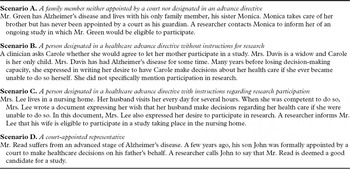
To assess respondents’ comfort with proxy consent to research involving older adults unable to consent, scenarios involving four different types of proxies were presented (Table 1). For each scenario, the participants were asked to assume that all characters are adults, and that the older adult is incapable of deciding and does not seem to object. The respondents then indicated all situations in which they would feel comfortable with the proxy deciding whether the person will participate in the study, from the following three choices: (a) if the study involves little or no risk to the person and may benefit him/her personally; (b) if the study involves little or no risk to the person, will not benefit him/her personally but may benefit future patients; and (c) if the study involves serious risks to the person but also potential personal benefits that outweigh the risks. We specified that the respondent should assume that each study had previously been approved by a recognized REB, that the risks and potential benefits were as stated and could be psychological and social as well as physical. Respondents could also answer “in no situation” if they felt uncomfortable with all types of studies.
Scenarios to assess comfort with proxy consent to research with older adults unable to consent

A final question asked the respondents to imagine themselves unable to make decisions about research. They were then asked in which situations they would feel comfortable with a close relative or friend deciding whether they would participate in a research study. The same choices – (a), (b), (c) and in no situation – were provided and the respondents could check all that applied. The questionnaire also collected socio-demographic information regarding age, sex, education, religion, research experience and province (jurisdiction).
Statistical analyses
The characteristics of the respondents were compared to available census data. Only one group, physicians, was not representative of their respective population. Physicians aged 65 years and older, and those based in Ontario and Nova Scotia, were over-represented in our sample. Accordingly, all analyses involving physicians were weighted.
Next, the proportion of respondents feeling comfortable with proxy consent from different types of proxies and studies of varying risk-benefit profiles were computed. Multilevel logistic regression analyses were performed to determine the effect of type of proxy, risk-benefit profile and respondents’ characteristics on comfort with proxy consent. A multilevel analysis was necessary because of the repeated nature of responses by each participant (each gave responses for studies with three levels of risk-benefit profiles within four types of proxy). To avoid over fitting the model, we included the two variables of primary interest (risk-benefit profile and type of proxy) and then added the respondents’ characteristics using a stepwise process to arrive at a final model that included only statistically significant correlates at the 0.05 level. Parameter estimation for a population-average model was done with the method of full penalized quasi-likelihood (full PQL) (Raudenbush et al., Reference Raudenbush, Bryk, Cheong and Congdon2004). Odds ratios for being comfortable with proxy consent were derived along with their 95% confidence intervals based on robust sandwich estimation of the variance.
Finally, we computed the proportions of respondents feeling comfortable with a non-designated close relative or friend deciding whether they would themselves participate in a study in the event that they are no longer able to make decisions. We compared these answers with those given in Scenario A involving consent by a non-designated family member for someone else using McNemar χ2 tests.
Analyses were conducted with SAS (SAS Institute Inc., Cary, NC), version 9.2 and HLM for Windows (Scientific Software International, Inc.), version 6.08.
Results
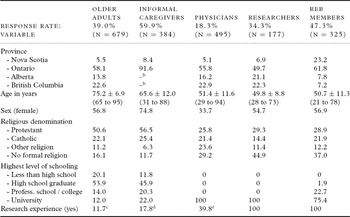
The questionnaire was returned by 2060 people, resulting in a global response rate of 32.7%. The rate varied across the five groups and the four provinces, from 14.2% of physicians from British Columbia to 60.0% of caregivers from Ontario. Response rates are given for each group in Table 2 along with respondents’ characteristics. Our proportional sampling strategy resulted in most respondents residing in Ontario. Across the groups, ages ranged from 21 to 95 years old, and 54.3% of the respondents were women. The respondent groups, overall, are diverse in their sociodemographic characteristics, experience with research and professional profile.
Respondents’ characteristicsa

aData reported as percentage or mean ± standard deviation (range). Rates of missing data range from 0.6% (for physicians’ province) to 6.8% (for researchers’ age). These have already been reported in Bravo et al. (in press).
bWe were unable to recruit informal caregivers from Alberta and British Columbia for various reasons (no membership lists, staff shortages, confidentiality issues, etc.).
cParticipated in a health-related study in the last five years.
dThe person in their care participated in a health-related study in the last five years.
eInvolved in studies with human subjects or member of an REB in the last five years.
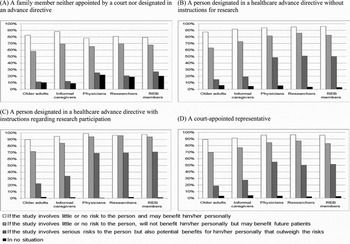
Figure 1 shows the percentage of respondents from each group expressing comfort with proxy consent to studies offering various risk-benefits for each of the four types of potential proxies. The proportion of respondents stating that the proxy should not be allowed to decide varies from 2% (for Scenario C) to 20% (for Scenario A). The latter relatively high level of discomfort with non court-appointed or non-designated family members as proxies was observed across the three groups professionally involved in research, but was two times smaller among older adults and informal caregivers.
Percentage of respondents expressing comfort with consent to research from four different types of proxies.

Figure 1 illustrates the small effect that the type of proxy has on comfort and the large effect of the study's risk-benefit profile. Regardless of the type of proxy, as the study's risk-benefit profile becomes less favorable, the proportion of respondents expressing comfort with proxy consent decreases in all groups. For studies involving little or no risk and potential personal benefits, over 90% of the respondents were comfortable with substitute consent by a designated or court-appointed proxy. In the case of a family member neither appointed by a court nor designated in an advance directive (Scenario A), the percentages are still high, around 80%, for all groups. For studies involving serious risks with greater potential personal benefits, comfort with substitute consent is clearly lower when the proxy is neither appointed nor designated (Scenario A) and higher when the person has been designated in a healthcare advance directive with instructions regarding research participation (Scenario C). Notably, percentages are always similar within the three groups professionally involved in research and are different from those observed in the two groups of lay respondents, whose responses are similar.
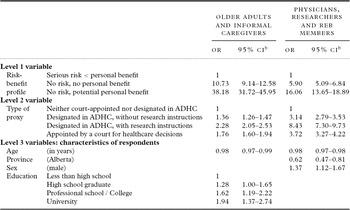
Formal statistical testing of these effects requires multilevel logistic regression modeling. Since the effects were different for lay respondents (older adults and informal caregivers) on one hand and professionals on the other, we built separate models. Table 3 presents the results of the three-level models fitted for the lay respondents and for the professionals.
Results of the multilevel logistic regressiona

ADHC = advance directive for health care.
aThe dependent variable is comfort or not with proxy consent to research involving older adults unable to consent.
b95% confidence interval based on robust sandwich estimator of the variance.
As expected, the variable having by far the strongest effect on comfort with proxy consent is the study's risk-benefit profile. Relative to the reference category of studies involving serious risks lower than potential personal benefits, older adults and informal caregivers were 10 times more comfortable with studies involving little or no risk without personal benefits and 38 times more at ease with studies involving little or no risk with potential personal benefits. Although the odds ratios (ORs) were smaller for professionals, this group also shows three distinct levels of comfort with proxy consent given the risk-benefit profile (ORs of 6 and 16 respectively).
With respect to the type of proxy, this time the effect is stronger in the professional groups. Relative to the reference category of non-assigned proxies, physicians, researchers and REB members were three times more comfortable with substitute consent by a court-appointed proxy or someone designated in a healthcare advance directive. The odds ratio rises to 8 when instructions regarding research participation are included in the advance directive. Although the effect is smaller, the same pattern is observed for older adults and informal caregivers, who are twice as comfortable with a proxy designated in a healthcare advance directive with instructions regarding research participation relative to a non-assigned family member. Among the respondents’ characteristics, only the age and education of respondents had a significant effect for lay persons while age, sex and province were associated with comfort for the professionals.
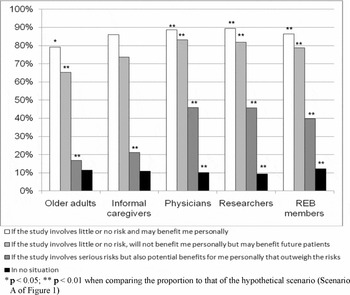
Figure 2 illustrates the proportion of respondents expressing comfort with a non-designated close relative or friend deciding whether the respondents themselves participate in studies offering varying risk-benefit profiles. The proportion of older adults and informal caregivers stating that proxy consent should never be allowed is similar to that of the hypothetical scenario (Scenario A of Figure 1), while the proportion of professionals (i.e. researchers, physicians and REB members) of the opinion that proxy consent should never be allowed was higher in the hypothetical situation. Informal caregivers gave similar answers for both types of studies involving little or no risk but were more comfortable with proxy consent to research for themselves in studies involving serious risks. Older adults were more comfortable with proxy consent to research for themselves for studies involving serious risks as well as for studies where there are neither risks nor personal benefit. For studies with little or no risk with potential personal benefit, older adults were less comfortable with proxy consent when the decision involved them personally. All groups of professional respondents feel more comfortable with proxy consent regarding themselves no matter the risk-benefit profile.
Percentage of respondents feeling comfortable with a close relative or friend deciding whether they will participate in a study in the event that they are no longer able to make decisions, that no one has been appointed by a court to make decisions for them, and that they have never designated a person to make healthcare or other decisions for them.

Discussion
It is clearly important to create an environment wherein valuable research on the causes, treatment, and prevention of dementia can advance. Such research necessarily involves the participation of persons who have dementia, yet loss of decisional capacity among some of these persons precludes obtaining an informed decision. This raises the question of who, if anyone, can legitimately enrol a decisionally impaired person in a research study; moreover, are there conditions under which research should never be allowed? For example, should court appointment of a guardian or designation of a proxy in a research-specific advance directive be required in order to authorize proxy consent? The reality is that it is uncommon for decisionally incapacitated persons to have either court-appointed guardians (Kim et al., Reference Kim, Appelbaum, Jeste and Olin2004) or research-specific advance directives (Bravo et al., Reference Bravo, Dubois and Pâquet2003a). Restricting participation to those few would likely result in skewed samples, thereby invalidating study results (Kim et al., Reference Kim, Appelbaum, Jeste and Olin2004; Bravo et al., Reference Bravo, Duguet, Dubois, Delpierre and Vellas2008). Moreover, guardianship proceedings are both time-consuming and costly in financial and emotional terms. Other solutions are necessary; allowing non-assigned family members to act as surrogate decision-makers is one of them. But how do concerned individuals (potential future subjects and surrogate decision-makers, as well as people professionally involved in research) feel about this?
We found that Canadians are comfortable with allowing family members to be research decision-makers for decisionally impaired older adults, even if they are not court-appointed or designated in an advance directive. This suggests trust in loved ones to make appropriate decisions. Our survey also revealed that the study's risk-benefit profile is far more important than the type of proxy in determining whether proxy consent should be allowed. A large majority of the respondents are comfortable with any type of proxy when the study involves little or no risk, particularly if benefits for the participant can be expected. On the other hand, for studies involving serious risks to the person, respondents (especially older adults and informal caregivers) are less comfortable with consent from any type of proxy. Those professionally involved in research are more comfortable with consent from a non-assigned family member for research with serious risks than are older adults or informal caregivers. Interestingly, half of the clinician, researcher and REB respondents tell us that proxy consent to seriously risky research is acceptable when the proxy is court-appointed or designated in an advance directive. This figure rises to 70% when the advance directive contains instructions regarding research participation. Note how this position contrasts with that of older adults and informal caregivers. It is possible that clinicians and researchers hold higher expectations of treatment effects (Graham, Reference Graham2008).
Older and less educated lay respondents were less comfortable with proxy consent for research. Among the researchers, REBs and clinicians, being female, older and from Alberta was independently associated with less comfort. Here we might ask specifically why the Albertan researchers, REB members and clinicians were less likely to support proxy consent to research, regardless of the risk-benefit category, than were representatives of the same groups from other provinces. This may reflect an entrenched ethos of individual autonomy (understood as freedom from interference) in that province, or alternatively, the fact that there is wider awareness (and wariness) of the potential for eugenic abuse (Muir v. Alberta, 1996). Finally, there is perhaps less familiarity with substitute consent to medical interventions generally in that province as, until recently, its health care consent laws authorized medically necessary treatment of incapable patients without proxy consent, even in the absence of a medical emergency.
To date, very few studies have examined whether people are comfortable with proxy consent for research involving older adults who lack decision-making capacity. While direct comparison of our results with the studies that do exist are limited by differences in populations, the data collected, and methods, our results still generally concur with these studies.
For example, the risk of harm to subjects has been identified as a major predictor of acceptability of surrogate consent to research with persons at risk of Alzheimer's disease (Kim et al., Reference Kim, Kim, McCallum and Tariot2005). Relative to a reference category of “studies perceived to be of high risk”, acceptability for surrogate consent was 35 times higher for studies classified as “minor increase over minimal risk” and 60 times higher for studies defined as minimal risk (described as “risk of everyday activities”). Our study corroborates these findings, showing a strong association between comfort and risk-benefit profile.
Bravo and colleagues empirically assessed whether court-appointment should be a requirement for a proxy deciding whether an adult who lacks decision-making capacity will take part in a research protocol in the province of Quebec and in France (Bravo et al., Reference Bravo, Pâquet and Dubois2003b; Reference Bravo, Dubois, Pâquet, Langlois and Bernier2004b; Reference Bravo, Gagnon, Wildeman, Marshall, Pâquet and Dubois2008). Our results generally concur with these earlier findings where the majority of respondents agreed that proxy consent to research participation should be permitted, and that the proxy should not have to be court-appointed when the study poses little risk. As the risk increased, respondents became less comfortable with proxy consent from someone not appointed by a court, or more generally with inclusion of cognitively impaired individuals in research. Bravo's previous studies also revealed that lay persons differ from clinicians and researchers in their attitudes to proxy consent to research.
Saks et al. (Reference Saks, Dunn, Wimer, Gonzales and Kim2008) recently examined the variable legal landscape in the USA concerning proxy consent to research. They argue that “family members should be permitted to serve as proxies,” even in the absence of formal court appointment or designation in an advance directive. When there is more than one person available to act as a proxy, a person with durable power of attorney (DPA) for research decision-making should be recognized first, followed by a DPA for treatment, followed by a family member named guardian of the person. The authors leave open the question of whether, in the absence of one of these categories of proxy, a court-appointed guardian who is not a family member, or alternatively an undesignated family member, should be preferred. Our study provides empirical data to support the ranking suggestions made by Saks et al. (Reference Saks, Dunn, Wimer, Gonzales and Kim2008). Respondents felt most comfortable with proxy consent from someone designated in a healthcare advance directive with research instructions (corresponding to a DPA for research), then either with someone designated in a healthcare advance directive without research instructions (DPA for treatment) or with a court-appointed family proxy. There was least comfort with consent from family members who are neither court-appointed nor designated by way of an advance directive.
Other studies have focused only on proxy consent from a family member who is neither court-appointed nor designated in an advance directive. Although they elicited opinions differently by presenting hypothetical or actual studies, these studies also concluded that a large number of older adults (Wendler et al., Reference Wendler, Martinez, Fairclough, Sunderland and Emanuel2002; Ayalon, Reference Ayalon2009; Karlawish et al., Reference Karlawish, Rubright, Casarett, Cary, Ten Have and Sankar2009; Kim et al., Reference Kim, Kim, Langa, Karlawish, Knopman and Appelbaum2009a) and informal caregivers of persons with dementia (Karlawish et al., Reference Karlawish, Kim, Knopman, van Dyck, James and Marson2008; Kim et al., Reference Kim2010) support proxy consent from a family member. Research Ethics Committee members are largely in favor of proxy consent to research from a family member if there is “potential therapeutic benefit for the subject and no more than minimal risk for adverse events” (Peterson and Wallin, Reference Peterson and Wallin2003). The proportion in favor of proxy consent however drops substantially if there is “no potential therapeutic benefit for the subject with no more than minimal risk for adverse events but potential therapeutic benefit to others”.
Whatever the risk-benefit profile, our respondents (especially the clinical and research groups) were generally more open to proxy consent to research for themselves than in hypothetical situations involving fictitious characters. This tendency to be more cautious for others is seen in other studies as well (Bravo et al., Reference Bravo, Pâquet and Dubois2003b; Reference Bravo, Dubois, Pâquet, Langlois and Bernier2004b; Reference Bravo, Gagnon, Wildeman, Marshall, Pâquet and Dubois2008; Kim et al., Reference Kim, Kim, McCallum and Tariot2005).
There are limitations to our study. The response rate was less favorable in some groups and provinces. However, the overall sample size was relatively large and confidence intervals were narrow. Moreover, analyses suggest participants were representative of their population, with the exception of the physician group which required weighting. Nonetheless, those who did not return the questionnaire may have different views, possibly being less pro-research than the respondents who volunteered to participate in our survey. Second, we investigated views of Canadians, which might not be the same as views of people from other countries. Third, our scenarios did not cover all types of proxies (e.g. a court-appointed guardian who is not a family member), all kinds of research (e.g. serious-risk studies with no personal benefit) and we did not cover the gap between “little or no risk” and “serious risks”. These could be targeted in a future study. The design of our study may also have directed participants somewhat owing to obvious gradations in risk-benefit as well as in some types of proxies.
Of course, our scenarios are hypothetical; using scenarios is not the same as measuring real preferences in real life. Had our descriptions included other information (e.g. quality of family relationship), the answers may have been different. Questions may have been misinterpreted by some respondents, and postal questionnaires provide little insight into the rationale behind a respondent's answer. Finally, one might argue that some of our respondents (especially those not professionally involved in research) did not understand, or appreciate the complexities of either the scientific or ethical issues involved (Kim et al., Reference Kim, Wall, Stanczyk and De Vries2009b). However, Kim et al. (Reference Kim2010) suggest that support for proxy consent is even higher after educating lay people on the issue.
It is not trivial to elicit opinions regarding proxy consent to research given varying levels of risk. Other studies depict hypothetical or actual research scenarios to assess comfort with proxy consent that are specific to that particular context alone. In those studies, individuals may well arrive at different risk-benefit profiles for the same case, and thereby answer differently. We chose, instead, to limit these potential interpretative differences by presenting graded risk-benefit profiles. The weakness of our approach is that we do not know how the risk-benefit profile might translate for a given, contextualized, study. Nevertheless, it is interesting to find that regardless of the approach, the results are in the same direction.
Our study also has a number of strengths. It spanned geographically distinct regions across Canada and surveyed random samples of five concerned groups with diverse characteristics. The postal survey and questionnaire were designed according to proven methodology. Respondents’ views were sought for four different types of proxies, as well as for studies with three levels of risk-benefit profile.
In closing, we must emphasize that no matter who becomes a research proxy, it is imperative that the person with dementia be consulted regarding research participation. One must keep in mind the importance of assuring assent and respecting dissent of anyone participating in research, every time data are collected (Slaughter et al., Reference Slaughter, Cole, Jennings and Reimer2007). There is support for the thesis that risk-related preferences remain relatively stable in dementia (Kim et al., Reference Kim, Cox and Caine2002). In any case, seeking assent and respecting dissent is arguably a necessary component of respect for the research subject's personhood (Kim et al., Reference Kim, Kim, McCallum and Tariot2005).
Conflict of interest
None.
Description of authors' roles
Marie-France Dubois designed the study, performed statistical analyses and wrote the paper. Gina Bravo, Janice Graham, Sheila Wildeman and Carole Cohen designed the study and revised the paper. Karen Painter and Suzanne Bellemare supervised the data collection and helped revise the paper.
Acknowledgments
The study was funded by the Canadian Institutes of Health Research (Grant #200409MOP). We thank the members of our advisory committee (composed of representatives from either the Department of Justice or the Department of Health from each province) as well as Justice David T. Marshall who helped design the questionnaire. We also wish to thank two anonymous reviewers for their comments on the previous version of this paper.