Introduction
Violence is a major public health problem and the elucidation of factors that predict violence is essential to inform risk management and the development of interventions for risk reduction. Although violence is most typically conceptualized as being externally directed, compelling arguments have been made for including self-harming behaviors within the rubric of violence (Gray et al. Reference Gray, Hill, McGleish, Timmons, MacCulloch and Snowden2003). Elevated rates of both self-directed violence (SDV) and other-directed violence (ODV) have been identified among psychiatric patients (Torrey et al. Reference Torrey, Stanley, Monahan and Steadman2008), and both forms of violence represent important targets for clinical intervention. However, despite substantial clinical interest in elucidating SDV and ODV among psychiatric patients, relatively few studies have examined the extent to which these distinct forms of violence are associated with common versus distinct risk factors. In the present study we address this by examining how individual differences associated with general violence predict inward- or outward-directed violence.
SDV and ODV
Several investigations have reported a link between SDV and ODV. Angst & Clayton (Reference Angst and Clayton1986) found higher aggression scores at last observation among psychiatric patients who eventually died by suicide relative to controls. Conner et al. (Reference Conner, Cox, Duberstein, Tian, Nisbet and Conwell2001) found that interpersonally violent behavior in the last year of life predicted suicide in a large community sample. In addition to suicide deaths, the association between ODV and SDV extends to suicide attempts (Angst & Clayton, Reference Angst and Clayton1986; Conner et al. Reference Conner, Swogger and Houston2009) and non-lethal, self-injurious behavior (Hillbrand, Reference Hillbrand1995). Common biological underpinnings of SDV and ODV raise the possibility that tendencies toward the two may arise from the same diathesis. Serotonergic function is crucial for the regulation of ODV (Gietl et al. Reference Gietl, Giegling, Hartmann, Schneider, Schnabel, Maurer, Moller and Rujescud2007), and several studies have demonstrated a correlation between low serotonergic activity and SDV (Mann, Reference Mann2003; Braquehais et al. Reference Braquehais, Oquendo, Baca-Garcia and Sher2010). Similarly, alterations in cholesterol homeostasis have been implicated in attempted suicide and in suicide among individuals with low serum cholesterol (Gietl et al. Reference Gietl, Giegling, Hartmann, Schneider, Schnabel, Maurer, Moller and Rujescud2007), and studies of interpersonally violent individuals have shown decreased levels of serum cholesterol relative to non-violent individuals (Troisi & D'Argenio, Reference Troisi and D'Argenio2006). It has been suggested that these largely genetically determined biological mechanisms interact to create a diathesis for generally violent behavior (Gietl et al. Reference Gietl, Giegling, Hartmann, Schneider, Schnabel, Maurer, Moller and Rujescud2007). Whereas this genetic and biological-level model of violence highlights features that underlie both SDV and ODV, it has been posited that the presence or absence of additional variables may determine whether an individual with tendencies toward violence is predominantly violent toward the self or others (Plutchik et al. Reference Plutchik, van Praag and Conte1995). Therefore, the identification of readily assessed psychological variables that predict inwardly versus outwardly directed violence is of considerable utility.
Externalizing psychopathology (Krueger et al. Reference Krueger, Hicks, Patrick, Carlson, Iacono and McGue2002; Krueger, Reference Krueger and Patrick2006), including antisocial behavior disorders, substance use disorders, and related personality traits, is a promising avenue of exploration in the effort to identify features that confer risk for SDV versus ODV. Externalizing psychopathology can be reliably assessed and is associated with increased risk for both types of violence (Conner et al. Reference Conner, Cox, Duberstein, Tian, Nisbet and Conwell2001; Verona et al. Reference Verona, Patrick and Joiner2001; Leistico et al. Reference Leistico, Salekin, DeCoster and Rogers2008). However, unlike the fine-grained analyses that have linked specific internalizing features such as hopelessness (Beck et al. Reference Beck, Steer, Kovacs and Garrison1985) and depression (Cavanagh et al. Reference Cavanagh, Carson, Sharpe and Lawrie2003) to SDV (Brown et al. Reference Brown, Ten Have, Henriques, Xie, Hollander and Beck2005), there are few data on specific aspects of externalization that promote risk for SDV versus ODV. Given the prevalence of externalizing psychopathology in community, psychiatric and forensic populations (Verona et al. Reference Verona, Sachs-Ericsson and Joiner2004; Walsh et al. Reference Walsh, Allen and Kosson2007), more and better data on specific risk-promoting aspects of externalization are needed (Swogger et al. Reference Swogger, Conner, Meldrum and Caine2009).
Psychopathy and anger
Psychopathy and anger are among the most robust individual-level predictors of violent behavior. Psychopathy is a personality syndrome characterized by a diminished capacity for remorse, impulsive behavior and superficial charm (Cleckley, Reference Cleckley1976). A wealth of data from both forensic and non-forensic settings has established its relationship to ODV (Skeem & Mulvey, Reference Skeem and Mulvey2001; Hare, Reference Hare2003; Leistico et al. Reference Leistico, Salekin, DeCoster and Rogers2008). As assessed by the Hare Psychopathy Checklist – Revised (PCL-R; Hare, Reference Hare2003) and its derivatives, the psychopathic personality consists of two higher-order factors: Factor One (F1) reflects callous, unemotional personality and manipulative interpersonal style, and Factor Two (F2) reflects impulsive and antisocial lifestyle and behavior. More recently, a four-factor model has been validated in which each of the original two factors is composed of two correlated facets (Hare, Reference Hare2003). Factor One (F1) comprises distinct interpersonal (i.e. charm, deceit, manipulation) and affective (i.e. emotional shallowness, lack of empathy and remorse) facets, and Factor Two (F2) comprises lifestyle (i.e. impulsivity and irresponsibility) and antisocial (i.e. chronic and varied antisocial behavior) facets. Although the PCL-R facets are highly correlated, there is important heterogeneity among individuals with high psychopathy scores (Swogger & Kosson, Reference Swogger and Kosson2007) such that specific patterns of elevations may be meaningful because of their differential correlates (Hare & Neumann, Reference Hare and Neumann2009). Research has demonstrated that both F1 and F2 are related to ODV (Kosson et al. Reference Kosson, Steuerwald, Forth and Kirkhart1997; Skeem & Mulvey, Reference Skeem and Mulvey2001; Woodworth & Porter, Reference Woodworth and Porter2003), although some studies have found that F1's relationship to ODV is reduced substantially after controlling for shared variance with F2 (e.g. Harris et al. Reference Harris, Rice and Quinsey1993; Skeem & Mulvey, Reference Skeem and Mulvey2001). Regarding SDV, studies using the two-factor psychopathy model indicate that F1 is either orthogonal to or inversely related to suicidal behavior (Verona et al. Reference Verona, Hicks and Patrick2005), and F2 is positively associated with suicidal behavior (Verona et al. Reference Verona, Sachs-Ericsson and Joiner2004; Douglas et al. Reference Douglas, Herbozo, Poythress, Belfrage and Edens2006). A more recent analysis using MacArthur Violence Risk Assessment Study (MVRAS) data and incorporating the four-factor model of psychopathy provided evidence that the antisocial facet, in particular, is associated with suicide attempts among psychiatric in-patients (Swogger et al. Reference Swogger, Conner, Meldrum and Caine2009).
The associations between psychopathy dimensions and ODV and SDV raise intriguing possibilities. The interpersonal and affective facets comprising F1 may be distinctly correlated with ODV and may not predict SDV. However, given the robust association between F2 and ODV, and the association between ODV and SDV, the link between F2 and SDV may be an epiphenomenon of the more general association between psychopathy and violence. If this is true, the examination of psychopathic traits and SDV without taking into account ODV may obscure the true nature of the association between psychopathic traits and SDV. We are aware of no studies that have examined psychopathy and SDV in light of levels of ODV.
Anger is an important correlate of externalizing psychopathology (Wang & Diamond, Reference Wang and Diamond1999) and often plays a central role in ODV (Wilkowski & Robinson, Reference Wilkowski and Robinson2008; Sadeh et al. Reference Sadeh, Shabnam, Finy and Verona2011). Anger is associated with interpersonally violent behavior including intimate partner violence, workplace violence, and child abuse (Nomellini & Katz, Reference Nomellini and Katz1983). Moreover, data from the MVRAS indicate that self-reported anger predicts ODV among discharged psychiatric patients (Doyle & Dolan, Reference Doyle and Dolan2006). There is also evidence that anger is associated with SDV. Trait anger has been found to correlate with number of suicide attempts (Esposito et al. Reference Esposito, Spirito, Boergers and Donaldson2003) and with a previous history of suicide attempts among adolescent patients (Daniel et al. Reference Daniel, Goldston, Erkanli, Franklin and Mayfield2009). However, findings regarding the relationship between anger and SDV are equivocal, as anger has been found to be unrelated to SDV among adult in-patients (Brezo et al. Reference Brezo, Paris and Turecki2006) and criminal offenders (Sadeh et al. Reference Sadeh, Shabnam, Finy and Verona2011). In short, relative to the robust relationship between trait anger and ODV, data on the trait anger/SDV relationship are preliminary (Brezo et al. Reference Brezo, Paris and Turecki2006).
The present study was designed to address gaps in the existing literature by examining whether psychopathic traits and trait anger are broadly related to both SDV and ODV, or whether unique combinations of these traits specifically predict tendencies toward inwardly or outwardly directed violence. To this end, we examined the unique and combined power of psychopathic traits and anger to predict whether patients discharged from in-patient psychiatric treatment would commit ODV, SDV, or both (i.e. co-occurring violence; COV) during a 1-year follow-up period. To provide a fine-grained analysis of psychopathic traits, we used the four-factor model of psychopathy. We predicted that all features of psychopathy would predict ODV and COV. Based upon prior findings, we hypothesized that interpersonal and affective features (F1) of psychopathy would predict ODV but not SDV or COV in adjusted analyses that controlled for all other variables. We expected that trait anger would predict both ODV and COV in these analyses. Consistent with the idea that the relationship between antisocial features of psychopathy and SDV is an epiphenomenon of a relationship between these features and ODV, we hypothesized that antisocial features of psychopathy would be related to ODV and COV but not SDV in adjusted analyses. Informed by the literature on ODV and SDV, we included select covariates. Substance use disorders have been extensively studied in relation to both self-directed and interpersonal violence, and exhibit associations with both SDV and ODV (Verona et al. Reference Verona, Sachs-Ericsson and Joiner2004). Likewise, studies of SDV and ODV have yielded gender and ethnic differences (Conner et al. Reference Conner, Swogger and Houston2009; Swogger et al. Reference Swogger, Conner, Meldrum and Caine2009). Thus, we examined substance use disorder diagnosis, gender and ethnicity as covariates.
Method
Participants
Participants were 851 civil psychiatric patients between the ages of 18 and 40 (mean=30.3, s.d.=6.1) years who were sampled from one of three acute in-patient hospitals for the MVRAS; see Silver et al. (Reference Silver, Mulvey and Monahan1999) for a detailed description of this study. Additional inclusion criteria were: (a) civil admission, (b) English speaking, and (c) diagnosis, based on medical records, of schizophrenia, schizo-affective disorder, schizophreniform disorder, dysthymia, mania, depression, brief reactive psychosis, alcohol or other drug abuse or dependence, delusional disorder, or personality disorder. Otherwise eligible individuals who were hospitalized for 21 days or more prior to enrollment were excluded to obtain a sample of acute, rather than chronic, psychiatric patients. Participants were administered a baseline interview in the hospital and follow-up interviews in the community, attempted at approximately 10-week intervals. Eighty-six percent of attempted follow-up interviews were successfully completed.
For the present study we have incorporated data from the baseline interview and all five follow-up interviews. After excluding data from 285 participants who were not administered the Psychopathy Checklist: Screening Version (PCL:SV) and a baseline measure of anger, data on 492 males and 359 females (n=851) were analyzed. This sample comprised individuals with independently determined baseline primary diagnoses of depression (41%), schizophrenia or schizo-affective disorder (17%), bipolar disorder (11%), substance use disorder (22%), personality disorder (2%), or other disorder (7%). The ethnic distribution was 602 (71%) European American and 249 (29%) African American.Footnote 1 Footnote †
Measures
Psychopathy
Psychopathy was assessed by trained raters using the PCL:SV (Hart et al. Reference Hart, Cox and Hare1995), based on a semi-structured interview and supplemented by a review of file information. The PCL:SV was administered to all participants during the first or second follow-up session. Prior research with this sample reported good inter-rater reliability (κ=0.66) (Fleiss, Reference Fleiss1981) and internal consistency (α=0.87) (Skeem & Mulvey, Reference Skeem and Mulvey2001). The sample mean total PCL:SV score was 8.5 (s.d.=5.6). Mean scores on the PCL:SV facets were as follows: interpersonal=1.4 (s.d.=1.6), affective=1.7 (s.d.=1.7), lifestyle=2.9 (s.d.=1.9), and antisocial=2.5 (s.d.=1.8).
Anger
Anger was assessed at baseline using the Novaco Anger Scale (NAS; Novaco, Reference Novaco, Monahan and Steadman1994), a 60-item self-report measure of inclination toward anger reactions through cognitive (e.g. rumination, hostility), arousal (e.g. somatic tension, anger intensity), and behavioral (e.g. impulsive reaction, verbal aggression) domains. The NAS displays good internal reliability (Novaco, Reference Novaco, Monahan and Steadman1994) and good construct validity (Doyle & Dolan, Reference Doyle and Dolan2006). The sample mean score for the NAS was 94.7 (s.d.=16.9).
Substance use diagnosis
Based upon administration of the DSM-III-R checklist (Janca & Helzer, Reference Janca and Helzer1990) at baseline, the presence versus absence of a current substance use disorder diagnosis was determined. Four-hundred and eighty-six participants (57.1%) met criteria for a substance use disorder.
SDV and ODV
Two questions were asked to assess SDV. During the follow-up interviews, participants were asked whether they had thought of hurting themselves during the approximately 10 weeks since the previous interview. Those who answered affirmatively were asked whether they had attempted to hurt themselves during that time. Two hundred and forty-three participants (29%) reported SDV (i.e. an attempt to hurt themselves) at least once during the follow-up period. ODV was assessed during the same follow-up interviews with participants, and also by interviews with collateral informants. ODV was defined as battery resulting in physical injury (ranging from bruises to death), sexual assault, and threats with weapons in hand. Two hundred and thirty-eight participants (28%) committed ODV at least once during the follow-up period. Based upon presence versus absence of SDV and ODV during the follow-up period, four groups were created: (1) no violence (n=464), (2) SDV only (n=149), (3) ODV only (n=144), and (4) COV (n=94).
Data analysis
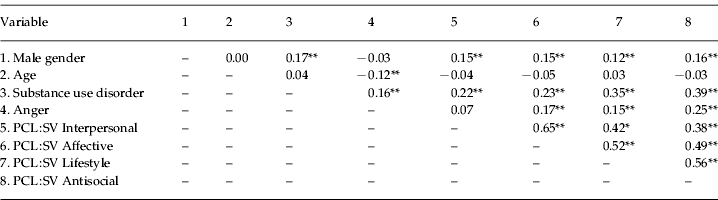
Analyses were based on multinomial logistic regression models. Odds ratios (ORs) and asymptotic confidence intervals (CIs) were computed using the method of profile likelihood. Statistical significance was based on α=0.05. Predictors were the four psychopathy facets and trait anger, along with covariates that included presence/absence of a current substance use disorder, age, gender, and ethnicity. There was an absence of pronounced multicollinearity among predictors (r⩽0.65). For the primary analyses, we first examined each variable in a univariate test, and then entered them simultaneously in a multinomial model predicting membership in the SDV, ODV and COV groups relative to non-violent participants. Finally, we conducted two supplementary analyses. In the first, we used the SDV group as a reference to determine which variables predict ODV and COV relative to SDV only. In the second, we examined group differences on the NAS cognitive, arousal, and behavioral subscales.
Results
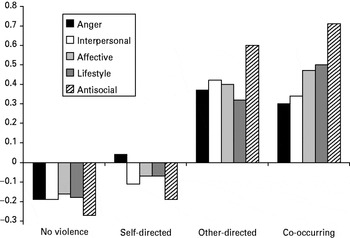
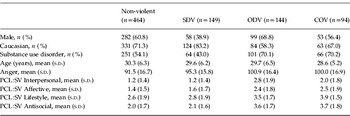
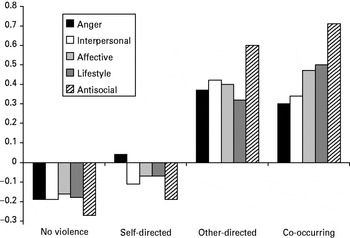
More than 80% of follow-up interviews were completed for each group (range 83–88%). Group demographics and means on each variable are shown in Table 1. For descriptive purposes, anger and psychopathy facet z scores for each group are depicted in Fig. 1.
Anger and psychopathy facet z scores for each group.
Intercorrelations among predictors
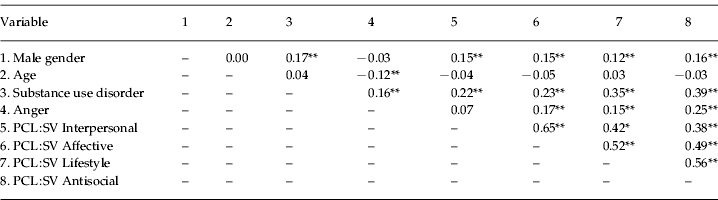
PCL:SV, Psychopathy Checklist: Screening Version.
Unadjusted analyses
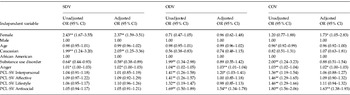
Univariate results showing the predictive value of each variable on group membership are presented in Table 2. Female gender and Caucasian ethnicity were associated with SDV, whereas age was negatively related to COV. Substance use disorder was negatively associated with SDV and positively associated with ODV and COV. Anger was positively associated with membership in each violent group relative to the non-violent reference group, and each psychopathy facet was related to ODV and COV in univariate analyses.
Descriptive statistics for the four groups formed based on violent acts committed during follow-up
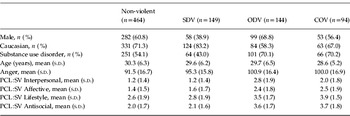
SDV, Self-directed violence; ODV, other-directed violence; COV, co-occurring violence; PCL:SV, Psychopathy Checklist: Screening Version; s.d., standard deviation.
Multivariate analyses
Multivariate results are shown in Table 3. After adjustment for covariates, anger predicted membership in each violent group relative to individuals with no violent acts during follow-up. Psychopathy facets remained unrelated to the SDV group. With regard to psychopathy, whereas ODV was predicted by both interpersonal and antisocial facet scores, COV was predicted by antisocial facet scores only.Footnote 2
Multinomial models predicting SDV, ODV and COV group membership
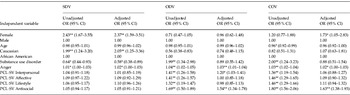
SDV, Self-directed violence; ODV, other-directed violence; COV, co-occurring violence; OR, odds ratio; CI, confidence interval; PCL:SV, Psychopathy Checklist: Screening Version.
* p<0.05, ** p<0.01. Individuals in each of these three groups are compared to a non-violent reference group.
Supplementary analyses
To determine which variables predicted ODV and COV relative to SDV only, we conducted a multivariate analysis identical to the primary analysis, except that SDV was used as the reference group. After adjusting for covariates, antisocial features of psychopathy predicted ODV (OR 1.47, 95% CI 1.23–1.75, p<0.01) and COV (OR 1.56, 95% CI 1.28–1.89, p<0.01). Interpersonal features of psychopathy predicted ODV at the trend level (OR 1.19, 95% CI 0.98–1.45, p=0.09.) Anger predicted ODV or COV relative to the SDV group.
Finally, to obtain more detailed information regarding facets of anger associated with membership in each group, groups were contrasted on the NAS cognitive, arousal and behavioral subscales using ANOVAs. Tukey HSD post-hoc tests revealed the following group differences (p<0.05): for the cognitive subscale, mean scores for COV (mean=32.94, s.d.=4.93) and ODV (mean=33.60, s.d.=5.38) were higher than scores for the non-violent group (mean=31.09, s.d.=5.02). For the arousal subscale, scores were higher for COV (mean=33.48, s.d.=6.39), ODV (mean=34.44, s.d.=6.08), and SDV (mean=33.83, s.d.=6.04) than the non-violent group. For the behavioral subscale, scores were higher for COV (mean=33.24, s.d.=6.51) and ODV (mean=32.86, s.d.=6.61) than SDV (mean=29.28, s.d.=6.62) and the non-violent group (mean=28.76, s.d.=6.80).
Discussion
In the present study, we aimed to determine whether psychopathic traits and trait anger are broadly related to SDV, ODV and COV, or whether unique combinations of these traits predict inwardly or outwardly directed violence. Our results indicate that unique patterns of elevation on psychopathic traits differentially predict violence among discharged psychiatric patients. That is, elevations on interpersonal and antisocial features of psychopathy differentially predicted ODV and COV relative to a non-violent reference group after adjusting for all other predictors. Moreover, trait anger was broadly, though weakly, related to all forms of violence even after adjusting for substance use disorders, psychopathic traits, and relevant demographic covariates. Psychopathic traits did not differentiate members of the SDV group from individuals who displayed no violence during follow-up.
Consistent with prior literature (e.g. Kosson et al. Reference Kosson, Steuerwald, Forth and Kirkhart1997; Leistico et al. Reference Leistico, Salekin, DeCoster and Rogers2008), psychopathy, including all four psychopathy dimensions, predicted ODV. Moreover, all four dimensions of psychopathy were predictive of co-occurring violence against the self and others during follow-up. Consistent with our hypothesis, in adjusted analyses controlling for variance associated with all other variables, the unique contribution of antisocial features of psychopathy predicted ODV and COV relative to non-violent individuals. Also consistent with our expectations, interpersonal features predicted ODV, but not SDV and COV. Contrary to our hypothesis, the unique contribution of affective features of psychopathy was not significant in the prediction of ODV, SDV or COV. No psychopathy facets predicted SDV in the absence of violence toward others. These results help to clarify the literature on psychopathy and SDV. Prior studies had found that the relationship between psychopathy and SDV was primarily due to the antisocial, and possibly impulsive-antisocial, features of psychopathy (Douglas et al. Reference Douglas, Herbozo, Poythress, Belfrage and Edens2006; Swogger et al. Reference Swogger, Conner, Meldrum and Caine2009). However, in the present study antisocial features of psychopathy predicted SDV only among individuals who also committed ODV, suggesting that the relationship between these traits and SDV may be an artifact of the relationship between antisocial features of psychopathy and general violence. Indeed, this overlap between personality variables and violence may also apply to other personality disorders. For example, Mann et al. (Reference Mann, Waternaux, Haas and Malone1999) noted that borderline personality disorder and interpersonal violence are both robust predictors of suicide attempts; however, the two are strongly interdependent and difficult to separate. In the present study, no features of psychopathy were related to SDV among individuals who committed no ODV during follow-up. This finding raises the possibility that, in assessing individuals’ risk for self-harm, antisocial features of psychopathy only confer risk among individuals who exhibit violence toward others.
In general, the interpersonal facet of psychopathy has been associated with instrumental violence, that is violence used as a means to attain a subsidiary goal, often in the absence of intense emotion (Walsh et al. Reference Walsh, Swogger and Kosson2009). Although findings are mixed (see Walsh et al. Reference Walsh, Swogger and Kosson2009), impulsive and antisocial features of psychopathy are more highly associated with reactive violence, that is violence that occurs in response to a perceived threat or provocation and is associated with emotional arousal including anger and anxiety, poor modulation of physiological arousal, and loss of behavioral control (Swogger et al. Reference Swogger, Walsh, Houston, Cashman-Brown and Conner2010). Notably, reactive violence is thought to confer risk for suicidal behavior (Conner et al. Reference Conner, Swogger and Houston2009). Our results are consistent with a model in which violence against others stems from both a manipulative and a calculating interpersonal style consistent with instrumental violence, whereas prodigious antisociality and poor behavioral controls are consistent with reactive violence. The fact that only the antisocial facet is related to COV is consistent with the reactive violence–suicidal behavior hypotheses, in which poor behavioral controls lead to both SDV and ODV.
Anger is a construct that overlaps with psychopathy and, in particular, the antisocial facet (Jackson et al. Reference Jackson, Neumann and Vitacco2007). Nonetheless, anger can be psychometrically distinguished from psychopathy and there is evidence that minimal negative affect distinguishes a psychopathy subtype (Selborne et al. Reference Sellborn, Ben-Porath, Lilienfeld, Patrick and Graham2005; Swogger & Kosson, Reference Swogger and Kosson2007). Our results provide evidence for the role of trait anger in predicting SDV, ODV and COV, suggesting a broad relationship between anger and violence. Whereas Doyle & Dolan (Reference Doyle and Dolan2006) have already demonstrated the importance of anger for predicting ODV in the MVRAS dataset, current findings broaden the previous analysis to show that anger also predicts general violence, including SDV and COV, even after adjusting for substance use disorders and demographic variables. Our study is the first prospective investigation of the relationship between anger and self-harm in psychiatric patients. The results replicate some prior findings on this understudied relationship (Esposito et al. Reference Esposito, Spirito, Boergers and Donaldson2003; Brezo et al. Reference Brezo, Paris and Turecki2006). In contrast to features of psychopathy that only predicted self-harm among interpersonally violent individuals, anger predicted SDV both with and without ODV. Notably, however, our supplementary analyses suggest that, of the components of anger, it is anger arousal that may be most highly related to SDV in the absence of violence toward others.
Given that both anger and psychopathy can be reliably measured, the current findings indicate the utility of assessing these constructs as part of risk assessments for SDV and ODV. Trait anger may indicate elevated risk for either SDV or ODV. Individuals with a history of prodigious criminal behavior and poor behavioral controls (antisocial traits) are also at risk for SDV and ODV. Among these individuals, those who do not display superficial charm, pathological lying and grandiosity (interpersonal traits) may be more likely to engage in self-harm.
Several limitations of this study are worth noting. First, data on SDV were based upon self-report using a small number of items. Future studies might address this limitation by obtaining collateral information or hospital records to enhance assessment. Future studies might also distinguish between non-suicidal self-injury and self-harm with intent to die. In addition, this study is of Caucasian and African American psychiatric patients, so caution is warranted in generalizing to other populations. Finally, it should be noted that individuals included in our analysis were less likely than those lost to follow-up to have a history of violence (Steadman et al. Reference Steadman, Mulvey, Monahan, Robbins, Appelbaum, Grisso, Roth and Silver1998), further indicating the necessity of caution in generalizing our findings. These limitations were balanced by several strengths. The prospective design enabled us to examine prediction of ODV and SDV across a large sample of data that included a substantial representation of African Americans. Moreover, this study is novel in that we analyzed anger in addition to psychopathy to examine predictors of SDV.
Acknowledgements
This research was supported by a grant from the National Institute on Drug Abuse (K23 DA027720-01A1) to M. T. Swogger.
Declaration of Interest
None.