INTRODUCTION
Accounts of contemporary American politics emphasize the polarization of the two major parties, with the Republican Party moving in a conservative direction on nearly all major policy issues while the Democratic Party grows more liberal. Indeed, research in political science demonstrates a substantial and widening policy gap between the parties’ leaders, elected officials, and mass coalitions (Abramowitz and Saunders Reference Abramowitz and Saunders1998; Stonecash, Brewer, and Mariani Reference Stonecash, Brewer and Mariani2003; Jacobson Reference Jacobson2005; McCarty, Poole, and Rosenthal Reference McCarty, Poole and Rosenthal2006; Theriault Reference Theriault2008; Levendusky Reference Levendusky2009; Lee Reference Lee2009). This fissure has expanded across a host of policy domains — from cultural and lifestyle issues to racial, economic, and social welfare issues (Layman and Carsey Reference Layman and Carsey2002; Brewer and Stonecash Reference Brewer and Stonecash2007; Layman et al. Reference Layman, Carsey, Green, Herrera and Cooperman2010). It has been accompanied by increasing stridency and viciousness in political rhetoric, debate, and campaigns, and a growing inability of the two parties to compromise to reach consensus policy solutions (Jamieson and Falk Reference Jamieson, Falk, Bond and Fleisher2000; Sinclair Reference Sinclair2006; Brownstein Reference Brownstein2007; Levendusky Reference Levendusky2013).
Two of the key culprits for growing party polarization and inflexibility have been party activists and religion. Due to their outsized influence over party nominations and the resources they provide, the ideological extremity of party activists pulls the parties toward their ideological poles (Aldrich Reference Aldrich1995; Chappell and Keech Reference Chappell and Keech1986; Miller and Schofield Reference Miller and Schofield2003; Layman et al. Reference Layman, Carsey, Green, Herrera and Cooperman2010). Activists’ distaste for compromise on their preferred policy stands also may have exacerbated political gridlock and partisan stridency (Fiorina, Abrams, and Pope Reference Fiorina, Abrams and Pope2005; Layman Reference Layman, Wolfe and Katznelson2010). Furthermore, the Republican coalition has grown more traditionally religious as the Democratic constituency has become more secular, which has exacerbated ideological divisions between the parties and encouraged partisans to view the opposing party as morally bankrupt (Hunter Reference Hunter1991; Reference Hunter1994; Layman Reference Layman2001; Dionne Reference Dionne2004; Layman and Green Reference Layman and Green2006).
Given that both party activism and contemporary religious divisions independently contribute to partisan divergence, their conjunction may have a particularly polarizing effect. In this article, we make use of the Convention Delegate Studies (CDS) to examine religious division among party activists and its effects on party polarization. While prior work has demonstrated a growing religious-secular divide between Republican and Democratic activists and has linked this religious divergence to increasing ideological polarization and growing partisan stridency (Layman Reference Layman2001; Reference Layman, Wolfe and Katznelson2010; Green and Jackson Reference Green, Jackson and Campbell2007), this work extends only to the 1990s or early 2000s and misses much of the increased polarization observed during the ensuing period. We extend the analysis to the most recent presidential election with a new survey of delegates to the Democratic and Republican national conventions in 2012.
Furthermore, much of the prior work on this topic has failed to distinguish between party activists who are non-religious and those who are secular — terms that may seem synonymous but, as we will explain, are distinct. Employing a new battery of “secular belief” questions developed by Campbell, Layman, and Green (Reference Campbell, Layman and Green2013; see also Schoettmer et al. Reference Schoettmer, Campbell, Layman and Green2011) and fielded in the most recent wave of the CDS, we assess the differences between Democratic and Republican activists in “active secularism” and the impact of secular beliefs and traditional religiosity on activists’ policy attitudes, ideological orientations, and support for compromise.
PARTY ACTIVISTS, THE RELIGIOUS DIVIDE, AND POLITICAL POLARIZATION
A number of scholars have identified party activists as the principal catalysts for the recent growth in ideological polarization between the Democratic and Republican parties in government and in the electorate (Shafer Reference Shafer2003; Saunders and Abramowitz Reference Saunders and Abramowitz2004; Fiorina, Abrams, and Pope Reference Fiorina, Abrams and Pope2005; Layman et al. Reference Layman, Carsey, Green, Herrera and Cooperman2010). This is hardly surprising since theoretical work has long argued that party activists help to pull parties and candidates away from the political center and create party differences on policy issues (Aranson and Ordeshook Reference Aranson, Ordeshook, Niemi and Weisberg1972; Aldrich Reference Aldrich1995; Chappell and Keech Reference Chappell and Keech1986; Miller and Schofield Reference Miller and Schofield2003).
Activists play such a role in contemporary politics regardless of one's understanding of political parties. According to the leading view of parties in political science, parties are groups of people focused primarily on winning political office: political candidates and elective office holders (Downs Reference Downs1957; Aldrich Reference Aldrich1995; Rohde Reference Rohde1991; Cox and McCubbins Reference Cox and McCubbins1993; Reference Cox and McCubbins2005). These “office-seeking” parties take policy stands that maximize their chances of winning elections. For some scholars, that means that parties take centrist positions, as close as possible to those of the median voter (Downs Reference Downs1957; Davis, Hinich, and Ordeshook Reference Davis, Hinich and Ordeshook1970). Other scholars suggest that, although politicians are the essential elements of parties, political activists who do not seek election for themselves are crucial to party fortunes. They are crucial because they provide the resources — money, time, labor, and information — necessary for a party to win elections (Aldrich Reference Aldrich1995; Miller and Schofield Reference Miller and Schofield2003). In the contemporary period, they are even more important because they are disproportionately represented in the primaries and caucuses that determine party nominees (Ranney Reference Ranney1972; Fiorina, Abrams, and Pope Reference Fiorina, Abrams and Pope2005).
Thus, the policy positions of activists fundamentally shape the parties’ stands on issues. Because activists hold more ideologically-extreme views than the typical voter (Miller and Jennings Reference Miller and Jennings1986; Aldrich Reference Aldrich1995) and are growing increasingly polarized on a range of policy issues (Layman et al. Reference Layman, Carsey, Green, Herrera and Cooperman2010; Saunders and Abramowitz Reference Saunders and Abramowitz2004), their political influence helps to pull office-seeking parties toward the ideological poles.
An important alternative perspective on parties sees them as broad coalitions of “interest groups, social group leaders, activists, and other ‘policy demanders’ working to gain control of government on behalf of their goals” (Cohen et al. Reference Cohen, Karol, Noel and Zaller2008, 6; Bawn et al. Reference Bawn, Cohen, Karol, Masket, Noel and Zaller2012). From this standpoint, activists and their policy goals are fundamental to the very nature of parties. Parties are unlikely to abandon those goals to improve their electoral fortunes. Thus, the ideological extremity of activists pulls the parties away from the political center and increasing polarization among activists produces greater ideological polarization between the parties.
The importance of activists to party politics also may encourage inflexibility in political deliberation. Although the policy-demanding perspective on parties holds that party activists always have been motivated by their policy preferences and reluctant to compromise on those preferences, the traditional view of parties suggests that this has become more true over the last half-century. Party “professionals” or “pragmatists” motivated by partisan victory and material gain increasingly have been replaced by “amateurs” or “purists” motivated primarily by ideology and unwilling to sacrifice their policy goals to the goal of party victory (Wilson Reference Wilson1962; Wildavsky Reference Wildavsky1965; Soule and Clarke Reference Soule and Clarke1970; Aldrich Reference Aldrich1995; Fiorina, Abrams, and Pope Reference Fiorina, Abrams and Pope2005). As the parties’ activist bases grow more unyielding in their policy positions, the potential for comity and compromise in deliberation between the parties may decline.
The division of the Democratic and Republican parties along religious and secular lines may well exacerbate these tendencies of party activists. In recent decades, the traditional religious fault lines between the parties have given way to a new politically-relevant religious divide. This new fissure — referred to as a religious “restructuring” in some work (Wuthnow Reference Wuthnow1988; Smidt, Kellstedt, and Guth Reference Smidt, Kellstedt, Guth, Smidt, Kellstedt and Guth2009) and as the “culture wars” divide in other scholarship (Hunter Reference Hunter1991; Layman Reference Layman2001) — is based primarily on religious beliefs and behaviors, and pits individuals who subscribe to traditionalist religious beliefs and engage in traditional religious practices against those who hold modernist beliefs and disavow traditional forms of worship. Numerous scholars document a growing division of the parties along traditionalist-modernist religious lines, with religious traditionalists gravitating toward the Republican Party, while the Democratic camp is comprised increasingly of religious modernists and individuals with no religious affiliation at all (Kohut et al. Reference Kohut, Green, Keeter and Toth2000; Green Reference Green2007; McTague and Layman Reference McTague, Layman, Smidt, Kellstedt and Guth2009).
The new religious divide has emerged most clearly among party activists, with committed evangelicals and other religious traditionalists becoming an increasingly large and influential force among Grand Old Party (GOP, which is a nickname for the Republican Party) activists while non-religious citizens have grown in numbers and importance among active Democrats (Layman Reference Layman2001; Reference Layman, Wolfe and Katznelson2010; Green and Jackson Reference Green, Jackson and Campbell2007). This has helped to expand the policy differences between active Democrats and Republicans because there is a substantial gap between traditionally-religious Americans and their religiously modernist and non-religious counterparts not only on cultural issues, where the divide is largest (Kohut et al. Reference Kohut, Green, Keeter and Toth2000; Layman Reference Layman2001), but also on social welfare issues, issues of national defense and foreign policy, and in general ideological orientations (Layman and Green Reference Layman and Green2006; Putnam and Campbell Reference Putnam and Campbell2010). It also may have contributed to the increasingly strident and inflexible style of American politics. Because of the essential incongruity between the moral and cultural perspectives of traditionalists and modernists and of religious and secular people, there is a tendency for those on each side to view the positions of the other camp as illegitimate, and thus to see compromise with political opponents as a moral failure (Hunter Reference Hunter1991; Reference Hunter1994; White Reference White2003).
“ACTIVE SECULARISM” AND THE PARTISAN DIVIDE
The growth of the religious-secular divide between the two parties has been accompanied by a substantial expansion of the secular camp. Data from the General Social Survey show that the percentage of Americans reporting no religious affiliation has tripled from 7 in 1991 to over 21 in 2014. In the 2012 American National Election Study, the non-religious percentage of the electorate is over 24, making “nones” larger than any of the major American religious traditions — slightly larger than evangelical Protestants at 23% and Catholics at 22%.
Increased disaffiliation may further intensify the religious divide between party activists, both by increasing the presence of non-religious people among active Democrats and by spurring more counter-mobilization among religious traditionalists in the GOP.Footnote 1 However, political scientists may underestimate, or at least not fully understand, the importance of growing secularism for party conflict because we conflate secularism with not being religious. Nearly all work in political science has conceptualized secularism as simply a lack of religion (e.g., Green et al. Reference Green, Guth, Smidt and Kellstedt1996; Layman Reference Layman2001). There has been little effort to capture the distinctions between individuals who may be detached from organized faith, but hold conventional sets of religious beliefs — a majority of the new “nones” according to some scholars (Hout and Fischer Reference Hout and Fischer2002; Sherkat Reference Sherkat2008) — and people who are expressly secular, rejecting religious and supernatural ways of viewing the world for secular, rationalistic, and humanist perspectives.
However, it is likely that a substantial portion of the growing body of religiously unaffiliated Americans, and perhaps some portion of citizens who affiliate with a religion, have an affirmative identification with and commitment to secular views of the world. That possibility has led some researchers to distinguish between “passive secularism” — the absence of religiosity (not affiliating with a religion, not attending religious services, not believing in God) — and “active secularism” — a positive acceptance of secular perspectives and an affirmation of a secular identity (Schoettmer et al. Reference Schoettmer, Campbell, Layman and Green2011; Campbell, Layman, and Green Reference Campbell, Layman and Green2013).
This has clear implications for party activism and party polarization. Because active seculars are more likely than passive seculars to identify with and support the Democratic Party (Schoettmer et al. Reference Schoettmer, Campbell, Layman and Green2011), they should have a greater presence in the ranks of Democratic convention delegates. Moreover, because active seculars are noticeably more liberal than passive seculars on a range of policy issues, their presence in the Democratic activist ranks should exert a greater impact on levels of party polarization. Finally, active seculars’ political involvement may be particularly conducive to political intransigence. Because they have actively rejected religious world-views in favor of rational, factual, and humanistic perspectives, active seculars may be particularly disdainful of political compromise with their traditionally religious political opponents — just as religious traditionalists disdain compromise with them.
In this way, the growth of active seculars in the Democratic Party should have similar effects to those of religious traditionalism's ascendance within the Republican Party. Traditionally religious groups — particularly devout evangelical Protestants — have grown increasingly important within the Republican Party's electoral coalition and activist base (Oldfield Reference Oldfield1996; Green Reference Green2007; Layman Reference Layman2001; Wilcox and Robinson Reference Wilcox and Robinson2011). These activists are more conservative than other Republican activists — particularly on the cultural issues that motivate them politically. They also are less willing to compromise on policy concerns for the sake of party victory (Layman Reference Layman, Wolfe and Katznelson2010; Green and Jackson Reference Herrera2007). Thus, the growth of religious traditionalism in the GOP has made the party more conservative and more politically inflexible.
In short, we anticipate stark religious divisions between Democratic and Republican activists. Those divisions should correspond to ideological polarization, with traditionally-religious Republican activists and actively-secular Democratic activists pushing their parties toward the ideological poles. Moreover, the partisan divide between religious traditionalists and active secularists should discourage flexibility in party politics, with both groups eschewing compromise and pragmatic moderation in favor of commitment to deep-seated policy principles.
DATA
To examine the growth and political importance of the religious and secular divides between the parties’ activists, we employ the CDS surveys of Democratic and Republican national convention delegates from 1980 to 2012. We focus particularly on the 2012 CDS, because it reflects party activism in the most recent presidential election and was the first CDS survey to include measures of active secularism. The CDS surveys from 1980 through 2004 captured every set of presidential nominating conventions except for those in 1996, and they are described in detail in other work.Footnote 2 The 2012 CDS was modeled after the earlier CDS surveys.Footnote 3
In addition to the long time series and appropriate questions they provide, the CDS surveys tap into a particularly important group of political activists. To be sure, delegates to the parties’ national conventions comprise a more “elite” group of activists — including both party and elected officials — than the general population of people who are active in party politics (Miller and Jennings Reference Miller and Jennings1986). So, even though most national convention delegates are not professional politicians (Layman Reference Layman2001), developments at the level of national conventions may not fully reflect changes among grassroots-level activists. On the other hand, the fact that national convention delegates are among the most active participants in party politics and receive considerable attention during presidential election campaigns may give them more influence than ordinary activists on the parties’ policy positions and the electorate's perception of the parties. Thus, trends in the religiosity and secularism of this set of activists may have particularly important consequences for the parties’ policy agendas and electoral coalitions.
RELIGION AND NON-RELIGION AMONG PARTY ACTIVISTS, 1980–2012
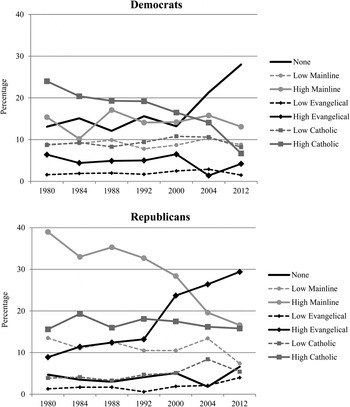
To begin, we examine changes over time in activists’ religious affiliations and commitment. In Figure 1, we trace the percentage of Democratic and Republican delegates from 1980 to 2012 who fell into seven religious categories: individuals with no religious affiliation and members of the three largest American religious traditions — evangelical Protestant, mainline Protestant, and Catholic — with low and high levels of religious commitment.Footnote 4 On the Democratic side, there has been a relatively consistent decline in the presence of highly committed Catholics and a sharp increase since 2000 in the percentage of activists with no religious affiliation. For Republican activists, there has been a clear shift in the nature of Protestant affiliation. The number of highly committed mainline Protestants has steadily declined, while highly committed evangelical Protestants have markedly increased their representation at GOP conventions.
Religious affiliation and commitment of Democratic and Republican national convention delegates, 1980–2012. Source: 1980–2012 Convention Delegate Studies.

The clear religious divisions that previous work has found between Republican and Democratic activists have not only continued in recent years, but have grown markedly. The United States now has a traditionally-religious party and a secular party, whose members increasingly reject religious affiliation. This has potentially profound consequences for American politics.
THE MEASUREMENT AND STRUCTURE OF RELIGION AND SECULARISM AMONG PARTY ACTIVISTS
Like most work on religion and American politics, however, these results fail to distinguish between “passive” secularism, or the absence of religiosity, and the positive commitment to secular perspectives of “active” secularism (Schoettmer et al. Reference Schoettmer, Campbell, Layman and Green2011; Campbell, Layman, and Green Reference Campbell, Layman and Green2013). There is, as yet, no direct evidence that active secularists have become a substantial presence in Democratic ranks or in politics more generally.
To search for such evidence and distinguish between active and passive secularism, the 2012 CDS included not only measures of religiosity, but also direct measures of an affirmative commitment to secular perspectives. To gauge religiosity, we included three standard measures of traditional religious devotion and beliefs: frequency of worship attendance, the amount of guidance one receives from religion, and views about the authority of Scripture.Footnote 5
To measure active secularism, we asked respondents their level of agreement or disagreement with several “secular belief” statements adopted from the work of Campbell, Layman, and Green (Reference Campbell, Layman and Green2013; see also Schoettmer et al. Reference Schoettmer, Campbell, Layman and Green2011). While traditional religiosity and active secularism are undoubtedly negatively related, they should not be mutually exclusive. One may have a rationalist, humanist, or secular perspective on the world without rejecting religion. Therefore, Campbell, Layman, and Green purposely designed their statements to capture an affirmative conviction that scientific evidence and human reason provide the proper foundation for understanding the world and establishing moral parameters, and not the rejection of religion or religious worldviews. With that in mind, we presented CDS respondents with five statements, three worded in a secular direction and two worded in a non-secular direction.
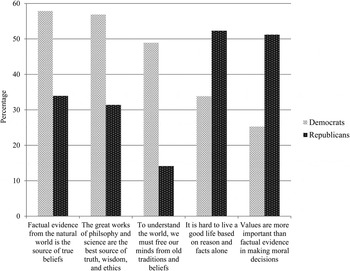
In Figure 2, we show the full text of the five statements and the percentage of Democratic and Republican delegates in 2012 stating that they either “agree” or “agree strongly” with each of them. Democratic delegates are much more likely than Republican delegates to agree with the statements worded in a secular direction (“factual evidence,” “great works,” and “free minds”). Republicans are much more likely than Democrats to agree with the statements worded in a non-secular direction (“hard to live” and “values more important”). There is clearly a partisan divide in secular bases for establishing truth, making moral judgments, and understanding the world.
Agreement with secular and non-secular belief statements, 2012 Democratic and Republican national convention delegates. Source: 2012 Convention Delegate Study.

However, are our indicators of secular beliefs really capturing an active commitment to secular perspectives, or are they just another measure of a lack of religiosity? To assess this, we undertook both exploratory and confirmatory factor analyses. Because the analyses are fully consistent with each other, we focus here on the results of the confirmatory analyses.
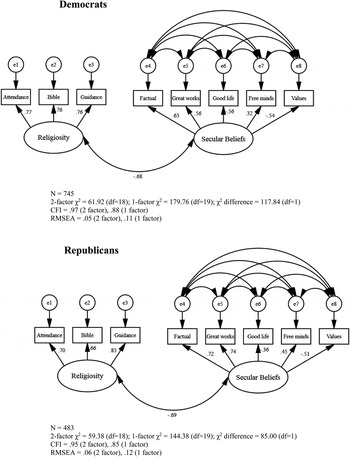
In Figure 3, we show the structure of our confirmatory factor model and present the key results obtained from estimating the model separately for Democratic and Republican activists. We allow our three indicators of religiosity to load on one latent factor, the five secular belief items to load on a second latent factor, and the two factors to be correlated with each other. We account for measurement error in each observed indicator, and treat the measurement errors for the religiosity items as random (i.e., uncorrelated). However, because the secular belief items are part of a question battery with items worded in opposite directions, it is possible that their measurement errors are non-random (Green and Citrin Reference Green and Citrin1994).Footnote 6 To account for that, we allow the measurement errors for the secular belief indicators to all be correlated with each other.Footnote 7
Confirmatory factor models of religiosity and secular beliefs. Source: 2012 Convention Delegate Study. Note: numbers are standardized confirmatory factor loadings and the correlation between the religiosity and secularism factors. All loadings and correlations are statistically significant at p < 0.001.

The figure shows the standardized factor loadings of the latent variables on the particular observed variables, and they are very strong for both factors and both parties.Footnote 8 The figure also presents key goodness of fit statistics for the two-factor model for both parties and for a model in which the religiosity and secular beliefs items all load on a single factor. An appropriate test of whether the difference in fit between a two-factor and one-factor model is statistically significant is provided by the difference in the chi-square values for the two models (itself distributed as a chi-square), and the difference here is significant at p < 0.001 for Democrats and Republicans.Footnote 9 The correlation between the two factors is strongly negative for both parties. However, they are not one and the same. The results make it clear that there is a distinction between passive secularism and active secularism for Democratic and Republican activists.Footnote 10
THE IMPACT OF RELIGION AND SECULARISM ON DELEGATES’ POLITICAL ORIENTATIONS
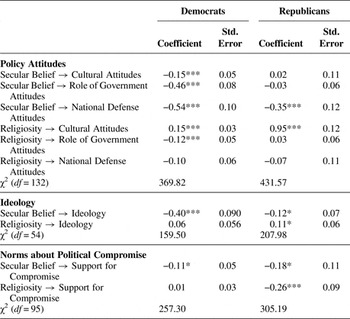
To determine whether the religiosity and secularism gaps between Democratic and Republican party activists have pushed the two parties farther toward the ideological poles and exacerbated inter-party and intra-party conflicts, we convert the confirmatory factor models of religiosity and secular beliefs into structural equation models in which latent religiosity and latent secular beliefs are the primary independent variables and the dependent variables are activists’ policy attitudes, ideological orientations, and support for political compromise. We estimate these models separately for Democrats and Republicans and include controls for age, education, income, gender, and race. Table 1 displays the effects of secular beliefs and religiosity on the dependent variables. The effects of the control variables and the confirmatory factor loadings for latent variables with multiple indicators are presented in our online appendix.
The impact of secular beliefs and religiosity on policy attitudes, ideology, and political norms

Source: 2012 Convention Delegate Study.
Note: Models estimated with full-information maximum likelihood estimation. N = 745 for all models for Democrats and 483 for all models for Republicans. The measurement model for secular beliefs included correlations between the measurement errors for each item. Because there is only one indicator of ideological identification, there is no measurement model for ideology. The compromise model includes four observed indicators with random measurement error. Models include controls for age, education, income, gender, and race. All variables range from 0 to 1. Higher scores on policy issues and ideology represent more conservative attitudes.
***p < 0.01; **p < 0.05; *p < 0.10 (two-tailed tests).
The 2012 CDS included a number of questions about policy issues, and the issues fall into three distinct dimensions: (1) cultural attitudes, comprised of views on abortion and same-sex marriage; (2) role of government attitudes, comprised of beliefs about government-provided health insurance, government services and spending, and government assistance to African Americans;Footnote 11 and (3) national defense attitudes, comprised of beliefs about defense spending and government surveillance of electronic communications. To assess the policy impact of religiosity and secularism, we estimate a single model (separately for each party) with latent cultural, role of government, and national defense attitudes serving as the dependent variables.Footnote 12
The first section of Table 1 shows the impact of religiosity and secular beliefs on these latent policy attitudes. The results for Democrats highlight the limitations of focusing only on passive secularism among party activists. Religiosity has relatively weak and inconsistent effects, leading to more-conservative positions on cultural issues, but more-liberal stands on role of government issues, and exerting no significant effect on national defense attitudes. In contrast, actively secular beliefs have consistently significant effects, all pushing Democratic activists toward greater liberalism. Interestingly, these effects are not greatest for the cultural issues of abortion and gay marriage, but for social welfare and national defense concerns. The most secular Democratic delegates are more liberal than the least secular Democrats by about half of the full scale on these matters. Clearly, the strong presence of active secularists in its activist corps helps to push the Democratic Party to the left on all major policy dimensions, and the impact of active secularism is noticeably larger than that of non-religiosity.
Among Republican activists, the results are a bit different. Secular beliefs influence Republicans’ policy attitudes only on national defense issues, where they move GOP delegates in a liberal direction. Religiosity is significantly related to policy attitudes only on cultural issues. However, the impact is overwhelming, as the most-religious Republicans are more conservative than the least-religious Republicans by nearly the entire breadth of the cultural attitudes scale.
In a second model, the results of which are shown in the second section of the table, we estimated the effect of secularism and religiosity on activists’ ideological self-identifications (on a scale ranging from “extremely liberal” to “extremely conservative”).Footnote 13 The results for Democrats again demonstrate that it is active secularism, not religiosity, which pushes the party toward the liberal extreme. Religiosity has no impact on Democratic ideological identification, but secular beliefs have a highly significant and substantial effect on ideological identification, with the most secular Democrats being considerably more liberal than the least secular Democrats. Among Republican activists, the effects of both religiosity and secular beliefs approach standard levels of statistical significance. As expected, greater secularism increases liberalism while religiosity increases conservatism.
It is apparent that the rise of traditional religiosity among Republican activists and the emergence of active secularism among Democratic activists have contributed to ideological polarization between the parties. Have they also contributed to the increasing rancor and inflexibility in American party politics? To assess that, we estimated a model in which the dependent variable is support for political compromise, a latent variable with four observed indicators. Three of the indicators are respondents’ levels of agreement with statements about intra-party compromise, or, more specifically, the importance of ideological conviction relative to intra-party harmony and electoral success.Footnote 14 The fourth indicator gauges support for compromise in inter-party politics, asking respondents to place themselves on a scale ranging from “Elected officials should stand up for their principles no matter what” and “Elected officials should compromise with their opponents in order to get things done for the country.”Footnote 15
The results, shown in the third section of Table 1, indicate that the religious-secular divide also encourages a more disagreeable and uncompromising style of political debate and party conflict. For Democratic activists, it is again secularism, and not religiosity, that is consequential — active secularists are less supportive of intra-party and inter-party compromise than their less-secular co-partisans. Among Republicans, both religiosity and secularism make activists less willing to compromise with their political opponents.
In sum, the religious-secular divide has lent considerable fuel to contemporary partisan conflict. It not only has pushed the two parties’ activist bases toward the ideological poles, but also has discouraged party activists from compromising with their intra-party and inter-party political opponents. Importantly, however, it is not simply religion and non-religion that have driven political polarization and acrimony. Traditional religiosity, as past work has shown, has helped to fashion a more-conservative and less-flexible GOP. However, it has been active secularism that has contributed to a more-liberal and more-rigid Democratic base.
THE RELIGION-SECULARISM NEXUS AND ITS RELATIONSHIP TO PARTY POLITICS
In conceptualizing and measuring active secularism, we have contended that religiosity and secularism are not mutually exclusive. Of course, most actively secular people are probably not very religious and most highly-religious people are unlikely to view the world in a very secular way. However, it is not impossible that someone could be religious, but also have rationalist or humanistic perspectives on the world and human life. Given that, it is important to examine the nexus between religiosity and secular beliefs: how combinations of religious and secular orientations are represented among Democratic and Republican activists and are related to policy and candidate preferences within the two parties.
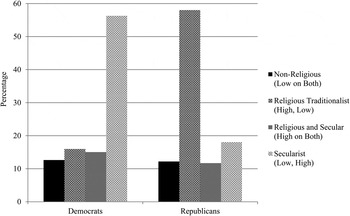
To do that, we first created observed factor scores of latent religiosity and secular beliefs, multiplying each indicator of the two constructs by its confirmatory factor loading for the particular party (shown in Figure 3), summing the products across all of the indicators of either religiosity or secular beliefs, and then recoding the weighted indices to range from zero to one. We then divided the religiosity and secular belief factor scores into two groups: “low” if a delegate's value on the factor score was less than or equal to 0.5 and “high” if the delegate's value was greater than 0.5. The various combinations of these two dichotomous variables produce a variable with the following four categories: (1) “Non-religious” people: people who are not very religious, but also are not actively secular (low on both scales); (2) “Religious traditionalists”: people who are high in religiosity and low in secular beliefs; (3) “Religious and secular” people: people who are high in religiosity and high in secular beliefs; and (4) “Secularists”: people who are low in religiosity and high in secular beliefs.
Figure 4 shows the percentage of Democratic and Republican activists falling into each of these four categories. A clear majority of Democratic activists are high in secular beliefs and low in religiosity, while a clear majority of Republican activists are high in religiosity and low in secular beliefs. It is interesting that the second-largest group among Republican activists is secularists by a substantial margin. However, none of the other combinations constitutes as much as 20% of either party's 2012 convention delegations. This evidence makes the religious-secular divide between the parties’ activists particularly stark. The Democrats are predominantly a party of secularists; the Republicans are primarily a party of religious traditionalists. Perhaps it is no wonder that parties with such activist bases have difficulty finding common ground.
Religiosity and secular beliefs among Democratic and Republican national convention delegates, 2012. Source: 2012 Convention Delegate Study.

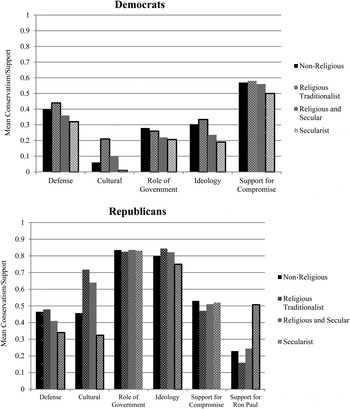
To illustrate how the combination of religiosity and secularism shapes the policy positions of the two parties, Figure 5 shows the mean positions of the four religion-secularism groups on national defense, cultural issues, role of government issues, ideology, and support for compromise (all coded to range from zero for the most liberal/least supportive position to one for the most conservative/most supportive position).Footnote 16 Not surprisingly, there are large inter-party differences on every dimension except defense (probably because both the Bush and Obama administrations were heavily involved in government surveillance) and support for compromise.
Policy attitudes and ideology by the combination of religiosity and secularism. Source: 2012 Convention Delegate Study. Note: Black borders around a bar indicate either that the difference between religious traditionalists and all other party delegates is statistically significant at p < 0.01 or that the difference between secularists and all other party delegates is statistically significant at p < 0.01.

However, there also are sizeable intra-party differences based on religiosity and active secularism. Among Democratic activists, secularists are the most liberal group in ideological identification and in every policy area, and they are the least supportive of compromise. Among active Republicans, religious traditionalists are the most conservative group in ideological identification and on defense and especially cultural issues, and they are also the least supportive of compromise. Secular Republicans are the most liberal in terms of ideological identification and every issue except the role of government.Footnote 17
CONCLUSION
In this article, we have examined the growth over time of the religious-secular divide between activists in the two major American parties, showing the growth of religious traditionalism in the GOP and the ascendance of non-religion and secularism in the Democratic Party. More importantly, we have shown that distinguishing between activists who are not religious, but not particularly secular and activists who are actively committed to secular beliefs has important consequences for our understanding of 21st century partisan conflict. Active secularism prevails in the ranks of Democratic activists, while religious traditionalism is predominant among active Republicans. This means that the parties are religiously quite different, and also helps to explain the growing ideological polarization of party politics and its increasingly inflexible character.
Active secularists are the most liberal group in the Democratic Party and are also more likely than other Democrats to eschew political compromise in favor of an unyielding pursuit of ideological principles. Similarly, religious traditionalists are more conservative than other active Republicans on nearly every realm of public policy and themselves display a highly “purist” approach to party politics. Given that secularists represent a clear majority of Democratic activists and religious traditionalists represent a clear majority of GOP activists, these differences in ideology and willingness to compromise would seem to be fueling much of the conflict others have observed both between and within the two parties.
As these findings illustrate, the rift between the most active segments of the Democratic and Republican parties has not only widened in recent years, but has formed between two groups with deeply held and fundamentally incompatible beliefs about the nature of human life, culture, and morality. While it remains to be seen whether the conflicting viewpoints of secularists and religious traditionalists completely preclude political compromise, there is good reason to believe the seemingly irreconcilable division between the two parties will persist or become even more acrimonious and insoluble so long as these already polarized segments of the two parties remain split along religious and secular lines.
There are, however, two reasons for hope. One is that, while secularists and religious traditionalists form the large majority of delegates to the Democratic and Republican parties’ conventions, respectively, neither party is completely segregated. Religious traditionalists comprise the second largest portion of Democratic delegates, while secularists hold the same position within the GOP. While the presence of these divergent groups may exacerbate intra-party conflict, it also may represent a possible path to long-term compromise or understanding between the parties. The second reason is that because a key goal of political parties is fashioning broad coalitions in order to win elections, activists tend to become less purist in their approach to politics the longer they are involved in a party (Stone and Abramowitz Reference Stone and Abramowitz1983). Layman (Reference Layman, Wolfe and Katznelson2010) shows that traditionalist evangelical Republicans grow more pragmatic as they become more experienced in party politics. The same thing may happen to secular Democratic activists and may continue to happen to traditionally-religious activists in the GOP.
Supplementary materials and methods
To view supplementary material for this article, please visit http://dx.doi.org/10.1017/S1755048316000079.