Introduction
Toxocara canis is an important and highly prevalent intestinal parasite of dogs and other canids (Sahu et al., Reference Sahu, Samanta, Sudhakar, Raina, Gupta, Maurya, Pawde and Kumar2014; Gasser et al., Reference Gasser, Korhonen, Zhu and Young2016). A wide range of animals can be infected by ingestion of embryonated eggs or infective larvae. The infective larvae develop and complete their life cycle in canid species, while they arrest developmentally in paratenic hosts but migrate to tissues/organs, causing the associated diseases named toxocariasis (Strube et al., Reference Strube, Heuer and Janecek2013). Human toxocariasis is characterized by visceral larva migrans (VLM), neurological toxocariasis (NT), ocular larva migrans (OLM) and/or covert/common toxocariasis (CT) (Rubinsky-Elefant et al., Reference Rubinsky-Elefant, Hirata, Yamamoto and Ferreira2010). The high seroprevalence of Toxocara infection/exposure in children (Archelli et al., Reference Archelli, Santillan, Fonrouge, Céspedes, Burgos and Radman2014; Cong et al., Reference Cong, Meng, You, Zhou, Dong, Dong, Wang, Qian and Zhu2015) and the important relationships with allergic disorders, such as asthma, chronic pruritus and urticaria, have raised public concern (Overgaauw & van Knapen, Reference Overgaauw and van Knapen2013; Lee et al., Reference Lee, Moore, Bottazzi and Hotez2014). Although treatment with albendazole or mebendazole is effective for visceral toxocariasis, there are still many gaps in our knowledge concerning this disease, which significantly hinder the development of effective diagnostic tools and interventional strategies (Othman, Reference Othman2012; Holland, Reference Holland2015; Poulsen et al., Reference Poulsen, Skov, Yoshida, Skallerup, Maruyama, Thamsborg and Nejsum2015).
Proteoglycans are macromolecules composed of a protein core and glycosaminoglycan chains, and display a great diversity of protein forms (Ruoslahti, Reference Ruoslahti1988; Hardingham & Fosang, Reference Hardingham and Fosang1992). The different chains and their various lengths, as well as their pattern of sulphation, result in the switching of different chain types (Iozzo, Reference Iozzo1998) and various functions (Laabs et al., Reference Laabs, Wang, Katagiri, McCann, Fawcett and Geller2007; Kwok et al., Reference Kwok, Dick, Wang and Fawcett2011). Chondroitin sulphate proteoglycans and heparan sulphate proteoglycans are widely distributed in extracellular matrices, and their functional roles in the development of the central nervous system and the response to central nervous system injury in vertebrates have been extensively reported (Yi et al., Reference Yi, Katagiri, Susarla, Figge, Symes and Geller2012; Dyck & Karimi-Abdolrezaee, Reference Dyck and Karimi-Abdolrezaee2015; Miller & Hsieh-Wilson, Reference Miller and Hsieh-Wilson2015). In addition, previous studies in the free-living nematode Caenorhabditis elegans indicated that chondroitin proteoglycans play crucial roles in embryonic development and vulval morphogenesis (Hwang & Horvitz, Reference Hwang and Horvitz2002; Izumikawa et al., Reference Izumikawa, Kitagawa, Mizuguchi, Nomura, Nomura, Tamura, Gengyo-Ando, Mitani and Sugahara2004; Olson et al., Reference Olson, Bishop, Yates, Oegema and Esko2006).
Although a great number of gender-, reproduction- and development-associated genes of nematodes have been predicted through newly completed genome and transcriptome projects, and studied with advanced molecular technologies (Boag et al., Reference Boag, Gasser, Nisbet and Newton2003; Nisbet et al., Reference Nisbet, Cottee and Gasser2004, Reference Nisbet, Cottee and Gasser2008), knowledge about molecular functions and/or biological involvement of chondroitin proteoglycans in parasitic nematodes is scant. Even though six female-enriched chondroitin proteoglycan genes were identified in previous genome and transcriptome analyses of adult T. canis (Zhu et al., Reference Zhu, Korhonen, Cai, Young, Nejsum, von Samson-Himmelstjerna, Boag, Tan, Li, Min, Yang, Wang, Fang, Hall, Hofmann, Sternberg, Jex and Gasser2015; Zhou et al., Reference Zhou, Ma, Korhonen, Luo, Zhu, Luo, Gasser and Xia2017) no functions and pathways were annotated. Hence, in the present study, we cloned and characterized the chondroitin proteoglycan 2 gene of T. canis (Tc-cpg-2), and examined its differential transcription in order to get a better understanding of its potential functional roles in this enigmatic parasite.
Materials and methods
Parasites and tissue samples
Adult T. canis worms were collected from naturally infected dogs at the Rongchang Campus Animal Hospital of Southwest University, China. Male and female adults were identified based on their morphological features (Urquhart et al., Reference Urquhart, Armour, Duncan, Dunn and Jennings2003). The germline tissues (including testis, seminal vesicle and vas deferens of male worms, and ovary, oviduct and uterus of female worms), intestine, musculature and cuticle were dissected from some male and female adult T. canis, and snap-frozen in liquid nitrogen. All parasites and tissue samples were stored at −80°C until use.
Molecular cloning and DNA sequencing
Total RNA was extracted from the whole body of male and female adult worms, respectively, using Trizol reagent (Invitrogen Corporation, Carlsbad, California, USA). The quality of total RNA was measured using a BioPhotometer (Eppendorf, Hamburg, Germany). M-MLV reverse transcriptase (Promega, Madison, USA) was used to synthesize the first-strand cDNA according to the manufacturer's instructions. Tc-cpg-2 was amplified by conventional polymerase chain reaction (PCR) with the primers cpg1 (5′-ATGGAGTTCAGATTCTTCATC-3′) and cpg2 (5′-TCAGTAGGCTTCACCGACCT-3′). The primer sets were designed using Primer Premier 5 software (Lalitha, Reference Lalitha2004), based on the nucleotide sequence of Tcan_06538. The PCR reaction contained 2.5 μl of 10 × PCR buffer (Mg2+ free), 3.0 μl MgCl2 (25 mm), 2.0 μl deoxynucleoside triphosphates (dNTP; 2.5 mm), 0.25 μl forward primer (10 μm), 0.25 μl reverse primer (10 μm), 2.0 μl (20–50 ng) DNA template, 0.13 μl rTaq polymerase and 14.87 μl sterile water, in a total volume of 25 μl. The PCR protocol consisted of 95°C for 4 min; 30 cycles of 95°C for 40 s, 55°C for 30 s and 72°C for 1 min; 72°C for 10 min and holding at 4°C. The PCR products were purified using the EasyPure quick gel extraction kit (Invitrogen Corporation), ligated into the pMD 19-T (simple) vector (Takara Bio, Dalian, China) at 4°C overnight and transformed into Escherichia coli DH5α competent cells. The transformed clones were screened using colony PCR and the positive clones were then sequenced by Sangon Biotech (Shanghai, China).
Sequence analysis
The sequences obtained were used for BlastX searching against the non-redundant protein sequences database (https://blast.ncbi.nlm.nih.gov/Blast.cgi). The signal peptide prediction was performed using SignalP 4.0 (Petersen et al., Reference Petersen, Brunak, von Heijne and Nielsen2011). The conserved domains of the predicted amino acid sequence of Tc-cpg-2 were searched against CDD v. 3.14 (Marchler-Bauer et al., Reference Marchler-Bauer, Derbyshire, Gonzales, Lu, Chitsaz, Geer, Geer, He, Gwadz, Hurwitz, Lanczycki, Lu, Marchler, Song, Thanki, Wang, Yamashita, Zhang, Zheng and Bryant2015). The structure and function of the inferred peptide were predicted using the I-TASSER server (Roy et al., Reference Roy, Kucukura and Zhang2010; Yang et al., Reference Yang, Yan, Roy, Xu, Poisson and Zhang2015). In addition, multiple alignment was carried out by aligning the deduced amino acid sequence of Tc-cpg-2 and the predicted chondroitin proteoglycan 2 of other nematodes using MUSCLE, Clustal Omega and MAFFT software (Edgar, Reference Edgar2004; Sievers et al., Reference Sievers, Wilm, Dineen, Gibson, Karplus, Li, Lopez, McWilliam, Remmert, Söding, Thompson and Higgins2011; Katoh & Standley, Reference Katoh and Standley2013). The phylogenetic relationship of these sequences was analysed by constructing a phylogenetic tree using maximum likelihood in MEGA 4 software (http://www.megasoftware.net/mega4/mega.html).
Quantitative real-time PCR assays (qRT-PCR)
Total RNA was extracted from the testis, seminal vesicle, vas deferens, intestine, musculature and cuticle of male worms and from the ovary, oviduct, uterus, intestine, musculature and cuticle of adult female T. canis, using Trizol reagent (Invitrogen), and measured using a BioPhotometer (Eppendorf). Total RNA was reversely transcribed using PrimeScript™ RT Reagent kit (Takara Bio, Dalian, China) to synthesize the cDNA. The primers cpg3 (5′-ACCCCGACAACGACGACTAT-3′) and cpg4 (5′-CGAACGCAAACCCGTATCT-3′) were designed using Primer Premier 5 software, based on the nucleotide sequence of Tcan_06538. The small subunit of ribosomal RNA (18S) gene was used as an internal reference control, using primers 18S1 (5′-AATTGTTGGTCTTCAACGAGGA-3′) and 18S2 (5′-AAAGGGCAGGGACGTAGTCAA-3′). The qRT-PCR reaction included 10.0 μl SYBR Premix Ex Taq II (Takara Bio), 0.8 μl of forward primer (10 μm), 0.8 μl reverse primer (10 μm), 2.0 μl DNA template and 6.4 μl sterile water, in a total volume of 20 μl. The qRT-PCR was performed with thermal cycling: 95°C for 30 s, and 40 cycles of 95°C for 30 s and 55°C for 30 s. Three technical replicates were performed, and the relative transcription level was established using the 2−ΔCt method, and presented as x̄ ± standard deviation (SD).
Results
The sequence of Tc-cpg-2 and predicted polypeptide sequence
Molecular cloning was performed to obtain the full-length coding sequence of the Tc-cpg-2 gene. After sequencing, a 1458-nucleotide open reading frame (ORF) was obtained. Homology searching showed high identities to cpg-2 genes of other nematodes. A 485-amino-acid (aa) polypeptide containing a signal peptide was predicted from the Tc-cpg-2 gene. Three chitin-binding peritrophin-A domains (CBM_14) were identified using conserved domain searching (fig. 1a). In addition, the three-dimensional structural model of predicted TcCPG2 (without signal peptide) was predicted with a TM score of 0.59 ± 0.14 and a root-mean-square deviation (RMSD) of 9.5 ± 4.6 Å (fig. 1b). The closest structural homologue to TcCPG2 was the poly-C9 component of the complement membrane attack complex (PDB-5fmw). The molecular function, biological process and cellular component of TcCPG2 were annotated as ion binding (GO:0043167), cytolysis (GO:0019835) and extracellular space (GO:0005615). The Tc-cpg-2 gene coding TcCPG2 was deposited in the GenBank database (accession no. KU521797).
The domains and structure of chondroitin proteoglycan 2 of Toxocara canis. The diagram of domains in the deduced peptide sequence (a) and protein structure (b) are shown. Three chitin-binding peritrophin-A domains (CBM_14) are indicated in orange–red.

Alignment and phylogenetic analysis
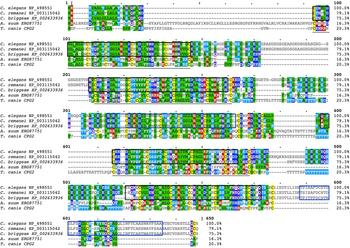
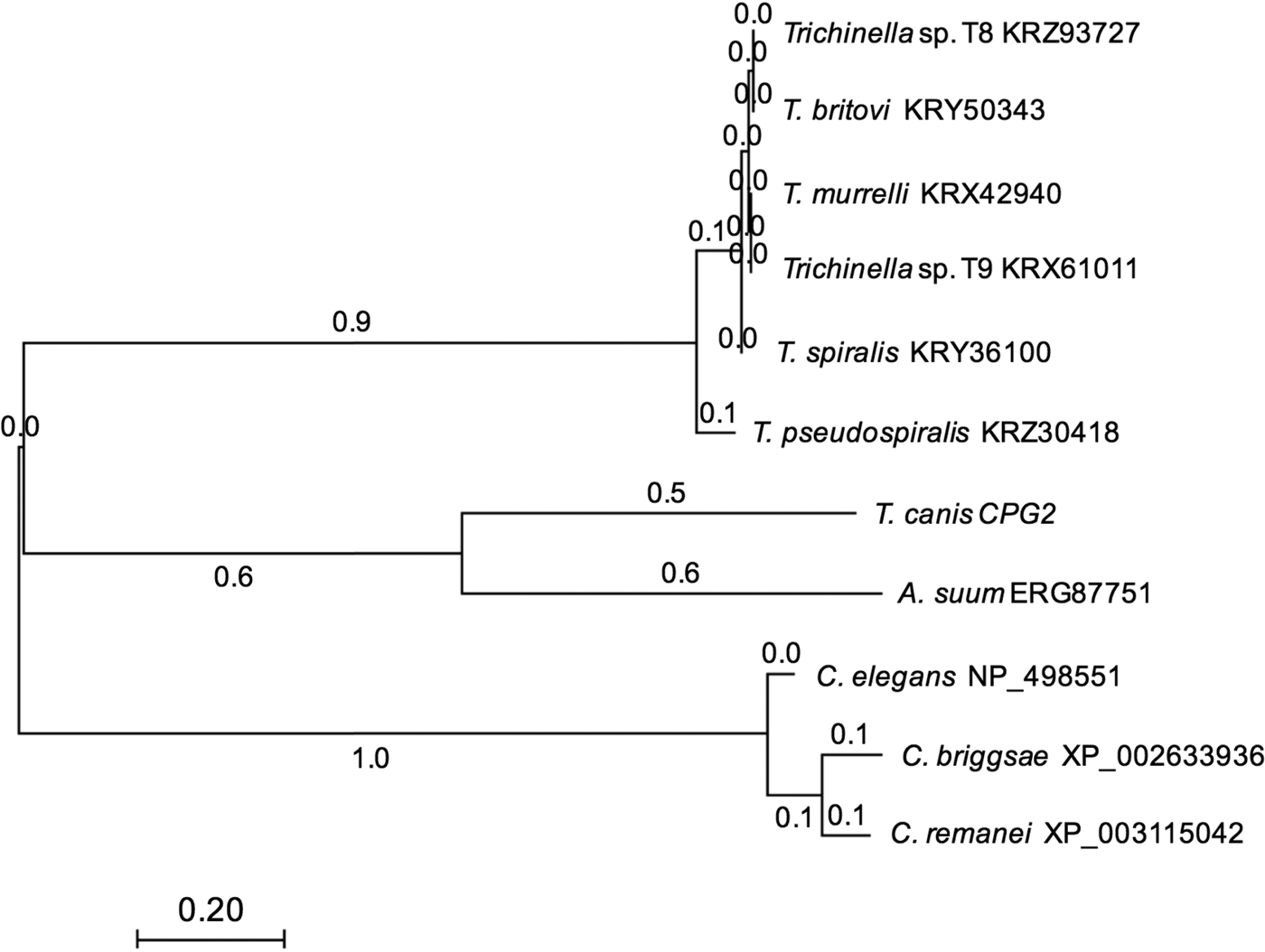
The predicted amino acid sequences of CPG2 of C. elegans, Caenorhabditis remanei, C. briggsae and Ascaris suum, as well as the deduced sequence of TcCPG2 were used for multiple alignment analysis. The three CBM_14 domains of TcCPG2 were highly conserved with those of C. elegans, C. remanei and C. briggsae, whereas high variation was found in both of the C- and N-terminal regions (fig. 2). Ten predicted amino acid sequences of CPG2 and the sequence of TcCPG2 were used for the phylogenetic analysis. A close relationship between T. canis and A. suum, and a relatively distant relationship to species of Trichocephalida and Rhabditidae, were indicated in terms of the protein sequence similarity (fig. 3).
Multiple alignment analysis of chondroitin proteoglycan 2 of Toxocara canis. Chitin-binding peritrophin-A domain (CBM_14, black frame) and chitin-binding domain type 2 (ChtBD2, blue frame) in the chondroitin proteoglycan 2 proteins predicted from Caenorhabditis elegans (no. NP_498551), C. remanei (no. XP_003115042) and C. briggsae (no. XP_002633936) are indicated. The conserved domains in TcCPG2 are underlined.

Phylogenetic analysis of chondroitin proteoglycan 2 of Toxocara canis. A phylogenetic maximum likelihood tree is shown, which was constructed from the predicted TcCPG2 and deduced sequence from Ascaris suum (no. ERG87751), Trichinella sp. T8 (no. KRZ93727), T. britovi (no. KRY50343), T. murrelli (no. KRX42940), Trichinella sp. T9 (no. KRX61011), T. spiralis (no. KRY36100), T. pseudospiralis (no. KRZ30418), Caenorhabditis elegans (no. NP_498551), C. remanei (no. XP_003115042) and C. briggsae (no. XP_002633936).

Tissue-specific expression of Tc-cpg-2
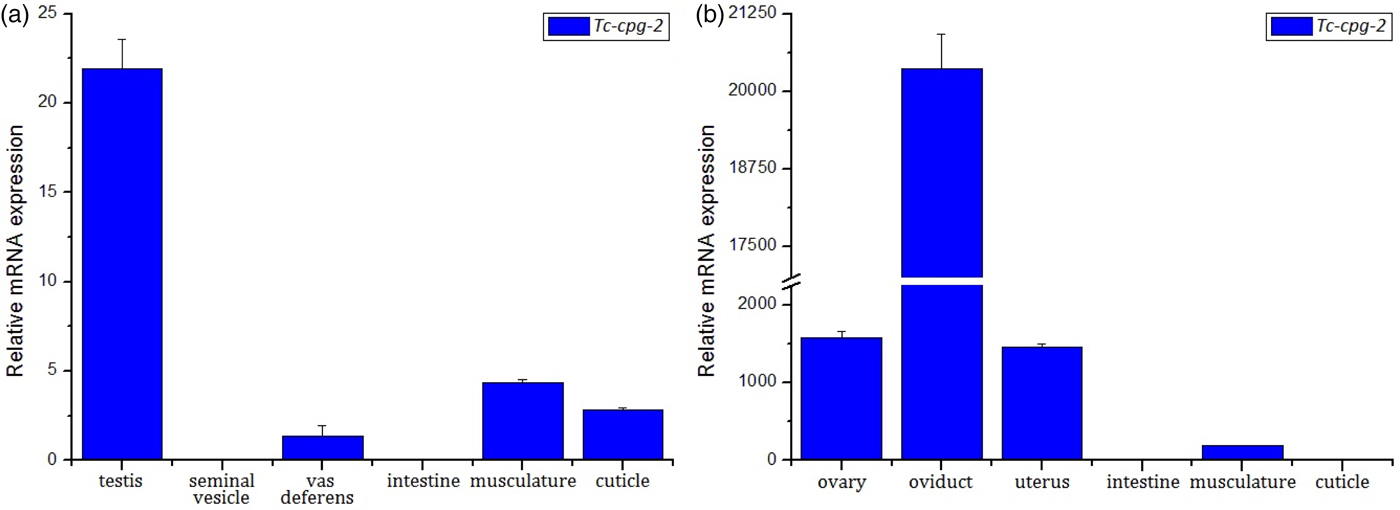
The differential transcriptions of Tc-cpg-2 in the germline tissues, intestine and body wall of adult T. canis were determined using qRT-PCR. Specifically, extremely high transcription of Tc-cpg-2 was detected in the ovary and uterus, particularly in the oviduct, of the female adult (fig. 4b). Low expression of Tc-cpg-2 was observed in the testis of the male adult, compared with even lower transcription in vas deferens and cuticle of the male adult (fig. 4a), and musculature of both male and female adult T. canis (fig. 4a, b). No transcription was detected in the intestine of both sexes. Generally, the transcriptional level of Tc-cpg-2 in the female adult worm was much higher than that in male adult T. canis, particularly in the germline tissues, suggesting its gender-related functional roles.
Tissue expression of Tc-cpg-2 of Toxocara canis. The relative mRNA transcription of the Tc-cpg-2 in testis, seminal vesicle, vas deferens, intestine, musculature and cuticle of male adult T. canis (a), and in the ovary, oviduct, uterus, intestine, musculature and cuticle of female adult T. canis (b) are shown.

Discussion
Proteoglycans are versatile components of pericellular and extracellular matrices, with interactive properties with other components of eukaryotic cells. Physically, proteoglycans function as molecular organizers of the matrix, playing important roles in keeping the matrix hydrated, increasing reaction rates and regulating cell–matrix dynamics (Gallagher, Reference Gallagher1989; Hardingham & Bayliss, Reference Hardingham and Bayliss1990; Schaefer, Reference Schaefer2014). In addition to their conventional physical effects or structural roles, chondroitin proteoglycans also have intriguing functions in a range of biological processes, such as the development of the central nervous system and wound repair (Morgenstern et al., Reference Morgenstern, Asher and Fawcett2002; Im et al., Reference Im, Kim, Kim, Cho, Park and Kim2013; Miller & Hsieh-Wilson, Reference Miller and Hsieh-Wilson2015). Recent studies in parasites indicated that cell-surface chondroitin proteoglycans play a role in the attachment of parasites to host cells; for instance, the adhesion of erythrocytes infected by the malaria parasite to liver cells (Pradel et al., Reference Pradel, Garapaty and Frevert2002) or placenta (Gamain et al., Reference Gamain, Gratepanche, Miller and Baruch2002; Mardberg et al., Reference Mardberg, Trybala, Tufaro and Bergström2002; Frick et al., Reference Frick, Schmidtchen and Sjöbring2003; Achur et al., Reference Achur, Kakizaki, Goel, Kojima, Madhunapantula, Goyal, Ohta, Kumar, Takagaki and Gowda2008). Multiple female-enriched chondroitin proteoglycan genes were identified in transcriptome analysis (Zhu et al., Reference Zhu, Korhonen, Cai, Young, Nejsum, von Samson-Himmelstjerna, Boag, Tan, Li, Min, Yang, Wang, Fang, Hall, Hofmann, Sternberg, Jex and Gasser2015; Zhou et al., Reference Zhou, Ma, Korhonen, Luo, Zhu, Luo, Gasser and Xia2017); however, almost nothing is known about the roles of proteoglycans in T. canis and related parasitic nematodes.
Chondroitin proteoglycans play potential roles in reproduction and/or embryotic development processes. It was reported that chondroitin proteoglycans are important components of extracellular matrices (ECMs), which are essential for ovulation and sperm–egg interaction (Camaioni et al., Reference Camaioni, Salustri, Yanagishita and Hascall1996; Johnston et al., Reference Johnston, Krizus and Dennis2006). In C. elegans, the possible involvement of chondroitin proteoglycans in early embryogenesis, embryonic development and vulval morphogenesis was indicated by disrupting genes involved in glycosaminoglycan biosynthesis (Hwang & Horvitz, Reference Hwang and Horvitz2002; Hwang et al., Reference Hwang, Olsen, Esko and Horvitz2003; Mizuguchi et al., Reference Mizuguchi, Uyama, Kitagawa, Nomura, Dejima, Gengyo-Ando, Mitani, Sugahara and Nomura2003; Izumikawa et al., Reference Izumikawa, Kitagawa, Mizuguchi, Nomura, Nomura, Tamura, Gengyo-Ando, Mitani and Sugahara2004). It was also found that simultaneous CPG1 and CPG2 are crucial for embryonic cell division in C. elegans (Olson et al., Reference Olson, Bishop, Yates, Oegema and Esko2006). Female-enriched chondroitin proteoglycan 2 of T. canis might have similar roles in reproduction and development to that of C. elegans.
In the current study, the alignment analysis showed conserved domains between the sequences of TcCPG2 and CPG2 of C. elegans, indicating conserved biological functions. In addition, high transcription levels of Tc-cpg-2 were detected in female germline tissues (fig. 4b), which can be supported by the distribution of chondroitin proteoglycans in the gonads and uterus, as well as in oocytes, spermatheca and fertilized eggs of hermaphrodite C. elegans (Mizuguchi et al., Reference Mizuguchi, Uyama, Kitagawa, Nomura, Dejima, Gengyo-Ando, Mitani, Sugahara and Nomura2003). Nevertheless, the relatively high transcription of this gene in the oviduct of T. canis differed from the tissue expression of CPG2 in C. elegans (Mizuguchi et al., Reference Mizuguchi, Uyama, Kitagawa, Nomura, Dejima, Gengyo-Ando, Mitani, Sugahara and Nomura2003). This might be associated with the differences in structure of the reproductive tract and related biological processes of fertilization (Sato et al., Reference Sato, Grant, Harada and Sato2008) between these two species. Although recent knowledge of proteoglycan biology has expanded from structural compounds to signalling molecules (Fthenou et al., Reference Fthenou, Zafiropoulos, Tsatsakis, Stathopoulos, Karamanos and Tzanakakis2006; Whitten & Miller, Reference Whitten and Miller2007; Schaefer & Schaefer, Reference Schaefer and Schaefer2010; Gubbiotti & Iozzo, Reference Gubbiotti and Iozzo2015), the molecular roles of chondroitin proteoglycans remain unclear in T. canis and related parasitic nematodes.
In conclusion, this female-enriched chondroitin proteoglycan 2 was predicted to be associated with reproduction and embryonic development; in particular, to be linked to oogenesis and embryogenesis. Although further functional studies, for instance, RNA-mediated interference, are required to confirm these findings, the exciting prospects of gender-biased proteoglycans could enhance our molecular knowledge of T. canis and related parasitic nematodes, and suggest important drug targets for controlling this enigmatic zoonotic parasite.
Acknowledgements
The authors would like to thank Professor Xing-Quan Zhu from Lanzhou Veterinary Research Institute, Chinese Academy of Agricultural Sciences, China, for constructive comments and valuable suggestions to improve the manuscript.
Financial support
This work was funded by the National Natural Science Foundation of China (grant no. 31172313) and Fundamental Research Funds for the Central Universities (no. XDJK2016E087).
Conflict of interest
None.
Ethical standards
Handling of animals was performed according to the requirements of the Ethics Procedures and Guidelines of the People's Republic of China.