

Key Points
Although forests are not explicitly mentioned in SDG 12, achieving the targets will result in positive contributions towards forest conservation and support forest-dependent livelihoods.
SDG 12 targets can contribute to reducing trade-offs between other SDGs; in particular, Target 12.3 (aimed at reducing food waste and food losses) can limit trade-offs between SDG 2 and SDG 15.
SDG 12 has its limitations, including the lack of absolute limits to consumption of forest products or products that place pressures on forests leading to deforestation and forest degradation.
The main players for achieving SDG 12 targets with positive outcomes for forests will comprise national governments, large companies and consumers involved in global value chains.
A thorough, integrative SCP approach that addresses systemic issues is required to achieve sustainable forest management and land use associated with responsible consumption.
12.1 Introduction
This chapter identifies and analyses the potential benefits, impacts and contributions of efforts to achieve SDG 12 – Sustainable Consumption and Production (SCP) – on forests and forest-dependent livelihoods. While SCP has been part of the international policy discourse for more than four decades, its uptake has not been smooth. A bias has tended towards relatively weak measures. Currently, SDG 12 has no specific direct reference to forests or forest-dependent people among its targets or indicators, despite linkages between sustainable forest management and agricultural commodity supply. These linkages have implications for deforestation and forest degradation.
The significant links between SCP and forests have yet to receive sufficient attention among the expert and policy communities. Although SDG 12 is considered a major contributor to the protection and enhancement of natural resources, including forests (FAO 2018), and is seen to be particularly relevant to the supply of forest products (Brack Reference Brack2018), ‘progress towards this goal has so far been very limited’ (Brack Reference Brack2018: 5).
This chapter’s overall findings align with the above assessments by FAO and the United Nations Forum on Forests (UNFF). Achieving SDG 12 targets can contribute to improving forest conservation and sustainable management by reducing pressures from forest-risk commodities (e.g. palm oil, soy, cacao, beef) and incentivising sustainable supply of forest products (e.g. timber, pulp and paper), leading to slowing or reducing current impacts.
The SDG 12 targets in Table 12.1 do not suggest any direct trade-offs that could emerge between achieving the SDG 12 targets and protecting forest ecosystem functions and services. However, depending on how governments and the private sector address SDG 12 in the forests and forest-risk commodities’ supply and value-chain governance, there can be issues of leakage and indirect social impacts (e.g. exclusion of smallholders and forest-dependent communities), resulting in trade-offs with SDG 10 (Reduced Inequalities).
| Targets | Indicators | Links to forests |
|---|---|---|
| 12.1 Implement the 10YFP on SCP, all countries taking action, with developed countries taking the lead, taking into account the development and capabilities of developing countries | 12.1.1 Number of countries with SCP national action plans or mainstreamed as a priority or a target into national policies | National SCP action plans can include mechanisms to support forest commodities and reduce pressures from forest-risk commodities, depending on country-specific priorities and resource base |
| 12.2 By 2030, achieve the sustainable management and efficient use of natural resources | 12.2.1 Material footprint, material footprint per capita and material footprint per GDP12.2.2 Domestic material consumption, domestic material consumption per capita and domestic material consumption per GDP | Forest commodities and forest-risk commodities as part of materials footprints and domestic material consumptionIncreased material efficiency in primary and secondary processing of forest products |
| 12.3 By 2030, halve per capita global food waste at the retail and consumer levels and reduce food losses along production and supply chains, including post-harvest losses | 12.3.1 Global food loss index | Reduced food waste and losses would mean reduced need for new agricultural land, leading to reduced deforestation for agricultural supply |
| 12.4 By 2020, achieve the environmentally sound management of chemicals and all wastes throughout their life cycle, in accordance with agreed international frameworks, and significantly reduce their release to air, water and soil in order to minimize their adverse impacts on human health and the environment | 12.4.1 Number of parties to international multilateral environmental agreements on hazardous waste, and other chemicals that meet their commitments and obligations in transmitting information as required by each relevant agreement12.4.2 Hazardous waste generated per capita and proportion of hazardous waste treated, by type of treatment | Prevent forest areas being used as illegal dumping grounds for industrial and hazardous waste productsLess soil and water pollution through avoidance of waste and careful management of chemicals in harvesting areas |
| 12.5 By 2030, substantially reduce waste generation through prevention, reduction, recycling and reuse | 12.5.1 National recycling rate, tons of material recycled | Reduction/improved use of harvesting and industrial residuesRecycling of paper and wood products |
| 12.6 Encourage companies, especially large and transnational companies, to adopt sustainable practices and to integrate sustainability information into their reporting cycle | 12.6.1 Number of companies publishing sustainability reports | Sustainable practices in supply chains of forest commodities and forest-risk commodities, reported by companies through their sustainability reports |
| 12.7 Promote public procurement practices that are sustainable, in accordance with national policies and priorities | 12.7.1 Number of countries implementing SPP policies and action plans | Certification schemes for forest commodities and agricultural commodities used in government SPP policies and related initiatives and practices |
| 12.8 By 2030, ensure that people everywhere have the relevant information and awareness for sustainable development and lifestyles in harmony with nature | 12.8.1 Extent to which (i) global citizenship education and (ii) education for sustainable development (including climate change education) are mainstreamed in (a) national education policies; (b) curricula; (c) teacher education; and (d) student assessment | Information and environmental education about sustainable forest production, forest conservation, and life-cycle assessments of forest products |
| 12.A Support developing countries to strengthen their scientific and technological capacity to move towards more sustainable patterns of consumption and production | 12.A.1 Amount of support to developing countries on research and development for sustainable consumption and production and environmentally sound technologies | Improved technological capabilities to reduce impacts on forests, e.g. improved harvesting and processing technologies with improved materials efficiency |
| 12.B Develop and implement tools to monitor sustainable development impacts for sustainable tourism that creates jobs and promotes local culture and products | 12.B.1 Number of sustainable tourism strategies or policies and implemented action plans with agreed monitoring and evaluation tools | Nature-based and forest-based tourism strategies as part of tourism strategies; tools to monitor the impact of tourism on forest resources |
| 12.C Rationalise inefficient fossil fuel subsidies that encourage wasteful consumption by removing market distortions, in accordance with national circumstances, including by restructuring taxation and phasing out those harmful subsidies, where they exist, to reflect their environmental impacts, taking fully into account the specific needs and conditions of developing countries and minimising the possible adverse impacts on their development in a manner that protects the poor and the affected communities | 12.C.1 Amount of fossil fuel subsidies per unit of GDP (production and consumption) and as a proportion of total national expenditure on fossil fuels | Linked to subsidies for bioenergy, potential trade-offs between reduction in fossil fuel subsidies and growth in bioenergy subsidies, with both positive and negative impacts on forests |
SDG 12 can enable conditions for advancing a more sustainable supply of forest commodities, notably timber and pulp and paper, as well as expanding the adoption of more sustainable practices in the supply of forest-risk commodities. These enabling conditions are primarily linked to the expansion of more responsible sourcing strategies downstream in the value chain, which may translate into improved standards and incentives for making upstream production more sustainable. The targets and indicators per se do not provide assurance that SDG 12 will effectively support forest conservation and sustainable forest management. To achieve the full potential of SCP approaches for forests and forest-dependent people, explicit criteria on land use and forests must be included in SDG 12 targets, accounting for leakage and spatial spillover effects (Lambin and Meyfroidt Reference Lambin and Meyfroidt2011).
SCP is a well-established interdisciplinary research field with a wide variety of practical life-cycle approaches, including life-cycle analysis (LCA), cleaner production, eco-efficiency, changes in consumption patterns, using less resource-intensive products, the 3Rs (reduce, reuse and recycle), moving from material products to immaterial services, energy conservation, sharing the use of products and using higher-quality products with longer lifespans (Lebel and Lorek Reference Lebel and Lorek2008). The academic discourse on SCP differentiates between improvements in technical-managerial resource efficiency and green supply chains (Rajeev et al. Reference Rajeev, Pati, Padhi and Govindan2017). It also comprises systemic approaches considering social and behavioural change and sufficiency approaches (Cohen et al. Reference Cohen, Brown and Vergragt2014). Sufficiency is defined as the consumption of commodities and services in amounts just enough for ideal health (Boulanger Reference Boulanger2010). Sufficiency principles include individual and societal restraint in consumption, precaution and ‘polluter pays’. It considers planetary risks, not just in the short term for immediate beneficiaries, but also in the long term for the under-represented and future generations (Princen Reference Princen2003). In the context of public health and sustainable food systems, sufficiency approaches regarding voluntary reduction and possible policy targets are important to address the overconsumption of meat (Allievi et al. Reference Allievi, Vinnari and Luukkanen2015), one of the main drivers of tropical deforestation.
Efficiency measures can encourage demand and consumption, offsetting gains; sufficiency approaches are necessary to address these rebound effects, also known as Jevons’ Paradox (Jevons Reference Jevons1865). There is evidence of rebound effects in the energy and transport sectors and the manufacturing industries; it has been observed in the agricultural sector, when improvements in water productivity and irrigation efficiency resulted in increases in total water use (Song et al. Reference Song, Guo, Wu and Sun2018). Regarding climate change, relying solely upon energy efficiency to reduce carbon emissions is misguided (Herring and Sorrell Reference Herring and Sorrell2009). Likewise for forests: relying solely on efficiency measures in the plantation, harvest and supply of forest products or forest-risk commodities could result in increases in demand and higher consumption levels. Environmental rebounds could also emerge from conservation policies that decrease the use of tropical hardwood, leading to a consumption shift towards materials using chemicals, toxic components or higher CO2 emissions (Maestre-Andrés et al. Reference Maestre-Andrés, Calvet Mir, van den Bergh, Ring and Verburge2012).
The need for complementarity between efficiency and sufficiency approaches can be illustrated by the example of pulp and paper. The efficiency approach aims at improving the supply-chain and industrial-production processes of mills by improving material and energy efficiency through new technologies (Griffin et al. Reference Griffin, Hammond and Norman2018) and increasing the use of recycled fibre. A systemic approach to SCP is more comprehensive, focusing on sustainable uses of paper, behavioural changes of institutional and industrial users and private consumers, and finding solutions to address the growing global demand for paper and paper products. While efficiency aspects are included under SDG 12 and are linked to SDG 9 (Industry, Innovation and Infrastructure), the more systemic ones are largely missing – with the exception of Target 12.8, aiming to provide more consumer information for sustainable lifestyles.
An analysis of SDG 12’s overall effectiveness for achieving SCP patterns (Bengtsson et al. Reference Bengtsson, Alfredsson, Cohen, Lorek and Schroeder2018) concludes that the current conception of targets mainly relies on efficiency approaches rather than a systemic approach considering sufficiency and inequality in consumption patterns. SDG 12 represents a partial and inadequate conceptualisation of SCP, hampering effective implementation and progress towards sustainability. The paper provides some suggestions on how governments and other actors involved in operationalisation of SDGs could more effectively pursue SCP from a systemic standpoint. While not specifically discussing the impact on forest resources and livelihoods, the findings are directly relevant for forests.
An efficiency-based approach, while potentially positive, does not automatically guarantee significant positive outcomes for forest conservation and sustainable management, nor for forest livelihoods. One of the main issues for forests is how SDG 12 can contribute to SCP for forest products, as well as reduce the negative impacts from forest conversion to meet growing demand for forest-risk commodities (e.g. soy, palm oil, beef and cocoa). Most SCP approaches implement voluntary sustainability standards in corporate sourcing or public procurement, aiming to increase efficiency and reduce environmental impacts in the production phase. While this approach is an important element for forest conservation efforts and reducing deforestation from large-scale agri-food production, what is less clear is how the efficiency-based approach will impact forest-based livelihoods. Small-scale producers may be excluded from value chains, if they are unable to comply with more stringent criteria, mainly due to uptake costs and market access.
Our analysis focuses in particular on the 10-Year Framework Plan (10YFP) on SCP (Target 12.1), food waste reduction (Target 12.3), the role of the private sector in adopting sustainable corporate practices (Target 12.6), sustainable public procurement (Target 12.7), sustainable tourism (Target 12.B) and rationalising inefficient fossil fuel subsidies (Target 12.C). The analysis features selected country-specific case studies on how adopting SCP principles and practices can provide a positive contribution to forests and forest livelihoods by achieving specific SDG 12 targets, along with associated issues arising from the process.
12.2 The 10YFP on SCP
Target 12.1 concerns in particular the 10-Year Framework Plan (10YFP) on SCP, an outcome of the Rio+20 conference, coordinated by the United Nations Environment Programme (UNEP). Various commentators have criticised the 10YFP for defaulting to ‘weak’ forms of sustainable consumption intervention, focusing on efficiency and technological innovation (Hobson et al. Reference Hobson2013). We review projects and initiatives implemented under the 10YFP that relate to forest protection and conservation. The 10YFP has 6 programmatic areas: consumer information, sustainable tourism, sustainable lifestyles and education, sustainable buildings and construction, sustainable food systems and sustainable public procurement (SPP). In 2018 the 10YFP was renamed and rebranded as the One Planet Network.
The 10YFP involves more than 500 stakeholders, including governments and implementing partners (UN bodies, civil society and private sector organisations). The 10YFP programmes are closely related to several SDG 12 targets; while links to forest and forest actors are not explicit, a number of international and national forest actors are involved (Table 12.2), the most active and visible of which is the Forest Stewardship Council (FSC).The FSC is devoted to the certification of forests and forest product value chains. For the 10YFP to become more relevant to forests, it has to connect to other important initiatives such as the New York Declaration on Forests, a partnership of governments, multinational companies, civil society and Indigenous peoples that strives to halve deforestation by 2020 and end it by 2030.
| 10YFP programme area | Forest-related stakeholders involvement | Links with SDG 12 targets |
|---|---|---|
| Consumer Information | Indonesia’s Ministry for Environment and ForestryISEAL Alliance | 12.1, 12.8 |
| Sustainable tourism | Rainforest AllianceIUCN WCPA Tourism and Protected Areas Specialist Group | 12.1, 12.2, 12B |
| Sustainable lifestyles and education | Japan’s Ministry of EnvironmentFrance’s Ministry of Ecology, Sustainable Development and EnergySweden’s Ministry of Environment | 12.1, 12.3 |
| Sustainable buildings and construction | Finland’s Ministry of the Environment Various green building initiatives | 12.1, 12.2, 12.7 |
| Sustainable food systems | IFOAM – Organics InternationalFAO | 12.1, 12.3, 12.8 |
| Sustainable public procurement | UNEP (lead) FSC Germany’s Ministry for Environment, Nature Conservation, Building and Nuclear Safety (BMUB)Various national ministries and organisations dealing with SPP policies on forest products | 12.1, 12.7, 12.8 |
The 10YFP has developed a complex institutional structure involving numerous stakeholders. For example, the 10YFP Sustainable Tourism Programme has established a multi-stakeholder advisory committee of committed institutions from different geographic regions and categories (governmental agencies, non-governmental organisations (NGOs), private sector businesses, intergovernmental organisations as well as academia and UN agencies) and acts as a forum for consultation, advice and support to the Lead, Co-Leads and Coordination Desk for its implementation. Similarly, the SPP programme set up a multi-stakeholder advisory committee that includes some forest actors, such as the FSC and Germany’s Ministry for Environment, Nature Conservation, Building and Nuclear Safety.
The 10YFP has established a global database on SCP initiatives (SCP Clearinghouse). Of the 1000+ initiatives and programmes registered, less than 10 focus explicitly on forests, indicating the weak link between the 10YFP and forests; however, there are many other forest initiatives that have not linked up or reported to the SCP Clearinghouse. Additionally, some of the 10YFP initiatives working on sustainable food systems, lifestyles and healthy diets have positive indirect effects on forests.
Target 8.4 also refers to the 10YFP, establishing a link between the 10YFP and the SDG 8 on economic growth and decent work. The wording about resource efficiency and decoupling of growth indicates that the 10YFP is largely situated within the neoliberal growth paradigm. Nevertheless, it provides a starting point for an alternative development model that aims for absolute reductions in resource use while also addressing inequality of existing consumption and production patterns.
12.3 Reducing Food Waste
The total global food wastage in 2017 involved almost 1.4 billion ha of land – about 28 per cent of agricultural land worldwide (FAO 2018). The food waste related to meat and dairy production is a major contributor to land conversion – here there are direct links to Targets 12.3 and 12.8 concerning sustainable lifestyles and healthy nutrition. Meat and dairy occupies about 78 per cent of the total land area in agricultural production, whereas their contribution to total food wastage makes up 11 per cent of all food (FAO 2013). This ratio indicates a high ‘land intensity’ of this commodity group’s food waste compared with other commodity groups, even if wastage volumes in all regions are comparatively low. For ruminants, the share of concentrated feed (e.g. grains, soymeal), its constituents (such as maize or soy) and the yields in the originating regions of these crops influences the arable-land occupation intensity (FAO 2013). By region, the major areas where food losses occur are North Africa, Western Asia and Central Asia, accounting for 27 per cent of food-loss areas globally (FAO 2013).
Target 12.3 – ‘by 2030, halve per capita global food waste at the retail and consumer levels and reduce food losses along production and supply chains, including post-harvest losses’ – is positively related to forest protection and SDG 2 (Zero Hunger). By preventing food waste and food losses, the conversion of forest areas to agricultural land for food production, which remains the main driver of deforestation, can be reduced or avoided. Target 12.3 can support forest conservation and avoid the potential trade-off between SDG 2 and SDG 15 (Life on Land), one of the major trade-offs identified in the SDG framework (ICSU 2016).
Forests are fundamental to food security and improved livelihoods. Agricultural development, governance of land-use changes and active policy interventions are key factors affecting forest conversion (FAO 2016). Globally, one-third of food produced for human consumption is lost or wasted each year (FAO 2013). This indicates an opportunity to improve global food security and food-chain resource use, which would significantly lower environmental impacts from greenhouse gas (GHG) emissions and land conversion, thereby reducing threats to forest resources. Preventing food waste and food losses reduces demand for agriculture, forestry and other land-use products, thereby decreasing not only inputs (fertiliser, energy, machinery), but also demand for land (Smith et al. Reference Smith, Bustamante and Ahammad2014) and generating benefits for other SDGs, such as 13 (Climate Action).
12.4 Tackling Waste through the 3Rs
Target 12.5 aims to ‘by 2030, substantially reduce waste generation through prevention, reduction, recycling and reuse’. The reduce–reuse–recycle, or 3Rs, as part of the circular economy is a SCP approach that combines both the technical-managerial efficiency aspect of recycling and the systemic approach to reduce overall consumption and waste generation. Since the circular economy is increasingly recognised as an alternative to the conventional economic model of ‘take–make–throw away’, Target 12.5 has direct links with SDG 8 (Decent Work and Economic Growth) and SDG 9 (Industry, Innovation and Infrastructure).
In the forest context, Target 12.5 is relevant for three stages in the value chains of paper and wood products: (1) reducing process waste in the production phase of paper and wood products; (2) reducing the amounts of paper and wood products used during the consumption phase; and (3) reducing waste generation at the end-of-life stage through reuse of wood products and recycling of wood and fibre. The world consumes about 300 million tons of paper annually. Globally, paper production accounts for about 35 per cent of industrial roundwood (Martin Reference Martin2011). Although much progress has been made in recovering and recycling paper – 230 million tonnes were recovered in 2016, a 354 per cent increase since 1980 (FAOSTAT 2016) – most paper today is still made from virgin pulp, while recycled paper accounts for only 38 per cent of the global fibre supply. There is much potential to increase recycling rates; however, 100 per cent recovery rates are impossible to achieve and the recycled fibre needs to be complemented with virgin fibre for technical reasons. Its maximum level depends on the product mix of the paper industry, which limits the potentials of paper recycling.
The third largest producer and consumer of paper and cardboard, Japan (RISI 2017), provides an example of paper recycling trends: increasing ratios in paper recycling and used paper collection, and continually growing recycled paper use since 2000 (Figure 12.1).
Trends of used paper collection ratio and paper recycling ratio in Japan.
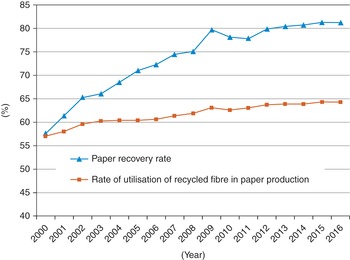
It is necessary to enhance the efficiency of 3R approaches on paper in large economies to contribute to global sustainable management of forests. Notably, impacts of 3R approaches on paper vary depending on the origin, type and status of trees used for material and the processes used in production and recycling (Čabalová et al. Reference Čabalová, Kačík, Geffert and Kačíková2011). In the case of Japan, efforts of industrial sectors related to paper production and facilitation of collective collection of used paper supported by municipalities contributed to the continuous enhancement in efficiency of paper recycling since the 1980s (synergies with SDG 9). Policies and institutions exist to facilitate recycling of resources, including the Act on Promoting Green Procurement, in force since 2001, that regulates the ratios of used paper content in paper-production materials (see also Box 12.3).
12.5 The Role of Business as an Actor in Forest Resource Management
Business is a main actor in global forest-commodity and agricultural value chains that place pressure on forest resources. Its active participation and contribution will be crucial to achieving SDG 12 and the wider goals of sustainability of forest resources and livelihoods. Target 12.6 specifically addresses the private sector: ‘encourage companies, especially large and transnational companies, to adopt sustainable practices and to integrate sustainability information into their reporting cycle’. A widespread practice of businesses in the forest industry is to prepare sustainability reports, which often rely on forest certification schemes, among others, in accounting for their sustainability performance.
In addition to reporting, there are several approaches companies of all sizes can use to help achieve SCP targets, including multinationals, local small and medium-sized enterprises and smallholders and communities controlling forest resources. In relation to global forest commodity chains, in the following section we focus on forest certification schemes, and zero-deforestation initiatives, especially those linked to palm oil. Regarding forest livelihoods, we discuss analogue forestry models and Indigenous practices.
12.5.1 Forest Certification Schemes
Several targets of SDG 12 are connected to the implementation of international and national forest certification schemes that seek to help manage natural and planted forests resources more sustainably and efficiently (Target 12.2). Such schemes can enable businesses to improve sustainability performance and adopt sustainable practices (Target 12.6); they can help the public sector to promote and adopt SPP practices (Target 12.7); and, by tracking forest product production and manufacturing via chains of custody, they can inform consumers about sustainable development (Target 12.8).
The two major international certification systems are the FSC and the Programme for the Endorsement of Forest Certification (PEFC). These two systems use internationally agreed upon principles of sustainable forest management and adopt mechanisms that favour their voluntary, credible, transparent, cost-efficient and non-discriminatory nature with respect to forest types and owners. The FSC and PEFC dominate forest certification worldwide in terms of land area. The FSC is a globally applied system, while the PEFC has criteria and rules to endorse national certification systems.
The FSC promotes a triumvirate of environmentally responsible, socially beneficial and economically viable forest management. By 2018, FSC-certified forest area exceeded 200 million ha (UNECE/FAO 2018). The PEFC originally worked mostly in Europe and North America but has expanded to South America and East Asia, with certification in Central and South America carried out since the 1990s (Romero et al. Reference Romero, Putz and Guariguata2013). Working to overcome high certification costs, both the PEFC and the FSC developed and popularised group certifications, supporting community forests, small-scale private forest owners and small rural communities to become incorporated into sustainable forest management efforts.
The total global certified forest area, subtracting double counting, was 431.4 million ha in mid-2017, up by 3.7 million ha from December 2016. The uptake of forest certification, including the FSC and PEFC, has been particularly strong in the UNECE region, which hosts 85 per cent (about 365 million ha) of the forest area certified globally. In 2016, about one-third of the global industrial roundwood supply originated in certified forests (UNECE / FAO 2018). Most certified forests are located in high-income countries, and 90 per cent in boreal and temperate forests (MacDicken et al. Reference MacDicken, Sola and Hall2015). Of the total area certified, 47 per cent is in North America, 38 per cent in Europe (of which, 53 per cent is in the EU, and 31.5 per cent in Russia), 5 per cent in Oceania, 4.5 per cent in Asia (half of which is in East Asia), almost 4 per cent in South America and the Caribbean (half of which, Brazil) and 1.4 per cent in Africa.
Forest certification schemes were created to advance sustainable forest management, including environmental, social and economic aspects (Romero et al. Reference Romero, Putz and Guariguata2013). Certification in tropical forests is associated with social and environmental benefits (Burivalova et al. Reference Burivalova, Hua, Koh, Garcia and Putz2017). Nevertheless, in developing countries it is often not financially sustainable in the short term without external subsidies, as good management practices tend to imply higher costs, even if price premiums on products are sometimes obtained. Benefits from price premiums and market access are limited, but certification yields social benefits including learning, governance, community empowerment and reputational benefits (Carlson and Palmer Reference Carlson and Palmer2016).
Other studies focus on individual regions and countries. For example, in Indonesia, Miteva et al. (Reference Miteva, Loucks and Pattanayak2015) suggest that forest certification schemes have reduced deforestation by 5 per cent, air pollution by 31 per cent, firewood dependence by 33 per cent and respiratory infections by 32 per cent, but they had no effect on fire incidence and increased forest perforation. In Brazil, McDermott et al. (Reference McDermott, Irland and Pacheco2015) indicate that forest certification initiatives have favoured large firms and external markets, while smallholders’ disadvantaged position due to tenure insecurity, complex forest registration, planning and management requirements has led to less success in reducing forest degradation and generating local benefit. In the Congo basin, Cerutti et al. (Reference Cerutti, Lescuyer and Tacconi2017) argue that forest certification has resulted in better working and living conditions for workers and their families, better negotiation institutions between the local population and logging companies, more effective benefit-sharing mechanisms, and respect for customary rights in forest areas for agriculture, hunting and collection of non-timber forest products. Certification in Mexico had no clear impacts on deforestation (Blackman et al. Reference Blackman, Goff and Planter2018), but it did help community forest enterprises and small carpentry workshops, with support of NGOs and government agencies, to promote sound forest management, rural development and SCP practices (Klooster Reference Klooster, Ponte, Gibbon and Vestergaard2011).
An analysis in the EU by Gómez-Zamalloa et al. (Reference Gómez-Zamalloa, Caparrós and Ayanz2011) shows that ecologically (i.e. biodiversity, structure and function of forests), the impacts of certification schemes are positive; economically (i.e. price of wood, price of certified products and market access), consumers would be willing to pay slightly more for certified products, but forest owners would have to bear the certification costs themselves; and socially, certification schemes would increase public knowledge of certification and increase social integration into forest management. In the EU, forest certification challenges included fragmented forest ownership and rural abandonment, but not excessive legislation (Gómez-Zamalloa et al. Reference Gómez-Zamalloa, Caparrós and Ayanz2011). In North America, Moore et al. (Reference Moore, Cubbage and Eicheldinger2012) found that certified organisations increased forest inventory programmes, established geographic inventory systems, controlled exotic invasive species, monitored chemical use and best management practices, and increased natural heritage planning. They also increased social and community efforts through releasing management plans, reporting their programmes and consulting with the public, and they promoted outreach and extension activities. Forest certification effects in Estonia, Germany, Latvia, Russia, Sweden and the UK showed significant improvements within certified forests (Hirschberger Reference Hirschberger2005): ecologically (protection of natural reserves and key habitats, increase in deadwood, restoration of threatened forest types), economically (marketing of forest products, income, recreational use) and socially (health and safety legislation, equipment and training, worker qualifications, employment rights, local stakeholder decision-making). The case study in Box 12.1 looks at the impacts of forest certification schemes on biodiversity in more detail by comparing the cases of Sweden and Russia, the two biggest FSC-certified countries in Europe.
Sweden and Russia are the two biggest FSC-certified countries in Europe and have a high opportunity for biodiversity and conservation (Elbakidze et al. Reference Elbakidze, Angelstam, Andersson, Nordberg and Pautov2011). Russia holds the largest area of forest on the planet (815 million ha) and the largest area of primary forest (273 million ha); it certifies 60 million ha through the FSC and PEFC (FAO 2015). Sweden holds the second largest area of certified forest (28 million ha) and certifies 23 million ha under the FSC and PEFC (FAO 2015). Forest certification schemes deliver biodiversity conservation through maintaining/improving ecologically valuable forest land, preventing conversion of forests to cropland, and reducing logging pressure on high-conservation-value forests (Gulisson Reference Gulisson2003). A study on forest sites in Sweden and Russia (Elbakidze et al. Reference Elbakidze, Angelstam, Andersson, Nordberg and Pautov2011) investigates biodiversity conservation at spatial scales from individual trees to stands to landscapes, and finally to eco-regions. This analysis shows that the Russian standard implied higher ambitions related to biodiversity conservation than the Swedish standard at various spatial scales – mainly larger ones. The reasons are that Russia contains three times more land set aside for focal species and ecosystem connectivity; Russia has less history of forest management and thus more abundant naturally dynamic forests with high biodiversity value; also, Russian forests are state-owned, while in Sweden there is a mix of public, state, industrial and private ownership. The role of national FSC standards for biodiversity in these cases is positive, but the standards need to be integrated with formal forest protection at various spatial scales, and require the collaboration of different stakeholders.
12.5.2 Deforestation-Free Supply in Forest-Risk Commodities
Companies are increasingly committing to embrace sustainable supply and, specifically, to delink their supply chains from deforestation in response to increasing consumer pressure. Zero-deforestation commitments have been adopted by consumer goods companies, traders and retailers in the context of the Consumer Goods Forum in 2010 and the New York Declaration of Forests in 2014. These companies have been putting pressure on their suppliers to embrace similar types of commitments. Private sector commitments aimed at eliminating deforestation from a company’s operations or supply chain involve objectives with different levels of ambitions (Jopke and Schoneveld Reference Jopke and Schoneveld2018). Lambin et al. (Reference Lambin, Gibbs and Heilmayr2018) suggest that these commitments take different forms (e.g. codes of conduct, individual and collective pledges) and often fall short in achieving their targets. Company pledges vary in the degree to which they include time-bound interventions and the definitions and criteria to achieve verifiable outcomes. According to these same authors, in terms of short- and long-term sustainability for forest resources, ‘zero-deforestation policies by companies may be insufficient to achieve broader impact on their own due to leakage, lack of transparency and traceability, selective adoption and smallholder marginalisation’ (Lambin et al Reference Lambin, Gibbs and Heilmayr2018: 109).
In the specific case of palm oil, the major traders and corporate groups producing it (Wilmar, Musim Mas Group, Golden Agri Resources, Cargill) in Malaysia and Indonesia, which are the main producer countries, have adopted No Deforestation, No Peat and No Exploitation policies. While these groups have placed pressure on their third-party suppliers to comply with zero-deforestation commitments, this has proven difficult to achieve in practice, particularly with independent smallholders, a portion of which also supply to independent mills (Skye and Paoli Reference Skye and Paoli2015). Some of the main palm oil corporate groups had already certified part of their operations based on the Roundtable on Sustainable Palm Oil (RSPO) standards (Box 12.2). However, voluntary certification was questioned for failing to reduce the expansion of oil palm plantations into forest lands (Pirard et al. Reference Pirard, Fishman, Snych, Kbidzinski and Pacheco2015). An alternative approach to the High Conservation Value concept that is part of the RSPO criteria adopted by companies is the High Carbon Stock approach, which provides clearer criteria for ensuring compliance with zero-deforestation commitments (HCSA 2016).
The RSPO was established in 2004 as a non-profit, industry-led trade organisation to promote the production and use of sustainable palm oil (Oosterveer et al. Reference Oosterveer, Adjei, Vellema and Slingerland2014). The RSPO provides certification for sustainably produced palm oil (Certified Sustainable Palm Oil-CSPO) based on its principles and criteria, which include conservation of biodiversity and natural resources and reductions in greenhouse gases. The RSPO emerged through a multi-stakeholder process, including private sector and civil society organisations. Since its inception, the RSPO has seen a slow but steady uptake of the standard. As of March 2018, 19 per cent of global palm oil production was RSPO-certified (RSPO 2018). Recent research suggests RSPO certification has reduced losses of primary forests in certified plantations; yet, it also found that certified operations were those with more consolidated plantations, likely with few forests under pressure (Carlson et al. Reference Carlson, Heilmayr and Gibbs2018). Certification of palm oil plantations has been slower in new frontier areas.
Transnational processes, such as the EU Renewable Energy Directive, have included RSPO as part of the different certification mechanisms to ensure compliance with sustainable palm oil supply for the EU biodiesel market. There is an ongoing debate about whether the EU should apply more stringent criteria for the procurement of palm oil, including a ban on palm oil for biodiesel. A long-awaited EU Action Plan on Deforestation and Forest Degradation – suggested in 2017, discussion to be initiated in 2019 – may eventually consider options for strengthening EU regulations on supply chains of agro-commodities and other forest-risk commodities as a way to reduce their negative effects in producer countries. The Amsterdam Declaration – a group of seven European countries (Denmark, France, Germany, the Netherlands, the UK, Norway and Italy) – committed to 100 per cent sustainable sourcing of palm oil by 2020, relying on RSPO standards.
Initiatives formulated under zero-deforestation frameworks by major corporate groups, while relying on sustainable palm oil certification, are trying to move beyond the uptake of voluntary sustainability standards such as RSPO to make a stronger case for more explicit criteria on zero deforestation. RSPO, through RSPO Next, is considering the inclusion of explicit zero-deforestation criteria in order to improve the accountability of company commitments (Jopke and Schoneveld Reference Jopke and Schoneveld2018).
The main issues for companies have been tracing their suppliers, particularly independent farmers, and the complex local market networks dominated by intermediaries (Jelsma and Schoneveld Reference Jelsma and Schoneveld2016). In this same vein, Lyons-White and Knight (Reference Lyons-White and Knight2018) identify a number of barriers to the realisation of zero-deforestation supply chains in the palm oil sector. Barriers include perceived incompatibility of no-deforestation commitments and development priorities and the complexity of the supply chain – hindering the implementation of no-deforestation commitments by obscuring palm oil traceability and hindering engagement with indirect customers or suppliers. The existing model ‘in which companies adopt unilateral no-deforestation commitments is unsuited to the complexity of the palm oil supply chain and is, therefore, likely to fail’ (Lyons-White and Knight Reference Lyons-White and Knight2018: 311).
In order to tackle these challenges, new initiatives are emerging to foster partnerships between the public and private actors in the palm oil sector, particularly in Indonesia. These initiatives, often orchestrated by NGOs, aim at supporting private efforts to clean supply chains, mainly through improved traceability systems and delivery of technical services to independent farmers while also promoting more active government engagement, mainly in land-use planning and land-tenure regularisation – particularly at the provincial level (Luttrell et al. Reference Luttrell, Komarudin and Mike2018). Pacheco et al. (Reference Pacheco, Schoneveld, Dermawan, Komarudin and Djama2018) argue that these initiatives constitute experimentalist approaches with potential to overcome main performance gaps in the palm oil sector (i.e. land-tenure conflict, yield differences between large- and small-scale producers and carbon debt). These initiatives have three broad objectives: (1) to refine and harmonise sustainability regulations, standards and tools; (2) to implement business models that increase productivity while overcoming the challenges of involving smallholders; and (3) to reconcile value-chain interventions with territorial perspectives by adopting jurisdictional approaches. These approaches are receiving increasing attention and are increasingly orchestrated by provincial-level governors and facilitated by NGOs, which tend to operate as intermediaries.
12.5.3 Forest Livelihoods, Analogue Forestry and Non-Timber Forest Products
Forests provide food, wood energy, medicines, fodder, fibre, income and employment opportunities, as well as ecosystem services such as biodiversity and climate regulation. An example of how the objectives of forest-based livelihoods and forest conservation can be aligned is through approaches such as analogue land-management techniques to create biodiverse agroforestry systems inspired by mature forest ecology (and, hence, ‘analogous’ in structure and function). Furthermore, many Indigenous practices can be linked to analogue forestry.
Analogue forests differ from traditional agroforestry in their emphasis on mimicking native forest structure and in their biodiversity. This increases their utility, both in diversity of production and in the ecosystem services they provide. They are more effective as biological corridors since their structure more closely approximates a natural forest and the remnant forest patches they seek to connect (Dickinson Reference Dickinson2014). The inherent species richness in analogue forestry systems can provide diversified income streams by providing multiple products that offer a variety of processing and marketing opportunities. For example, systems that produce non-timber forest products (NTFPs) such as spices (e.g. vanilla, nutmeg, cinnamon and black pepper) can also produce cut flowers, animal fodder, rice, beans, bamboo and plants for essential oils such as patchouli (Aguilar and Gates Reference Aguilar and Gates2013). The viability of this approach from an economic perspective depends on markets for the products. Value can be added by using a label or brand associated with a set of production standards, such as third-party or participatory guarantee systems (Aguilar and Gates Reference Aguilar and Gates2013). The International Federation of Organic Agriculture Movements (IFOAM) standard to certify forest garden products (FGP) is an example of how analogue forestry can be linked to international forest value chains. The certification aims to develop markets for products such as teas, spices, tamarind, guaraná, nuts and other products from countries including Sri Lanka, India, Vietnam, Thailand and Brazil (IAFN 2014).
An example of a sustainable NTFP from Brazil is the açai berry, which can be harvested through sustainable agroforestry practices that support local livelihoods and forest conservation efforts (Tunçer and Schroeder Reference Tunçer, Schroeder, Tischner, Stø, Kjaernes and Tukker2010). Another example is the Brazil nut, a crucial non-timber product in the Amazon – a very tall (up to 50 m), slow-growing, carbon-rich species that can live for over 500 years and thrives in dense, undisturbed rainforests. Sustainable exploitation and regeneration of such species is crucial to secure this practice and product into the future (Wadt et al. Reference Wadt, Kainer, Staudhammer and Serrano2008). Analogue forestry is a recent concept that needs to be tested in specific local conditions; SCP and SDG 12 could be an approach to enhance the economic viability of its broader application.
12.6 Sustainable Public Procurement Policies
Target 12.7 – ‘promote public procurement practices that are sustainable, in accordance with national policies and priorities’ – is closely related to forest certification schemes. Public procurement represents 5–20 per cent of total forest product consumption; the indirect impact on the sector is much larger. Certification schemes often serve procurement policies as a tool to verify and demonstrate that products come from sustainably managed forests. There is a large number of countries that have specific public procurement policies for forest products. This section looks at sustainable public procurement (SPP) schemes and their links to certification schemes such as the FGP for the international market, the BES 6001 Responsible Sourcing of Construction Products and other standards. SPP schemes are expected to enable regime shifts towards sustainable societies with socio-economically and environmentally harmonised production and consumption cycles (Trindade et al. Reference Trindade, Antunes and Partidário2018). In 2017, the International Organisation for Standardisation (ISO) issued a new standard, ISO 2040, to guide sustainable procurement. This new standard can be used to facilitate the introduction of SPP in public sectors. The development of information technology is another factor that can support SPP. In the academic discourses on SPP, the contribution of E-procurement and communication with suppliers to facilitate SPP is discussed (Walker and Brammer Reference Walker and Brammer2012). SPP practices are implemented in different regions of the world; however, the concept of SPP varies significantly among sectors and regions (Walker and Brammer Reference Walker and Brammer2009, Reference Brammer and Walker2011). For example, while local authorities tend to focus on buying from local and small-sized suppliers to facilitate production and consumption cycles in the given region, education sectors emphasise environmental aspects (Walker and Brammer Reference Walker and Brammer2009). These kinds of variations may cause conflicts among stakeholders, hindering national and international collaborations on SPP.
Appropriate timing is required when introducing SPP, considering the specific markets of the countries involved (Crespin-Mazet and Dontenwill Reference Crespin-Mazet and Dontenwill2012). Individual regions, with different market characteristics, need to develop their own concepts and schemes of SPP. Finding similarities among SPP regions, as well as individual uniqueness, and sharing knowledge and experience regarding SPP can contribute to global collaboration for facilitating such schemes. Furthermore, considering the cultural background of regions and implementing educational activities can facilitate the implementation of SPP (Aragão and Jabbour Reference Aragão and Jabbour2017, Delmonico et al. Reference Delmonico, Chiappetta Jabbour and Pereira2018).
In recent academic discourses, SPP has been discussed in the framework of green public procurement (Lundberg and Marklund Reference Lundberg and Marklund2018). The need for scientific evidence on effects of SPP to support decision-making on SPP schemes in relation to forest sectors has been emphasised (Cerutti et al. Reference Cerutti, Ardente, Contu, Donno and Beccaro2018). One of the major challenges is to link global forest certification systems such as the PEFC and FSC with SPP initiatives. An example of standards for building and construction within SPP policies is the BES 6001 Responsible Sourcing of Construction Products (UNECE / FAO 2016). It requires a range of life-cycle criteria to be met as part of the procurement process for construction materials. If mainstreamed across public procurement systems, it has the potential to influence the entire life-cycle of materials. However, as it stands, it is likely to mainly impact the production and consumption phases. At the end of 2014, the total number of valid BES 6001 certificates stood at 89, covering 76 companies. Recently, the FGP was approved by IFOAM-Organics International. FGP is the first set of organic standards developed in countries of the Global South and emphasises the place-based and sustainable production activities to produce forest products. Choosing the products with appropriate certificates to circulate them through SPP can enhance the effects of SPP on the aspects of environment, economy and society in individual countries and regions. Several national PEFC standards have been established in developing countries, such as the Philippine Sustainable Forest Certification System or the Pan-African Forest Certification (covering Cameroon, Congo and Gabon).
While the Japanese government has not yet conducted SPP in all three aspects – environment, economy and society – the 2001 Act on Promoting Green Procurement emphasises the environmental ones. Based on this Act, the national and local governments and independent administrative institutions introduced green procurement practices. The government and institutions have an obligation to procure products and services that can reduce environmental impacts (Ministry of the Environment 2001). The definition of eco-friendly is updated once a year; the 2017 guidelines promoted the procurement of 274 products and services in 21 sectors (Ministry of the Environment 2017).
Regarding SPP in forestry sectors, Japan has yet to develop regulatory frameworks to prohibit and reduce illegal logging. The above Act is only a policy to facilitate the procurement of legal timber and wood products (Shimamoto Reference Shimamoto2014). The SPP guidelines include specific guidelines for forest products, including legality and sustainability certification of timber and wood products, and credit for procurement of certified timber and for use of lumber and wood chips from thinning. Nevertheless, other countries and environmental NGOs argue that Japan provides a market for illegal forest products because they lack relevant regulatory frameworks (Shimamoto Reference Shimamoto2014). Furthermore, public procurement of wood products is estimated to account only for 2–3 per cent of the national demand (Morita Reference Morita2007). To promote green procurement, the ‘Eco Mark’ label is used to help users find the promoted products and services under the Act. However, uptake of green procurement among private sectors and improvement of the schemes to mainstream SPP among the government remain challenging tasks (CSO Network Japan 2017).
12.7 Sustainable Tourism Plans and Monitoring
Target 12.B – ‘develop and implement tools to monitor sustainable development impacts for sustainable tourism that creates jobs and promotes local culture and products’ – has relevance to forest conservation and sustainable forest management, and has potentially positive impacts on livelihoods. Although Target 12.B only asks for tools to monitor impacts, there is a link with the programmatic area of Sustainable Tourism of the 10YFP under Target 12.1. Some limited evidence indicates that establishing closer links between sustainable tourism and forest management would potentially benefit and support forest conservation.
We have explored the potential benefits and possible trade-offs between sustainable tourism (e.g. ecotourism, community-based tourism) and forests in different country contexts. However, the empirical evidence base is not solid as there is only limited research on the impact of nature-based tourism on forests. IUFRO recognises the potential of sustainable tourism and nature-based tourism for forest conservation efforts, while at the same time acknowledging the need for more research to examine how land-management agencies can use innovative techniques to incorporate local community residents into tourism decision-making (IUFRO 2017). IUFRO also emphasises that forest managers and policymakers have yet to recognise the potential benefits that quality nature-based tourism planning and management can bring to local communities and forest conservation.
Forest landscape management is extremely complex, involving a wide range of factors and institutions; integrating nature-based tourism considerations into the management plans increases both complexity and the number of stakeholders, posing challenges to implementation. According to Rizio and Gios (Reference Rizio and Gios2014), the difficulties involved in the coordination of such a complex system stem from the multiple interests, stakeholders and utility flows. The whole set of forest and tourism management tools and mechanisms needs to be integrated into a collaborative management approach in order to achieve long-term sustainability through nature-based tourism. There are opportunities to align nature-based tourism and sustainable forest management in a collaborative approach.
The focus on operating an economically viable tourism destination that also conserves forests could be a successful approach to forest conservation for local governments, financing the conservation of the forest area and funding forest reserves through tourism. In addition, designation of land and forests as sustainable tourism destinations can be a way to protect them from invasions and illegal deforestation activities. A prominent example is Costa Rica, which has successfully pursued this approach (Bien Reference Bien2010); the integration of farming communities and Indigenous communities into ecotourism has had positive livelihood impacts through improving marginal sources of incomes. At the same time, this approach can support official acknowledgement of the ecological importance of the forest region by locals, government and tourists (which links to Target 12.8).
The variety of forest landscapes, in terms of wildlife and the ecosystems more generally, offer numerous opportunities for tourism. Forest peoples often play a role in making a place tourist-friendly, both in terms of interesting cultural features and in terms of their role in managing services. Forest landscapes often serve at least two functions within the local tourism context: they are both a good in their own right and a background for the pursuit of sustainable recreational activities. Furthermore, these tourism uses provide potential income sources for the local population. To conclude, key issues for Target 12.B are to monitor (and control) overuse of protected areas for tourism and promote benefit sharing with local populations.
12.8 Fossil Fuel Subsidy Phase-Out and National Bioenergy Policies and Strategies
Target 12.C is to
rationalise inefficient fossil fuel subsidies that encourage wasteful consumption by removing market distortions, in accordance with national circumstances, including by restructuring taxation and phasing out those harmful subsidies, where they exist, to reflect their environmental impacts, taking fully into account the specific needs and conditions of developing countries and minimising the possible adverse impacts on their development in a manner that protects the poor and the affected communities.
It relates directly to SDG 7 (Affordable and Clean Energy) and SDG 13 (Climate Action).
According to the International Monetary Fund, fossil fuel subsidies amounted globally to USD 233 billion in 2015 – more than four times the subsidies promoting renewable energy. Fossil fuel subsidies have a negative impact on the development of renewable energy (Bridle and Kitson Reference Bridle and Kitson2014). The elimination of fossil fuel subsidies would not only be beneficial from a climate change perspective (creating synergies with SDG 7 and 13), since these subsidies work in practice as a negative carbon price, but would also help eliminate a significant market distortion that encourages inefficient consumption of fossil fuels (Sampedro et al. Reference Sampedro, Arto and González-Eguino2018). The overall environmental benefit of phasing out fossil fuel subsidies will be positive, especially for the global climate in terms of reducing CO2 emissions from sectors dependent on fossil fuels.
It is unclear how the phase-out of subsidies would affect forests. The concern is that it could increase the use of forest resources for energy generation (e.g. traditional biomass, fuelwood, pellets). Although the issue of subsidies for the production and use of biomass, bioenergy and biofuels is not included in Target 12.C, we consider these interlinked issues of fossil fuel phase-out important in relation to national strategies for bioenergy and biofuels. Production, processing and use of forest-based biomass for energy is not necessarily harmful to forests, but it does require careful policy design to avoid trade-offs and unintended consequences.
EU member states have committed to phase out environmentally harmful studies – including fossil fuels – by 2020. European governments have made parallel pledges to end inefficient fossil fuel subsidies under the G7 and the G20. Despite the commitments, 11 European countries and the EU provided at least EUR 112 billion annually during the period 2014–2016 in subsidies towards fossil fuel production and consumption, with EUR 4 billion from the EU itself (Whitley et al. Reference Whitley, van der Burg, Worrall and Patel2017). Fiscal support and other measures for subsidies included, as in the case of Italy, a reduction on tax applied to diesel used in the agricultural sub-sectors of farming, horticulture, forestry and aquaculture, as well as VAT concessions to petroleum products for use in agriculture, forestry and inland fisheries (Whitley et al. Reference Whitley, van der Burg, Worrall and Patel2017). According to research by Chatham House (Brack Reference Brack2017), many policies intended to boost biomass use are ‘not fit for purpose’ because they inadvertently increase pollution by ignoring emissions from burning wood in power stations and failing to account for changes in forest carbon stocks. The UK rules for bioenergy and those recently revised by the EU are inadequate for managing and monitoring emissions from burning biomass. Global electricity generation from biomass, including wood pellets, more than doubled from 2005 to 2015, and the EU has emerged as the world’s biggest user of biomass for electricity generation: bioenergy is expected to contribute 57 per cent of the EU’s total renewable energy by 2020 (Brack Reference Brack2017). The implications of these growth trends for forests, forest-based products and the climate have yet to be systematically analysed.
Optimisation of biomass-flow cascades increase resource-use efficiency and may reduce competition; however, there may be trade-offs, again between SDG 2 (Zero Hunger) and SDG 15 (Life on Land). For example, using crop residues for bioenergy or roughage supply may leave less carbon and nutrients on cropland, reduce soil quality and carbon storage in soils and increase the risk of losses of carbon through soil erosion. Residues are also often used as forage, particularly in the tropics (Smith et al. Reference Smith, Bustamante and Ahammad2014). In conclusion, Target 12.C’s impacts on forests can be positive, but due to complex interlinkages between sectoral fuel and biomass subsidies, safeguarding measures are needed for mitigating and avoiding possible negative outcomes.
12.9 Conclusions
Although SDG 12 targets do not explicitly mention forests and forest-based livelihoods, and even though they mainly take a so-called efficiency approach to SCP, our assessment shows that the targets are important for forest conservation and forest livelihoods. Absolute limits to consumption of resources such as forest products or meat are not part of SDG 12, and the targets do not address systemic issues of deforestation and overconsumption of forest resources and agricultural products that drive deforestation. Therefore, the overall benefits of SDG 12 to long-term sustainability of forests and forest livelihoods are limited to slowing down impacts, rather than reversing unsustainable trends. Unless mainstreamed throughout the economy, it is unlikely that the important Target 12.2 (by 2030, achieve the sustainable management and efficient use of natural resources) will be met through the approaches presented under this SDG, such as consumer education, SPP, voluntary sustainability initiatives and reporting by the private sector, food waste reduction, eco-labelling and sustainable tourism. Therefore, measures to be taken under other SDGs, notably SDG 15, are necessary. Regarding SDG 12 target implementation, the main programme covering various issues is UNEP’s 10YFP on SCP. Our analysis shows that the 10YFP does not specifically focus on forests or forest livelihoods; however, some of the initiatives, such as SPP, consumer information and eco-labelling, are consistent with and linked to ongoing efforts to further SCP of forest commodities. There are potentials for the 10YFP to initiate more specific activities and programmes to directly address forest protection and livelihoods.
Linking national and sub-national deforestation analyses with national SCP plans could be a promising strategy, especially SPP schemes or national sustainable tourism development plans and policies. SPPs are useful tools to promote the uptake of forest certification schemes to achieve SDG 12 with potentially positive impact on forests.
National governments and large companies involved in global value chains of forest products and agricultural commodities will be the main players for achieving SDG 12 targets. How SDG 12 can be leveraged to advance conservation efforts for forests is, however, not straightforward. We have attempted to provide a number of examples of how synergies between SDG 12 and forest protection and livelihoods can be created. SDG 12 can possibly also address and lessen trade-offs between other SDGs such as SDG 2 and SDG 15 (food production versus biodiversity and forest conservation) and SDG 9 and SDG 15 (industrialisation versus biodiversity and forest conservation) (See Table 12.3). To enhance forest conservation through SCP, a more integrative approach addressing systemic issues needs to be adopted. This would include efforts to address industrial drivers, poverty, food security and other underlying causes of deforestation, such as increasing levels of consumption driven by consumerism.
| Target | Synergies and Trade-offs | Chapter Section |
|---|---|---|
| 12.1 | Synergies | 12.2 |
| Improve resource efficiency in production and consumption and decouple economic growth from environmental degradation in accordance with the 10YFP (8.4) | ||
| Mobilise resources to finance sustainable forest management (15.B) | ||
| 12.2 | See SDG 12.6 | 12.5 |
| 12.3 | Synergies | 12.3 |
| Ensure sufficient food and end hunger (2.1) | ||
| Ensure sustainable food production that maintains ecosystems and improve soil and land quality (2.4) | ||
| Improve diversity of terrestrial landscapes and reduce the need for deforestation (15.1, 15.2) | ||
| 12.4 | Synergies | 12.4 |
| Reduction of waste and toxic chemicals dumped in forest areas (15.1, 15.2) | ||
| 12.5 | Synergies | 12.4 |
| Foster innovation to tackle waste through environmentally sound technologies (9.4) | ||
| Strive for a land degradation-neutral world (15.3) | ||
| Integrate ecosystem values into planning (15.9) | ||
| Mobilise finance and provide incentives for sustainable forest management (15.B) | ||
| Improve multi-stakeholder partnerships (16.7, 17.16) | ||
| 12.6 | Synergies | 12.5 |
| Improved biodiversity (15.2) | ||
| Reduced deforestation (15.1) | ||
| Reduced GHGs (13.2) | ||
| Improved welfare and access to land (1.4) | ||
| Improved working conditions and safety (8.4, 8.8) | ||
| Improved negotiation between actors (16.7, 17.16) | ||
| Trade-offs | ||
| Can increase forest canopy perforation (15.3) | ||
| Can reduce biodiversity in monodominant stands (15.1) | ||
| Can reduce profitability and productivity (8.2) | ||
| Can disadvantage smallholders and forest communities in their access to markets and multi-stakeholder partnerships (1.1, 8.4, 8.8, 16.7, 17.6) | ||
| Focus on large transnationals may limit economic, social and environmental links between rural to urban areas (11.A) | ||
| 12.7 | Synergies | 12.6 |
| Promote uptake of forest certification programmes (15.1) | ||
| Reduce corruption between local stakeholders, national authorities and international organisations and increase transparency (16.5, 16.6) | ||
| May be strengthened through considering cultural background of regions and education (11.4, 4.4) | ||
| 12.8 | Synergies | 12.5 |
| Promote uptake of forest certification programmes (15.1) | ||
| 12.A | Synergies | |
| Improve technical and statistical capacity to implement sustainable forest management (15.1) | ||
| 12. B | Synergies | 12.7 |
| Increase local income through diversification and innovation (8.2) | ||
| Raise local, government and tourist awareness of the value of nature heritage (11.4, 12.8) | ||
| Promote collaborative management approach between all actors (16.7, 17.16) | ||
| 12.C | Synergies | 12.8 |
| Increase the global share of renewable energy (7.2) | ||
| Reduce greenhouse gas emissions (13.2) | ||
| Improve economic and social viability of sustainable forest management (15.2) | ||
| Trade-offs | ||
| Bioenergy subsidies may reduce forest cover and biodiversity (15.1, 15.2) | ||
| May affect land that is currently used for agriculture (2.1, 2.4) |


 Open access