I. Introduction
AUTHORITARIAN regimes use their security forces to prevent or respond to the mobilization of mass resistance.Footnote 1 Yet security forces find it difficult to repress the dissidents who mobilize resistance because dissidents organize covertly.Footnote 2 Covertness presents an information problem: security forces must first identify and locate dissidents who mobilize popular threat before they can repress them.Footnote 3 As a result, regimes allocate repression across their territory consistent with available information on dissidents. One way regimes can address the information problem is civilian collaboration. For example, Argentina's 1976–1983 military regime told the public, “Your weapons are your eyes, your ears, and your intuition … Your information is always useful. Bring it to us.”Footnote 4 Why do civilians share such information about dissidents, and how does it shape repression?
This article considers the role of information provision by civilians in authoritarian regimes, particularly regimes that take power in reaction to mass mobilization and revolutionary threats. I argue that civilians share more information with regimes in areas that had intense political rivalries under democracy, altering the frequency and targeting of repression there.Footnote 5 Regimes seek out dissidents to prevent future mobilization,Footnote 6 but identifying them is difficult because their covert action and shared loyalties with civilians reduce the regime's ability to gather information from the population.Footnote 7 At the same time, greater divisions among civilians in areas with close political competition give regimes an opportunity to gather information because heightened political rivalries motivate civilians who support the regime to offer up political opponents as targets for repression.Footnote 8 Inviting repression of political opponents reduces the electoral influence of those opponents while satisfying the civilians’ desire to inflict harm on them. But supporters invite repression against any civilian regime opponents rather than against just the smaller subset of dissidents that the regime prefers to target.Footnote 9 This argument implies that in areas of close political competition, civilians’ political rivalries lead regimes to repress more frequently and to target more non-dissidents than in areas without close competition.Footnote 10
There are two main empirical challenges in testing the argument's implications. First, the argument applies to preventive repression—cases in which regimes repress dissidents to stop the mobilization of latent opposition.Footnote 11 Yet repression can be also be responsive, and in such cases, regimes use coercion to curtail overt resistance, such as protests. A research design that does not separate the two will produce biased estimates because preventive and responsive repression relate to opposition differently.Footnote 12 Despite this potential source of bias, research designs that distinguish types of repression are rare.Footnote 13 Second, the relationship between political competition and repression often runs in both directions: repression affects preferences toward the regime,Footnote 14 attitudes toward other civilians,Footnote 15 and induces civilians to conceal their true preferences,Footnote 16 which thereby affect competition. Addressing reverse causality requires measuring political competition in a manner free of the effects of anticipated or actual repression.
In this article, I examine repression in the first months after the September 1973 military coup in Chile—a period with intense partisan rivalries and qualitative evidence of civilian information provision. The coup deposed democratically elected Marxist President Salvador Allende and brought Augusto Pinochet's military dictatorship to power. This setting allows me to address the two empirical challenges. To address the two types of repression, I leverage that, after the coup, the military regime repressed to prevent the mobilization of popular threats rather than repress in response to them.Footnote 17 The postcoup period isolates preventive repression, providing a clean test of the argument. To address reverse causality, I leverage Chile's pre-coup status as a liberal democracy.Footnote 18 In the democratic period, Chile's armed forces did not credibly threaten repression, nor did civilians expect the military to retain power and repress with frequency after a coup.Footnote 19 Prior to September 1973, Chilean civilians expressed political views free from the effects of regime violence.
I use original archival data on the political killings of 1,141 people in the period after the coup to estimate the relationship between political competition and the frequency and targeting of repression across Chile's municipalities. The regime killed significantly more victims in municipalities with close political competition between Allende's legislative coalition and its political opponents than in municipalities without close competition. The regime also killed more non-dissidents (individuals not active in organizations the regime prioritized as targets) in municipalities with close elections than in those without close elections. These relationships are robust to different measurements of close elections and dissident classifications, while placebo tests and sensitivity analyses strengthen the findings.
Following the main results, I qualitatively trace the partisan rivalry mechanism. Using analyses of archival and primary source evidence, I compare two sets of municipalities with close political competition and frequent civilian denunciations in the months after the coup. Qualitative accounts suggest that denunciations of political opponents in these otherwise contrasting municipalities resulted from high levels of pre-coup political competition between workers and owners. Corroborating these qualitative accounts with evidence of denunciations that is more indirect, I show partisan rivalries correspond to civilians’ active participation in repression with data from Chile's Truth and Reconciliation Commission report.
I also address alternative explanations. First, I consider the possibility that increased repression in areas of close political competition resulted only from the regime's strategic purposes rather than from an information problem that was resolved by civilians. For example, in these municipalities, General Pinochet's military dictatorship could have repressed more frequently to reinforce political control for itself or for its civilian supporters. Indeed, there is compelling evidence that the Chilean regime repressed to cultivate the backing of its civilian supporters.Footnote 20 I consider this possibility by evaluating whether the regime repressed its high-priority targets—members of violent militant groups—more frequently in municipalities with close competition. I find that repression of non-dissidents in these areas significantly exceeded the repression of militants in these same areas, supporting the hypothesized information problem explanation.Footnote 21
I further test the regime-strategy explanation by evaluating who fell victim to political killing when the regime had direct information on targets and ordered their repression. That is, inferring the regime's objectives for targeting requires identifying incidents of repression in which the regime's top leadership authorized violence with no information problem. I use historical data on a military unit, the Caravan of Death, that the regime sent to kill targets, and find that this unit killed members of militant groups, labor unions, and party activists, but not non-dissidents, in the municipalities it visited. I also consider alternative victim behaviors: that some dissident victims turned themselves in and that political killings occurred differently between urban and rural areas.Footnote 22
This article makes four main contributions. First, scholars often emphasize regime-based explanations for variation in repression, expecting state violence to differ with regime characteristics, such as democracy,Footnote 23 or its security forces’ ability to project force and carry out operations.Footnote 24 Furthermore, existing arguments emphasize that the targeting of repression corresponds to the efficiency or compliance of regime agents because personnel who lack incentives or institutional tools are less likely to align their targets with those of the regime principals.Footnote 25 By considering political rivalry, I advance a population-based explanation of how coercion varies even when regime attributes are held constant. Such a focus on variation in population characteristics is consistent with work on local political milieusFootnote 26 or relational ties between the regime and civiliansFootnote 27 that condition the activities of security forces.
Second, among the population-based explanations for repression, this article specifies a less-studied pathway: civilian contributions to state violence. In the study of authoritarian regimes, civilians tend to receive attention to the extent that they participate in anti-regime collective action, although some recent work focuses on the role of ordinary civilian regime supportersFootnote 28 and regime allies among the civilian economic elite.Footnote 29 By considering how regime supporters encourage repression, I highlight a distinct and consequential aspect of civilian agency in dictatorships—particularly in counterrevolutionary regimes in which violence reflects political rivalries from the period before a new regime takes power.Footnote 30 Furthermore, scholars who have studied civilian complicity in state violence detail both material and ideological incentives for the complicit.Footnote 31 My research suggests that in the absence of material inducements for civilian informants and in the presence of political instability, increased power through eliminating partisan rivals motivates civilians to abet state violence.
Third, considering civilian agency in regimes’ use of coercion adds to the literature on the legibility problem in preventive repression.Footnote 32 Christopher Sullivan, for example, argues that although “governments may prefer to repress mobilization prior to the onset of overt, collective challenges, they often have trouble identifying the initial instances of mobilization.”Footnote 33 Past research on solutions to the legibility problem concentrates on institutional explanations like the organization of intelligence servicesFootnote 34 or bureaucracy.Footnote 35 This article synthesizes insights from work on conventional civil conflictFootnote 36 and the sociological study of dictatorshipFootnote 37 to show that civilians offer a solution, however imperfect, to the problem. Furthermore, demonstrating comparable patterns from behind the front lines of civil conflict and from periods after dictators take power highlights a broader phenomenon: civilians embroiled in partisan rivalries exploit state violence to achieve their political goals and to bring harm to their opponents.
Fourth, the article suggests a mutually reinforcing relationship between repression and political competition. Recent scholarship has shown that experiences of repression affect the salience and nature of group identification, with the particular consequence of increasing social and political alienation between the repressed group and other, less-repressed groups.Footnote 38 I show, at least in the case of Chile, that a reverse process also occurs. That is, environments in which groups are in close competition for political power create favorable conditions for repression. More generally, the findings corroborate a central observation in work on democratic backsliding: intensely partisan civilians are willing to sacrifice democracy and the rule of law to harm or otherwise constrain their political opponents.Footnote 39
II. Popular Threats, Repression, and Political Competition
A restive population, which may overthrow a dictatorship in a mass uprising, threatens a regime's survival—particularly in periods around regime change and of political instability. Among those who mobilize a restive population are dissidents, individuals who “plan, publicize and initiate anti-regime protest.”Footnote 40 Dissidents carry out mobilization while embedded in a population. They have shared loyalties with local civilians who possess anti-regime attitudes. These shared loyalties are characteristics or organizational affiliations between dissidents and ordinary civilians, such as membership in the same ethnic group, social class, workplace, or religion. But unlike dissidents, civilian regime opponents generally do not exhibit anti-regime behavior absent large-scale popular mobilization like protests. Dissidents mobilize civilian regime opponents by leveraging social ties, organizations, and communication technology.Footnote 41 In turn, they rely on civilian regime opponents to conceal mobilization activities, which are most effective when covert.Footnote 42
By mobilizing groups of civilians for overt collective action, dissidents threaten a dictatorship's control over the population. These threats are especially acute in counterrevolutionary regimes—dictatorships taking power in reaction to mass mobilization that threatens established institutions—during their “chaotic” and “bloody” consolidation of power.Footnote 43 In the midst of such chaos, dictatorships turn to repression to maintain or reestablish control when other strategies to counter dissidents, such as cooptation, are ineffective.Footnote 44 Repression accomplishes this objective when it levies physical sanctions against dissidents embedded in the population, undercutting their covert efforts to organize overt, public resistance to a regime.Footnote 45 This repression occurs preventively, before dissidents can mobilize such public resistance.Footnote 46 Moreover, to avoid backlash, regimes prefer not to repress the civilians whom dissidents organize because mobilization grows when civilians learn of the regime's harshness and react angrily to violence against the population.Footnote 47
When carrying out preventive repression, regimes must choose how to allocate repression across their territory. Given the risk of popular threats, the regime should, in theory, condition the frequency of repression on the geographic location of dissidents who compose the threat. In targeting dissidents for repression, the dictatorship deters their mobilization efforts and thereby prevents dissidents’ followers from protesting in the future.Footnote 48 Yet a regime faces constraints on time and resources and must set priorities, increasing the frequency of repression in certain locations of popular threat over others.Footnote 49
Opposition strongholds are areas of popular threat in which a regime might prefer to repress more frequently. In them, dissidents have the highest concentration of civilian regime opponents to mobilize for protest. But these strongholds are difficult areas for the regime to exert control.Footnote 50 A regime has limited ability to repress in opposition strongholds because information about local dissidents is scarce. Opposition areas provide less information because shared loyalties between dissidents and civilian regime opponents make the latter unwilling to reveal dissidents’ identities, locations, or movements to the repressive apparatus.Footnote 51 As a result, dissidents become indistinguishable from the civilian population.
Dictatorships are particularly concerned about distinguishing dissidents from civilians so that dissidents can be repressed. Lisa Blaydes calls this the legibility problem.Footnote 52 French counterinsurgency theory, which influenced repression in many twentieth-century dictatorships,Footnote 53 elaborates: “In modern warfare, the enemy is far more difficult to identify. No physical frontier separates the two camps … it is a non-physical, often ideological boundary, which must however be expressly delineated if we want to reach the adversary and defeat him.”Footnote 54 If the regime fails to delineate this boundary and represses civilians instead, it leaves dissidents untouched while inflaming popular threat.Footnote 55
Regimes often have institutional tools, such as intelligence organizations, to solve the legibility problem.Footnote 56 But in counterrevolutionary regimes, dictatorships take power with “haphazard military organization” and “irregular networks of communication,” and thus, poor intelligence-gathering capabilities.Footnote 57 In such cases, areas of close political competition between regime supporters and opponents can also provide a solution to the legibility problem. In these areas more than others, civilians provide more information to the regime about potential targets of repression. Close political competition between civilian groups heightens political rivalries, which in turn motivate regime supporters to provide information about opponents who security forces should target for repression. Studies of historical dictatorships suggest that regime supporters provide information to encourage repression of those in the immediate area—including dissidentsFootnote 58 and civilian political rivals.Footnote 59 A similar process occurs behind the front lines of conventional civil conflicts. Heightened political rivalries in areas of close political competition motivate civilians to share information with security forces and participate in local acts of violence.Footnote 60 Civilian participation in violence, therefore, reflects and continues political conflict that existed before the new regime took power.Footnote 61
Close political competition generates information-sharing through both rational and emotional incentives. When rational incentives motivate regime supporters, particularly local elites, they “take into consideration the effects of violence for the future of their locality” and provide information to security forces to reduce regime opponents’ influence and secure future electoral gains.Footnote 62 The use of force against regime opponents in competitive areas alters the balance of electoral power in favor of regime supporters.Footnote 63 Emotional incentives also motivate regime supporters to share information. Close electoral competition sharpens identification with the civilians’ political in-group and decreases their identification with political opponents.Footnote 64 Strengthening in-group identification raises status passions—emotions of pride, envy, or spite—which create desires to protect the in-group and harm opponents.Footnote 65 Regime supporters convert these emotions into political actionFootnote 66 by providing information the regime needs to repress more possible targets. The first hypothesis follows.
—H1. Frequency Hypothesis. A dictatorship facing popular threat represses more frequently in areas with close political competition between regime supporters and opponents than in areas without close political competition.
Yet regime supporters do not share the regime's objectives about whom repression should target, creating a principal-agent problem between the regime and civilian informers.Footnote 67 Civilians are unreliable repressive agents who provide information that satisfies their grievances rather than the regime's objectives.Footnote 68 In an environment of close competition, regime supporters have grievances with any opponent in the population, not just those dissidents who most threaten the regime. Inviting violence against these opponents would change the balance of future electoral power and inflict harm on a desired target. By contrast, the regime prefers to target dissidents to reduce mass threat and prevent future mobilization against its rule. Repressing dissidents prevents the mobilization of opposed civilians, whereas repressing civilians may inflame popular threat. Yet information from regime supporters leads the security forces to target more non-dissidents. The second hypothesis follows.
—H2. Targeting Hypothesis. A dictatorship facing popular threat targets more non-dissidents in areas with close political competition between regime supporters and opponents than in areas without close political competition.
It is important to consider the argument's scope conditions. The link between political competition and repression first depends on rivalries being sufficiently intense, so that civilians are willing to inflict harm, and potentially, death, on political opponents.Footnote 69 Rivalries’ intensity varies over time and space. In electoral autocracies, for example, intensity may increase leading up to and surrounding a vote as opposition parties mobilize, the incumbent represses opposition, and political instability grows.Footnote 70 In non-electoral autocracies, rivalries intensify around periods of opposition mobilization that follow a calendar of coordinated dissent and preventive repression.Footnote 71 More generally, rivalries increase when political power is contested: periods of regime change and revolutionary threat heighten the salience of ideology for civilians, offering the regime's civilian supporters the opportunity to protect or solidify the regime's hold on power by providing information on regime opponents.
Intense political rivalries are not sufficient to motivate the regime's interest in information provided about political opponents. The regime must share its local supporters’ incentive to eliminate threats originating from partisan electoral competition. Not all dictatorships face such threats, as primary political divisions may occur along ethnic, religious, or geographic lines.Footnote 72 In these regimes, information on partisan loyalties provided by civilian supporters is less salient. But in cases where regime opponents’ undetected policy preferences heighten the threat of mobilization and mass uprisings, gathering information on those preferences is a top priority.Footnote 73 By making their partisan opponents legible, these regimes can address threats from below and thereby become more durable.Footnote 74
For civilians seeking to provide information on regime opponents, not only must rivalries be intense and salient to the regime, but there must also be security forces willing to repress dissidents and prevent mobilization. More liberalized regimes that “have loosened restrictions on speech and association, creating the conditions for a larger and more diverse organizational ecology”Footnote 75 are less likely to repress preventively or give security forces license to kill suspected dissidents. Regimes may also pursue other policy responses to potential mobilization, such as co-opting dissidents or otherwise using material inducements to prevent unrest.Footnote 76 Even if regimes seek to repress dissidents, they may substitute kinetic force with “less visible, low-intensity repression,”Footnote 77 such as censorship. Whether partisan rivalries generate demands from regime supporters for low-intensity repression is beyond the scope of this article, although censoring opposing views is plausibly among supporters’ preferences.Footnote 78
Regimes with limited information about dissidents are more likely to rely on the information provided by civilians to select targets of repression. When regimes’ security forces can coordinate operations, they are better equipped to independently collect and analyze intelligence and target dissidents.Footnote 79 Furthermore, well-coordinated security forces tend to recruit and incentivize civilian informers with “monetary rewards and career advancement” that do not depend on local characteristics such as political competition.Footnote 80 Uncoordinated security forces without well-developed intelligence collection also coincide with counterrevolutionary regimes and periods of revolutionary threat generally. New regimes, or even military factions in civil conflict, often must “sweep the rear” of newly seized territory and do so without “local knowledge or access to sources of information.”Footnote 81
In addition, regimes must be willing to bear the risks of repressing targets about whom they receive information. One risk of using state violence against suspected dissidents is backlash; bystanders may react to this violence with outrage and increased anti-regime behavior.Footnote 82 But backlash is conditional on repression's targets. If the regime represses dissidents who are well-connected and influential, for example, an increase in opposition is probable. Such dissidents are less apt to face repression, rather choosing or being forced into exile, as was the case for many elected politicians in Chile after the 1973 coup.Footnote 83 When there are sufficient dissidents without high profiles—those not previously holding political office, for example—the regime is more likely to act on the information it receives about them.
The section below introduces an empirical case that fits these scope conditions. In 1973, Chile experienced intense partisan rivalries, a new military regime prioritizing preventive repression, and security forces beset with coordination and information problems in the midst of chaotic and bloody regime change.
III. Research Design
The Military Coup and Civilian Collaboration in Chile, 1973
The hypotheses are tested in Chile during the turbulent first months of Pinochet's military dictatorship, which ruled from 1973 to 1990. The prelude to the dictatorship began when Allende, a socialist running under a left-wing coalition called Popular Unity (up), won a plurality in the 1970 presidential election. Allende's redistributive economic policies, including land reform and nationalization of industry, generated support from organized labor and working-class Chileans while drawing opposition from the middle and upper classes.Footnote 84 His election particularly unnerved the Chilean military. With its links to the United States’ Cold War national security program, the military had a strong anticommunist bent.Footnote 85 Ardent anticommunism led top ranks of the armed forces to believe that intervention in politics was necessary to contain leftist political movements.
Chile's political situation destabilized by 1972. Despite economic growth in the first year of the Allende government, copper prices collapsed—limiting Chile's primary commodity export—and strikes occurred against land redistribution programs. Allende's legislative coalition partner, the centrist Christian Democrats, defected and joined the right-wing National Party in a new coalition named the Confederation of Democracy (code). Allende became politically isolated, and code defeated the up in the March 1973 legislative elections.Footnote 86 By the middle of the year, code called for a military intervention to transfer executive power from Allende to itself. In August, military hardliners forced commander-in-chief General Carlos Prats, who opposed intervention, to resign. Political elites and the public thus divided on the question of whether Allende should stay in power.
From these divisions, political rivalries between Allende's civilian supporters and opponents intensified from 1972 into 1973. Mario Valdés describes how the months leading up to September contained “confrontations among the people” and revealed “a society clearly polarized in which no middle existed.” Furthermore, there were “conflicts and fights, including within families: parents and children.”Footnote 87 One civilian noted the collective “psychosis and panic” of 1973, and that “in our hearts we were all at war.”Footnote 88 Many right-wing civilians came to support the “national liberation” they believed military intervention against the Allende government would bring.Footnote 89 In mid-1972, a year before social conflict reached fever pitch, 16.5 percent of surveyed Chileans—a share comparable to half the vote share for the right-wing candidate in 1970 elections—believed the military should “seize the government.” Meanwhile, on the left, 14.2 percent of all respondents believed that mir, the violent leftist revolutionary group, had good intentions or was otherwise constructive for Chile. Fifteen percent wanted Allende to restrict opponents’ civil liberties.Footnote 90
As support for repression and violence built on each side of the political divide, civilians began to consider the possibility of armed conflict between the Allende government's supporters and its opponents.Footnote 91 Far-right paramilitary organizations escalated recruitment and operations in mid-1973. One such group, Fatherland and Liberty, stockpiled weapons in anticipation of targeting Allende supporters.Footnote 92 Another paramilitary group, the Nationalist Strike Force, announced its creation on July 31, 1973, with an estimated membership of three thousand.Footnote 93 Concurrently, the Chilean Communist Party's armed wing planned to create “a network of paramilitary units throughout Chile which could be used for street fighting” and “retaliation against opposition groups.”Footnote 94
The climactic moment came when the military staged a coup on September 11, deposing Allende with the backing of up opponents. The new regime declared a countrywide state of siege with its Decree Law No. 3. On September 12, the regime issued Decree Law No. 5, which declared “the need to prevent and severely punish, with the greatest speed, crimes committed against internal security.”Footnote 95 The regime imposed a strict curfew, restricted public gatherings, and named dissidents—officials and supporters of the Allende government—for repression. Consuelo Amat observes that the regime ordered its agents to target “lists of known individuals”Footnote 96 composed of “leaders of left-wing political parties, trade unions, and political activists of the left”Footnote 97 and “people linked to … revolution.”Footnote 98 Members of the Chilean security forces sought out suspected dissidents with the objective of “preventing a resurgence of [dissident] group political activity.”Footnote 99
Despite their swift actions in September 1973, the Chilean military had little preparation for sweeping repression against suspected dissidents. The military leadership did not break decisively for a coup until the middle of 1973, and the support of key figures—including Pinochet—was not known until just days before the eleventh.Footnote 100 It was only late July when the military, over General Prats’ objections, formed a “council of 15 generals and flag officers … to formulate an anti-insurgency contingency plan.”Footnote 101 This left six weeks for counterinsurgency plans to develop. Furthermore, military plotters remained unsure of the National Police's support, even though police cooperation was essential for repressing dissidents after the coup.Footnote 102
To evade a counterinsurgency campaign, many dissidents went underground after the coup. “Those who supported the [Allende] government [did not go home]. They did not want to accept the new situation, and began to defend the government.”Footnote 103 Information their locations, activities, and movements was difficult to gather. The campaign's hasty and secretive planning did not help the military, either. Security forces struggled to coordinate operations against dissidents, and division commanders operated with relative autonomy.Footnote 104 Information sharing between divisions and branches was limited, and thus “repression in the first weeks [after the coup] … was not conducted under conditions of strategic intelligence.”Footnote 105 In particular, “no [centralized] information was collected on those who were disappeared or executed.”Footnote 106 To fill the resulting intelligence gaps, civilian regime supporters aided the military in identifying and locating dissidents.
There is ample qualitative evidence indicating that civilians provided information to the regime in the immediate aftermath of the coup. Chile's Truth and Reconciliation Commission notes, “Civilians were involved in pointing out who these ‘conflictive’ people were … and a smaller number provided help for the arrests in the form of vehicles or interrogation sites or were even involved in executions.”Footnote 107 In the Mulchén municipality, where up received 49 percent of the March 1973 vote, “military and civilians of Mulchén went to … farms, carrying a previously prepared list of people who had to be detained and who were subsequently killed.”Footnote 108 Other evidence from the commission describes civilians providing information:
In late 1973 some people who had power settled accounts with others who did not. Those who did so were not only, nor indeed primarily, the military, but also and perhaps mostly civilians who at that moment through their authority, friendship, false accusations, or political intrigue were in a position to utilize the power of weapons for their own purposes.Footnote 109
Brian Smith makes a similar observation, noting leftist sympathies sufficed for denunciation:
After the events of 11 September 1973 many people took advantage of the situation to denounce their own neighbors who had lived in the area for years, and who had expressed sympathies or identification with the Left. Others toasted the fall of the former government.Footnote 110
Regime supporters also erased evidence of the Allende government, joining a campaign of “disinfection” in which ideological representations associated with leftist political movements were removed from public spaces.Footnote 111 The regime institutionalized civilian assistance by the end of 1973, forming a brigade of civilian informants inside the newly created National Intelligence Directorate.Footnote 112
Addressing Two Threats to Inference
Using Chile after the 1973 military coup as a case also allows me to address the two main threats to inference, reverse causality and separating types of repression. Reverse causality would be a threat if political competition in Chile resulted from repression. A measurement of political competition should therefore meet two criteria: it should be taken before the onset of repression and when the threat of future repression is not credible. Otherwise, ongoing or anticipated repression would affect civilians’ preferences. Yet devising a measurement free of such effects is challenging. The threat of repression induces civilian regime opponents to self-censor, creating incongruence between their public expression and their private preferences.Footnote 113 Additionally, repression affects civilians’ attitudes toward their political rivals,Footnote 114 and regimes often repress before a public expression of opposition.
Chile in 1973 provides a measurement of political competition—voting in the March 1973 legislative elections—that meets both criteria. If up supporters (who were thus regime opponents) feared repression after the coup and self-censored before September 11, then this measure of political competition would not be free of repression's influence. But the military made no credible threats of repression before the March elections.Footnote 115 Democratic institutions in Chile were uninterrupted between 1925 and 1973, and Chileans saw the armed forces as a “guarantee for the survival of democracy” rather than as an institution that would undermine it.Footnote 116 According to an army chief speaking about the Chilean military's historical role, “The armed forces have a clear doctrine: military power is consciously subordinated to the political power.”Footnote 117 Furthermore, Allende's legislative opposition supported the coup believing the military would defer to civilian rule. Leaders of the Christian Democrats met with regime officers on October 10 to request a “prompt transfer of power” back to civilian government.Footnote 118 Civilians, even coup supporters, did not anticipate the military's retention of power.
The case also separates preventive and responsive repression, allowing a test of hypotheses pertaining to preventive repression. It could be the case that the regime repressed both to prevent popular mobilization and in response to overt collective action, such as protests. Using data on all types of repression to measure only preventive repression would therefore introduce systematic measurement error. An ideal measurement strategy would separate the two purposes of repression by identifying events in which repression intended to prevent future mobilization and those in which it responded to overt collective action. Although recent research has applied this strategy,Footnote 119 using it most effectively requires a level of detail on individual repressive operations that repressive events data often lack.
An alternative strategy is to leverage a case in which repression was only preventive. The Chilean case fits this strategy because there was no overt collective action after the coup to which the regime could have responded. The Truth and Reconciliation Commission report observes, “within forty-eight hours [of the coup] … armed activity in Santiago and its region had come to a halt,”Footnote 120 and Allende-sympathizing militants went into hiding. The regime also did not seek to avenge past violence against the military, as militants did not regularly target the armed forces before the coup.Footnote 121 The coup also undercut nonviolent mobilization, preventing overt collective action for most of the 1970s. Because the regime targeted dissidents in militant groups, leftist parties, and trade unions, these groups were unable to mobilize for years after the onset of repression.Footnote 122
Data
The primary data source for repression is an original list of 1,141 political killing victims between September and December 1973.Footnote 123 I collected these data through archival sources that documented political killings after the end of the dictatorship, drawing on the testimony of contemporaneous witnesses. The first archive is from Chile's Center for Research and Information and the University of Chile.Footnote 124 The second archive is the database of the country's Museum of Memory and Human Rights. Using these sources, I identify the municipalities in which 1,114 of the 1,141 killings occurred. I then aggregate the data at the municipality level.Footnote 125
In many of these killings, the regime targeted dissidents.Footnote 126 For example, on October 11, members of the military kidnapped and executed union leader Máximo Neira Salas in the southern city of Talcahuano. But non-dissidents fell victim to repression, too, due to false accusations. One target reported that “[she] was arrested in September 1973 and accused of having acted as a spy … [she] said that she had not taken part in any political activity.”Footnote 127
Variables
The dependent variable of interest for the frequency hypotheses is the number of political killing victims, total victims, measured at the municipality level. To ascertain the municipality for each victim, I use the following rule. I code the killing as occurring in the municipality in which the repressive operation that resulted in the killing was carried out. For example, if the regime abducted a victim in municipality x and killed them in municipality y, the killing is coded as occurring in municipality x.Footnote 128 The archival sources often code the location of repression as the municipality of a death, requiring verifying the location of the repressive operation itself from each incident description. Based on these descriptions, I create a count of the total number of political killing victims in each municipality. To address overdispersion in this variable when using linear models, I add one and then take the logarithm of the count.
Political killings are the preferred measurement of repression for two reasons. First, Chile's Truth and Reconciliation report, from which the repression data are drawn, found that killings composed the vast majority of lethal violence cases in late-1973 Chile (in contrast to enforced disappearances, which became the majority of cases in 1974 and beyond). Civilians seeking to eliminate partisan rivals would most likely accomplish their goal through this repertoire of violence during the period of observation. Second, Francisco Gutiérrez-Sanín and Elisabeth Wood note that quantitative analysis of violence requires “a nearly complete list of events/victims.”Footnote 129 Laia Balcells, in turn, argues that lethal violence has less underreporting and misclassification compared to other measures of violence.Footnote 130 The Truth and Reconciliation Commission conducted a public investigation in which it solicited information on victims of lethal violence from human rights organizations, the military, mir, and family members of victims. The commission examined each case individually and sought corroborating evidence for its inclusion in the report, concluding that this process identified “every single victim of grave human rights violations” that appear in the archival sources.Footnote 131
The dependent variable of interest for the targeting hypothesis is the count of non-dissident victims, also measured at the municipality level. For this measurement, I identify those victims whose background placed them highest on the regime's list of repression targets.Footnote 132 I create the count variable, non-dissident victims. The variable counts the number of political killing victims in each municipality who were not active in a leftist party, militant group, or labor union—categories of dissidents described by Karen Remmer.Footnote 133 Non-dissidents, therefore, include working- and professional-class members without known political activity and students. Similar to the total victims variable, when using linear models, I transform the variable by adding one and taking its logarithm.
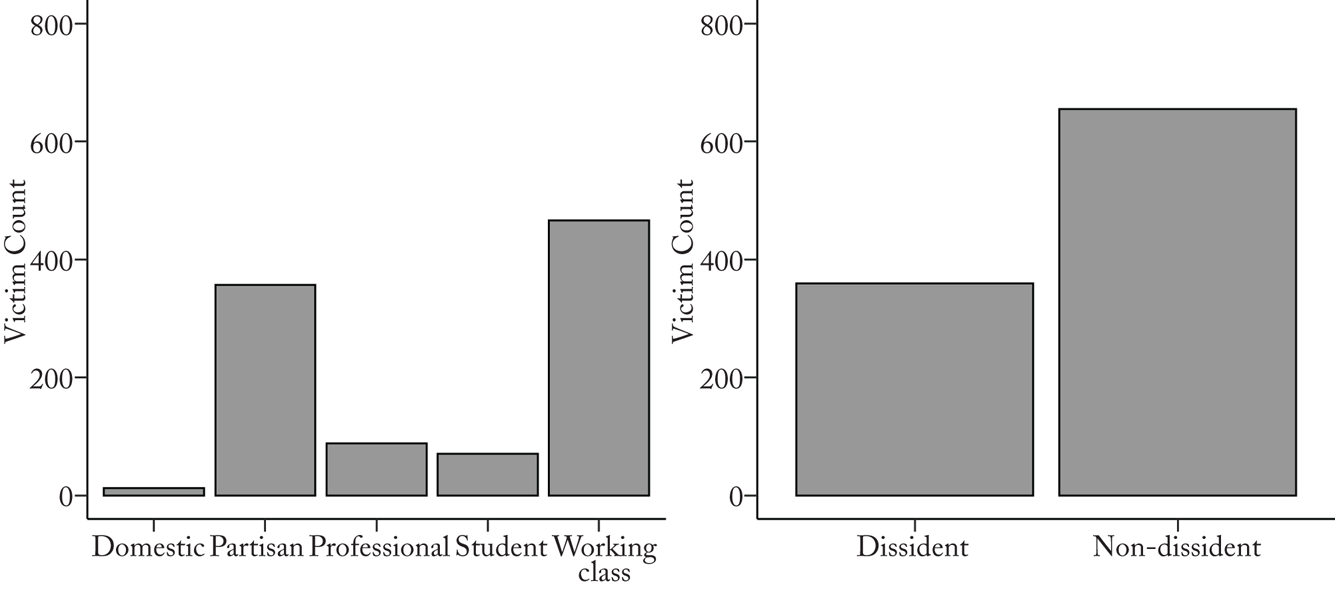
Figure 1 shows descriptive statistics for victims’ dissident status. Thirty-five percent of victims whose background is known were dissidents, these include active leftist party leaders, union leaders, and militants. Sixty-five percent of victims were non-dissidents, that is, not active members of left-wing parties, militant groups, or organized labor. The latter group includes workers, farmers, students, and white-collar professionals.
Political Killing Victim Characteristicsa
a Figure shows descriptive statistics from individual-level archival data on repression following the 1973 military coup. Victim category is on the x-axis and count of killing victims is on the y-axis.

Here, I preview two concerns about measurement validity that the robustness tests below address. First, the measurement strategy for non-dissident victims could exclude targets of regime repression who local partisans also wanted to eliminate to affect the balance of power or to satisfy rivalries. Locally active leftist party members could fit this category.Footnote 134 Thus, the measurement of non-dissidents would be too restrictive. I use an alternative, broader measurement classifying leftist party members as non-dissidents to determine whether their killings increase in municipalities with close competition. Doing so leaves only militants and labor union members labeled as dissidents. Second, some victims classified as non-dissidents may actually have been high-priority regime targets. For example, prior to the coup, Chilean university students tended to support the Allende government.Footnote 135 I employ another alternative, narrower measurement excluding students from classification as non-dissidents.
The independent variable is an indicator of whether a municipality had close political competition between regime supporters and opponents. I operationalize whether a municipality has a close election by comparing electoral support for Allende's up coalition with that of its political competitors. To do this, I create the close election, 1973 indicator variable, which takes a value of one if a municipality had a narrow up electoral margin, either above or below a majority, relative to the non-up vote share. For the main results, this margin is 6 percent (53 percent minus 47 percent) or less. All other electoral margins outside this range take a value of zero.Footnote 136 This measure is preferred because it distinguishes between close elections and up vote share; the latter is included as a control variable below. In the robustness tests, I use as independent variables a series of similarly close electoral margins in which the results are consistent. Furthermore, the robustness tests include use of another close election variable with an index from BalcellsFootnote 137 and a continuous vote margin.
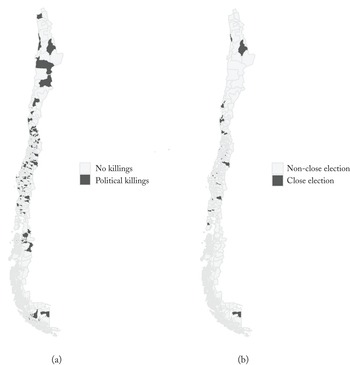
Figure 2 depicts patterns of repression and close elections in 1973. Each division in the map represents a municipality. Panel (a) displays variation in a dichotomized coding of the dependent variable: shaded municipalities experienced at least one political killing between September and December 1973. Panel (b) displays variation in the independent variable: shaded municipalities had close elections in March 1973. Overall, 31 percent of municipalities experienced at least one political killing, and 16 percent had a close election.
Repression and Close Elections in Chile, 1973a
a Figure depicts geographic variation in the dependent and independent variables of interest. The left panel shows variation in 1973 political killings across Chile's municipalities. Highlighted municipalities experienced at least one political killing. The right panel shows variation in close elections. Highlighted municipalities had between 47 percent and 53 percent vote share for the UP in March 1973 legislative elections.

Despite addressing the threat of reverse causality, potential endogeneity concerns remain. That is, there are likely omitted variables that correlate with political competition and the frequency or targeting of repression. To this end, I include several control variables based on plausible sources of omitted variable bias. First, it could be that political killings occur more frequently in municipalities with larger populations that are also municipalities with close elections. To account for this, I include the logarithm of the municipality population in 1970, population, 1970. Because the regime's 1974 administrative reform combined many rural municipalities and available 1970 census data are aggregated at the level of post-reform municipalities,Footnote 138 I estimate the population of combined municipalities according to their distribution of vote totals in the 1970 elections.Footnote 139
Political killings could also result from repression based on social identity group. Given that socioeconomic class was a salient social cleavage in Chile in the 1970s,Footnote 140 the regime may have repressed more frequently or targeted more non-dissidents in municipalities with higher poverty levels that also had closer political competition. I measure a municipality's poverty level through its 1972 infant mortality rate. I label this variable, infant mortality, 1972.Footnote 141 The regime could also repress based on a municipality's political loyalty as areas with higher support for Allende could have become priorities for targeting killings. To account for this possibility, I include a municipality's Allende support, which is the count of votes Allende received in 1970 presidential elections.Footnote 142
It's possible that other political characteristics shaped competition in 1973 and the frequency and targeting of repression as well. Ideological polarization could have driven competition and motivated civilians to encourage repression against their opponents. For this reason, I create the variable polarized, which indicates whether Allende (Socialist) and Jorge Alessandri, the right-wing candidate in the three-way 1970 presidential elections, were the top two finishers in a municipality. Political engagement could also drive competition and repression. Therefore, in the absence of data on the number of eligible Chilean voters, I proxy voter turnout with voter share, the proportion of a municipality's 1970 population that voted in that year's presidential elections.Footnote 143
It could be the case too, that the regime repressed in areas of past social conflict and contention, and that these areas were more competitive in 1973. Chile's capital region, Santiago, was a center of social conflict in the years before the 1973 coup. Because Santiago is the most densely urbanized, industrialized region in the country, municipalities around the capital were centers of working-class mobilization.Footnote 144 The capital was also one of the most politically divided and electorally contested regions of the country. Other regions, such as Bío Bío and its capital, Concepción, were sites of pre-coup mobilization. For this reason, I include region dummies in models with covariates.
Additionally, municipalities with army bases could introduce omitted variable bias. These bases increased the regime's capacity to carry out repressive operations and also affected local political preferences.Footnote 145 I create the variable army base and code it 1 for municipalities with an army base and 0 for municipalities without an army base.Footnote 146
Estimation Strategy
To test the frequency hypothesis, I estimate the relationship between close electoral competition and the number of political killing victims in municipality i using linear regression with robust standard errors. A count model specification is described in the supplementary material. The cross-sectional estimating equation takes the following form, where X i is a vector of covariates for a given municipality i and γ r is a region dummy:
 $$\openup-3.4pt\eqalign{&{Log}( {{Political\ Killing\ Victims} + 1} ) _i = \alpha + \beta \cdot {Close\ Election}, \;1973_i \cr&\hskip7.6pc + \delta \cdot {X}_i + \gamma _r + \epsilon _i.}$$
The coefficient β in the regression estimates the expected difference in the log of political killing victims between a municipality with close political competition and a municipality without close political competition. I specify a baseline model with the independent variable of interest only, close election, 1973, as well as a model that adds the covariates population, 1970; infant mortality, 1972; Allende support; polarized; voter share; and army base; and region dummies.
For the targeting hypothesis, I estimate the relationship between close elections and non-dissident victims in municipality i using linear regression with robust standard errors:
 $$\openup-3.4pt\eqalign{&{Log}( {{Non}\hbox{-}{Dissident\;Victims} + 1} ) _i = \alpha + \beta \cdot {Close\ Election}, \;1973_i \cr &\hskip7.9pc + \delta \cdot {X}_i + \gamma _r + \epsilon _i.}$$
The coefficient β estimates the expected difference in the number of non-dissident victims between a municipality with close political competition and a municipality without close political competition. Model specifications are otherwise identical to those for the test of the frequency hypothesis.
IV. Analysis
Main Results
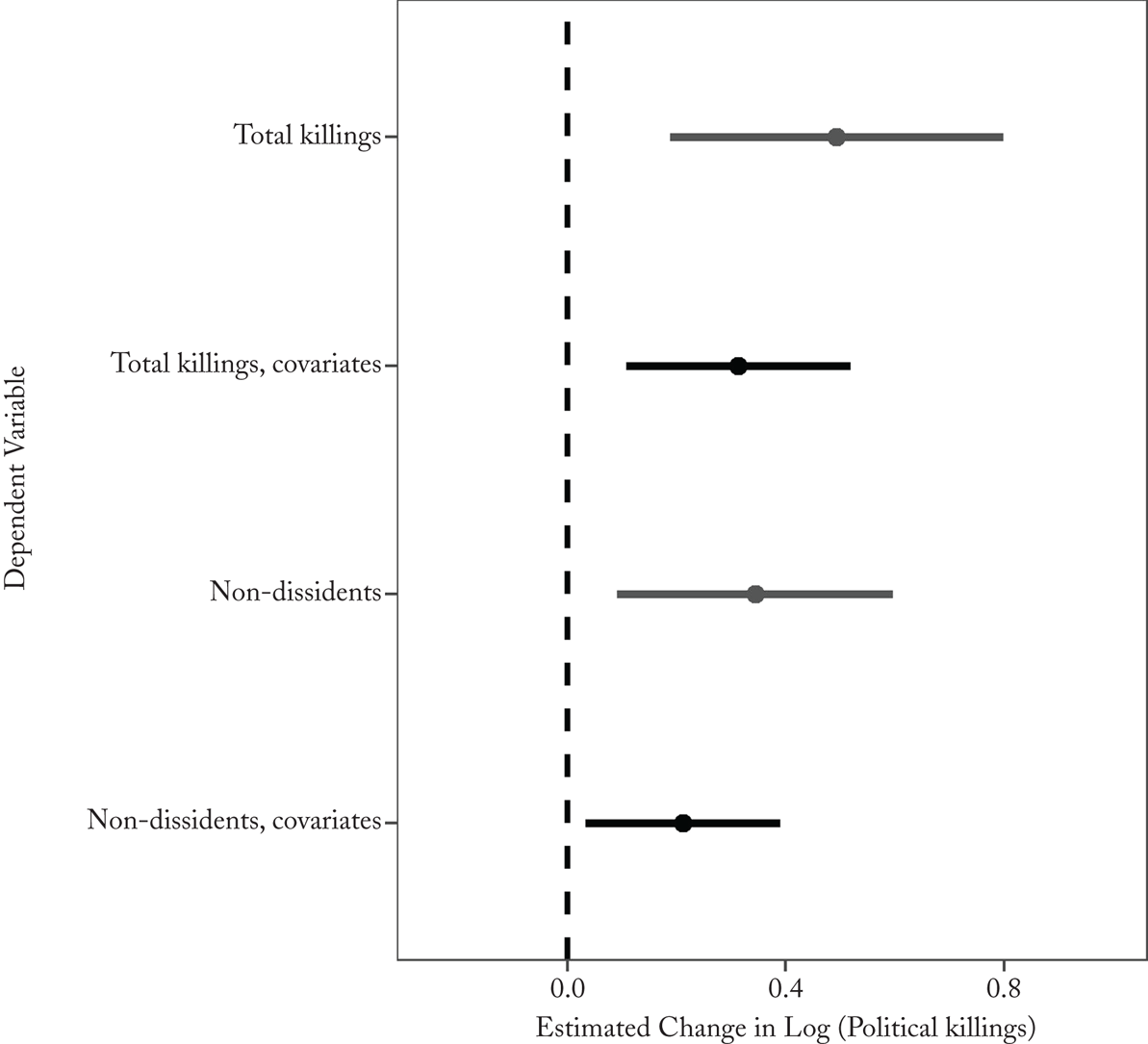
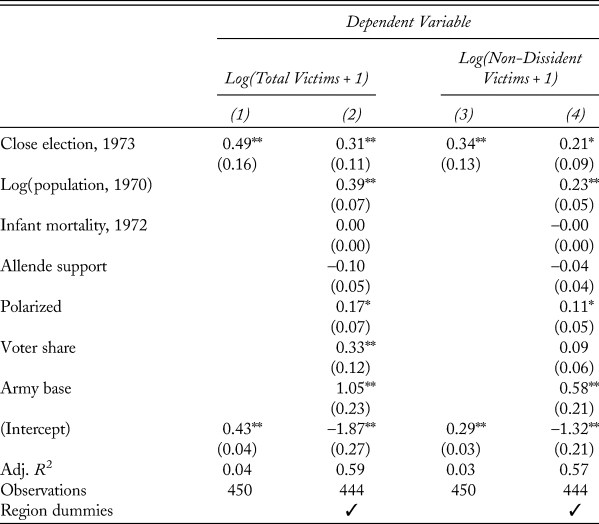
Table 1 displays results for tests of the two hypotheses. The table's first and second columns report coefficient estimates for tests of the frequency hypothesis. The third and fourth columns report estimates for tests of the targeting hypothesis. The results show a clear pattern. Municipalities with close elections in 1973 witnessed an increase in political killings and killings of non-dissidents compared to municipalities without close elections. Coefficient estimates for the close election, 1973 variable are significant at the p = 0.05 level in both specifications for total victims. Estimates are also substantively significant. A municipality with a close election corresponds to a roughly 33 percent increase in political killing victims. The magnitude of the estimates is more than one-third of a standard deviation of the total victims variable. For non-dissident victims, a municipality with a close election corresponds to an increase in such killings of roughly 24 percent compared to municipalities without close elections. The magnitude of the estimates is about one-fifth of a standard deviation of the non-dissident victims variable. Figure 3 depicts the estimates in a coefficient plot.
Political Competition and the Frequency and Targeting of Repressiona
a Figure depicts the expected change in political killing victims between close election and non-close election municipalities and the expected change in nondissident victims between close election and non-close election municipalities; 95 percent confidence intervals are shown. Model specifications are on the y-axis.

Political Killing Victims by Municipality Electoral Characteristics

**p < 0.01, *p < 0.05.
Robustness Tests
To increase confidence in the results, I conduct several robustness tests. First, since the un-transformed dependent variables are count variables, I estimate a series of negative binomial regression models. I estimate two model specifications with each dependent variable—total killings and non-dissident victims—as in the main analysis, one with the independent variable alone and one including covariates. Similarly, given concerns about excess zeroes in the dependent variable, I estimate a series of zero-inflated negative binomial models in which the first-stage model includes 1970 population, and the second-stage model includes the close election indicator and other covariates. As a final check for overdispersion, I transform the dependent variables into the log rate of total killings and non-dissident killings per 100,000 population, and estimate linear models. The coefficient estimates for close election, 1973 remain robust across the count models and rate of killings models. Full results are in tables B.1, B.2, and B.3 of the supplementary material.
Next, I consider error in the measurement of non-dissident victims. The results for the targeting hypothesis (using non-dissident victims) could be sensitive to the classification of dissidents and non-dissidents. Identifying dissidents, that is, those perceived by the regime to have the most potential to mobilize mass threat, is fraught theoretically and empirically.Footnote 147 The baseline measurement of  ${Log}( {{Non}\hbox{-}{Dissident}\ {Victims} + 1} ) $ includes all victims who were not members of leftist parties, militant groups, and labor unions. To test the sensitivity of this operationalization, I reestimate the targeting hypothesis models using the two alternatives explained above—including leftist party leaders in the non-dissident category and then excluding students from the same category. Under both classification schemes, the results (reported in Table B.4 of the supplementary material) remain consistent.
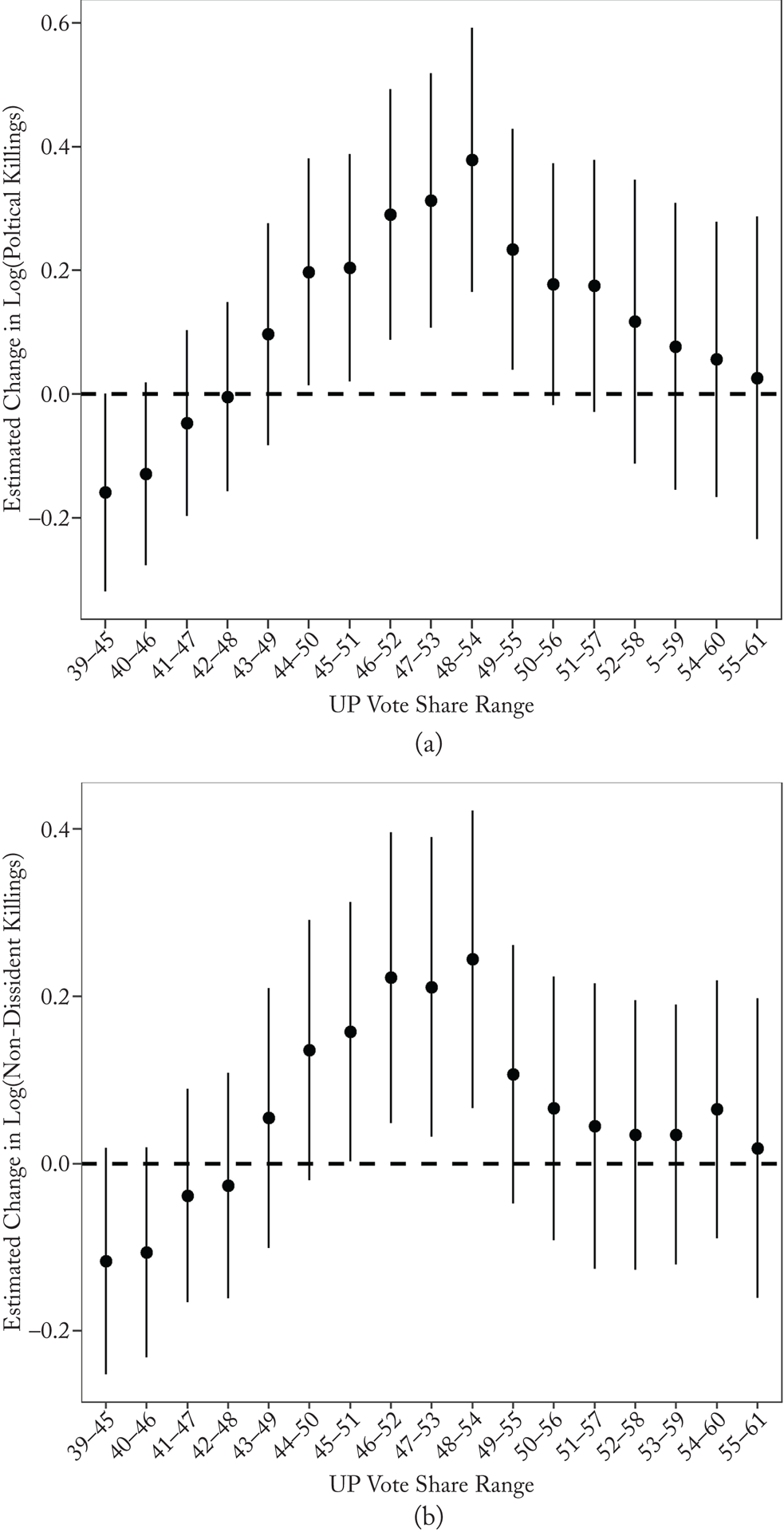
It is also important to test whether the main results are sensitive to the measurement strategy for a close election. The underlying concept is political competition close enough that repression of regime opposition could affect the future electoral victor or close enough to trigger more intense negative emotions. But it could be the case that repression increases in municipalities with higher up support, and that those areas tended to have close elections. Indeed, only 10 percent of municipalities had a up vote share above 60 percent. To rule out this possibility, I estimate the relationship between killings and a series of placebo close election windows, and show the relationship weakens at both higher and lower levels of up support (see Figure 4). Tables B.5, B.6, B.7, and B.8 of the supplementary material present full results. I conduct one additional test with placebo windows: if the measurement of close elections widens to include larger margins, the main results should weaken. Incrementally widening the threshold separating close election municipalities and non-close election municipalities in the close election, 1973 variable reveals the expected weakening patterns.Footnote 148
Placebo Close Election Thresholdsa
a Figure depicts the expected change in political killing victims between close election and non-close election municipalities across shifting UP support thresholds defining a close election; 95 percent confidence intervals are formed from robust standard errors. UP vote ranges defining close elections are on the x-axis.

Another concern is that the sample of political killings could include responsive, rather than preventive, repression. In particular, the military did not gain complete control of the country until late afternoon on September 11, and met isolated armed resistance for several days.Footnote 149 Because the data include killings beginning on the eleventh, the day of the coup, if they occurred in close election municipalities, it could be that killings that occurred as the military fought for initial control explain the results. To address this possibility, I take a subset of the data excluding killings on September 11 and 12. The models are reestimated with no change in the significance of the close election coefficient estimates. Full results are in Table B.15 of the supplementary material.Footnote 150
In addition, because there remain unobserved variables that could confound the relationship between political competition and repression, I perform a sensitivity analysis. The procedure derives a robustness value—the strength of a potential unobserved confounding variable's correlation with close elections and repression needed to render their estimated relationship insignificant, measured by partial R 2.Footnote 151 To invalidate the main results, an omitted variable would need to have an impact greater than the logarithm of 1970 population and the relationship between close elections and political killings. Population is a desirable benchmark variable because it strongly relates to political killings and weakly to close elections. Figure B.1 of the supplementary material reports results.
V. Tracing the Partisan Rivalry Mechanism
There is robust evidence that more political killings and killings of non-dissidents occurred in municipalities of close political competition between Popular Unity and its opponents. The argument posits that partisan rivalry explains these findings, driving civilians to provide more information on potential targets of repression—denunciations—in areas of close political competition. If the partisan rivalry mechanism is correct, then we should observe a qualitative relationship between close political competition and civilian denunciations. To trace this relationship, the next two paragraphs connect competition and civilian denunciation at the national and regional levels. I then illustrate two contrasting sets of cases: industrial municipalities and agricultural municipalities sharing both frequent civilian denunciations and close political competition in March 1973 elections. A quantitative test follows the case illustrations.
During Allende's presidency, and especially throughout 1973, political divisions spilt Chilean society. As described above, Chileans observed that during this period, “in our hearts we were all at war.”Footnote 152 Growing protests and mobilizations “ended in confrontation … between supporters and opponents of the Popular Unity government.”Footnote 153 When the coup occurred on September 11, this “confrontation and conflict” gave way to a “state of war” in which the new regime's supporters “[directed] their views … to make the state and its institutions a device of repression and terror.”Footnote 154 Mario Garcés and Sebastián Leiva make a similar observation: political hatred led to “dehumanization of the internal enemy” in the form of labeling rivals as “antisocial” people and encouraging the use of state violence against them.Footnote 155
Through archival research in the Santiago region, Manuel Guerrero links close pre-coup political competition and post-coup civilian encouragement of state violence. He argues, “Part of the high death rate during those months [after the coup] may have as a cause the successful … collaboration of the civilian population with the military, by way of denunciations of neighbors and colleagues.”Footnote 156 In a detailed study of the regime's information problem regarding identifying and repressing dissidents, he observes that denunciations during this period occurred where civilians interacted with “both sides simultaneously”—a condition met in areas he labels “intermediate zones,” in which neither the new regime nor supporters of the up government were dominant.Footnote 157
To show how these intermediate zones generated denunciations and violence, I turn to a case comparison using archival evidence from two contrasting areas of Chile that had close political competition in 1973—the rural agricultural municipalities of Mulchén and Collipulli and the urbanized municipalities of Laja, Puente Alto, and San Joaquín.
In Chile's southern agricultural regions, long-running political tensions simmered between indigenous Mapuche workers and large landowners. A 1934 agricultural workers’ rebellion in remote municipalities of the Bío Bío region was repressed, although land reform policies in the 1960s began to address the underlying grievances.Footnote 158 Accelerating land reform was one of Allende's top priorities on taking office in 1970. His government formed municipality-level agricultural worker councils to support expropriation of landowners’ property, increasing conflicts with owners who sought to block the reforms’ local implementation.Footnote 159 Using evidence from twenty-first century judicial proceedings, Rodrigo Araya and Magdalena Garcés note that after the coup, these “frictions between expropriated landlords and mobilized agricultural workers” led to “landlords and civilians tied to them facilitating detentions in collaboration with police.”Footnote 160 Among the most deadly of such incidents was the October 1973 killing of more than a dozen workers in Mulchén, a rural Bío Bío municipality with a 49 percent up vote share in March 1973 and intense polarization.Footnote 161 In these killings, civilians with a list of workers to detain and kill accompanied military units to farms. Collipulli, an adjacent municipality with a 50 percent up vote share also experienced such denunciations.
A connection between close political competition and civilian denunciations also occurred after the coup in a contrasting set of municipalities—urban areas with tensions between industrial workers and firms.Footnote 162 On September 13 in Laja, a small city in Chile's south that had a 50 percent up vote share in March 1973 elections, a manager at a local paper factory who had “maintained a list with every one of the names of persons [who were eventually detained],” indicated “to the police who each of them were, facilitating their identification and detention.” The paper factory had been the target of the attempted nationalization of local firms by the Allende government that provoked conflict between sympathetic workers and hostile ownership.Footnote 163 Other municipalities in Santiago's urban core witnessed similar incidents. In Puente Alto, with a 50 percent up vote share, police took lists of civilians to recreation centers and arrested large numbers of youth. These incidents exemplified a pattern around Santiago in which neighbors denounced youth deemed extremist and antisocial.Footnote 164
These examples reveal municipalities that had both close electoral competition and post-coup civilian denunciations of political rivals, but were otherwise dissimilar. One threat to drawing an inference supporting the partisan rivalry mechanism is the possibility that civilian denunciations were likewise high in municipalities without close competition. In a study comparing Santiago-area neighborhoods, Garcés and Leiva suggest otherwise: killings of “extremist” and “antisocial” civilians were higher in the neighborhood of La Legua than in nearby areas “in the first months following the coup.”Footnote 165 La Legua composes much of the San Joaquín municipality, which had closer March 1973 elections (52 percent up vote share) than any adjoining municipality.
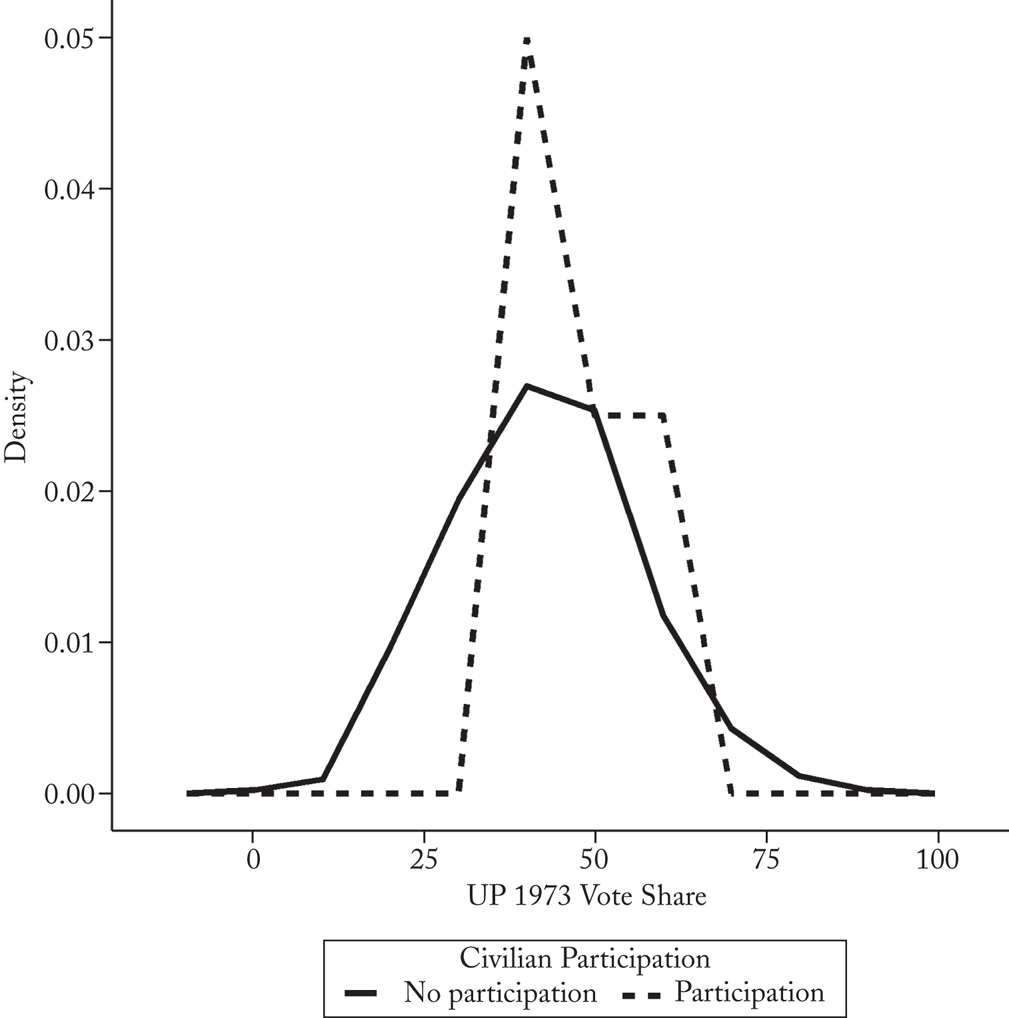
While quantitative evidence on denunciations is unavailable for the last months of 1973, I systematically test the link between close electoral competition and civilian denunciations with an indirect measure: civilians’ active participation in repression. Chile's Truth and Reconciliation report identifies eight municipalities in which civilians participated in killings. The mean vote share for Popular Unity in these eight municipalities was 48.15 percent, while its mean vote share in municipalities without civilian participation in killings was 42.63 percent. Figure 5 shows density plots for these two groups. A difference in means test, reported in Table C.1 of the supplementary material, returns a p-value of 0.058, close to rejecting the null hypothesis that elections are not closer in municipalities with civilian participation in repression.Footnote 166 To test whether close competition drove repression via direct civilian participation, I conduct a mediation analysis that, with a significance level of p = 0.11, estimates that about 5 percent of the relationship between close competition and repression is mediated by civilians’ participation. The results are presented in Table C.2 of the supplementary material.Footnote 167
Civilian Participation in Repression and UP Votea
a Figure depicts density plots for Popular Unity 1973 vote share for municipalities mentioned in the Truth and Reconciliation report as having civilian participation in repression and municipalities which were not mentioned. x-axis depicts vote share and y-axis depicts density.

VI. Alternative Explanations
Regime Strategy
It is possible that the main results are explained by a premeditated regime strategy to increase repression in municipalities with close political competition, rather than by civilian information provision to decentralized repressive operations. Such a regime strategy could also explain the results for the frequency hypothesis: political killings were simply greater across all categories of victims in these municipalities. To address this alternative, I conduct a further placebo test. I create a new variable, militant victims, which counts the number of political killing victims in a municipality who were members of a leftist militant group like the mir, a principal opponent of the new military regime. If the regime strategically increased repression in municipalities with close political competition, the number of militant victims would also be higher there. Results, reported in Table D.1 of the supplementary material, suggest that the increase in killings of non-dissidents, predicted by the frequency hypothesis (H1), is significantly greater than any changes in militant killings in competitive municipalities.
Further ruling out regime strategy as an alternative for the targeting results requires showing that the regime preferred to target dissidents when it ordered political killings. This requires inferring the regime's preferences by identifying who it repressed when not facing an information problem about its targets. To make this inference, I examine killings that the regime is known to have directly ordered after the coup. To carry out these orders, General Sergio Arellano Stark organized the Caravan of Death, the unit mentioned above that was designed to increase repression and find victims to accuse of participating in Plan Z—a regime black propaganda effort that purported to uncover evidence that leftists were plotting an imminent takeover of Chile.Footnote 168 If the theory is correct and such dissidents were the regime's preferred targets, the municipalities the Caravan of Death visited should have a greater number of victims belonging to leftist parties, labor unions, and militant groups than the municipalities it did not visit. Furthermore, these same municipalities should not have more non-dissident victims.
To test the implication, I create the indicator variable caravan of death, and code a municipality as 1 if the Caravan of Death visited.Footnote 169 The first dependent variable of interest for this test is dissident victims. The second dependent variable of interest is non-dissident victims, from the main test of the targeting hypothesis. This variable includes working class, student, and white-collar and domestic worker victims. I estimate linear and negative binomial regression models, including specifications with and without covariates. In specifications with dissident victims as the outcome, coefficient estimates are positive and significant—and substantively larger than coefficients in specifications with non-dissident victims as the outcome. These results are consistent with rejecting the regime-strategy explanation, and are presented in tables D.2 and D.3 of the supplementary material.
Different Victim Behaviors
Another alternative explanation is that partisan rivalries and information provision did not shape repression in close election municipalities, and repression instead followed from victims’ behaviors. First, it could be that dissidents potentially become legible to the regime through their own actions. In the Chilean case, many high-profile dissidents, such as up officials and leaders, turned themselves in soon after the coup, responding to broadcasts of “lists of political figures who should report for questioning”Footnote 170 and believing themselves safe from physical harm.Footnote 171 Some centrist Christian Democratic politicians were also summoned. To account for this alternative process of repression, which would place such dissident leaders outside the scope of the analysis, I estimate the relationship between political competition and repression on a sample excluding 167 leftist and centrist party officials and leaders—15 percent of the victims—from the sample. Results, which are robust, are in Table D.4 of the supplementary material.
Second, it could be that repression in urban municipalities occurred through a different process than in rural ones. For example, city-dwelling victims could have been repressed in different municipalities than those in which they lived or worked. Especially in the capital of Santiago, municipalities are tightly clustered and travel between them for routine activities is common. Such spillover repression could introduce measurement error in the dependent variable and violate the assumption of independence between units. Furthermore, Pablo Gutiérrez-Seguel notes that civilian assistance in repression occurred mainly in rural areas.Footnote 172 To account for the threat to inference from inter-municipality travel in urban areas, I estimate the relationship between political competition on two reduced samples, one excluding municipalities in the metropolitan region of Santiago and another excluding all municipalities with a population greater than one hundred thousand. Results, in tables D.5 and D.6 of the supplementary material, are robust across these specifications.
VII. Discussion: Repression during Regime Change
Although these tests indicate a robust relationship between political competition and repression in Chile following the September 1973 military coup, the scope conditions of the argument suggest this relationship does not hold over time. The fever pitch of political rivalry and the lack of military coordination that permit voluntary civilian intelligence provision are most likely to occur in the immediate aftermath of regime change. During this period, new regimes consolidate political control and institutionalize information gathering while civilians seeking to harm political opponents eliminate their most desired targets. For example, Jeffrey Kopstein and Jason Wittenberg note that Eastern Polish citizens’ pogroms against Jewish populations who were politically competitive occurred from June to August 1941, as the Nazi regime gained territorial control.Footnote 173 Balcells observes that citizen-driven violence behind the Spanish Civil War's front lines peaked around the 1936 coup and decreased thereafter.Footnote 174
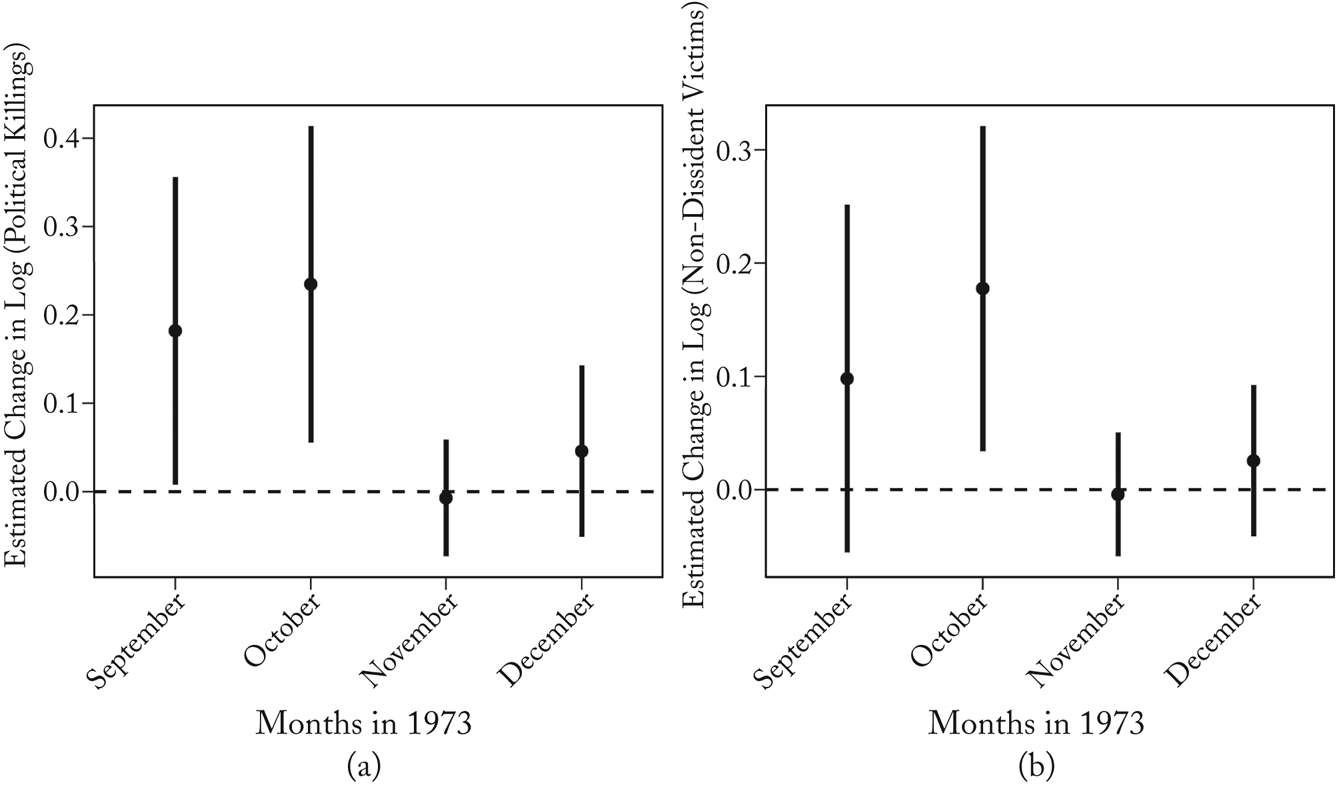
To determine whether similar patterns occurred in Chile following the coup, I disaggregate political killings by month and estimate the relationship between political competition and repression separately in September, October, November, and December of 1973. Given the conjectured scope conditions and comparable cases in Poland and Spain, the relationship should weaken from September to December. Figure 6 depicts the results. Consistent with expectations, political competition has a positive and significant relationship with repression in the months after the coup, but the difference in political killings between competitive and uncompetitive municipalities is statistically indistinguishable from zero in November and December. Full results are in Table E.1 of the supplementary material.
Temporal Patterns in Repression by Close Electiona
a Figure depicts the expected change in political killing victims between close election and non-close election municipalities using monthly subsets of data; 95 percent confidence intervals are formed from robust standard errors.

Although the evidence here suggests the relationship between political competition and repression applies more to periods around regime change than to stable authoritarian rule, it nonetheless relates to settings other than dictatorships. Namely, the argument should apply when partisan rivalries, regime change, and use of political violence—by the state and nonstate groups alike—converge. Areas behind the front lines of conventional civil conflict, territory that changes hands during interstate wars, and states experiencing sudden democratic reversals or revolutionary threats each fit these criteria. Of course, civilians still collaborate with dictatorships during periods of stability, but their motives in these periods are less about changing the local balance of political power and eliminating political opponents. Rather, material self-interest or settling private disputes drive collaboration.Footnote 175
VIII. Conclusion
To study the relationship between political competition and repression, I have examined the state violence that followed Chile's 1973 military coup. Historical accounts and quantitative tests suggest that close political competition, which heightens partisan rivalries among civilians, corresponded with more frequent repression. Repression also targeted more non-dissidents in areas with close elections compared to areas without close elections. Qualitative accounts of civilian denunciations in municipalities with close political competition combined with quantitative evidence from Chile's Truth and Reconciliation Commission report, strengthen support for the partisan rivalry mechanism. I find little support for alternative explanations that repression in those areas resulted from regime strategy or victim behavior. The link between political competition and repression demonstrates that population-based characteristics shape the frequency and targeting of preventive repression, particularly when dissidents are concealed among civilians.
The evidence comes from a Cold War-era military dictatorship in Latin America, but the argument that civilians provide information to the regime—and thereby affect repression—likely applies to other regimes and time periods. Scholars have documented the role of civilians in stimulating violence in single-party dictatorships,Footnote 176 monarchies,Footnote 177 and in civil conflict.Footnote 178 The breadth of these findings suggests that civilian agency in violence is a widespread and enduring feature of politics. When presented with an opportunity, such as a military coup, political rivalries turn emotion and dislikeFootnote 179 into behavior that inflicts violence on opponents. While political competition is one source of rivalries, an emerging research agenda suggests repression itself inflames intergroup rivalries.Footnote 180 Taken together, these findings point to rivalries and repression as mutually reinforcing.
The findings also correspond to a growing focus on nonstate actors in the study of authoritarian repression. While a preponderance of scholarship considers regime type, institutions, and principal-agent relationships to explain variation in repression,Footnote 181 recent work suggests that looking beyond the regime at nonstate actors, such as civilians, and their preferences reveals new explanations for state violence.Footnote 182 Integrating civilian agency—outside of protest—into the study of repression aligns this literature with others that consider non-protest forms of civilian behavior in dictatorships, such as voting and propagandizing.
Future research should expand on the links this article suggests between the microdynamics behind the front lines of conventional civil conflict, changes in territorial control during interstate war, and the turbulent periods around military coups in dictatorships and counterrevolutionary regimes. Civilian agency is a well-documented process in conflict settings,Footnote 183 and civilian support is critical to armed groups’ survival. My work has shown one aspect of theories of civilian agency in conflict that have analogs in authoritarian repression. Chile's military regime took power at a time of domestic political, social, and economic turmoil. Rivalries among the public were intense, repression was the military's top priority, and intelligence was limited. For these reasons, the regime is a most likely case for studying civilian agency in repression. Identifying cases in which insights about civilian agency in conflict provide analytical leverage on the legibility problem faced by authoritarian regimes, and in those cases examining civilian supporters’ information provision and regime-opposing civilians’ efforts to shelter dissidents, are fruitful avenues for future scholarship.
Supplementary Material
Supplementary material for this article can be found at https://doi.org/10.1017/S0043887122000132.
Data
Replication data for this article can be found at https://doi.org/10.7910/DVN/VAFGTO.
Acknowledgments
I thank Natália Bueno; Ryan Carlin; Charles Hankla; Abigail Heller; Jennifer Gandhi; Danielle Jung; Patrick Pierson; Miguel Rueda; the Emory Comparative Politics Reading Group; participants at the 2018 Atlanta Symposium on Political Science, the 2018 Georgia Human Rights Network at Georgia State University, and the 2018 Southeast Latin American Behavior Conference at Vanderbilt University; and the World Politics editors and three anonymous reviewers for thoughtful comments.