Introduction
In recent years, interest in the role of individuals’ health in political engagement has emerged as a growing area in political science. This reflects the increasing awareness that health plays a major part in explaining individuals’ roles as active political citizens. This is especially important in the context of ageing populations in many welfare states. As people get older, they are more likely to confront various kinds of health problems, which can affect their willingness and capacity to participate fully in politics. However, health-related issues are not only restricted to older citizens, as many younger people are also affected by chronic or severe physical or mental illnesses, which may hamper their possibilities to engage in politics. If this is the case, increasing levels of health problems may have implications for the functioning of the whole representative democracy. In the end, it is a question of how well the interests of different health groups are represented in the decision-making process (see Pacheco and Ojeda, Reference Pacheco and Ojeda2020).
The existing studies on the effects of health on political participation have shown that health is an important component in explaining participation and that health’s impact in terms of size is often comparable to many socioeconomic factors usually seen as crucial in understanding participation. Thus, to fully understand factors behind individuals’ decisions to participate and the particular ways in which they want to do so, the role of health has to be taken into account. Previous studies have mostly concentrated on voting (e.g. Denny and Doyle, Reference Denny and Doyle2007a,Reference Denny and Doyleb; Goerres, Reference Goerres2007; Mattila et al., Reference Mattila, Söderlund, Wass and Rapeli2013; Pacheco and Fletcher, Reference Pacheco and Fletcher2015; Burden et al., Reference Burden, Fletcher, Herd, Moynihan and Jones2017; Couture and Breux, Reference Couture and Breux2017) and, to a lesser extent, other forms of political participation (e.g. Ojeda, Reference Ojeda2015; Söderlund and Rapeli, Reference Söderlund and Rapeli2015; Christensen et al., Reference Christensen, Setälä and Jäske2019). However, most of these studies have focused on individual forms of participation, with less attention given to the broader picture of how health and different modes or profiles of participation are related. In addition, a problem with existing studies is that they have not analysed in detail the cognitive mechanisms that connect health with observable political behaviour, that is, any analysis of the mechanisms that mediate health effects is mostly lacking in the literature. In this article, I explore whether political trust could constitute such a mediating factor, that is, if differences in personal health status affect individuals’ trust levels and, consequently, influence the way they participate (or not) in politics.
This study contributes to our knowledge in the context of studies on the relationship between health and political engagement and, more generally, the field of political participation. There are three main contributions to these fields. First, the study of mechanisms linking health and political participation constitutes an area that is still in its infancy. This study analyses how political trust can function as a mediating mechanism between health and political participation. Second, unlike previous studies on health and politics, this article concentrates on wider modes of participation, instead of individual forms of political acts. This kind of approach can reveal important differences between institutional and non-institutional forms of participation on a more general level. Third, this study makes use of a novel measure of individual health status (EQ-5D), which is theoretically justified and empirically more reliable than the single-item self-rated health (SRH) measure used in most of the previous analyses. Using a new health measure can, in addition to validating previous results, bring out new nuances in the relationship between health and participation.
In the following, I start with a review of how the relationship between health and political participation has been approached in the literature and discuss why political trust is plausibly a mechanism that mediates the effects of health on participation. After this, I discuss the existing results from studies on health and participation. I also elaborate why I expect different results regarding the effects of health and trust when looking at either institutional or non-institutional participation. The empirical results show that, when concentrating on modes of participation instead of individual activities, it is mostly non-institutional participation that is associated with individuals’ health status, and this relationship is negative: people with poor health are more likely to be active in non-institutional political participation than those in good health. In contrast, the relationship between institutional participation and health is weaker. Furthermore, the results show that political trust is a mediating factor that channels the effects of health participation. At a more general level, the results demonstrate the need to include health issues as an important factor to consider when encompassing explanations for inequalities in political participation in contemporary societies are sought.
Theoretical approaches
Theoretically, the relationship between political participation and health has been approached from at least three influential perspectives: resources, grievance, and self-interest theories. The resource approach has probably been the most commonly used. It assumes that people have certain resources that either incentivize or depress participation. This theory is famously summarized by Verba et al. (Reference Verba, Schlozman and Brady1995) who wrote that time, money, and skills drive participation. The more that people have these resources at their disposal, the more active in politics they are likely to be. The resource approach has obvious connections with health, as good health can be understood as a resource that enables individuals to participate (Pacheco and Fletcher, Reference Pacheco and Fletcher2015: 106). Health may also impact participation through more traditional resources: poor health may lead to unemployment, early retirement, or otherwise negatively affect individuals’ incomes.
The effects of poor health can also be approached with reference to grievance theory (Gurr, Reference Gurr1970; Kern et al., Reference Kern, Marien and Hooghe2015; Kurer et al., Reference Kurer, Häusermann, Wüest and Enggist2019). This perspective is based on the idea of relative deprivation, that is, a situation where a person’s position in society declines in relation to her reference group. This relative decline could mobilize individuals into political activities in order to try to improve their position in society. Poor health can function as this kind of activating grievance factor. Those experiencing health problems might try to influence political actors to improve, for example, public healthcare services or financial subsidies aimed at alleviating the costs of health problems. Thus, if health problems lead to decreased tangible or psychological resources, one can assume that individuals confronting health issues choose to concentrate their efforts on forms of participation that can be linked directly to policy issues close to their hearts. This would lead them to choose participation forms that enable them to control the agenda, that is, to choose such forms that are directly aimed at influencing health policies (Söderlund and Rapeli, Reference Söderlund and Rapeli2015: 32).
Theories based on self-interest are closely related to grievance theory. We can assume that people in poor health are, generally, more likely to pay attention to public health policies than those in good health. In general, if the expected payoffs are low, compared to the required investment, self-interest will not affect an individual’s political behaviour. However, deteriorating health can be a factor that motivates people to act out of self-interest: the payoff for a favourable policy outcome is higher when a person needs support from the public healthcare sector to cope with personal health problems (Rapeli et al., Reference Rapeli, Mattila and Papageorgiou2020).
For the purposes of this study, the important similarity between grievance and self-interest theories is that they are both more likely to mobilize people to display behaviours that are aimed at influencing specific political issues, especially with regard to health and social care policies. Thus, people with health problems might favour forms of political activities that enable them to control the agenda. For example, participating in demonstrations and signing petitions are activities where participants can choose the agenda: they can participate in demonstrations where the issue is particularly important to them or sign petitions that are especially related to their concerns. In contrast, most institutional forms of participation take place in an environment which is defined by politicians, parties, and the media, not by the individual (Mattila and Papageorgiou, Reference Mattila and Papageorgiou2017). In a similar way, Söderlund and Rapeli (Reference Söderlund and Rapeli2015) hypothesize that the health gap in participation is smallest in those participation types that are aimed at making a substantive policy impact. Based on these theoretical justifications, I assume that, if health concerns mobilize individuals, they are more likely to affect the popularity of non-institutional participation forms.
In addition to a direct effect, health can affect political participation through cognitive mediating factors, such as political efficacy, interest, knowledge, party identification, or political trust. Existing research has shown that the relationship between the first four of these factors and the individuals’ general health status is either weak or inconsistent (Mattila et al., Reference Mattila, Rapeli, Wass and Söderlund2017: 53–64; Papageorgiou et al., Reference Papageorgiou, Mattila and Rapeli2019). However, the situation is different for political trust, as health and trust seem to be quite closely connected (Mattila and Rapeli, Reference Mattila and Rapeli2018). Hence, I will next concentrate more on this potential trust-mediated mechanism between health status and participation.Footnote 1
Based on previous results, I assume that poor health leads to lower levels of trust, which, in turn, has implications for political participation. Previous studies have shown that health is strongly connected to political trust: people in poor health are less trusting of political actors and the political system than those in good health, with the differences between health groups being largest in Nordic welfare states such as Finland (Mattila and Rapeli, Reference Mattila and Rapeli2018). One reason for low trust among people with poor health may be related to the gap between citizens’ expectations and their assessment of the reality of government outputs. For example, previous research in Sweden has shown how contacts with selective needs-tested welfare-state institutions erode trust (Kumlin and Rothstein, Reference Kumlin and Rothstein2005). It is especially perceptions of lack of fair treatment that decrease public trust. Comparable correlations between low political trust and dissatisfaction with welfare service provision have been observed in other contexts as well (e.g. Morgeson and Petrescu, Reference Morgeson and Petrescu2011; Gustavsen et al., Reference Gustavsen, Pierre and Røiseland2017).
On a more general level, Wroe (Reference Wroe2014) has analysed political trust as an implicit ‘psychological-democratic trust contract’: individuals extend their trust to a political system and its actors only when they feel that they are receiving enough material or immaterial benefits from the system. Thus, elevated expectations of extensive and high-quality services in countries with strong universal welfare state traditions may lead to disappointments when unmet by citizens’ actual experiences of public services. Consequently, unsatisfactory experiences with health care services may have a spill over effect and extend the dissatisfaction to wider national-level politics.
There is a large body of literature linking political trust and political participation, although the relationship can be rather complex (see Levi and Stoker, Reference Levi and Stoker2000). While some claim that political trust is a prerequisite for all kinds of participation and that distrusting individuals become passive, others maintain that distrust can depress certain forms of participation but encourage others. The positive association between trust and institutional participation has been established in studies (Hooghe and Marien, Reference Hooghe and Marien2013). Research on the association between low trust and increased levels of non-institutional participation has produced results that are more varied. Some, especially single-country studies, have failed to find empirical support for this claim (e.g. Norris et al., Reference Norris, Walgrave and Van Aelst2005; Dubrow et al., Reference Dubrow, Slomczynski and Tomescu-Dubrow2008; Dalton et al., Reference Dalton, Van Sickle and Weldon2010), while, in other studies, the idea has been supported (Kaase, Reference Kaase1999; Hooghe and Marien, Reference Hooghe and Marien2013; Braun and Hutter, Reference Braun and Hutter2016). The results reported by Braun and Hutter (Reference Braun and Hutter2016) are particularly interesting in the context of this study. Their research shows that distrust is more likely to be manifested as increased levels of non-institutional participation in culturally open societies, such as the Nordic states. Thus, if there is a link between health and non-institutional participation, it is likely to be found in a country such as Finland.
Forms of participation and health
Most of the previous studies on health and political participation have concentrated on analysing individual forms of participation, such as voting, demonstrating, or signing petitions. However, as Theocharis and van Deth (Reference Theocharis and van Deth2018a: 17) note, ‘by increasing the level of abstraction, participation in general can be understood as a latent concept […] that covers more than one form’ of political activities. These combinations of two or more forms can be referred to as modes or types of participation. When analysing if and how health and participation are related, it may be more useful to look at certain modes of participation, instead of merely concentrating on individual forms. This is because factors such as a person’s health can affect her whole style of participation, not just the levels of particular participation forms (Dalton, Reference Dalton2008: 94). Thus, switching the view from individual acts of participation to the whole of a person’s participation repertoire can help us gain a more comprehensive understanding of the total significance of health in participation.
However, deciding which forms of participation belong to which modes of participation is far from easy. Among political scientists, there is a long history of categorizing different political activities, with new forms of participation added to the list as society changes. In the first stage, political participation was mostly restricted to voting, elections, and party-related activities. In the 1970s, Barnes et al. (Reference Barnes, Allerbeck, Farah, Heunks, Inglehart, Jennings, Klingeman, Marsh and Rosenmayr1979) expanded the repertoire by turning attention to what they called unconventional forms of participation, such as demonstrations, boycotts, and even violence. Later, Teorell et al. (Reference Teorell, Torcal, Montero, Van Deth, Montero and Westholm2007) elaborated the typology of participation forms by making a distinction between representational and extra-representational and exit-based and voice-based participation and by cross-tabulating these two dimensions. However, as the potential forms of participation increase, a common framework is needed to systematically and efficiently capture all possible forms of participation and to make a distinction between political and non-political participation. For this need, Theocharis and van Deth (Reference Theocharis and van Deth2018a) propose a new conceptual map of participation based on a set of decision rules, instead of listing individual acts of participation.
As this short review shows, categorizing political participation forms is a complex task. In this study, to simplify the analysis, I decided to opt for a relatively straightforward option by only concentrating on two main modes of participation: institutional and non-institutional participation. Institutional participation refers to participation activities that aim to influence ‘the political system directly, while participants in non-institutionalised forms of political participation keep some distance from the political system by trying to have an indirect impact on political decision making or by circumventing the political system altogether’ (Marien et al., Reference Marien, Hooghe and Quintelier2010: 188). Hence, while voting can be considered as a quintessential act of institutional participation, taking part in party work or electoral campaigns, wearing election campaign badges, and contacting politicians are also included in this participation mode (Fuchs and Klingemann, Reference Fuchs, Klingemann, Klingemann and Fuchs1995; Marien et al., Reference Marien, Hooghe and Quintelier2010, Theocharis and van Deth, Reference Theocharis and van Deth2018a: 24).
In contrast, non-institutional participation takes place outside of the institutionalized sphere of politics and, in a way, circumvents the traditional electoral process (Kaase, Reference Kaase1999; Stolle and Hooghe, Reference Stolle and Hooghe2011). Often, these political acts are issue-based. For example, people sign petitions or take part in demonstrations to advance some particular cause. They can also use their influence digitally on social media to further their preferred political issues. Furthermore, boycotting or ‘buycotting’ some products or services for ethical or environmental reasons is a way to try and influence political matters through the market mechanism (Stolle et al., Reference Stolle, Hooghe and Micheletti2005; Yates, Reference Yates2011). However, it must be acknowledged that it is sometimes difficult to make a theoretical or empirical distinction between all possible forms of participation. For example, Theocharis and van Deth (Reference Theocharis and van Deth2018b) distinguish between digital, volunteering, protest, and consumerist modes of participation in Germany. Nevertheless, in this study, I follow the more commonplace categorization where demonstrating, petitions, political consumerism, and digital participation are included in the mode of non-institutional participation (Marien et al., Reference Marien, Hooghe and Quintelier2010; Stolle and Hooghe, Reference Stolle and Hooghe2011; Bengtsson and Christensen, Reference Bengtsson and Christensen2016; Braun and Hutter, Reference Braun and Hutter2016).
As mentioned earlier, most studies that have focused on the relationship between health and participation have used turnout as the dependent variable. Hence, the empirical evidence for the negative association between poor health and low turnout, especially among older people (Peterson, Reference Peterson1987; Goerres, Reference Goerres2007; Nygård and Jakobsson, Reference Nygård and Jakobsson2013), is quite convincing. Nevertheless, the negative effect is not restricted to seniors. Population-level survey studies have shown how poor physical or mental health depresses voting in Ireland (Denny and Doyle, Reference Denny and Doyle2007a), in the UK (Denny and Doyle, Reference Denny and Doyle2007b; Rapeli et al., Reference Rapeli, Mattila and Papageorgiou2020), in Europe in general (Mattila et al., Reference Mattila, Söderlund, Wass and Rapeli2013), in Canada (Couture and Breux, Reference Couture and Breux2017), in the Nordic countries (Söderlund and Rapeli, Reference Söderlund and Rapeli2015), and in the USA (Gollust and Rahn, Reference Gollust and Rahn2015; Pacheco and Fletcher, Reference Pacheco and Fletcher2015; Burden et al., Reference Burden, Fletcher, Herd, Moynihan and Jones2017; Ojeda and Slaughter, Reference Ojeda and Slaughter2019). The results somewhat vary depending on the country or type of election concerned, but generally the difference in turnout is about 10% points between the opposite ends of the 5-point SRH scale.
Register-based information with validated measures of turnout and health can allow for a more detailed picture on the relationship. In general, the size of the effect of health on voting seems to be smaller in these studies. In Sweden, Bryngelson (Reference Bryngelson2009) investigated the association between long-term sickness absence and turnout using register-based information on sickness absences, although her measure of voting relied on self-reported survey data. Her results were not statistically significant. In the USA, Burden et al. (Reference Burden, Fletcher, Herd, Moynihan and Jones2017) did find a significant effect when they combined survey data on health with validated voting records on turnout. There are also some studies from Finland that use validated register data on both health variables (such as sickness absence days and medical diagnosis) and turnout (Lahtinen et al., Reference Lahtinen, Mattila, Wass and Martikainen2017; Mattila et al., Reference Mattila, Wass, Lahtinen and Martikainen2018), confirming that a relationship between health and turnout exists, but the connection is not necessarily as strong as survey results would lead us to believe. Finally, register-based data have been used to analyse disease-specific effects on turnout. Neurodegenerative brain diseases, alcoholism, and mental disorders are especially linked to lower levels of turnout (Sund et al., Reference Sund, Lahtinen, Wass, Mattila and Martikainen2017).
Other forms of institutional participation have been less studied in the health context and the results are definitely more varied. Ojeda (Reference Ojeda2015) used an index of six forms of institutional participation and found that depression suppresses participation. Other studies have looked at individual forms of institutional participation with more general measures of health status. Results from the Nordic countries by Söderlund and Rapeli (Reference Söderlund and Rapeli2015) showed that poor SRH increased the level of contacting politicians and wearing badges, although the effect was rather small. There were no differences between health groups in the probability of working for parties or action groups. Finally, Burden et al. (Reference Burden, Fletcher, Herd, Moynihan and Jones2017) observed that a person’s health status was not related to campaign contributions according to US data.
Unlike in voting, the relationship between good health and non-institutional participation seems to be negative. Taking part in demonstrations is more prevalent among those with health issues, at least in Europe (Söderlund and Rapeli, Reference Söderlund and Rapeli2015; Mattila and Papageorgiou, Reference Mattila and Papageorgiou2017; Stockemer and Rapp, Reference Stockemer and Rapp2019). The results concerning signing petitions are less conclusive: in the Nordic countries, the probability of signing petitions is not related to health (Söderlund and Rapeli, Reference Söderlund and Rapeli2015), but results from Canada indicate that people with poor mental health are more likely to sign online petitions (Couture and Breux, Reference Couture and Breux2017). Furthermore, a study using Finnish data showed that especially young people with health problems are more likely to sign citizens’ initiatives (Christensen et al., Reference Christensen, Setälä and Jäske2019). Finally, the probability of engaging in political consumerism was analysed using Nordic data, but participation in boycotts was not related to respondents’ health status (Söderlund and Rapeli, Reference Söderlund and Rapeli2015). However, results by Stockemer and Rapp (Reference Stockemer and Rapp2019) show that the likelihood of boycotting products is higher among those who report that their life is being hampered by illness in the European-wide European Social Survey (ESS) data.
Hypotheses
Based on the previous theoretical discussion and the review of empirical results, I formulate four hypotheses for my empirical analysis. From the resource perspective, health-related problems can be seen as draining individuals’ personal resources. Bad health can lead to unemployment or early retirement, which in turn lowers individuals’ income levels. Furthermore, medical costs can exhaust a considerable part of one’s disposable income. Falling ill, living with chronic conditions, or recovering from illness consume time, which could otherwise be directed at other activities. Health issues at an older age do not necessarily affect a person’s civic skills (with the exception of neurodegenerative diseases), but childhood and adolescent poor health can negatively affect education, which may later manifest itself in lower levels of civic skills. Thus, poor health can deplete all three types of resources – money, time, and skills – and lead to diminished participation. Hence, the first hypothesis is:
Hypothesis 1: Poor health decreases both institutional and non-institutional participation.
Grievance theory and theories related to self-interest lead to an opposite hypothesis. If individuals experience poor health as a decline in their social status, they are more likely to try to correct the situation through political action. This may lead to increased participation through more traditional ways, such as voting or party work. It is also possible that those affected by health issues may increasingly turn to non-institutional forms of participation which enable them to directly address their health policy concerns. Thus, I assume that poor health increases all kinds of political activities.
Hypothesis 2: Poor health increases both institutional and non-institutional participation.
The next two hypotheses are related to the role of political trust as a mediating factor. Based on previous studies, I assume that poor health leads to lower levels of political trust. Political trust can be understood as a psychological relation between citizens and political actors and institutions. The level of trust is based on evaluations of whether political actors are performing ‘in accordance with the normative expectations held by the public’ (Miller and Listhaug, Reference Miller and Listhaug1990: 358). When experiencing health problems, individuals often confront the reality of public health services, and the actual support they receive from the public sector often falls short of their initial expectations leading to lowered levels of trust (Mattila and Rapeli, Reference Mattila and Rapeli2018). Low trust, in turn, and in accordance with previous studies (e.g. Marien et al., Reference Marien, Hooghe and Quintelier2010; Hooghe and Marien, Reference Hooghe and Marien2013; Braun and Hutter, Reference Braun and Hutter2016), leads to decreased institutional participation but increased non-institutional participation. Thus, health may affect participation both directly (as assumed in Hypothesis 1 and Hypothesis 2) and indirectly (Hypothesis 3 and Hypothesis 4) through trust:
Hypothesis 3: Poor health leads to lower political trust, which in turn decreases institutional participation.
Hypothesis 4: Poor health leads to lower political trust, which in turn increases non-institutional participation.
The theoretical discussion above and the accompanying hypotheses are presented in causal terms. However, I am keenly aware that proving causality with observational data is extremely difficult and next to impossible with only cross-sectional survey data. Nevertheless, I believe that this analysis and the empirical results can inform us of how well the data are consistent with the theoretical ideas outlined here. Hopefully, in future, it will be possible to test the ideas with more suitable panel data and accompanying methods. As far as I can tell, however, such data that combine theoretically meaningful measurements of both health and political variables do not exist at present.Footnote 2
Data and measurement
This analysis is based on survey data collected in Finland during the spring of 2016 (Mattila et al., Reference Mattila, Rapeli, Wass and Söderlund2017).Footnote 3 In the survey, 2001 respondents were asked questions on a wide variety of aspects relating to health and political participation. The sampling frame was based on 25,000 randomly selected Finnish individuals, aged 18 years or older, derived from the Finnish Population Register. This frame was then used to again randomly select the 2001 people who were interviewed by telephone.
The original 25,000 individuals in the sampling frame were also linked (via personal identification codes) to some basic individual-level register-based socioeconomic information from Statistics Finland (e.g. gender, age, mother tongue, education, income, and number of children). With this linkage, it was possible to assess potential biases among the 2001 respondents and to calculate sample weights to correct for them (see the online Appendix for more information). These weights are used in the subsequent analyses.
Measuring health
Almost all of the survey-based studies on health and political participation measure individuals’ health status with a single-item indicator. The most popular indicator is the SRH measure, where respondents rate their general health status on a five-point scale. This measure has been one of the most used health indicators in sociological health research since the 1950s (Jylhä, Reference Jylhä2009: 307). Including the SRH measure in surveys is inexpensive and, despite its brevity, generally produces valid and reliable results. However, there are also problems with the SRH indicator. As a measure, it is rather crude with only five ordinal levels and may have some reliability issues when different social groups are compared (Dowd and Zajacova, Reference Dowd and Zajacova2010; Layes et al., Reference Layes, Asada and Kephart2012). For example, Pacheco (Reference Pacheco2019) shows that interpersonal comparability problems with the SRH measure can lead to unreliable results. In her study, the turnout differences between health groups disappear when anchoring vignettes are used to measure health instead of the SRH indicator. Also, Stockemer and Rapp’s (Reference Stockemer and Rapp2019) results indicate how the effect of health on participation is dependent on the way health is measured.
In light of these problems, another approach is chosen here. I use the EQ-5D method to gauge respondents’ health status. The EQ-5D measure is based on multidimensional health profiles which can be used to generate a single value for each health state (Bowling, Reference Bowling2005: 75). The original idea was to develop a simple and practical, yet theoretically informed and valid, measure for use in surveys (McDowell, Reference McDowell2006: 694–703). It has been used in hundreds of studies since 1990 when it was first developed (Rabin et al., Reference Rabin, Gudex, Selai and Herdman2014; van Reenen et al., Reference Van Reenen, Oppe, Boye, Herdman, Kennedy-Martin, Kennedy-Martin and Slaap2015). The measure consists of five single-item questions relating to five dimensions of health-related quality of life: mobility, self-care, usual activities, pain/comfort, and anxiety/depression (see the online Appendix for the exact wording for these items). Each item is coupled with three answering options that reflect different levels of perceived problems: (1) no problem, (2) some problems, and (3) extreme problems (van Reenen et al., Reference Van Reenen, Oppe, Boye, Herdman, Kennedy-Martin, Kennedy-Martin and Slaap2015). These levels should be treated as ordinal and not used as cardinal scores. Thus, the five items produce 243 (=35) possible different health profiles.
As the responses to the EQ-5D items are not cardinal, they cannot be used as such to calculate, for example, an additive health scale (this is also why they are not used to construct a latent variable in the following analyses). The reason for this is that respondents’ health profiles are not directly comparable to each other. For example, one cannot say that ‘some problems’ with mobility is more serious than ‘some problems’ with anxiety. However, EQ-5D health profiles can be converted into a single summary index by using a formula that attaches weights to each of the levels in each dimension (van Reenen et al., Reference Van Reenen, Oppe, Boye, Herdman, Kennedy-Martin, Kennedy-Martin and Slaap2015). These weights can be derived from previously produced country-specific value sets, where different EQ-5D health profiles have been compared to other health measures (Szende et al., Reference Szende, Oppe and Devlin2007). For the data in this article, the Finnish value set from Oppe et al. (Reference Oppe, Szende, de Charro, Szende, Oppe and Devlin2007) was used.
In the EQ-5D scheme, the health of a person who has no problems in any of the five dimensions is coded as one, while numbers smaller than one indicate at least some problems with at least one of the dimensions. In practice, the values vary between −0.01 and 1 in the data used in this study.Footnote 4
Measuring political trust and participation
Hooghe (Reference Hooghe2011) has shown that political trust is basically a unidimensional construct, as citizens do not typically distinguish between the functioning of various political institutions. In the following analysis, political trust is understood as a latent variable that has five empirical indicators. These indicators are based on responses to the question that was worded thus: ‘On a scale from zero to 10, how much do you personally trust the following institutions? Zero means a total lack of trust and 10 means that your trust in the institution is extremely high’. The five institutions listed were parliament, politicians, the government, political parties, and civil servants.
The two latent variables measuring institutional and non-institutional political participation each have four indicators. The question was worded as follows: ‘Next, we list a set of societal participation forms. Have you taken part in these forms during the past year?’ The answer options were simply ‘Yes’ and ‘No’. Furthermore, turnout was established with a different question which asked if the respondent had voted in the previous parliamentary elections. The indicators for institutional participation were voting, contacting public officials, or civil servants, being active in a party and wearing electoral campaign badges, while the indicators for non-institutional participation were signing petitions or citizens initiatives, participating in demonstrations, boycotting certain products, and expressing societal opinions on social media.
Control variables used in the analysis are gender, age, age-squared, and education, which, based on earlier studies, are known to affect participation (e.g. Marien et al., Reference Marien, Hooghe and Quintelier2010). Education is divided into three categories (primary, secondary, and tertiary education), with the first two of these categories included as dummy variables in the models. I also include income in the models. Income was measured with four dummy variables indicating which quintile the respondent belonged to (with the least earning quintile as the reference group). Finally, the models include several dummies to capture respondents’ labour market status: unemployed, full-time student, retired, and other (conscripts, non-military servicemen, or homemakers). The reference category is full-time or part-time employed persons.
Empirical analyses
I analyse the data using structural equation models (SEMs) in which institutional and non-institutional participation and political trust are measured as latent variables. In contrast, health is measured directly with the EQ-5D index, not as a latent variable. The reason for this is that the EQ-5D measure is already based on careful theoretical development; hence, the theoretical measurement model behind it differs from the standard latent variable in the SEM construction.
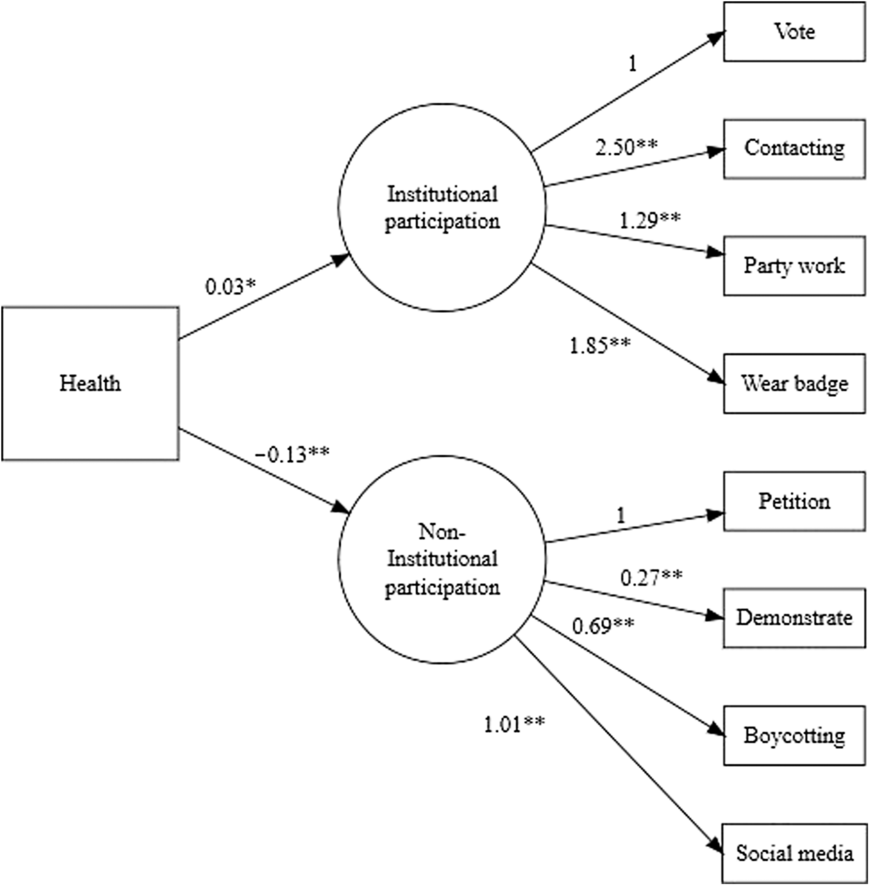
The empirical analysis starts with a model in which the direct relationship between health and the two modes of political participation – institutional and non-institutional – is examined. Health is measured with the EQ-5D index as explained earlier, and the two modes of participation are measured as latent structures, each of which comprises four indicators. Both the structural part of the overall model and the measurement models included within it are based on linear regressions. The model also includes control variables (age, age-squared, gender, education, income, and labour market status).Footnote 5 The latent variables are regressed on these controls to ensure that the results are not affected by the omission of such important confounding factors. To save space, the results are depicted as figures but the full (standardized and unstandardized) results are available in the online Appendix.
The model is estimated with the Stata programme (version 15). Using weights in the analysis restricts the available goodness-of-fit measures, as some of them are not appropriate for use with a complex survey design (StataCorp, 2017: 113–114). The available goodness-of-fit test results for the first model are presented at the bottom of Figure 1. In general, they indicate an acceptable fitness level. The standardized root mean square residual (SRMR = 0.026) and the coefficient of determination (CD = 0.536) measures indicate a very good fit (Hooper et al., Reference Hooper, Coughlan and Mullen2008).
The relationship between health and institutional and non-institutional participation (linear weighted model, n = 1974, unstandardized coefficients). *P < 0.05; **P < 0.01; standardized root mean square residual = 0.026. Coefficient of determination = 0.536. The model also includes control variables (gender, age, age-squared, education, income, and labour market status). The latent variables (institutional and non-institutional participation) were regressed on these control variables. These results are available in the online Appendix.

Substantively, the model presented in Figure 1 shows that health is related in a statistically significant way to both institutional and non-institutional political participation, although the coefficient for the health variable from health to non-institutional participation is larger than the one to institutional participation. This is somewhat surprising, as the link between more active voting and good health has been established in several studies, as reviewed above. However, when looking at institutional participation overall as a mode with several components, the positive relationship between good health and high levels of institutional participation seems to be rather weak but still in line with Hypothesis 1. This is, however, not the case with non-institutional participation. Here, the relationship is negative and statistically significant, suggesting that individuals in poor health are more likely to turn to the non-institutional mode of participation than those in good health.
The results concerning non-institutional participation are in line with Hypothesis 2 and also with some of the previous studies, which have demonstrated how poor health or disability is associated with some individual forms of non-institutional participation, such as more active signing of citizen initiatives (Christensen et al., Reference Christensen, Setälä and Jäske2019) and demonstrating (Mattila and Papageorgiou, Reference Mattila and Papageorgiou2017). However, neither of the first two hypotheses gained full support in this analysis. It seems that both of them are partly correct and partly wrong. Health, seen from the resource perspective (Hypothesis 1), increases institutional but not non-institutional participation, while good health is negatively related to non-institutional participation, as proposed by Hypothesis 2.
In addition to statistical significance, the substantive magnitude of the health effect needs to be assessed. As both modes of participation are measured as latent constructs, they do not have a natural scale for interpretation. It is, however, possible to compare the sizes of the coefficients within each mode of participation to assess the magnitude of the effect of health in relation to other important variables.
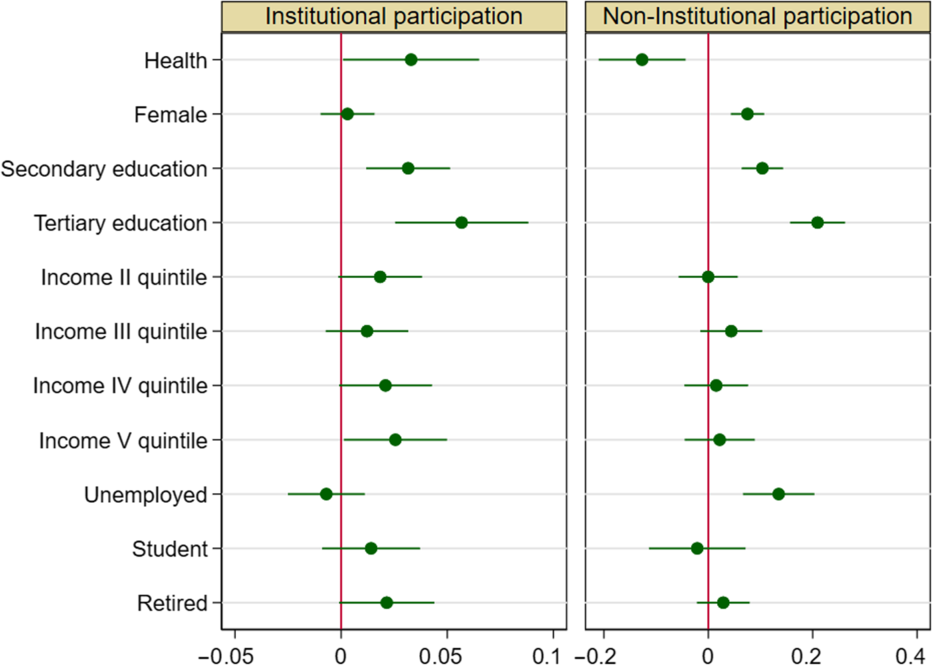
The coefficient sizes are shown in Figure 2. As already mentioned, those respondents with no health issues receive 1 on the EQ-5D measure and values below this indicate worse health. However, in practice, the health variable varies between 0 (indicating poor health) and 1 (good health). There is only one observation in the data that has a value of less than 0 for her health and even this value is very close to 0 (−0.011). This means that we can assess the approximate effect of health on participation by comparing the coefficient on health to the coefficient of other socioeconomic variables that are measured with dummy variables.
The regression coefficient sizes of health and socioeconomic variables with 95% confidence intervals.

When looking at institutional participation, Figure 2 shows that the effect of health, when moving from the lowest value to the highest, is about the same as the difference between respondents with secondary and only primary education and somewhat smaller than between those with university-level education and those with only primary-level education. In the case of non-institutional participation, the absolute coefficient value (0.13) of the health variable is the same as the value for the highest income quintile, indicating that the effect of health is similar in size to the effect of income. Health also has a larger impact on non-institutional participation than gender. However, one has to bear in mind that, in these comparisons, the extreme ends of the health variable were used, which may make the overall effect of health seems larger than it probably is in the real world. Nevertheless, the results show that the effect of health is comparable to many socioeconomic variables used in participation studies.
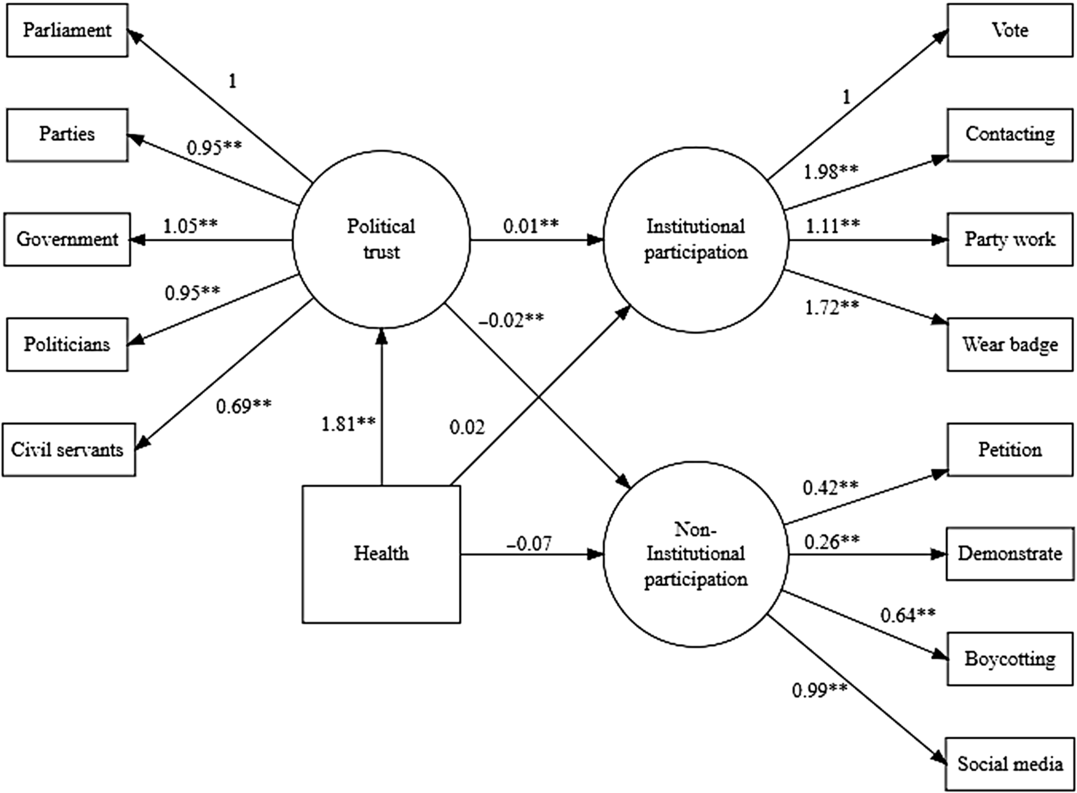
The second model, in Figure 3, expands the first model by introducing political trust as a mediating factor between health and participation. The goodness of fit of this model, as indicated at the bottom of the figure, is broadly at the same level as the first model. The SRMR (0.030) and the CD (0.585) are still at a very good level.
The relationship between health, trust, and institutional and non-institutional participation (linear weighted model, n = 1859, unstandardized coefficients). *P < 0.05; **P < 0.01; standardized root mean square residual = 0.030. Coefficient of determination = 0.585. The model also includes control variables (gender, age, age-squared, education, income, and labour market status). The latent variables (trust and institutional and non-institutional participation) were regressed on these control variables. These results are available in the online Appendix.

The extended model in Figure 3 shows that political trust is linked to participation in quite a complex way. In general, the results here support Hypothesis 3 and Hypothesis 4. Those with high levels of trust are more likely to take part in institutional political activities, while low trust increases the tendency to participate in non-institutional activities. Trust is also linked to health in a statistically significant way: individuals in good health tend to trust political actors and institutions more than those in poor health.
However, the inclusion of trust as a mediating factor leads to the disappearance of the direct effect between health and both modes of participation. Nevertheless, health is indirectly connected to both institutional and non-institutional participation through trust. Problems with health decrease political trust, with low political trust, in turn, leading to increased levels of non-institutional participation. An indirect link through trust also connects health and institutional participation, that is, good health leads to high trust, which is linked to more active institutional participation. However, this latter mechanism is distinctly weaker, as the coefficient is only about half of the corresponding coefficient between trust and non-institutional participation.
I used Sobel’s test (Reference Sobel1987) to confirm whether the results in Figure 3 are consistent with the mediation hypotheses (Hypothesis 3 and Hypothesis 4). Sobel’s mediation test is an approximate method for testing whether the mediation between two variables through a third one is statistically significant (Kline, Reference Kline2016: 245). The test shows that the hypothesis for mediation between health and institutional participation cannot be supported (P = 0.08), although the test result is not far away from the conventionally required level of statistical significance. The situation is different for non-institutional participation. In this case, the test shows that the indirect link between poor health and increased non-institutional participation is statistically significant (P = 0.02).
To further evaluate the reliability of the results, I performed some robustness checks. The results presented above were based on weighted data. However, the need to use survey weights in multivariate models, such as SEMs, is not completely without controversy. Weights are certainly needed when estimating population-based descriptive statistics, but it is far from evident that one should always use them when applying multivariate methods in order to analyse relationships between variables (Solon et al., Reference Solon, Haider and Wooldridge2015; Bollen et al., Reference Bollen, Biemer, Karr, Tueller and Berzofsky2016). Therefore, I re-estimated the models in Figures 1 and 2 without survey weights. These results led to similar conclusions as the models with weighted data, with one exception. After the re-estimation, the direct effect of health on non-institutional participation is statistically significant (and negative) in the second model, confirming the earlier observation of health’s larger importance to non-institutional than institutional participation.
The second robustness test was related to the composition of the latent institutional participation variable. Often, in analyses of participation modes, voting is not included in the institutional participation index, as it is by far the most popular form of institutional participation and could overshadow all other information in the data (Marien et al., Reference Marien, Hooghe and Quintelier2010: 198). One can also see in Figures 1 and 2 how the link between voting and the latent institutional participation variable is clearly weaker than for other indicators of institutional participation. Thus, I repeated the analyses by dropping voting from the models. This improved the model fit indicators slightly but did not lead to any changes in the statistical significance of the coefficients or in any changes in the empirical conclusions.Footnote 6
Finally, Finland is a Nordic country with a comparatively large public welfare sector which may mean that these results are not necessarily repeatable in other countries with less extensive healthcare services. To assess the external validity of these results, I performed a similar analysis to that above with the ESS Round 8 data from 23 countries collected in 2016 (the results are available in the online Appendix).Footnote 7 However, as the ESS data do not include the EQ-5D health measure, I used the SRH measure available in this data set. Earlier, I argued that this measure is likely to be inferior to the EQ-5D measure used in the analysis above, and hence, the value of this validity test is only indicative. Nevertheless, the results are very encouraging. They are similar to those from the analysis with Finnish data in Figures 1 and 3, with the exception that the relationship between SRH and institutional participation was not statistically significant. However, the negative relationship between poor health and non-institutional participation also remained statistically significant in the ESS data. Thus, it seems that the results presented in this article are at least partly generalizable to other countries in Europe.
Conclusions and discussion
In most welfare states, the population is growing older, which means that the importance of health issues on the political agenda will inevitably become higher in the future. With an ageing population, problems with health are likely to become more prevalent at the individual level as well. Recent studies on political behaviour have tried to analyse these effects, but there has been scant research on wider modes of participation in the field which is almost exclusively centred on individual forms of participation. Consequently, in addition to these studies, a more wide-ranging perspective is needed. In this article, I have tried to provide a more comprehensive view of the relationship between health and political participation by focusing on two modes of activities: institutional and non-institutional participation.
The results show that health is related to both modes of participation, but the direction and strength of the relationship vary considerably. The linkage is strongest between non-institutional participation and poor health. When people who experience problems with their health are willing to participate, they are more likely to rely on non-institutional activity forms, such as signing petitions, taking part in demonstrations, or using social media to voice their concerns. The relationship between health and institutional forms of participation is weaker and points to a different direction: good health is connected with institutional participation, such as voting or working for a party. In theoretical terms, these results show that neither the resource model nor the grievance model is sufficient to predict political participation where health is concerned. It seems that the resource model is better at explaining the relationship between health and institutional participation, while grievance theory does a better job when health and non-institutional participation are analysed.
These differences can be explained by introducing political trust into the picture as a mechanism through which health has an indirect effect on participation. Health is strongly connected to trust: those in good health have higher levels of trust in the political system and its actors, while poor health is connected to decreased levels of trust. This difference, in turn, manifests itself in varying behaviour. Poor health decreases trust, which leads to increased non-institutional participation, while good health instead leads to trust and favours institutional activities.
The results presented in this article contribute not only to the growing knowledge on health and political behaviour but also to the wider field of participation studies in general. In the field focusing on health gaps in participation, the results can explain some of the contradictory observations in the existing literature concerning the mobilizing vs. the demobilizing effect of health. Furthermore, this study highlights trust as a mechanism connecting personal health and participation. However, this field needs much more analysis, as other mechanisms could include political efficacy, interest, and knowledge. The broader contribution underlines the general need to take health issues into account in participation studies when explaining political participation. Health is a factor that affects political action, as do socioeconomic factors or other resources available to citizens. In fact, the results here show that the substantial effect of health differences on participation is approximately on the same level as some important socioeconomic variables, such as education, income, or gender. Changes in health can also affect participation through increased self-interest in health policies or by increasing grievances that motivate people into action. However, the conceptualization of participation forms into institutional and non-institutional forms was relatively simple, and further studies could concentrate on how people combine various individual types of activities and how health is related to these combinations.
The answer to the question posed in the title is: ‘Yes, poor health does mobilize people into political action, especially in the forms of non-institutional participation’. However, an even bigger question concerns whether this heightened involvement in non-institutional participation among those in poor health is enough to compensate for their decreased involvement in institutional forms of participation. If not, there is a real risk that the interests of people in poor health are overridden by other interests in the political process. For the functioning of a democratic system, it is important to take into account health-related differences in participation, as these inequalities tend to easily transform themselves into inequalities in representation. There is already some evidence that this is happening in the USA (Pacheco and Ojeda, Reference Pacheco and Ojeda2020) and further studies are needed in other countries.
Supplementary material
To view supplementary material for this article, please visit https://doi.org/10.1017/S175577391900033X
Acknowledgements
The author is grateful for constructive and helpful comment by the journal reviewers, Luca Bernardi, Hannu Lahtinen, Achillefs Papageorgiou, and Lauri Rapeli.
Funding
This work was supported by Academy of Finland (grant number 266844).