Background
Gunshot wounds (GSWs) to the head are highly morbid and are frequently lethal injuries. Despite recent reports of improved outcomes with aggressive resuscitation,Reference Joseph, Aziz and Pandit1 most studies have low rates of survival with many patients dying pre-hospital or in the emergency room.Reference Cavaliere, Cavenago and Siccardi2 Self-inflicted (SI) GSWs to the head, in particular, may have survival rates of only 10%-15%.Reference Selden, Goodman and Cordell3
In the local population, there is a high frequency of SI GSWs to the head, and many of these patients are brought in by Emergency Medical Services (EMS) with an extrication collar in place. Studies on spinal motion restriction (SMR) in penetrating trauma have indicated a lack of cost-effectiveness as well as an increased risk of mortality.Reference Kaups and Davis4–Reference Haut, Kalish and Efron6 The use of SMR may impede airway management and hemorrhage control.Reference Kaups and Davis4,Reference DuBose, Teixeira and Hadjizacharia7 Moreover, cadaveric and imaging studies suggest that concurrent cervical spine fractures are rare in GSWs to the head and indirect cervical spine injuries do not occur.Reference Kaups and Davis4,Reference Klein, Cohn and Soffer8,Reference Lanoix, Gupta and Leak9 These radiographic studies predominantly evaluated for bony injuries through plain radiographs of the cervical spine; the frequency of cervical spine injury identified through thin-slice computerized tomography (CT) is not known.
This study characterizes cervical spine injuries identified on CT at this institution and compares them to the frequency observed in a review of the US National Trauma Data Bank (NTDB; American College of Surgeons Committee on Trauma; Chicago, Illinois USA). Fracture incidence is hypothesized to be lower in the SI GSW population. Secondarily, factors associated with prehospital SMR use are evaluated.
Methods
The institutional review board at University Medical Center (Las Vegas, Nevada USA) approved this protocol (UMC-2017-112). Gunshot wounds to the head and face were queried from the hospital’s prospectively maintained Level 1 trauma registry from 2013-2017. Patients with GSWs to the neck, multiple GSWs, polytrauma, less than 17 years of age, and incomplete records were excluded. Datasets included age, gender, SI versus not, cervical spine fracture, spinal surgery, length-of-stay (LOS), and mortality. The EMS run sheets and trauma documentation were reviewed for the presence of SMR (namely a cervical collar), hypotension, cardiopulmonary resuscitation (CPR), and intubation prior to arrival. Type of imaging (x-ray, CT, or magnetic resonance imaging [MRI]) and duration of SMR were assessed.
Institutional data were compared to the US NTDB Research Data Sets from 2012 through 2016.10 The NTDB, which is maintained by the American College of Surgeons Committee on Trauma, is a publicly available repository containing data from over 900 registered trauma centers and 6,000,000 records. For each data year, ICD-9/10 E-Codes (mechanism of injury) were used to identify records for GSWs and separated by intent – suicide (ICD-9 955; ICD-10 X72-74) and non-suicide (ICD-9 922, 965, 985; ICD-10 W32-34, X93-95, Y22-24). Craniofacial GSWs were identified as having an abbreviated injury scale (AIS) greater than two for the head or face region. Records were excluded with AIS greater than two for other body regions (suggesting polytrauma or multiple GSWs) or age less than 17. Datasets were evaluated for presence of cervical spine fracture by D-codes (diagnosis; ICD-9 805, 806, 839; ICD-10, S12-13), spinal surgery (CPT codes), demographics, LOS, and mortality.
Statistical analysis was performed with Stata Version 14 (Stata Corp.; College Station, Texas USA). Descriptive variables are reported as number of patients and percentage of cohort with 95% confidence intervals (CI). Continuous variables are reported as mean and standard deviation (SD), with ranges when appropriate. Non-normally distributed data are presented as median with interquartile ranges (IQR). Normally distributed variables were compared using Student’s t-test, with Chi-square or Fisher exact test for categorical comparisons. Significance was set at a P value of less than .05.
Results
Demographics
Isolated craniofacial GSWs occurred in 241 patients with a mean age 39 (SD = 18) years (range 17 to 92). The cohort had 205 (85%) males. Injuries were SI in 158 (66%), with no difference by gender (P = not significant). Overall, 137 (57%) individuals died: 107 (68%) of SI and 30 (36%) of non-SI GSWs (P < .01). Seventy patients (29%) died in the emergency department, with the remaining 67 (28%) dying after intensive care unit (ICU) admission. For the 104 surviving patients, median hospital LOS was 14 days (IQR 4-29), ICU LOS six days (IQR 2-12), and mechanical ventilation 3.5 days (IQR 0-7.5). Craniotomy was performed in 25 (24%) and tracheostomy in 35 (34%).
EMS Intervention
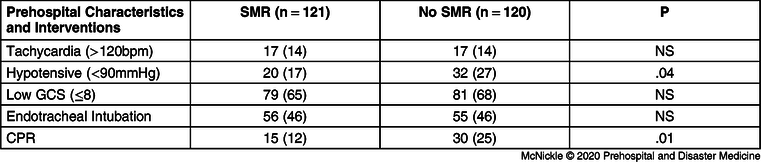
Emergency Medical Services placed SMR for 121 (50%) patients prior to hospital arrival, with six (2%) additional cervical collars placed in the trauma bay at the discretion of the attending physician. Emergency Medical Services intubated 111 (46%) and performed CPR on 45 (19%) individuals. Patients arriving without SMR had increased frequency of hypotension or receiving CPR (Table 1); SMR was placed for 80 (51%) SI and 41 (49%) non-SI patients (P = not significant).
Prehospital Characteristics of Patients with Spinal Motion Restriction

Note: Data presented as n (%).
Abbreviations: CPR, cardiopulmonary resuscitation; GCS, Glasgow Coma Scale; NS, not significant; SMR, spinal motion restriction.
Imaging
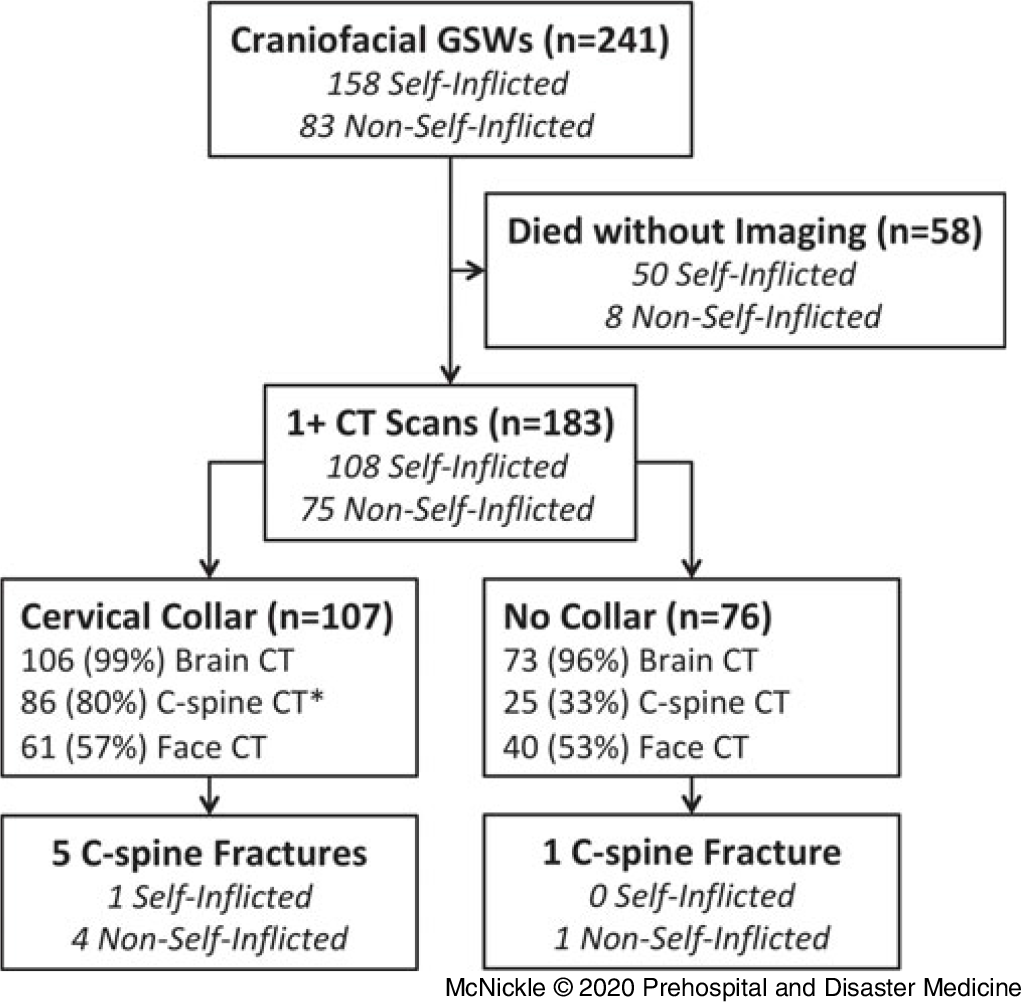
One or more CT scans were obtained in 183 (76%) patients; the remaining 58 (50 SI and eight non-SI) died prior to imaging. Patients with SMR had increased use of cervical spine CT (80% versus 33%; P <.01). Frequency of brain and maxillofacial CTs were not different (Figure 1). No patients received x-rays of their cervical spine; however, one (<1%) had a subsequent MRI to exclude ligamentous injury. There was no evidence of any missed injuries.
Imaging and SMR Management in Craniofacial GSWs.

Cervical Spine Fractures
Cervical spine fractures were identified in six (3%) patients, of which five of five (100%) brought in by EMS had SMR prior to arrival. Patient 3 was transported by private vehicle and without neurologic deficits, and thus was placed into SMR after his C1 transverse process fracture was discovered. All fractures were direct ballistic injuries and are described in Table 2. The frequency of cervical spine fracture was higher in non-SI wounds (7% [5/75] versus <1% [1/108]; P = .03). Patient 4 arrived with a complete spinal cord injury and was the only patient to undergo surgical decompression. All others were managed non-operatively with a cervical collar.
Institutional Cervical Spine Fractures

Note: Patient 3 arrived by private vehicle and was not in spinal motion restriction (SMR) until his C1 transverse process fracture was discovered.
Abbreviations: CT, computerized tomography; LTAC, long-term acute care facility; SI, self-inflicted.
Comparison of Fracture Frequency to the NTDB
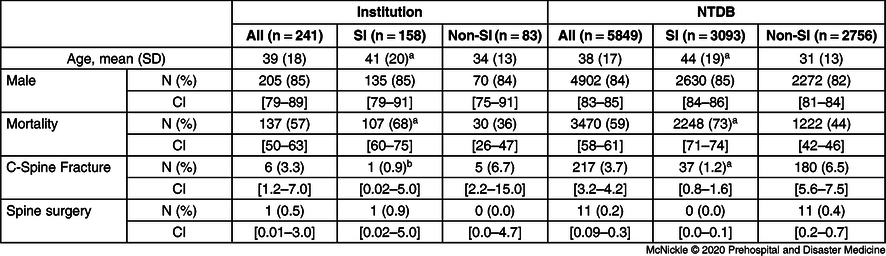
The 241 local patients were compared to 5,849 from the NTDB with isolated craniofacial GSWs. Mean age of the NTDB cohort was 38 (SD = 17) years (range 17 to 89) with 3,093 (53%) SI cases. The frequency of SI cases was higher at this institution than the NTDB (66% versus 53%). For both institutional and NTDB cohorts, patients were predominantly male (>80%) with SI subsets being older (P < .01) and having higher mortality (P < .01; Table 3). Overall, cervical spine fractures occurred in 223 (4%), of which 12 (5%) underwent spinal surgery (<1% of total study population). The frequency of fracture was five-fold greater in non-SI patients (P < .05).
Frequency of Cervical Spine Injury in Isolated Craniofacial GSWs

Abbreviations: GSW, gunshot wound; NTDB; National Trauma Data Bank; SI, self-inflicted.
a P < .01.
b P < .05.
Discussion
This study demonstrated a low frequency of cervical spine fractures in isolated craniofacial GSWs; GSWs to the head are highly morbid and are frequently lethal injuries. Self-inflicted GSWs to the head have an overall survival of only 10%-15%.Reference Selden, Goodman and Cordell3 Gunshot wounds crossing midline (as in many SI cases), involving multiple lobes, or significant intraventricular hemorrhage are identified as highly lethal injury patterns. The majority of patients die on-scene, and of those surviving to the hospital, approximately 50% will die in the emergency department.Reference Cavaliere, Cavenago and Siccardi2 Within this severely injured population, this study identified a low incidence of concurrent cervical spine fractures.
The current results of a four percent prevalence of cervical spine fractures in GSW to the head as identified by CT parallels previous literature reporting on radiographic and cadaveric studies. This body of research predominantly used plain radiographs as the imaging modality for cervical spine evaluation with less frequent flexion-extension x-rays, fluoroscopy, or CT. Kennedy, et al noted a 10% incidence of cervical spine fractures with GSW trajectory involving the face or neck.Reference Kennedy, Gonzalez and Beitler11 Kaups and Davis reported a 93% cervical clearance rate with radiographs, with three direct bullet injuries suggested by trajectory and no evidence of indirect spinal column injuries.Reference Kaups and Davis4 Cervical spine fractures have not been identified when the trajectory is limited to the cranium.Reference Klein, Cohn and Soffer8,Reference Lanoix, Gupta and Leak9,Reference Kennedy, Gonzalez and Beitler11,Reference Chong, Ware and Harris12 Thus, it is logical that the rate of cervical spine fractures in the SI cohort is lower than the assault population, as most SI tracts (bitemporal, transoral, or submental) would be limited to the cranium. Similarly, penetrating spinal injuries rarely results in instability, thus, the very low overall rate of spinal surgery in this population. A review of over 300 GSWs with bony spinal column injury identified only two cases (<1%) requiring decompression of spinal canal and no cases of instability requiring operative intervention.Reference DuBose, Teixeira and Hadjizacharia7
The frequency of cervical spine fractures in patients with craniofacial GSW was four percent in a review of five years of NTDB data. The higher frequency of cervical spine fracture in non-SI GSW patients was similar to frequencies in the NTDB cohort. The single case of SI-GSW with a cervical spine fracture was caused by an unusual trajectory through the mandible, hyoid bone, and into the spinal column at the C5 level, and was identified on CT scan. No cervical spine fractures were observed in SI patients with the more common submental, transoral, or bitemporal trajectories.
Spinal immobilization is suggested to have limited benefit and high potential for harm. A retrospective analysis of the NTDB demonstrated twice the risk of death from penetrating trauma in spine-immobilized patients.Reference Haut, Kalish and Efron6 Similarly, the Eastern Association for the Surgery of Trauma (EAST; Chicago, Illinois USA) practices management guideline for spinal immobilization found a risk ratio of 2.4 for mortality and no benefit on mitigating neurologic defects.Reference Velopulos, Shihab and Lottenberg13 Prehospital spine immobilization is not cost-effective for penetrating torso or extremity injuries and is unlikely to be advantageous for penetrating head injuries.Reference Garcia, Liu and Victorino5 Cervical spine immobilization has the potential to mask potentially life-threatening conditions and impede airway or hemorrhage management. Specifically, cervical spine immobilization has been associated with an increased number of intubation attempts.Reference Kaups and Davis4 Given these findings, it is recommended to delay or omit cervical spine immobilization in favor of airway and hemorrhage management.Reference DuBose, Teixeira and Hadjizacharia7,Reference Velopulos, Shihab and Lottenberg13,Reference Medzon, Rothenhaus and Bono14
Despite these concerns, one-half of the GSWs to the head presenting at this institution arrived in SMR, with no difference in frequency between SI and assault cases. Contraindications for SMR in the local EMS protocols include penetrating trauma to the head or neck with no evidence of spinal injury; cases where airway management, ventilation, or hemorrhage control is compromised; and cardiac arrest.15 Patients that were hypotensive or receiving CPR had lower rates of SMR, in line with these guidelines. Apart from hemodynamic instability, there were no other factors consistently associated with SMR use. Not surprisingly, the presence of SMR increased the frequency of dedicated cervical spine imaging.
Limitations
This study is limited by its retrospective, observational design. The EMS run sheets were often incomplete, which limited the ability to evaluate the impact of SMR on interventions. Although endotracheal intubation occurred at a similar frequency regardless of SMR, it was impossible to ascertain the number of attempts or elapsed time from the prehospital documentation. The NTDB allowed a larger scale estimate of cervical fractures in GSWs to the head and paralleled the observation of a higher frequency observed in non-SI cases. As with any database, there are limitations based upon accurate coding/data entry, missing data (excluded in this review), and the ability to extract the desired parameters. Unfortunately, the use of SMR is not a collected prehospital variable in the NTDB dataset.
Conclusion
Cervical spine fractures were identified in less than four percent of isolated craniofacial GSWs overall, and five-fold more frequently in non-SI cases. Cervical spine CT was an accurate modality for detection of fractures. Prehospital SMR should be avoided in cases consistent with SI injury, and for all others, SMR should be discontinued once CT imaging is completed with negative results.
Acknowledgements
The authors would like to thank the University Medical Center Trauma Registrars (Las Vegas, Nevada USA) for their contribution to this work.
Conflicts of interest
none