Summations
Most of the evidence found supported the use of paroxetine for the efficacy (reduction and response) and tolerability (dropouts due to any cause) of SAD in adults.
Olanzapine ranked relatively high for treatment efficacy, and buspirone ranked worse for dropouts due to any cause.
Most of the findings were based on low to very low quality of evidence.
Considerations
We suggest clinicians consider paroxetine as a first-line treatment for SAD based on our efficacy and acceptability (dropout due to any cause) findings.
The finding on the relatively high rank of olanzapine and buspirone should be interpreted with caution given that only one study was found for this intervention.
Further research is needed to confirm the estimates of effect.
Introduction
Social anxiety disorder (SAD) begins as early as eight years of age, with studies reporting a lifetime prevalence of between 3% and 16% (Kessler et al., Reference Kessler, Berglund, Demler, Jin, Merikangas and Walters2005; Stein et al., Reference Stein, Lim, Roest, de Jonge, Aguilar-Gaxiola and Al-Hamzawi2017). People with SAD perceive social situations as threatening and fear being noticed, scrutinised, or negatively evaluated by others (American Psychiatric Association, 2013; Heimberg et al., Reference Heimberg, Hofmann, Liebowitz, Schneier, Smits, Stein, Hinton and Craske2014). Social interactions, where unavoidable, are tolerated with extreme distress (American Psychiatric Association, 2013). SAD is associated with considerable comorbidity with other mental health problems, particularly depression (19%), substance-use disorder (SUD, 17%), generalised anxiety disorder (GAD, 5%), panic disorder (PD, 6%), and posttraumatic stress disorder (PTSD, 3%) (National Institute for Health and Care Excellence, 2013; Stein & Stein, Reference Stein and Stein2008). It is notable that 17% of people with the disorder misuse alcohol or drugs to cope with their anxiety and depression (National Institute for Health and Care Excellence, 2013).
There is a growing body of literature on the treatment of SAD, including work on a range of psychological and pharmacological interventions (Cuijpers et al., Reference Cuijpers, Sijbrandij, Koole, Andersson, Beekman and Reynolds2013; Mayo-Wilson et al., Reference Mayo-Wilson, Dias, Mavranezouli, Kew, Clark, Ades and Stephen2014). Current guidelines emphasise the use of selective serotonin reuptake inhibitors (SSRIs), serotonin and norepinephrine reuptake inhibitors (SNRIs), monoamine oxidase inhibitors (MAOIs), reversible inhibitors of monoamine oxidase A (RIMAs), benzodiazepines, and anticonvulsants with gamma-amino butyric acid (GABA) analogues as first-line medications for the treatment of SAD (Blanco et al., Reference Blanco, Bragdon, Schneier and Liebowitz2013; De Menezes et al., Reference De Menezes, Coutinho, Fontenelle, Vigne, Figueira and Versiani2011; National Institute for Health and Care Excellence, 2011; Williams et al., Reference Williams, Hattingh, Kariuki, Tromp, van Balkom, Ipser and Stein2017; World Health Organisation, 2013). These recommendations are based on standard pairwise meta-analyses, which pool data from studies and compare estimates of the efficacy of different agents indirectly (Curtiss et al., Reference Curtiss, Andrews, Davis, Smits and Hofmann2017; Williams et al., Reference Williams, Hattingh, Kariuki, Tromp, van Balkom, Ipser and Stein2017). Nevertheless, this approach only provides conclusions about interventions that have directly been compared with one another and does not provide clinicians with comparisons between all potential interventions at their disposal in treating a specific disorder (Efthimiou et al., Reference Efthimiou, Debray, van Valkenhoef, Trelle, Panayidou, Moons, Reitsma, Shang and Salanti2016; Mavridis et al., Reference Mavridis, Giannatsi, Cipriani and Salanti2015).
Network meta-analysis (NMA) is a quantitative data synthesis approach that allows investigators to combine indirect comparisons of interventions, as well as direct head-to-head comparisons, thereby supporting conclusions about the relative efficacy and tolerability of interventions between all combinations of treatments. NMAs are therefore particularly informative within clinical settings where competing interventions are available (Mavridis et al., Reference Mavridis, Giannatsi, Cipriani and Salanti2015; Salanti, Reference Salanti2012). Two NMAs of the efficacy of pharmacotherapy for SAD have been published (Hansen et al., Reference Hansen, Gaynes, Gartlehner, Moore, Tiwari and Lohr2008; Mayo-Wilson et al., Reference Mayo-Wilson, Dias, Mavranezouli, Kew, Clark, Ades and Stephen2014). These require updating and would benefit from additional focus on acceptability of interventions (dropouts due to any cause and dropouts due to side effects), the use of surface under the cumulative ranking (SUCRA) to rank interventions for SAD (from the best to the worst treatment) (Salanti et al., Reference Salanti, Ades and Ioannidis2011), and using GRADE to determine the quality of the evidence to assist in making judgements about best treatment options. Here we provide an updated NMA to compare the efficacy and acceptability of different pharmacological interventions in the treatment of SAD in adults.
Objectives
The aim of this systematic review is to use NMA methodology to compare the efficacy and acceptability of different pharmacological interventions against one another or placebo in the treatment of SAD in adults and to provide a clinically useful summary of the comparative evidence that can be used to guide decisions about acute treatment of SAD in adults.
Methods
The study protocol is available from PROSPERO with the following identifier CRD42015017493.
Search strategy
We used a search from our previous SAD Cochrane review (Williams et al., Reference Williams, Hattingh, Kariuki, Tromp, van Balkom, Ipser and Stein2017) conducted by the Cochrane Common Mental Disorders Group who searched their controlled trials register (CCMDCTR-Studies) (17 August 2015, see Appendix A; 2 August 2017, see Appendix A). The CCMDCTR includes generic searches of Medline, Embase, and PsychINFO, including the Cochrane Central Register of Controlled Trials (CENTRAL). Individual updated searches were also conducted by TW of Medline (via PubMed), PsychINFO (via EbscoHost), clinical.trial.gov, and the Clinical Trials Search Portal (ICTRP) (apps.who.int/trialsearch) (to August 2012 and to November 2018), using the terms ‘social phobia’ OR ‘social anxiety disorder’ and ‘medication’ OR ‘pharmacotherapy’ OR ‘treatment’. All clinical trials registers were updated with a search conducted on 13 November 2018.
Two authors (TW and JI) also hand-searched Google Scholar (13 November 2018) for additional studies and scanned the bibliographies of all identified studies. Published and unpublished studies from key researchers were also obtained. We placed no restriction on the language and publication status of included trials. Thereafter, studies were independently assessed for eligibility and inclusion. Disagreements were resolved via discussion with a third author (DS). See Appendix A for the full search queries.
Selection criteria, study characteristics, and intervention type
We included all randomised, double-blind, controlled studies comparing any pharmacological intervention with placebo or another pharmacological intervention in the treatment of SAD, as well as studies investigating multimodal treatments, on the condition that an active drug and placebo group was a comparator. We included both monotherapy and add-on pharmacotherapy trials. Quasi-randomised controlled studies and open-label studies were excluded. We included adult participants diagnosed with SAD according to criteria from the Diagnostic and Statistical Manual of Mental Disorders (DSM-III and later) or the International Classification of Diseases (ICD and later). Randomised controlled trials (RCTs) investigating specific social anxiety (performance anxiety) were excluded. No restrictions were placed on psychiatric comorbidity and setting of the studies. Studies that only included a subset of participants that met the review inclusion criteria in the analysis were excluded. We placed no restriction on the dose of medication interventions, including both fixed-dose and flexible-dose designs.
We included RCTs that evaluated one or more of the following pharmacological interventions: 5HT1A partial agonists (e.g. buspirone and vilazodone), anticonvulsants (e.g. gabapentin, levetiracetam and pregabalin), antipsychotics (e.g. olanzapine), benzodiazepines (e.g. clonazepam and bromazepam), beta-blockers (e.g. atenolol), mono-amine oxidase inhibitors (MAOIs, e.g. phenelzine), noradrenaline reuptake inhibitors (NARIs, e.g. atomoxetine), noradrenergic and specific serotonergic antidepressants (NaSSAs, e.g. mirtazapine), other medications/experimental drugs (e.g. GW876008 also known as emicerfont, GR205171, LY686017), RIMAs (e.g. brofaromine and moclobemide), serotonin antagonist and reuptake inhibitors (SARIs, e.g. nefazodone), SNRIs (e.g. venlafaxine), and SSRIs (e.g. citalopram, fluoxetine, fluvoxamine, paroxetine, and sertraline).
Outcome measures
Acute treatment was defined as an 8-week treatment in all analyses. If studies did not provide information at 8 weeks, we extracted data at the closest assessment. The primary outcomes were treatment efficacy and acceptability. The primary outcome of treatment efficacy (as continuous outcome) was measured using the total score on the Liebowitz Social Anxiety Scale (LSAS). The LSAS scale was chosen given that this is a validated, commonly used and psychometrically sound instrument for measuring SAD (Liebowitz, Reference Liebowitz1987). Acceptability of treatment was defined as the proportion of patients who left the study early by any cause during the first 8 weeks of treatment (range 6 to 12 weeks). Secondary outcomes included treatment response and tolerability. The secondary outcome of treatment response (as dichotomous outcome) was measured by the total number of patients who responded according to the Clinical Global Impressions Improvement Scale (CGI-I). We defined responders as having a change item score of 1 (‘very much’) or 2 (‘much’) improved (Guy, Reference Guy1976) on the CGI-I, or similar. Tolerability of treatment was defined as the proportion of patients who left the study early due to side effects during the first 8 weeks of treatment (range 6 to 12 weeks).
Data extraction and Management
Two authors (TW, JI), independently and in duplicate, assessed the title and abstract of RCTs identified from an update search of the literature. We subsequently scanned full-text articles agreed upon as potentially eligible. We resolved any disagreements in the trial assessment and data collation procedures by discussion with a third review author (DS). Information extracted included study characteristics (such as lead author, publication year, setting), participant characteristics (such as diagnostic criteria, sample size, mean baseline score), intervention details (such as medication, dose ranges, and duration of studies), and outcome measures (i.e. rating scales) using a piloted data extraction form.
Furthermore, the Cochrane ‘Risk of Bias’ tool was used to assess the risk of bias of individual studies by two reviewers (TW, JI) (Higgins & Green, Reference Higgins and Green2011). Moreover, the quality of evidence contributing to each network estimate was assessed using the Grading of Recommendation, Assessment, Development and Evaluation (GRADE) framework, which characterises the quality of a body of evidence based on the study limitations, imprecision, inconsistency, indirectness, and publication bias for the primary and secondary outcomes (Guyatt et al., Reference Guyatt, Oxman, Akl, Kunz, Vist and Brozek2011, by TW and MM). The approach by Puhan et al. (Reference Puhan, Schünemann, Murad, Li, Brignardello-Petersen, Singh, Kessels and Guyatt2014) was also used to assess indirect comparisons. Thereafter, we applied methods by the GRADE NMA Working group on making conclusions from a NMA for direct comparisons, based on the traditional five GRADE criteria. In summary, these steps included (i) specifying a clear reference standard or decision threshold, (ii) grouping treatments’ relative effectiveness compared to the reference standard using confidence intervals, (iii) further grouping treatments based on all available pairwise comparisons in the network, (iv) separating groups based on quality of evidence and lastly checking consistency of case-by-case pairwise comparisons and rankings. Thus, this process allowed us to draw conclusions regarding which interventions are most effective considering estimates of effect, quality of evidence, and NMA rankings (Brignardello-Petersen et al., Reference Brignardello-Petersen, Bonner, Alexander, Siemieniuk, Furukawa, Rochwerg, Hazlewood, Alhazzani, Mustafa, Murad, Puhan, Schünemann and Guyatt2017).
Statistical analysis
For continuous outcomes, where the same measure was used to assess an outcome, the mean difference (MD) was extracted (Higgins & Green, Reference Higgins and Green2011). Dichotomous outcomes were analysed by calculating the odds ratio (OR). Missing dichotomous outcome data were managed according to the intention-to-treat (ITT) principle or analysed using last observation carried forward (LOCF). When the standard deviation (SD) of the effect estimates was not reported in articles and attempts to obtain them by contacting trial authors was unsuccessful, they were derived from p-values, t-values, confidence intervals, or standard errors, where available (Higgins & Green, Reference Higgins and Green2011).
Where heterogeneity was found (based on I2 values), we explored reasons for heterogeneity from methodological or PICO variables (population, intervention, comparison, and outcomes) (Schardt et al., Reference Schardt, Adams, Owens, Keitz and Fontelo2014). We performed a meta-regression to determine whether the assumption of transitivity (which implies that the available treatment comparisons do not differ with respect to the distribution of effect modifiers (Chaimani et al., Reference Chaimani, Mavridis and Salanti2014)) across treatment comparisons was upheld, by testing whether the following variables affected each of the outcomes: year of publication, baseline severity, sponsorship, and mean age at onset across the different pairwise comparisons. If the distributions were balanced across comparisons, we concluded against evidence of intransitivity (Wood et al., Reference Wood, Egger, Gluud, Schulz, Jüni, Altman, Gluud, Martin, Wood and Sterne2008). This was done by comparing the covariates (effect modifiers) log estimate of treatment effect size and standard error of treatment effect size for each outcome in STATA version 15.
Initially, we performed standard pairwise meta-analyses using a random effects model (Higgins & Green, Reference Higgins and Green2011) and inverse variance method using the R package meta (Schwarzer, Reference Schwarzer2007) for every treatment comparison with at least two studies per intervention. We also performed a frequentist random effect NMA to synthesise the available evidence from the entire network of studies by pooling direct and indirect treatments using R package netmeta (Rücker & Schwarzer, Reference Rücker and Schwarzer2018). We assume a constant heterogeneity variance which is added to each comparison of the network and was estimated via a generalised method of moments estimate (Jackson et al., Reference Jackson, White and Riley2012). Results from the NMA were presented as summary relative effect sizes (MD or OR) for each possible pair of treatments. Furthermore, we calculated P-scores, as a frequentist analogue to SUCRAs (Rücker & Schwarzer, Reference Rücker and Schwarzer2015), to rank the treatments.
Results
Description of included studies
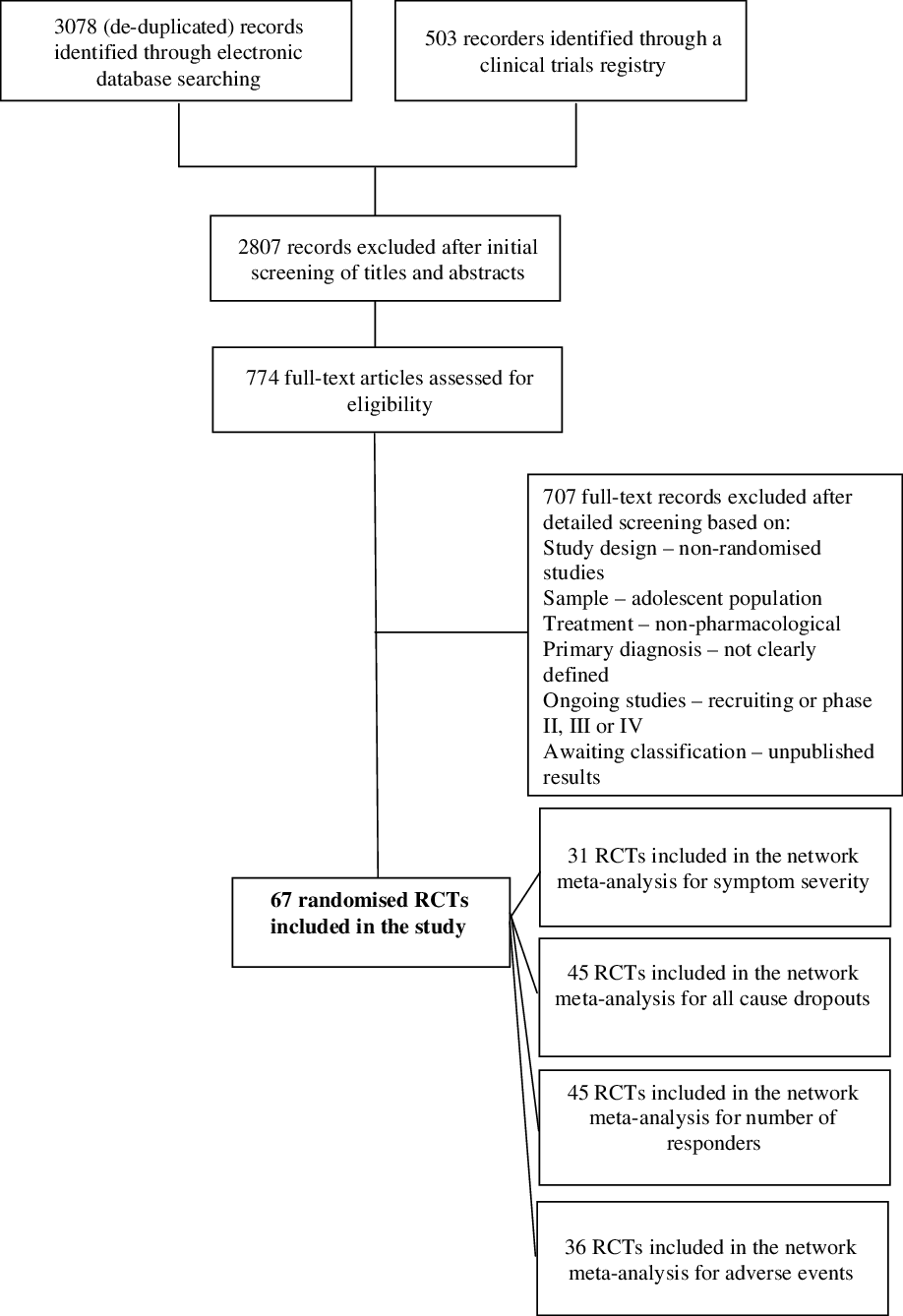
We found a total of 3581 records through electronic database searching (k = 3078) and from a clinical trials registry (k = 503) (see Figure 1). Two thousand eight hundred and seven records were excluded after initial screening of titles and abstracts. After independent review of the full text for the remaining 774 studies, 707 studies did not meet study inclusion and were excluded from the search (see Figure 1 and Appendix A). The systematic review included 67 studies (published from 1993 to 2016, see Appendix B) with 12122 patients, randomised to 27 different interventions, including a placebo arm. The mean duration of studies was 15.5 weeks (SD = 10.2; k = 67), and the mean age of the patients was 36.2 years (SD = 3.5; k = 63). Most of the studies were 2-arm (k = 49) with twelve 3-arm studies, four 4-arm studies, one 5-arm study, and one 6-arm study. Over 50% of the studies were industry funded (k = 40). Only 6% (k = 4) of the studies had an add-on design. Fifty-six (84%) studies used LSAS as a rating scale for assessing the reduction of anxiety symptoms, with a mean baseline severity of 80.1 (SD = 15.9; k = 52), were reported. The majority of studies included patients with coexisting psychiatric conditions (N = 37), and the RCTs were mainly conducted in outpatient settings (N = 45) (also see Appendix C).
Study selection process. PRISMA diagram of included and excluded studies.

Assessment of risk of bias
In terms of studying internal validity, 19 (28%) studies reported randomisation procedures and were rated low for risk of bias. The remaining studies were rated unclear for risk of bias. When assessing the allocation of treatment for each group, 17 (25%) studies were rated low for risk of bias, and the additional studies were rated unclear for risk of bias. Twenty-one percent of the studies (N = 14) reported that participants and personnel were blinded and were rated low for risk of bias. The remaining studies were rated unclear for risk of bias. Outcomes assessors were blinded in only 13 (19%) studies. Moreover, three studies were rated high for risk of bias, and 51 studies were rated unclear for detection bias. Only eight studies provided study protocols to fully determine bias caused by selective reporting, with three out of the 67 studies reporting high for risk of bias, and 56 out of the 67 studies reporting unclear for risk of bias. Although over 50% of the studies did provide data on the number of participants who dropped out of the study, seven studies were rated high for risk of bias. The remaining studies were rated unclear for attrition bias (see Appendix D).
Network meta-analysis results
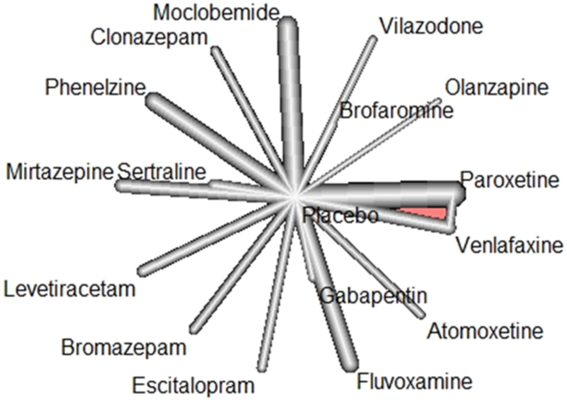
Twenty-one studies with 18 different interventions were included in the NMA for the continuous outcome of symptom reduction. For the binary outcome of treatment response, 45 studies describing 23 interventions were included in the network. For the binary outcomes of acceptability, 36 (adverse events) and 45 (all cause dropouts) studies describing 18 and 21 different interventions were included in the network, respectively. All studies had at least one placebo-controlled arm. Figure 2 represents the network structure of eligible comparisons for the primary outcome, symptom severity, for the NMA (the networks for acceptability and treatment response were similar; see Appendix E). We excluded the ‘LY686017’ arm from the analysis given the lack of FDA approval for this medication.
Network graph of eligible comparisons for the network meta-analysis of the outcome symptom severity. The width of the lines is proportional to the number of studies and sample sizes comparing every pair of treatments. The networks of eligible comparisons for the acceptability analysis (i.e. dropout rate and adverse events) and secondary outcome of treatment response are similar (see Appendix E).
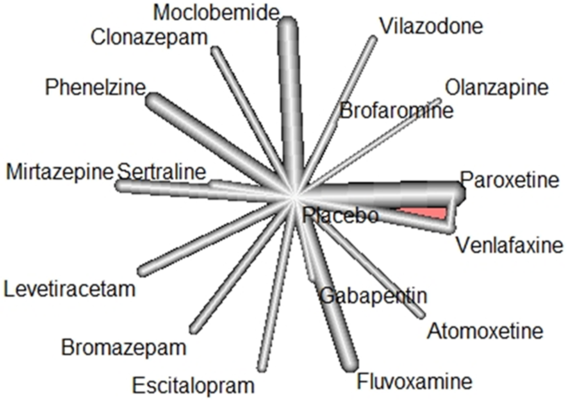
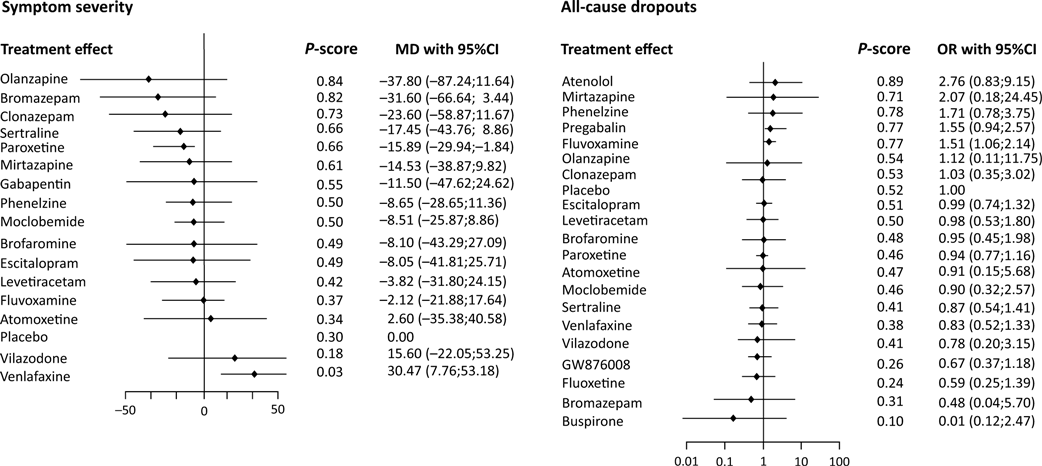
Table 1 shows the relative treatment effects for the two primary outcomes (change in symptom severity and all-cause dropouts). In terms of efficacy, paroxetine (k = 6, MD −15.89; CI −29.94 to −1.84, SUCRA = 0.66, N = 961) was significantly more effective than placebo in reducing anxiety symptoms, based on low to very low quality evidence. Among the moderate to high-quality category of quality of evidence, we found no interventions superior; however, clonazepam is amongst the least effective interventions (k = 1, MD −23.60, 95% CI −58.87 to 11.67, SUCRA = 0.73, N = 75) (also see Appendix D).
Network meta-analysis results and P-scores for the comparisons of active treatments versus placebo for the primary outcomes (a) change in symptoms and (b) all-cause dropouts. Legend. MD: mean difference; OR: odds ratio; CI: confidence interval

Although a significant difference in symptom severity was observed following treatment with venlafaxine compared to placebo, this effect favoured the placebo intervention (k = 2, MD 30.47, 95% CI 7.76 to 53.18, SUCRA = 0.03, N = 538), with evidence of low to very low quality (see Appendix D). No other statistically significant differences were found between the rest of the treatments and placebo. In terms of dropout rate, most of the medications (12 out of 19 comparisons) reported lower dropout rates due to any cause than placebo, but no statistically significant difference was found. This conclusion was based on low to very low quality evidence. Dropout rates were highest for buspirone, GW876008, bromazepam, vilazodone, atomoxetine, brofaromine, levetiracetam, clonazepam, olanzapine, mirtazapine, pregabalin, phenelzine, and atenolol. Fluvoxamine was the only medication for which significantly greater dropout rates were found and was amongst the most harmful interventions (k = 5, OR 1.51, 95% CI 1.06 to 2.14, SUCRA = 0.22, N = 972) in the moderate to high quality category.
In addition to paroxetine (k = 13, OR 2.64; CI 1.97 to 3.54, N = 2746), greater response to treatment compared to placebo was observed for brofaromine (k = 3, OR 8.10; CI 3.57 to 18.39, SUCRA = 0.87, N = 207), bromazepam (k = 1, OR 20.00; CI 4.31 to 92.71, SUCRA = 0.94, N = 60), clonazepam (k = 1, OR 14.50; 3.62 to 58.14, SUCRA = 0.92, N = 72), escitalopram (k = 3, OR 1.96; CI 1.21 to 3.17, N = 1595), fluvoxamine (k = 4, OR 1.89; CI 1.14 to 3.12, SUCRA = 0.48, N = 904), phenelzine (k = 3, OR 3.37; CI 1.59 to 7.15, SUCRA = 0.70, N = 183), and sertraline (k = 1, OR 2.50; CI 1.02 to 6.15, SUCRA = 0.59, N = 401). This conclusion is based on low to very low quality of evidence with the exception of paroxetine (SUCRA = 0.64) and escitalopram (SUCRA = 0.50) which were superior to the most effective medications and is based on high to moderate quality evidence (see Appendix F and G).
In terms of dropouts due to adverse events, brofaromine (k = 3, OR 3.98, 95% CI 1.28 to 12.36, SUCRA = 0.29, N = 213), escitalopram (k = 2, OR 2.02, 95% CI 1.09 to 3.75, SUCRA = 0.57, N = 946), fluvoxamine (k = 4, OR 6.51, 95% CI 3.56 to 11.93, SUCRA = 0.12, N = 679), paroxetine (k = 11, OR 2.59, 95% CI 1.87 to 3.58, SUCRA = 0.46, N = 2676), pregabalin (k = 2, OR 3.60, 95% CI 1.31 to 9.93, SUCRA = 0.32, N = 463), sertraline (k = 2, OR 2.76, 95% CI 1.09 to 7.02, SUCRA = 0.43, N = 427), and venlafaxine (k = 4, OR 2.87, 95% 1.89 to 4.36, SUCRA = 0.40, N = 1117) performed worse in comparison to placebo (see Appendix F and G), based on low to very low quality evidence. In addition, moclobemide was among the least effective interventions based on high to moderate quality evidence (k = 2, OR 1.76, 95% CI 0.71 to 4.34, SUCRA = 0.62, N = 454) (see Appendix D).
Heterogeneity was substantial for the continuous outcome of symptom severity (i.e. tau2 = 290.8; I2 = 93.8%) and the binary outcome response rate (i.e. tau2 = 0.1640; I2 = 62.1%); in both NMAs, the test of overall heterogeneity and inconsistency was highly statistically significant (i.e. p < 0.0001). For the binary outcome of acceptability, the I2 was 8.7% for dropouts due to any cause and 1.6% for dropouts due to adverse events. For the respective NMAs, this was not statistically significant. Mean age, mean age of onset, mean baseline severity, sponsorship, and year of publication did not contribute to any heterogeneity in the NMA for the outcomes of symptom severity and tolerability. For the secondary outcome of treatment effectiveness (number of responders), 14.5% of the variation in the effect size was explained by mean age and 23% by year of publication.
We report treatment rankings for the primary outcomes. According to the rankings, olanzapine performed better than the rest of the treatments in terms of the reduction in social anxiety symptoms and buspirone worse than the rest of the treatments for dropouts due to any cause. These findings are supported by the actual effect sizes presented in Table 1. Bromazepam performed well in comparison to the rest of the medications, and placebo groups in treating the number of responders and placebo groups worse in dropouts due to adverse events (see Appendix H).
Discussion
Our NMA included 45 studies with 23 different interventions compared to at least one placebo-controlled group, for the efficacy and acceptability of pharmacological treatments for SAD. The network revealed that paroxetine was most effective in reducing anxiety symptoms as compared to placebo. Superior response to treatment was also observed for paroxetine, brofaromine, bromazepam, clonazepam, escitalopram, fluvoxamine, phenelzine, and sertraline. Venlafaxine, however, provided evidence of an increase in anxiety symptoms. Fluvoxamine did significantly increase the number of dropout rates due to any cause. Olanzapine yielded a relatively high rank for treatment efficacy and buspirone the worse for dropouts due to any cause. For dropouts due to adverse events, brofaromine, escitalopram, fluvoxamine, paroxetine, pregabalin, sertraline, and venlafaxine performed worse than the rest of the individual medications. A relatively high rank was observed for bromazepam in treating the number of patients who responded to treatment and placebo groups for dropouts due to adverse events.
The strong evidence supporting the effects of paroxetine in treatment reduction (including response) in this review contributes to 33% (15/45) of the evidence in the network. Despite indications that paroxetine may be efficacious in treating SAD, its use was also associated with more dropouts due to adverse effects. There were low absolute rates of withdrawal for paroxetine compared to placebo and there is no evidence of heterogeneity for this outcome, however. The findings of venlafaxine could be attributed to the substantial heterogeneity observed in the network and the potential limitations of the methodology (risk of bias and quality of evidence) and the complexity of patients with SAD and the uncertainties that may result from the choice of dose or treatment setting. Moreover, the validity of the findings of venlafaxine might be limited by the fact that our network was star-shaped (meaning that there are few direct comparisons between medications), and that we could not check for inconsistency.
The findings from the NMA indicating efficacy of brofaromine, bromazepam, clonazepam, escitalopram, fluvoxamine, paroxetine, phenelzine, and sertraline support the emphasis of current clinical guidelines on SSRIs (Blanco et al., Reference Blanco, Bragdon, Schneier and Liebowitz2013; De Menezes et al., Reference De Menezes, Coutinho, Fontenelle, Vigne, Figueira and Versiani2011; National Institute for Health and Care Excellence, 2011; World Health Organisation, 2013). Mean age (14.5%) and year of publication (23%) accounted for up to 50% of the heterogeneity in the model. Thus, lower treatment effect estimates in more recent publications are consistent with evidence for greater response to placebo over time. However, the finding that brofaromine, escitalopram, fluvoxamine, paroxetine, pregabalin, sertraline, and venlafaxine had higher drop-out rates than other medications and placebo groups is also important to consider when prescribing SSRIs. Given that current evidence may not support the choice of one second-generation antidepressant over another in terms of differences in efficacy and effectiveness, clinical decisions may be informed based on the patient symptoms and their response to treatment (Del Re et al., Reference Del Re, Spielmans, Flückiger and Wampold2014).
Olanzapine performed better than the rest of the treatments in terms of treatment response and buspirone worse than the rest of the treatments for dropouts due to any cause. However, this finding should be interpreted with caution given that only one study investigating olanzapine and one study investigating buspirone were included in the analysis, with a sample size of 10 and 30, respectively. Similarly, the data on bromazepam showing the best ranked treatment performed well in treating the number of responders, and placebo groups worse for dropouts due to adverse events, need to be considered preliminary given the low sample size of the study of these agents.
Our study has several limitations. Most studies included in our analysis did not report adequate information about randomisation and allocation concealment, and this might undermine the quality of the overall findings. Judgements of response to treatment with the SSRIs, and paroxetine in particular, were based on evidence rated as being of very low quality, which raises questions regarding the reliability of reported effect estimates. This is also confirmed by the total heterogeneity score and inconsistency for between and within group differences (p < 0.0001), presumably resulting from the large number of small studies included in the NMA. We also included augmentation studies in our review although this may not likely to have had a considerable impact on the findings, given the small number and sizes of the augmentation studies.
Moreover, the finding that paroxetine was the only medication which demonstrated efficacy in treating SAD symptoms may be due to the relatively large evidence base for this agent, lending greater power to analyses of treatment effect estimates. The findings from this analysis apply only to acute-phase treatment of SAD. Future studies considering the maintenance phase of these studies could add additional value in our understanding of the efficacy of these medications in treating SAD over the long term. Likewise, although we employed an extensive and rigorous search of the literature for both published and unpublished pharmacotherapy RCTs of SAD, certain sources, such as conference proceedings, were not systematically searched, which might have biased our results. However, due to the strict inclusion criteria, all the primary studies were sufficiently similar with respect to population, intervention, and outcome so that no concerns about indirectness or intransitivity emerged. We followed the PICO set out for the NMA rigorously throughout the study (Schardt et al., Reference Schardt, Adams, Owens, Keitz and Fontelo2014). In addition, we did not consider other potential mediators and moderators of response to treatment (submissive behaviour, childhood maltreatment, suppression of anger, depression, working alliance, sex, and length of treatment) which may also have had an impact on the interpretation of the estimate of effect (Cohen et al., Reference Cohen, Drabick and Heimberg2017; Curtiss et al., Reference Curtiss, Andrews, Davis, Smits and Hofmann2017).
Nevertheless, this review included rankings of medications which are missing in previous published NMAs and includes the gradings of RCTs by medication class which is a novel method of interest by the GRADE Working Group. The data included in this review are also consistent with findings from other systematic reviews and meta-analyses in identifying that SSRIs like paroxetine are first-line agents for the treatment of SAD (Ballenger et al., Reference Ballenger, Davidson, Lecrubier, Nutt, Bobes, Beidel, Ono and Westenberg1998; Bandelow et al., Reference Bandelow, Zohar, Hollander, Kasper and Moller2002; Bandelow et al., Reference Bandelow, Sher, Bunevicius, Hollander, Kasper, Zohar and Möller2012; Bandelow & Michaelis, Reference Bandelow and Michaelis2015; Blanco et al., Reference Blanco, Schneier, Schmidt, Blanco-Jerez, Marshall, Sanchez-Lacay and Liebowitz2003; Van der Linden et al., Reference Van der Linden, Stein and van Balkom2000), aside from documented differences in the incidence of specific adverse events, existing evidence for a NMA does not suggest differences in the effectiveness of this drug(s) (Blanco et al., Reference Blanco, Schneier, Schmidt, Blanco-Jerez, Marshall, Sanchez-Lacay and Liebowitz2003; Hansen et al., Reference Hansen, Gaynes, Gartlehner, Moore, Tiwari and Lohr2008; Liu et al., Reference Liu, Li, Zhang, Sun, Sun, Xu and Tian2018; Mayo-Wilson et al., Reference Mayo-Wilson, Dias, Mavranezouli, Kew, Clark, Ades and Stephen2014). The outcomes of this review are also generalisable to a diverse range of settings, and the interventions targeted both men and women across a wide age range.
Furthermore, it is important to note that this study differs to our previous published SAD Cochrane review (Williams et al., Reference Williams, Hattingh, Kariuki, Tromp, van Balkom, Ipser and Stein2017) in that we use an NMA approach, which is an extension of the Cochrane standard pairwise meta-analysis approach, where we combine both direct and indirect comparisons. In terms of results differing, in this review, acute treatment was defined as an 8-week treatment in all analyses. Therefore, the scores differ from our Cochrane review where we mainly report endpoint scores at 12 weeks. Studies that report data at 6 weeks were also excluded for the purposes of this paper.
In this review, we did not include a cost-effectiveness analysis, and this may be worth undertaking in the future. Additional work is needed to determine the best approach for people who fail to respond to pharmacotherapy; there are relatively few studies of treatment augmentation (Aarre, Reference Aarre2003; Ipser et al., Reference Ipser, Sander, Seifan and Stein2009; Pecknold et al., Reference Pecknold, McClure, Appeltauer, Allan and Wrzesinski1982; Stein et al., Reference Stein, Sareen, Hami and Chao2001; Van Ameringen et al., Reference Van Ameringen, Mancini and Wilson1996) or pharmacotherapy switching (Kelsey, Reference Kelsey1995). Another research priority revolves around the combined use of pharmacotherapy with psychotherapy and when and if these treatments should be combined or sequenced (Curtiss et al., Reference Curtiss, Andrews, Davis, Smits and Hofmann2017).
Given that most of the evidence in our analysis suggests that paroxetine is better than other drugs in terms of efficacy and acceptability (i.e. dropout due to any cause), paroxetine could be used in future studies to increase the applicability of our results. Although evidence was observed for medications such as brofaromine, bromazepam, clonazepam, escitalopram, fluvoxamine, phenelzine, and sertraline, these findings were based on few studies with small sample sizes. We therefore recommend further investigation of these medications in the treatment of SAD.
Supplementary material
To view supplementary material for this article, please visit https://doi.org/10.1017/neu.2020.6
Acknowledgements
Authors contributions: Dr. Taryn Williams compiled and coordinated the manuscript. All data were extracted by Dr. Taryn Williams and Dr. Jonathan Ipser including risk of bias data. Dr. Taryn Williams, Michael McCaul, and Guido Schwarzer conducted the statistical analysis. Dr. Taryn Williams and Michael McCaul conducted GRADE for this manuscript. In addition, Prof. Andrea Cipriani, Prof. Dan Stein, Dr. Jonathan Ipser, Michael McCaul, and Guido Schwarzer reviewed the manuscript and gave comments where relevant.
We would also like to acknowledge the GRADE Working group and Romina Brignardello for allowing us to apply their methodology around ranking medications based on quality of evidence.
Financial support
This study was not industry funded.
Statement of interest
None.