Introduction
The increase in life span, decrease in child birth, and changes in the family system – including the entry of women into the workforce and the popularity of the nuclear family – have resulted in a shortage of available family members to provide unpaid care of the sick (Popenoe, Reference Popenoe1993). Because of the low status and prestige associated with caregiving in many Western countries, around-the-clock home care supplied by foreign workers has become a popular alternative (Ehrenreich and Hochschild, Reference Ehrenreich and Hochschild2000).
Israel has the second largest ratio of foreign workers to citizens in the world. Currently there are approximately 38,000 documented foreign home care workers and an additional 30,000 undocumented workers (Heller, Reference Heller2003). The Filipino home care community in Israel is the largest and most established community of home care workers in the country, encompassing about 70% of the market.
In contrast to other countries that may allow foreign workers to become citizens after a certain time, Israel, as a Jewish state, makes every attempt to limit their stay in the country and offers limited options for foreign workers to become full citizens (Borowski and Yanay, Reference Borowski and Yanay1997). Whereas Israel's official policy in recent years has focused on reducing the number of foreign home care workers in the country (Borowski and Yanay, Reference Borowski and Yanay1997; Amir, Reference Amir2002), the one industry that has increased in size is the home care industry because this industry is determined solely on the basis of demand (Klein-Zeevi, Reference Klein-Zeevi2003).
The international literature has shown that whereas the salaries of foreign home care workers in the host culture are usually higher than their salaries in their countries of origin, their social status in the host country tends to be lower and many are exposed to harsh working conditions (Hayashi et al., Reference Hayashi, Gibson and Weatherley1994). These workers obtain positions that are not wanted by the people in the host country (Raijman et al., Reference Raijman, Schammah-Gesser and Kemp2003). They are portrayed as the invisible caregivers, whose work is acknowledged only when problems arise and are often discriminated against on the basis of gender, ethnicity/race, religion, legal status, financial status, and employment status (Glenn, Reference Glenn1992; Neysmith and Aronson, Reference Neysmith and Aronson1997). The intimate nature of this around-the-clock work within the private realm tends to blur the boundaries between private and professional (Martin-Matthews, Reference Martin-Matthews2007) and increases the potential for abuse (Ben Israel, Reference Ben Israel2007). Qualitative research has shown that even when the job description of the home care worker is well defined, the worker is eventually expected to perform additional tasks for longer hours than initially agreed upon at no extra pay (Aronson and Neysmith, Reference Aronson and Neysmith1996a; Reference Aronson and Neysmith1996b).
Nonetheless, only very few systematic surveys have focused specifically on violence and aggression within the home care environment (Barling et al., Reference Barling, Rogers and Kelloway2001; Bussing and Hoge, Reference Bussing and Hoge2004; Geiger-Brown et al., Reference Geiger-Brown, Muntaner, McPhaul, Lipscomb and Trinkoff2007). According to some reports, verbal abuse was the most common type of abuse, experienced by over 30% of respondents, whereas physical abuse was experienced by only 3–7% of the sample (Barling et al., Reference Barling, Rogers and Kelloway2001). Others, on the other hand, reported somewhat lower rates of abuse of home care workers (Geiger-Brown et al., Reference Geiger-Brown, Muntaner, McPhaul, Lipscomb and Trinkoff2007). None of these surveys, however, focused specifically on foreign home care workers. Furthermore, these studies focused on heterogeneous populations of home care workers including nurses, social workers, child management specialists, etc. and were not limited to direct care workers nor to around-the-clock workers. Given qualitative research that has found high levels of racism and exploitation of home care workers (Aronson and Neysmith, Reference Aronson and Neysmith1996a; Reference Aronson and Neysmith1996b; Denton et al., Reference Denton, Zeytinoglu and Davies2002), this is likely to be an underestimate of abuse in this highly vulnerable population of foreign home care workers. It is highly likely that foreign workers who provide direct around-the-clock personal care and are at the bottom of the professional and social hierarchies are exposed to the harshest working conditions and to higher levels of abuse than the general population of home care workers.
Given the increasing popularity of this caregiving arrangement worldwide and the important role that foreign home care workers play in the life of frail individuals, it is important to evaluate their working conditions and their clinical correlates in a systematic manner. It was hypothesized that Filipino home care workers would report high levels of abuse and that they would acknowledge such abuse more openly over a paper and pencil questionnaire than during in-depth interviews. It was further hypothesized that those with greater exposure to abuse and worse working conditions (e.g. providing care to a couple, working around the clock with no days off, experiencing work-related injuries) would report higher levels of caregiving burnout.
Methods
Phase I: quantitative research
Procedure
The study was approved by the institutional review board of Bar Ilan University. All participants signed an informed consent prior to participating in the study. All Filipino home care workers who provided around-the-clock care to a person aged 60 years and older were eligible to participate in this study. Participants were recruited in a variety of places commonly attended by foreign workers, such as home care agencies, human rights organizations, public parks, Tel Aviv central bus station, and the Filipino consulate in Israel. Recruitment was conducted either by trained Israeli research assistants or by Filipino home care workers. A snowballing technique was employed. Workers were encouraged to complete the questionnaire either in English (56.7%) or Tagalog (43.3%).
Participants
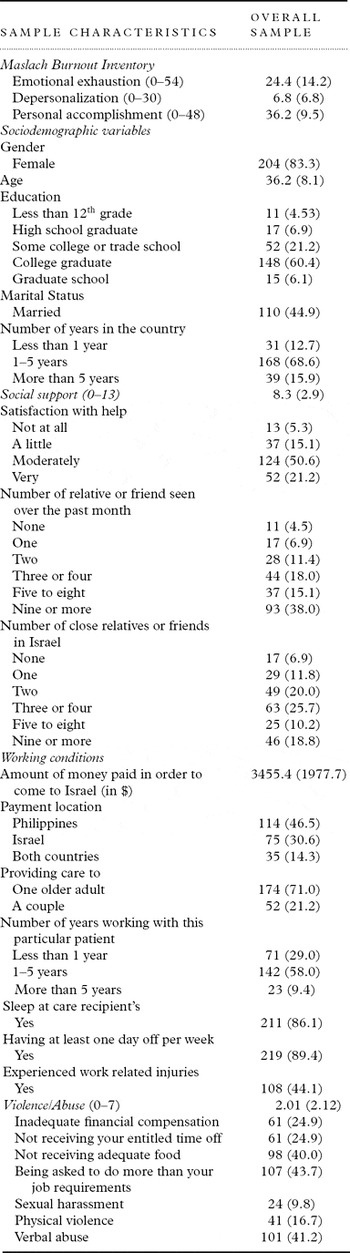
Overall, 245 Filipino home care workers completed the questionnaire. The sample comprised females with at least some college or trade school education. The majority were not married and indicated that they had been in Israel between one and five years. See Table 1.
Demographic and clinical characteristics of the sample (N = 245)

Note: Results are reported as N (%) for categorical variables and as mean (SD) for continuous variables. Results do not sum to 100% because of missing values for some of the variables.
Measures
The questionnaire was designed based on a review of the literature and preliminary interviews with foreign home care workers, social workers and family caregivers. The questionnaire was further revised based on feedback from foreign home care workers, human rights organizations, and members of the Filipino consulate in Israel.
Dependent variables
Maslach Burnout Inventory. The measure consists of 22 items that encompass three aspects of the job experience: emotional exhaustion, depersonalization, and personal accomplishment (Maslach et al., Reference Maslach, Schaufeli, Leiter, Fiske, Schacter and Zahn-Waxler2001). The three scales are believed to be independent of each other and to represent three different aspects of burnout. Participants are asked to rate each statement on a 7-point scale. Greater burnout is indicated by higher scores on the Emotional Exhaustion and Depersonalization scales and a lower score on the Personal Accomplishment scale (ranges: 0–54, 0–30, 0–48, respectively; Maslach et al., Reference Maslach, Jackson and Leiter1996). Internal consistencies in the present study were: 0.84, 0.60 and 0.72 respectively.
Predictors
Working conditions. Home care workers were asked about a variety of work-related conditions (see Table 1).
Abuse of home care workers. Seven questions were related to exposure to work-related abuse in Israel (Table 1). The scale ranges from zero to seven, with a higher score indicating a greater number of abuse experiences. Internal consistency in the present study was 0.79.
Covariates
Demographic information. Age, gender, education, number of years in Israel, and marital status were based on self-report.
Social support. Selected questions from the Resources for Enhancing Alzheimer's Caregivers' Health (REACH, 2005) were used in the present study. The range was from 0 to 13; in the present study α = 0.56.
Analysis
To obtain a relative estimate of burnout, scores on the Maslach Burnout Inventory were compared to scores of a comparison group of Israeli nursing care workers (Ayalon, Reference Ayalon2007), using one-sample t-tests. Next, bivariate regression analyses were conducted with each of the factors of the Maslach Burnout Inventory (emotional exhaustion, depersonalization, and personal accomplishment) as a dependent variable and working conditions and the abuse scale as potential predictors. All variables significant at 0.05 were included in multivariate models that were further adjusted for age, gender, education, number of years in the country, and social support.
Phase II: qualitative research
Procedure
Inclusion criteria in this phase were (a) being a Filipino home care worker who provides around-the-clock care to a person aged 60 years and older; (b) being a family member of a person aged 60 years and older who receives around-the-clock home care services by a Filipino home care worker; or (c) being a social worker involved in the employment of Filipino home care workers. Care recipients were not interviewed owing to severe cognitive and physical limitations. I used a convenience sample in an attempt to achieve maximum variations in gender and geographical location. Participants in this phase were not the same as those who participated in the quantitative phase.
All interviews were conducted by experienced Israeli qualitative interviewers. Interviews with Filipino home care workers were conducted in either English or Hebrew (two of the interviews were conducted in Hebrew because the interviewees had lived in Israel for over 10 years and were proficient in Hebrew). Interviews with social workers and family members were conducted in Hebrew. Foreign home care workers were asked about their decision to come to Israel, challenges and advantages associated with their work, and their beliefs about appropriate care for the elderly. When interviewing family members, questions encompassed the decision to hire a foreign home care worker, changes that took place following the arrival of the foreign home care worker, and beliefs about the appropriate care for older adults. Social workers were asked about their experience working with Filipino home care workers; challenges and advantages associated with having a Filipino home care worker; and ways of improving the quality of life of Filipino home care workers in Israel. Interviewers were instructed to use a funnel approach, starting from broad questions followed by more specific ones. Interviews lasted between one to three hours. All interviews were tape-recorded and transcribed verbatim with the exception of one focus group with foreign home care workers and one in-depth interview with a family member that were not tape-recorded due to a technical glitch.
Participants
Between February 2006 and November 2007, 29 Filipino home care workers were interviewed. Seven of the Filipino home care workers were interviewed during in-depth individual interviews. In addition, three focus groups of between two and eleven participants were conducted. The majority of Filipino home care workers were female (82%). They ranged in age from 18 to 56.
Twenty-two individual interviews with family members of older adults cared for by a Filipino home care worker were conducted. The majority of family members were women (54%). Of these, the majority were daughters (83%) of an older adult cared by a Filipino home care worker. Of the five spouse caregivers, two were wives. Caregivers' ages ranged from 38 to 84.
Thirty-one social workers employed by the third largest nursing agency in the country and by another social work agency participated in four focus groups. Between three and ten participants attended each focus group. Focus groups were largely homogenous in terms of participants' role in the agency. Participants were purposely selected to represent a range of geographical locations (north, central and south Israel, including both urban and rural areas) as well as different levels of interaction with the parties involved (from direct placement of the foreign home care worker to ongoing assistance to care recipient and his or her family). All but two of the participants were female; all but two had a Bachelor's degree in social work or a related field. The other two had a Masters degree. On average, participants had seven years of experience working with older adults.
Analysis
Interviews were analyzed by three independent raters, all experienced in qualitative research. One of the raters was blinded to the research question and study rationale. We coded data categories in stages, with each stage representing a more complex conceptual level (Strauss and Corbin, Reference Strauss and Corbin1998). Each interview was first coded thematically for major content areas. Next, commonalities and differences across interviews were evaluated and themes were regrouped to represent major content areas that received considerable attention across participants. Data were not forced into preconceived themes, but instead guided the creation of the categories (Creswell, Reference Creswell1998). The final stage was selective coding, which involved the identification of core categories to create a story line (Strauss and Corbin, Reference Strauss and Corbin1998). Owing to the large volume of complex data, this paper focuses on major themes related to working conditions and work-related abuse.
Results
Phase I: quantitative research
Mean emotional exhaustion was 24.4 (SD = 14.2), mean depersonalization was 6.8 (SD = 6.8) and mean personal accomplishment was 36.2 (SD = 9.5). Relative to Israeli nursing care workers (Ayalon, Reference Ayalon2007), the present sample reported higher levels of depersonalization (t [181] = −3.72, p < 0.001) and lower levels of personal accomplishment (t [176] = −3.49, p = 0.001). There was no significant difference between the two samples on the emotional exhaustion subscale (t [193] = −0.74, p = 0.45).
A majority slept at the care recipient's home and provided care to one older adult. Overall, 44.1% of the sample experienced a work-related injury, 43.7% received inadequate food, and 40.0% received inadequate financial compensation. A total of 24.9% experienced physical harassment and 24.9% reported sexual harassment (Table 1).
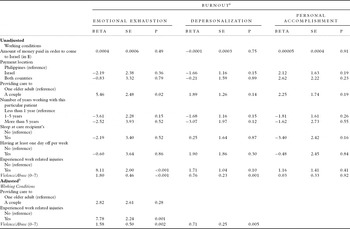
In bivariate analyses, work-related injuries, no matter whether care was given to one individual or a couple, and abuse were related to emotional exhaustion. Abuse was also related to depersonalization. None of the potential predictors were significantly associated with personal accomplishment (Table 2).
Working conditions and exposure to abuse as predictors of burnout (N = 245)

a Separate regression analyses were conducted with each of the burnout factors (e.g. emotional exhaustion, depersonalization, personal accomplishment) as an outcome variable.
b Separate regression analyses were conducted with each of the burnout factors (e.g. emotional exhaustion, depersonalization, personal accomplishment) as an outcome variable. All analyses were adjusted for age, gender, education, number of years in the country, and social support. Only significant predictors (e.g., working conditions, abuse) in bivariate analyses were evaluated in multivariate analyses.
In multivariate analyses, after adjusting for age, gender, education, number of years in Israel, and social support, experiencing work related injuries and abuse were associated with emotional exhaustion (R2 = 0.21, p = 0.0004). In addition, experiencing work-related abuse was associated with depersonalization (R2 = 0.12, p = 0.03); see Table 2.
Phase II: qualitative research
Five major themes of work-related abuse were evident based on interview data: inadequate food, verbal and emotional abuse, exploitation, physical abuse, and sexual abuse/harassment. An additional overarching theme was barriers to the legal system. These themes are consistent with, but are not identical to, data obtained in the quantitative phase and serve as a complementary source of information. Below, I describe each of the main themes in detail.
Inadequate food
Food was identified as a major source of difficulty and conflict in most interviews. Many times, it was not only the scarcity of food that caused problems, but also the type of food available to the worker. The fact that Israeli culinary preferences are so different from Asian cuisine made this caregiving arrangement particularly difficult. Reportedly, whether or not a worker received his or her favorite type of rice made a huge difference in this worker's attitudes towards the job and willingness to stay on.
“The families don't understand why they [workers] should get meat daily and why they don't want leftovers from the previous day. In the Philippines, you buy groceries, cook, eat, and that's it, they don't eat the same food for several days like us [Israelis].” (Social worker)
Verbal and emotional abuse
The theme of verbal and emotional abuse was one of the most frequent themes identified in interviews with all stakeholders. Many stated that foreign home care workers are being treated like “slaves.” This includes being shouted at, yelled at, and cursed. Being treated with suspicion and working under constant surveillance were additional themes. Many times the abuser was an incapacitated older adult. Yet, for many workers, this still represented a very difficult challenge that impacted on their mental health and attitudes towards their job.
“All the commodities are here, all are here but she doesn't want to believe me . . .. Then her son came and he looked at the Heshbon [receipt] from the supermarket and said ‘yes she bought this and here is the Heshbon.’ it was a big big lesson to me. Since then, the Heshbon is very important to her!” (Foreign home care worker).
Exploitation
The theme of exploitation repeated during interviews with all stakeholders. Many interviewers reported that workers are asked to do more than their job requirements at no adequate financial compensation.
“My old woman – she treated me as a machine so that I have to work all throughout the day, only at nights I get to rest. Because of this treatment, I look at myself as a slave . . .” (Foreign home care worker)
In addition, many around-the-clock workers did not receive even one day off per week. According to social workers, even if workers were compensated financially for working around the clock, it still had very negative effects on their mental health. Another aspect related to foreign home care workers' exploitation is the fact that almost all foreign home care workers were asked to pay money to Israeli and/or Filipino agencies in order to work as home care workers in Israel. Whereas this exploitation takes place at the government/agency level and not at the family level it has major implications on the worker who is obligated to work even under the most horrendous conditions in order to pay back the loan that was taken in order to come to Israel.
“They come here to make money. But I want to emphasize that I don't think they really make money here. Many of them leave Israel with no savings, because they didn't really find a family they got along with. So. . .they keep losing their money . . . and the money they had to pay in order to come to the country . . . They are being abused both financially and mentally. . . .” (Social worker)
Physical abuse
Physical abuse was acknowledged primarily by family members and social workers. Oftentimes, violence was a result of the care recipient's dementia-related irritability and confusion. However, physical violence was also executed by other family members of care recipient.
“All of a sudden, I [son of care recipient] got a phone call from the worker and she told me that he [son of care recipient] hit her. She didn't want to stay there for another minute. Meanwhile, because of fear, he [son of care recipient] hit her, he probably didn't notice this or was unaware, because of fear he fell over . . . and then he blamed her . . .” (Family member)
Sexual abuse/harassment
Like the theme of physical abuse, the theme of sexual abuse/harassment was hardly mentioned by foreign home care workers. However, this theme was repeatedly mentioned in interviews with family members and social workers. According to social workers, this was a very common problem especially in male dominated households. Reportedly, the blurred boundaries between private and public within the home-work environment serve as precipitators of sexual exploitation.
“We had a case of an older adult who watched porn movies at night. The worker did not have a bedroom, so she had to stay in the living room when he watched the movies. He didn't bother her, so she stayed there . . . it took so long for her to tell me what was going on . . . and it took me so long to understand her . . . what she was trying to tell me . . .” (Social worker)
Very often workers were exploited because they were not aware of their rights. For example, according to one social worker, it was very common among novice foreign home care workers to bath the care recipient with their own shirts off, as this was presented to them as part of their job requirement. The same social worker stated that following a workshop on sexual abuse, she received several complaints from workers who had been raped by family members of a care recipient and as a result became pregnant. These workers were subsequently threatened by family members of the care recipient that they would lose their job if they decided to keep their baby.
Barriers to approaching the legal system
The inferiority of the worker relative to the care recipient, his or her family members, and the legal system in the country is a result of their lower professional status, lower financial status, lack of legal or civil status, female gender (most often), as well as lack of familiarity with the language and the legal system. All of these factors hamper workers' use of the legal system for their own protection. Often, workers were too afraid to engage with the legal system because their legal status in the country was uncertain. However, even when workers approached the system, communication difficulties and lack of trust (on all sides) hampered their ability to benefit from the legal system. In addition, families tended to support the predator (a family member) instead of the victim (foreign home care worker).
“This worker stayed with an extremely violent care recipient. She would have lost the job and would have had to go back to the Philippines had she complained, because her work permit had expired.” (Social worker)
Despite these difficulties, many social workers acknowledged that several recent changes in the legal system have helped to protect workers' rights, such as the establishment of a minimum wage, and the requirement to provide workers with a weekly day off and some vacation time.
Discussion
The most significant findings of the present study are the high levels of abuse reported by Filipino home care workers. In the present sample, 64% reported being exposed to at least one kind of work-related abuse and almost half reported experiencing work-related injuries. Being asked to do more than was required in their job description was the most common abuse reported by workers. Next were verbal abuse and receiving inadequate food. The study shows that these high levels of abuse have extremely negative consequences on the well-being of Filipino home care workers and are associated with higher levels of emotional exhaustion and depersonalization. In addition, work-related injuries are associated with higher levels of emotional exhaustion.
Relative to Israeli nursing care workers (Ayalon, Reference Ayalon2007), Filipino home care workers report higher levels of depersonalization and lower levels of personal accomplishment. Given ample research that has consistently shown a strong relationship between high levels of burnout and the potential risk for inadequate care of older adults (Wierucka and Goodridge, Reference Wierucka and Goodridge1996), these findings serve as a red flag.
The rates of abuse are higher than past rates of abuse of home care workers reported in the international literature (Barling et al., Reference Barling, Rogers and Kelloway2001; Bussing and Hoge, Reference Bussing and Hoge2004; Geiger-Brown et al., Reference Geiger-Brown, Muntaner, McPhaul, Lipscomb and Trinkoff2007). The fact that the present study has focused on around-the-clock foreign home care workers could explain the discrepancy, as around-the-clock foreign home care workers lack many of the social and legal rights guarantied to citizens and are highly dependent on the care recipient and his or her family not only for obtaining a work permit, a job and an income, but also for food and shelter.
Sexual abuse and direct physical violence were less commonly reported by Filipino home care workers. When acknowledged, this was more frequently done in the quantitative survey than during face-to-face qualitative interviews. The low rates reported could be partially attributed to the stigma associated with being sexually harassed, but may also be attributed to lack of awareness. In addition, Filipino home care workers come from a collectivistic society and may refrain from disclosing abuse in order to avoid bringing shame not only to themselves but also to their families.
The present study is not without limitations. First, the scale of work-related abuse evaluated lifetime exposure as home care workers and did not evaluate frequency of events or current abuse. A more detailed scale is needed in order to gain a better understanding of abuse of home care workers. Further, the scale was developed specifically for use in this study and its psychometric properties were evaluated in the present study for the first time. Nonetheless, the scale was developed based on preliminary interviews with the involved parties, who subsequently evaluated its face validity. Furthermore, the mixed methods used in present study provide preliminary data regarding its construct validity by demonstrating its relevance to data obtained during interviews. Second, this is a cross-sectional study that does not allow for inferences about cause and effect. Third, foreign home care workers were interviewed in English and Hebrew and not in Tagalog. This probably affected the data obtained in the qualitative interviews. However, it is important to note that most Filipinos (and hence, Tagalog-speaking individuals) in Israel are licensed to work only as home care workers. It is almost impossible to identify a Tagalog-speaking individual in Israel who is both an Israeli citizen eligible to work as a research assistant and qualified for such a job. Finally, this is a convenience sample and no data on refusal rate are available. However, because about 50% of the foreign home care workers in Israel are undocumented, it is impossible to obtain a representative sample of this population.
Implications for research
This study presents results from Israel, which, like most of Western society, relies heavily on foreign home care (Yeoh et al., Reference Yeoh, Huang and Gonzalez1999; Chang, Reference Chang2000; Ehrenreich and Hochschild, Reference Ehrenreich and Hochschild2000; Glenn, Reference Glenn2000; Salazar Parrenas, Reference Salazar Parrenas2001; Brush and Vasupuram, Reference Brush and Vasupuram2006; Martineau and Willetts, Reference Martineau and Willetts2006). Because there is variability worldwide in the legal status of foreign home care workers, in the legal prospects of these workers to become citizens in the host country, and even in the name these workers are assigned (i.e. “foreign workers” in Israel and Europe versus “immigrants” or “ethnic minorities” in the U.S.A.), this type of comparison is extremely important from a public policy perspective.
The present study demonstrates a relationship between work-related abuse and burnout, but it does not evaluate the impact of abuse on the care recipient. Hence, another important focus for research is the relationship between elder abuse and home care worker abuse.
Implications for public policy
Based on qualitative interviews, it is clear that even though there have been advances geared towards protecting the rights of foreign workers in Israel many barriers still exist. These barriers include fear of the legal system, fear of losing one's work place and work permit, fear of reactions from the care recipient's family members, and communication difficulties. A tendency of Israelis to trust and favor Israeli citizens rather than foreign workers is another barrier faced by those workers who dare to access the legal system. Any intervention geared towards protecting the rights of foreign home care workers must take all of these factors into consideration.
Interventions should address not only the foreign home care workers but also the family members of the care recipient, the care recipients themselves (where possible); and the social workers involved in this caregiving arrangement. As is evident from the qualitative interviews, incidents that are not viewed as problematic by the family can strongly affect the quality of life of the worker. Hence, educational efforts should specifically target these gray areas as they are very common yet often the most difficult situations to identify and resolve.
The present data also suggest that the working conditions of Filipino home care workers should be more closely monitored. Whereas many social workers view protection of these workers as part of their job, identifying it as an official responsibility might increase social workers' awareness of the vulnerability of foreign home care workers. Another issue that must be addressed is the fact that almost 90% of the Filipino workers we interviewed had to pay large amounts of money in order to work in Israel. These payments were requested not only in the Philippines but also in Israel. Given that an average yearly salary of a Filipino home care worker in Israel is about $10,000, the average fee of $3,455 paid by workers in order to come to the country is substantial and likely requires them to devote the first year in the country to repaying their loans. Furthermore, qualitative interviews revealed that this serves as an additional incentive for many workers to stay in their jobs even in abusive situations. Collaboration between the Israeli and Filipino governments is needed to put an end to this practice.
Finally, in many Western countries, including Israel, care of the frailest is left in the hands of foreigners (Yeoh et al., Reference Yeoh, Huang and Gonzalez1999; Salazar Parrenas, Reference Salazar Parrenas2001; Chang, Reference Chang2000; Ehrenreich and Hochschild, Reference Ehrenreich and Hochschild2000; Glenn, Reference Glenn2000; Brush and Vasupuram, Reference Brush and Vasupuram2006; Martineau and Willetts, Reference Martineau and Willetts2006), who only rarely become citizens of the host country. This practice places all three entities of home care, older adults, and foreign workers in an inferior social position with little hope of change. Whereas the personal and social costs associated with institutional care (Aneshensel et al., Reference Aneshensel, Pearlin, Levy-Storms and Schuler2000) or family care (Schultz and Beach, Reference Schultz and Beach1999) are well understood and well documented, little attention has been paid to the social and moral costs associated with foreign home care.
Conflict of interest
None.
Acknowledgment
This research was supported by a grant from the G.I.F., the German-Israeli Foundation for Scientific Research and Development.