Implications
Salted duck egg is one of the most popular preserved egg products in China and Southeast Asia. Feeding laying ducks unconventional feedstuffs such as sorghum (SO), distillers dried grains with solubles (DDGS), or rapeseed meal may reduce the quality of their salted eggs. We designed this study to test this hypothesis. The results of this study will help to improve the quality of salted eggs.
Introduction
Salted duck egg is one of the most popular preserved egg products in China and Southeast Asia. Generally, salted eggs can be made by brining eggs in saturated saline or by coating the eggs with a paste of soil mixed with salt for about 20 to 30 days (Chi and Tseng, Reference Chi and Tseng1998). The desirable characteristics of salted egg yolk include orange color, oil exudation and gritty texture. During pickling, the yolk gradually solidifies and hardens (Kaewmanee et al., Reference Kaewmanee, Benjakul and Visessanguan2009). During storage, the desirable quality attributes of most non-preserved products decrease due to lipid oxidation, which has long been considered as a major factor affecting both the sensory attributes and the nutritional quality of foods. Lipid is the main component of egg yolk, and the decrease in shelf life of the eggs during storage is mainly caused by lipid oxidation in the yolk and overall reduction in egg quality (Harlina et al., Reference Harlina, Shahzad, Ma, Geng and Wang2015). The quality of salted egg yolks was found to decline year by year, mainly appearing as hard salted egg yolks, white color, less oil and less gritty texture, which seriously affected the quality and sale value of salted egg yolks (Peng et al., Reference Peng, Lin, Huang and Zheng2011). Research of egg quality and the maturation mechanism of salted egg yolk mainly focused on chemical composition, physical properties and biochemical changes, but not on duck breeds, feeding methods and feed formulations, etc. Scanning electron microscopy has revealed that yolk granules are polyhedral in shape and aligned closely as salting proceeds. Smaller protein spheres exist together with oil droplets in salted yolk, as visualized by transmission electron microscopy (Kaewmanee et al., Reference Kaewmanee, Benjakul and Visessanguan2009; Wang et al., Reference Wang, Gao, Xiao, Wang and Bai2013). Zheng et al. (Reference Zheng, Peng, Lin and Lu2013) reported that the content of soluble protein in salted egg yolk increased and hydrosulphonyl content changed when salting proceeds. Differential scanning calorimetry showed that salting promoted heat tolerance of egg yolk protein. SDS-PAGE showed that salt did not affect the structure of peptide chains, but could result in significant change in the secondary structure of yolk protein; α-helices and β-sheets of major secondary structures of fresh egg yolk protein turned into T turns. Lipid peroxidation produced a mass of free radicals and secondary reactive products, which covalently combined with protein molecules and resulted in protein oxidation. Studies indicated that lipid peroxidation caused protein denaturation was the main factor in the decline in food quality.
Readily available but unconventional feedstuffs may result in nutritional imbalances, such as high levels of polyunsaturated fatty acids (PUFA) in SO and corn DDGS, and anti-nutritional factors like tannin and glucosinolate in SO and rapeseed meal if they are used excessively in feed, may lead to adverse effects on body’s redox balance system and can reduce the quality of animal by-products. Jiang et al. (Reference Jiang, Zhang and Shan2013) reported that the proportion of yolk saturated fatty acids (SFA) decreased and PUFA increased linearly in chicken eggs as the level of dietary corn DDGS increased; high concentrations of PUFA are susceptible to oxidation, and further combination with reactive oxygen species to generate hydroperoxide. The objectives of this study were to investigate the effect of different energy and protein sources in diets of laying ducks on antioxidant status, fresh yolk fatty acid profile and related salted egg yolk quality.
Material and methods
Birds, housing and experimental design
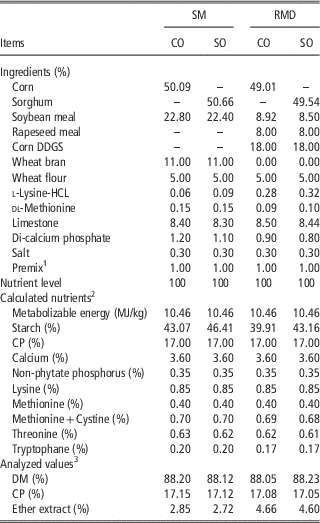
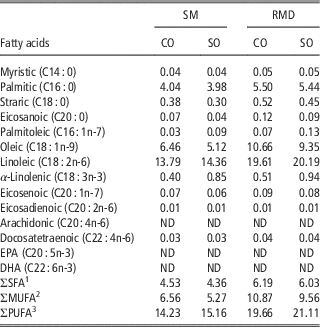
The study was approved by the Animal Care and Use Committee of Guangdong Academy of Agriculture Sciences. A total of 360 19-week-old Longyan ducks of the same genetic background and of comparable BW, were randomly assigned to four treatments in a factorial arrangement (2×2). The diets had 2 energy sources, corn (CO) or SO and two protein sources, soybean meal (SM) and double-low rapeseed meal with corn DDGS (RMD). Each diet was fed a total six replicates, each of 15 birds. The ducks were individually housed in galvanized steel battery cages (length 42 cm×width 30 cm×height 50 cm; Guangzhou Huanan Poultry Equipment Co., Ltd, Guangzhou, China) with a nipple drinker and feeder; the ambient temperature varied from 15°C to 32°C during the 16-week experimental period. Fresh drinking water was available ad libitum, whereas 80 g feed/twice daily was introduced at 07.00 and 15.00 h, and a 16 h light: 8 h dark photoperiod was applied throughout the study. Birds in the control group (I) were fed the CO + SM diet; Group (II) received the SO + SM diet which substituted SO for CO; Group (III) received the CO + RMD diet which substituted 8% double-low rapeseed meal and 18% corn DDGS for SM and Group (IV) was fed the SO + RMD diet with both substitutions, as in Groups II and III. Dietary nutrient levels, as shown in Table 1, were based on previous studies from this laboratory for Longyan ducks. Low-tannin SO, double-low rapeseed meal, and corn DDGS (US origin) were purchased from China SDIC International Trade Co., Ltd (Beijing, China) and was stored under refrigeration. The measured fatty acid compositions of the four diets are presented in Table 2.
Composition and nutrient levels of experimental diets (% as fed basis)

SO=sorghum; RMD=rapeseed meal and corn distillers dried grains with solubles; CO=corn; SM=soybean meal; DDGS=distillers dried grains with solubles.
1 The premix provided per kilogram diet: vitamin A 12 000 IU, vitamin D3 2400 IU, vitamin E 20 mg, vitamin K3 2.5 mg, vitamin B1 4.0 mg, vitamin B2 6.0 mg, vitamin B6 6.0 mg, vitamin B12 0.02 mg, chloride choline 500 mg, nicotinic acid 15 mg, d-pantothenic acid 20 mg, folic acid 1.0 mg, biotin 0.2 mg, Fe 60 mg, Cu 8 mg, Mn 100 mg, Zn 90 mg, I 0.5 mg, Se 0.2 mg, Co 0.26 mg.
2 Values were calculated based on the data provided by Feed Database in China (2004).
3 Crude protein was analyzed by Kjeldahl method; ether extract were analyzed by Soxhlet extraction.
Fatty acid composition of experimental diets (as fed basis (g/kg diet))

SM=soybean meal; RMD=rapeseed meal and corn distillers dried grains with solubles; CO=corn; SO=sorghum; ND=not detected; SFA=saturated fatty acids; MUFA=monounsaturated fatty acids; PUFA=polyunsaturated fatty acids.
1 ΣSFA=14 : 0+16 : 0+17 : 0+18 : 0+20 : 0.
2 ΣMUFA=16 : 1+18 : 1+20 : 1.
3 ΣPUFA=18 : 2n-6+20 : 2n-6+20 : 3n-6+20 : 4n-6+18 : 3n-3+20 : 5n-3+22 : 6n-3.
Laying performance
The feed intake was recorded daily on a per replicate basis. The numbers of total, broken, shell-less eggs and mortality of ducks were recorded daily by replicate. Egg production (including of broken and shell-less eggs), average egg weight, egg mass, average daily feed intake, feed conversion ratio (FCR, g feed/g egg), broken rate and abnormal rate were calculated daily, on a per replicate basis, then averaged for the complete 16 weeks study period.
Egg quality
Egg quality was measured on four eggs collected at random from each replicate of each month, and the average of these 24 eggs was used. Yolk color score, albumen height and Haugh unit were measured on the day of collection using an Egg Analyzer (model EA-01; ORKA Food Technology, Ramat HaSharon, Israel). The strength of the shell was determined on the vertical axis using an Egg Force Reader (model EFR-01; ORKA Food Technology). Eggshell thickness was measured using a digital micrometer, and egg shape index (SI) was determined with a digital caliper and calculated with the formula SI=width×100/length. Yolks were separated, weighed and expressed as percentages of egg weight. Yolks fat were separated by Soxhlet extraction, weighed and expressed as percentages of yolk weight.
Plasma sampling and determination
After 16 weeks of feeding, two birds were selected at random from each replicate, excluding obvious outliers in BW for the treatment group. Heparinized blood was collected from the wing vein, centrifuged (3000×g) at 4°C for 10 min and plasma was held at −20°C for analysis. The plasma contents of reduced glutathione (GSH), oxidized glutathione (GSSG), malondialdehyde (MDA) and the activities of total superoxide dismutase, glutathione peroxidase (GSH-Px) and total antioxidant capacity (T-AOC) were measured with kits from Nanjing Jiancheng Bioengineering Institute (Nanjing, Jiangsu, China).
Determination of fresh egg yolk fatty acid profile
The SFA, monounsaturated (MUFA) and PUFA profiles were determined using 24 fresh egg yolks per group (six replicates of four eggs each) at 34 weeks of age by gas chromatography according to the method described by Metcalfe et al. (Reference Metcalfe, Schmitz and Pelka1996). Fatty acid compositions are expressed as percentages of total FA.
Quality of salted egg yolks
Fresh eggs of Longyan ducks, having average weights of 65 to 72 g, were obtained from each group, within 5 days of being laid and stored in dark controlled temperature room (18°C and 75% to 80% relative humidity). After inspection by a MOBA grading machine (2500; Barneveld, the Netherlands) at the Kaiping Xuri Egg Products Co., Ltd (Jiangmen, Guangdong, China), the qualified eggs of each group were salted by coating with ~2 to 3 mm of the salting paste (mud: salt: water, 5:4:3, w/w). The eggs were then coated with rice hull ash and stored at room temperature for 30 days, enclosed in plastic film. The contents of MDA and carbonylated proteins (CP) were measured with kits from Nanjing Jiancheng Institute of Bioengineering (Nanjing, Jiangsu, China) on four salted yolks collected at random from each replicate, and the average of these 24 salted egg yolks was used. The percentage of hard salted egg yolks was determined following the method of Chi and Tseng (Reference Chi and Tseng1998). For each replicate, 100 salted egg yolks were rolled on a filter paper to remove residual egg white, placed on a plate, baked at 145°C for 15 min in a multifunctional baking oven (KS-410; KPS Electrical, Guangzhou, China) and cooled at room temperature for 30 min. The cooked salted yolks were gently crushed with a food durometer (Jisc JSV-H100; Japan Instrumentation System Co., Ltd, Nara, Japan); if the interior yolk was hardened (>1 kgf), the exterior soft yolk was removed. The numbers (N) and weight of the interior (hardened) yolk (W in) were measured and expressed as percentages and weight, respectively.
Determination of microstructure of salted egg yolks using scanning electron microscopy
Microstructure of salted egg yolks, uncooked or cooked, was analyzed using a Scanning electron microscope (SEM) (Hitachi S-3700N; Hitachi High-Technologies Corporation, Tokyo, Japan) according to the method described by Kaewmanee et al. (Reference Kaewmanee, Benjakul and Visessanguan2009). For each treatment, 12 samples were coated with gold, scanned, and imaged by SEM at a standard magnification of ×500.
Statistical analysis
All data were analyzed by two-way ANOVA procedures for completely randomized designs using the GLM models of SAS software (SAS Institute Inc., Cary NC, USA). The statistical model used included the effects of energy, protein sources, and their interactions. Statistical significance of differences was assessed among treatments by using the LSD test. Correlations between MDA, CP and percentage of hard salted yolks were calculated and analyzed statistically by Pearson’s correlation. All data presented in the tables are presented at least square mean values with pooled standard error of the mean. Values were considered significant at P<0.05.
Results
Laying performance
The laying performance of ducks at the whole experimental period (19 to 34 weeks) from the different dietary treatments is presented in the Supplementary Materials (Table S1). Egg production, average egg weight, egg mass, FCR, broken rate and abnormal rate during the experimental period were not affected by diet.
Biochemical analyses related to antioxidant status
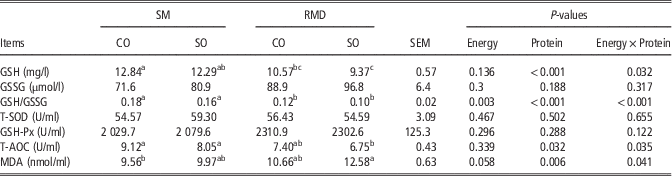
As shown in Table 3, the plasma contents of GSH, GSH/GSSG and T-AOC in laying ducks fed with RMD decreased (P<0.05) compared with SM diets, along with a substantial increase (P=0.006) in plasma content of MDA. Ducks fed diets based on CO had a higher plasma GSH/GSSG value than did those fed diets based on SO (P=0.003). There were interactions between energy and protein sources on plasma contents of GSH, GSH/GSSG, MDA and T-AOC (P<0.05). There were no significant effects of diet on the plasma activities of SOD and GSH-Px (P>0.05).
Effect of different energy and protein sources on biochemical indicators in blood of laying ducks in 35 weeks oldFootnote 1

SM=soybean meal; RMD=rapeseed meal and corn distillers dried grains with solubles; CO=corn; SO=sorghum; SEM=standard error mean; GSH=reduced glutathione; GSSG=oxidized glutathione; T-SOD=total superoxide dismutase; GSH-Px=glutathione peroxidase; T-AOC=total antioxidant capacity; MDA=malondialdehyde.
a,b,c Values within a row with different superscripts differ significantly at P<0.05.
1 n=6 replicate/treatment.
Egg quality and yolk fatty acid profile
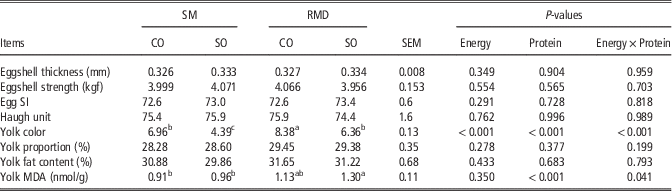
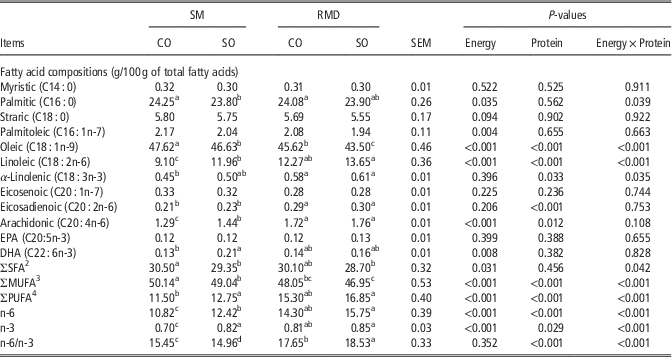
Of the indices of egg quality (Table 4), yolk MDA and yolk color significantly increased (P<0.001) in the diets containing RMD compared with those with SM. There were interactions between energy and protein sources on yolk MDA and yolk color; yolk MDA was highest with the SO + RMD diet and color was highest with CO + RMD. There was no effect of diet on eggshell thickness, eggshell strength, egg SI, Haugh unit or yolk rate. The fatty acid composition of egg yolk lipids is provided in Table 5. A significant difference in the concentrations of SFA, MUFA and PUFA in the egg yolks were found between diets based on CO and SO. Egg yolks from laying ducks fed CO diets showed a higher content of SFA and MUFA compared with SO diets, whereas the relative contents of PUFA were the reverse. Linoleic acid (C18 : 2n-6) was the most predominant PUFA in egg yolks from ducks fed CO and SO diets. With regard to docosahexaenoic acid the egg yolks from ducks fed SO diets showed a higher content than those fed CO diets (P=0.008). The CO diets contained a higher n-6/n-3 ratio (P<0.001). Egg yolks coming from laying ducks fed with RMD showed a higher content of PUFA (17.00% v. 12.63%) and n-6/n-3 ratio compared with SM diets (P<0.001). C18:2n-6 was also the most predominant PUFA in the egg yolks coming from ducks fed SM and RMD diets. There were interactions between energy and protein sources on SFA, MUFA, PUFA and n-6/n-3, especially for oleic acid (C18 : 1) and C18 : 2n-6.
Effect of different energy and protein sources on egg quality of laying ducksFootnote 1

SM=soybean meal; RMD=rapeseed meal and corn distillers dried grains with solubles; CO=corn; SO=sorghum; SEM=standard error mean; SI=shape index; MDA=malondialdehyde.
a,b,c Values within a row with different superscripts differ significantly at P<0.05.
1 n=6 replicate/treatment.
Effect of different energy and protein sources on fresh egg yolk fatty acid compositions of laying ducksFootnote 1

SM=soybean meal; RMD=rapeseed meal and corn distillers dried grains with solubles; CO=corn; SO=sorghum; SEM=standard error mean; SFA=saturated fatty acids; MUFA=monounsaturated fatty acids; PUFA=polyunsaturated fatty acids.
a,b,c Values within a row with different superscripts differ significantly at P<0.05.
1 n=6 replicate/treatment.
2 ΣSFA=14 : 0+16 : 0+17 : 0+18 : 0+20 : 0.
3 ΣMUFA=16 : 1+18 : 1+20 : 1.
4 ΣPUFA=18 : 2n-6+20 : 2n-6+20 : 3n-6+20 : 4n-6+18 : 3n-3+20 : 5n-3+22 : 6n-3.
Quality of salted egg yolks
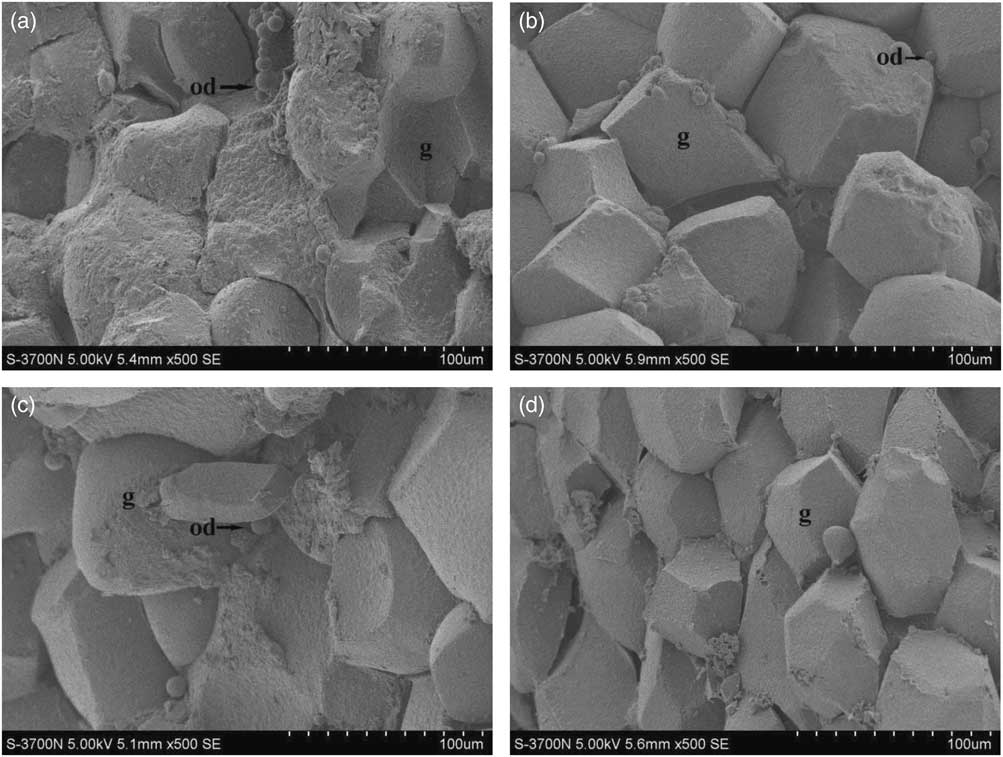
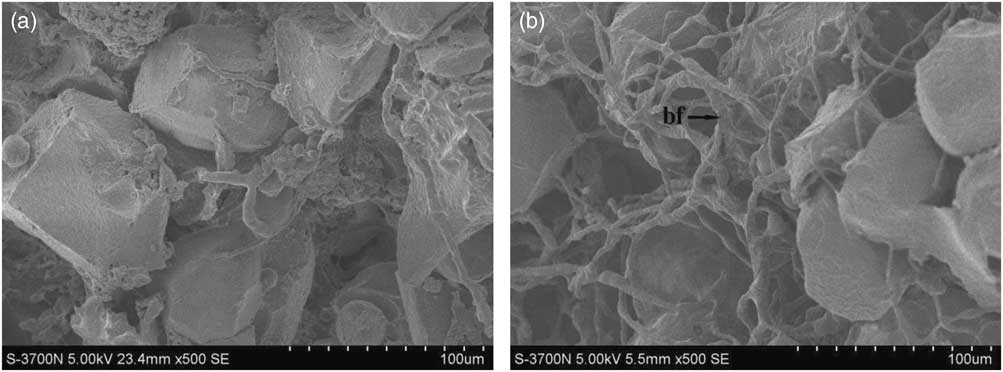
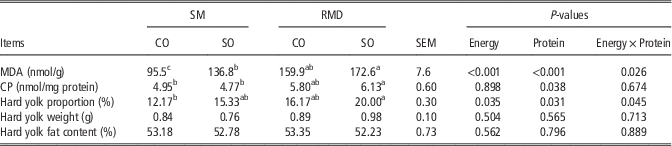
As shown in Table 6, feeds with RMD resulted in higher (P<0.05) salted yolk MDA, CP and percentage of hard salted yolks compared with SM diets. Diets based on SO also had higher (P=0.003) salted yolk MDA and percentage of hard salted yolks than those based on CO diets. There were strong positive correlations were observed between MDA and percentage of hard salted yolks, the correlation was 0.777 and significantly different from zero (P<0.05). The other two correlations were 0.155 and 0.138, respectively, but they were not significantly different from zero (P>0.05) (data not shown). The microstructures of yolks after 30 d of salting, visualized by SEM, are shown in Figure 1. Salted yolk had polyhedral granules with a size range of 100 to 150 μm. The polyhedral granules from ducks fed the SO + RMD diet was rougher with fewer oil droplets within the gaps than granules from the CO+SM diet. Further, in the cooked yolks, the polyhedral granules were surrounded by a layer of bunchy fibers (Figure 2).
Scanning electron microscope images of salted yolks after 30 days of salting. (a) Polyhedral granules (g) from ducks fed the corn + soybean meal diet (CO + SM) were more oil droplets (od) than ducks fed the sorghum + soybean meal diet (SO + SM) in (b) and corn + rapeseed meal and corn distillers dried grains diet (CO + RMD) in (c). (d) Polyhedral granules (g) from ducks fed the sorghum + rapeseed meal and corn distillers dried grains with solubles diet (SO + RMD) were rougher with fewer od within the gaps than other three diets. ×500 magnification.

Scanning electron microscope images of cooked salted yolks after 30 days of salting. (b) Polyhedral granules (g) from ducks fed the sorghum + rapeseed meal and corn distillers dried grains with solubles diet (SO + RMD) were surrounded by a layer of bunchy fibers (bf). There were less bf surrounded the polyhedral granules (g) from ducks fed the corn + soybean meal diet (CO + SM) in (a). ×500 magnification.

Effect of different energy and protein sources on salted yolk quality of laying ducksFootnote 1

SM=soybean meal; RMD=rapeseed meal and corn distillers dried grains with solubles; CO=corn; SO=sorghum; SEM=standard error mean; MDA=malondialdehyde; CP=carbonylated proteins.
a,b,c Values within a row with different superscripts differ significantly at P<0.05.
1 n=6 replicate/treatment.
Discussion
In the present study, there were no effects of the different diets on laying performance of ducks at ages of 19 to 34 weeks, which indicates the SO (energy source), RMD (protein source) could be partially used in the diets of laying ducks. Sorghum is the fifth most cultivated cereal in the world, it offers excellent nutritional value and can partially or totally replace corn in poultry diets (Ambula et al., Reference Ambula, Oduho and Tuitoek2003; Rosa et al., 2017). Chen et al. (Reference Chen, Ruan, Wang, Cui, Xia, Wang, Zheng and Lin2016) reported that low-tannin SO can be used in diets for laying ducks without adverse effects on performance. Rapeseed meal and corn DDGS are unconventional protein sources, having poor palatability, anti-nutritional factors and amino acid imbalances, and for these reasons they can’t be used in excess for livestock production. Deniz et al. (Reference Deniz, Gencoglu, Gezen, Turkmen, Orman and Kara2013) reported that feeding corn DDGS up to 15% had no negative effect on egg production, whereas 30% was acceptable in other studies (Loar et al., Reference Loar, Schilling, McDaniel, Coufal, Rogers, Karges and Corzo2010). It has been reported that feeding canola meal (same as double-low rapeseed meal) from 0% to 20% had no effects on poultry performance (Khajali and Slominski, Reference Khajali and Slominski2012). The above studies showed that SO with RMD could partially replace CO and SM as sources of energy and protein for laying birds.
Although SO and RMD diets did not affect laying performance, it modulated the antioxidant status of laying ducks in the current study, which was featured with the decreased GSH, GSH/GSSG and T-AOC and increased MDA content in plasma in RMD diet, and decreased plasma GSH/GSSG ratio in SO diet. The present findings with laying ducks are in agreement with previous studies in broilers (Jiang et al., Reference Jiang, Nie, Qu, Bi and Shan2014; Min et al., Reference Min, Li, Liu, Zhang, Gao and Liu2015), who reported that dietary contained with corn DDGS from 0% to 15% during starter (days 1 to 15) and their rearing period (till day 49) could promote lipid peroxidation and elevated MDA levels in plasma, liver or breast muscles. Furthermore, the inclusion of 24% corn DDGS in laying ducks increased hepatic MDA content (Ruan et al., Reference Ruan, Fouad, Fan, Chen, Xia, Wang, Cui, Wang, Yang and Zheng2017). In agreement with other studies, the present study in laying ducks showed that diets with RMD had higher lipid oxidation compared with those with SM, probably induced by the higher lipid content of RMD diets. The tannin fraction of SO has been reported to have antioxidant properties. It can prevent superoxide formation and have free-radical scavenging activity, which can prevent lipid peroxidation (Wu, Reference Wu2012). Cherian et al. (Reference Cherian, Selvaraj, Goeger and Stitt2002) reported that the thiobarbituric acid reactive substances were lower in the leg muscle of broilers fed Mason cultivar (SO strain) when compared with Kinsman (SO strain) or the control diet, which may be related to tannin content of the two varieties.
In the present experiment, yolk MDA and color increased in eggs from RMD diets compared with SM diets and, yolk color decreased with diets based on SO rather than CO. In laying ducks (Chen et al., Reference Chen, Ruan, Wang, Cui, Xia, Wang, Zheng and Lin2016) and in Jing Brown chickens (Yan et al., Reference Yan, Liu, Yan, Liang, Guo and Duan2016), increasing SO had no effects on Haugh unit, egg SI or eggshell quality, but yolk color decreased. Also, several studies (Jiang et al., Reference Jiang, Zhang and Shan2013; Świątkiewicz et al., Reference Świątkiewicz, Arczewska-Włosek, Krawczyk, Puchała and Józefiak2013; Shin et al., Reference Shin, Kim, Kim, Lee, Lee and Kil2016) reported that inclusion corn DDGS in diets of laying hens improved yolk color without effects on Haugh unit, yolk proportion and eggshell quality. These results indicated that the value of yolk color was higher for diets containing higher levels of CO or corn DDGS exhibiting higher levels of xanthophylls than SO.
Dietary fatty acid composition is the most important factor influencing the fatty acid composition of broiler meat and hen eggs (Cortinas et al., Reference Cortinas, Villaverde, Galobart, Baucells, Codony and Barroeta2004). The oil content of SO ranges from 3.6% to 5.6%, and is rich in PUFA, with C18:2n-6 (40.10% to 45.44%), and C18:3n-3 (2.16% to 2.27%) being the most abundant PUFA (Liu, Reference Liu2011). In the current study, we found that ducks fed diets with SO increased proportions of PUFA in egg yolks, and the C18 : 2n-6 was the most abundant PUFA, which was also observed in the laying hens (Rosa et al., Reference Rosa, Bonilla, Londero, Giacomini, Orso, Fernandes, Moura and Hermes2017). Similarly, Cherian et al. (Reference Cherian, Selvaraj, Goeger and Stitt2002) found that the proportions of n-3 PUFA was higher in the breast and leg muscles of birds fed different cultivars of SO than birds fed with CO. Corn DDGS contains ~10% oil, which nearly 60% consists of C18 : 2n-6 (Ruan et al., Reference Ruan, Fouad, Fan, Chen, Xia, Wang, Cui, Wang, Yang and Zheng2017). Egg yolks from the ducks fed with RMD increased the proportions of C18 : 2n-6, PUFA and n-6/n-3 ratio compared with SM diets. These results were consistent with previous reports (Jiang et al., Reference Jiang, Zhang and Shan2013; Sun et al., Reference Sun, Lee, Samaraweera, Persia and Ahn Dong2013) though Jiang et al. (Reference Jiang, Zhang and Shan2013) found that the proportions of palmitic acid, stearic acid and SFA decreased in egg yolks with increased dietary corn DDGS. In this respect, increasing dietary content of corn DDGS for the ducks here increased egg yolk proportions of important fatty acids especially C18 : 2n-6. In addition, higher lipid content in diet may decrease the hepatic neo-synthesis of lipids and reduce the deposition of MUFA in egg yolk, which may be a result of decreased MUFA in egg yolks with increased dietary corn DDGS. There is ~0.9% to 1.5% rapeseed oil in rapeseed meal, which has been recognized as rich source of C18 : 3n-3. Rowghani et al. (Reference Rowghani, Arab, Nazifi and Bakhtiari2007) reported that adding 3% and 5% canola oil to laying hen diet based on CO and SM, could increase the contents of C18 : 3n-3, DHA, and total n-3 fatty acids in egg yolk. Because an increased proportion of PUFA is an indicator of increase susceptibility to oxidation (Jiang et al., Reference Jiang, Nie, Qu, Bi and Shan2014), increasing the level of SO or RMD in the diets could make egg yolk more susceptible to oxidation. Therefore, the use of SO and RMD in laying ducks diets has been low to avoid adverse effects on the quality of egg yolks.
There are many complex biochemical changes during the brining of eggs, and the mechanisms are unclear. Egg yolk proteins include low-density lipoproteins, high-density lipoproteins, phosvitin and livetin, which showed a high proportion of α-helix chains, having a strong adsorption capacity at the oil-water interface (Anton et al., Reference Anton, Martinet, Dalgalarrondo, Beaumal, David-Briand and Rabesona2003). As salting proceeds, the greater dehydration, together with the release of lipids in egg yolk, may reduce the emulsion capacity of the protein portion. Increased viscosity in interior salted egg yolk and hardening of exterior salted egg yolk also made the yolk more difficult to disperse in the dye solution (Kaewmanee et al., Reference Kaewmanee, Benjakul and Visessanguan2011). Zheng et al. (Reference Zheng, Peng, Lin and Lu2013) reported that the content of soluble protein in salted egg yolk increased when salting proceeded, with hydrosulphonyl content and their secondary structure changed. After brining, part of the lipids in salted egg yolk became free because of the structural changes in low-density lipoprotein (LDL) induced by dehydration and increased salt content, and more lipids were freed in salted egg yolk after cooking, resulting from loss of their emulsifying properties of the LDL (Lai et al., Reference Lai, Chung, Jao and Hsu2010). The current study showed that ducks fed diets with RMD and SO had higher incidence of hard salted yolks compared with those fed CO and SM diets. Furthermore, MDA was strongly and positively correlated with percentage of hard salted yolks. During food processing, free-radical lipid peroxidation and their degradation products can covalently bind with protein molecules or subunits, exposing hydrophobic groups and forming protein-protein cross-linked polymers and protein carbonyls (Estévez, Reference Estévez2011; Lund et al., Reference Lund, Heinonen, Baron and Estévez2011). Oxidative decomposition of PUFA initiates chain reactions that lead to the formation of a variety of carbonyl species, especially α, β-unsaturated aldehydes, di-aldehydes and keto-aldehydes (Suzuki et al., Reference Suzuki, Carini and Butterfield2010). Liu et al. (Reference Liu, Liu, Zhao and Qu2015) showed that oxidized fish oil could accelerate protein denaturation, and significantly decreased sulfur content, and increased surface hydrophobicity. The reduction of α-helix, β-pleated sheet and the increase of random coil, and β-bend were most obvious. The microstructure of salted yolks, assessed by SEM, revealed diet-related changes in the polyhedral granules, their tightness of packing and the occurrence of surrounding fibers. The various indices of yolk quality examined here indicated that feedstuffs, rich in PUFA, could affect the composition of the yolk lipids in duck eggs, and lead to eggs more vulnerable to lipid peroxidation and protein oxidation during the process of salting, and thus reduce resultant quality of salted egg yolks. However, further investigations are needed to better understand the mechanisms of hard salted yolk formation.
In summary, the present study showed that laying performance was not affected when ducks were fed with diets based on SO or RMD, somewhat unconventional ingredients that are readily available and economical to use. These dietary constituents reduced antioxidant capacity and increased egg yolk concentrations of PUFA such as C18 : 2n-6, C18 : 3n-3 and C20 : 4n-6. It appeared that egg yolks were more sensitive to lipid peroxidation and protein oxidation during the salting process, and had reduced quality of salted yolks, an important processed product from the laying duck industry in Asia.
Acknowledgments
The authors sincerely thank W. Bruce Currie (Emeritus Professor, Cornell University, Ithaca, NY) and Y. N. Zhang (PhD, Feed Research Institute, Chinese Academy of Agricultural Sciences, Beijing) for their help in presentation of this manuscript. This study was supported by the Earmarked Fund for Modern Agri-industry Technology Research System (project no. CARS-42-13), Supporting Program for the Research of State Key Laboratory of Livestock and Poultry Breeding, Science & Technology Program of Guangdong Province (project no. 2013A061401020), Operating Funds for Guangdong Provincial Key Laboratory of Animal Breeding and Nutrition (project no. 2014B030301054), Supporting Program for Guangdong Agricultural Research & Development Center of Livestock and Poultry Healthy Breeding, and President Foundation of Guangdong Academy of Agricultural Science (project no. 201619).
Supplementary material
To view supplementary material for this article, please visit https://doi.org/10.1017/S1751731117003561