1. INTRODUCTION
There has been considerable interest in the non-linear propagation of intense laser beams in plasmas because of its relevance to laser induced fusion and charged particle acceleration. In laser induced fusion, the most important problem is the efficient coupling of laser energy to plasmas to heat the latter. In coupling process, many non-linear phenomena such as self-focusing, stimulated raman scattering and stimulated brillouin scattering, and several others (Deutsch et al., Reference Deutsch, Furukawa, Mima, Murakami and Nishihara1996; Esarey et al., Reference Esarey, Sprangle, Krall and Ting1996; Tajima & Dawson, Reference Tajima and Dawson1979) play a crucial role. However, self-focusing continues to be a subject of great fascination due to its relevance to ionospheric radio propagation, optical harmonic generation, X-ray lasers, and other important applications (Burnett & Corkum, Reference Burnett and Corkum1989; Amendt et al., Reference Amendt, Eder and Wilks1991; Hora, Reference Hora1981; Jones et al., Reference Jones, Mead, Coggeshall, Aldrich, Norton, Pollak and Wallace1988; Liu & Kaw, Reference Liu and Kaw1976; Ginzburg, Reference Ginzburg1970; Shi, Reference Shi2007; Merdji et al., Reference Merdji, Guizard, Martin, Petite, Quéré, Carré, Hergott, Dé Roff, Salie'Res, Gobert, Meynadier and Perdrix2000). The self-focusing of laser beams, having non-uniform distribution of irradiance in a plane, normal to direction of propagation leads to non-uniform distribution of carriers along the wavefront, which further leads to a change in dielectric constant of plasma. The collisional non-linearity occurs because of electrons acquiring temperature higher than other species on account of net effect of ohmic heating and energy lost by electrons due to collisions (Sodha et al., Reference Sodha, Ghatak and Tripathi1974; Umstadter, Reference Umstadter2001) with heavy particles (atoms/molecules and ions) and by thermal conduction (Sodha et al., Reference Sodha, Khanna and Tripathi1973, Reference Sodha, Kaushik and Kumar1975, Reference Sodha, Ghatak and Tripathi1976). These analyses consider only one type of energy loss viz. collisions or thermal conduction. Generation of harmonics of electromagnetic waves in plasmas engaged the attention of a number of researchers due to its practical value for many applications. Harmonic generation in intense laser plasma interaction has been studied extensively both experimentally and theoretically (Hafizi et al., Reference Hafizi, Ting, Sprangle and Hubbard2000; Young et al., Reference Young, Baldis, Johnston, Kruer and Estabrook1989; Engers et al., Reference Engers, Fendel, Schuler, Schulz and von der Linde1991; Parashar & Pandey, Reference Parashar and Pandey1992; Esarey et al., Reference Esarey, Ting, Sprangle, Umstadter and Liu1993). The early work on harmonic generation in collisional plasmas has been reviewed (Sodha & Kaw, Reference Sodha, Kaw and Marton1969). This phenomenon arises on account of the second harmonic component in the isotropic part of the distribution function of electron velocities in a plasma caused by a high irradiance electromagnetic wave. The presence of second harmonic term in the current density, which is proportional to the square of the electric vector of the fundamental wave gives rise to second harmonic. A number of investigations on optimization of conditions for maximum magnitude of generated harmonics were later published. All these investigations on generations of harmonics and combination frequencies in collisional plasma are applicable, when the fundamental wave is a plane wave, with uniform irradiance along the wavefront.
Since most of the electromagnetic beams have non-uniform distribution of irradiance along the wavefront, there was a need to take in account this non-uniformity in the theory of harmonic generation. It is well known that such beams exhibit the phenomenon of self-focusing/self-defocusing. Since for a given power of beam, the average of square of electric vector in the wavefront is much higher for non-uniform irradiance distribution than that for uniform irradiance distribution; the magnitude of the generated harmonics is higher in the case of non-uniform irradiance. This provides a strong motivation for the study of the second harmonic yield by taking self-focusing in to account.
The interest in the interaction of laser beam with plasma is not limited only to harmonic generation. The propagation of intense electromagnetic waves in underdense plasmas can also excite plasma wave. This instability is of interest in laser inertial confinement fusion because it can generate energetic electrons that can preheat the fuel and reduce the implosion efficiency. Another case where plasma wave is of increasing interest is in laser particle acceleration. This plasma wave interacts with the plasma particles and transfers its energy to particles by wave particle interaction (Fibich, Reference Fibich1996) and hence acceleration of particles takes place. Harmonic generation has been studied by number of workers (Malka et al., Reference Malka, Modena, Najmudin, Dangor, Clayton, Marsh, Joshi, Danson, Neely and Walsh1997; Baton et al., Reference Baton, Baldis, Jalinaud and Labaune1993; Brandi et al., Reference Brandi, Giammanco and Ubachs2006; Gupta et al., Reference Gupta, Sharma and Mahmoud2007; Ganeev et al., Reference Ganeev, Suzuki, Baba and Kuroda2007; Schifano et al., Reference Schifano, Baton, Biancalana, Giuletti, Giuletti, Labaune and Renard1994; Ozaki et al., Reference Ozaki, Kieffer, Toth, Fourmaux and Bandulet2006, Reference Ozaki, Bom, Ganeev, Kieffer, Suzuki and Kuroda2007, Reference Ozaki, Bom and Ganeev2008; Nuzzo et al., Reference Nuzzo, Zarcone, Ferrante and Basile2000). In most of the above mentioned works, investigations have been carried out in the paraxial approximation due to small divergence angles of the laser beams involved. In some experiments, where solid state lasers are used, wide angle beams are generated for which the paraxial approximation is not applicable. Also, if the beam width of laser beam used is comparable to the wavelength of the laser beam, paraxial approximation is not valid. Paraxial theory approach (Akhmanov et al., Reference Akhmanov, Sukhorukov and Khokhlov1968; Sodha et al., Reference Sodha, Ghatak and Tripathi1974, Reference Sodha, Ghatak and Tripathi1976) takes in to account only paraxial region of the beam, which in turn leads to large error in the analysis. In this theory, non-linear part of the dielectric constant is taylor expanded up to second order term and higher order terms are neglected. However, moment theory (Vlasov et al., Reference Vlasov, Petrishchev and Talanov1971; Lam et al., Reference Lam, Lippmann and Tappert1977) is based on the calculation of moments and does not suffer from this defect. In moment theory approach, non-linear part of the dielectric constant is not taylor expanded, rather taken as a whole in calculations. (Sodha et al., Reference Sodha, Sinha and Sharma1979; Sinha & Sodha, Reference Sinha and Sodha1980; Singh & Walia, Reference Singh and Walia2010, Reference Singh and Walia2011; Singh & Singh, Reference Singh and Singh2010, Reference Singh and Singh2011a, Reference Singh and Singh2011b, Reference Singh and Singh2011c; Walia & Singh, Reference Walia and Singh2011). Moment theory is difficult to apply wherever the propagation of more than one wave is involved and therefore one always prefer to apply paraxial theory, in which the mathematical calculations become simpler as compared to moment theory approach. To the best of our knowledge, so far no one has used moment theory approach to study the second harmonic generation. So, the novelty of the present work is that we have considered the full non-linear part of the dielectric constant in the present investigation.
In the present paper, second harmonic generation is studied in detail by taking the plasma wave as a source for generating a second harmonic in collisional plasma (t > τE, where τE is the energy relaxation time). The non-linearity arising through non-uniform heating leads to redistribution of carriers, which modifies the background plasma density profile in a direction transverse to pump beam axis and hence generates the plasma wave at pump frequency. This plasma wave in turn interacts with incident laser beam and a second harmonic is generated. In Section 2, we have set up and solved wave equation for the laser beam with the help of moment theory approach. In Section 3, we have derived an expression for the density perturbation associated with the electron plasma wave. In Section 4, second harmonic yield is estimated. Last, a brief discussion of the results is presented in Section 5.
2. SOLUTION OF THE WAVE EQUATION
Consider the propagation of a laser beam of angular frequency ω0 in a homogeneous plasma along z-axis. The initial intensity distribution of beam along the wavefront at z = 0 is given by

where r 2 = x 2 + y 2 and r 0 is initial width of the main beam, and r is radial co-ordinate of the cylindrical coordinate system. For collisional plasma i.e., for the case of non-uniform heating type non-linearity, the modified electron concentration may be written as Sodha et al., (1976)

Where S is a parameter characterizing the nature of collisions. In plasmas, various types of collisions take place; e.g., S = −3 corresponds to collisions between electrons and ions, S = 2 for collisions between electrons and diatomic molecules, and S = 0 corresponds to collisions, which are velocity dependent and α is the non-linearity constant given by
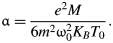
Here, K B is the Boltzmann constant, ω0 is the angular frequency of laser beam, T 0 is equilibrium temperature of plasma, e and m are charge and mass of electron, respectively, and M is mass of ion. Slowly varying electric field E 0 of the laser beam satisfies the following wave equation.

In the Wentzel-Kramers-Brillouin approximation, the second term ∇ (∇.E 0) of Eq. (4) can be neglected, which is justified when 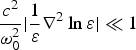 ,
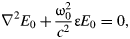
and

Where ɛ0 and Φ (AA*) are linear and non-linear parts of the dielectric constant, respectively.

and
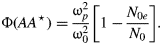
Where 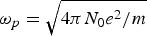 is the electron plasma frequency.
Further, taking E 0 as

where A(r, z) is a complex function of its argument. The behavior of the complex amplitude A(r, z) is governed by the following parabolic equation obtained from the wave Eq. (5) by assuming variations in the z direction being slower than those in the radial direction,

This equation is also known as the quasi-optic equation. Now, Eq. (10) can be written as
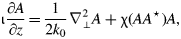
where 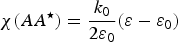 and ɛ = ɛ0 + Φ (|AA*|), where
 and Φ (|AA*|) are the linear and non-linear parts of the dielectric constant, respectively. Also,
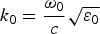 and ωp are propagation constant and plasma frequency, respectively. Now from the definition of the second order moment, the mean square radius of the beam is given by
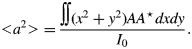
From here one can obtain the following equation:

where I 0 and I 2 are the invariants of Eq. (11) (Vlasov et al., Reference Vlasov, Petrishchev and Talanov1971)
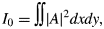
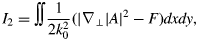
with (Lam et al., Reference Lam, Lippmann and Tappert1977)
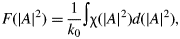
and

For z > 0, we assume an energy conserving gaussian ansatz for the laser intensity (Akhmanov et al., Reference Akhmanov, Sukhorukov and Khokhlov1968; Sodha et al., Reference Sodha, Ghatak and Tripathi1974, Reference Sodha, Ghatak and Tripathi1976)
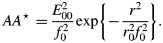
From Eqs. (12), (14), and (18) it can be shown that


Where f 0 is dimensionless beam width parameter and r 0 is beam width at z = 0. Now, from Eqs. (13)–(20) we get

Where ξ = (z/k 0r 02) is the dimensionless propagation distance. Eq. (21) is a basic equation for studying the self-focusing of a gaussian laser beam in a non-linear, non-absorptive medium. Now, by making use of Eqs. (2), (8), (15)–(18), and (21) we get
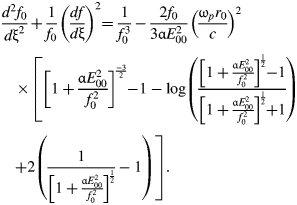
Initial conditions of plane wavefront are  and f 0 = 1 at ξ = 0. Eq. (22) describes the change in the beam width parameter of a gaussian beam on account of the competition between diffraction divergence and nonlinear focusing terms as the beam propagates in the collisional plasma.
3. PLASMA WAVE GENERATION
We consider the interaction of a weak plasma wave and a Gaussian laser beam in a collisional plasma. Due to non-uniformity in heating, the background electron density gets modified, which further leads to change the amplitude of the plasma wave, which depends on the background electron density. Following the standard procedure, the equation governing the electron plasma wave generation can be written as,
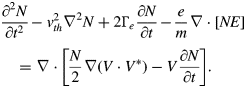
Where 2Γe is landau damping factor, v th is the electron thermal speed, E is the sum of electric vectors of electromagnetic wave and self-consistent field, V is the sum of drift velocity of electron in electromagnetic field and self-consistent field, m is mass of electron. The density component varying at pump wave frequency (N 1) can be written as
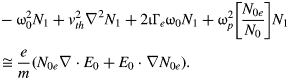
Where N 0 is the equilibrium electron density, 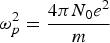 is the electron plasma frequency, V 0 is the oscillation velocity of the electron in the pump wave field, and ω0 is the pump wave frequency.It is obvious from the source term of Eq. (24) that one component of N 1 varies as E 0 and that the second component is the solution of homogeneous Eq. (24). Therefore, N 1 can be written as

Where N 10 (r, z) and N 20 (r, z) are the complex functions of their arguments and satisfy the following equations.
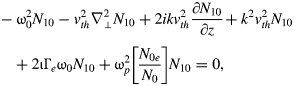
and
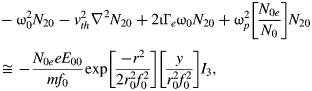
where
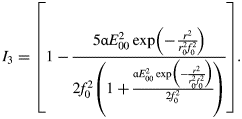
Now, Eq. (26) can be written as,

Where, 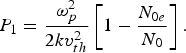
Now, from the definition of second order moment

where I 0 is zeroth order moment and can be written as
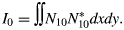
Now, solution of Eq. (28) is of the form,

Now, from Eqs. (29), (30), and (31), it can be shown that

and

Now, with the help of Eqs. (29) and (33), one can get

where
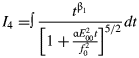
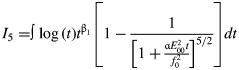
β1 = α1 − 1 where 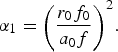
Now, Solution of Eq. (27) gives the second harmonic source equation as

4. SECOND HARMONIC POWER
Generated plasma wave can interact with the incident laser beam to produce second harmonic. The electric vector of the second harmonic (A 2) satisfy the following equation.
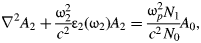
where ω2 = 2 ω0 and ɛ2 (ω2) is the effective dielectric constant of plasma at the second harmonic frequency and is given by

where Φ2 (A · A*) is non-linear part of the dielectric constant and is given by
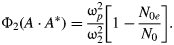
Now, the solution of Eq. (36) can be written as

where A 20 and A 21 are the complex functions of their arguements and satisfy following equations
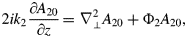
and

Now, from the definition of second order moment,

where I 0 is zeroth order moment and can be written as

Now, solution of Eq. (40) is of the form,
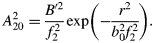
Now, from Eqs. (42), (43), and (44), it can be shown that

and

Now, with the help of Eqs. (42) and (46), one can get

where
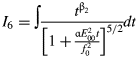
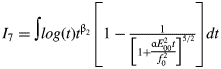
β2 = α2 − 1 where 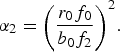
Now, solution of equation (41) can be written as,

Now, the constants B ′ and b 0 are obtained from the boundary condition that second harmonic wave is zero at z = 0.

and b 0 = r 0, respectively.
Now, the second harmonic yield can be written as

where
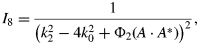
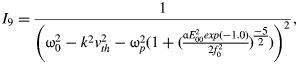
and

5. DISCUSSION
Eq. (22) governs the behavior of dimensionless beam width parameter f 0 of a beam as a function of dimensionless distance of propagation ξ (=zc/ω0r 02). This equation has been solved numerically for the following set of parameters; ω0 = 1.778 × 10¹⁴ rads−1, r 0 = 30 µm, αE002 = 1.27, 1.37, ωp2 / ω02 = 0.17, 0.20.
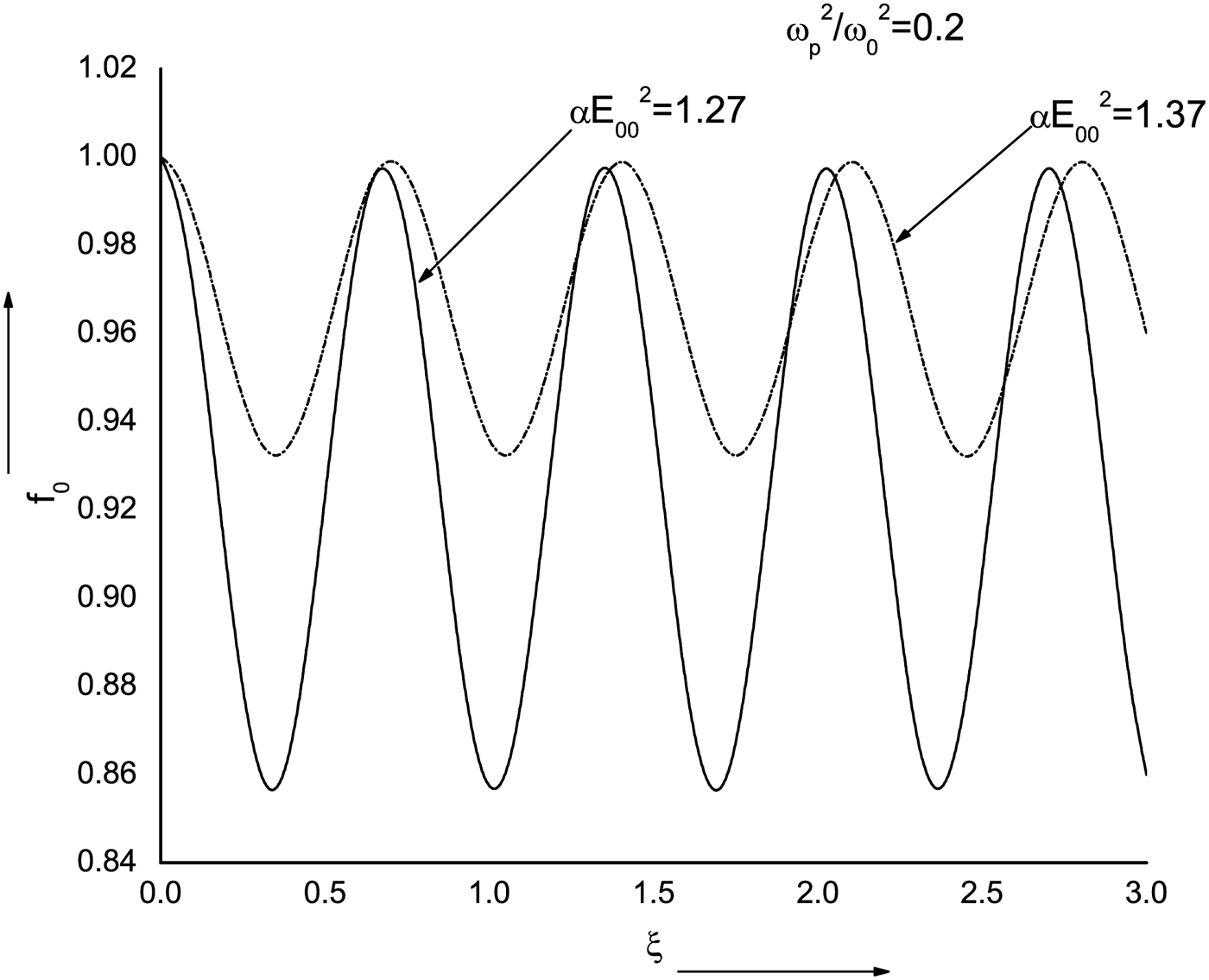
The first term on the right-hand side of Eq. (22) represents diffraction phenomenon of the laser beam. The second term which arises due to collisional non-linearity represents the non linear refraction. The relative magnitude of these terms determines the focusing/defocusing behavior of the beam. Figure 1 describes the variation of beam width parameter f 0 of a beam with normalized distance of propagation ξ = zc / ω0r 02 for different values of intensity parameter α E 002 = 1.27, 1.37 at a fixed value ofplasma density, ωp2 / ω02 = 0.20. It is observed from Figure 1 that extent of self-focusing of the beam decreases with increase in intensity. This is due to the fact that the non-linear refractive term is very sensitive to the intensity of the laser beam. So, with the increase in the intensity of the laser beam, diffractive term relatively becomes stronger but not enough to overpower the non-linear refractive term, as a result beam remains in a self-focusing mode. So, one can infer that as the intensity of the laser beam is increased, there is decrease in the non-linear term, which leads to decrease in self-focusing.
Variation of beam width parameter f 0 against the normalized distance of propagation ξ(=zc/ω0r 02) for plasma density ωp2 / ω02 = 0.20 and for intensity αE 002 = 1.27, 1.37.

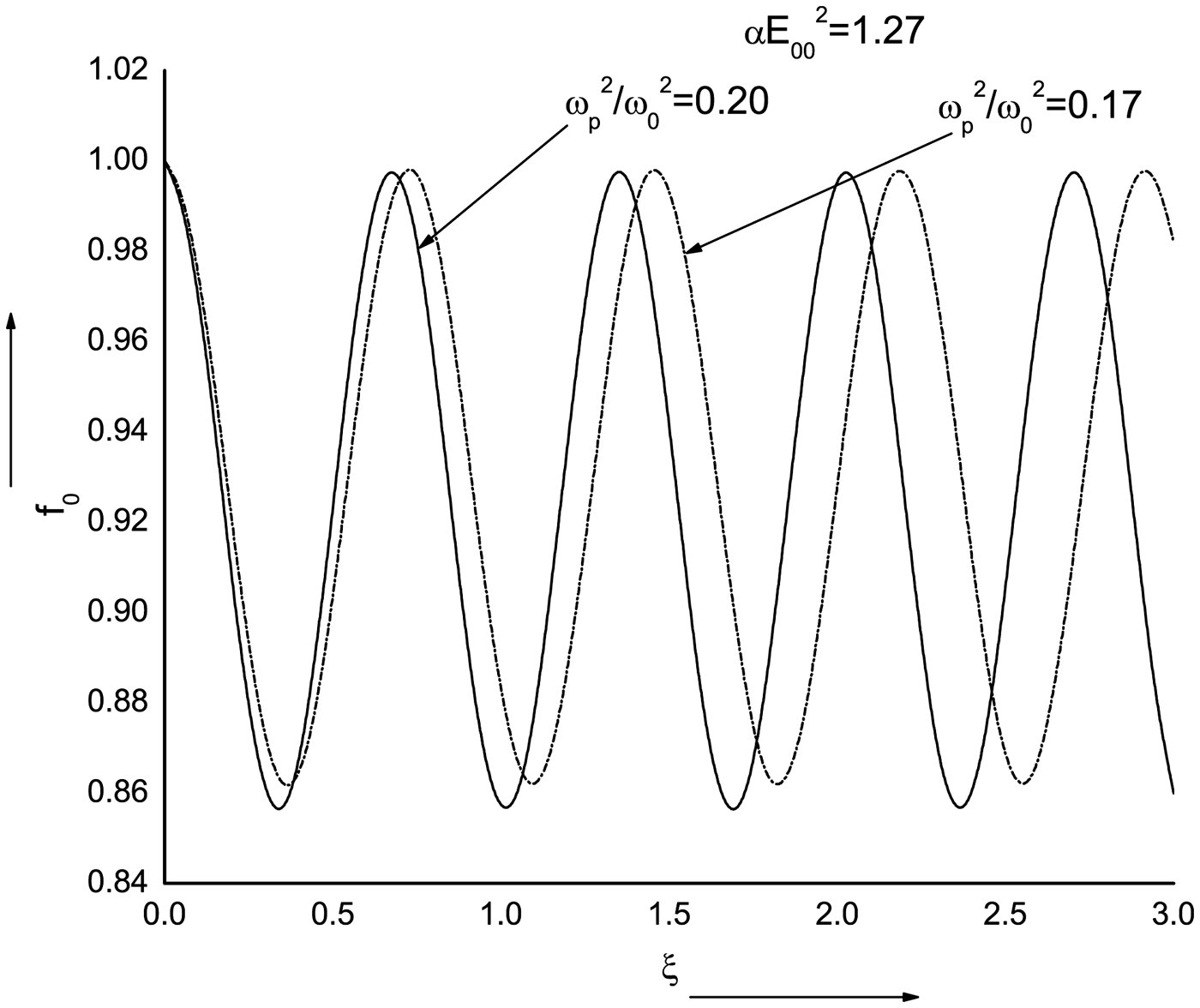
Figure 2 describes the variation of beam width parameter f 0 of a beam with normalized distance of propagation ξ for different values of plasma density ωp2 / ω02 = 0.17, 0.20 and at a fixed value of intensity parameter αE 002 = 1.27. It is observed that with increase in plasma density extent of self-focusing of the beam increases. This is due to the fact that the refractive term dominates the diffractive term as we increase the value of plasma density.
Variation of beam width parameter f 0 against the normalized distance of propagation ξ for intensity αE 002 = 1.27 and for plasma density ωp2 / ω02 = 0.17, 0.20.
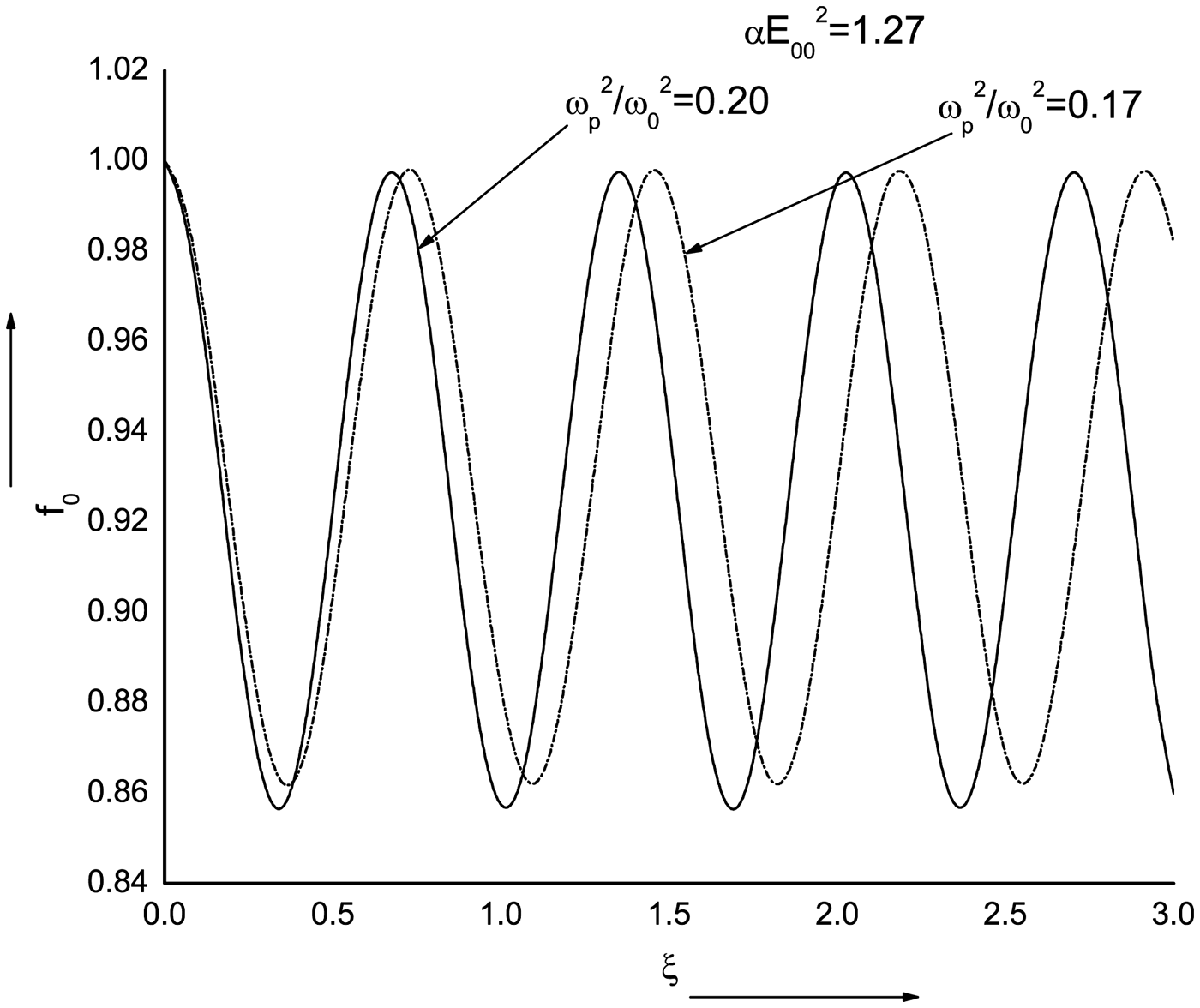
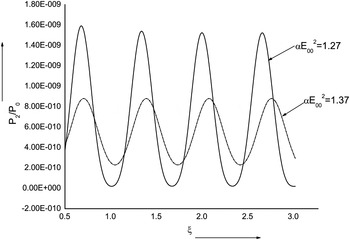
Figure 3 depicts the variation of second harmonic yield P 2 / P 0 with the normalized distance of propagation ξ for different values of intensity parameter αE 002 = 1.27, 1.37 and at ωp2 / ω02 = 0.20. It is observed that second harmonic yield decreases with increase in intensity. This is due to the reason that with increase in intensity, the self-focusing of the laser beam decreases, which results in decrease in non-uniform heating of the carriers in the focal region and hence decreases the amplitude of plasma wave generation and ultimately the second harmonic yield.
Variation of second harmonic yield P 2 / P 0 against the normalized distance of propagation ξ for plasma density ωp2 / ω02 = 0.20 and for intensity αE 002 = 1.27, 1.37.

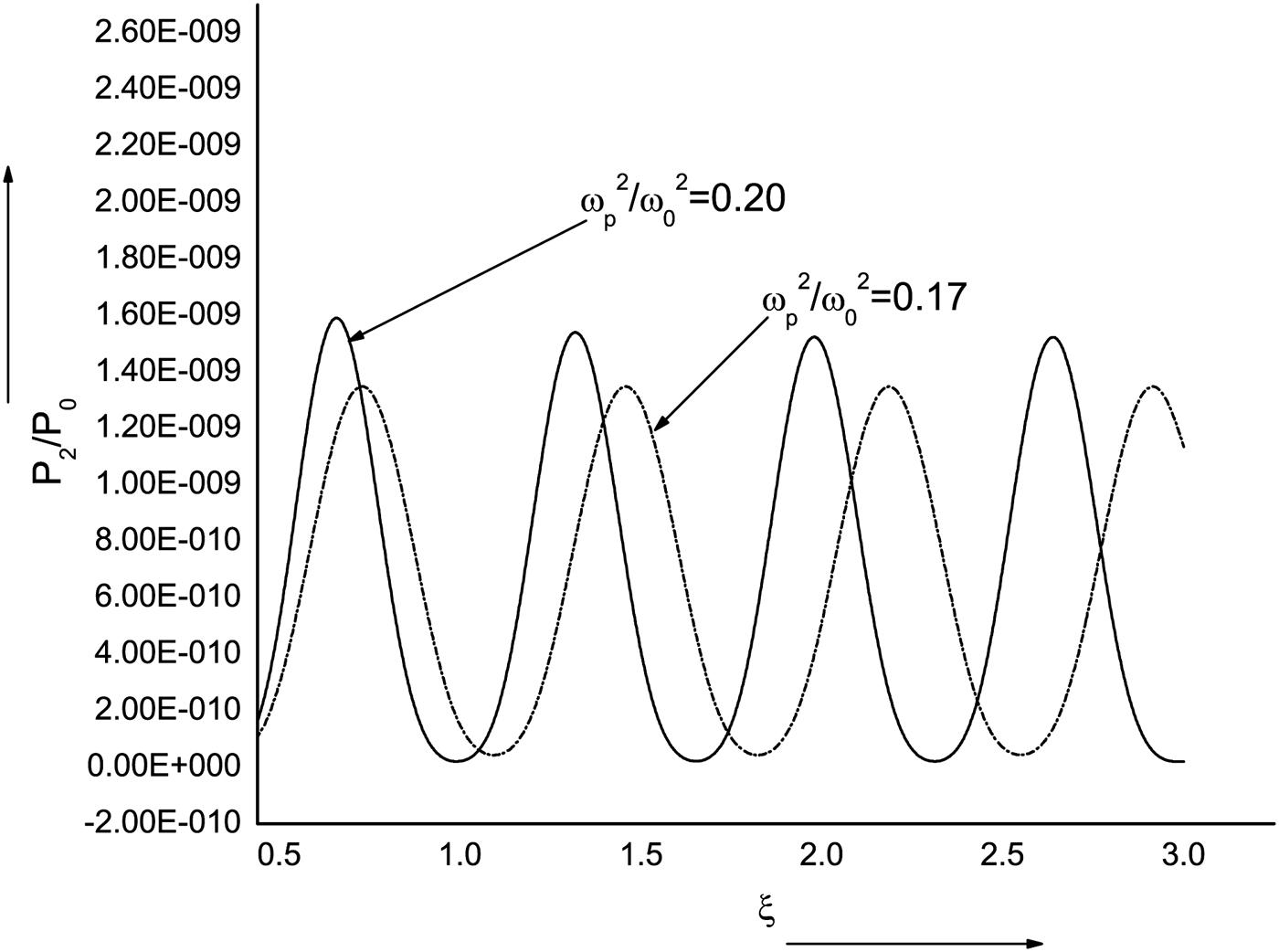
Figure 4 depicts the variation of second harmonic yield P 2 / P 0 with the normalized distance of propagation ξ for different values of plasma density ωp2 / ω02 = 0.17, 0.20 and at fixed value of intensity parameter αE 002 = 1.27. It is observed from Figure 4 that second harmonic yield increases with increase in plasma density. This is due to the reason that with increase in plasma density, the self-focusing of the laser beam increases which results in increase in non-uniform heating of the carriers in the focal region, which in turn leads to increase the amplitude of plasma wave generation and hence the second harmonic yield.
Variation of second harmonic yield P 2 / P0 against the normalized distance of propagation ξ for intensity αE 002 = 1.27 and for plasma density ωp2 / ω02 = 0.17, 0.20.

6. CONCLUSION
In the present work, moment theory has been developed to study the second harmonic generation of laser beam, when Collisional non-linearity is operative. Following important observations are made from present analysis.
(1) The effect of increase of laser beam intensity/plasma density is to increase/decrease the self-focusing length.
(2) Self-focusing of the laser beam becomes stronger with increase in the plasma density and becomes weaker with increase in laser beam intensity.
(3) There is an increase in the second harmonic yield with increase in the plasma density and also with decrease in laser beam intensity. Thus laser power and plasma density parameters are crucial to harmonic generation.
Results of the present analysis are useful in understanding the physics of high power laser driven fusion in which second harmonic generation play important role.
ACKNOWLEDGMENTS
The authors are thankful to the Department of Science and Technology(DST), Government of India for providing financial assistance for carrying out this work.