In recent years, there have been renewed efforts in the United States to restrict abortion, most of which have been initiated at the state level. The policy changes that might result from these efforts are of particular interest to the scientific and medical community because they could have implications for medical research and practice. For example, one policy area that may be impacted by this ongoing controversy is embryonic stem cell research, which requires the destruction of human embryos to create new stem cell lines.
The primary catalyst for policy debates over embryonic stem cell research can usually be traced to differing viewpoints about when life begins, which is particularly the case in the United States, where there is a strong association between religious beliefs and public opinion on stem cell research (Allum et al., Reference Allum, Allansdottir, Gaskell, Hampel, Jackson, Moldovan, Priest, Stares and Stoneman2017). Some individuals, especially those with strong religious convictions, believe that an embryo is a human life and that artificially stopping the process of its development at any stage is tantamount to killing an innocent human being. Others argue that a human life does not begin until much later, and even if embryos are considered to be potential human lives, the decision to terminate their development should be free for any woman to make. Though nuanced views are held by many, there is a considerable degree of polarization on this topic, not unlike other moral issues.
This polarization has not been limited to the citizenry. In August 2001, U.S. president George W. Bush enacted a policy that restricted federal funding for embryonic stem cell research. Only stem cell lines that were currently in existence at the time of his announcement would be funded. Congress responded by passing two bills that would have allowed new stem cell lines created through the use of embryos typically discarded from fertility clinics to be eligible for federal funding. The first bill, Stem Cell Research Enhancement Act of 2005, passed in the House of Representatives and Senate. President Bush then used his first veto while in office to block the legislation. The second bill, Stem Cell Research Enhancement Act of 2007, met a similar fate and was vetoed.
It is clear that President Bush’s personal values and religious views strongly influenced his decision to create restrictive policy and to veto these two legislative acts. In an address to the nation after announcing the policy, he even stated, “My position on these issues is shaped by deeply held beliefs” (Vogel, Reference Vogel2001, p. 1245). When President Barack Obama later reversed President Bush’s policy, Obama was quoted as saying that his administration would make “scientific decisions based on facts, not ideology,” a clear rebuke of Bush’s personalized decision (Childs & Stark, Reference Childs and Stark2009).
Previous research has explored how personal values and religious views have translated into action on this issue, such as what motivates individuals to participate publicly on stem cell policy (Goidel & Nisbet, Reference Goidel and Nisbet2006) and their voting intentions to publicly fund stem cell research (Dragojlovic, Reference Dragojlovic2014). More recent research has compared citizen and legislative voting behavior on this issue in Switzerland, finding greater support for stem cell research among the citizens of that country than among its politicians (Stadelmann & Torgler, Reference Stadelmann and Torgler2017). This article seeks to extend this growing body of work by exploring research questions stemming from three analytical tasks: first, using exit poll results from the 2006 stem cell research initiative in Missouri, to analyze how values and partisanship affected citizens’ voting behavior and whether partisanship was the primary determinant of vote choice; second, to determine whether U.S. senators voting on the 2005 stem cell research bill were more concerned with their constituents’ preferences or their own policy preferences when casting their votes; and third, to compare the complexity of the Missouri citizen initiative with the legislation in the U.S. Senate followed by an exploration of potential implications for making science policy.
Citizen voting behavior
In 2006, Missouri voters had the chance to directly express their policy opinion on stem cell research. An initiative was placed on the ballot that asked voters whether they wanted their state to allow all types of stem cell research permitted by the federal government. This initiative would have barred the state legislature from interfering with stem cell policies in the state; given the conservative leanings of the legislature, this was a likely possibility (St. Louis Post Dispatch, 2005). It was also thought that the initiative would send a signal to biotechnology companies that the state was a good place to relocate and conduct research. However, the initiative passed by only 51% to 49%, and the controversy, lawsuits, and further attempts to limit stem cell research that ensued ended up serving as a setback for those in favor of bringing more biotech jobs to the state (Associated Press, 2007). This section seeks to determine what factors were important in an individual’s vote on this initiative.
On a number of disparate issues, partisanship has been the most useful predictor of voter behavior on ballot initiatives (Branton, Reference Branton2003). Voters are able to make reasonable evaluations of initiatives based on their partisan and ideological orientations (Bowler & Donovan, Reference Bowler and Donovan1998). Whether these findings on partisanship apply to the morally charged issue of stem cell research is questionable. For instance, it is hypothesized that religion has a measurable effect distinct from partisanship because it has a strong influence on the formation of political attitudes through its effects on an individual’s underlying values and, especially for evangelical Christians, its creation of a strong group identity. Values are defined as an individual’s general conception of the desirable and undesirable end states of human life. As discussed earlier, differing values regarding the conception of life strongly influence opinions of stem cell research. Also of importance to citizen voting behavior on stem cell research is that psychological attachment to a religious group can help individuals form political attitudes for complex issues like stem cells (Wlezien & Miller, Reference Wlezien and Miller1997). Endorsements and messages by religious leaders provide cues for individuals to use in the development of their political attitudes, and so it is expected that religious affiliation will be important in this analysis.
Even though religion and values are likely to be important for determining how an individual decides to vote on the issue of stem cell research, partisanship is also likely to remain important, as most politically active Americans identify with one of the two major parties (Abramson et al., Reference Abramson, Aldrich, Gomez and Rohde2014). Since stem cell research is closely tied to opinions on abortion in an individual’s mind, and abortion has become a partisan issue over time, it is expected that Democrats will mostly support it, whereas opposition will be mostly found among Republicans.
Another important influence on the development of political attitudes is ideology (see Jacoby, Reference Jacoby, Carpini, Huddy and Shapiro2002). Ideology and partisanship are often related, especially in the current political environment, in which there is a great deal of ideological polarization among elites (Poole, Reference Poole2005). Ideology’s effects are greatest for those who are the most politically aware. However, it should be noted that most Americans often do not think in these terms (Converse, Reference Converse and Apter1964), and so partisanship is likely to be a better indicator of political beliefs. There is evidence that the lack of consistent ideological thinking in the American electorate is a result of ambivalence (Zaller & Feldman, Reference Zaller and Feldman1992). People hold conflicting considerations for and against political issues, something that is important to consider when viewing an issue such as stem cell research, which has components of health, morality, science, and economic policy. Even though conflicted opinions exist, it is expected that liberals will vote for stem cell research because of their greater tolerance of and openness on similar issues. Conservatives would be expected to be less supportive, especially evangelical Christians, who often hold more traditional social views.
On the specific issue of stem cells, research has shown that an individual’s personal values, ideological disposition, issue-specific knowledge, and degree of religious devotion are significant determinants of their support for stem cell research (Nisbet, Reference Nisbet2005). A more recent analysis of cross-sectional, nationally representative survey data collected between 2002 and 2010 confirmed that political and social factors such as partisanship have a significant effect on public opinion of stem cell research, though the study found that an individual’s beliefs about science and society have the strongest influence on their opinion (Nisbet & Markowitz, Reference Nisbet and Markowitz2014). Of particular relevance is a study by Nick Dragojlovic (Reference Dragojlovic2014) that combined individual and county-level data to analyze opposition to California’s Proposition 71, a 2004 ballot initiative to provide $3 billion in state funding for stem cell research. The results of a statistical test to determine whether evangelical Protestants were more likely to oppose Proposition 71 than other voters suggested that “value-based opposition to embryonic stem cell research influenced Californians’ voting behavior on Proposition 71 over and above their partisanship and demographic characteristics” (Dragojlovic, Reference Dragojlovic2014, p. 365). If this result holds for how citizens reported voting on Missouri’s ballot initiative, it will be a noteworthy finding.
To confirm whether partisanship or other deeply held values are most important in an individual’s voting decision on whether or not to permit stem cell research, exit poll data from Edison Media Research and Mitofsky International collected from randomly distributed questionnaires completed by 1,820 Missouri voters as they left their polling places during the general election of 2006 have been used to carry out logistic regression analysis with the following variables: an individual’s vote on the stem cell amendment to the Missouri constitution (1 indicates a yes vote, 0 indicates a no vote), two variables for self-identified partisan affiliation (one for Republicans and one for Democrats; independents are the reference group), two variables for an individual’s self-identified political ideology (one for conservatives and one for liberals; moderates are the reference category), opinion of abortion (coded as 1 for it should be legal in all or most cases, 0 if it should be illegal in all or most cases), church attendance (coded as 1 for attends at least weekly, 0 for attending less than this amount or not at all), and education (coded as 1 for having a college degree, 0 for not having a college degree). Descriptive and collinearity statistics for these variables can be found in the appendix along with the text of the exit poll questionnaire.
Empirical results
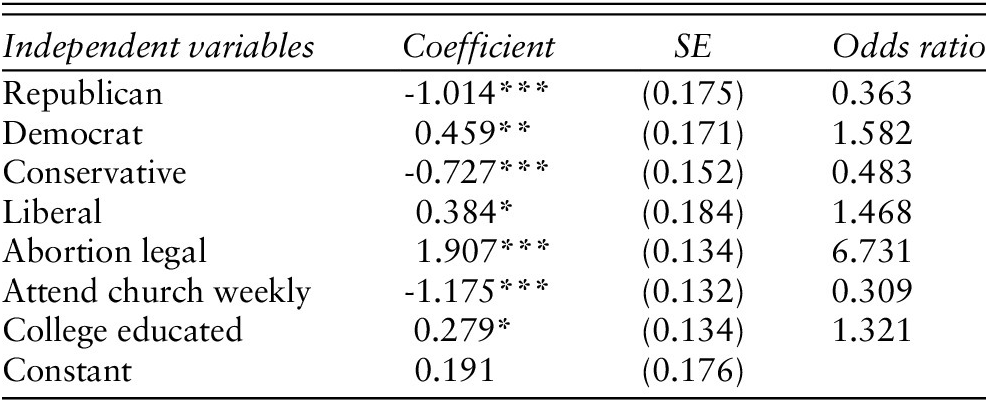
Table 1 conveys a notable result: partisanship was not the most important factor in how someone decided to vote on the stem cell ballot initiative. Religious factors and beliefs about abortion were the most important determinants of someone’s vote for or against stem cell research. Partisanship had an effect—Republicans were 64% less likely to vote for stem cell research, whereas Democrats were 1.6 times more likely than independents to vote for it—but it was not the deciding factor. For political ideology, it seems that it had similar effects as partisanship: conservatives were 52% less likely to vote for the amendment, and liberals were 1.5 times more likely than moderates to vote for it.
Missouri stem cell research amendment voting behavior.
Dependent variable: Vote (1 = yes, 0 = no)

* = p < .05; ** = p < .01; *** = p < .001; two-tailed tests
Observations 1,820
Log likelihood -769.333
Model significance p < .0001
Psuedo R2 value 0.409
Percent predicted correctly 81.15%
Interestingly, it was an individual’s opinion of abortion that was the single most important determinant of their vote: if someone thought abortion should be legal in all or most cases, they were 6.7 times more likely to vote for the stem cell research amendment than someone who wanted abortion to be illegal in all or most cases. Church attendance was the second-largest determinant. Someone who attended church at least weekly was 69% less likely to vote for the amendment than someone who did not. In this analysis, having a college degree was the least consequential determinant of an individual’s vote: college-educated individuals were 1.3 times more likely to vote in favor of stem cell research than those without a college degree (research by Jon Miller [Reference Miller2009] suggests that possessing a college education can serve as a reasonable approximation of an individual’s general level of scientific knowledge, given that the strongest determinant of adult scientific literacy is the number of postsecondary science courses that a person has taken). Recent research specific to stem cells has cast doubt on the notion that partisanship is the most important variable of interest for this policy issue. The findings from this analysis confirm that personal values and religious devotion are the primary determinants of an individual’s voting behavior on the controversial issue of stem cell research, swamping the effects of other potentially relevant considerations, such as scientific literacy.
A look at the predicted probabilities of voting in favor of stem cells from exit poll respondents provides an indication of the importance of abortion opinion and church attendance. Among respondents with a college degree, a conservative Republican who thought abortion should be legal and did not attend church weekly had a 65% predicted probability of voting in favor of stem cells, whereas a conservative Republican who did not believe abortion should be legal and who attended church weekly had only an 8% predicted probability of voting in favor of stem cells. Among respondents without a college degree, a liberal Democrat who thought abortion should be legal and did not attend church weekly had a 95% predicted probability of voting in favor of stem cells, whereas a liberal Democrat who did not believe abortion should be legal and who attended church weekly had a 46% predicted probability of voting in favor of stem cells. Partisanship and ideology were important, but these predicted probabilities show how abortion opinion and church attendance could mediate their effects.
Legislator voting behavior
At the state level, the initiative provides citizens with the ability to alter public policy through two primary means: directly by voting in policies they prefer and indirectly by influencing the behavior of their elected representatives. The initiative process can motivate representatives to vote in laws they may not otherwise have been inclined to pass because legislators desire to preempt the possibility of the initiative process being used to create laws that run afoul of their preferences. For example, it has been shown that legislatures in states with the initiative pass abortion laws that more accurately resemble the preferences of the median voter in those states (Gerber, Reference Gerber1996). Considering that the issues raised by abortion and stem cell research are similar, such an effect could occur for stem cell legislation.
However, an opposite effect could also occur in state legislatures. Voters may pass initiatives that are binding on elected officials and government bureaucrats, but these political actors can seek out ways to obstruct the implementation or enforcement of these initiatives. Policies passed through initiative can often be too controversial to be handled by the legislature; the result is a lack of support from politicians to carry out new regulations required by the initiative (Gerber et al., Reference Gerber, Lupia and McCubbins2004). Evidence from the Missouri Stem Cell Research Amendment shows this to be the case, as conservative lawmakers in the state responded to passage of the constitutional amendment by stripping funding from a $150 million research center at the University of Missouri in Columbia and creating enough controversy over the stem cell issue that biotechnology companies were deterred from relocating their stem cell research facilities to the state (Gross, Reference Gross2007).
Therefore, it is appropriate when examining the preferences of elected representatives on the issue of stem cell research to look to the national level, where the threat of the initiative is unlikely to significantly alter legislator preference. Another reason for analyzing voting behavior on a national bill is that research has shown that the debate over the Stem Cell Research Enhancement Act, which has been chosen for this study, increased the salience of stem cell research policy and served as a diffusion mechanism for the introduction of state legislation (Karch, Reference Karch2012). The analysis that follows seeks to determine whether senators vote on stem cell research policy because of their sincerely held political and religious beliefs or whether they vote to appease their constituents.
Party affiliation is usually the strongest predictor of a senator’s vote, and senators choose their party affiliation based on the perception that a party best fits with their ideology and that a particular party will allow them to promote their interests (Mehmood & Zhang, Reference Mehmood and Zhang2001). A liberal (greater government intervention in the economy) and conservative (reduced role for government) scale based on party affiliation can account for legislators’ voting decisions on 80% of all roll call votes cast between 1789 and 1985 (Poole & Rosenthal, Reference Poole and Rosenthal1997). The ideological differences between the parties often result in politicians taking starkly different positions on issues. For example, the issue of abortion has become polarized at the elite level, with most Republicans lining up against the practice and most Democrats expressing support for access to abortion (Stimson, Reference Stimson2004). It is expected that the issue of stem cell research, which engenders similar concerns as abortion, will also be a partisan issue in Congress and that representatives’ ideology and partisanship are highly correlated on this issue.
Even though it has been found that at times legislators do advocate for policies that are not supported by a majority of their constituents (Fiorina & Abrams, Reference Fiorina and Abrams2009), it would be naive to assume that in all instances legislators vote their conscience, and in fact there is evidence to suggest that the policy preferences of constituents do matter (e.g., Page & Shapiro, Reference Page and Shapiro1983; Stimson et al., Reference Stimson, MacKuen and Erikson1995), particularly in instances of electoral insecurity (e.g., Griffin, Reference Griffin2006; Sullivan & Uslaner, Reference Sullivan and Uslaner1978). It has been found that legislators are usually responsive to constituents on high-profile issues that could threaten their reelection (Mezey, Reference Mezey2008), though there is not as much evidence to suggest they are directly influenced by the interests of their constituents on less controversial issues (Bertelli & Carson, Reference Bertelli and Carson2011). This ambiguity makes it difficult to determine whether it is likely that voting based on constituent interest will take place. It could be argued that certain constituents see stem cell research as a high-profile issue to them. In particular, this could be said of devout Christians with conservative views on abortion. It is expected that if stem cells are considered a high-profile issue, and if legislators are listening to voters in their districts on this particular issue, there will be evidence of this demographic affecting their vote.
On an issue such as stem cell research, which has a strong moral component, how do legislators vote? Do they vote based on their party allegiance or ideology, or do they vote in line with the views of their constituents? Previous research has shown that on the issue of abortion, legislators were more likely to vote their own preferences rather than the preferences of their constituents (Medoff et al., Reference Medoff, Dennis and Bishin1995). Since abortion prompts many of the same controversies and concerns as stem cell research, it is not unlikely that similar results will be found. Before determining whether this is the case, what policies voters in a district or state prefer must be ascertained.
Determining the preferences of constituents in a legislator’s district or state has long been a problem for political scientists, though research has confirmed that, despite its shortcomings, the two-party presidential vote share is an appropriate proxy (Levendusky et al., Reference Levendusky, Pope and Jackman2008). Since this information is readily available, measuring the partisan preferences of a district or state is relatively easy; measuring a district or state’s religiosity is far more difficult. One way to do so would be to use the stated religious affiliation of constituents within a district or state (see Smith et al., Reference Smith, Olson and Fine2010). However, this method seems unsatisfactory for measuring the religiosity of a district or state. Unlike demographic variables such as race or occupation, for which the observed characteristic corresponds nearly perfectly with the variable of interest, a person’s stated religious affiliation does not correspond to the importance of religion in their daily lives. Someone who is a practicing Catholic would likely have a stronger religious basis for their opinion on abortion than a Catholic who only goes to mass on Christmas and Easter. The differences between denominations, and particularly the differences between individual churches within denominations, further complicates using religious affiliation as a proxy for religious preferences; the split in the Anglican Church between conservative and liberal parishes highlights this problem.
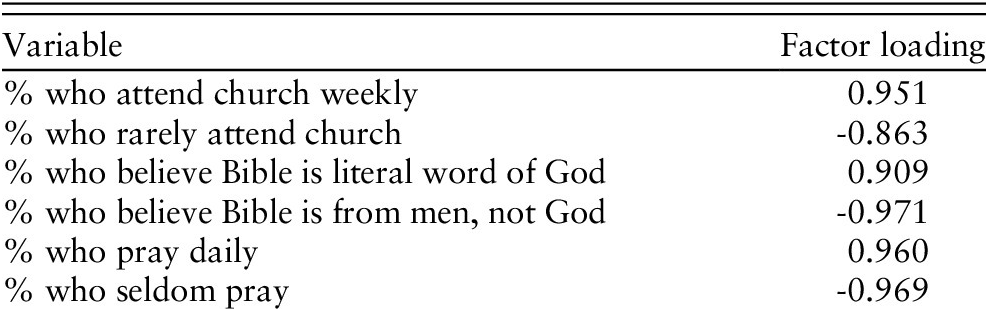
A better method of determining religious preferences within a district or state is to use survey data from questions that are relevant to religious devotion. Those who are strongly devoted to the practice of their religion are most likely to have their political views influenced by their religiosity, since their religion significantly shapes their values. In 2008, Gallup conducted representative statewide surveys in the United States asking individuals a simple question: “Is religion an important part of your daily life?” Gallup found that the South is the most religious region in the country, with the Midwest being the second most religious and the Northeast and West being the least religious (Newport, Reference Newport2009). In 2007, the Pew Research Center conducted representative statewide surveys on religious practice that were more in-depth than the Gallup surveys, asking, among other things, questions regarding church attendance, views of the Bible, and frequency of prayer (Pew Research Center, 2007). Using answers to the questions from the Pew survey, a variable can be created that taps in to the religiosity of a state. The results of this factor analysis are listed in Table 2. Correlating the predicted state values of religiosity from the factor analysis with the answers to the Gallup surveys on the importance of religion produces a correlation coefficient of 0.96. Accordingly, in the interest of parsimony, the Gallup survey measure will be used as the proxy for state religiosity in the analysis that follows.
Iterated principal factor analysis retaining one factor.
Eigenvalue = 5.28

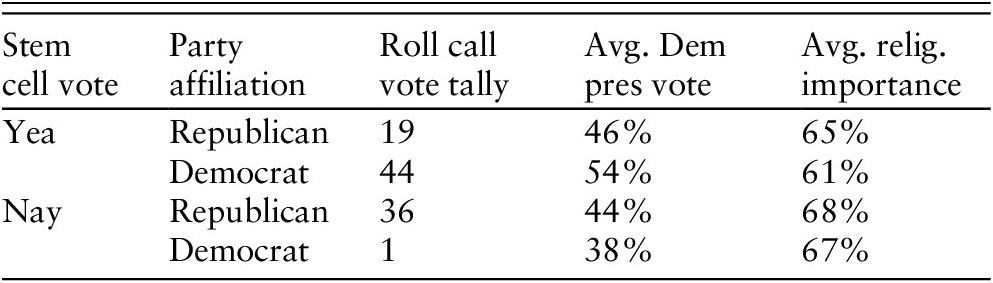
Having developed an appropriate measure of a state’s religious preferences, a model can be developed for understanding the primary determinants of a senator’s vote. First, descriptive analysis is employed to uncover potential relationships in the data, which are then further explored in the logistic regression that follows. Tables 3 and 4 provide information about voting patterns on the 2005 Stem Cell Research Enhancement Act. It is apparent from Table 3 that Democrats had near-unanimous support for the bill (Ben Nelson from conservative Nebraska was the lone Democrat to vote against the legislation), whereas support from Republicans was more splintered. The group of senators voting yea on the bill were from states with higher mean Democratic presidential vote shares for 2004 and 2008 and from states with a lower mean percentage of residents responding that religion is an important part of their daily lives than the group of senators voting nay; however, the group of Republicans voting yea were from states with constituent characteristics that were similar to the group of Republicans voting nay, and so the extent to which a senator’s constituents influenced their voting is unclear.
Descriptive statistics of senator voting by party.

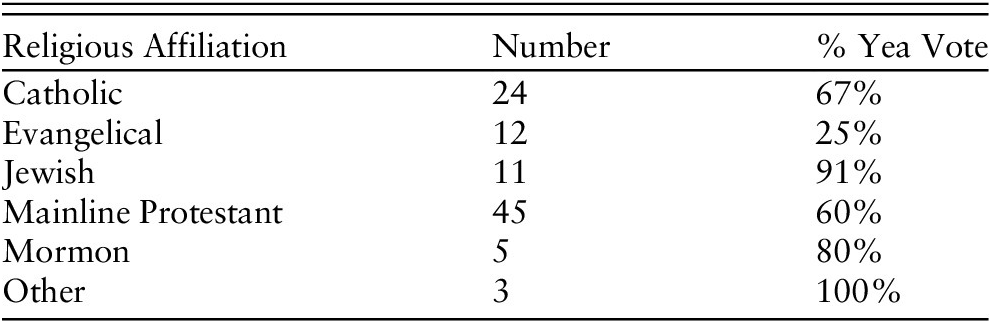
Stem cell roll call votes by religion.

Voting by religious affiliation (Table 4) indicates that evangelicals were likely to oppose the legislation, whereas senators who were Jewish or Mormon were likely to lend their support. What is surprising is the degree of support from Catholics given that the Catechism of the Catholic Church mandates the protection of human life from the moment of conception. It would seem that senators such as Rick Santorum, a pro-life Catholic who voted nay on the legislation and whose “religious beliefs would come to infuse every aspect of his political life,” according to the New York Times biographical article “From ‘Nominal Catholic’ to Clarion of Faith” (Stolberg & Goodstein, Reference Stolberg and Goodstein2012), were in the minority of Catholics. Given the difficulty of determining a senator’s religious devotion and opinion of abortion based solely on their stated religious affiliation, a different proxy is used in the logistic regression that follows.
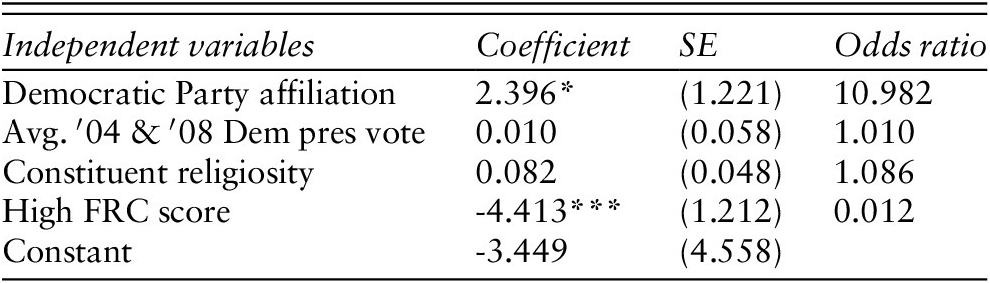
The following variables have been included for logistic regression analysis: a U.S. senator’s vote on the 2005 Stem Cell Research Enhancement Act (1 indicates a yea vote; 0 indicates a nay vote), the average of the 2004 and 2008 Democratic presidential vote share in a state, constituent religiosity as determined by the percentage of residents in a state responding that religion is an important part of their daily lives, and a dummy variable for exhibiting a pro-life stance that accords with conservative Christian principles (senators who received a score of 85% or greater in the 109th Senate from the Family Research Council, "a Christian public policy ministry in Washington D.C. defending religious liberty, the unborn, and families," were assigned a 1 and all others were assigned a 0; previous research has used Family Research Council scores [e.g., Smith et al., Reference Smith, Olson and Fine2010], and the 85% threshold was established based on the method by which the non-partisan voter information site OnTheIssues.org classifies pro-life stances using similar National Right to Life Committee scores). Table 5 presents the results.
Determinants of a senator’s stem cell research vote.
Dependent variable: Vote (1 = yea, 0 = nay)

* = p < .05; ** = p < .01; *** = p < .001; two-tailed tests
Observations 100
Log likelihood -27.918
Model significance p < .0001
Psuedo R2 value 0.532
Percent predicted correctly 88%
Empirical results
The only significant variables in the analysis were a senator’s partisan identification and their score from the Family Research Council (FRC); partisan preferences of constituents and constituent religiosity had no discernible effect on a legislator’s vote. According to the results, Democrats were approximately 11 times more likely than Republicans to vote for the bill, indicating that stem cell research, like abortion, is a polarized issue for the two parties. Being identified by the FRC as a legislator supportive of evangelical and pro-life stances had a considerable impact on a senator’s vote: a senator with a score greater than or equal to 85% from the FRC meant they were nearly 99% less likely to vote for the bill than a senator with a lower FRC score. A review of the data reveals that of the 37 nay votes on the bill, 34 were from senators with high FRC scores. These results suggest that voting on a morally charged issue such as stem cell research is a personal decision based on a legislator’s individual partisanship/ideology and their religious/moral beliefs. This finding should not be all that surprising: expecting a senator to compromise their moral convictions to better reflect the interests of the majority of their constituents would be asking for a degree of responsiveness that even many voters may not desire.
Comparing the citizen initiative and the legislative act
When comparing the similarities and differences between citizen and legislative voting behavior on a controversial scientific issue, it seems appropriate not only to study what drove individual decision-making but to also analyze the actual texts that were being voted on; after all, the legislative process and the initiative process are not the same. It is expected that there will be some differences between the text of H.R. 810 (Stem Cell Research Enhancement Act of 2005) and the text of Constitutional Amendment 2 (Missouri Stem Cell Research and Cures Initiative) given that one is a federal policy intended to be implemented by executive agencies and the other is a state policy intended to be a stand-alone addition to state law. Analysis of these two policies sets the groundwork for a later discussion of the role citizens and legislators play in making policy for science. If the state constitutional amendment seems to be a poorly worded ideological statement drafted by ill-informed activists in comparison to a skillfully crafted bill from a professional legislature, it would lend credence to the notion that science policymaking is best left to the experts. On the other hand, if the state constitutional amendment articulates its policy goals as well as the legislation and is just as complex, it would lend credence to the notion that citizens are capable of playing a significant role in making policy for science.
The primary sponsor of H.R. 810 was Representative Diana DeGette (D-CO), who had worked on such a bill since 2001, when President George W. Bush announced his policy of restricting federal funding for stem cell research. Even after the failure to override presidential vetoes of stem cell bills in 2005 and 2007, DeGette continued to push for passage of legislation. In a hearing on a stem cell bill in 2008, she noted the benefits of the legislative process for drafting new laws: “Input from the experts in the fields is key to crafting quality legislation, which is also part of the reason we are holding this hearing. I look forward to a vigorous discussion here today with our witnesses about where the science is currently, where the science is likely to go in the future, and what we, as federal lawmakers, should do in order to best support and promote all the promising new research that our scientists are working on” (Stem Cell Science, 2008). Though these remarks seem to imply that the legislation was motivated entirely by the desire for sound science policy, the representative’s personal attachment to the legislation was made clear in other remarks she made at the hearing: “I pray every day that my 14-year-old daughter will be cured of diabetes and I frankly don’t care if she is cured by embryonic stem cell research or adult stem cell research or ethical somatic cell nuclear transfer. I don’t really care and I don’t think the rest of the parents in this country care either” (Stem Cell Science, 2008). A legislative summary of the Stem Cell Research Enhancement Act of 2005 is included here (the full text is available at http://www.govtrack.us/congress/bills/109/hr810/text):
Amends the Public Health Service Act to require the Secretary of Health and Human Services to conduct and support research that utilizes human embryonic stem cells, regardless of the date on which the stem cells were derived from a human embryo, provided such embryos: (1) have been donated from in vitro fertilization clinics; (2) were created for the purposes of fertility treatment; (3) were in excess of the needs of the individuals seeking such treatment and would never be implanted in a woman and would otherwise be discarded (as determined in consultation with the individuals seeking fertility treatment); and (4) were donated by such individuals with written informed consent and without any financial or other inducements.
Requires the Secretary to: (1) issue final guidelines to carry out this Act within 60 days; and (2) submit annual reports on activities and research conducted under this Act.
The citizen initiative in Missouri, like the federal act, was prompted by proposed restrictions on stem cell activities; it was created in response to repeated attempts by Republican state senator Matt Bartle to restrict stem cell research in the state. An advocacy group called the Missouri Coalition for Lifesaving Cures was formed to oppose these legislative efforts. The nonprofit group consisted of leaders from medical, business, academic, research, civic, and patient organizations. At one point, the group had considered drafting a proactive stem cell research bill but ultimately decided on developing a citizen initiative that would amend the state constitution, for which the group then worked to acquire enough signatures to ensure ballot access (Patel, Reference Patel2011). Opponents objected to how the initiative used the word cloning and the initiative’s language was challenged in state court. The ballot language was eventually upheld in Missourians Against Human Cloning v. Robin Carnahan, Secretary of State (2006); one justice in his opinion described the standard to be used by Missouri courts in evaluating such cases: “The general principle is that ballot information is designed to provide an informed vote. A ballot description must be complete enough to convey an intelligible idea of the scope and import of the proposed law; it ought not to be clouded by undue detail, or so abbreviated as not to be readily comprehensible. It must give a true and impartial statement of the purpose of the measure.” The language that appeared on the November ballot is included here (the full text of the initiative is available from the Missouri Secretary of State at http://www.sos.mo.gov/elections/2006petitions/ppStemCell).
Shall the Missouri Constitution be amended to allow and set limitations on stem cell research, therapies, and cures which will:
• ensure Missouri patients have access to any therapies and cures, and allow Missouri researchers to conduct any research, permitted under federal law;
• ban human cloning or attempted cloning;
• require expert medical and public oversight and annual reports on the nature of and purpose of stem cell research;
• impose criminal and civil penalties for any violations;
• and prohibit state or local governments from preventing or discouraging lawful stem cell research, therapies and cures?
The proposed constitutional amendment would have an estimated annual fiscal impact on state and local governments of $0 to $68,916.
Empirical test and results
Descriptive information about the citizen initiative and the legislative act indicate that important similarities were shared by both: they each sought to protect and expand existing stem cell research, prohibit the selling of human embryos, and provide expert oversight of cell-based research activities. Though this descriptive analysis is intriguing, it does not do enough to objectively compare the two. Of particular interest in this study is the complexity of the language used in each. It may be presumed that bills drafted in a legislature are likely to be more complex given that they are written with the benefit of experienced congressional aides, professional legislative agencies, and testimony from experts. The best way to test such a hypothesis is empirical analysis using a Flesch-Kincaid Grade Level readability test, a method that has been used in other research studies (see Reilly & Richey, Reference Reilly and Richey2011). The Flesch-Kincaid Grade Level provides the number of years of education required to read and fully understand a text; a score of 16 would mean that someone having the equivalent of 16 years of education (i.e., someone possessing a college degree) should be able to understand the text. The measure is calculated using the average sentence length (ASL) and the average number of syllables per word (ASW) multiplied by constants.
A Flesch-Kincaid Grade Level readability test results in a score of 12.3 for the legislation and a score of 17.8 for the initiative. What this result means is that someone would need 18 years of education to able to be able to fully understand the initiative, whereas someone would only need 12 years of education to fully understand the legislation; in other words, the equivalent of a high school education would be required to comprehend the language of the legislation, but the equivalent of a graduate degree would be required to comprehend the language of the initiative. In terms of complexity, this analysis refutes the aforementioned hypothesis: just because the stem cell legislation was drafted in a legislature does not mean that it was more complex than the citizen initiative.
Implications and conclusions
Stem cell research is a controversial issue. How someone perceives the issue is in large part determined by that individual’s view of abortion and their degree of religious devotion. For some, the use of embryonic stem cells is tantamount to the killing of a potential human life, but for others, this research holds great promise for one day extending the lives of those with currently incurable diseases such as Parkinson’s. Regardless of which stance best reflects an individual’s opinion, the basis for their attitude is tied to underlying values that are stable over time and unlikely to experience much change.
In the case of the 2006 Missouri constitutional amendment to allow for all types of stem cell research permitted by federal law, the single greatest determinant of someone’s vote was their opinion of abortion. Religiosity was also a strong determinant of the decision to vote for or against stem cell research. Partisanship and ideology were significant, but they were not as important as deep-seated values and religion. Perhaps moral issues such as stem cell research are framed differently in citizens’ minds, which is then reflected in their voting behavior. For instance, previous research has indicated that morality policy is characterized by “clashes of first principle” rather than “technical debate about whether the policy will ‘work’ or not” (Mooney, Reference Mooney1999, p. 676), suggesting that moral considerations may predominate over other concerns. Irrespective of the reason for the reduced role of partisanship it seems clear that future research on voting behavior needs to take into account the contextual factors relevant to the issue being studied; much of the story from this study would have been lost if it had exclusively focused on partisanship and ideology.
Survey results of the public’s views on stem cell research from surveys conducted at the time support this study’s finding that partisanship was not the primary determinant of voter preference. A 2007 Pew Research Survey found that in response to whether it was more important to conduct stem cell research or to not destroy embryos, 37% of Republicans and 60% of Democrats stated it was more important to conduct research, whereas among evangelicals who attended church weekly only 23% said it was more important to conduct research, with that number rising to 68% among those not having a religious affiliation (Masci, Reference Masci2008). That partisanship was not the primary influence on citizen voting behavior is particularly surprising considering how attached the initiative became to the Missouri Senate race that was taking place in 2006. David Lieb (Reference Lieb2006) of the Washington Post noted that it was “a campaign that focused on McCaskill’s support for a stem-cell research referendum,” resulting in a “mixing of the Senate race and stem cell initiative.” Descriptive analysis of exit poll data indicates there was a correlation between vote choice in the Senate race and vote choice on the initiative, with 80% of those who voted in favor of stem cell research voting for Democrat Claire McCaskill and 78% of those who voted against stem cell research voting for Republican Jim Talent. However, as this analysis and surveys from the time indicate, partisanship was not the sole deciding factor for voters on this issue.
It is clear from these results that how individuals form their opinions and how they decide to vote on this scientific issue is dominated by moral considerations such as their opinion of abortion. Since science is unable to answer questions such as whether or not life begins at conception and whether or not it is morally acceptable to terminate a developing fetus, it is unlikely that improving scientific literacy would promote greater acceptance of stem cell research, a claim that supports the conclusion of Ho, Brossard, and Scheufele (Reference Ho, Brossard and Scheufele2008, p. 187) in their study of public attitudes toward controversial science: “congruent with previous research, scientific knowledge played an almost negligible role in shaping attitudes toward stem cell research, overshadowed by the main effects of value predispositions.” Improving citizen knowledge of stem cells could provide a marginal increase in support of this type of research (as a study by Nisbet, Reference Nisbet2005 suggests), but a sea change of opinion on a controversial scientific issue such as stem cell research is much more likely to come about from individuals reinterpreting how the issue coincides with their existing value structure rather than from acquiring additional information on the matter, a finding supported by a growing body of literature (Suhay & Druckman, Reference Suhay and Druckman2015). When there is a clash of deep-seated values, it is difficult to have an informed scientific debate, which is likely to impact the development of policy for future biotechnological advances such as CRISPR gene editing.
Senators, not unlike citizens, determine their vote for or against stem cell research based on their own personal values and political beliefs. When a senator’s vote and the preferences of constituents matched on this issue, more likely than not it was coincidental rather than intentional representation of public opinion in that state. On a sensitive political issue that taps into similar concerns as existing policy areas where there is a high degree of ideological polarization (in this case abortion), legislators are unlikely to accommodate the preferences of their constituents. If citizens want their preferences on stem cell research to be represented in Congress, they need to elect legislators who share their ideological and religious background or who have a strong stated opinion on abortion. Evidence for the importance of these matters can be seen from the results of the 2006 Missouri senate race. Talent had a 100% rating from the National Right to Life Committee and voted no on the 2005 Stem Cell Research Enhancement Act; McCaskill replaced Talent by the slimmest of margins and had a 100% rating from Planned Parenthood Action Fund, voting yes on the 2007 Stem Cell Research Enhancement Act. This point is further emphasized by the fact that every senator who voted on the 2007 stem cell bill who had also voted on the 2005 stem cell bill cast their vote in the exact same way. Eileen Burgin (Reference Burgin2009) interviewed congressional aides in the House and Senate about the voting decisions of legislators on the 2005 stem cell bill, and her results corroborate the findings from this analysis; the interviews highlighted how “contrasting views of morality drove how members voted” (p. 10) and for opponents and proponents alike “constituent perspectives typically complemented members’ own inclinations and interpretations” (p. 12), with legislators perceiving “the ‘folks back home’ as backing their own personal preferences and notions of sound policy” (p. 11).
Though there are some similarities in how legislators and citizens voted, it is clear that senators were more partisan in their voting behavior than citizens, a finding echoed by analysis of citizen and legislative voting on this issue in Switzerland (Stadelmann & Torgler, Reference Stadelmann and Torgler2017), which is an indication that this divergence in making policy for science between members of the public and officials elected to represent them is unlikely to be an isolated phenomenon. There are a few explanations why the effect of partisanship was significantly greater for legislators than citizens. Legislators are more partisan and ideological than the public, and so in the case of the United States, it is not surprising that as levels of political polarization have increased in the country it has led to more partisan voting in Congress. Another reason is that there are real consequences for legislators when they vote against the interests of their parties: legislators face losing their preferred committee assignments, losing much-needed campaign support, or angering their base of supporters. On the other hand, there are few tangible consequences for citizens not voting in line with their stated party affiliation.
A practical consideration of the results of this analysis is that they can be useful in determining how values and beliefs are likely to influence policy outcomes in Congress or ballot initiatives at the state level for issues that engender division between religion and science. If the number of conservative Republicans with strong religious beliefs and pro-life abortion opinions represented in Congress increases, the likelihood of passing legislation that favors the promotion of scientific research that touches on similar value-based concerns as stem cell research is greatly diminished, irrespective of the sitting executive. At the state level, one can use the results of this analysis to determine the likelihood of success for stem cell research initiatives that provide state constitutional guarantees for controversial scientific research. These types of ballot initiatives are less likely to pass in conservative states with high levels of religious fundamentalism than in more liberal states where abortion is more widely accepted. This finding complements the results of previous research that identified partisan control of a state’s legislature and governorship, the strength of a state’s scientific community, the religious affiliations of a state’s citizens, and the policies of neighboring states as factors contributing to a state’s propensity to either adopt or restrict stem cell policies (Levine et al., Reference Levine, Lacy and Hearn2013; Mintrom, Reference Mintrom2009).
A more normative consideration of the results of this analysis, which is perhaps one of the more interesting points it raises, is its utility (at least in the context of science policy) in appraising Madison’s statement in Federalist No. 10 that “the public voice, pronounced by the representatives of the people, will be more consonant to the public good than if pronounced by the people themselves.” Certainly the legislative process is amenable to scientific input and it benefits from the content of legislation being drafted by lawyers after consultation with policy experts but if citizens were to have access to such resources or if citizens with relevant expertise were to be involved in the process, might they also be able to develop similar policies? The findings of this study suggest that is indeed the case. The motivations for legislators to vote on scientific policies include pressures that push them to vote in ways that may not be in the best interests of the public at large (partisanship is a significant determinant of a legislator’s vote and there is reason to suspect that special interest pressures are more impactful on a legislator than a citizen; after all, it is easier for an organization to marshal its resources to influence a few key legislators rather than the general public as a whole). Therefore, it is not clear that leaving science policy to politicians is all that much better than having citizens decide issues directly. The perceived faults of the initiative process are not all that dissimilar from the faults of the legislative process.
This study has shown that legislators and citizens are both likely to allow their subjective values and beliefs to predominate over other considerations (such as objective scientific information) when casting their votes; it is just that legislators may be even more likely to do so. Not only were citizens able to reach the same decision as a highly educated group of senators to support stem cell research, they were able to develop a more sophisticated policy and actually see it implemented as the initiative process was not subject to the whims of a chief executive. It is worth noting that the primary stumbling block in the implementation of the citizen initiative came about not because of the people but because of efforts by elected officials in the Missouri legislature to countermand the will of the public.
Comparison of legislator-developed and citizen-developed policies for scientific research in this policy area indicates that even though the stem cells initiative had to receive enough signatures to get on the ballot, its content was not drafted in some sort of haphazard forum of the citizenry; it exhibits the careful logic, attention to detail, and specific research language that only relevant experts would know to include. Past critics of direct democracy (including the framers of the U.S. Constitution) expressed concerns over mob rule and contemporary critics bemoan the increasing involvement of wealthy advocates and special interests (Broder, Reference Broder2000), but it seems unlikely that all citizen-led initiatives and the way in which they are developed and voted on are representative of such concerns. Good policy design matters, particularly for policies governing controversial science (Mintrom & Bollard, Reference Mintrom and Bollard2009), and this analysis has shown that the content of initiatives can be just as complex as legislation, can be based on sound science, and can be a successful way for citizens to bring about the incorporation of scientific information into policy.
The results of voting on state initiatives for a bevy of controversial scientific issues further illustrate this point: citizens have voted to allow the medicinal use of marijuana (which has been validated by a number of major medical organizations), to implement renewable energy portfolio standards (a policy in agreement with the warnings of many climatologists, who contend there is a need for this type of action), to reject labeling of genetically modified foods (which scientists have generally confirmed as safe), and to protect and expand stem cell research (a position supported by the vast majority of scientists). Less democracy in favor of a more technocratic model of governance is not necessarily the answer to bring about better policy for science (China’s troubling environmental record is a case in point); in fact, the answer may lie in greater democracy by providing more opportunities for citizens to directly translate their preferences into policy, relying upon an engaged electorate and the expertise that is readily available within the citizenry itself.
Appendix
Exit poll data descriptive and collinearity statistics
Total number of respondents (completed questionnaires): 1,820