Introduction
The sterile insect technique (SIT) is a biologically based method of pest management whereby mass-reared insects are rendered sterile and released en masse to control insect pest populations of agricultural, veterinary or medical significance (Nagel & Peveling, Reference Nagel, Peveling, Dyck, Hendrichs and Robinson2005). For the SIT to succeed in suppressing, eradicating, containing or preventing insect pest outbreaks, sterile males must succeed in competing against wild males for copulations with wild females, as such copulations result in female reproductive failure (Knipling, Reference Knipling1955). The family Tephritidae is one of several taxa that has been targeted by SIT for insect pest control, including several species from the genus Bactrocera, which are of major economic importance in agriculture, causing damage to fruit and other plant crops (Enkerlin, Reference Enkerlin, Dyck, Hendrichs and Robinson2005). The native Queensland fruit fly Bactrocera tryoni, is a polyphagous fruit fly and is one of Australia's most significant biosecurity threats to horticulture. This pest has a wide host range attacking over 240 native and commercial fruit and vegetable species (Hancock et al., Reference Hancock, Hamacek, Lloyd and Elson-Harris2000). Females oviposit eggs in batches of 4–20 and are capable of producing several hundred eggs in their lifetime (Pritchard, Reference Pritchard1969). Dependent upon temperature, moisture and availability of suitable larval host fruits, up to 15 generations per year are possible in northern regions of Australia (Yonow & Sutherst, Reference Yonow and Sutherst1998; Hancock et al., Reference Hancock, Hamacek, Lloyd and Elson-Harris2000). Adults do not undergo a true diapause but overwinter in colder areas, becoming sexually inactive and in the females developing oocytes are resorbed (Fletcher, Reference Fletcher1975; Meats & Khoo, Reference Meats and Khoo1976).
Most tephritid fruit flies, including B. tryoni, are anautogenic, and so must obtain adequate nutrition as adults to sustain reproductive development (Drew & Yuval, Reference Drew, Yuval, Aluja and Norrbom2000). In current SIT programmes, sterile B. tryoni are released as 2–3-day-old post-teneral adults (Reynolds & van der Rijt, Reference Reynolds and van der Rijt2011), and must succeed in foraging for nutrition in the field in order to mature before they can locate and mate with their wild counterparts. Foraging is time consuming (Prokopy & Roitberg, Reference Prokopy, Roitberg, Robinson and Hooper1989) and risky for sterile tephritid flies as they may use up what few nutritional reserves they have searching for food, and many may die before reaching maturity (Gavriel et al., Reference Gavriel, Gazit and Yuval2010). The post-teneral period during which sterile flies are held prior to release offers opportunities for interventions to enhance male tephritid performance. Supplementation of sucrose with yeast hydrolysate (YH), a rich source of amino acids, minerals, sterols and vitamins (Chang, Reference Chang2009; Fanson & Taylor, Reference Fanson and Taylor2012), has proved effective in promoting sterile fly performance in many tephritids including Anastrepha suspensa (Pereira et al., Reference Pereira, Sivinski and Teal2009), Anastrepha ludens, Anastrepha obliqua, Anastrepha serpentina, and Anastrepha striata (Aluja et al., Reference Aluja, Jácome and Maćias-Ordóñez2001), Anastrepha fraterculus (Segura et al., Reference Segura, Caceres, Vera, Wornoayporn, Islam, Teal, Cladera, Hendrichs and Robinson2009), Bactrocera dorsalis and Bactrocera correcta (Orankanok et al., Reference Orankanok, Chinvinijkul, Sawatwangkhoung, Pinkaew and Orankanok2013), Bactrocera cucurbitae (Haq et al., Reference Haq, Caceres, Hendrichs, Teal, Wornoayporn, Stauffer and Robinson2010), Bactrocera philippinensis (Obra & Resilva, Reference Obra and Resilva2013) and Ceratitis capitata (Kaspi & Yuval, Reference Kaspi and Yuval2000; Shelly & Kennelly, Reference Shelly and Kennelly2002). In recent years, there has been detailed investigation of YH as a dietary supplement for B. tryoni. Provision of YH as a dietary supplement has been found to produce longer copulations (Pérez-Staples et al., Reference Pérez-Staples, Prabhu and Taylor2007), increased mating probability (Vijaysegaran et al., Reference Vijaysegaran, Walter and Drew2002; Pérez-Staples et al., Reference Pérez-Staples, Prabhu and Taylor2007; Prabhu et al., Reference Prabhu, Perez-Staples and Taylor2008), increased sperm transfer, higher levels of sexual inhibition in mated females (Pérez-Staples et al., Reference Pérez-Staples, Harmer, Collins and Taylor2008), quicker and more complete reproductive development (Meats & Leighton, Reference Meats and Leighton2004; Meats et al., Reference Meats, Holmes and Kelly2004; Pérez-Staples et al., Reference Pérez-Staples, Weldon and Taylor2011; Weldon & Taylor, Reference Weldon and Taylor2011), and increased longevity (Pérez-Staples et al., Reference Pérez-Staples, Harmer, Collins and Taylor2008, Reference Pérez-Staples, Weldon, Smallridge and Taylor2009) (for a review, see Taylor et al., Reference Taylor, Perez-Staples, Weldon, Collins, Fanson, Yap and Smallridge2013 b ).
Although recent research has substantially advanced our understanding of how YH supplementation can enhance development and performance of B. tryoni, these studies have all been laboratory based with the exception of Pérez-Staples et al. (Reference Pérez-Staples, Weldon, Smallridge and Taylor2009) and Weldon et al. (Reference Weldon, Pérez-Staples and Taylor2008), which were conducted in field cages, and many have been based on fertile rather than sterile flies. Indeed, there are very few studies that have assessed recaptures of YH-fed and YH-deprived sterile tephritids in field releases (C. capitata Shelly & Edu, Reference Shelly and Edu2008; Gavriel et al., Reference Gavriel, Gazit and Yuval2010; A. ludens and A. obliqua Utgés et al., Reference Utgés, Vilardi, Oropeza, Toledo and Liedo2013). Of particular note, one recent laboratory and field cage study has suggested that benefits of YH supplements may be countered by increased starvation vulnerability in sterile B. tryoni (Taylor et al., Reference Taylor, Khan, Collins and Reynolds2013 a ), raising questions about the likely net effect of YH supplementation under field conditions where food might sometimes be scarce. Field studies are now needed to resolve the merits of YH supplementation under conditions that emulate operational SIT programmes. The main objective of the present study was to determine the effect of dietary YH on abundance of sexually mature sterile males of B. tryoni under field conditions, as substantial sterile to wild male over-flooding ratios are required for reduction in pest population numbers. Increased maturation, longevity and sexual performance result in greater efficiency and efficacy of SIT and ultimately may lower the costs of production as fewer sterile flies are required to maintain effective overflooding ratios.
Materials and methods
Low environmental stress cages
In a low environmental stress cage study, we determined the effects of YH supplementation provided continuously throughout the trial and for just the first 48 h on longevity of male and female sterile B. tryoni. Undyed B. tryoni pupae (F24–25) were obtained from the fruit fly production facility (FFPF) at the Elizabeth Macarthur Agricultural Institute, Menangle, New South Wales (NSW), Australia, in February and March of 2012. These were the progeny of flies collected from apples and pears at Bathurst Research Station, NSW on April 22, 2009. To produce sterile flies, pupae were sealed in plastic ‘zip-lock’ bags ∼2000 pupae per bag and left for approximately 20 h to achieve a hypoxic environment. Reduced oxygen atmospheres have been shown to lessen the deleterious effects of irradiation (Thoday & Read, Reference Thoday and Read1947) and are common practice in fruit fly SIT programmes (Schwarz et al., Reference Schwarz, Zambada, Orozco and Zavala1985; Dominiak et al., Reference Dominiak, Sundaralingam, Jiang and Nicol2011). Bags were then exposed to a 70–75 Gy dose of gamma radiation from a Cobalt 60 source (dose rate 9 Gy min−1) located at Macquarie University, Sydney, 1 day before emergence (following Collins et al., Reference Collins, Weldon, Banos and Taylor2009). This is the standard radiation dose used in B. tryoni SIT and induces >99.5% sterility (Collins et al., Reference Collins, Weldon, Banos and Taylor2009). To ensure that all test flies were the same age, only those that emerged within 24 h of irradiation were used in experiments.
Flies were sorted on the day of emergence into one of three diet treatment groups: sugar only (‘Sugar’), full diet comprising life-long access to sugar and YH (‘YH Full’) and 48 h access to sugar and YH and then sugar only diet (‘YH Sugar’). White sugar was used for all treatments. All flies emerged in a controlled environment (25±1 °C, 65±5% RH) laboratory at Macquarie University in Sydney under a light:dusk:dark:dawn period of 12:1:10:1 with a simulated dawn and dusk as the lights ramped up and down at the beginning and end of the light phase. Approximately 110 flies were housed in each 5l cage. After being held for 48 h post emergence in the laboratory with access to these diets, flies were released into small mesh cages (45.7×45.7×45.7 cm, Bug-Dorm, MegaView, Taiwan) and kept undercover outdoors. Each cage contained 100 flies (50 males and 50 females). Two cages were set up for each diet group. Sugar and YH sugar diet treatments had access to sugar in a 50 mm diameter Petri dish positioned in the centre of the cage floor. YH full diet had similar access to sugar but also had access to a Petri dish containing YH. To determine daily mortality, cages were checked each morning when dead flies were collected and their sex recorded. Cages were maintained for 50 days with water provided in 70 ml specimen jars, with a cotton wick inserted through an 8 mm diameter hole in the lid. Climatic data were obtained from a weather station about 200 m from the experimental location. Minimum daily temperatures for the duration of the trial ranged from 8.1 to 22.3 °C and maximum daily temperatures ranged from 18.6 to 31.9 °C. Minimum daily RH for the duration of the trial ranged from 33 to 94% and maximum daily RH ranged from 73 to 98%.
High environmental stress cages
In a high environmental stress cage study, we compared the effects of two different carbohydrate sources (brown and white sugar) and YH on the longevity of male and female sterile B. tryoni. B tryoni pupae (F13) marked with Pink dye powder (Fiesta FEX 1 fluorescent pigments, Swada, Australia) were obtained as pupae from the FFPF in October 2008. Flies were marked with the FFPF standard rate of 1 g dye per 100 g pupae. These were the progeny of flies reared from fruit collected from the Central Coast and Riverina regions, NSW during April 2007. Pupae had been irradiated with 70–75 Gy of Gamma radiation at the Australian Institute of Nuclear Science and Engineering (AINSE) facility, Lucas Heights, to render them sterile before they were transported by road to the Wagga Wagga Agricultural Institute (WWAI) entomology laboratory in NSW. Insects were reared out in a controlled environment room at the WWAI at 26±2 °C, 65±15% RH and a light:dusk:dark:dawn period of 13:1:9:1 with a simulated dawn and dusk as the lights ramped up and down at the beginning and end of the light phase. Depending on consignment, individual pupae weighed on average 10.5–11.4 mg, which is within the acceptable range produced by the FFPF (Dominiak et al., Reference Dominiak, Sundaralingam, Jiang, Jessup and Barchia2008). When tested, sterile flies were aged 2–3 days.
The effect of diet – white sugar only (‘White sugar’), brown sugar only (‘Brown sugar’), white sugar and YH (‘YH Full white’), and brown sugar and YH (‘YH Full brown’) on longevity was examined for sterile male and female B. tryoni. Sterile flies had continuous access to food both before and during testing. All flies were provided with a water-soaked cotton wick. Groups of 100 sterile flies (males and females) were released at 08:30 in mesh cages (47.5×47.5×138 cm; Bug-Dorm, Megaview, Taiwan) that contained two artificial tree branches and were housed in one of four outdoor cylindrical walk-in field cages (3 m floor diameter, 2.2 m high). Each field cage held four mesh cages, one for each diet treatment (i.e., four replicates) in a randomized complete block design. Flies from only one diet treatment were released per cage. The cages were monitored daily (08:30 h) for 57 days, and then weekly for four more weeks. Dead flies were collected, and the diet treatment and sex recorded. Climatic data were obtained from a Tinytag Ultra data logger (Hastings Data Loggers, PO Box 5112, Port Macquarie, NSW 2444, Australia) suspended in a field cage. Minimum daily temperatures for the duration of the trial ranged from 2.1 to 23.2 °C and maximum daily temperatures ranged from 29.7 to 47.1 °C. Minimum daily RH for the duration of the trial ranged from 1 to 67% and maximum daily RH ranged from 31 to 100%.
Field experiments
In a field study emulating the protocols of operational SIT programmes, to determine the effect of diet on the abundance we compared trap recapture rates of released YH-fed and YH-deprived mature sterile male B. tryoni. Male B. tryoni are only attracted to cue-lure baited traps once they are sexually mature (Weldon et al., Reference Weldon, Pérez-Staples and Taylor2008), so recapture rates in this study indicate the combined influences of survival and sexual maturity of a monitored population. Because only mature males are of value to SIT, this is the ideal metric to assess. Dyed sterile pupae were obtained from FFPF, as in high stress environment experiments for release 1 (F12), 2 (F15) and 3 (F7), except that pupae for release 3 were the progeny of flies from fruit collected from the Central Coast and Riverina regions, NSW during May 2008. Pupae were divided into 24×250 g lots and placed inside translucent lidded plastic adult rearing containers (PARCs) (Silverlock MH 0110, colour ‘natural’, 645 mm×413 mm×275 mm high), with a 430 mm×200 mm, 1 mm mesh on the lid and a 150 mm×100 mm mesh on two sides of the container for ventilation. Additional resting space was provided by wedging cardboard dividers (approximately 160 mm in height), two running lengthways and five across the width of the container, to sit just above the pupal bed. Nine sugar cubes were placed on the base of each release container. For YH-fed flies, a block of agar containing a mixture of white sugar and YH (3:1 by weight) and water (Reynolds & van der Rijt, Reference Reynolds and van der Rijt2011) was placed on top of the mesh of the PARC (12 PARCs) at fly emergence and was replaced as needed. For ‘YH-deprived’ flies, an agar block with sugar was provided without the added YH (a further 12 PARCs). PARCs were maintained at 26 °C±1 °C and 65±10%RH until fly release.
Three adult releases were conducted in the urban area of Wagga Wagga, NSW (35°70′S, 147°22′E) from October 2008 until March 2009. Recaptures were made using a 400 m spaced trapping grid comprising 20 Lynfield traps baited with Cue-lure (International Pheromones, London) and malathion (Meats et al., Reference Meats, Clift and Perepelicia2002), positioned at 1.5–2 m height on trees. Traps were cleared weekly after each release for 12 consecutive weeks or until no more sterile flies were trapped for at least two consecutive weeks. Fluorescent (Pink and Arc chrome) dyes were used to distinguish between treatments, with dye colour alternated between treatment types for each subsequent release. Reynolds et al. (Reference Reynolds, Smallridge, Cockington and Penrose2012) compared several dye pigments on emergence, flight and trap recapture rates for B. tryoni and found no significant effect on these parameters. There was an interval of at least 9 weeks between subsequent releases (Supplementary Fig. 1).
Twelve release sites on a 400 m grid were established within the 5×4 rectangular trapping grid, with release sites located central to four trapping sites, located at least 150 m from any trap. During each release, PARCs containing sterile flies were taken to the release sites in an air-conditioned vehicle and one PARC containing YH-supplemented flies and one PARC containing YH-deprived flies was opened at each site and the flies allowed to disperse without coercion. After 10–15 min, the PARCs were agitated and a feather duster brushed gently over the box and cardboard inserts to remove the remaining flies. The majority of sterile B. tryoni were aged 2–3 days when released.
Trapped fruit flies were collected and rinsed in 70% ethanol for approximately 1 min to remove excess dye. The flies were then left to dry on a paper towel before being placed in a labelled vial. Vials containing flies were then sent to the Orange Agricultural Institute, Orange, NSW, Australia, where they were assessed and classified by colour (as described in Reynolds et al., Reference Reynolds, Smallridge, Cockington and Penrose2012) as YH fed or YH deprived. The total number of flies (for each diet group) caught in the trapping grid was calculated per release, and the mean number of recaptured flies per release was determined. Temperature and RH data for Wagga Wagga, NSW, were obtained from the Bureau of Meteorology, Australia (Supplementary Figure 1).
Quality of released flies
Quality control
To determine the difference in standard quality control parameters between releases, emergence, flight, rate of fliers and pupal weight were determined for each field release (FAO/IAEA/USDA, 2003). For each release, five samples of 100 pupae were weighed, and then placed under flight-ability testing conditions to obtain emergence and flight results (FAO/IAEA/USDA, 2003).
Pupal debris
The remaining debris from each PARC (comprising empty pupal cases, un-emerged adults, partly emerged adults, deformed and non-deformed dead fruit flies remaining after emerged adult B. tryoni had been released) was taken back to the laboratory within 24 h of release for sampling as described in Reynolds et al. (Reference Reynolds, Smallridge, Cockington and Penrose2012), to determine the total number of emerged adults (empty pupal cases), fliers (total pupae minus non-fliers), non-fliers (deformed and non-deformed flies, un-emerged and partly emerged adults) and rate of fliers (empty pupal cases minus deformed and non-deformed flies).
Data analyses
Low and high environmental stress cages
Cage trials were analysed using proportional hazards models, which are a class of survival models that relate the time that passes before some event occurs (in this case, mortality) to one or more predictors. A Cox-mixed effects (CME) model was fitted using the ‘coxme’ function in R (Terry Therneau, Mayo Clinic, December 28, 2011). This function fits the model λ(t)=λ 0(t)eX β+Zb , b ∼ G(0,Σ(θ)) where λ0(t) is the ‘baseline’ hazard function and X and Z are design matrices for fixed effects and random effects, respectively whereas β is a vector of fixed effects coefficients and b is the vector of random effects coefficients. The random effects distribution G is modelled as Gaussian with mean zero and a variance matrix Σ, which depends on a vector of parameters θ. For the low environmental stress cages fixed effects included sex, diet and the interaction sex × diet, whereas random effects included replicate. For the high environmental stress cages, the baseline was taken to be the survival curve for Female +YH+white sugar, the fixed effects to be sex (M/F), YH supplementation/deprivation, sugar (brown/white) and all 2-way and 3-way interactions of these factors. Random effects included both walk-in field cage and mesh cage. Parsimonious models were identified using step-wise elimination of terms commencing with the highest order interaction and using the Likelihood ratio test at each step to determine significant model terms. The effect of treatments on the proportion of flies dead in outdoor mesh cages after 7, 14 and 21 days was also examined using a generalized linear model with logit link function and binomial errors in Genstat 11.0. Separate analyses were completed for times 7, 14 and 21 days. These days were selected based on predicted days to 50% survival (5–8 days) and 25% survival (6–28 days) from the CME model.
Field release
A generalized linear mixed model with binomial error distribution and logit link function was used to determine the effect of release date, on the proportion of flies which had received YH supplementation and were recaptured in traps. The data were individual trap total recaptures for a release (20 values/release) separated into YH-supplemented or YH-deprived flies identified using dyes appropriate for that release. Of a potential 12 weeks, totals were formed from only 7 weeks, 4 weeks and 5 weeks for releases 1–3, respectively due to zero captures across all traps in some weeks. The effect of release date was fitted as a fixed effect, whereas the effect of trap was fitted as a random effect. Traps which caught zero total flies for each release, but had positive captures at other releases, were retained in the data set but the proportion made a missing value for that release (release 1–1 trap; release 2–4 traps). For the 20 traps, trap totals varied between 0–43, 0–29 and 3–1005 flies for releases 1–3, respectively. This variability necessitated the use of a weighted regression approach with weights given by ‘individual trap total at a release’. Any clustering due to fly release, site proximity and prevailing winds at a release was accounted for by estimating the dispersion parameter (value 1.15) (McCullagh & Nelder, Reference McCullagh and Nelder1989). The ‘asreml’ package in R (Butler et al., Reference Butler, Cullis, Gilmour and Gogel2009) which estimates variance components by residual maximum likelihood (REML) was used for this analysis. The release/recapture date effects were tested with an approximate F statistic at the 5% significance level. In a supplementary analysis, weekly totals of recaptured sterile flies (YH supplemented or YH deprived) as a percentage of ‘total fliers’ for that release and treatment, were modelled using a linear mixed model (asreml in R) with release, week of recapture (as a factor with levels 1–7) and treatment (YH supplemented or YH deprived) and all 2-way interactions as fixed effects. The 3-way interaction was the residual variance.
The ‘total fliers’ for a release and diet treatment were estimated using the average weight per 100 pupae at a release (obtained from quality control data detailed above). The total pupae at each release for each diet treatment were calculated and this total was adjusted for percent emergence and further adjusted for percent fliers according to diet treatment.
Quality of released flies
Quality control
The quality control data comprising pupal weight, emergence, flight and rate of fliers were analysed for the field trial. An initial analysis using ‘Unbalanced ANOVA’ in Genstat 15th Edition examined the effects of release, colour and release × colour for each variable. Since P values for release × colour were between 0.136 (% part-emerged) and 0.989 (% deformed), P values for colour ignoring date were between 0.166 (weight) and 0.966 (% not emerged) and P values for colour eliminating date were between 0.463 (% part-emerged) and 0.974 (% emerged), the model for every variable was reduced to a one-way ANOVA with release as the only model factor with five samples per release.
Pupal debris
To determine the rate of fliers, an empirical logistic transformation of the form z=ln(y+0.5/m−y+0.5) with var(z) estimated using var(z)=(y+0.5)−1+(m−y+0.5)−1 was taken, where y is the number emerged/fliers, m−y is the number of un-emerged/non-fliers, respectively, and m is thus the total pupae/total emerged, respectively (McCullagh & Nelder, Reference McCullagh and Nelder1989). Var(z)−1 was used as weights in the linear mixed model with release date, treatment and release date × treatment as fixed effects and release date × release site as a random effect. Residual variance at each release was modelled.
Results
Low environmental stress cages
The CME model found significant sex differences in survival, with females tending to live longer than males (likelihood ratio χ2=4.80, df=1, P=0.028, risk ratio=1.17) (fig. 1). However, there was no evidence of differences in survival among the diet groups (Sugar, YH sugar, YH full) (likelihood ratio χ2=4.46, df=2, P=0.107) and no evidence of interaction between the effects of sex and diet (likelihood ratio χ2=2.16, df=2, P=0.339).
The survival of sterile B. tryoni (Froggatt) females and males for each diet treatment including Sugar (sugar only diet provided from emergence), YH Full (diet comprising constant access to yeast hydrolysate (YH) and sugar) and YH Sugar (48 h access to YH then sugar only) over the low environmental stress cage trial period.

High environmental stress cages
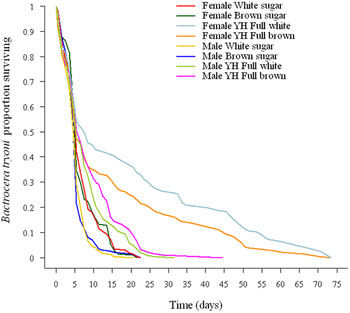
The CME model found a significant three-way interaction of sex × YH × sugar (likelihood ratio χ2=7.16, df=1, P=0.007) so the full model was retained. Summaries of fixed effects indicated highly significant effects of sex (z=2.75, P=0.006), and YH (z=−4.60, P<0.001) on the pattern of mortality (fig. 2). YH supplemented, white sugar-fed females had the lowest risk of mortality (fig. 2).
The survival of sterile male and female B. tryoni (Froggatt) over the duration of the high environmental stress cage trial when provided constant access to yeast hydrolysate (YH) and either brown sugar (YH Full brown) or white sugar (YH Full white), or sugar alone.

Examining particular days, on day 7 there was a significant effect associated with sex (F=17.6; df=1,24; P=0.003), provision of YH (F=15.7; df=1,8; P=0.0003) and a sex × YH interaction (F=10.69; df=1,24; P=0.003). Females supplemented with YH had a mortality of 51.39%, which did not differ significantly from the mortality of males supplemented with YH (54.25%). Both females and males supplemented with YH had significantly lower mortality than females fed sugar only (68.68%), which was in turn significantly lower than males fed sugar only (83.57%).
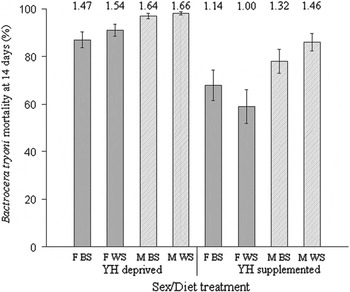
At 14 days there was a significant effect of YH (F=27.42; df=1,5; P=0.003), sex (F=58.23; df=1,24; P<0.001) and a sex × sugar interaction (F=4.39; df=1,25; P=0.046) on mortality (fig. 3). Compared with YH supplemented, white sugar-fed females (i.e., baseline control), YH-supplemented brown sugar-fed females had an increased risk of mortality (1.14 risk ratio).
The mean (logit) mortality of sterile male (M) and female (F) B. tryoni (Froggatt), fed either a yeast hydrolysate (YH) supplemented or deprived diet, YH and either brown sugar (BS) or white sugar (WS), or sugar alone after 14 days in a high environmental stress cage trial. The risk of mortality relative to the baseline (i.e., YH-supplemented, white sugar-fed females) is also given above each column.

At 21 days there was a significant effect of sex (F=50.59; df=1,24; P<0.001), YH (F=57.54; df=1,6; P<0.001), a sex × YH interaction (F=25.62; df=1,24; P<0.001) and a sex × sugar interaction (F=5.45; df=1,24; P=0.028). Male flies fed white sugar had higher mortality (98.64%) than females fed either white or brown sugar (mortality 91.53 and 94.51%, respectively), whereas male flies fed brown sugar (mortality 97.02%) differed only from female white sugar-fed flies. There was over 98.5% mortality for YH-deprived B. tryoni, under 75.8% mortality for female YH-supplemented B. tryoni and under 95.1% mortality for male YH-supplemented fruit fly.
Field releases
In the open field, cue-lure baited traps had a higher probability of capturing YH-supplemented flies than YH-deprived flies with 1.2 YH-supplemented flies trapped for every YH-deprived fly trapped (predicted relative probability of capture, 0.54 and 0.46 flies/trap, respectively). While mean captures did not vary significantly with release date, the least variable results were from the third release with the probability of trapping YH-fed flies 0.54±0.014 (mean±SE) compared with 0.52±0.037 and 0.62±0.047 for release 1 and 2, respectively.
Overall, of the estimated 1.3 million sterile flies released (rate of fliers) at the release sites (0.48, 0.37 and 0.45 million for release 1, 2 and 3, respectively), 1581 YH-supplemented and 1431 YH-deprived flies were recaptured. In release 1, 102 YH-supplemented and 90 YH-deprived flies were recaptured with comparable numbers of fliers released for both treatments; in release 2, 74 YH-supplemented and 46 YH-deprived flies were recaptured with 10% more fliers released for YH supplemented than for YH deprived; in release 3, 1405 YH-supplemented and 1295 YH-deprived flies were recaptured again with comparable numbers of fliers for both treatments. Recapture of YH-supplemented flies was 0.240±0.0061% of all flies released, comprised 0.043±0.010% flies for release 1, 0.040±0.010% flies for release 2 and 0.64±0.010% flies for release 3. For YH-deprived flies the recapture rate was 0.217±0.0061% of all flies released, comprised 0.038±0.010% flies for release 1, 0.028±0.010% flies for release 2 and 0.586±0.010% flies for release 3.
Quality of released flies
Quality control
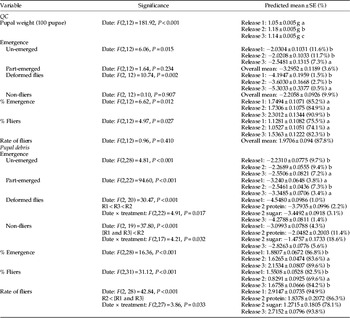
Release 1 and 2 had the highest and lowest pupal weights (per 100 pupae), respectively (table 1). Release 3 had greater emergence and fliers than release 1 and 2 and fewer emergence abnormalities (part-emerged and deformed flies) than release 2.
Quality control (QC) and pupal debris sampling data for B. tryoni (Froggatt) over three releases, October 2008 (release 1), January 2009 (release 2) and March 2009 (release 3) in Wagga Wagga, New South Wales. For emergence and flight variables, logit scale predicted means, which are followed by the same letter are not significantly different from one another (P>5%) when tested on the logit scale. Pupal weight was not transformed for analysis.

Pupal debris
Release 1 and 3 had higher emergence, fliers and rate of fliers than release 2. Release 3 had fewer un-emerged and part-emerged adults than release 1 and 2; however, release 1 had the least deformed adults, followed by release 3, with release 2 showing the highest number of deformed adults.
Discussion
The present study demonstrates an effect of pre-release diet on abundance of sexually mature sterile male B. tryoni under semi-field and field conditions. In the cage study that was carried out under comparatively benign conditions, no effect of diet was evident, although overall females lived longer than males. In the cage study that was carried out under more challenging conditions, the incorporation of YH in the adult diet increased longevity; YH-fed flies had lower mortality than their YH-deprived counterparts at 7, 14 and 21 days. YH-fed females had greater survival than males after 14 and 21 days. While laboratory and field cage experiments in the present study and in previous studies have provided a compelling case for consideration of YH supplementation in SIT programmes, such research does not adequately emulate operational conditions, requiring too great an inferential leap to provide a sound basis for operational decisions. Field studies have been needed to establish whether the benefits of YH observed under controlled and contained conditions persist in the field. In the present study, the higher in-field trap recapture rates of YH-fed sterile adult male B. tryoni provide strong support for pre-release YH supplementation as part of an SIT programme.
While there have been numerous studies of fertile flies, only two prior studies have investigated the effects of YH supplementation on longevity of sterile B. tryoni; Pérez-Staples et al. (Reference Pérez-Staples, Prabhu and Taylor2007) and Reynolds & Orchard (Reference Reynolds and Orchard2011). Pérez-Staples et al. (Reference Pérez-Staples, Prabhu and Taylor2007) reported that when both sugar and YH was available in the diet, sterile and fertile flies had similar longevity, but when only sugar was available sterile flies had substantially lower longevity than fertile flies. Reynolds & Orchard (Reference Reynolds and Orchard2011) compared YH-supplemented chilled adult B. tryoni with YH-supplemented non-chilled flies, YH-deprived chilled, and non-chilled flies, and found no evidence overall of longevity varying with fly diet, except in one trial where YH-supplemented females survived the longest. Taylor et al. (Reference Taylor, Perez-Staples, Weldon, Collins, Fanson, Yap and Smallridge2013) postulated that YH supplementation might increase the survivorship of sterile males significantly more than females, although this was not apparent in either of our outdoor cage experiments. However, given males have a lower dietary requirement for YH than females (Drew, Reference Drew1987; Pérez-Staples et al., Reference Pérez-Staples, Prabhu and Taylor2007, Reference Pérez-Staples, Weldon, Smallridge and Taylor2009, Reference Pérez-Staples, Weldon and Taylor2011), it may be feasible to reduce the pre-release period in which sterile B. tryoni are provided with dietary YH, or to constrain availability through dilution, to a point where female survival is less than male survival. Male-only release is frequently more effective than dual sex releases at inducing reproductive failure in wild tephritid populations (McInnis et al., Reference McInnis, Tam, Grace and Miyashita1994; Rendón et al., Reference Rendón, McInnis, Lance and Stewart2004; Orozco et al., Reference Orozco, Hernandez, Meza and Quintero2013). This is because in male only releases, there are only wild females to copulate with and no competing sterile females. Thus, if it was possible to reduce the quality of sterile females, then dual sex releases, such as those currently used for B. tryoni, may function similarly to those of male only releases. Indeed, a recent study demonstrated that providing YH for 48 h after adult eclosion led to an increase in reproductive development and sexual performance of male B. tryoni (Pérez-Staples et al., Reference Pérez-Staples, Weldon and Taylor2011). In contrast, females provided the same supplementation had poorly developed ovaries and, especially at younger ages, were less likely to mate than males (Pérez-Staples et al., Reference Pérez-Staples, Weldon and Taylor2011).
In the cages that were maintained in a stressful environment, overall it was evident that the largest increase in mortality occurred when the flies were aged 5 days, when the maximum daily temperature approached 48 °C and humidity was at its lowest throughout the trial. The higher longevity of YH-supplemented flies suggests that nutrients obtained from YH can play a significant role in long-term survival, and in particular stress tolerance. The type of sugar (brown or white) had no significant bearing on longevity until 14 days and the effects observed differed between the sexes. There was a weak tendency for females to suffer higher mortality when fed brown sugar and males vice versa (i.e., higher mortality when fed white sugar). Unlike white sugar, which contains only cane sugar (100 g total carbohydrate (sugars) per 100 g and <0.25 mg sodium per 100 g), brown sugar contains cane sugar and a concentration of natural syrups (98 g total carbohydrate (per 100 g) and <0.5 mg sodium per 100 g) (http://www.csrsugar.com.au/; accessed 2 September 2013). The slight amounts of additional nutrition available in brown sugar may not be sufficient to yield a substantial effect.
In the present study, we evaluated recapture of sterile male B. tryoni in cue-lure baited traps in the field, and found that YH-fed flies were trapped at a higher rate than YH-deprived flies. Only sexually mature male B. tryoni are attracted to cue-lure baited traps (Weldon et al., Reference Weldon, Pérez-Staples and Taylor2008) and, thus, recapture rates of YH-fed flies reflect the combined effects of survivorship and sexual maturation. However, over time it might be expected that the YH-deprived sterile flies would find adequate nutrition in the field and mature to a point where they would be recaptured as often as YH-fed flies. Male B. tryoni have a lower nutritional requirement than females (Drew, Reference Drew1987; Pérez-Staples et al., Reference Pérez-Staples, Weldon and Taylor2011), and are therefore more likely to obtain sufficient nutrition to complete reproductive development after release in the field. However, YH-deprived flies did not catch up with YH-fed flies over time in the present study, raising the question of whether this effect reflects early mortality of YH-deprived flies or failure to find sufficient nutrition (especially protein) in the field to complete development. Results of the high environmental stress cage study point to early mortality as a likely explanation; as early as 7 days after release in the cages, mortality of YH-deprived sterile flies was higher than YH-fed sterile flies. In the Mediterranean fruit fly, C. capitata, under natural conditions where ample food is available, Gavriel et al. (Reference Gavriel, Gazit and Yuval2010) concluded that sterile male fly survival is unaffected by pre-release YH supplementation. They showed that the supplementation of YH to the sterile-male diet did not affect survival after 4, 6 and 7 days. Furthermore, Gavriel et al. (Reference Gavriel, Gazit and Yuval2010) found no diet-related effect on fly survival, measured by similar numbers of YH-fed and YH-deprived flies recaptured in trimedlure traps after 4 and 7 days. Earlier, Shelly & McInnis (Reference Shelly and McInnis2003) had also concluded that YH had little effect on the survival of two sterile C. capitata strains in a field cage after 4 days. There have been very few field studies that have sought to validate such laboratory and field cage studies comparing the trap recapture of YH-fed and YH-deprived flies. Shelly & Edu (Reference Shelly and Edu2008) endeavoured to confirm laboratory and field cage studies by comparing the short-term dispersal from a central release point of sterile C. capitata males, but found no significant difference between sterile males fed a sugar only diet compared to a sugar diet supplemented with YH in either the number or spatial distribution of recaptured flies.
In the present study, a comparison of overall recapture rates revealed that the first two releases had comparatively low recapture rates, up to 30 times less than the numbers recaptured in the final release, although trap recapture rates throughout the trial were within the range commonly observed for B. tryoni (Jackman et al., Reference Jackman, Bailey, Milton-Hine, Perepelicia, Jessup and Brewer1996; Perepelicia et al., Reference Perepelicia, Black, Bailey, Terras, Schinagl and Dominiak1997; Meats et al., Reference Meats, Duthie, Clift and Dominiak2003; Reynolds et al., Reference Reynolds, Smallridge, Cockington and Penrose2012). A similar scenario was observed when Reynolds et al. (Reference Reynolds, Smallridge, Cockington and Penrose2012) compared recapture rates of sterile flies in NSW and South Australia (SA) simultaneously. South Australia consistently recorded much lower recapture rates than NSW (for two different release methods), and although a number of possible factors were suggested, such as environmental conditions, reduced ability to locate food, and food scarcity, the cause of these differences remains unclear. In the present study, the differences were over time, as opposed to location. The environmental data recorded at Wagga Wagga during the present trial (Supplementary Fig. 1) revealed that release 2 recorded some of the highest temperatures and lowest relative humidity levels. Male B. tryoni recapture is negatively correlated with daily maximum, minimum and average temperatures, and it is believed that high temperatures lead to high mortality (Weldon & Meats, Reference Weldon and Meats2010). While this scenario is likely (our trial was not designed to directly compare climatic data with recapture rates), given that recapture rates were highest for release 3, with releases 1 and 2 comparable, it appears that other factors are likely to have played more of a role in recapture rates. In addition, although quality control data showed a similar trend to recapture rates (i.e., higher % emergence and % flight for release 3 compared with release 1 and 2; table 1), the pupal debris sampling revealed that flies from release 1 and 3 had significantly higher emergence and flight compared with release 2. However, what is apparent is that flies from release 3 were from a younger generation than flies from release 1 and 2. It is recognized that within several generations laboratory colonies can undergo changes or become adapted to the mass-rearing environment (Gilchrist et al., Reference Gilchrist, Cameron, Sved and Meats2012) and it is possible that this may lead to reductions of several traits including longevity and stress resistance (Miyatake, Reference Miyatake1997; Hoffmann et al., Reference Hoffmann, Hallas, Sinclair and Partridge2001) upon release.
A previous study has shown that YH-supplemented B. tryoni are more vulnerable to starvation when food becomes scarce (Taylor et al., Reference Taylor, Khan, Collins and Reynolds2013 a ). We might therefore expect in the present study a greater impact of starvation on YH-supplemented flies than YH-deprived flies. Two scenarios are therefore possible. YH supplementation had no adverse effect under field conditions on starvation survival of flies. Food scarcity is therefore not likely under this scenario. The other possible scenario is that a higher number of YH-fed flies starved, but their increased maturation rate more than compensated for this compared with their YH-deprived counterparts. It is an extreme assumption that flies will not find nutrients in nature (Haq et al., Reference Haq, Ca´ceres, Liedo, Soriano, Jessup, Hendrichs, Teal and Robinson2013) and indeed, sterile flies have demonstrated the capability to forage for resources. It has been shown that C. capitata regularly need to and are capable of obtaining new resources in the environment to be able to participate in energetically costly lekking and courtship activities (Maor et al., Reference Maor, Kamensky, Shloush and Yuval2004). In the present study, a likely explanation for the difference in recapture rates between releases remains elusive.
Although we have only considered YH as a nutritional supplement for B. tryoni to enhance the effectiveness of the SIT, there are other food supplements and treatments that have shown benefits for a range of fruit flies, including bacterial (Drew et al., Reference Drew, Courtice and Teakle1983) and probiotic diets (Ben Ami et al., Reference Ben Ami, Yuval and Jurkevitch2010), phenylpropanoids and synthetic analogues (Shelly & Dewire, Reference Shelly and Dewire1994; Tan & Nishida, Reference Tan and Nishida1995; Wee et al., Reference Wee, Tan and Nishida2007), juvenile hormone analogues (Faria et al., Reference Faria, Pereira, Dellinger and Teal2008; Collins et al., Reference Collins, Taylor and Reynoldsin press), access to fruits (Aluja et al., Reference Aluja, Jácome and Maćias-Ordóñez2001) and aromatherapy (Shelly, Reference Shelly2001; Shelly et al., Reference Shelly, McInnis, Pahio and Edu2004). All of these interventions seek to enhance male sexual performance through accelerated maturation, sexual advantage, increased mate attraction and increased mating success and warrant further investigation. The choice of white or brown sugar for sterile adults also warrants further study.
Although a single previous study on B. tryoni showed that sterile male survival is increased by YH in the pre-release diet (Pérez-Staples et al., Reference Pérez-Staples, Prabhu and Taylor2007), this required open field validation. As the inclusion of YH to the adult diet enhances male mating success (Pérez-Staples et al., Reference Pérez-Staples, Prabhu and Taylor2007, Reference Pérez-Staples, Weldon, Smallridge and Taylor2009) and, as shown here, improves persistence and abundance of sexually mature male B. tryoni in the field, results of the present study support the supplementation of the pre-release diet with YH as a means of improving the effectiveness of B. tryoni SIT programs.
Supplementary material
The supplementary materials for this article can be found at http://www.journals.cambridge.org/BER
Acknowledgements
We thank Vincent van der Rijt and Scott Clark for providing technical assistance and Peter Gillespie and Rosy Kerslake for identifying different dye-coloured adult B. tryoni. Mark Stevens is thanked for comments on an earlier draft. Two anonymous reviewers are also thanked for providing useful comments on the manuscript. This project was facilitated by Horticulture Australia Ltd in partnership with industry.