INTRODUCTION
The most efficient and cheapest way of conserving rainfall is to conserve where it falls. Evaporation loss can be reduced greatly if rainfall is stored in soil to make it readily available to plants rather than in structures with a free water surface. Such methods are economically feasible to resource poor farmers (Gebre and Georgis, Reference Gebre and Georgis1988). The results on soil moisture recharge, moisture use patterns, and soil moisture–corn yield relationships indicated the critical dependence of the crop on stored soil moisture (Holt et al., Reference Holt, Timmons, Voorhees and Van Doren1964). For the north eastern region (NER) of India, there is always a high degree of erosion associated with the practice of agriculture and utmost care is an important precaution, even for the normal operations required for cultivation. Further, in NER, according to the land capability classification, there are no class I and class II land; little of class III and some class IV lands are used for cultivation (Satapathy, Reference Satapathy, Bhatt, Bujarbaruah, Sharma and Patiram2003). The normal practice of the region is monocropping because of severe water shortage during November to April (winter season). Water-harvesting, moisture conservation, and prevention of soil erosion, especially in hill areas are of crucial importance for the realization of the agricultural potential and for ensuring double cropping. As such, agronomic measures to conserve soil moisture are very much suitable in the region because of their low-cost and capabilities to reduce soil erosion. The residual moisture in soil can be utilized better by adopting suitable practices like minimum tillage (Gupta and Gupta, Reference Gupta and Gupta1986) and zero tillage (ZT; Jat et al., Reference Jat, Gathala, Ladha, Saharawat, Jat, Kumar, Sharma, Kumar and Gupta2009), which, in combination with mulching is also beneficial for soil conservation, besides increasing productivity.
Tillage reduces bulk density (BD) and increases aeration and porosity (Pratibha et al., Reference Pratibha, Pillai and Satyanarayana1998) which in turn, helps in conserving water efficiently (Feng et al., Reference Feng, Huang, Yu, Chai, Tao and Li2009; Jaggi, Reference Jaggi1987). In addition to soil moisture changes, tillage may affect other soil physical and chemical properties. Changes in soil chemical properties brought about by tillage can affect crop yield and crop responses to tillage (Bauer and Kucera, Reference Bauer and Kucera1978).
One of the components of conservation tillage is no-till (NT) or ZT, wherein, a new crop is planted on the residue of the previous crop without any prior tillage or seedbed preparation and is usually possible when all weeds are controlled by the use of herbicides. NT agriculture is considered as an innovative step in preventing land degradation and rehabilitation of the fragile lands (Kasam, Reference Kasam2011). Studies conducted in varied ecologies of South Asia have revealed potential benefits of conservation-agriculture-based crop management technologies on resource conservation, use-efficiency of external inputs, yield enhancement, soil health improvement and adaptation to changing climate (Gupta and Seth, Reference Gupta and Seth2007).
Besides tillage, mulching is also a common practice for conserving soil moisture. Generally, crop residues are used as mulch. The practice of mulching has been widely used as a management tool in many ancient civilizations. The Great Plains region of USA, which was once considered a dust bowl, has been turned into the granary of the world through the adoption of surface stubble or flattened straw mulch (Acharya et al., Reference Acharya, Hati, Bandyopadhay, Hillel, Rozenzweig, Pawlson, Scow, Sorger, Sparks and Hatfield2005). Mulching has a buffering effect and it dampens the influence of negative environmental factors on soil (Bristow and Abrecht, Reference Bristow and Abrecht1989). The magnitude of the buffering effect depends on the quality, quantity and durability of the mulch material.
Mulches improve the physical condition and fertility of the soil, check runoff and soil erosion, increase infiltration (Ghosh et al., Reference Ghosh, Dayal, Bandyopadhay and Mohanty2006), help in maintaining soil temperature, impede movement of water vapour (evaporation) from soil to air, check weed growth and thereby, reduce transpiration loss of water (Blevins and Frye, Reference Blevins and Frye1993), develop high humidity within the residue mulch (Phillips, Reference Philips, Phillips and Phillips1984) and reduce the kinetic energy of impacting rain drops on the soil surface and thus, reduce soil compaction and aggregate disintegration (Mbagwu, Reference Mbagwu1991).
The use of in situ soil moisture conservation practices represents great diversity in physical and chemical conditions and other natural phenomena which ultimately affects the crop growth and performance. In dry season when crops were grown on residual moisture, tillage causes greater loss of water through evaporation from the soil (So and Ringrose-Voase, Reference So and Ringrose-Voase1996), thus ZT plays an important role in conserving moisture in the soil (Tanaka and Anderson, Reference Tanaka and Anderson1997). The high moisture in ZT was attributed to more infiltration and existence of more continuous pore system from dead roots and worms (Guzha, Reference Guzha2004).
In view of the above facts and considering the need for low-cost technology for wider adoption by the farmers, maize stalk and local weed biomass were evaluated for their role as a component of in situ soil moisture conservation. In NER, maize stalks are not used as fodder for animals and are usually burnt, in or outside the fields. Similarly, during rainy season, Ambrosia artemisiifolia, a weed (shrub) available in plenty and found around cultivated areas or roadsides which are of luxuriant growth, obnoxious in nature and difficult to control.
The objective of the present study was (i) to compare the crop productivity under ZT and conventional tillage (CT) and (ii) to study the interaction effect of tillage and mulching measures on productivity of maize and toria. The hypothesis tested was ‘ZT and residue mulching interact positively to conserve soil moisture and gives higher crop productivity especially during dry season than that of CT and residue removal’.
MATERIAL AND METHODS
Experimental site
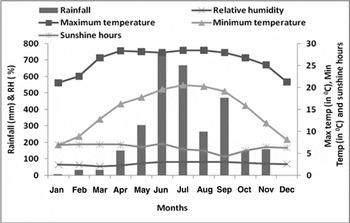
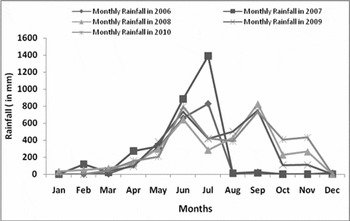
The present investigation was carried out at the Research Field of the Indian Council of Agricultural Research (ICAR), Research Complex for NEH region, Umiam, Meghalaya, India, from 2006–10, which was located at a latitude of 26°41′N and longitude of 91°54′E and an elevation of 980 m above mean sea level. The climate of the region as a whole is sub-tropical humid hot summer and cold winter. Normally, the monsoon season starts from the month of June and extends up to the month of September and the rainfall is less from the month of October. November to April is generally dry period in the region. The average temperature, relative humidity and sunshine hours at the experimental site from 2006 to 2010 have been depicted in Figure 1 and the monthly rainfall received from 2006 to 2010 and their average have been depicted in Figure 2.
Average monthly weather parameters at Umiam during 2006–10.

Monthly rainfall pattern during 2006–10 at Umiam, Meghalaya.

Treatment details
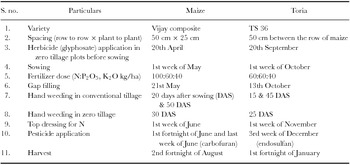
Maize stalk and Ambrosia were used as mulching materials. Farmyard manure (FYM) and poultry manure (PM) were also used for comparison. The experiment was laid out in a split-plot design with two tillage practices in main plots, six residue mulching measures in sub-plots and the treatment combinations replicated thrice. The main plot treatments were CT and ZT and sub-plot treatments were residue removal (control) – M0, maize stalk cover (MSC) – M, MSC + Ambrosia sp. 5 t/ha – MA5, MSC + Ambrosia sp. 10 t/ha – MA10, MSC + FYM 10 t/ha – MF10 and MSC + Ambrosia sp. 5 t/ha + PM 5 t/ha – MA5P5. The net plot size was 5 × 5 m2. The details of the inputs and cultural practices followed during the experimentation are given in Table 1.
Cultural practices followed in the study.

Maize was sown in last week of May with all the recommended agronomic practices. The biomass of Ambrosia sp. was applied between the rows of standing maize, 20 days before maize harvest in third week of August, as per treatment. After harvest of maize cob, the maize stalk was cut and spread vertically all over the field just above the applied Ambrosia sp. to form a MSC in the field. This way, the two layers of mulch (Ambrosia sp. and MSC) acted as ‘double mulch’. Toria (variety TS 36) was sown between the rows of maize by pushing maize stalk aside manually with an iron made fork in the first week of October. The maize stalks were placed back between the toria rows immediately after sowing and left as such in the field until the harvest of toria.
Ambrosia was collected from nearby areas like farm fences and wastelands. The plants were then weighed and applied in the field as per the treatment and evenly distributed along the row direction to cover the soil surface. Crops were sown directly using a manual NT drill. In CT two manual spading (to a depth of about 15 cm) followed by planking was given before sowing.
Soil moisture estimation
For periodical soil moisture estimation, soil samples from 0–15, 15–30, 30–45 and 45–60-cm depths were collected using a soil auger during each operation such as harvest of maize, application of Ambrosia sp., maize stalk cutting and at 15 days interval throughout the growth period of toria crop. The soil moisture content was determined by gravimetric method.
Yields
The crop from 16-m2 net area for each treatment was harvested and threshed separately. Grain and seed of maize/toria were sun dried to a constant moisture level of 14% and yields were recorded as t/ha. Similarly, stovers of maize and toria were sun dried and weight recorded as t/ha.
Statistical analysis
Data obtained from various studies were statistically analyzed in split plot design using the technique of analysis of variance. The differences between the treatment means were tested as to their statistical significance with appropriate critical difference (C.D.) value at 5% level of probability (p = 0.05). The interaction effects of year × treatments were performed using JMP 8.0 software.
RESULTS
Soil moisture
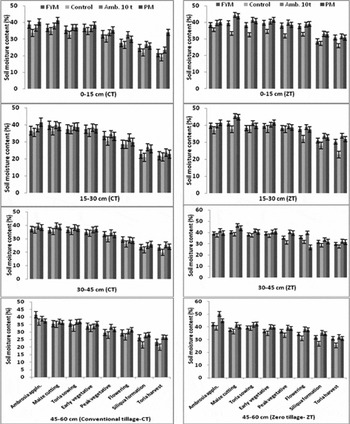
There existed a general trend of higher soil moisture content under ZT than CT. Soil moisture stock (Figure 5) up to 60-cm depth was the highest in the MA5P5 and MA10 irrespective of tillage, and the lowest was recorded under the control. The moisture content showed an increasing trend with increase in soil depth and was the highest at 45–60-cm depth.
Nutrient supply through mulching
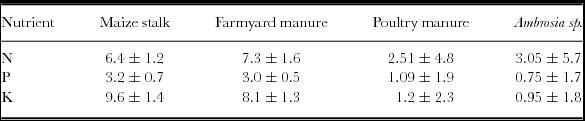
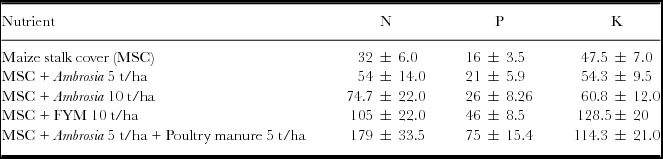
The nutrient concentrations and possible nutrient supplying potential of different mulching materials used in the study are presented in Tables 2 and 3. The N concentration was the highest in Ambrosia sp biomass followed by PM. Whereas, PM had the highest P content followed by Ambrosia sp. All the materials were rich in K (0.95 to 1.2 g/kg K). The nutrient concentrations when multiplied with respective mulch biomass under different treatments gave an assessment of their nutrient supplying potential (Table 3). The N supplying potential through mulching materials under different treatments ranged from 32 to 179 kg/ha. Similarly, P and K potential ranged from 16 to 75 kg and 47.5 to 128.5 kg/ha, respectively. MA5P5 had the highest N and P potential, whereas, MF10 had the highest K supplying potentials to the soil. Thus, in addition to conservation of soil moisture, various mulching materials have influenced soil nutrient status and crop productivity. However, unlike nutrients from inorganic fertilizers, macronutrients in crop residues are not readily available due to immobilization. Since recommended dose of fertilizer was also supplied to both maize and toria using synthetic fertilizers (urea, single super phospohate and muriate of potash were applied), the negative effect of immobilization was not observed to crops. Rather, applied fertilizer can have some beneficial effect on the mineralization of the mulching materials to make available additional nutrients to crops.
Nutrient content (g/kg) of the mulch inputs, pooled data (± standard deviation).

Nutrient supplying potential (kg/ha) of mulch inputs, pooled data (± standard deviation).

Toria seed yield
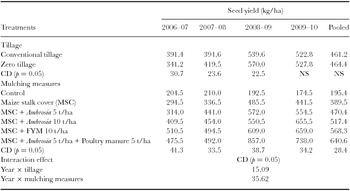
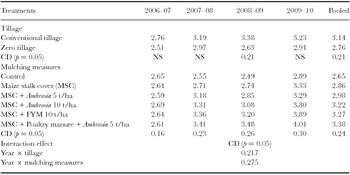
Tillage and residue mulching measures had significant effect on the seed yield of toria (Table 4). The seed yield of toria was higher under ZT than that under CT in all the years but 2006–07. In 2006–07, the productivity of toria was significantly higher under CT and in 2009–10, the productivity of toria under two tillage systems were not significantly different. However, the four-year average (pooled) yield of toria under CT and ZT was statistically similar.
Effect of tillage and residue mulching measures on seed yield of toria.

NS = not significant.
Among the mulching measures, MA5P5 recorded significantly higher toria productivity than those under other treatments in 2008–09, 2009–10 and pooled. MF10 and M10 were the next best mulching options which recorded significantly higher yield than those under other treatments. The four-year average toria productivity under MA5P5, MF10 and MA10 were 228, 191 and 165% higher than that under control, respectively.
In CT, MA5P5 and MA10 gave the highest and similar yield, while in ZT, MA5P5 was the best. The lowest yields under both the tillage systems were obtained from the control plots. Regarding the tillage options, ZT gave higher yield than CT except for first year, however, the effect was non-significant (Table 4). The interaction effects of year × tillage and year × mulching measures were significant on toria productivity. The toria productivity in 2008–09 under ZT was the highest which was at par with CT in the same year but was significantly higher than other years both under CT as well as ZT. Considering interaction effect of mulching and year, toria seed yield was significantly higher under MA5P5 in 2008–09 and 2009–10 compared to other years and mulching measures.
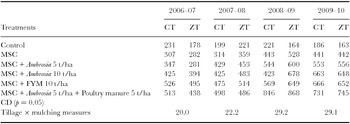
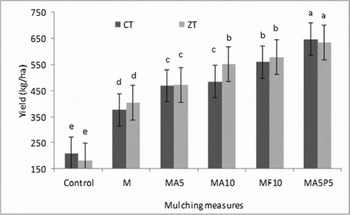
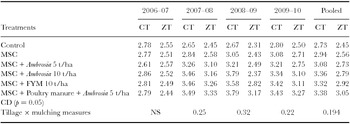
The interaction effects of tillage and residue mulching measures were also significant on toria yield (Table 5). The four-year average yield indicated that the residue mulching treatment MA5P5 recorded significantly higher yield under both CT and ZT than other mulching treatments (Figure 3). MF10 was the next best mulching option which recorded significantly higher yield than all other treatments but remained statistically inferior to MA5P5. MA10 and MA5 had equal effect on yield and were superior to M and control. Considering ZT, toria productivity under MA5P5, MF10, MA10, MA5 and M were 249, 218, 203, 160 and 122% higher than that of residue removal (control), respectively. A similar trend of mulch effect on toria yields was observed under CT. It is evident from the data in Table 7 that only due to retention of MSC (M), the yield enhancements were 80 and 122% higher than that of residue removal under CT and ZT, respectively. Under no residues (control), toria productivity under ZT was less than that under CT.
Interaction effect of tillage and mulching measures on toria seed yield (kg/ha).

CT = conventional tillage; ZT = zero tillage.
Interaction effect (four-year pooled data) of tillage and mulching measures on toria seed yield (kg/ha); bars with similar letters are not significantly different (p = 0.05).

Grain yield of maize
The tillage effects on maize productivity was non-significant for all the years except 2008–09 (Table 6) while the pooled yields for four years were significantly higher under CT compared to ZT. The four-year average maize productivity under CT was observed to be about 14% higher than that under ZT. Among the residue mulching measures, MA5P5 recorded the highest grain yield that remained at par with MF10 and MA10. The four-year average results revealed that the treatments MA5P5, MF10 and MA10 enhanced maize productivity by 27.5, 23.5 and 21.5% over residue removal (control). The interaction effects of year × tillage and year × mulching measures were significant on maize productivity. Maize productivity in 2008–09 under CT was significantly higher than that under ZT. The four-year average maize yield (pooled) under CT was also significantly higher than that under ZT. Considering interaction effect of mulching and year, maize yield was significantly higher in 2009–10 compared to other years and four-year average yield.
Effect of tillage and mulching measures on kernel yield (t/ha) of maize.

The interaction effects of tillage and mulching measures on maize yield were significant for all the years except 2006–07 (Table 7). The pooled maize yield was significantly higher in MA5P5 under CT which was at par with MF10 and MA5 but significantly superior to other mulching measures under CT and all the mulching measures under ZT. Considering CT, maize productivity under MA5P5, MF10, MA10, MA5 and M were 23.8, 21.6, 23, 13 and 8% higher than that under control. As soil moisture was not a constraint during maize season due to sufficient rain, the yield differences under various mulching measures were due to influence of organic materials on soil nutrient status and other soil properties.
Interaction effect of tillage and mulching measures on kernel yield of maize (t/ha).

CT = conventional tillage; ZT = zero tillage.
Economic studies
Cost of cultivation:
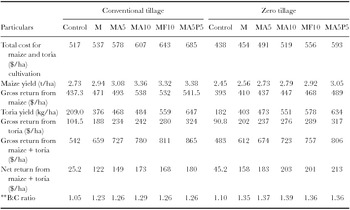
In general, the cost of cultivation was higher for CT than ZT, for both the crops (Table 8). The cost of cultivation was $516.6/ha and $ 438/ha for maize–toria system under CT and ZT, respectively, without any residue mulching measures (control). However, the cost of treatment imposition was found to vary for the tillage as well as residue mulching measures.
Economics of treatments as affected by tillage and residue mulching measures.

M – Maize stalk cover, MA5 – M+ Ambrosia 5 t/ha, MA5 – M+ Ambrosia 10 t/ha, MF10–MA5 – M+ farmyard manure 105 t/ha, MA5P5 – M+ Ambrosia 5 t/ha + poultry manure 5 t/ha.
**Benefit:cost ratio.
Gross return:
Values of gross return for the treatments under maize and toria are shown in Table 8. The gross return was found to be higher for CT than for ZT. The maximum gross return for the total system was obtained under the treatment MA5P5 ($865/ha) followed MF10 ($811/ha) under CT and MA5P5 under ZT ($805/ha). Minimum gross returns were recorded under the control for both the tillage options.
Net return:
In general the net returns were higher under ZT compared to that of CT irrespective of residue mulching measures (Table 8). The highest net returns of the maize–toria system were obtained from the MA5P5 ($212.5/ha) followed by MA10 ($203.2/ha) and MF10 ($201.0/ha) under ZT. The net returns obtained from these mulching options under CT were $179.9, $173.4 and $164.1/ha, respectively. Under both the tillage practices, residue removal (control) recorded the minimum net returns.
Benefit:cost ratio:
The benefit:cost ratio at the end of cropping cycle is presented in Table 8. In general, CT systems gave the benefit:cost ratios lower than that of ZT. The maximum benefit:cost ratio (1.39) for the maize–toria sequence was recorded in the treatment MA10 under ZT and the lowest (1.05) under control in CT. Under the CT systems, residue mulching treatment MA10 gave the highest B:C ratio (1.29).
DISCUSSION
Soil quality can be improved by sound residue management practices (Karlen et al., Reference Karlen, Wallenhaupt, Erbach, Berry, Swan, Eash and Jordahl1994). Returning crop residue as mulch can have synergistic effects with fertilizer use. Residues and manure used as mulch contain substantial quantities of plant nutrients. In the present study, the nutrient concentration in oven-dry tissue of residues ranged from 0.48 to 3.05% for N, 0.17 to 0.3% for P and 0.81 to 1.2% for K. The nutrient supplying potential for various mulching options in our study ranged from 32 to 79 kg N, 16 to 75 kg P and 47.5 to 128.5 kg K/ha, respectively. It is reported that on a dry weight basis, the major plant nutrients contained in 1 tonne of crop residue may range from 15 to 60 kg of N, P and K (FAO, 1990). Crop residue mulches with low C:N ratios have more beneficial effects than those with high C:N ratios (Schoningh and Alkamper, Reference Schoningh and Alkamper1984). Long-term application of crop residue increases soil organic matter (SOM), total N, availability of several nutrients in soils. Only a small fraction of P in the residue is available to crop in the first year and rest is immobilized as microbial biomass (Stevension, Reference Stevension1986). Crop residues contain large amount of K which upon incorporation increases K availability in soil and helps to reduce K depletion from non-exchangeable K fraction to soil (Chattterjee and Mondal, Reference Chatterjee and Mandal1996).
Surface retention of crop residues increases N uptake and yield (Mandal et al., Reference Mandal, Misra, Hati, Bandyopadhyay, Ghosh and Mohanty2004). Though residues incorporation leads to immobilisation of inorganic N, addition of 15–20 kg N with straw incorporation increases the yield of cereal crops. NT in particular can complicate manure application and may also contribute to nutrient stratification within soil profile from repeated surface applications without any mechanical incorporation (NAAS, 2012). Thus, in the present study, application of recommended fertilizer N (100 kg to maize and 60 kg to toria) through urea may have enhanced the mineralization of various mulching materials to release nutrients to soil.
Total N incorporated into residues amounts to approximately one-third of the total amount taken up by crops (Smil, Reference Smil1999). Crop residues incorporate almost 30% of all P taken up by crops and approximately 65% of all K. Complete recycling of residues and their eventual mineralization would supply approximately 30% of the N, between 20–30% of the P, and more than 100% of the K applied in inorganic fertilizers (Smil, Reference Smil1999). This supports the hypothesis that mulching in addition to conserving soil moisture also contributes to soil fertility and plant nutrition.
The beneficial effects of returning crop residue as mulch on crop yields are due not only to the recycling of plant nutrients but also to improvements in soil moisture and temperature regimes, enhancement of soil structure and erosion control. Residue-covered soils tend to have greater soil moisture content than bare soil except after extended drought. Compared with an unmatched control, crop yields were improved with any mulch material (Okigbo and Lal, Reference Okigbo and Lal1980). Mulching increased tuber yield by 20% on an acid soil in eastern Nigeria (Maduakor et al., Reference Maduakor, Lal and Opare-Nadi1984). Linear increase of soil organic N with higher returns of crop residues has been reported (Campbell and Zentner, Reference Campbell, Zentner, Paul, Elliott, Paustian and Cole1997).
Nutrients in crop residues are not readily available to crops. The high cellulose and lignin content of crop residues precludes rapid degradation, particularly in colder climates. In addition, the high C:N ratios of crop residues – which commonly range from 50 to 150 – are higher than those of fresh leafy phytomass (12–15 for grasses) or animal manure (typically 15–25). Biomass with C:N ratios below 20 will fairly rapidly release net N for plant growth; in contrast, the decomposition of high C:N ratio residues will actually withdraw N from the soil, temporarily immobilizing the nutrient during the early stages of decay and thereby reducing the short-term productivity of the soil. The pattern of P immobilization is similar to that of nitrogen. The C:N ratio of maize stalk is about 55, thus, resist easy decomposition (FAO, 1990). Application of N fertilizer speeds up the mineralization by narrowing down the C:N ratio (Schomberg et al., Reference Schomberg, Steiner and Unger1994). Thus, in the present study, application of recommended dose of fertilizer N to maize and toria helped in narrowing down the C:N ratio of mulching materials and facilitated slow but steady release of nutrients to crops.
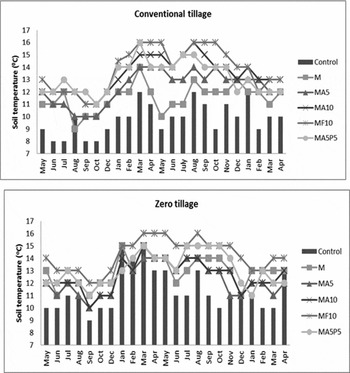
In our study, soil temperature in toria (winter season) was relatively higher under mulching than residue removal. On an average, soil temperature enhanced by 2–5 °C due to various mulching treatments (Figure 4). The soil temperature under MF10 was maximum followed by MA10 and MA5P5 irrespective of tillage. The presence of mulch barrier acted to moderate the soil thermal regime and increase the soil temperature that favoured the growth of plants. This ability of mulch to moderate the soil thermal regime was reported in many studies (Acharya et al., Reference Acharya, Hati, Bandyopadhay, Hillel, Rozenzweig, Pawlson, Scow, Sorger, Sparks and Hatfield2005; Ghosh et al., Reference Ghosh, Dayal, Bandyopadhay and Mohanty2006).
Soil temperature as affected by tillage and residue mulching measures.

The residue mulching measures also helped to improve the soil moisture (Figure 5). The results from the experiment showed that the combined use of MSC + Ambrosia 5 t/ha + PM 5 t/ha (MA5P5) was the most efficient soil moisture conservation measure, followed by MF10 and MA10. In general, ZT had higher soil moisture than CT (Figure 5). This may be due to the higher infiltrability of the soil surface as well as the undisturbed structure of the soil. The even distribution of the mulch over the soil surface of the ZT plots might have acted as a barrier to overland flow, reduce the flow velocity, preventing splash erosion that could cause blockage to the pores and also reduced the moisture loss from the soil, whereas, in CT, the existence of ridges and furrows made during earthing up of maize, inhibited the uniform coverage of the soil surface by the mulches. There was no significant difference in root penetration resistance of the CT and ZT up to a depth of 30 cm, but beyond 30-cm soil depth, it was more under CT. This could have resulted from the higher BD and compaction in the CT plots compared to the porous soil under ZT.
Soil moisture (%) at different growth stages of toria as affected by tillage and residue mulching measures (the vertical bars are standard error).

Soil moisture storage decreases from ZT to mulch tillage and finally to CT system (Josa and Hereter, Reference Josa and Hereter2005). It was also reported that ZT with mulching proved better in the long term (Sharma et al., Reference Sharma, Singh and Dhyani2005). In sandy loam soil, relatively higher moisture content at all stages of mustard (Brassica juncea) grown after Sali (rainy season) rice was observed under ZT with other stubble mulching over CT of four ploughings with country plough (Baruah, Reference Baruah1994). Yield increase due to mulch application primarily attributed to greater water conservation. The link between crop residue management and tillage to increase yield of crops attributed to enhanced stored water with mulch application (Brown, et al., Reference Brown, Cruise and Colbin1989; Mesfine et al., Reference Mesfine, Abebe and Al-Tawaha2005). On the other hand, various results have been reported of enhanced stored water with the mulch application without being reflected to bring higher grain yield as the result of many reasons like poor seedling establishment at early growth stage and other factors for zero tillage (Griffith et al., Reference Griffith, Mannering, West and Parsons1988). In an acid Alfisol (typic Hapludalf) in north-west India, application of fresh lantana (Lantana camara L.) biomass as mulching during standing crop of maize was most effective in conserving rainwater and enhancing productivity of succeeding wheat crop (Sharma and Acharya, Reference Sharma and Acharya2000).
In the case of maize yield, the effect of residue mulching measures was significant in all the four years of experimentation whereas, the tillage effect was significant only during 2008–09 and for pooled yield. The four-year pooled yield was significantly higher under CT compared to ZT (Table 6). Higher yield of maize under CT in maize–mustard system from a three-year study has been also reported by Saha et al., (Reference Saha, Chakraborty, Sharma, Tomar, Bhadraray, Behera, Purkayastha, Garg and Kalra2010). In contrast, toria yield was significantly affected due to residue mulching measures and tillage. The increased yield of the crops under residue mulching is a direct indication of the efficiency of the practices to effectively conserve and improve the water available to the crops and also to improve the water use efficiency (WUE).
Among the residue mulching measures, MA5P5 gave the highest yield of maize followed by MF10, MA10 and MA5. Similar results were also obtained by Awasthi et al. (Reference Awasthi, Singh and Dubey2007) and Rao and Shaktawat (Reference Rao and Shaktawat2002). The higher maize yields have been brought about by the higher test weight, large cob diameter combined with comparatively longer cobs, resulted from the improved uptake of nutrients. The lowest yield was realized from the control plots where the combination of small cobs, low shelling percentage and low test weight reduced the yield, mainly due to low soil moisture and soil temperature.
The practice of in situ moisture conservation viz. tillage and residue mulching greatly increased the productivity of toria crop. Regar et al. (Reference Regar, Rao and Joshi2007) also reported similar findings. In the present study, it was observed that from second year onwards, the productivity of toria was non-significantly higher under ZT compared to CT. However, the average productivity was non-significantly higher under CT. A similar trend was reported by Kumar (Reference Kumar2000) from his work on wheat crop. Sharma and Acharya (Reference Sharma and Acharya2000) reported that conservation tillage + mulch produced significantly higher wheat yield (1.93–2.84 t/ha) than CT + mulch (1.58–2.62 t/ha) from the third cropping cycle onwards.
Besides tillage, the residue mulch treatments also improved the yield of the crop indicating a positive effect on yield by the mulching material as well as the interaction of mulch and tillage. Among the treatments, MA5P5 gave the highest yield, followed by MF10, MA10 and MF10. The lowest yield was recorded in the control plots. This could be ascribed to the improved soil profile moisture storage (Figure 4), physico-chemical properties as well as the available nutrient status of the soil, which facilitated in maintaining a steady supply of nutrients throughout the crop growth to obtain higher seed yield of toria (Kuswanha et al., Reference Kuswanha, Tripathi and Singh2001)
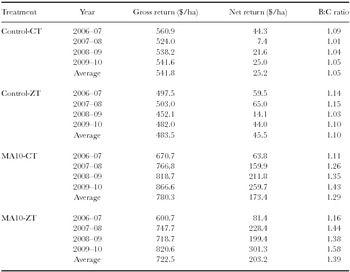
Economic evaluation of the treatments for the maize–toria system was done on the basis of gross return, net return and benefit: cost ratio. In general gross returns were higher under CT compared to ZT. Whereas, a reverse trend was observed as regards to net returns. The overall performance on the basis of B:C ratio was found best in case Ambrosia 10 t/ha (MA10). The treatments involving only Ambrosia mulch were observed to have higher B:C ratio because of the minimal cost involvement in Amrosia mulch than those of other biomass such as FYM and PM. The overall B:C ratios were found to be better under ZT than CT. Higher B:C ratio under ZT than CT was due to low cost of cultivation owing to avoidance of tillage operations.
Comparison of two mulching options, control versus MA10, under CT and ZT as regards to economics is presented in Table 9. The gross returns for maize–toria system were mulch higher under control-CT and MA10-CT than those observed under control-ZT and MA10-ZT. In contrast, net returns and B:C ratio were higher under ZT than that under CT. Within CT and ZT, the four-year average data indicated that gross returns and net returns due to MA10 were 44 and 49% and 588 and 346%, respectively higher than that under control. The B:C ratio over the years were much higher under ZT and MA10 than the residue removal (control) and CT. Thus, the study clearly and consistently proved the role of mulching in achieving higher productivity and economic returns from maize–toria system.
Year wise economics of resiue removal and Ambrosia mulching under CT and ZT.

CT = conventional tillage, ZT = zero tillage, MA10 = Maize stalk cover + Ambrosia 10 t/ha.
CONCLUSIONS
Our four-year results indicated that, the seed yields of maize and toria were almost similar under ZT and CT. The net returns were higher under NT than that under CT. The double mulching with MSC and Ambrosia is an innovative approach for soil moisture conservation and enhanced yield of dry season crop (toria) by 99 to 228% over residue removal (control). Hence, ZT with residue mulching is a recommendable option for moisture conservation, improved soil health and higher return in northeast Indian Himalaya and other similar high rainfall hill ecosystems.