Personal protective equipment (PPE) is an essential component of a multifaceted infection prevention and control strategy to prevent transmission of severe acute respiratory coronavirus virus 2 (SARS-CoV-2) in healthcare settings. 1 Early in the coronavirus disease 2019 (COVID-19) pandemic, high rates of healthcare personnel (HCP) infections occurred in part due to inadequate PPE availability and unknowns in disease transmission. Reference Wang, Zhou and Liu2 PPE supply has since stabilized and understanding of disease transmission has improved; however, HCP risk remains elevated due to the continued occupational exposure to patients with COVID-19.
In healthcare settings, transmission of SARS-CoV-2 to HCP may occur from patients, visitors, or coworkers. To mitigate this spread, national and international societies have adopted recommendations for rapid diagnosis and isolation of patients with COVID-19. Reference Islam, Rahman and Sun3 Given that transmission may also occur when PPE is not utilized because patients are not suspected of having COVID-19, universal PPE is recommended for all HCP. Reference Heinzerling, Stuckey and Scheuer4
Despite preventive measures, HCP also sustain occupational exposures when lapses in PPE occur during the care of patients with COVID-19. Information regarding the impact of PPE lapses on patient-to-HCP transmission of SARS-CoV-2 is limited. Thus, we sought to identify PPE-related factors associated with disease transmission to HCP from SARS-CoV-2 exposures at our tertiary-care center in Minnesota.
Methods
We conducted a retrospective review of all reported patient-to-HCP exposure incidents occurring at Mayo Clinic in Rochester, Minnesota. Universal face mask and eye protection policies for HCP were instituted on April 1, 2020, and May 13, 2020, respectively. Patients were screened for symptoms of COVID-19 upon institutional entry. Patients admitted to the hospital were evaluated for SARS-CoV-2 by reverse transcriptase polymerase chain reaction (RT-PCR). Positive or suspected cases were admitted to designated COVID-19 units under isolation precautions, where the recommended PPE included a face mask, eye protection, gown, and gloves. Appropriate eye protection included use of a face shield, protective wraparound eye wear, or a polycarbonate face shield or helmet. Eyeglasses without wraparound features were not considered to confer adequate eye protection and thus were not part of PPE. HCP were advised to disinfect re-usable equipment, including eye protection after doffing using standard disinfection practices. Use of a respirator (eg, N95 respirator, powdered air-purifying respirator, or controlled air purifying respirator) was required for an aerosol-generating procedure (AGP). HCP were trained on best practices for PPE use. COVID-19 units were defined as units that routinely provide care for patients with COVID-19, including the emergency department, medical ICU, general medical wards, obstetrics suite, and radiology.
Exposures to COVID-19 were evaluated by occupational health services staff based on guidance from the Centers for Disease Control and Prevention (CDC) (Table 1). A 14-day postexposure quarantine period was used throughout the study for HCP. Shorter quarantine options presented by the CDC in December 2020 were not endorsed by state public health authorities for healthcare workers in Minnesota. 5 After a significant exposure, HCP were tested between 12 and 15 days, and earlier if symptoms occurred. Each reported exposure incident and related exposure assessments were documented in an electronic contact tracing system designed to capture salient exposure characteristics including exposure source, type, and location, exposure risk level, quarantine dates, RT-PCR test results, and elements of PPE worn by the HCP. Data were collected through electronic tools within the contact tracing system or through interviews conducted by providers. Reference Breeher, Boon, Hainy, Murad, Wittich and Swift6 Exposure and demographic data, including age, gender, role, and work unit were abstracted from this database.
HCP Risk Level of Exposure and Plana

Note. HCP, healthcare personnel; PPE, personal protective equipment; AGP, aerosol-generating procedure; RT-PCR, reverse-transcriptase polymerase chain reaction.
The Fisher exact test and the Student t test were used for statistical analyses. This study was deemed exempt from approval by the Mayo Clinic Institutional Review Board.
Results
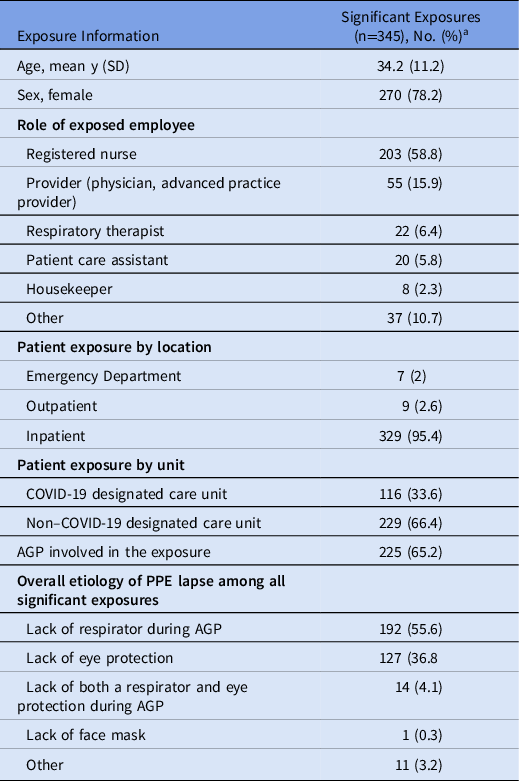
Between May 13, 2020, and November 30, 2020, 121 patient-to-HCP exposure incidents involving 581 HCP were identified. In total, 348 HCP sustained a significant exposure. Of these, 345 HCP were tested for SARS-CoV-2 by RT-PCR during the 14-day postexposure quarantine period and were included in this evaluation. Nurses accounted for 55.8% of HCP exposure, and most exposures occurred in the hospital setting (Table 2). Only one-third of exposures (n = 116, 33.6%) occurred in COVID-19 units. In COVID-19 units, 84 of 116 exposures (72.4%) involved the lack of a respirator during an AGP, compared to 123 of 229 exposures (53.7%) in regular units (RR, 1.35; 95% CI, 1.14–1.59; P = .001). Conversely, a lack of eye protection was implicated in 30 (25.9%) of 116 exposures in COVID-19 units compared to 111 (48.4%) of 229 exposures in non–COVID-19 units (RR, 1.43; 95% CI, 1.22–1.70; P < .001). HCP who lacked both a respirator and eye protection as the reason for their significant exposure were included in each exposure etiology group for comparison.
Demographic Information

Note. SD, standard deviation; AGP, aerosol-generating procedure; PPE, personal protective equipment.
a Values shown are no. (%) unless otherwise stated.
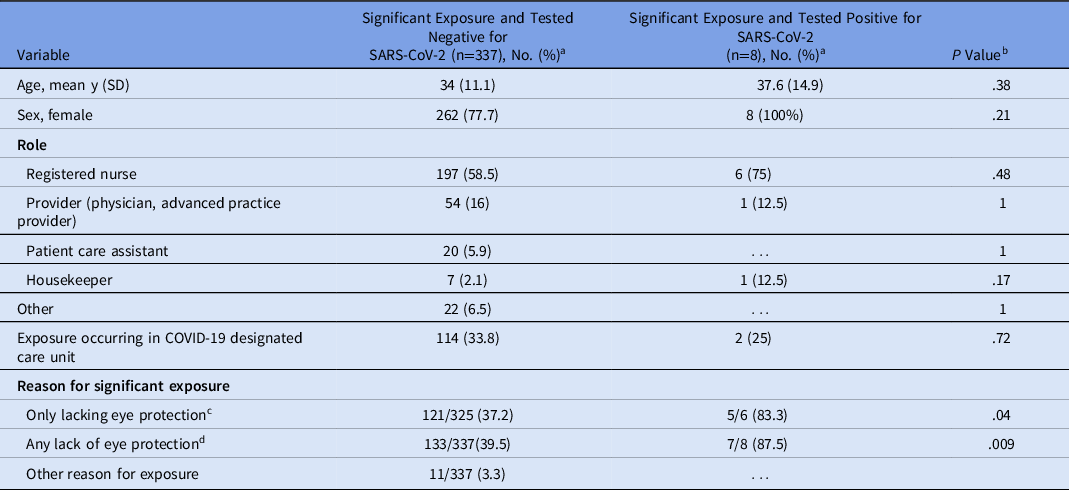
Of the 345 HCP with significant exposures, 8 (2.3%) tested positive for SARS-CoV-2 during the postexposure quarantine period (Table 3). Of these 8 HCP, 5 (62.5%) had reported lacking only eye protection, 1 (12.5%) reported lacking only a respiratory during an AGP (but wore a surgical face mask), and 2 (25%) lacked both eye protection and a respirator during an AGP (but these 2 HCP wore a surgical face mask). Thus, 7 of the 8 HCP (87.5%) who tested positive for SARS-CoV-2 lacked eye protection during their patient encounter, compared to 133 (39.5%) of the 337 HCP who tested negative after their exposure (RR, 10.25; 95% CI, 1.28–82.39; P= .009). According to institutional policy, each HCP who tested positive for SARS-CoV-2 was individually evaluated. The 8 HCP who tested positive during their postexposure quarantine period did not identify another potential source of infection such as a household or community contact. Given the timing of testing positive for SAR-SoV-2 within 14 days of exposure and individual evaluation, these 8 HCP were felt to have had sustained occupational exposures to patients due to lapses in PPE.
Comparing Employees Who Tested Positive for SARS-CoV-2 Against Other Employees Involved in all Significant Exposures

Note. HCP, healthcare personnel; AGP, aerosol-generating procedure.
a Values shown are no. (%) unless otherwise stated.
b The Student t test was used for continuous variables. The Fisher exact test was used for categorical variables.
c HCP who lacked both eye protection and a respirator during an AGP were excluded from this comparison.
d Includes HCP thatwho only lacked eye protection, and those who lacked both eye protection and a respirator during an AGP.
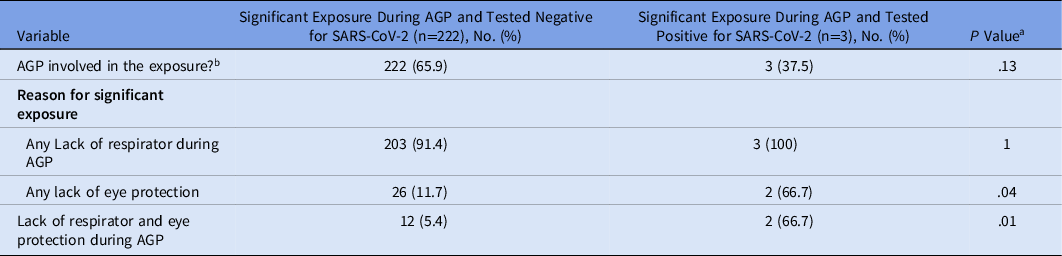
In a subgroup analysis of significant exposures related to an AGP, a lack of eye protection was also associated with transmission of SARS-CoV-2 (RR, 14.1; 95% CI, 1.3–150.1; P = .04), as was lacking both eye protection and a respirator (RR, 30.1; 95% CI, 2.9–312.5; P = .01) (Table 4). In this cohort, all HCP utilized either a respirator or surgical face mask during an AGP, and the use of a surgical face mask instead of a respirator during an AGP was not associated with transmission of SARS-CoV-2 (RR, 0.99; 95% CI, 0.96–1; P = 1).
Comparing Employees Who Tested Positive for SARS-CoV-2 Against Other Employees Involved in a Significant Exposure During an AGP

Note. AGP, aerosol-generating procedure.
a The Student t test was used for continuous variables. The Fisher exact test was used for categorical variables.
b Total with significant exposure and tested negative = 337; total with significant exposure and tested positive = 8 including exposures not involving an AGP.
Discussion
Adequate supply and appropriate use of PPE has been shown to prevent transmission to HCP providing care to patients with COVID-19. Reference Liu, Cheng and Xu7 However, despite sufficient PPE supplies, occupational exposure from patients to HCP may still occur for a multitude of reasons: PPE malfunction, inappropriate donning and doffing, and rapid changes in patient status necessitating urgent or unanticipated AGP. Ideal PPE use can be challenging in a busy clinical environment with critically ill patients and PPE fatigue, leading to imperfect adherence to PPE recommendations such as accidentally overlooking eye protection when caring for a patient with COVID-19 or not utilizing a respirator during an AGP.
In this cohort, 2.3% of HCP tested positive for SARS-CoV-2 within 15 days of a significant exposure to a patient with COVID-19, comparable to the 1.6% conversion rate for acute-care workers in Minnesota. 8 This conversion rate is in line with the conversion rate in nonhousehold contacts (1.9%) in a study of 48,481 individuals in Korea. Reference Park, Choe and Park9 Notably, the conversion of HCP after sustaining a patient exposure was lower than that of acute-care workers exposed to a coworker (3.6%) in Minnesota, and much lower than the household attack rate of 16.6% based on a meta-analysis of 77,758 participants. Reference Madewell, Yang, Longini, Halloran and Dean10
Similar to previous reports, our study has also demonstrated that most patient-to-HCP transmission occurred in units that do not typically provide care for patients with COVID-19. Reference Zabarsky, Bhullar and Silva11 In an early study of contact tracing in travel-associated cases of COVID-19, most lapses in PPE occurred prior to COVID-19 being suspected. Reference Burke, Balter and Barnes12 Diagnosis and isolation of patients with COVID-19 remains critical to prevent transmission within healthcare settings. However, false-negative tests, asymptomatic infection, and asymptomatic or presymptomatic transmission underscore the importance of a universal approach to PPE use in healthcare settings.
Our findings suggest that eye protection plays a critical role in protecting HCP from occupational exposures. The entry receptor for SARS-CoV-2, angiotensin converting enzyme 2, is expressed in lung and gastrointestinal mucosal tissue. The receptor is also located on conjunctival and corneal epithelial cells, though in lower concentration than in lung tissue. Reference Sun, Wang, Liu and Liu13 Early guidance regarding eye protection was based on mechanistic plausibility and data from SARS-CoV-1 transmission. Reference Marra, Edmond, Popescu and Perencevich14 An extensive meta-analysis evaluated eye protection in addition to face masks and physical distancing on the transmission of MERS and SARS-CoV-1 and found an additional benefit to wearing eye protection to reduce transmission. Reference Chu, Akl and Duda15
A study of emergency department clinicians found that when eye protection was added to universal masking, rates of COVID-19 in emergency department HCP were similar to rates in the surrounding community. Reference Hawkins, Fertel, Muir, Meldon, Delgado and Smalley16 However, this study was conducted in a low-prevalence area at that time, and only 4 HCP contracted COVID-19 during the study period. Burke et al Reference Burke, Balter and Barnes12 found that of the HCP who had lapses in PPE, most often eye protection was missing, though there was no patient-to-HCP transmission of SARS-CoV-2 that evaluation. A study of community healthcare workers in India found a significant proportion (12 of 62, 19%) testing positive for SARS-CoV-2 after home visits to household contacts of patients with SARS-CoV-2 despite maintaining a distance of 2 m (6 feet) and wearing standard PPE equipment of a 3-layer face mask, gloves, and shoe covers. Reference Bhaskar and Arun17 After the addition of face shields, no community healthcare workers tested positive for SARS-CoV-2 in the following 40 days. Although observational studies with preintervention versus postintervention analysis may be confounded by local changes in disease transmission, as well as behavior of source patients and HCP, these studies have provided initial evidence to the importance of eye protection in preventing transmission of SARS-CoV-2. To our knowledge, this is the first study that directly links a lack of eye protection to the transmission of SARS-CoV-2 from patients to HCP.
Our findings are consistent with a small report that found that patients hospitalized for COVID-19 were less likely to wear glasses for >8 hours per day than the general population. Reference Zeng, Wang and Li18 Although prescription glasses do not provide the eye protection needed in clinical interactions, authors concluded a possible link between eyeglasses and decreased transmission of SARS-CoV-2, possibly due to eyeglasses preventing wearers from touching their eyes. The importance of eye protection to mitigate the risk of SARS-CoV-2 transmission found in our study may also help to explain unexpected results in an observational Danish study in which mask use alone was not beneficial. Reference Bundgaard, Bundgaard and Raaschou-Pedersen19 Though this study had several limitations, including low prevalence of SARS-CoV-2 during the study period, it is possible that a lack of eye protection contributed to a lack of clear benefit from face mask use. Other studies, however, have shown a benefit of widespread face mask use without eye protection. Reference Coclite, Napoletano and Gianola20,Reference Gandhi and Marr21
The absence of association between lapse in use of a respirator and SARS-CoV-2 transmission in this study could be due to multiple factors including the protection in place from use of a face mask in these instances. In addition, a conservative approach was taken when assessing exposures during AGPs, and no time threshold was in place by which to consider an exposure without a respirator significant. Therefore, even brief exposures <5 minutes during AGP were classified as significant if appropriate PPE was not used.
This study has several limitations. Overall, a small number of HCP tested positive for SARS-CoV-2 after an exposure. In some instances, patient-to-HCP exposures were not classified as a significant risk but could potentially have resulted in transmission. Data based on wearable technology in the National Football League raised concerns on risk evaluation based on proximity and time cutoffs in nonhealthcare settings, though the type of interactions and PPE worn significantly differs from healthcare settings. Reference Mack, Wasserman and Perrine22 Additionally, not all lapses in PPE may have been realized or reported, although any lapses should have resulted in nondifferential misclassifications were thus unlikely to introduce significant bias.
The risk of SARS-CoV-2 transmission to HCP due to occupational exposure to patients with SARS-CoV-2 is present in both COVID-19 designated care units and non–COVID-19 units. In COVID-19 units, the risk of exposure was more often attributable to lack of respirator use during an AGP, whereas lapses in appropriate eye protection were most often reported as the reason for exposure in non–COVID-19 units. While the use of a face mask rather than a respirator during an AGP did not result in significantly elevated transmission of SARS-CoV-2, this evaluation was not designed to assess airborne spread of SARS-CoV-2 outside of PPE lapses during an AGP. Overall, a lack of eye protection correlated significantly with transmission of SARS-CoV-2. Our data support that all HCP, including those in units that do not typically care for patients with COVID-19, should be vigilant about PPE use, particularly with eye protection. Appropriate use of recommended PPE remains a critical mitigation strategy to decrease the transmission of SARS-CoV-2 to HCP.
Acknowledgments
Financial support
No financial support was provided relevant to this article.
Conflicts of interest
All authors report no conflicts of interest relevant to this article.