Professional educator or not, any person who has attempted to teach something to someone has likely run into a wall when students just don’t seem to get it. This confusion might be manifested as a question that is asked in class or as a seemingly bizarre response to an exam question. Regardless of the form that such uncertainty might take, the remedy is consistent: feedback. Indeed, feedback has been established as a foundational element of any successful training endeavor, and teaching is no exception. A crucial part of students’ learning experience comes from identifying and addressing areas of weakness and areas in which they need to improve. As such, an instructor plays an important role as the person who delivers feedback to students to guide them in the right direction toward improvement and knowledge enhancement.
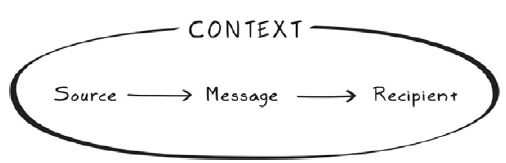
Although feedback is mentioned in Kath etal.’s (Reference Kath, Salter, Bachiochi, Brown and Hebl2021) focal article, it is only mentioned briefly and does not receive extensive discussion. We agree with the authors that feedback is important, and we further assert that the teaching of industrial and organizational (I-O) psychology can be greatly enhanced when you as the instructor are aware of and put into practice the principles of giving feedback based on research in our field. In this commentary, we elaborate further on the use of feedback in the classroom to expand upon the ideas that were presented in the focal article. As a guiding framework, we touch on the three elements of a typical feedback episode (the source of feedback, the feedback message, and the recipient of the feedback; Ilgen etal., Reference Ilgen, Fisher and Taylor1979) and organize our discussion by addressing each of these in turn, relying on the parsimonious model (Figure 1) presented by Gregory and Levy (Reference Gregory and Levy2015).
The source of feedback
It can be easy to assume that students should accept all feedback from their instructors simply on the basis of the instructor’s expertise. Certainly, as instructors, we are authorities on the subject we teach and we have personal insight into our own motivation to help students learn. But to become a master of delivering feedback, we must be intentional in how we present ourselves to our students so as to be effective sources of feedback. It is certainly true that the feedback messages that you as an instructor convey to your students exist in a context that you have largely defined (i.e., the classroom), but this is not the whole story. You set the tone in meetings with students as well as in the classroom. Therefore, relationships matter in this context, and they define the boundaries that work for the feedback process. In particular, your students’ perceptions of your credibility, trustworthiness, expertise, and supportiveness (or empathy) are critical pieces of how they will perceive you as a feedback source (Gregory & Levy, Reference Gregory and Levy2015). To a large extent, credibility and expertise are established by your position as instructor. However, trustworthiness must be earned and supportiveness demonstrated. Anything that you as an instructor can do to convince your students of your trustworthiness and supportiveness provides the foundation for their acceptance and reactions to the feedback that follows. In other words, building good rapport with your students is valuable not only in making the classroom a more enjoyable place for everyone but also in making your students more open to feedback (Levy & Williams, Reference Levy and Williams2004; Pichler, Reference Pichler2012)
It is also important to consider the purpose of the feedback. As the person giving feedback, you should consider whether you are trying to mold the student and push them a bit to be truly outstanding or trying to wake them up to what needs to be done to be successful in class. In the former case, your feedback should take the form of a subtle high-level feedback conversation; in the latter case, it is more effective to deliver a clear feedback message around progress and what needs to happen. Put simply, different purposes call for different approaches (Fleenor etal., Reference Fleenor, Steelman and Williams2019). A student who comes to you to personally discuss a question would warrant the high-level feedback conversation. By giving the student greater insight into their question, or by prompting them to think more broadly about the material, your feedback can greatly expand their understanding. On the other hand, providing feedback to a student who struggled with an answer on an exam or failed to adequately complete part of an assignment might call for clear feedback regarding a specific piece of the student’s performance.
A feedback conversation is inherently dynamic, so it is insufficient to think only of the information you wish to convey. Sometimes, depending on the situation, you may need to make use of active listening. Often there is information from the student that is important for the instructor to hear and understand. Sure, sometimes these are excuses. Along these lines, students’ perceptions of their feedback can sometimes be skewed by the Dunning–Kruger effect (Sheldon etal., Reference Sheldon, Dunning and Ames2014), as students with low skill in an area are also likely to lack the ability to recognize that they are performing poorly in that same domain. But sometimes the information that students share can give you important information about the student that can help you give more specific and personalized feedback that can change the student’s behavior and improve their performance. You may learn that their understanding of some material was confused by a small detail or even that they do understand the material but are expressing that understanding incorrectly.
The feedback message
Receiving negative feedback is stressful, but it might be just as unpleasant to deliver negative feedback (Cox etal., Reference Cox, Marler, Simmering and Totten2011; Rosen & Tesser, Reference Rosen and Tesser1970). That being said, delivering the bad news and letting students know when, where, and how they are underperforming is an important part of being a teacher. By understanding the different facets of a feedback message, you can feel confident that the feedback you deliver will be effective and useful to your student. For one, remember that balanced feedback is important (Gregory & Levy, Reference Gregory and Levy2015)—perhaps one student’s test score was not very good, but they come to class and actively participate. Be sure to point out to the student that you notice this. Recognizing strengths and providing feedback around those strengths is important. Of course, this scenario can be a source of concern for the student as well—they may fear that if they are engaged and coming to class and still doing poorly, then there is little more that they can do to improve. This is an important conversation to have, as it may reveal important insights into the student’s behaviors that may warrant further feedback. At the end of the conversation you may realize, for example, that the student is not studying as carefully and completely as they need to. Diagnostic feedback about how to improve should follow from this analysis. This negative feedback that also includes strategies for improving is critical, as is the feedback about what the student is doing well (e.g., coming to class, engaging in conversations).
The timeliness of your feedback is also critical (Bracken etal., Reference Bracken, Timmreck, Fleenor and Summers2001; Levy etal., Reference Levy, Tseng, Rosen and Lueke2017). A struggling student needs time to make adjustments and improve their grades, so nothing is gained by waiting to deliver that feedback. If you are concerned about a student’s performance, let them know early on that you are concerned about their class performance and that you want to help them improve whenever possible. It is important that this message be conveyed to all of your students, but particularly to students who might be struggling. Ultimately, whenever you see an opportunity to offer helpful feedback to students, you should take that opportunity without hesitation. Remember that the classroom setting already establishes a context in which students expect you to offer direction, so you should feel comfortable offering feedback whenever it feels appropriate.
Feedback is most effective when it stays specific and behavior focused rather than when it emphasizes individual personal characteristics (Kluger & DeNisi, Reference Kluger and DeNisi1996). Therefore, do not make assumptions or draw conclusions from unclear data. Talk to the student and try to uncover the issues so that the message can be about fixing the issues, changing behaviors, adjusting attitudes or expectations, and any other specific changes that should be made. In a similar vein, when you deliver feedback you should also give the student some work to do: develop an action plan. One approach that we have found to be successful is asking students to go back and read a chapter in the book and then write an outline to summarize the chapter. We have found that, more often than not, this exercise reveals when students are missing the important points of the chapter or are simply not outlining the chapter in a way that makes sense to the student. Providing feedback on the outline after it is completed can be really helpful. Also, identifying the holes where the student is not going deep enough in the outline or too deep can be extremely helpful for students—so the feedback on that outline is critical.
The recipient of feedback
Understanding your role as a feedback source and the components of an effective feedback message are both fantastic ways to improve your self-efficacy and ability for giving feedback. However, to become truly exceptional in delivering feedback, you must also consider how you can tailor your message to the individual feedback recipient. Although there are different individual differences that you might consider, we believe that feedback orientation (Linderbaum & Levy, Reference Linderbaum and Levy2010) is particularly important and bears discussion. In essence, it is extremely helpful for the instructor to know how receptive a student is to feedback.
When considering a student’s feedback orientation or how receptive a student is to feedback, you can start by thinking about how a student will react to your giving feedback to them. Will the student feel accountable for using the feedback? The extent to which students will feel compelled to respond to your feedback partly depends on their individual attitudes about feedback. On one hand, if you are giving negative feedback to a student who isn’t interested, you may have to work harder to make it relevant for them and also to make it clear that following the feedback is likely to have positive outcomes for them, per expectancy theory (Vroom, Reference Vroom1964). On the other hand, if you are giving negative feedback to someone who has a growth mindset (Dweck, Reference Dweck2006) and feels obliged to use the feedback you won’t have to work to get them on board; you just need to simply point out what to do to improve and create expectations that using the feedback will work.
Will the student think the feedback is useful? This one is sometimes hard to determine, but the instructor has to figure out whether the student believes that the feedback delivered will be useful to them. This may likely come back to those source characteristics: whether the source is credible and trustworthy and the feedback is delivered with empathy. The instructor should take control of this and act in a way that will lead the student to believe the feedback will be useful. For instance, students might not believe that your feedback is very useful if they do not believe that you have their best interests in mind. That is, if students do not believe that you are giving feedback because you genuinely want to see them succeed and instead believe that you are only doing so because it is required for your job, they may be less likely to feel that the feedback they receive will truly be useful to them.
Will the student feel competent in how to use the feedback to improve? Some students will need to have their feedback self-efficacy enhanced because their experiences have been that feedback hasn’t helped them before because, perhaps, they didn’t know how to use it effectively. For these students, more direction about HOW to use the feedback may be necessary. For instance, a student may have had a discouraging past experience in which they failed to improve in a class despite receiving and actively attempting to use feedback from the instructor. In this case, you as the instructor and the feedback giver can help build up the student’s self-efficacy for dealing with feedback by diagnosing where previous strategies fell short and helping the student adopt more effective strategies moving forward.
Conclusion
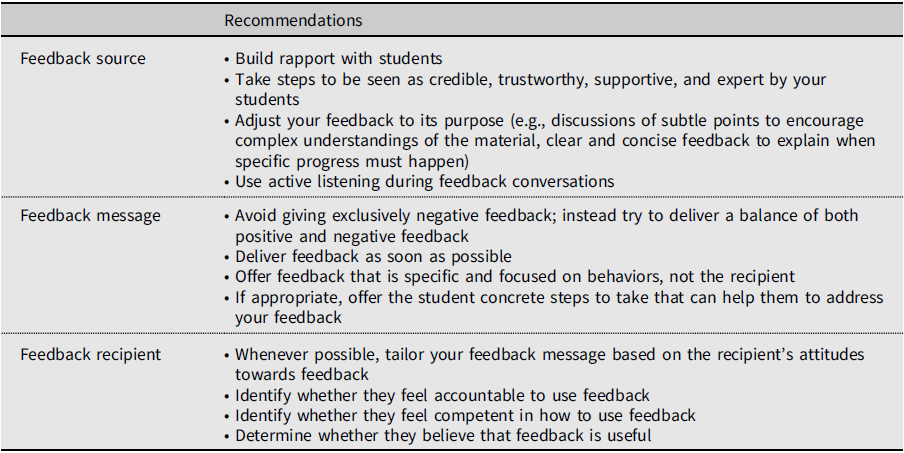
We have tried to show the importance of feedback in the classroom and have provided a series of suggestions that can be categorized around the parsimonious Gregory and Levy (Reference Gregory and Levy2015) model that defines the feedback source, message, and recipient as critical to the process. Table 1 summarizes our suggestions.
Table 1.
Summary of recommendations for effectively using feedback in the classroom




 You have Access
Professional educator or not, any person who has attempted to teach something to someone has likely run into a wall when students just don’t seem to get it. This confusion might be manifested as a question that is asked in class or as a seemingly bizarre response to an exam question. Regardless of the form that such uncertainty might take, the remedy is consistent: feedback. Indeed, feedback has been established as a foundational element of any successful training endeavor, and teaching is no exception. A crucial part of students’ learning experience comes from identifying and addressing areas of weakness and areas in which they need to improve. As such, an instructor plays an important role as the person who delivers feedback to students to guide them in the right direction toward improvement and knowledge enhancement.
Although feedback is mentioned in Kath etal.’s (Reference Kath, Salter, Bachiochi, Brown and Hebl2021) focal article, it is only mentioned briefly and does not receive extensive discussion. We agree with the authors that feedback is important, and we further assert that the teaching of industrial and organizational (I-O) psychology can be greatly enhanced when you as the instructor are aware of and put into practice the principles of giving feedback based on research in our field. In this commentary, we elaborate further on the use of feedback in the classroom to expand upon the ideas that were presented in the focal article. As a guiding framework, we touch on the three elements of a typical feedback episode (the source of feedback, the feedback message, and the recipient of the feedback; Ilgen etal., Reference Ilgen, Fisher and Taylor1979) and organize our discussion by addressing each of these in turn, relying on the parsimonious model (Figure 1) presented by Gregory and Levy (Reference Gregory and Levy2015).
Parsimonious model of the feedback process from Gregory & Levy Reference Gregory and Levy(2015).
The source of feedback
It can be easy to assume that students should accept all feedback from their instructors simply on the basis of the instructor’s expertise. Certainly, as instructors, we are authorities on the subject we teach and we have personal insight into our own motivation to help students learn. But to become a master of delivering feedback, we must be intentional in how we present ourselves to our students so as to be effective sources of feedback. It is certainly true that the feedback messages that you as an instructor convey to your students exist in a context that you have largely defined (i.e., the classroom), but this is not the whole story. You set the tone in meetings with students as well as in the classroom. Therefore, relationships matter in this context, and they define the boundaries that work for the feedback process. In particular, your students’ perceptions of your credibility, trustworthiness, expertise, and supportiveness (or empathy) are critical pieces of how they will perceive you as a feedback source (Gregory & Levy, Reference Gregory and Levy2015). To a large extent, credibility and expertise are established by your position as instructor. However, trustworthiness must be earned and supportiveness demonstrated. Anything that you as an instructor can do to convince your students of your trustworthiness and supportiveness provides the foundation for their acceptance and reactions to the feedback that follows. In other words, building good rapport with your students is valuable not only in making the classroom a more enjoyable place for everyone but also in making your students more open to feedback (Levy & Williams, Reference Levy and Williams2004; Pichler, Reference Pichler2012)
It is also important to consider the purpose of the feedback. As the person giving feedback, you should consider whether you are trying to mold the student and push them a bit to be truly outstanding or trying to wake them up to what needs to be done to be successful in class. In the former case, your feedback should take the form of a subtle high-level feedback conversation; in the latter case, it is more effective to deliver a clear feedback message around progress and what needs to happen. Put simply, different purposes call for different approaches (Fleenor etal., Reference Fleenor, Steelman and Williams2019). A student who comes to you to personally discuss a question would warrant the high-level feedback conversation. By giving the student greater insight into their question, or by prompting them to think more broadly about the material, your feedback can greatly expand their understanding. On the other hand, providing feedback to a student who struggled with an answer on an exam or failed to adequately complete part of an assignment might call for clear feedback regarding a specific piece of the student’s performance.
A feedback conversation is inherently dynamic, so it is insufficient to think only of the information you wish to convey. Sometimes, depending on the situation, you may need to make use of active listening. Often there is information from the student that is important for the instructor to hear and understand. Sure, sometimes these are excuses. Along these lines, students’ perceptions of their feedback can sometimes be skewed by the Dunning–Kruger effect (Sheldon etal., Reference Sheldon, Dunning and Ames2014), as students with low skill in an area are also likely to lack the ability to recognize that they are performing poorly in that same domain. But sometimes the information that students share can give you important information about the student that can help you give more specific and personalized feedback that can change the student’s behavior and improve their performance. You may learn that their understanding of some material was confused by a small detail or even that they do understand the material but are expressing that understanding incorrectly.
The feedback message
Receiving negative feedback is stressful, but it might be just as unpleasant to deliver negative feedback (Cox etal., Reference Cox, Marler, Simmering and Totten2011; Rosen & Tesser, Reference Rosen and Tesser1970). That being said, delivering the bad news and letting students know when, where, and how they are underperforming is an important part of being a teacher. By understanding the different facets of a feedback message, you can feel confident that the feedback you deliver will be effective and useful to your student. For one, remember that balanced feedback is important (Gregory & Levy, Reference Gregory and Levy2015)—perhaps one student’s test score was not very good, but they come to class and actively participate. Be sure to point out to the student that you notice this. Recognizing strengths and providing feedback around those strengths is important. Of course, this scenario can be a source of concern for the student as well—they may fear that if they are engaged and coming to class and still doing poorly, then there is little more that they can do to improve. This is an important conversation to have, as it may reveal important insights into the student’s behaviors that may warrant further feedback. At the end of the conversation you may realize, for example, that the student is not studying as carefully and completely as they need to. Diagnostic feedback about how to improve should follow from this analysis. This negative feedback that also includes strategies for improving is critical, as is the feedback about what the student is doing well (e.g., coming to class, engaging in conversations).
The timeliness of your feedback is also critical (Bracken etal., Reference Bracken, Timmreck, Fleenor and Summers2001; Levy etal., Reference Levy, Tseng, Rosen and Lueke2017). A struggling student needs time to make adjustments and improve their grades, so nothing is gained by waiting to deliver that feedback. If you are concerned about a student’s performance, let them know early on that you are concerned about their class performance and that you want to help them improve whenever possible. It is important that this message be conveyed to all of your students, but particularly to students who might be struggling. Ultimately, whenever you see an opportunity to offer helpful feedback to students, you should take that opportunity without hesitation. Remember that the classroom setting already establishes a context in which students expect you to offer direction, so you should feel comfortable offering feedback whenever it feels appropriate.
Feedback is most effective when it stays specific and behavior focused rather than when it emphasizes individual personal characteristics (Kluger & DeNisi, Reference Kluger and DeNisi1996). Therefore, do not make assumptions or draw conclusions from unclear data. Talk to the student and try to uncover the issues so that the message can be about fixing the issues, changing behaviors, adjusting attitudes or expectations, and any other specific changes that should be made. In a similar vein, when you deliver feedback you should also give the student some work to do: develop an action plan. One approach that we have found to be successful is asking students to go back and read a chapter in the book and then write an outline to summarize the chapter. We have found that, more often than not, this exercise reveals when students are missing the important points of the chapter or are simply not outlining the chapter in a way that makes sense to the student. Providing feedback on the outline after it is completed can be really helpful. Also, identifying the holes where the student is not going deep enough in the outline or too deep can be extremely helpful for students—so the feedback on that outline is critical.
The recipient of feedback
Understanding your role as a feedback source and the components of an effective feedback message are both fantastic ways to improve your self-efficacy and ability for giving feedback. However, to become truly exceptional in delivering feedback, you must also consider how you can tailor your message to the individual feedback recipient. Although there are different individual differences that you might consider, we believe that feedback orientation (Linderbaum & Levy, Reference Linderbaum and Levy2010) is particularly important and bears discussion. In essence, it is extremely helpful for the instructor to know how receptive a student is to feedback.
When considering a student’s feedback orientation or how receptive a student is to feedback, you can start by thinking about how a student will react to your giving feedback to them. Will the student feel accountable for using the feedback? The extent to which students will feel compelled to respond to your feedback partly depends on their individual attitudes about feedback. On one hand, if you are giving negative feedback to a student who isn’t interested, you may have to work harder to make it relevant for them and also to make it clear that following the feedback is likely to have positive outcomes for them, per expectancy theory (Vroom, Reference Vroom1964). On the other hand, if you are giving negative feedback to someone who has a growth mindset (Dweck, Reference Dweck2006) and feels obliged to use the feedback you won’t have to work to get them on board; you just need to simply point out what to do to improve and create expectations that using the feedback will work.
Will the student think the feedback is useful? This one is sometimes hard to determine, but the instructor has to figure out whether the student believes that the feedback delivered will be useful to them. This may likely come back to those source characteristics: whether the source is credible and trustworthy and the feedback is delivered with empathy. The instructor should take control of this and act in a way that will lead the student to believe the feedback will be useful. For instance, students might not believe that your feedback is very useful if they do not believe that you have their best interests in mind. That is, if students do not believe that you are giving feedback because you genuinely want to see them succeed and instead believe that you are only doing so because it is required for your job, they may be less likely to feel that the feedback they receive will truly be useful to them.
Will the student feel competent in how to use the feedback to improve? Some students will need to have their feedback self-efficacy enhanced because their experiences have been that feedback hasn’t helped them before because, perhaps, they didn’t know how to use it effectively. For these students, more direction about HOW to use the feedback may be necessary. For instance, a student may have had a discouraging past experience in which they failed to improve in a class despite receiving and actively attempting to use feedback from the instructor. In this case, you as the instructor and the feedback giver can help build up the student’s self-efficacy for dealing with feedback by diagnosing where previous strategies fell short and helping the student adopt more effective strategies moving forward.
Conclusion
We have tried to show the importance of feedback in the classroom and have provided a series of suggestions that can be categorized around the parsimonious Gregory and Levy (Reference Gregory and Levy2015) model that defines the feedback source, message, and recipient as critical to the process. Table 1 summarizes our suggestions.
Summary of recommendations for effectively using feedback in the classroom