Lactic acid bacteria (LAB) belong to a large family of Gram positive, non-sporulating, microaerophilic microorganisms that produce lactic acid as the main product of glucose fermentation. They are found naturally in many foods, including milk and dairy products (Franciosi et al., Reference Franciosi, Settanni, Cavazza and Poznanski2009). LAB can contribute as starter cultures or adjuvants for the production of desirable characteristics in food products. In addition to directly influencing the sensory level, some strains are able to synthesize substances with antimicrobial activity against pathogens. The main components with inhibitory activity are acids, diacetyl, hydrogen peroxide, carbon dioxide, alcohol, aldehyde and bacteriocins (Hernández et al., Reference Hernández, Cardell and Zárate2005).
Bacteriocins, peptides produced by some LAB, are synthesized ribosomally, have antimicrobial activity and are included in the generally recognized as safe category by the FAO. They can be used as a natural preservative (Diop et al., Reference Diop, Dubois Dauphin, Tine, Ngom, Destain and Thonart2007) and, due to the growing consumer demand for more natural products, bacteriocins can be considered a more suitable alternative to chemical preservatives (Yildirim et al., Reference Yildirim, Bilgin, Isleroglu, Tokatli, Sahingil and Yildirim2014).
Some bacteriocins have been used to inhibit pathogens, such as Listeria monocytogenes in food, through the addition of bacteriocin-producing microbial cultures or the addition of this purified or semi-purified antimicrobial peptide (Pingitore et al., Reference Pingitore, Todorov, Sesma and Franco2012; Ribeiro et al., Reference Ribeiro, Coelho, Todorov, Franco, Dapkevicius and Silva2014; Cárdenas et al., Reference Cárdenas, Arroyo, Calzada, Peirotén, Medina, Rodríguez and Fernández2016). Nisin is one of the most often used bacteriocins in foods and can control the growth of pathogens (Balciunas et al., Reference Balciunas, Martinez, Todorov, Franco, Attilio and Oliveira2013).
Numerous bacteria can contaminate cheeses, especially fresh or poorly matured cheeses made with raw or even pasteurized milk, but which do not have adverse conditions for the growth of pathogens. This is in contrast to cheeses that mature for more than 60 d. One of the most important bacteria, in this context, is Listeria monocytogenes, which is of concern for its high lethality and for concentrating several characteristics that favor its contamination and survival in cheeses. Listeria monocytogenes is an environmental bacterium, frequent in milk and dairy processing plants, and can contaminate products after pasteurization. It can also survive and multiply under refrigeration conditions. Cheese is a strong candidate for contamination, due to the various production and handling steps (Schvartzman et al., Reference Schvartzman, Maffre, Tenenhaus-Aziza, Sanaa, Butler and Jordan2011). Outbreaks of listeriosis related to the consumption of cheese, produced with raw milk or recontaminated after heat treatment, have been reported in many countries, causing numerous deaths, fetal loss, meningoencephalitis and septicemia (Martinez-Rios and Dalgaard, Reference Martinez-Rios and Dalgaard2018). Thus, where the consumption of fresh or under-ripened cheeses is frequent, it would be desirable that the safety of the product could be improved. In this sense, bacteriocins seem to be an excellent alternative, and are worthy of further study to extend their use beyond established technologies, such as the sprinkling of carcasses with nisin. Edible films for coating and food protection is an example. In this work, we identified bacteriocin-producing bacteria and evaluated their applicability in the control of Listeria monocytogenes in cheese.
Materials and methods
Identification of bacteriocin-producing strains
In total, 355 LAB strains were studied including 270 strains from goat milk and 85 from artisanal Serrano cheese. The strains belonged to Laboratório de Inspeção de Produtos de Origem Animal at Universidade Estadual de Londrina (LIPOA/UEL) and they were previously isolated from other researchers (Rios et al., Reference Rios, Pereira, Tamanini, Mareze, Gonzaga, Ossugui, Nero and Beloti2018; Seixas et al., Reference Seixas, Rios, de Oliveira AL, Beloti and Poveda2018). All the isolates were selected according to the antimicrobial activity against Listeria monocytogenes ATCC 7644, using the spot-on-lawn method (Lewus et al., Reference Lewus, Kaiser and Montville1991). An anti-listeria cell-free supernatant (CFS) was prepared to investigate the nature of the antimicrobial compound, more specifically, the presence of bacteriocins or bacteriocin-like substances. The cells were removed from MRS broth by centrifugation (14 500 rpm, 15 min, 10°C), and the CFS was neutralized to pH 6.0 with 0.1 N NaOH, filter-sterilized using cellulose acetate membrane filters (0.22 μm), and then heated at 80°C for 10 min, to exclude the antimicrobial effect of organic acids or peroxidase. The CFS was treated with proteinase K, and the inactivation of anti-listeria effect was observed, confirming the protein origin of substance (Cavicchioli et al., Reference Cavicchioli, Camargo, Todorov and Nero2017).
DNA extraction and 16s rRNA gene amplification
The boiling technique was used for extraction according to Ribeiro-Junior et al. (Reference Ribeiro-Junior, Tamanini, Soares, Oliveira, Silva, Silva, Augusto and Beloti2016). Partial amplification of the 16S rRNA gene by Polymerase Chain Reaction (PCR) was performed using primers 27f (5′-AGAGTTTGATCMTGGCTCAG-3′) and 1492r (5′-TACCTTGTTACGACTT), described by Osborne et al. (Reference Osborne, Galic, Sangwan and Janssen2005). The assay was performed as described by Young et al. (Reference Young, Kuykendall, Martínez-Romero, Kerr and Sawada2001) with modifications of the temperature of annealing that was 64°C for 45 s. To visualize the PCR result, the amplified samples were applied on a 1% agarose gel (Invitrogen, Carlsbad, CA, USA) and submitted for 1 h at a constant voltage of 5 V/cm2. The gels were stained in a 0.2 μg/ml ethidium bromide solution for 20 min and the image captured in a UV transilluminator.
DNA sequencing
Purification of the PCR product was performed using the PureLink® Quick Gel Extraction Purification Kit (Life Technologies, Carlsbad, CA, USA) and DNA quantification was executed using the Qubit® dsDNA BR Assay Kit (Invitrogen, Carlsbad, USA), as per the manufacturer's recommendations. For rRNA gene sequencing of the strains, the BigDye® Terminator v3.1 Cycle Sequencing kit (Life Technologies, Carlsbad, CA, USA) was used in an automatic sequencer using the Sanger method (ABI 3500. Genetic Analyzer, Applied Biosystems, Carlsbad, CA, USA) with primers 27F (5′-GAGTTTGATCMTGGCTCAG-3′) and 1492R (5′-GGYTACCTTGTTACGACTT-3′) (OSBORNE et al., Reference Osborne, Galic, Sangwan and Janssen2005), with a product of 1400 bp. The sequences were compared with the GeneBank database of the National Center for Biotechnology Information (NCBI) using the BLAST tool (Basic Local Alignment Search Tool) to search for similarities.
Technological and food safety characterization of the strains
All analyses of technological characterization and food safety of the strains were performed in duplicate. The proteolytic activity (Franciosi et al., Reference Franciosi, Settanni, Cavazza and Poznanski2009), lipolytic activity (Hantsis-Zacharov and Halpern, Reference Hantsis-Zacharov and Halpern2007), diacetyl production (Ribeiro et al., Reference Ribeiro, Coelho, Todorov, Franco, Dapkevicius and Silva2014), and phenotypic tests for the production of hemolysin (Asteri et al., Reference Asteri, Robertson, Kagkli, Andrewes, Coolbear, Holland, Crow and Tsakalidou2009) and gelatinase (Terzic-Vidojevic et al., Reference Terzic-Vidojevic, Veljovic, Tolinacki and Nikolic2009) were evaluated.
Evaluation of the effect of CFS of strain QS494 in-vitro against Listeria monocytogenes ATCC 7644.
To determine whether the CFS of strain QS494 had bactericidal or bacteriostatic activity against Listeria monocytogenes, we initially inoculated Listeria monocytogenes ATCC 7644 in 10 ml of CFS and in 10 ml of MRS (control) simultaneously, thus obtaining a final concentration of 104 CFU/ml. The media were incubated at 35°C and aliquots were collected at 0, 2, 4, 6, 8, 10, 12 and 24 h. Viable cells were enumerated in a selective Listeria agar.
Precipitation and characterization of bacteriocin
Partial purification of bacteriocin was performed according to the modified methodology of Guitierréz-Cortés et al. (Reference Gutiérrez-Cortés, Suarez, Buitrago, Nero and Todorov2018). The strains were cultivated in 500 ml of MRS broth for 18 h at 37°C, the CFS was obtained by centrifugation for 15 min at 14 500 rpm at 4°C. The CFS proteins were precipitated by 80% saturation with ammonium sulfate at 4°C (overnight), and the precipitate centrifuged for 60 min at 12 000 g at 4°C. The pellets were resuspended in 5 ml of 25 mM phosphate buffer (pH 6.5) and the confirmation of the anti-listeria activity of the CFS was evaluated as described by (Hernández et al., Reference Hernández, Cardell and Zárate2005). Determination of the bacteriocin molecular weight was performed by the SDS-PAGE electrophoresis technique, using the neutralized and precipitated CFS (Laemmli, Reference Laemmli1970; Schägger, Reference Schägger2006). In order to locate the protein/peptide bands with antibacterial activity, a part of the SDS-PAGE gel (unstained) was placed in a Petri dish and covered with BHI agar (1.5%) inoculated with Listeria monocytogenes ATCC 7644 (approx. 105 CFU/ml). The stained gel was compared with the part of the gel inoculated on the plates, to verify the size of the band with inhibition activity against Listeria monocytogenes (Cytryńska et al., Reference Cytrynska, Zdybicka-Barabas, Jablonski and Jakubowicz2001).
Sensitivity of bacteriocin to different pH and temperatures
The evaluation of the pH interference in relation to the stability and activity of the bacteriocin was carried out as described by Guerreiro et al. (Reference Guerreiro, Monteiro, Ramos, Franco, Martinez, Todorov and Fernandes2014), using CFS obtained from Lactiplantibacillus plantarum subjected to pH changes with sterile solutions of 0.3 N NaOH and 0.3 N HCl to reach pH 4.5, 5.0, 5.5, 6.0, 6.5, 6.7, 7, 0, 8.0 and 11.0. After incubation for 1 h at the aforementioned pH values, the samples were readjusted to pH 6.0 and the antimicrobial activity against Listeria monocytogenes was determined by the spot agar method (Hernández et al., Reference Hernández, Cardell and Zárate2005). The effect of temperature on the stability of bacteriocin produced by Lactiplantibacillus plantarum was tested by heating the CFS at 55, 80 and 100°C for 10 min and at 121°C for 15 min. The CFS was also subjected to freezing (−20°C) and the inhibitory activity was verified after 12 weeks (Guerreiro et al., Reference Guerreiro, Monteiro, Ramos, Franco, Martinez, Todorov and Fernandes2014). After each treatment, the inhibition activity against Listeria monocytogenes was determined by the spot agar method (Hernández et al., Reference Hernández, Cardell and Zárate2005).
Study of the anti-listeria effect of Lactiplantibacillus plantarum producer of bacteriocin in cheese
All the cheeses were made according to the traditional procedure described by Ministerio da Agricultura, Pecuária e Abastecimento (Brasil, 1996). Three studies were carried out, where the cheeses were inoculated with different concentrations of Listeria monocytogenes (106, 104 and 102). In each study, 5 batches of Minas Frescal cheese were produced with 5 cheeses each, and batches 3, 4 and 5 were inoculated with Listeria monocytogenes. Batch 1 was manufactured with a commercial culture and there was no inoculation of pathogen in this batch. Batch 2 was produced with the bacteriocin-producing Lactiplantibacillus plantarum strain to be tested and was also pathogen free. Batch 3 was produced with the Lactiplantibacillus plantarum strain and inoculated with Listeria monocytogenes. Batch 4 was produced with the commercial culture and inoculated with Listeria monocytogenes and batch 5 was produced without LAB starter and was inoculated with Listeria monocytogenes only. Batches 1 and 2 were used as negative controls for Listeria monocytogenes. Subsequently, the cheeses were aged for 15 d at a temperature of 8 to 12°C and a relative humidity of 85%. Every 96 h, LAB (ISO 11290, 1998b) and Listeria monocytogenes (ISO 15214, 1998a) counts were performed in duplicate.
Production of edible film with anti-listeria effect
To prepare the edible bacteriocin films of QS494, a bacteriocin solution (200 mg/ml) was used. Gelatin films at 3% (w/v), 1% agar (w/v), and 1% glycerol (v/v) were prepared. First, the gelatin, agar and glycerol solutions were dissolved in distilled water and sterilized at 115°C for 15 min. After cooling in a water bath at 40°C, the bacteriocin solution was added, reaching final concentrations of 50 and 25 mg/ml. Thereafter, 12 ml of the fluid was deposited in Petri dishes. After solidification, the films were incubated at 37°C for 24 h whereupon they were ready for use and had a final thickness between 0.15 and 0.18 mm. The antimicrobial effect against Listeria monocytogenes ATCC 7644 of the edible films was evaluated by agar diffusion technique (Emiroğlu et al., Reference Emiroğlu, Yemis, Coşkun and Candoğan2010), using 10 × 10 mm pieces of film. BHI agar plates were inoculated with Listeria monocytogenes and the edible film fragments were overlaid on the agar. The plates were incubated at 37°C for 24 h, and the antibacterial activity was quantified by measuring the inhibition halo around the edible films. Negative controls were included, using edible films without addition of tested antimicrobial substance.
Results
Of the 355 LAB strains studied with anti-listeria effect, two strains (QS494 and QS530) isolated from Serrano cheese showed an effect when factors such as the presence of hydrogen peroxide and acids were eliminated. When investigating the nature of the antimicrobial compound, both of the CFS were treated with proteinase K whereupon inactivation of the anti-listeria effect was observed, confirming the protein origin of the inhibitory substance, thus indicating that it was a bacteriocin.
The two bacteriocinogenic LAB strains (QS494 and QS530) were identified with >99% similarity by sequencing the 16S rRNA gene as Lactiplantibacillus plantarum and Lactiplantibacillus pentosus, respectively. As a result of the technological characteristics, in addition to bacteriocin production, the two studied strains exhibited proteolytic and lipolytic activities, as well as diacetyl production. The isolates showed negative results, by phenotypic methods, for the expression of virulence factors gelatinase and hemolysin. As the two strains had similar technological characteristics and antimicrobial activity, the study continued with the QS494 strain alone.
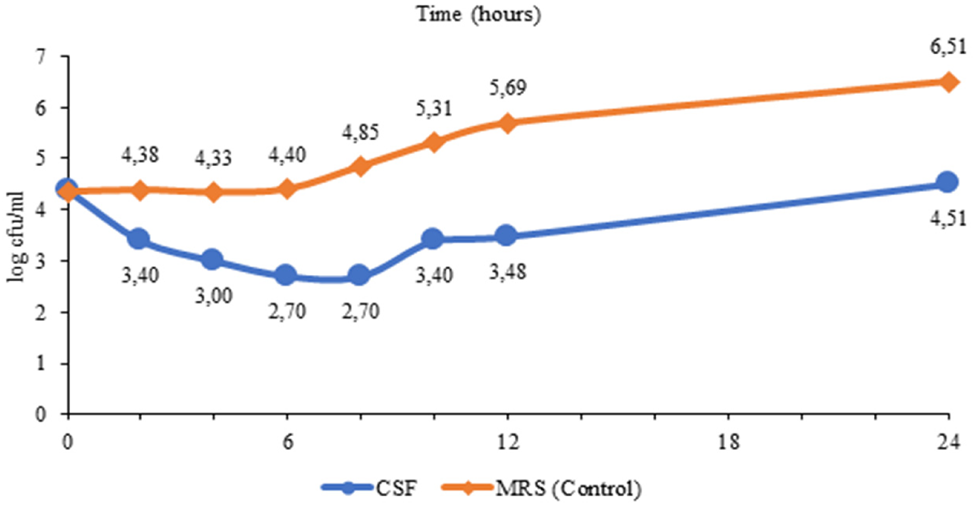
When we evaluated the effect of the CSF strain (QS494) in vitro against Listeria monocytogenes, we observed a bactericidal effect in the first 8 h, with a reduction of 1.7 log CFU/ml (Fig. 1). In the bacteriocin precipitation, a solution with 200 mg/ml of bacteriocin QS494 was obtained. This solution was subjected to a serial decimal dilution in saline solution, and the effect was tested by the spot-on-lawn method. An anti-listeria activity was observed with up to 20 mg/ml. Based on analysis of SDS-PAGE gels, the antimicrobial effect of bacteriocin was attributed to a band < 10 kDa. Changes in the pH of CFS obtained from Lactiplantibacillus plantarum did not affect the antimicrobial activity, which also remained stable after 10 min at 55, 80 and 100°C, as well as treatment for 15 min at 121°C. After freezing (−20°C) for 12 weeks, inhibitory activity was observed after thawing.
Viability of Listeria monocytogenes ATCC 7664 in supernatant (CFS) inoculated with strain QS494 and adjusted to pH 6.0 and heated at 80°C for 10 min (SAA) and MRS (growth control).

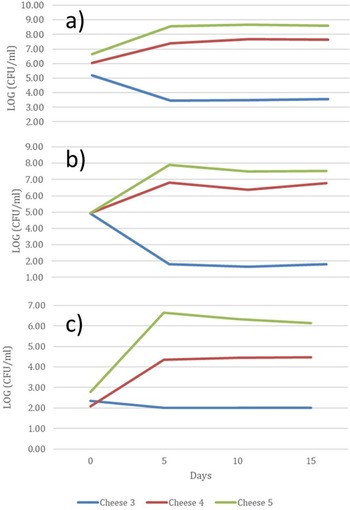
In the cheeses inoculated with bacteriocinogenic LAB, there was a reduction in the count of Listeria monocytogenes over time whereas in the cheeses inoculated with the commercial LAB culture, there was an increase (Fig. 2). In the first study, where we inoculated a concentration of 106 of Listeria monocytogenes, we observed a reduction of 3 logs in 120 h in cheeses produced with bacteriocinogenic LAB, while in cheeses produced with commercial LAB there was an increase of 1 log, as shown in Fig. 2a. In the second study, where we inoculated 104 of Listeria monocytogenes, we also observed a 3 log reduction in the Listeria monocytogenes count in cheeses produced with bacteriocinogenic LAB (Fig. 2b). Finally, in the third study, when we inoculated 102 of Listeria monocytogenes, we had a reduction in the Listeria monocytogenes count, even not detecting it in the counts (Fig. 2c).
Listeria monocytogenes counts in cheeses inoculated with a Listeria monocytogenes concentration of 106 (Fig. 2a), 104 (Fig. 2b) and 102 (Fig. 2c) Cheese 3 was produced with the bactericinogenic LAB strain, Cheese 4 was produced with the commercial LAB strain and Cheese 5 was produced without the addition of LAB. All were made in triplicate.

In the evaluation of the antagonist activity of the film, containing different concentrations of bacteriocin, 50 and 25 mg/ml, against Listeria monocytogenes, halos of 19 and 14 mm, respectively, were observed. Packaging systems containing bacteriocin are effective in inhibiting the growth of pathogenic and/or spoilage microorganisms (Balciunas et al., Reference Balciunas, Martinez, Todorov, Franco, Attilio and Oliveira2013).
Discussion
The higher percentage of bacteriocin-producing strains isolated from cheese, when compared to strains isolated from milk, is also reported by other studies. Sumathi and Reetha (Reference Sumathi and Reetha2009) reported finding 11.11% in cheese and 6.25% in milk. This can be explained by the influence of the environment on the production of bacteriocins, as it is known that the environment acts by influencing the production of bacteriocin to overcome competitive strains (Pattnaik et al., Reference Pattnaik, Grover and Batish2005). The two strains exhibited proteolytic and lipolytic activities as a result of their good technological characteristics, in addition to bacteriocin production.
The production of proteases is a very important characteristic for the technological profile of LAB, because the catabolism of casein and peptides has a major influence on the development of cheese texture, in addition to producing volatile aromatic compounds that contribute to the development of cheese flavor during the maturation (El-Gaish et al., Reference El-Ghaish, Dalgalarrondo, Choiset, Sitohy, Ivanova, Haertlé and Chobert2010). The hydrolysis of triglycerides also contributes to the aroma and flavor of cheeses (Fadda et al., Reference Fadda, Mossa, Pisano, Deplano and Cosentino2004). Lipolytic enzymes together with glycolytic and proteolytic enzymes act in the transformation of fundamental cheese nutrients into compounds with desirable sensory properties (Lima et al., Reference Lima, Lima, Cerqueira, Ferreira and Rosa2009). Furthermore, diacetyl, which is an end product of citrate metabolism, is an essential component in many dairy products as it provides a typical aroma (Shibamoto, Reference Shibamoto2014). When added in the cheese production process, LAB influence proteolysis patterns, contributing to a greater production of aromatic compounds and a reduction in the maturation period (Hong-Xin et al., Reference Hong-Xin, Mi-Ya and Guand-Yu2015).
The isolates showed negative results, by phenotypic methods, for the expression of the virulence factors gelatinase and hemolysin. Gelatinase plays an important role in pathogenicity as it is a protease that is involved in the breakdown of collagen, casein, hemoglobin and small bioactive proteins (Moraes et al., Reference Moraes, Perin, Todorov, Silva, Franco and Nero2012). Hemolysins also play an important role in virulence, as they cause the lysis of erythrocytes, thus increasing the severity of the infection (Franz et al., Reference Franz, Muscholl-Silberhorn, Yousif, Vancanneyt, Swings and Holzapfel2001). This result is interesting, because the absence of these virulence factors is considered a good indicator in the selection of probiotic strains.
The size of the substance band observed in the SDS-Page gel analysis (<10 kDa) is in agreement with most known and characterized bacteriocins, with molecular mass <10 kDa (Chen et al., Reference Chen, Wang, Chow, Yanagid, Liao and Chiu2014; Song et al., Reference Song, Zhu and Gu2014; Du et al., Reference Du, Liu, Zhao, Zhao and Doyle2017). The pH stability information suggests that the bacteriocin produced by Lactiplantibacillus plantarum has antagonist potential in foods with acidic, neutral and alkaline pH, and the evaluation of thermal stability demonstrates that it can be used in the production of pasteurized dairy products and thermally processed foods. Thus, we can say that the evaluated bacteriocin is a promising natural and safe biological preservative for industrial foods.
Other authors have reported similar results to ours regarding the thermal stability of bacteriocins. Wang et al. (Reference Wang, Qin, Xie, Zhang, Hu and Li2018) demonstrated that LPL-1 plantaricin remained stable after treatment at 60, 80, and 100°C for 15 and 30 min and even after treatment at 120°C for 20 min, inhibitory activity was observed. Another study that is in agreement with our results is that of Barbosa et al. (Reference Barbosa, Todorov, Ivanova, Belguesmia, Choiset, Rabesona, Chobert, Hartlé and Franco2016) in which the bacteriocin activity was not affected by the temperature from 4 to 100°C, remaining active even after treatment at 121°C for 15 min.
Considering that Listeria monocytogenes represents a serious food contamination problem, and that it can survive in cheese during manufacture, maturation and refrigerated storage (Morgan et al., Reference Morgan, Bonnin, Mallereau and Perrin2001), the results of the tests of anti-listeria effect in cheese indicate that bacteriocinogenic LAB could contribute to the microbiological safety of cheeses by controlling the growth of Listeria monocytogenes. Although we have only tested in one variety of cheese, the likelihood of the observed effects extending to other types of cheese appears plausible, particularly when technological manufacturing and maturation conditions closely resemble those that facilitate the growth and maintenance of the studied lactic acid bacteria. The fundamental mechanisms governing bacteriocin activity, such as inhibition of pathogenic bacteria and spoilage organisms, are likely to remain consistent across various cheese varieties, making it reasonable to speculate that similar outcomes may be achievable with appropriate adjustments in future research and cheese production practices. Further studies exploring the versatility and adaptability of bacteriocins in different cheese varieties would provide valuable insights into their broader applicability within the dairy industry.
Furthermore, the antagonistic activity of the edible film comprising different concentrations of bacteriocin (50 and 25 mg/ml) against Listeria monocytogenes, where halos of 19 and 14 mm were observed, demonstrates the effectiveness of the edible film against Listeria monocytogenes. Balciunas et al. (Reference Balciunas, Martinez, Todorov, Franco, Attilio and Oliveira2013) reported the effectiveness of packaging systems containing bacteriocin for inhibiting the growth of pathogenic and/or deteriorating microorganisms. However, further studies are required to evaluate the in vitro result of the technological potential of Lactiplantibacillus plantarum (QS494), bacteriocin produced by them, as well as the edible film containing bacteriocin. These studies should aim to identify bacteriocins and demonstrate their effectiveness in protecting cheese against Listeria monocytogenes when used as a wrapping edible film. This technology is a simple alternative, low cost, natural and biodegradable solution, satisfying the growing consumer demand for fresh food, which is minimally processed and free of chemical preservatives (Valdés et al., Reference Valdés, Ramos, Beltrán, Jiménez and Garrigós2017).
In conclusion, although only two of the strains (Lactiplantibacillus plantarum and Lactiplantibacillus pentosus) produced bacteriocin both also exhibited excellent technological characteristics without the presence of phenotypic virulence characteristics (hemolysin and gelatinase production). Thus, they are two strains with technological and biosafety potential for use in the food industry, especially in the production of dairy products, and especially in cheese. The bacteriocin produced by Lactiplantibacillus plantarum was thermostable and resistant to variation in pH, which suggests that it can be used as an alternative to preservatives in many food products, perhaps as a component of edible films for packaging. Large-scale tests using the bacteriocin as a component of an industrial ferment and the skin in cheeses produced in an industrial environment are desirable.
Acknowledgments
The authors acknowledge the Instituto Nacional de Ciência e Tecnologia para a Cadeia Produtiva do Leite (INCT – Leite) and the Conselho Nacional de Desenvolvimento Científico e Tecnológico (CNPq) for financial support.