Introduction
Despite growing evidence for white matter (WM) impairments in bipolar disorder (BD) using diffusion tensor imaging (DTI), findings have been inconsistent (Heng et al. Reference Heng, Song and Sim2010; Vederine et al. Reference Vederine, Wessa, Leboyer and Houenou2011; Nortje et al. Reference Nortje, Stein, Radua, Mataix-Cols and Horn2013). Moreover, impaired WM may reflect either genetic liability for the disorder, illness progression or the effects of treatment (Hajek et al. Reference Hajek, Carrey and Alda2005). First-degree relatives of patients with BD are at increased risk of developing this condition, and recent research has demonstrated strong heritability of WM morphology (Chiang et al. Reference Chiang, Barysheva, McMahon, De Zubicaray, Johnson, Montgomery, Martin, Toga, Wright, Shapshak and Thompson2012). Consequently, studying WM brain abnormalities in individuals at familial risk of developing BD may facilitate understanding of biological risk factors predicting the later development of BD. A number of studies have revealed both widespread and localized reductions in WM integrity in unaffected relatives of patients with BD, but the spatial distribution and extent of these impairments remains uncertain (Frazier et al. Reference Frazier, Breeze, Papadimitriou, Kennedy, Hodge, Moore, Howard, Rohan, Caviness and Makris2007; Versace et al. Reference Versace, Ladouceur, Romero, Birmaher, Axelson, Kupfer and Phillips2010; Matsuo et al. Reference Matsuo, Kopecek, Nicoletti, Hatch, Watanabe, Nery, Zunta-Soares and Soares2011; Sprooten et al. Reference Sprooten, Sussmann, Clugston, Peel, McKirdy, Moorhead, Anderson, Shand, Giles, Bastin, Hall, Johnstone, Lawrie and McIntosh2011; Linke et al. Reference Linke, King, Poupon, Hennerici, Gass and Wessa2013; Mahon et al. Reference Mahon, Burdick, Ikuta, Braga, Gruner, Malhotra and Szeszko2013; Sprooten et al. Reference Sprooten, Brumbaugh, Knowles, McKay, Lewis, Barrett, Landau, Cyr, Kochunov, Winkler, Pearlson and Glahn2013; Emsell et al. Reference Emsell, Chaddock, Forde, Van Hecke, Barker, Leemans, Sunaert, Walshe, Bramon, Cannon, Murray and McDonald2014; Roybal et al. Reference Roybal, Barnea-Goraly, Kelley, Bararpour, Howe, Reiss and Chang2015). For example, whilst lower fractional anisotropy (FA) in the corpus callosum (CC) of high-risk and BD individuals compared with controls has been reported by Sprooten et al. (Reference Sprooten, Brumbaugh, Knowles, McKay, Lewis, Barrett, Landau, Cyr, Kochunov, Winkler, Pearlson and Glahn2013), another study identified this deficit in BD individuals only (Linke et al. Reference Linke, King, Poupon, Hennerici, Gass and Wessa2013). Similarly, reduced WM integrity in the superior longitudinal fasciculus of unaffected relatives has been reported, but whether this effect is intermediate or comparable with the decrease observed in BD patients remains unclear (Frazier et al. Reference Frazier, Breeze, Papadimitriou, Kennedy, Hodge, Moore, Howard, Rohan, Caviness and Makris2007; Sprooten et al. Reference Sprooten, Brumbaugh, Knowles, McKay, Lewis, Barrett, Landau, Cyr, Kochunov, Winkler, Pearlson and Glahn2013), and in the absence of group differences another study reported genetic liability to be associated with FA in this tract (Emsell et al. Reference Emsell, Chaddock, Forde, Van Hecke, Barker, Leemans, Sunaert, Walshe, Bramon, Cannon, Murray and McDonald2014). Among other regions, pathways involved in emotion regulation involving fronto-temporal lobes such as temporal associative tracts, left orbital frontal tracts, superior longitudinal fasciculus, cingulum (Frazier et al. Reference Frazier, Breeze, Papadimitriou, Kennedy, Hodge, Moore, Howard, Rohan, Caviness and Makris2007; Versace et al. Reference Versace, Ladouceur, Romero, Birmaher, Axelson, Kupfer and Phillips2010; Sprooten et al. Reference Sprooten, Sussmann, Clugston, Peel, McKirdy, Moorhead, Anderson, Shand, Giles, Bastin, Hall, Johnstone, Lawrie and McIntosh2011; Mahon et al. Reference Mahon, Burdick, Ikuta, Braga, Gruner, Malhotra and Szeszko2013; Sprooten et al. Reference Sprooten, Brumbaugh, Knowles, McKay, Lewis, Barrett, Landau, Cyr, Kochunov, Winkler, Pearlson and Glahn2013; Emsell et al. Reference Emsell, Chaddock, Forde, Van Hecke, Barker, Leemans, Sunaert, Walshe, Bramon, Cannon, Murray and McDonald2014), pathways connecting fibres to frontal regions such as the internal capsule (Sprooten et al. Reference Sprooten, Sussmann, Clugston, Peel, McKirdy, Moorhead, Anderson, Shand, Giles, Bastin, Hall, Johnstone, Lawrie and McIntosh2011), and intra-hemispheric tracts of the CC responsible for inter-hemispheric communication (Sprooten et al. Reference Sprooten, Brumbaugh, Knowles, McKay, Lewis, Barrett, Landau, Cyr, Kochunov, Winkler, Pearlson and Glahn2013; Roybal et al. Reference Roybal, Barnea-Goraly, Kelley, Bararpour, Howe, Reiss and Chang2015) have been implicated in subjects at increased familial risk of developing BD.
DTI allows for sensitive exploration of WM microstructural features. FA is perhaps the most widely accepted DTI measure and reflects directionally constrained diffusion of water along nerve fibres (Thomason & Thompson, Reference Thomason and Thompson2011). Tract-based spatial statistics (TBSS) is a popular means of quantifying FA that restricts the evaluation of diffusion parameters to a WM skeleton (Smith et al. Reference Smith, Jenkinson, Johansen-Berg, Rueckert, Nichols, MacKay, Watkins, Ciccarelli, Cader, Matthews and Behrens2006) and addresses prior methodological concerns regarding smoothing and normalization (Jones et al. Reference Jones, Griffin, Alexander, Catani, Horsfield, Howard and Williams2002; Chao et al. Reference Chao, Chou, Yang, Chung and Wu2009). Using TBSS, three previous studies have investigated FA in subjects at increased genetic risk of developing BD compared with controls (Versace et al. Reference Versace, Ladouceur, Romero, Birmaher, Axelson, Kupfer and Phillips2010; Sprooten et al. Reference Sprooten, Sussmann, Clugston, Peel, McKirdy, Moorhead, Anderson, Shand, Giles, Bastin, Hall, Johnstone, Lawrie and McIntosh2011; Roybal et al. Reference Roybal, Barnea-Goraly, Kelley, Bararpour, Howe, Reiss and Chang2015).
A limitation of several studies investigating WM abnormalities in unaffected relatives has been the lack of a comparator BD group. The inclusion of such a group enables clarification of whether FA findings in unaffected relatives are similar to, or distinct from, those with the established condition. Hitherto, few studies have investigated (within the same study) FA in patients with established BD, individuals at high genetic risk of developing BD, and controls. To our knowledge, only three previous studies have employed TBSS in all three groups within the same study, each of which had limitations (Linke et al. Reference Linke, King, Poupon, Hennerici, Gass and Wessa2013; Mahon et al. Reference Mahon, Burdick, Ikuta, Braga, Gruner, Malhotra and Szeszko2013; Sprooten et al. Reference Sprooten, Brumbaugh, Knowles, McKay, Lewis, Barrett, Landau, Cyr, Kochunov, Winkler, Pearlson and Glahn2013). Two of these three studies had a modest sample size (Linke et al. Reference Linke, King, Poupon, Hennerici, Gass and Wessa2013; Mahon et al. Reference Mahon, Burdick, Ikuta, Braga, Gruner, Malhotra and Szeszko2013), and the study with the largest sample (n for all groups = 170) (Sprooten et al. Reference Sprooten, Brumbaugh, Knowles, McKay, Lewis, Barrett, Landau, Cyr, Kochunov, Winkler, Pearlson and Glahn2013) recruited unaffected relatives who had already passed the typical age of illness onset (<30 years). Using voxel-based analysis (Frazier et al. Reference Frazier, Breeze, Papadimitriou, Kennedy, Hodge, Moore, Howard, Rohan, Caviness and Makris2007; Chaddock et al. Reference Chaddock, Barker, Marshall, Schulze, Hall, Fern, Walshe, Bramon, Chitnis, Murray and McDonald2009), tractography (Emsell et al. Reference Emsell, Chaddock, Forde, Van Hecke, Barker, Leemans, Sunaert, Walshe, Bramon, Cannon, Murray and McDonald2014) and TBSS (Skudlarski et al. Reference Skudlarski, Schretlen, Thaker, Stevens, Keshavan, Sweeney, Tamminga, Clementz, O'Neil and Pearlson2013), WM deficits have been detected in both psychotic and non-psychotic BD individuals, as well as their unaffected relatives. In three of these four studies, the mean age of unaffected relatives was over 30 years, again suggesting that many would have already passed the typical onset age of BD illness (Chaddock et al. Reference Chaddock, Barker, Marshall, Schulze, Hall, Fern, Walshe, Bramon, Chitnis, Murray and McDonald2009; Skudlarski et al. Reference Skudlarski, Schretlen, Thaker, Stevens, Keshavan, Sweeney, Tamminga, Clementz, O'Neil and Pearlson2013; Emsell et al. Reference Emsell, Chaddock, Forde, Van Hecke, Barker, Leemans, Sunaert, Walshe, Bramon, Cannon, Murray and McDonald2014). Furthermore, DTI findings in studies that included all three groups have been inconsistent in terms of the location and extent of WM abnormalities.
Here, using TBSS, we compared FA in a large young sample of: (i) ‘high risk’ (HR) first-degree relatives of patients with BD who have not been diagnosed with BD; (ii) patients with BD; and (iii) control (CON) subjects without a family history of BD or other mental illness. As those HR subjects with recurrent major depressive disorder (rMDD) are at greatest risk for later development of a manic or hypomanic episode (Hillegers et al. Reference Hillegers, Reichart, Wals, Verhulst, Ormel and Nolen2005; Duffy, Reference Duffy2010), we also compared this subgroup with both the BD and CON groups. To our knowledge, this DTI study comprises both the largest HR sample, and the largest combined sample, across all three groups to date.
Method
Participants
The sample comprised three groups: (i) 111 CON participants [defined as subjects with no parent or sibling with bipolar I (BD-I) or II (BD-II) disorder, recurrent major depression, schizo-affective disorder, schizophrenia, recurrent substance abuse or any past psychiatric hospitalization; and no parent with a first-degree relative who had a past mood disorder hospitalization or history of psychosis]; (ii) 150 subjects genetically ‘high risk’ for BD who had not yet developed this condition (HR) [defined as children or siblings of a proband with a confirmed Diagnostic and Statistical Manual of Mental Disorders, 4th edition (DSM-IV) diagnosis of BD-I or BD-II]; and (iii) 63 BD subjects (defined as meeting DSM-IV criteria for either BD-I or BD-II). All participants were aged between 12 and 30 years. Clinical details of the three groups have been described elsewhere (Perich et al. Reference Perich, Lau, Hadzi-Pavlovic, Roberts, Frankland, Wright, Green, Breakspear, Corry, Radlinska, McCormack, Joslyn, Levy, Lenroot, Nurnberger and Mitchell2015). The study was approved by the Human Research Ethics Committee of the University of New South Wales, and complied with the guidelines of the Australian National Health and Medical Research Council.
The lifetime or current presence of psychiatric disorders (including depression and anxiety) besides BD was not an exclusion factor for either HR or CON subjects. This ecological approach has been used by similar studies of individuals at high genetic risk for BD (Nurnberger et al. Reference Nurnberger, McInnis, Reich, Kastelic, Wilcox, Glowinski, Mitchell, Fisher, Erpe, Gershon, Berrettini, Laite, Schweitzer, Rhoadarmer, Coleman, Cai, Azzouz, Liu, Kamali, Brucksch and Monahan2011). All participants are involved in an ongoing longitudinal study of individuals at high risk for BD aged 12–30 years. HR and BD participants were recruited from families who had previously participated in a BD pedigree molecular genetics study or a specialized BD research clinic, or were otherwise recruited from clinicians, mental health consumer organizations and other forms of publicity. Control subjects were recruited via print and electronic media, and noticeboards in universities and local communities.
The subjects aged between 12 and 21 years are involved in a collaborative high-risk study with a US consortium headed by J.I.N. which is based at Indiana University, Johns Hopkins University, Washington University in St Louis and Michigan University (Nurnberger et al. Reference Nurnberger, McInnis, Reich, Kastelic, Wilcox, Glowinski, Mitchell, Fisher, Erpe, Gershon, Berrettini, Laite, Schweitzer, Rhoadarmer, Coleman, Cai, Azzouz, Liu, Kamali, Brucksch and Monahan2011). As this US–Australian collaboration involves common clinical assessments for participants aged 12–21 years, we report separately on instruments used for the younger (12–21 years) and older (22–30 years) age groups in this sample. Both groups shared consensus best estimate DSM-IV current and lifetime diagnoses derived from semi-structured diagnostic interviews. Brain imaging studies were only undertaken in the Australian sample. A number of functional imaging studies on this BD HR sample have been previously reported (Roberts et al. Reference Roberts, Green, Breakspear, McCormack, Frankland, Wright, Levy, Lenroot, Chan and Mitchell2013; Breakspear et al. Reference Breakspear, Roberts, Green, Nguyen, Frankland, Levy, Lenroot and Mitchell2015).
Proband consensus DSM-IV diagnosis was determined by two independent raters following best estimate methodology (Leckman et al. Reference Leckman, Sholomskas, Thompson, Belanger and Weissman1982), using information from the Diagnostic Interview for Genetic Studies (DIGS) version 4, the Family Interview for Genetic Studies (FIGS) and medical records (where available). Confidence rating ranges using the best estimate methodology vary from 1 to 4, where 1 represents criteria not met for a diagnosis and 4 represents a definite diagnosis. All diagnoses reported have a confidence rating of 3 or 4 (probable or definite). Structured diagnostic interviews were also performed on all HR, CON and BD participants. For those aged between 12 and 21 years (CON, n = 51; HR group, n = 92; BD group, n = 11), an adapted version of the Schedule for Affective Disorders and Schizophrenia for School-Age Children – Present and Lifetime Version (K-SADS-BP) was developed specifically for use in the US–Australian collaborative study of young people at genetic risk for BD (Nurnberger et al. Reference Nurnberger, McInnis, Reich, Kastelic, Wilcox, Glowinski, Mitchell, Fisher, Erpe, Gershon, Berrettini, Laite, Schweitzer, Rhoadarmer, Coleman, Cai, Azzouz, Liu, Kamali, Brucksch and Monahan2011). The K-SADS-BP combines items from the K-SADS Present and Lifetime Version (Kaufman et al. Reference Kaufman, Birmaher, Brent, Rao, Flynn, Moreci and Ryan1997), and uses extended sections on depression, mania and attention-deficit/hyperactivity disorder derived from the Washington University in St Louis K-SADS (WASH-U K-SADS) to elicit detailed information on pre-pubertal mania, rapid-cycling, attentional and subthreshold bipolar symptoms (Geller et al. Reference Geller, Zimerman, Williams, Bolhofner, Craney, DelBello and Soutullo2001). The K-SADS-BP was administered to both the child and one parent. For participants aged under 21 years, clinicians completed the Children's Global Assessment Scale (CGAS).
For participants aged between 22 and 30 years (CON, n = 60; HR group, n = 58; BD group, n = 52), the DIGS (version 4) was used to measure the current and lifetime presence of Axis I DSM-IV disorders. Consensus DSM-IV diagnoses of the HR, BD and CON subjects were determined by two independent raters with best estimate methodology (Leckman et al. Reference Leckman, Sholomskas, Thompson, Belanger and Weissman1982), using the DIGS, the FIGS and medical records (where available). For participants aged between 22 and 30 years, clinicians completed the Global Assessment Scale (GAS).
To assess current mood state, for those aged between 12 and 21 years, the Children's Depression Inventory (CDI) was used, and for participants aged 22–30 years, the Montgomery–Åsberg Depression Rating Scale (MADRS) was administered. To assess current manic symptoms the Young Mania Rating Scale (YMRS) (Young et al. Reference Young, Biggs, Ziegler and Meyer1978) was used for participants aged 22–30 years. Intellectual ability was assessed with the Wechsler Abbreviated Scale of Intelligence. Participants aged 12–30 years completed clinical and neuropsychological assessments on the same day as the scan (McCormack et al. Reference McCormack, Green, Rowland, Roberts, Frankland, Hadzi-Pavlovic, Joslyn, Lau, Wright, Levy, Lenroot and Mitchell2016). The majority of parental reports using the K-SADS were also completed on the same day as the scan.
Magnetic resonance imaging (MRI) acquisition
Images were acquired with a 3-T Philips Achieva scanner at Neuroscience Research Australia (NeuRA) in Sydney with an eight-channel head coil. Two acquisitions of 32 directional DTI data (b = 1000 s/mm2 with one diffusion weighed b0) were acquired using a single-shot echo planar imaging sequence. The imaging parameters were as follows: repetition time = 7638 ms, echo time = 68 ms, 55 slices, slice thickness = 2.5 mm, gap = 0 mm, field of view = 240 × 138 × 240, acquisition matrix size = 96 × 96, flip angle = 90° with an image time of 4 min 42 s per acquisition.
DTI processing
Details of pre-processing and TBSS processing steps are provided in the online Supplementary Method. For skeletonization and region of interest (ROI) extraction from FA images we followed the ENIGMA-TBSS protocols (http://enigma.ini.usc.edu/wp-content/uploads/2014/01/ENIGMA_TBSS_protocol_USC.pdf). We extracted the mean FA across the full skeleton and subsequently calculated average FA values bilaterally for 21 intra-hemispheric and four inter-hemispheric tracts, yielding a total of 46 ROIs. The regions analysed are listed in online Supplementary Table S1.
Statistical analyses
All statistical analyses were carried out using SPSS v.22 (IBM, USA). Sociodemographic differences between groups were assessed using univariate analysis of variance followed by pairwise comparisons for multiple comparisons using the least significant difference (LSD) method. To compare tracts of interest across diagnostic groups, generalized estimating equations (GEE) models were used as they accommodate within-family correlation arising from the inclusion of siblings from within the same family in either the CON, HR or BD groups (families were not split between diagnostic groups). Each base GEE model was run with FA of the ROI as the dependent variable, hemisphere (right and left) as the within-subject factor, diagnostic group as the between-subject factor (CON, HR, and BD), hemisphere × group as an interaction, and age and gender as covariates. To address whether the relationship between age and FA of ROIs differed between groups, a second set of GEE models was fitted where the age × group interaction was also included as an interaction term in the base model. In order to select the most parsimonious model, for ROIs with no significant age × group interaction (p > 0.05) the base model was selected.
Correction for multiple testing of the main effects of group, hemisphere and the group × hemisphere interaction was carried out using false-discovery rate (FDR) q values using the Benjamini & Hochberg (Reference Benjamini and Hochberg1995) method. For each dependent variable we used the most parsimonious model and ranked group, hemisphere and group × hemisphere comparisons (group, hemisphere and group × hemisphere comparisons for 21 intra-hemispheric tracts, and group comparisons for four inter-hemispheric tracts, yielding a total of 67 ranked comparisons). We also compared HR subjects with rMDD (HR-rMDD) (n = 16) against the CON and BD groups where we selected the base models and ranked group, hemisphere and group × hemisphere comparisons for 21 intra-hemispheric tracts, and group comparisons for four inter-hemispheric tracts.
Planned comparisons
Planned post-hoc comparisons were carried out on tracts that revealed either a significant group effect or group × hemisphere interaction after correction for multiple testing: nine group × hemisphere interaction comparisons (three between-group differences within the left and right hemispheres, respectively, in addition to three between-hemisphere differences within each study group), and three between-group comparisons. Planned comparisons were carried out using the LSD method, and corrected using FDR q values.
Effects of medication and illness severity
Separate analyses were performed to determine whether group differences were related to exposure to lithium, antidepressants or antipsychotics. To assess associations between FA and measures of illness severity and course, relationships between FA and age of onset of first manic, hypomanic, depressive or any mood episode were explored using Pearson's correlations; and relationships between FA and number of episodes of hypomania, mania or depression relationships were explored using Spearman's correlations (as that data were not normally distributed).
Results
Demographic and clinical data
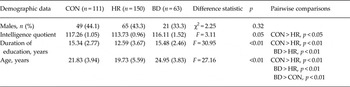
Demographic and clinical data for each group are provided in Tables 1 and 2. The HR participants were slightly younger than both the CON and BD participants, whilst the BD group was older than the CON group. On the MADRS and YMRS, 22- to 30-year-old BD participants scored significantly higher than both their HR and CON counterparts, with no significant differences observed between the latter two groups. Among the 12- to 21-year-old participants, the BD group had significantly higher scores on the CDI than both the HR and CON participants.
Demographic data for CON, HR and BD groups

Data are given as mean (standard deviation) unless otherwise indicated.
CON, Control; HR, high-risk; BD, bipolar disorder.
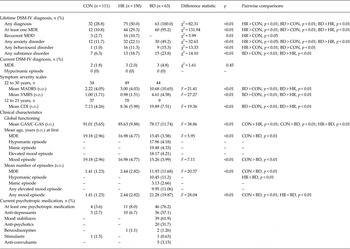
Clinical and medication data for CON, HR and BD groups

CON, Control; HR, high-risk; BD, bipolar disorder; DSM-IV, Diagnostic and Statistical Manual of Mental Disorders, 4th edition; MDE, major depressive episode; MDD, major depressive disorder; MADRS, Montgomery–Åsberg Depression Rating Scale; s.d., standard deviation; YMRS, Young Mania Rating Scale; CDI, Children's Depression Inventory; GAS, Global Assessment Scale; C-GAS, Children's Global Assessment Scale.
a All participants had an intelligence quotient above 80. A lifetime MDE is defined as meeting DSM-IV criteria for at least one MDE. Confidence rating ranges using the best estimate methodology vary from 1 to 4, where 1 represents criteria not met for a diagnosis and 4 represents a definite diagnosis. All diagnoses listed here have a confidence rating of 3 or higher (i.e. probable or definite). Among the 13 participants with a behavioural disorder, 10 had attention-deficit/hyperactivity disorder (five current), three had oppositional defiant disorder (one current) and three had conduct disorder (none current). The average age of onset of recurrent or single-episode MDD in our sample was 17.9 (s.d. = 5.0) years in the HR group, 19.1 (s.d. = 2.9) years in the CON group and 15.1 (s.d. = 2.8) years in the BD group. For anxiety disorders, the ages were 12.7 (s.d. = 6.5), 11.3 (s.d. = 6.7) and 12.5 (s.d. = 6.1) years, respectively. Of the 39 BD participants taking a mood stabilizer, 15 were taking lithium.
Current and lifetime consensus best-estimate DSM-IV diagnoses in all three groups are also detailed in Table 2. It was revealed by χ2 comparisons that the lifetime occurrence of at least one major depressive episode (MDE) or any lifetime DSM-IV diagnosis (including rMDD) was significantly higher in the HR (p < 0.01) compared with the CON group, consistent with prior reports of high-risk populations (Birmaher et al. Reference Birmaher, Axelson, Monk, Kalas, Goldstein, Hickey, Obreja, Ehmann, Iyengar, Shamseddeen, Kupfer and Brent2009; Nurnberger et al. Reference Nurnberger, McInnis, Reich, Kastelic, Wilcox, Glowinski, Mitchell, Fisher, Erpe, Gershon, Berrettini, Laite, Schweitzer, Rhoadarmer, Coleman, Cai, Azzouz, Liu, Kamali, Brucksch and Monahan2011). There were also significantly higher rates of anxiety (p < 0.05) and behavioural disorders (p < 0.01) amongst HR individuals.
Of the 150 HR participants, 81.3% had a parent with BD and 18.7% had a sibling with BD. Of the 63 BD subjects, 34 had BD-I (54%) and 29 BD-II (46%). The 324 participants belonged to 262 families.
FA results: group findings
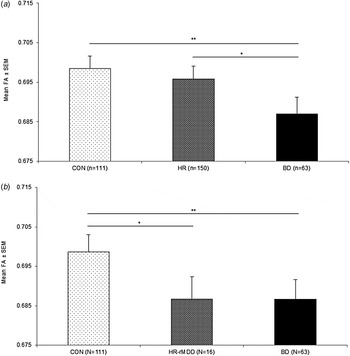
The genu of the CC was the only tract with significant group differences in FA after correction for multiple comparisons (see Fig. 1a ). Pairwise comparison between the groups showed that this effect was driven by lower FA in the BD compared with the HR and CON groups (BD < HR p = 0.03, BD < CON p = 0.003, all FDR corrected). There were no FA differences within the BD group between participants with and without current lithium treatment, between those with and without current antidepressant treatment, and between those with and without current antipsychotic treatment (all p > 0.05 uncorrected). Further, the FA finding remained significant when those with current lithium and/or antipsychotic treatment in the BD group, and those with current MDE and/or current antidepressant treatment current antidepressant use across all three groups were removed [n = 107 CON, n = 139 HR, n = 19 BD; Wald χ2 = 6.41, degrees of freedom (df) = 2, p = 0.040; BD < CON p = 0.025, BD < HR p = 0.012; FDR-corrected pairwise comparisons].Within the BD group, measures of illness severity and course, and mood state did not correlate with FA (all p > 0.05). Furthermore, there were no differences between BD-I and BD-II patients (all p > 0.05).
Group differences in mean fractional anisotropy (FA) in the genu of the corpus callosum (CC). (a) The bipolar disorder (BD) group showed lower FA in the genu of the CC compared with high-risk (HR) and control (CON) groups. False discovery rate (FDR)-corrected group effect and pairwise comparisons. (b) When HR subjects with a lifetime diagnosis of recurrent major depressive disorder (HR-rMDD) (n = 16) were selected from our total HR sample (n = 150) and compared against the CON and BD groups, the HR-rMDD group had reduced FA in the genu of the CC compared with CON subjects. FDR-corrected pairwise comparisons. Estimated means are reported after covarying for age and gender, with standard errors (SEM) represented by vertical bars. * p < 0.05, ** p < 0.01.

To exclude any potential confounding effect of subjects with lifetime major depressive or other DSM-IV disorders in the CON group, we repeated analyses after excluding these subjects. The finding of lower FA in the genu of the CC remained significant when we compared CON participants with no prior or current depressive episode with our total HR and BD samples (n = 99 CON, n = 150 HR, n = 63 BD; Wald χ2 = 8.63, df = 2, p = 0.013; BD < CON p = 0.003, BD < HR p = 0.032), and when we compared CON participants without any lifetime DSM-IV diagnosis with our total HR and CON sample (n = 79 CON, n = 150 HR, n = 63 BD; Wald χ2 = 8.75, df = 2, p = 0.013; BD < CON p = 0.003, BD < HR p = 0.035; BD < CON but not BD < HR pairwise comparison survived FDR correction). Further, to exclude any effect of prior depressive episodes in the HR sample, we compared CON and HR subjects with no prior or current depressive episodes with our BD sample; the differences remained significant (n = 99 CON, n = 106 HR, n = 63 BD; Wald χ2 = 10.09, df = 2, p = 0.006; BD < CON p = 0.002, BD < HR p = 0.013). Additionally, there were no significant differences between those with at least one lifetime depressive compared with those without, both within the CON (p = 0.798) and HR (p = 0.455) groups. Likewise, there were no significant differences between those with or without a lifetime DSM-IV diagnosis within both the CON (p = 0.609) and HR (p = 0.311) groups.
There were no significant differences in FA in the genu of the CC between the total HR and CON groups. However, as detailed in the introduction above, when we compared only HR subjects with rMDD (HR-rMDD) (n = 16) against the CON and BD groups, we found that the HR-rMDD group had lower FA in the genu of the CC compared with CON subjects (Wald χ2 = 12.53, df = 2, p = 0.002; BD < CON p = 0.002, HR-rMDD < CON p = 0.012; all FDR corrected) (see Fig. 1b ). There was no significant difference in FA in this tract between the HR-rMDD and BD groups. This finding remained significant when those with current lithium and/or antipsychotic treatment in the BD group, and those with current MDE and/or current antidepressant use across all three groups were removed (n = 107 CON, n = 12 HR, n = 19 BD; Wald χ2 = 9.21, df = 2, p = 0.010; BD < CON p = 0.012, HR-rMDD < CON p = 0.038). Group comparisons of all ROIs are detailed in online Supplementary Table S2.
Hemisphere results and group × hemisphere interactions
Hemispheric asymmetries are summarized in online Supplementary Table S3 as they are not the focus of this paper. None of the ROI FAs showed a group × hemisphere interaction at either the corrected or uncorrected level. Online Supplementary Table S4 summarizes all group × hemisphere interactions.
Group × age interaction
Only one ROI showed an age × group interaction (for sagittal stratum; p = 0.046); hence in the GEE models this interaction was only included for the sagittal striatum tract.
Discussion
We found reduced WM integrity in the genu of the CC of BD patients compared with both CON subject and those at high familial risk (HR group) in a large and relatively young sample, confirming a number of recent reports of reduced WM integrity of the CC in BD (Barysheva et al. Reference Barysheva, Jahanshad, Foland-Ross, Altshuler and Thompson2013; Lagopoulos et al. Reference Lagopoulos, Hermens, Hatton, Tobias-Webb, Griffiths, Naismith, Scott and Hickie2013; Leow et al. Reference Leow, Ajilore, Zhan, Arienzo, Gadelkarim, Zhang, Moody, Van Horn, Feusner, Kumar, Thompson and Altshuler2013; Linke et al. Reference Linke, King, Poupon, Hennerici, Gass and Wessa2013; Skudlarski et al. Reference Skudlarski, Schretlen, Thaker, Stevens, Keshavan, Sweeney, Tamminga, Clementz, O'Neil and Pearlson2013; Sprooten et al. Reference Sprooten, Brumbaugh, Knowles, McKay, Lewis, Barrett, Landau, Cyr, Kochunov, Winkler, Pearlson and Glahn2013; Emsell et al. Reference Emsell, Chaddock, Forde, Van Hecke, Barker, Leemans, Sunaert, Walshe, Bramon, Cannon, Murray and McDonald2014; Li et al. Reference Li, Kale, Chen, Tang, Ouyang, Jiang, Fan, Ren, Liu, Zhou, Jiang, Liu, Xu and Wang2014; Sarrazin et al. Reference Sarrazin, Poupon, Linke, Wessa, Phillips, Delavest, Versace, Almeida, Guevara, Duclap, Duchesnay, Mangin, Le Dudal, Daban, Hamdani, D'Albis, Leboyer and Houenou2014, Reference Sarrazin, d'Albis, McDonald, Linke, Wessa, Phillips, Delavest, Emsell, Versace, Almeida, Mangin, Poupon, Le Dudal, Daban, Hamdani, Leboyer and Houenou2015; Bauer et al. Reference Bauer, Ouyang, Mwangi, Sanches, Zunta-Soares, Keefe, Huang and Soares2015). Furthermore, and of particular interest, we report the novel finding that whilst the overall HR group showed no difference in this tract compared with CON subjects, there was reduced WM integrity in the CC of those HR individuals with rMDD – a finding which remained significant after exclusion of those with a current MDE or antidepressants. This finding is of particular relevance, as rMDD in those at familial high risk for BD is a strong clinical predictor of later development of hypo/manic episodes (Hillegers et al. Reference Hillegers, Reichart, Wals, Verhulst, Ormel and Nolen2005; Duffy, Reference Duffy2010), suggesting the possibility that lower FA in the genu of the CC may represent a trait marker for BD.
Previous DTI studies of subjects with BD have reported abnormalities in the shape, network organization and WM microstructure of the CC (Bellani et al. Reference Bellani, Yeh, Tansella, Balestrieri, Soares and Brambilla2009; Bellani & Brambilla, Reference Bellani and Brambilla2011). A meta-analysis of CC findings in BD revealed a volumetric reduction in the CC of patients, when compared with controls (Arnone et al. Reference Arnone, McIntosh, Chandra and Ebmeier2008). Prior DTI studies have also reported lower FA throughout the CC, whereas others have reported lower FA in various localized subregions of the CC, in both youth and adults with BD compared with controls (Yurgelun-Todd et al. Reference Yurgelun-Todd, Silveri, Gruber, Rohan and Pimentel2007; Barnea-Goraly et al. Reference Barnea-Goraly, Chang, Karchemskiy, Howe and Reiss2009; Chaddock et al. Reference Chaddock, Barker, Marshall, Schulze, Hall, Fern, Walshe, Bramon, Chitnis, Murray and McDonald2009; Saxena et al. Reference Saxena, Tamm, Walley, Simmons, Rollins, Chia, Soares, Emslie, Fan and Huang2012; Barysheva et al. Reference Barysheva, Jahanshad, Foland-Ross, Altshuler and Thompson2013; Lagopoulos et al. Reference Lagopoulos, Hermens, Hatton, Tobias-Webb, Griffiths, Naismith, Scott and Hickie2013; Linke et al. Reference Linke, King, Poupon, Hennerici, Gass and Wessa2013; Skudlarski et al. Reference Skudlarski, Schretlen, Thaker, Stevens, Keshavan, Sweeney, Tamminga, Clementz, O'Neil and Pearlson2013; Sprooten et al. Reference Sprooten, Brumbaugh, Knowles, McKay, Lewis, Barrett, Landau, Cyr, Kochunov, Winkler, Pearlson and Glahn2013; Emsell et al. Reference Emsell, Chaddock, Forde, Van Hecke, Barker, Leemans, Sunaert, Walshe, Bramon, Cannon, Murray and McDonald2014; Li et al. Reference Li, Kale, Chen, Tang, Ouyang, Jiang, Fan, Ren, Liu, Zhou, Jiang, Liu, Xu and Wang2014; Sarrazin et al. Reference Sarrazin, Poupon, Linke, Wessa, Phillips, Delavest, Versace, Almeida, Guevara, Duclap, Duchesnay, Mangin, Le Dudal, Daban, Hamdani, D'Albis, Leboyer and Houenou2014, Reference Sarrazin, d'Albis, McDonald, Linke, Wessa, Phillips, Delavest, Emsell, Versace, Almeida, Mangin, Poupon, Le Dudal, Daban, Hamdani, Leboyer and Houenou2015; Bauer et al. Reference Bauer, Ouyang, Mwangi, Sanches, Zunta-Soares, Keefe, Huang and Soares2015). In accordance with our finding in the genu, four of these studies found significantly reduced FA in the genu of the CC of BD subjects early in the course of illness compared with controls (Barnea-Goraly et al. Reference Barnea-Goraly, Chang, Karchemskiy, Howe and Reiss2009; Saxena et al. Reference Saxena, Tamm, Walley, Simmons, Rollins, Chia, Soares, Emslie, Fan and Huang2012; Lagopoulos et al. Reference Lagopoulos, Hermens, Hatton, Tobias-Webb, Griffiths, Naismith, Scott and Hickie2013; Leow et al. Reference Leow, Ajilore, Zhan, Arienzo, Gadelkarim, Zhang, Moody, Van Horn, Feusner, Kumar, Thompson and Altshuler2013). We found no association in our BD subjects between this FA finding in the genu of the CC and indices of BD illness course and severity, mood state or current psychotropic medications, suggesting that this WM abnormality was not secondary to either illness course or severity, or medication exposure. This is not surprising given that our BD group represented a young population early in the course of their illness, who appeared to be high functioning, as suggested by above-average intelligence quotient scores (Wechsler, Reference Wechsler1999) and average GAS scores of over 70 (Endicott et al. Reference Endicott, Spitzer, Fleiss and Cohen1976; Shaffer et al. Reference Shaffer, Gould, Brasic, Ambrosini, Fisher, Bird and Aluwahlia1983).
Relatively few studies have examined WM integrity in the CC of subjects at high familial risk of BD, and results have been less consistent than those in patients with established BD. Using voxel-based morphometry, genetic liability for BD has been found to be significantly associated with WM deficits in, among other regions, the genu of the CC (McDonald et al. Reference McDonald, Bullmore, Sham, Chitnis, Wickham, Bramon and Murray2004). In contrast, in other morphological studies of CC size and shape, abnormalities appeared to be disease-related rather than indicative of genetic vulnerability (Walterfang et al. Reference Walterfang, Wood, Barton, Velakoulis, Chen, Reutens, Kempton, Haldane, Pantelis and Frangou2009; Bearden et al. Reference Bearden, Van Erp, Dutton, Boyle, Madsen, Luders, Kieseppa, Tuulio-Henriksson, Huttunen, Partonen, Kaprio, Lonnqvist, Thompson and Cannon2011). In TBSS studies which have included the three groups (controls, those at high familial risk of developing BD, and BD subjects), there have been reports of reduced WM integrity in the CC of BD patients but not in unaffected relatives (Linke et al. Reference Linke, King, Poupon, Hennerici, Gass and Wessa2013). However, subtle significant FA reductions in regions such as the splenium and body of the CC have also been observed in unaffected relatives, with more widespread FA reductions evident in BD patients (Sprooten et al. Reference Sprooten, Brumbaugh, Knowles, McKay, Lewis, Barrett, Landau, Cyr, Kochunov, Winkler, Pearlson and Glahn2013). It is noteworthy that the age ranges in the Linke et al. (Reference Linke, King, Poupon, Hennerici, Gass and Wessa2013) and Sprooten et al. (Reference Sprooten, Brumbaugh, Knowles, McKay, Lewis, Barrett, Landau, Cyr, Kochunov, Winkler, Pearlson and Glahn2013) studies were 18–65 and 18–70 years, respectively, suggesting that many participants included as being at familial risk of developing BD may have already passed the peak age of onset for BD. Also, in accord with the direction of our FA findings, a prior TBSS study that did not include a BD comparison group reported lower FA in one large cluster that included the CC in young high-risk individuals aged 12–25 years compared with controls (Sprooten et al. Reference Sprooten, Sussmann, Clugston, Peel, McKirdy, Moorhead, Anderson, Shand, Giles, Bastin, Hall, Johnstone, Lawrie and McIntosh2011), whereas in contrast, another TBSS study that also did not include a BD comparison group reported increased FA in the body splenium and genu of the CC of children at high risk of developing BD compared with controls (Roybal et al. Reference Roybal, Barnea-Goraly, Kelley, Bararpour, Howe, Reiss and Chang2015).
As our HR group has not yet passed the peak age of onset for developing BD (<30 years), this group is more likely than samples of older subjects to include a higher proportion of individuals who will later convert to BD. Although it is not known at the time of this study which of these individuals may later develop BD, those who have already developed rMDD have been found in other studies to be at greater risk of conversion (Hillegers et al. Reference Hillegers, Reichart, Wals, Verhulst, Ormel and Nolen2005; Duffy, Reference Duffy2010). Our novel finding of reduced WM integrity in the genu of the CC in those who have already developed rMDD in the HR group raises the question of whether this may represent a biological as well as clinically distinct phenotype that may be at particular high risk of ultimately developing BD.
As the CC is the largest WM fibre tract that connects the brain hemispheres, facilitating communication between left- and right-side brain structures (De Lacoste et al. Reference De Lacoste, Kirkpatrick and Ross1985), our findings support the proposition that abnormal interhemispheric connectivity may represent a trait marker for BD (Bellani et al. Reference Bellani, Yeh, Tansella, Balestrieri, Soares and Brambilla2009). Little is known about the functional role of each subregion of the CC. However, anterior regions such as the genu connect the frontal cortices (Aboitiz et al. Reference Aboitiz, Scheibel, Fisher and Zaidel1992) which play an important role in higher-order cognitive and emotional processing (Davidson & Irwin, Reference Davidson and Irwin1999; Galinowski et al. Reference Galinowski, Miranda, Lemaitre, Paillère Martinot, Artiges, Vulser, Goodman, Penttilä, Struve, Barbot, Fadai, Poustka, Conrod, Banaschewski, Barker, Bokde, Bromberg, Büchel, Flor, Gallinat, Garavan, Heinz, Ittermann, Kappel, Lawrence, Loth, Mann, Nees, Paus, Pausova, Poline, Rietschel, Robbins, Smolka, Schumann and Martinot2015). Given the frontal abnormalities frequently reported in BD (Phillips, Reference Phillips and Swartz2014), it is conceivable that microstructural disturbances in the genu of the CC may contribute to the cognitive and emotional deficits characteristic of BD. Bearden et al. (Reference Bearden, Van Erp, Dutton, Boyle, Madsen, Luders, Kieseppa, Tuulio-Henriksson, Huttunen, Partonen, Kaprio, Lonnqvist, Thompson and Cannon2011) has reported a significant association between the genu of the CC and response inhibition, as well as verbal processing speed, in BD probands and their unaffected twins. Recent studies have identified associations between the genu of the CC and multiple neurocognitive domains including working memory, processing speed and psychomotor coordination in BD subjects compared with controls (Ajilore et al. Reference Ajilore, Vizueta, Walshaw, Zhan, Leow and Altshuler2015; McKenna et al. Reference McKenna, Theilmann, Sutherland and Eyler2015; Poletti et al. Reference Poletti, Bollettini, Mazza, Locatelli, Radaelli, Vai, Smeraldi, Colombo and Benedetti2015). Taken together, these findings support the postulation that reduced WM integrity in the genu of CC in our BD and HR-rMDD subjects may be linked to impulsivity and cognitive disturbances.
Limitations
Several methodological issues require consideration. Employment of complementary techniques such as tractography, a technique used to visually represent neural tracts, and whole-brain voxel-based analyses, would contribute to a fuller understanding of possible WM microstructural abnormalities in this population. Furthermore, while FA is widely accepted to be an index of general WM integrity, specific microstructural defects – such as myelin damage, axonal disorganization, or fibre incoherence – which may underlie changes in this metric, remain to be elucidated (Assaf & Pasternak, Reference Assaf and Pasternak2008). Whilst the current study derived average FA per tract, the majority of the cited TBSS BD high-risk papers have used voxel-based TBSS or whole-brain voxel-based analyses, making direct comparison between the present results and previous findings difficult. Further, as the study groups differed on age, we covaried for the potential effects of age, and age × group interactions, in our statistical models. In contrast to a report by Versace et al. (Reference Versace, Ladouceur, Romero, Birmaher, Axelson, Kupfer and Phillips2010), we found no evidence of age × group interactions in CC FA. However, as typical WM cortical development is non-linear (Imperati et al. Reference Imperati, Colcombe, Kelly, Di Martino, Zhou, Castellanos and Milham2011; Lebel et al. Reference Lebel, Gee, Camicioli, Wieler, Martin and Beaulieu2012) and non-linear effects of age could not be incorporated into our model, we cannot exclude the possibility of non-linear effects of age on our findings.
Our results need to be interpreted with caution given the absence of differences between CON subjects and our total cohort of HR subjects (n = 150). Although it is likely that a substantial proportion of our HR individuals with rMDD will develop BD, the time course for this is unknown. With all the current participants enrolled in an ongoing longitudinal study, follow-up data will improve our understanding of the underlying mechanisms that contribute to trajectories that result in BD. As our MRI scans are repeated at multiple time points, in future years we will be able to investigate whether abnormalities in the genu of the CC are more frequent in those who subsequently develop BD. Further, in view of recent studies (Xu et al. Reference Xu, Jiang, Ren, Ouyang, Kong, Womer, Liu, Blumberg, Tang and Wang2013; Bessette et al. Reference Bessette, Nave, Caprihan and Stevens2014) and a meta-analysis (Liao et al. Reference Liao, Huang, Wu, Yang, Kuang, Du, Lui, Yue, Chan, Kemp and Gong2013) which have reported abnormalities in the genu and body of the CC of patients with MDD not at familial risk of BD, it is not possible at present to distinguish between our finding representing a specific risk to future BD or a broader generic risk to mood disorders including MDD.
Conclusions
These results from a large sample provide further evidence that the genu of the CC may play a role in the pathophysiology of BD. Furthermore, in a novel finding, we extend previous CC findings by showing that lower FA in the genu of the CC was also present in those at high familial risk who have rMDD. While it need be acknowledged that the number of those with rMDD was relatively small, and that longitudinal data are needed to definitively determine trajectories that result in BD, our findings nonetheless raise the tantalizing possibility that WM integrity of the CC may represent a potential trait marker for BD.
Supplementary material
The supplementary material for this article can be found at http://dx.doi.org/10.1017/S0033291716001161
Acknowledgements
This study was funded by the Australian National Medical and Health Research Council (Program Grant 1037196) and the Lansdowne Foundation. M.B. acknowledges support from the Queensland Government Office of Health and Medical Research.
Declaration of Interest
J.I.N. is an investigator for Assurex on a study of the clinical efficacy of pharmacogenetic screening and has consulted with Janssen Pharmaceuticals regarding high-risk studies in BD. All other authors report no biomedical financial interests or other potential conflicts of interest.