1. Introduction
This paper focuses on the gender assigned to English nouns when they are borrowed into a gendered language. More specifically, we analyze the factors that govern gender assignment to anglicisms in Dutch. Our analysis indicates that there is variation when gender is assigned to these nouns: Language users do not necessarily agree about the gender they assign to a borrowed noun. Furthermore, we discuss the conditions under which gender variation is the greatest.
This paper is structured in the following way. Section 2 provides an overview of previous studies on gender assignment to anglicisms. First, some universalities that have been identified in previous research are outlined. Then, the notion of gender variation is introduced. In section 3, the gender system of Dutch is discussed. The gender system that applies to native nouns is described, followed by an overview of previous research into gender assignment to anglicisms in Dutch. Section 4 discusses the questionnaire that was used for the analysis, the factors that were taken into account, and the methodology of the study. Section 5 inquires into the factors that influence the choice of the common or neuter article for an anglicism in Dutch. Furthermore, the amount of agreement among the respondents regarding this choice is analyzed. Section 6 outlines the conclusions drawn on the basis of this analysis, the shortcomings of the present study, and suggestions for further research. Section 7 is a conclusion.
2. Gender Assignment to Loanwords
2.1. Universalities in Gender Assignment to Loanwords
Gender assignment to non-native nouns has been studied in the context of lexical borrowing and against the background of bilingualism. Most studies on this topic are based on corpus data; they generally start with a set of anglicisms and their gender from a corpus, questionnaire, or dictionary (for example, Poplack et al. Reference Poplack, Pousada and Sankoff1982, Budzhak-Jones Reference Budzhak-Jones1997, Smead Reference Smead2000, Violin-Wigent Reference Violin-Wigent2006, Cruz Cabanillas et al. Reference Cruz Cabanillas, Martínez, Prados and Redondo2007, Chirsheva Reference Chirsheva2009, Thornton Reference Thornton2009). Most of these studies rely on raw frequencies or proportions to determine the relative importance of the factors that influence gender assignment.
In general, it is assumed that the gender system of the host language applies to loanwords as well, possibly augmented by some loanword-specific additional rules (Corbett Reference Corbett1991, Reference Corbett and Corbett2014). As described in Onysko Reference Onysko2007:164, the English noun family, for instance, is feminine in German, because of a native semantic rule according to which collectives of individuals receive feminine gender (for example, die Gruppe ‘group’).
Determinants of gender assignment that apply to loanwords but not to native nouns have been identified as well. Some scholars have used semantic analogy as an explanation for gender assignment (for example, Poplack et al. Reference Poplack, Pousada and Sankoff1982, Corbett Reference Corbett1991, Thornton Reference Thornton2009): Anglicisms can receive a specific gender due to a semantic association with a native noun in the host language (this factor is also referred to as “lexical equivalence”, “lexical analogy” or “lexical-semantic equivalence”). More specifically, a certain gender is assigned to a loanword because a cognate or translation equivalent in the host language has that gender as well. Cruz Cabanillas et al. (Reference Cruz Cabanillas, Martínez, Prados and Redondo2007), who use data from a corpus of English computer terms borrowed into Spanish, suggest that URL, for example, is feminine likely due to its association with the native feminine noun dirección ‘address’, even though most anglicisms receive masculine gender in Spanish.
However, the explanation of gender assignment through the process of semantic analogy has received some criticism (Corbett Reference Corbett1991, Berteloot & Van der Sijs Reference Berteloot, Van der Sijs and Görlach2003, Onysko Reference Onysko2007, Onysko et al. Reference Onysko, Callies and Ogiermann2013). First, some scholars note that gender equivalence between semantically analogous nouns can also be explained by an underlying semantic gender association that is applicable to native nouns in the host language as well (Corbett Reference Corbett1991, Onysko Reference Onysko2007). Second, determining the closest native equivalent is often problematic. Onysko (Reference Onysko2007:166–167, 327–328), for instance, finds that only 17 out of 63 monosyllabic masculine anglicisms have the same gender as their native German equivalents (for example, der Beat like der Schlag or der Takt), while for 18 out of 63 anglicisms the gender of the native equivalent is not masculine (for example, der Song versus das Lied). The rest of the 63 monosyllabic masculine anglicisms in his corpus (N=28) either have no clear German equivalent (for example, der Flow) or have more than one native equivalent, with different genders (for example, der Chip like der Jeton, but also die Marke).
Onysko et al. (Reference Onysko, Callies and Ogiermann2013:108–109) argue for an interpretation of lexical equivalence as a continuum of associative strength. This continuum can be interpreted in a quantitative way: The stronger the association between an anglicism and a native noun, the more likely it is that the anglicism will be assigned the gender of the associated native noun. The association between an anglicism and a native noun is the strongest when the native language has a cognate that resembles the anglicism in (etymological) form and meaning (for example, das Notebook analogous to German das Buch ‘the book’). The association between an anglicism and a native noun is the weakest when the native language has a translational equivalent that is not formally related to the English noun (for example, die E-Mail analogous to die elektronische Post). The central portion of the continuum is taken up by anglicisms associated with a basic concept for which only one native lexical item exists (for example, die Time like die Zeit).
Loanwords can also receive gender by being assigned the unmarked, or default gender of the host language (for example, Haugen Reference Haugen1969:440–449, Weinreich Reference Weinreich1968:45, Hock & Joseph Reference Hock and Joseph1996:266–269). The unmarked gender is often equated with the most frequent gender, but, according to Corbett Reference Corbett1991, this view is problematic: Attributing default status to the most frequent gender can mask aspects of the underlying gender system of the host language. In Russian, for instance, the proportion of masculine nouns is exceptionally high among German loanwords (78.5% of all German loanwords are masculine). Based on frequency alone, masculine gender seems to be the default gender in Russian: The proportion of neuter native nouns is decreasing over time in favor of masculine (and feminine) nouns. So it could be argued that German loanwords receive masculine gender by default. However, Corbett argues that in this case, an explanation of gender assignment in terms of unmarked gender ignores the constraints of the host language (see also Poplack et al. Reference Poplack, Pousada and Sankoff1982). The large proportion of German loans that receive masculine gender can be explained by the fact that in German, many nouns end in a consonant. These types of nouns always receive masculine gender in Russian. Finally, some scholars argue that the grammatical gender of a noun in the donor language may play a role as well (Corbett Reference Corbett1991; Rothe Reference Rothe, Zenner and Kristiansen2014). However, since in English, nouns do not carry overt gender markers, this rule does not apply to anglicisms.Footnote 1
This study focuses on the assignment of gender to anglicisms in a gendered language, Dutch. In the Dutch language, the gender of nouns is to a large extent arbitrary. As a result, the influence of the second set of factors, which apply to loanwords but not to native nouns, may be especially significant.
2.2. Variation in the Degree of Homogeneity in the Speech Community
The assumption that the gender system of the host language applies to loanwords, as well as the two explanations that apply to loanwords but not to native nouns (that is, semantic analogy and unmarked gender) imply that speakers generally agree on the gender of loanwords (see, for instance, Corbett Reference Corbett1991). Any variation in gender assignment has usually been explained by the fact that the borrowed nouns are not yet established in the host language. For instance, Poplack et al. (Reference Poplack, Pousada and Sankoff1982) find some variation in their corpora used to study the gender of anglicisms in Puerto Rican Spanish and Montreal French. However, they explain this variation by referring to the role of the speech community: “[o]nce a borrowed noun is assigned a gender by whatever criteria, there is generally unanimous agreement among speakers” (Poplack et al. Reference Poplack, Pousada and Sankoff1982:25).
Like the studies mentioned in section 2.1, Poplack et al. Reference Poplack, Pousada and Sankoff1982 is based on corpus data; experiment-based studies on this topic are relatively few. One study that uses experimental data is Callies et al. Reference Callies, Onysko, Ogiermann and Furiassi2012. The authors explicitly address variability in the gender of anglicisms in German. Their analysis shows that the amount of variation is relatively large, especially in experimental data. These findings suggest that in corpus-based studies, the amount of variability in the gender of loanwords could have been underestimated.
Our study aims to investigate variability in gender assignment using the following approach. First, following Callies et al. Reference Callies, Onysko, Ogiermann and Furiassi2012, the dataset used for the analysis is based on experimental data, collected on the basis of a forced choice task, to avoid diminishing the amount of variability in the speech community. Second, we empirically investigate the findings of Poplack et al. Reference Poplack, Pousada and Sankoff1982 that the gender of a loanword is variable until the noun is established in the host language by including two types of anglicisms in our dataset. On the one hand, we take into account established anglicisms, which are “widespread, recurrent and accepted” (Rothe Reference Rothe, Zenner and Kristiansen2014:209; see also Muysken Reference Muysken2000). More specifically, we use English nouns that were borrowed in the 1950s or later, but that are already listed (with a particular gender) in a Dutch dictionary. On the other hand, we incorporate nonestablished anglicisms in our dataset. These are English loans that are not dictionary-listed and not wide-spread. We also make sure to include nonestablished anglicisms that occur with varying frequencies. This strategy allows us to empirically assess whether there really is “unanimous agreement among speakers” (Poplack et al. Reference Poplack, Pousada and Sankoff1982:25) once an anglicism becomes associated with a particular gender in the speech community.
Third, we analyze gender assignment to anglicisms in Dutch in a quantitative way. Our goal is to find out whether there are statistical differences between established and nonestablished anglicisms. More-over, we aim to add some methodological innovations to this field of study by relying on inferential statistical techniques rather than on raw frequencies or proportions. Additionally, we use the predictions of our quantitative analysis to empirically investigate the connection between the establishment of an anglicism and the lack of homogeneity in the speech community. Before presenting our analysis, we first discuss the gender system of Dutch and some previous research on the gender of anglicisms in Dutch.
3. Gender in Dutch
3.1. The Gender of Native Nouns in Dutch
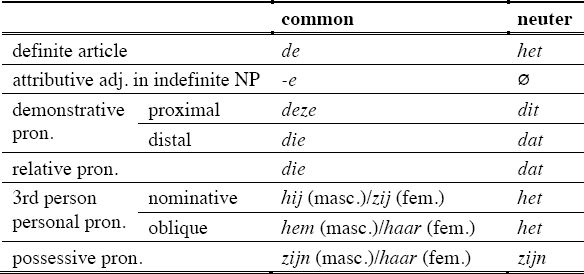
The gender of nouns in Dutch is largely arbitrary (Haeseryn et al. Reference Haeseryn, Romijn, Geerts, De Rooij and Van Den Toorn1997). For most nouns in Standard Dutch, gender is not distinguishable on the basis of properties of the nouns themselves. Only for a small group of nouns, some formal or semantic tendencies have been described.Footnote 2 The definite article identifies the gender of a noun: Nouns preceded by de are common (for example, de stoel ‘the chair’), while het is used for neuter nouns (for example, het huis ‘the house’).
Other constituents within the noun phrase—such as the attributive adjective, the 3rd person personal pronoun, and the demonstrative pronoun—can mirror the gender of a noun as well (see table 1).Footnote 3 Interestingly, the personal and possessive pronouns still reflect the traditional three-way division into masculine, feminine, and neuter gender. However, due to the loss of formal gender marking on the noun, the pronominal gender system shows variation (De Vogelaer & De Sutter Reference Vogelaer and De Sutter2011, Kraaikamp Reference Kraaikamp2012; also see Audring Reference Audring2009).
Gender in Dutch in the singular noun phrase.

The Dutch language offers an interesting perspective on gender assignment to anglicisms. Most scholars assume that the native gender system is reflected in gender assignment to loanwords (see section 2.1). As the Dutch gender system is currently undergoing change, and gender assignment to native Dutch nouns is arbitrary to a large extent, it is expected that non-native factors, such as semantic analogy and default gender, will turn out to be important.
3.2.
The Gender of Anglicisms in Dutch
Previous research on the gender of anglicisms in Dutch has identified the most important tendency: Anglicisms are assigned common gender by default unless there is a reason for using neuter (Schenck Reference Schenck1985, Koenen & Smits Reference Koenen and Smits1992, Geerts Reference Geerts1996, Posthumus Reference Posthumus1996, Verhoeven & Jansen Reference Verhoeven and Jansen1996, Haeseryn et al. Reference Haeseryn, Romijn, Geerts, De Rooij and Van Den Toorn1997, Berteloot & Van der Sijs Reference Berteloot, Van der Sijs and Görlach2003, Hamans Reference Hamans, Burger and Pienaar2009). Such reasons can be semantic or morphological, or they can involve some kind of analogy between the anglicism and a native Dutch noun.
First, some anglicisms are assigned common or neuter gender because they fit into a particular semantic category. Breeds of dogs, for instance, such as bulldog or husky, and drinks such as gin, tonic, or whiskey, are assigned common gender, while collectives such as panel or team, and sports such as rugby or hockey, are neuter in Dutch.Footnote 4 Some nouns that denote substances, such as plastic or velvet, are neuter, while others can be either neuter or common (for example, de/het nylon, de/het rubber).
Second, the morphology of the anglicism can also play a role. More specifically, suffixes can influence the gender of a loanword, especially when the foreign suffix resembles a native suffix. For instance, nouns ending in -ing, such as dancing, generally receive common gender (for instance, Dutch de mededeling ‘announcement’), while nouns with the suffix -ment, such as management, are usually neuter (for instance, Dutch het argument ‘argument’, het document ‘document’).
Third, it has been noticed that many anglicisms in Dutch copy the gender of a closely related equivalent (semantic analogy). In some cases, the equivalent is a cognate, which is both formally and semantically related. For instance, arthouse is probably assigned neuter gender under the influence of its neuter cognate huis ‘house’; copyright is probably neuter under the influence of neuter gender recht ‘justice, law’. The gender of yet another group of anglicisms is said to be influenced by the gender of a translational equivalent, which does not formally resemble the borrowed noun. For example, it is possible that approach is assigned common gender by analogy with the Dutch common gender noun aanpak, whereas bacon may be neuter because it is associated with the native Dutch neuter noun spek.
However, it is not very clear how these rules interact. Most scholars merely provide an overview of all the rules applicable to anglicisms in Dutch, based on a list of English loans that follow one (or more) of those rules. Geerts (Reference Geerts1996) is one notable exception: He constructs a hierarchy that describes what happens if multiple rules apply to a single anglicism in Dutch. According to Geerts, the gender of a cognate has a stronger influence than the prototypical gender of nouns within the same semantic field; the latter, in turn, has a stronger influence than the gender associated with a particular suffix, which is, again, more important than a translation equivalent's gender. For instance, gingerbeer is a neuter noun in Dutch because its association with the native neuter cognate bier takes precedence over the prototypical common gender associated with the semantic field drinks.Footnote 5
4. Data and Methods
Our analysis aims to answer two distinct research questions. First, we use inferential statistical techniques to determine which factors had a significant influence on the gender of anglicisms in Dutch. Second, we used the results of our statistical analysis to identify anglicisms whose gender causes the most disagreement within the speech community (that is, among the respondents of our survey). To answer these research questions, we used data collected through a questionnaire. The analysis was carried out using R (R Development Core Team Reference Onysko, Callies and Ogiermann2013). This section presents the data, variables, and methodology used in the analysis. Section 4.1 outlines the design of the questionnaire. Section 4.2 provides an overview of the variables that were used for the analysis. In section 4.3, the methodology is explained.
4.1. Data Collection
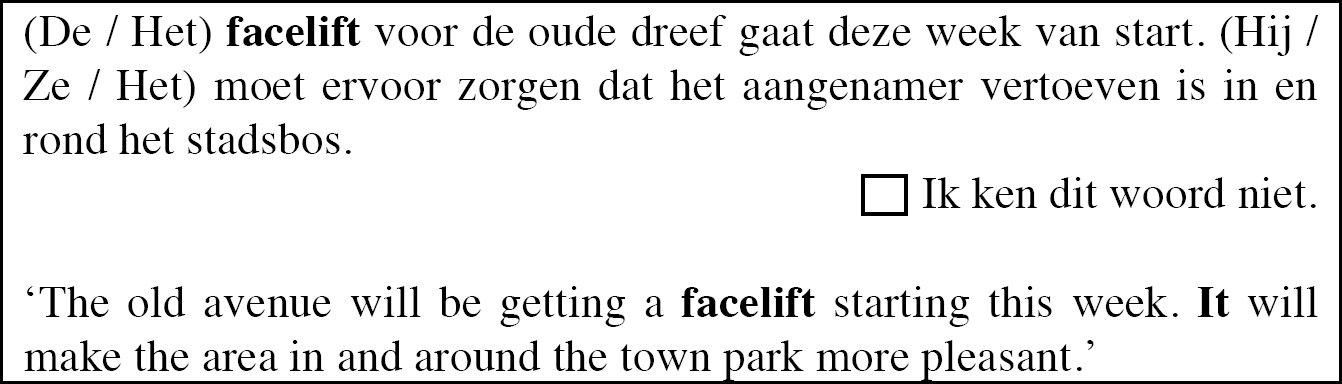
The questionnaire consisted of two parts. The first part contained a forced choice task, in which 175 sentences were presented to the respondents, with one nominal anglicism per sentence (see figure 1). Each of the 175 anglicisms in the study represents a combination of several predictors as discussed in section 4.2 below. Participants were asked to choose the definite article (common de or neuter het) and personal pronoun (masculine hij, feminine ze, or neuter het) to replace the anglicism (marked in bold) in the sentence.Footnote 6 They could also check a box labeled Ik ken dit woord niet ‘I don't know this word’ in case they did not know the anglicism in question.
Excerpt from the main section (part 1) of the questionnaire.

We collected the nominal anglicisms used in the questionnaire in two ways. The established loanwords were selected from the 14th edition of Van Dale, an important descriptive and implicitly normative dictionary of Dutch (Den Boon & Geeraerts Reference Boon and Geeraerts2008). We selected nouns with an English etymology borrowed in 1950 or later. Our final dataset contains 97 established anglicisms. The second group consists of nonestablished English nouns selected from both Dutch and English sources. As Dutch has two national varieties—Netherlandic Dutch and Belgian Dutch—and is considered a pluricentric language (Clyne Reference Clyne1992), we used two news corpora, the Twente News Corpus (TwNC) and the Leuven News Corpus (LeNC), which represent Netherlandic Dutch and Belgian Dutch, respectively. TwNC contains all the newspaper articles that appeared in the five national daily newspapers in the Netherlands from 1999 to 2002. LeNC is a corpus of national daily newspapers from Flanders. It contains all the newspaper data from 1999 to 2005. Together TwNC and LeNC contain over 1.6 billion words.
The nonestablished anglicisms were collected by first matching all the lexemes from English WordNet to token frequency lists of both corpora (see Zenner et al. Reference Zenner, Speelman and Geeraerts2012, Zenner Reference Zenner2013). Ambiguous items, such as cognates (for example, man), items with unclear etymology (for example, supervisor), and loans from other languages (for example, minister) were removed from this list. Next, a manual search was conducted in the Van Dale dictionary for entries with an etymological link to English to ensure that the anglicisms were not established in Dutch. Finally, we restricted our attention to relatively frequent nonestablished anglicisms: Only anglicisms that occur with a minimum of 100 tokens in TwNC and LeNC combined and that are not listed in the 14th edition of Van Dale were included in the questionnaire. In total, our questionnaire contains 78 nonestablished anglicisms.
For drafting the stimulus sentences, we used a search engine (google.be) and a news website (mediargus.be).Footnote 7 Using these sources ensures that the sentences in the questionnaire are as natural as possible. We presented the sentences to our respondents in two randomized orders. A chi-square test indicates that there is no significant difference between the answers of the respondents in the two versions of the questionnaire.
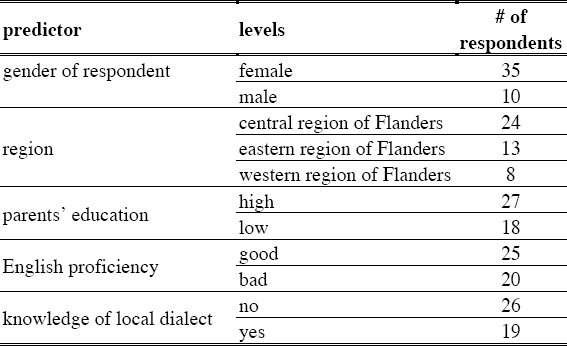
In the second part of the questionnaire, the respondents provided information about their age, gender, place of residence, area of study, and the occupation of their parents. The data from 45 respondents were analyzed.Footnote 8 All of the respondents were students at the University of Leuven at the time the questionnaire was distributed (April/May 2013). The mean age of the respondents was 21.49. Men are underrepresented in our data (10 male respondents out of 45). The respondents come from all over Flanders: Twenty-four respondents live in the provinces of Antwerp and Flemish Brabant (central region of Flanders), 13 in the province of Limburg (in the eastern region of Flanders), and 8 in the provinces of East or West Flanders (in the western region of Flanders). The socio-economic status of the participants was assessed based on their parents’ occupation. More specifically, we relied on the Standard Occupations Classification (Standaard Beroepenclassificatie) provided by the Dutch Central Bureau of Statistics in 2010 (Centraal Bureau voor de Statistiek). Each respondent was assigned an ID number from 1 to 45.
4.2. VariablesFootnote 9
In this section, we present factors, which, based on previous research, may influence gender assignment to loanwords in Dutch. These factors are used as predictors in a logistic regression analysis. A few theoretically interesting predictors, such as the presence of a suffix associated with a particular gender, were not included in the analysis. Determining the influence of the gender associated with a suffix is relatively difficult in a multifactorial setting because most Dutch suffixes used with English loanwords are associated with common gender (one exception is the suffix -ment).
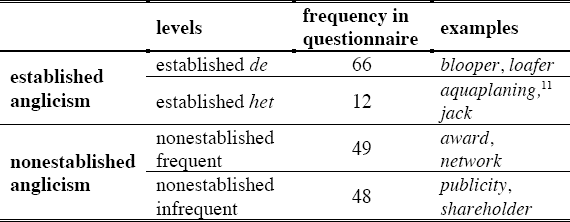
The first predictor in our analysis is establishment. As discussed in sections 2.1 and 4.1, in our study we used established and nonestablished anglicisms. Established anglicisms were then further divided into two groups, based on the Dutch article with which they appear in the dictionary: de versus het. Nonestablished anglicisms were further divided into frequent and infrequent. The values of the predictor establishment appear in table 2.
Levels of the predictor establishment.

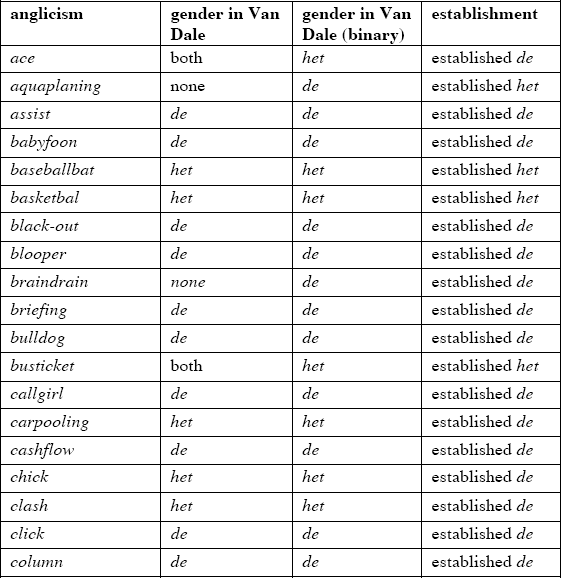
In section 4.1, the different data collection methods used to collect established and nonestablished anglicisms were discussed. The frequency value of the nonestablished anglicisms is based on their token counts in TwNC and LeNC: Frequent nonestablished anglicisms occur 300 times or more in TwNC and LeNC combined, whereas infrequent nonestablished anglicisms occur less than 300 times (see appendix 2).Footnote 10 With regard to the established nouns, we follow the information listed in the Van Dale dictionary: Anglicisms listed as common nouns are coded as established de, while anglicisms listed as neuter nouns are classified as established het (see appendix 1).
The frequency of nonestablished anglicisms and the gender listed for established anglicisms are combined in the composite variable establishment. This categorical variable has four possible levels: “established de”, “established het”, “nonestablished frequent”, “nonestablished infrequent”.
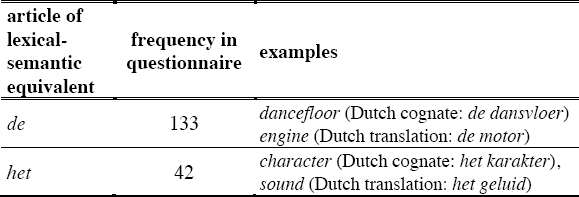
Table 3 provides an overview of the frequency of the anglicisms in the questionnaire—that is, the number of sentences per type (or level)—along with examples. Appendices 1 and 2 contain a list of all the nouns in the questionnaire. For the established anglicisms, the gender listed in the Van Dale dictionary is specified. For the nonestablished ones, their token frequency in TwNC and LeNC, and the categorical division into frequent and infrequent is provided.
Absolute frequencies of anglicisms for the predictor establishment.

With respect to the established anglicisms, we expected our respondents to prefer the gender listed in the dictionary; with respect to the nonestablished anglicisms, we expected them to prefer the default article de. Furthermore, the predictor establishment allows us to determine to what extent establishment of an anglicism can explain variability in agreement about its gender (see section 2.2). We expected to observe less homogeneity in case of anglicisms that are not yet established and infrequent.
Our second predictor is article of lexical-semantic equivalent; it has two levels: de and het. This variable takes two types of analogy into account: analogy with the gender of a Dutch cognate and analogy with the gender of a Dutch translational equivalent. We define a cognate as a formally and semantically associated word: Dutch kanaal, for instance, is a cognate lexeme of English channel; Dutch karakter is a cognate of English character. A translational equivalent has a looser connection with the anglicism: The Dutch noun does not bear any formal similarity to the borrowed noun. For example, prestatie is the translational equivalent of English achievement, whereas gastenverblijf is the translational equivalent of English guesthouse (which also contains a Dutch cognate, huis). To determine the most suitable translation, we use a translation dictionary (Van Dale Lexicografie 2006).
Rather than using the presence or absence of a cognate or a translation as a predictor, we instead rely on the gender listed for that cognate or for the translation of an anglicism. The gender of the cognate or translation is based on the Van Dale dictionary (Den Boon & Geeraerts Reference Boon and Geeraerts2008) and the online edition of the Woordenlijst Nederlandse Taal (Instituut voor Nederlandse Lexicologie & Nederlandse Taalunie 2005), which lists the official spelling and gender of a large number of Dutch words.
We expected that anglicisms would frequently adopt the gender of their Dutch lexical-semantic equivalent. Our initial analysis confirmed that for the purposes of gender assignment, an analogy is more likely to be drawn between the anglicism and its cognate than between the anglicism and its translation equivalent (see also Onysko et al. Reference Onysko, Callies and Ogiermann2013). Therefore, we used a coding procedure for the lexical-semantic equivalence predictor that consists of two parts. As the first step, we checked whether an anglicism had a clear cognate. If so, we coded the gender of that cognate. If the anglicism did not have a clear cognate, we coded the gender of the translational equivalent.Footnote 12 For example, skateboard is translated as a common noun rol(schaats)plank in the dictionary. However, it receives neuter gender as far as the predictor article of lexical-semantic equivalent is concerned: It occurs with the article het by analogy with bord, its neuter cognate. The anglicism beach does not have a clear cognate, so the neuter gender of its translation (‘strand’) is used for the purposes of article of lexical-semantic equivalent. Table 4 provides an overview of the distribution of anglicisms in the questionnaire with respect to the predictor article of lexical-semantic equivalent. In general, anglicisms with a common gender equivalent (article de) are much more frequent than anglicisms with a neuter equivalent (article het).
Absolute frequencies of anglicisms for the predictor article of lexical-semantic equivalent.

Our next predictor is animacy of the referent of the anglicism. A small group of native Dutch nouns receive a certain gender because of the semantic field to which they belong (see section 3.1; Haeseryn et al. Reference Haeseryn, Romijn, Geerts, De Rooij and Van Den Toorn1997). Nouns with animate referents, including names for occupations and animals, are generally common (de onderwijzer ‘the teacher’, de leeuw ‘the lion’), while names of sports, games, and metals are usually neuter (het voetbal ‘the soccer’, het goud ‘the gold’). However, with the exception of nouns referring to sports and games, and nouns referring to persons, most loanwords do not belong to these semantic categories.Footnote 13 Therefore, we focus on the animacy of the anglicisms in the dataset to determine whether animate loanwords show a preference for the common gender, as is the case for the native Dutch nouns.Footnote 14
An anglicism is coded as “animate” if the referent of the noun is a human or an animal (believer, bulldog). All other anglicisms are labeled “inanimate” (busticket, container ship). Table 5 provides an overview of the absolute frequencies of the anglicisms in the questionnaire with respect to the animacy predictor. Since native Dutch nouns with animate referents are usually common, we expected anglicisms with animate referents to occur frequently with the common gender article de as well.
Absolute frequencies of anglicisms for the predictor animacy.

The next set of predictors in our analysis concerns lectal features. We used personal information collected in the second part of the questionnaire to establish whether participants’ sociolinguistic background plays a role in what gender they assign to anglicisms. More specifically, we wanted to find out whether the participants’ gender, place of residence, parental educational level (as a proxy for the socio-economic status of the participants), level of English proficiency, and knowledge of a local dialect correlate with their responses (see table 6).Footnote 15
Overview of lectal variables.

Overall, the number of participants in the study is relatively low (N=45). This may explain why, as the results show, none of the lectal features reach significance in a multifactorial environment.
4.3. Methodology
Previous research on gender of anglicisms in Dutch relies on raw frequencies or proportions to determine the relative importance of the factors that influence gender assignment. Moreover, to identify gender assignment rules, these studies generally use small corpora or lists of anglicisms collected from dictionaries (see, for instance, Geerts Reference Geerts1996). We aim to complement these studies by using inferential statistics to determine which factors have a significant influence on the choice of gender. More specifically, we use multiple mixed-effects logistic regression to model the effect of lectal and language-internal features on the binary response variable article (common de or neuter het).
A major advantage of a multifactorial regression model is that it can assess the impact and the significance of each of the predictors while taking into account the combined influence of all the variables in the model. Furthermore, this model allows for the inclusion of random effects. Using random effects is appropriate when a factor cannot be replicated, in the sense that the levels of the factors are not fixed and would differ if the experiment is repeated (Baayen Reference Baayen2008). For instance, the levels of the variable gender remain the same (male, female) every time the experiment is repeated. By contrast, the anglicisms and respondents in our questionnaire are sampled from a large pool of possible anglicisms and respondents, and are therefore highly unlikely to reoccur from experiment to experiment. Moreover, each respondent in the dataset chose an article for 175 anglicisms. Accordingly, the dataset contains some respondent-specific regularities: The responses of each respondent are probably correlated. The same holds for each of the anglicisms: Forty-five respondents chose an article for each of the English nouns, so the responses per anglicism are probably correlated as well. To cope with this type of respondent-specific and anglicism-specific variation, random factors can be included in a logistic regression model.
5. Determinants of Gender Assignment to Anglicisms in Dutch
5.1. Predicting Anglicism Gender
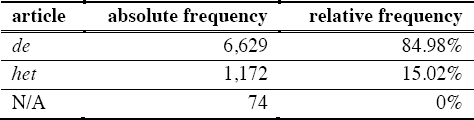
This section inquires into the factors that influence the gender chosen for anglicisms in Dutch. Overall, the participants in the study showed a preference for the common gender article de (see table 7).
Distribution of response variable article.

Using a forward stepwise selection procedure, we built a mixed-effects logistic regression model. We examined the influence of all the predictors discussed above, namely, establishment, the article of the lexical-semantic equivalent, animacy of the referent, and the lectal features (the participants’ gender, home region, parental educational level, level of English proficiency, and knowledge of a local dialect). Three predictors reach significance at the 0.05 level: the degree of establishment of the anglicism, the animacy of its referent, and the article of its lexical-semantic equivalent.Footnote 16 Interaction effects were taken into consideration, but they did not contribute enough to the explanatory power of the model to be included in the final model. Our model also contains random intercepts for two factors: anglicism and respondent. We checked whether by-subject random slopes could be added to the model, but the data do not support a model that is more complex than the model with two random intercepts. Diagnostics reveal a good fit of our model to the data.Footnote 17 The model performs well: It predicts 91.33% of the variants in our dataset correctly (compared to a baseline of 85% for a model that always chooses the most frequent variant de). The model's performance is also confirmed by the high C-value of 0.93 (a C-value of 0.8 or higher indicates that the model has predictive power).
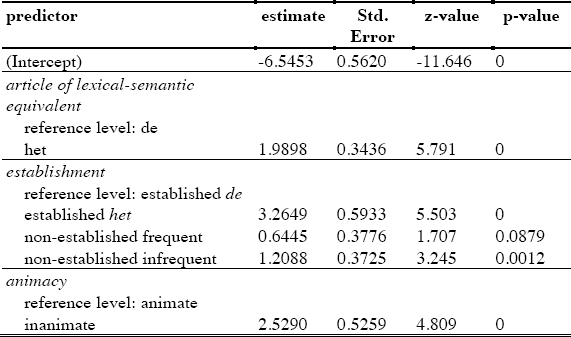
Table 8 presents the output for the fixed effects in the mixed model. The predictors are presented in their relative order of importance: The article of the lexical-semantic equivalent and the degree of establish-ment of the anglicism have a significant influence on the choice between de and het. Animacy does not influence the alternation as much as the other two variables.
One reference level is chosen for each of the variables in the model. This level is included in the intercept, and so it does not receive separate values in the output. For instance, the reference level for article of lexical-semantic equivalent is de. The estimates, which are shown in the second column of the table, convey the direction and effect size of the impact of each predictor. These estimates for the levels of each predictor should be compared to the estimate for the intercept. The final column reports the p-value for each of the estimates (alpha level=0.05). The model predicts het, which means that positive estimates with a p-value smaller than 0.05 indicate that the odds of respondents choosing het are higher in comparison to the reference level, while significant negative estimates indicate that the probability of respondents choosing de is higher in comparison to the reference level. In other words, positive estimates indicate a higher probability of het, whereas negative estimates indicate a higher probability of de.
Output for the fixed effects in the mixed effects logistic regression model.

Table 8 shows that, not surprisingly, the gender of the Dutch cognate or translation equivalent often correlates with the gender assigned to an anglicism. More specifically, the chance of respondents using het with an anglicism is significantly higher when its Dutch lexical-semantic equivalent occurs with het than when it occurs with de. For example, only 1 out of 45 respondents used de for skateboard, which has a clear neuter cognate het bord, whereas for input, which has a common gender translation, de invoer, 44 out of 45 respondents selected de.
Moreover, table 8 confirms that the gender assigned to established anglicisms in the dictionary is a significant predictor of gender assignment. The probability of respondents using het is much higher if the anglicism is listed with het in the dictionary (for example, 31 out of 45 respondents use het for entertainment). In contrast, the probability of het is lower if the anglicism is listed as a common noun with de (for example, only 1 out of 45 respondents uses het for knowhow). Furthermore, table 8 also reveals significant differences between established loanwords listed with de and nonestablished anglicisms: The probability of de is lower for nonestablished anglicisms, especially if they are infrequent. This may be due to a strong correlation between established nouns that are listed with de and usage of the common gender determiner. For nonestablished anglicisms, such a correlation does not exist.
The estimates for the third predictor in the model, that is, animacy, indicate that respondents are more inclined to use the neuter article het for inanimate nouns. This is in accordance with the general agreement system of Dutch, as described in Haeseryn et al. Reference Haeseryn, Romijn, Geerts, De Rooij and Van Den Toorn1997: Nouns referring to humans and animals are generally common.
In sum, the analysis indicates that anglicisms generally occur with the common gender article de in Dutch, but the likelihood of het increases in certain cases. More specifically, when the anglicism has a neuter gender cognate or translation equivalent, when the anglicism is established and listed as neuter in the dictionary or when it is nonestablished and infrequent, and when the referent of the anglicism is inanimate, the likelihood of het is significantly higher.
The output for the random effects included in the model, namely, anglicism and respondent, offers some further insight into the structure of the variation found in the data set. Table 9 provides an overview of the variance and standard deviation associated with the random factors (both adjustments to the intercept) in the model. The reported variances reflect the importance of the random effects.
Examining the random intercepts reveals that the highest positive adjustments are made for the anglicisms character (4.55) and shoppingcenter (3.97). This means that, all other things being equal, the neuter gender article het is used for these nouns exceptionally frequently. The highest negative adjustments are associated with baseballbat (−3.32) and countdown (−3.20). For these nouns, the common gender article de is favored. Some by-subject variation occurs in the dataset as well. The intercept adjustments indicate that two respondents, with ID's 13 (2.22) and 36 (2.10), select the neuter gender article het much more frequently than the other respondents, all other things held constant. Both of these respondents are 21-year-old females, but they do not have any other socio-economic features in common. The highest negative intercept adjustments are made for respondents 3 (−1.15) and 17 (−0.75). However, the difference with the other subjects is not very large.
Variance and standard deviation of the random factors in the regression model.

Overall, Table 9 reveals that most of the variation is accounted for by intercept adjustments per anglicism, although differences between respondents are important as well.
5.2. (Dis)agreement Among Respondents: Analysis and Results
In this section, we examine the extent to which the respondents agree or disagree regarding the article they assign to an anglicism. As the discussion of the random factors in the regression model indicated, by-item intercept adjustments explain most of the variation. By-subject intercept adjustments contribute significantly to the model as well, which means that the respondents do not always agree about the gender they assign to a particular anglicism.
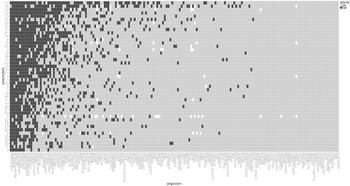
Figure 2 provides a visualization of the variation in our dataset per anglicism and per respondent. In the plot, a grey box indicates that the respondent selected de; a black box indicates that the respondent chose het, while a white box represents a missing value. For example, respondent 12 chose het for the anglicism jingle, while respondent 22 selected de for this noun. Respondents 5 and 24 did not make any selection. For computersoftware, respondent 17 selected het, while respondent 27 chose de. The anglicisms are ordered (on the x-axis) by decreasing proportion of het responses from left to right. The respondents are ordered (on the y-axis) by decreasing proportion of het responses from top to bottom.
Plot of article chosen per anglicism and per respondent.

The plot reveals that the proportion of neuter (or common) gender responses differs greatly per respondent and per anglicism. Respondent 3 chooses het the least (for 11 out of 145 anglicisms), while respondent 13 chooses het most frequently (for 66 out of 145 anglicisms). All respondents but one select het for skateboard, while for a relatively high number of anglicisms, on the right-hand side of the plot (that is, youngster, wall, vibe, etc.), all respondents choose the same article, de. Interestingly, there is not one anglicism in the dataset for which all respondents select het.
Furthermore, the plot corroborates the finding that within-respondent variation occurs in the dataset as well: Our respondents did not systematically opt for the same article for two anglicisms with similar properties. For instance, respondent 36 assigns neuter gender to teamspirit, an inanimate, nonestablished frequent anglicism, with a common gender Dutch cognate (spirit); however, the same respondent assigns common gender to a similar anglicism, (American) dream—also inanimate, nonestablished, frequent, and with a common gender Dutch cognate (droom).Footnote 18
Crucially, figure 2 also reveals variation in the amount of disagreement among the respondents in the dataset per anglicism. For some anglicisms, such as skateboard, youngster, wall, and vibe, all or most of the respondents agree about the appropriate gender, but for other anglicisms, there is much more variation. For the fitness term, squat, for instance, about 85% of the respondents (38 out of 45) choose the same article, de; for franchising, about 71% of the respondents (32 out of 45) agreed on de; for achievement, there is very little agreement: 22 respondents selected de, and 23 respondents selected het.
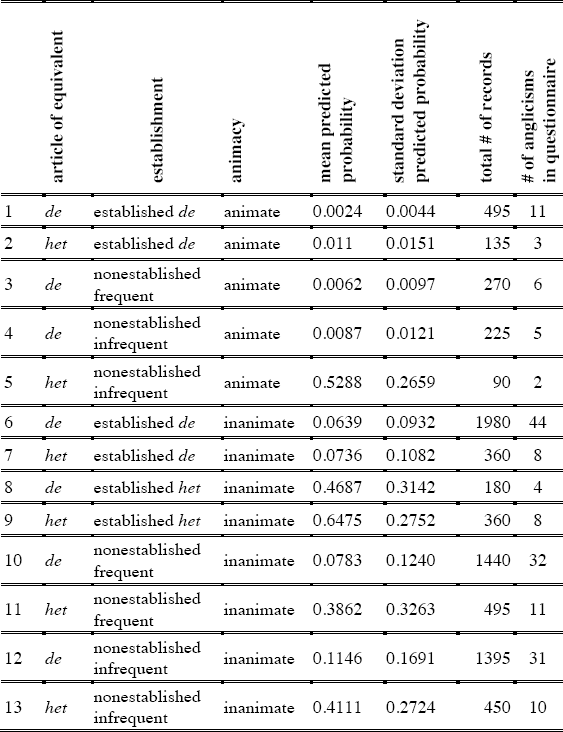
By relying on the predicted probabilities of the regression model, we can determine whether the amount of variation with respect to the anglicisms is influenced by the predictors discussed in section 4.2. More specifically, for each combination of the variables included in the questionnaire, we predicted the probability of the respondents selecting het. Disagreement is highest if this probability is close to 50%; if it is close to 0% or 100%, respondents show more agreement (they either all choose de, or all choose het).
Table 10 presents an overview of all the combinations of the levels of the predictors in the dataset. Columns 2, 3, and 4 show the level used per predictor. Columns 5 and 6 show the mean predicted probability of het and the standard deviation for that combination of levels. Columns 7 and 8 indicate how many records are available for the combination of predictors.
Predicted probabilities (for het) of each combination of predictors present in the dataset.

The table shows that the probability of using het is never higher than 65%. Furthermore, the greatest variability in the participants’ responses is observed when the mean predicted probability of het is close to 50%. The table indicates that this happens in case of a conflict between different factors that play a role in gender assignment. This is apparent in three sets of cases. First, the mean predicted probability of het is close to 50% in the case of 12 inanimate, established anglicisms listed with het (rows 8 and 9 in table 10). In this case, the article of their Dutch equivalents has only a minor influence. Row 9 shows the predicted probability of using het for established anglicisms for which there is no conflict between the neuter listed gender and the neuter gender of a Dutch equivalent. It is noteworthy that even if an established anglicism is listed as neuter and has a neuter Dutch equivalent, the probability of using het is still relatively low (64.75%). This is especially evident if one compares the predicted values for such neuter anglicisms to the predicted values for the inanimate established anglicisms in row 6: These anglicisms are listed with de and have a common gender Dutch equivalent. Most of the time, the respondents agree about their gender, as the probability of het is only 6.39%. This difference can be explained as follows: When properties that favor the neuter article are available, a conflict arises between these properties and the default article for anglicisms, de. Previous studies have argued that anglicisms receive the common definite article de, unless there is a reason for using neuter gender het (see section 2.2). However, our data indicate that respondents do not categorically select neuter gender in this case; instead, independent reasons for using neuter gender het causes greater disagreement among speakers.
Second, disagreement among respondents is relatively high in the case of nonestablished anglicisms that have a neuter gender Dutch equivalent. If these nouns have an animate referent, the disagreement among respondents is the greatest (52.88% probability of choosing het). However, note that only two nouns in the questionnaire belong to this group. These findings can be explained by the general semantic tendency in Dutch: Nouns that refer to people and animals are usually assigned common gender. As a result, there is a conflict between the common gender often used for nouns with an animate referent and the neuter gender of the Dutch equivalent.
Third, it is unexpected that the proportion of het is relatively low with the inanimate nonestablished nouns (38.62% and 41.11%). The 21 nouns that belong to this group do not display any features that favor common gender. At the same time, one salient feature that favors neuter gender—that is, inanimacy—is readily available. Nevertheless, many respondents prefer the default common gender article for this group of nouns.
In sum, these results seem to contradict the claim often made in the literature that gender variation (that is, disagreement in the speech community with respect to gender assignment) only concerns nonestablished nouns. In our data, this variation concerns established nouns as well, if they do not have the default gender listed in the dictionary. Consequently, establishment in the speech community does not serve as the sole explanation for an increase in homogeneity in our dataset. Furthermore, the analysis indicates that in the case of conflict between multiple factors that influence the gender of an anglicism—such as a neuter lexical-semantic equivalent versus the default common gender—homogeneity decreases. In other words, conflicting factors seem to lead to more heterogeneity in the speech community.
6. Discussion
6.1. Previous Research and Current Findings
In this paper, we focused on the gender of anglicisms in Dutch. We have reviewed previous studies noting their treatment of two issues: how gender is assigned to loanwords (section 2.1) and variability in gender assignment to loanwords (section 2.2). With respect to the first issue, it has been generally assumed that loanwords are subject to the gender-assignment rules of the host language. Furthermore, it has been proposed that loanwords can be assigned gender by semantic analogy. Finally, it has been proposed that loanwords can also be assigned the so-called default gender of the host language. Previous research suggests that in Dutch, anglicisms receive common gender by default (de), unless there is a reason for them to receive neuter gender (het). Such reasons can be semantic, morphological, or analogy-based. However, with the exception of Geerts (Reference Geerts1996), who discusses a hierarchy of gender assigning rules, scholars do not elaborate on the interaction between these determinants of anglicism gender.
With respect to the second issue—that is, variability in gender assignment—scholars have argued that variability or the lack thereof is related to (non-)establishment (but see Rothe Reference Rothe, Zenner and Kristiansen2014): Only those loanwords show variable gender that have not been established in the host language; once a loanword is established, the speakers generally agree about its gender.
This paper contributes to the debate through introducing novel research tools. We utilized inferential statistics to investigate gender assignment to anglicisms in Dutch. First, we analyzed the factors relevant for gender assignment to English loanwords in Dutch. This analysis yielded a model whose predictions were then used to assess the amount of (dis)agreement among the respondents when it comes to the gender of individual anglicisms. Furthermore, since the data included both established and nonestablished borrowings, we were able to verify whether the degree of establishment of a particular anglicism affects the amount of (dis)agreement among the speakers concerning its gender.
With respect to the factors underlying gender assignment to anglicisms, our findings are as follows. Our analysis confirms the prevalence of the default common gender article de: Only 15.02% of our data contain the neuter gender article het. Furthermore, the regression model provides evidence for the importance of the Dutch gender system: Anglicisms with an animate referent generally appear with the common gender article de, just like native Dutch nouns. In addition, the model suggests that anglicisms frequently receive the article of their Dutch cognate or translation equivalent. Finally, the degree of establishment of an anglicism also plays an important role in the respondents’ choice of an article.
Let us now turn to the issue of variability in gender assignment. The random factors in our regression model reveal inter-respondent variation in gender assignment to nominal anglicisms. A visualization of the results shows that the degree of variation varies from anglicism to anglicism. In addition, intra-respondent variation occurs as well: Language users do not systematically choose a particular gender for anglicisms with similar properties. The regression model also reveals that disagreement among the speakers is particularly high in case of (i) established anglicisms with an inanimate referent listed with het, and (ii) nonestablished anglicisms with a neuter gender Dutch equivalent. In other words, the model shows less homogeneity in the speech community if there is a conflict between the default article de and one or more factors that favor neuter gender.
It should be noted that previous studies consider the default article a last resort (for example, Geerts Reference Geerts1996, Hock & Joseph Reference Hock and Joseph1996:266–269): An anglicism would be assigned the default gender only if all other gender-assignment rules fail. However, our analysis indicates that this is not the case: Speakers are more likely to disagree about the gender of an anglicism that qualifies for the nondefault neuter gender; there is generally more consensus about the gender of anglicisms with a common gender Dutch equivalent. This is because language users do not automatically opt for neuter gender in the presence of a neuter gender favoring factor. Even when an anglicism has a very clear neuter gender cognate (see the skateboard example above), not all the respondents automatically assign neuter gender to the anglicism. This means that the last resort approach cannot account for the gender assignment pattern in Dutch.
Our results also contrast with Geerts (Reference Geerts1996). He assumes that in the case of a conflict between the default article de and the presence of a factor that favors the neuter article het, respondents unanimously choose the neuter article. Interestingly, our results indicate that in the case of such a conflict, there is more variability: Respondents find it harder rather than easier to choose an article for the anglicism. Furthermore, in our dataset, respondents never categorically choose het for any anglicism.
Moreover, Geerts (Reference Geerts1996) argues that the rules applicable to anglicisms can be arranged along a clear hierarchy, as shown in 1.Footnote 19 When multiple rules apply, some rules take precedence over others.
-
(1)


However, our dataset contains several anglicisms whose gender cannot be explained by this hierarchy. The anglicism member, for instance, receives neuter gender by virtue of having a neuter lexical-semantic equivalent (its neuter translation lid); at the same time, as a noun with an animate referent, it should acquire common gender. Furthermore, member is nonestablished and infrequent. It seems that, due to the conflict between the multiple factors that apply to the noun, and due to the availability of a default gender for anglicisms, our respondents disagree considerably on the gender of member: 31 respondents use de, while 14 respondents select het.
Finally, by explicitly including both established and nonestablished anglicisms in our questionnaire, we were able to examine whether establishment of an anglicism in the speech community reduces disagreement on its gender. In contrast with what has been argued in most other studies on gender assignment to anglicisms, our results indicate that the amount of variation does not depend solely on the degree of establishment of anglicisms. Our analysis shows that variation also depends on the interplay of other factors that influence gender assignment: Established anglicisms listed in the dictionary as neuter, for instance, show a high amount of variation as well, in comparison to established anglicisms listed with common gender.
6.2. Issues for Further Research
While we were able to attenuate some hypotheses formulated in previous research by showing that language users do not necessarily agree about the gender of an anglicism, our study has some shortcomings that should be addressed in further research. First, the dataset only contains responses of 45 participants. Moreover, as all respondents were university students, follow-up research should include a higher number of speakers from a more stratified sample of the population. Even though we used background information on each respondent to operationalize some lectal features as independent variables, these features did not reach significance in a multivariate environment. Using a larger, more stratified sample might uncover respondent-specific features that impact gender assignment to loanwords as well.
Second, previous studies indicate that the gender associated with the suffix of an anglicism plays a role in gender assignment as well. However, we were not able to include this predictor in our regression model because of the low number of recently borrowed anglicisms with a suffix generally associated with neuter gender in Dutch. Exploratory analyses confirm that this predictor influences the gender of anglicisms: The proportion of neuter gender articles is significantly higher in anglicisms with suffix -ment, which is associated with neuter gender, than in anglicisms with a suffix associated with common gender. However, follow-up studies are needed to corroborate this result.
Third, previous studies have argued that anglicisms belonging to particular semantic fields, such as breeds of dogs, drinks, collectives, sports, and substances, often receive a particular gender (see section 2.2). This claim is not entirely supported by our study. The only evidence we obtained for the relevance of semantic features is that anglicisms with an animate referent appear significantly more often with the common gender article de than nouns with an inanimate referent. Note, however, that most of the semantic fields discussed in previous studies could not be included in our analysis because of the low number of anglicisms belonging to these fields. Therefore, an interesting extension to this study might focus on a different host language with a semantic gender system.
Fourth, the Van Dale dictionary, an implicitly normative dictionary of Dutch, was used in this study to determine whether an anglicism is established or not. Words are included in this dictionary if they are found regularly and for an extensive period of time in the readily available language of the speech-making community (that is, writers, teachers, scientists, journalists, etc.; Den Boon & Geeraerts Reference Boon and Geeraerts2008). The more recent editions of the dictionary rely more heavily on digital texts to determine which lexical items should be included. For this reason, whether or not an anglicism is listed in the dictionary is often determined by its frequency. However, in some cases, frequency may not be on a par with the acceptedness or normative status of the word.
To remedy this shortcoming, follow-up studies may want to adopt an alternative, usage-based approach for determining whether a noun is established in the speech community. Factors that influence the success of anglicisms in Dutch have been examined using the entire onomasiological profile of the concept in large corpora—that is, the anglicism and all its (native) counterparts that express the same concept (Zenner et al. Reference Zenner, Speelman and Geeraerts2012, Zenner et al. Reference Zenner, Speelman and Geeraerts2014). The degree of establishment of an anglicism can then be quantified by taking into account its relative weight vis-à-vis the frequency of its (native) synonymous expressions. A second method that can be envisaged to determine the establishment of an anglicism relies on the degree to which a noun is adapted to the host language. Orthographic adaptation, for instance, can serve as an indication of a relatively high degree of establishment in the host language. Finally, attitudinal data may also provide information about the acceptedness of non-native material in the host language.
Further extensions of this study are also possible. The quantitative methodology applied in this paper offers a new way of investigating the adaptation of loanwords from gendered source languages. By taking into account both the native gender system and the homogeneity in the responses one may discover further criteria that do not apply to borrowings from a nongendered language, such as English. Alternatively, one could concentrate on host languages with more rule-based gender systems (as the gender system of Dutch is, to a large extent, arbitrary). This approach could reveal whether variability in the amount of (dis)agreement in the speech community is also related to the arbitrariness of the Dutch gender system.
Moreover, the preponderance of the common gender article de is expected on the basis of previous studies on Dutch. However, few scholars have asked why neuter gender was conventionalized for anglicisms in the first place; why not rely on the default common gender alone for all anglicisms? One exception is Geerts (Reference Geerts1970), who argues that Dutch undergoes a general process of deneutralization (ont-het-ting ‘de-het-ing’). This explanation was first offered by Van Haeringen (Reference Haeringen1951) for concrete mass nouns. Geerts proposes that the neuter gender for nouns in Dutch is a relatively closed category: Nouns only receive this gender when very compelling reasons apply. For anglicisms, such compelling reasons are usually not available: They often refer to novel objects or concepts, and they frequently lack the formal properties associated with neuter gender. However, a systematic diachronic quantitative study is necessary to corroborate this explanation.
7. Conclusion
Our paper offers valuable new insights and helps refine some of the hypotheses that have been put forward before. Methodologically, our multivariate approach enables us to demonstrate which factors influence the assignment of gender to anglicisms in Dutch. Furthermore, this methodology allows us to show that the degree of homogeneity in the speech community does not solely depend on the degree of establish-ment of an anglicism. Gender assignment to anglicisms in Dutch is not a categorical process, in contrast with what has been assumed in previous studies. On the theoretical level, we find clear evidence for the status of the common gender article de as the default article for anglicisms in Dutch. Regarding variation in the amount of agreement about the gender of an anglicism, the analysis indicates that homogeneity decreases when multiple rules apply. In sum, our analysis shows how the interplay between several factors influences both gender assignment to anglicisms in Dutch and disagreement within the speech community.
APPENDIX: List of Anglicisms
-
1. Established nouns
-
2. Nonestablished nouns