Introduction
Poor impulse control is a common feature in patients with traumatic brain injury (TBI; McAllister, Reference McAllister2008). High impulsivity might result in a wide range of problematic behaviors, such as irritability, aggression, loss of temper, impatience, suicidal behaviors, or poor decision making, which may impede community and vocational reintegration and are considered as obstacles to rehabilitation. Several lines of thought suggest that a failure of inhibition-related mechanisms in patients with TBI might account for difficulties in inhibiting impulsive and habitual behaviors and socially inappropriate responses (Ponsford, Sloan, & Snow, Reference Ponsford, Sloan and Snow2013; Rao & Lyketsos, Reference Rao and Lyketsos2000; Tate, Reference Tate1999). Because inhibitory control is associated with frontal–subcortical areas that are frequently damaged after a TBI (e.g., Levin & Kraus, Reference Levin and Kraus1994), we might expect these patients to show high levels of impulsivity and inhibition impairments. Crucially, a recent meta-analysis emphasized that prepotent response inhibition (the ability to inhibit a dominant or automatic motor response) in classic response inhibition paradigms such as the stop-signal task revealed a moderately sized impairment in adults with mild to severe TBI (Dimoska-Di Marco, McDonald, Kelly, Tate, & Johnstone, Reference Dimoska-Di Marco, McDonald, Kelly, Tate and Johnstone2011). In the current study, both impulsivity and inhibition are considered as multidimensional constructs, which should allow a more specific understanding of the cognitive mechanisms associated with impulsive behaviors after a TBI.
Some authors recently underscored the need to consider the various facets of impulsivity. More specifically, Whiteside and Lynam (Reference Whiteside and Lynam2001) developed the Urgency-Premeditation-Perseverance-Sensation seeking (UPPS) Impulsive Behavior scale, which measures four dimensions of impulsivity: urgency (the tendency to experience strong reactions, frequently under conditions of negative affect); (lack of) premeditation (the tendency to think and reflect on the consequences of an act before engaging in that act); (lack of) perseverance (the ability to remain focused on a task that may be boring or difficult); and sensation seeking (the tendency to enjoy and pursue activities that are exciting and openness to trying new experiences). This multidimensional conception of impulsivity allows researchers to demonstrate significant relationships between the four dimensions of impulsivity and several psychopathological states and/or problematic behaviors, such as addiction, aggressivity, antisocial conduct, attention deficit and hyperactivity disorders, and risky sexual behaviors in non–brain-damaged persons (e.g., Miller, Flory, Lynam, & Leukefeld, Reference Miller, Flory, Lynam and Leukefeld2003). Recently, a short version of the UPPS Impulsive Behavior scale was developed to assess impulsivity after a TBI (Rochat et al., Reference Rochat, Beni, Billieux, Azouvi, Annoni and Van der Linden2010). In addition, when retrospectively compared by the informants to the preinjury condition, a significant increase in urgency, lack of premeditation, and lack of perseverance was observed in these patients, whereas sensation seeking significantly decreased. Furthermore, in support of the predictive validity of this scale, Rochat, Beni, Billieux, Annoni, and Van der Linden (Reference Rochat, Beni, Billieux, Annoni and Van der Linden2011) highlighted in a sample of 74 patients with moderate to severe TBI that urgency was related to higher compulsive buying tendencies, as well as to the subjective burden perceived by the caregivers.
The construct of inhibition that has been proposed to play a core role in impulsivity (Bechara & Van der Linden, Reference Bechara and Van der Linden2005) has been divided into various mechanisms. Indeed, Friedman and Miyake (Reference Friedman and Miyake2004) emphasized that prepotent response inhibition is closely related to the ability to resist interference from irrelevant (distracting) information in the external environment (resistance to distracter interference), but that both abilities are unrelated to resistance to proactive interference (i.e., the ability to resist the intrusion into memory of information that was previously relevant but has since become irrelevant). These two inhibition mechanisms have recently been related to two specific dimensions of impulsivity of the UPPS model, namely, urgency and lack of perseverance, in young adults from the community. More specifically, difficulties in prepotent response inhibition in a go/no-go task were associated with higher urgency (Bechara & Van der Linden, Reference Bechara and Van der Linden2005; Gay, Rochat, Billieux, d'Acremont, & Van der Linden, Reference Gay, Rochat, Billieux, d'Acremont and Van der Linden2008). However, urgency has been defined as a tendency to act impulsively in an emotional context (Cyders & Smith, Reference Cyders and Smith2008), and several studies have shown that emotional stimuli interfere with the ability to inhibit prepotent responses (e.g., Verbruggen & De Houwer, Reference Verbruggen and De Houwer2007). Some contributors have suggested that task-irrelevant emotional information disturbs task performances because cognitive resources needed for the primary task are directed toward the processing of the emotion-laden stimulus. This reallocation of resources by emotion away from the primary task thus leads to fewer resources being available for effortful control, thereby disturbing inhibition performances (e.g., Pessoa, Reference Pessoa2009). Consequently, including emotional stimuli in inhibition laboratory tasks might be specifically relevant to assess the mechanisms at play in urgency (Billieux, Gay, Rochat, & Van der Linden, Reference Billieux, Gay, Rochat and Van der Linden2010).
As for the other inhibition-related mechanism highlighted by Friedman and Miyake (Reference Friedman and Miyake2004), two studies emphasized that lower ability to resist proactive interference in working memory in a “recent negative task,” a paradigm that allows past memorized items to interfere with the recognition of the current item, was associated with a higher lack of perseverance (Gay et al., 2008, Reference Gay, Courvoisier, Billieux, Rochat, Schmidt and Van der Linden2010). These difficulties in resisting proactive interference may result in distractions and irrelevant thoughts that interfere with project completion or goal-directed behavior (Gay et al., 2008, 2010).
Despite both inhibition impairments and impulsive behaviors having been frequently described in patients with TBI, few studies have examined impulsivity from a multidimensional perspective in these patients, and inhibition impairments associated with impulsivity remain poorly understood. Consequently, the first objective of our study was to replicate in an independent sample previous results that demonstrated an increase in urgency, lack of premeditation, and lack of perseverance in patients with moderate to severe TBI when retrospectively compared with the preinjury condition (Rochat et al., 2010, 2011). Second, we aimed to compare patients with TBI and matched healthy controls on two inhibition mechanisms highlighted by Friedman and Miyake (Reference Friedman and Miyake2004), namely, inhibition of prepotent response and resistance to proactive interference. We expected that patients would show lower performances than controls on these two inhibition mechanisms. Third, we examined the relationships between inhibition performances and impulsivity in patients with TBI. We more specifically hypothesized that (a) lower inhibition of prepotent responses, especially in response to negative emotional stimuli, relates to urgency because this facet of impulsivity directly refers to committing rash actions under conditions of negative affect; and (b) lower resistance to proactive interference relates to lack of perseverance. Indeed, difficulties in resisting the intrusion into memory of information that was previously relevant but has since become irrelevant may contribute to the inability to remain focused on a task that may be boring or difficult.
Method
Participants
Patients were prospectively recruited by a clinical neuropsychologist (CB) from a list of consecutive patients recorded in the database of the Neuropsychology Unit and Neurosurgery Department of the Geneva University Hospital, the Rehabilitation Center in Sion, and a private practice. Overall, 90 patients with moderate to severe TBI were contacted; of these, 61 agreed to participate and were allocated to one of two studies. More specifically, 28 patients were included in the current study and 33 in another study examining impulsivity and decision making, the results of which will be described elsewhere. Only participants for whom a significant other could provide information about the patient's current and pretraumatic impulsivity were included in the study. Among the persons who completed the questionnaire, 11 were spouses/husbands, 15 were parents, and the remaining 2 were siblings. Only those who knew the patients very well and had the opportunity to retrospectively compare patients’ behaviors before the injury and currently were given the scale to assess impulsivity. The 28 adults with TBI (24 males) included in the current study were between 19 and 59 years old (M = 32.44; SD = 12.38). Their years of schooling varied from 8 to 19 (M = 13.04; SD = 2.66), and time since the onset of the TBI ranged from 5 to 110 months (M = 33.43; SD = 27.73). Injury severity was measured by posttraumatic amnesia duration, Glasgow Coma Scale, or length of coma where available. Nineteen patients were classified accordingly with severe TBI and nine with moderate TBI. Exclusion criteria were any history of premorbid psychiatric or neurological disease.
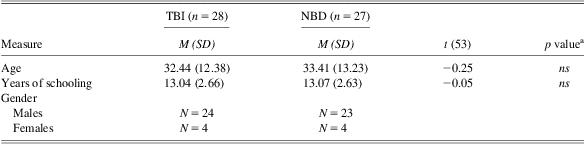
Furthermore, 27 healthy non–brain-damaged volunteers (23 males) acted as a comparison group for the cognitive measures. Control participants were recruited from the community through advertisements or personal contacts. They were matched to the TBI group for age, gender, and level of education (Table 1). The non–brain-damaged group had no neurological or psychiatric history. The study was approved by the local ethical committee, and informed consent was obtained for each participant.
Means, standard deviations, and results of group comparisons on demographic variables for TBI and NBD groups (t tests)
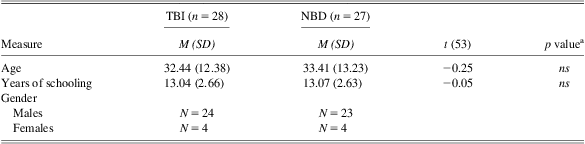
a Significance level set at .05 (two-tailed test).
NBD = non-brain-damaged; TBI = traumatic brain injury.
Impulsivity Measure
The short version of the UPPS Impulsive Behavior Scale (Rochat et al., 2008, 2010) assesses the multidimensional aspects of impulsivity after a TBI. The informants’ version of this scale contains 16 items evaluating the four components of impulsivity, namely, urgency (e.g., “In the heat of an argument, he will say things that he later regrets”); (lack of) premeditation (e.g., “Before making up his mind, he considers all the advantages and disadvantages”); (lack of) perseverance (e.g., “Once he starts a project, he finishes it); and sensation seeking (e.g., “He quite enjoys taking risks”). In the initial preliminary validation study of the scale, confirmatory factor analysis performed on the version of the scale completed by the caregivers revealed that a model taking into account four dimensions of impulsivity fit the data best. In addition, Cronbach's alphas indicated that the four subscales had acceptable to very good internal reliability (from .73 to 92). As confirmatory factor analysis failed to reveal a satisfactory model in the version of the scale completed by the patients, only the informants’ version was used in the current study. A preinjury score (retrospectively assessed by the significant others) and a current score for the four dimensions are computed, the total score ranging from 4 to 16 on both scales.Footnote 1 Higher scores indicate greater impulsivity.
Laboratory Tasks
Emotional stop-signal task
The ability to inhibit a prepotent response following the presentation of neutral or emotional stimuli was assessed with a task inspired from a classic stop-signal paradigm (Verbruggen & De Houwer, Reference Verbruggen and De Houwer2007). Emotional stimuli were included in the task because urgency has been conceptualized as a tendency to act impulsively in an emotional context (Cyders & Smith, Reference Cyders and Smith2008). In a stop-signal task, participants usually perform a choice reaction task (the ongoing task). On a random part of the trials (generally 25%), a stop signal (e.g., an auditory tone) is presented. Participants are instructed not to perform the choice reaction task (the “stop” trials) when the stop signal is presented.
The task had two distinct parts. In the first, used to build up a prepotent categorization response, participants were presented with 42 trials in which they had to categorize arrows pointing either left (<<) or right (>>) by pressing as quickly and accurately as possible on the appropriate response buttons from the keyboard. Each stimulus was preceded by a fixation cross (500 ms) immediately followed by a picture that was also presented for 500 ms, which consisted of a face expressing an emotion or not (1/3 joy, 1/3 neutral, 1/3 sadness). Then, the cue “<<” or “>>” appeared on the screen and required a response within 1500 ms. Our task differs from that developed by Verbruggen and De Houwer (Reference Verbruggen and De Houwer2007) on two main points: (1) the use of arrows pointing left or right as stimuli to be categorized in the ongoing task by pressing a left versus a right button response rather than arbitrary cues such as “@” and “#” to make the task easier for the patients; and (2) the use of emotional (joy, sadness) or neutral faces, as these kinds of stimuli are considered very powerful social cues in guiding behavior in everyday life (Yoon, Joorman, & Gotlib, Reference Yoon, Joormann and Gotlib2009) and influencing the production and regulation of affective states (Phillips, Drevets, Rausch, & Lane, Reference Phillips, Drevets, Rauch and Lane2003) rather than emotion-laden pictures. The faces were taken from the Karolinska Directed Emotional Faces battery (Goeleven, De Raedt, Leyman, & Verschuere, Reference Goeleven, De Raedt, Leyman and Verschuere2008; Lundqvist, Flykt, & Öhman, Reference Lundqvist, Flykt and Öhman1998).
The second part started with a practice phase of 20 trials, followed by the experimental phase, which consisted of two blocks of 96 trials in which participants were asked not to respond (i.e., to inhibit the prepotent response of the arrow categorization) when they heard a computer-emitted tone (25% of the trials), but otherwise to keep performing the same categorization task. During the practice phase, participants received immediate feedback if an error was made. Then, in the experimental phase, 32 faces (16 male and 16 female, each with the three different emotional expressions) were used. Each stimulus was presented twice (once in the first block and once in the second block). Stop signals were presented at predetermined intervals (150, 200, 250, or 300 ms) before the participant's expected response.
The dependent variable that reflects the latency of the inhibitory process is the stop-signal reaction time (SSRT), which was computed for each condition (Logan, Reference Logan1994). A higher SSRT corresponds to a lower prepotent response inhibition capacity. RT for go trials were also computed for each condition.
Recent negative task
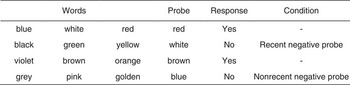
A recent negative task was used to assess resistance to proactive interference in working memory (Gay et al., Reference Gay, Rochat, Billieux, d'Acremont and Van der Linden2008; Hamilton & Martin, Reference Hamilton and Martin2005). In this task, a target set of three words is presented sequentially for 750 ms and has to be stored for a retention interval of 3 s. A probe word is then presented, which may or may not match one of the words of the target set. Participants have to indicate as quickly and accurately as possible whether the probe word was presented in the last set of three words by pressing on the appropriate button response of the keyboard. When the probe does not match the current target set (thus requiring a “no” response), two conditions are distinguished: (a) negative probes drawn from the previous trial's target set (i.e., recent negative probes); and (b) negative probes that did not occur in a recent target set but were presented three trials before the current one (i.e., nonrecent negative probes). The more interfering condition (recent negative probes) is expected to cause more errors and longer RT than its less interfering counterpart (nonrecent negative probes). There were 20 trials in each negative condition (20 recent and 20 nonrecent) and 40 trials in the positive condition (i.e., trials requiring “yes” responses). The stimuli were presented in a fixed prerandomized order to form the recent negative and nonrecent negative conditions. Two practice trials were administered before the beginning of the 80 trials of the experimental phase (see Figure 1).
Trial types illustrating the interference conditions from the recent negative task (practice trials). For each probe, participants had to respond “yes” or “no” about whether the probe was present in the last set of three words sequentially presented by pressing the appropriate response button. Recent negative probes (high interference condition) = negative probes drawn from the previous trial's target set. Nonrecent negative probes (low interference condition) = negative probes that did not occur in a recent target set but were presented three trials before the current one.

The words used were drawn from a set of 16 neutral, frequent, and semantically and phonologically unrelated disyllabic words composed of five or six letters. The words were selected to have neutral valence, arousal, and imagery levels and had a lexical frequency of between 1506 and 5066 per 100 million occurrences (Content, Mousty, & Radeau, Reference Content, Mousty and Radeau1990). The number of errors was recorded, as well as the RT for correct responses in both the negative recent and nonrecent conditions. An interference index was also computed by subtracting performances in the low-interference condition from performances in the high-interference condition. This index gives a measure of proactive interference induced by recently studied probes by controlling for nonrecent probes.
Statistical Analyses
Distributions of all variables were examined and logarithmic transformations were used for those variables showing excessive skewness. We used t tests for independent samples to compare patients with controls on demographical variables. Repeated measures analyses of variance (ANOVAs) were then used, on the one hand to examine whether patients had experienced significant changes on the four dimensions of impulsivity when retrospectively compared with their preinjury condition by their caregivers, and on the other hand, to compare patients and healthy participants on the inhibition measures. Effect sizes for each ANOVA were calculated using partial eta-squared (η2p). Finally, correlation analyses were conducted to examine the relationships between inhibition performances and current levels of impulsivity after a TBI, as well as the association between the two inhibition measures. Correlations were considered statistically significant at p < .05, corrected for multiple tests by using Benjamini and Hochberg's (1995) false discovery rate (FDR) procedure. When multiple tests are performed, FDR corresponds to the proportion of false positives (incorrect rejections of the null hypothesis) among those tests for which the null hypothesis is rejected. In contrast, the more common Bonferroni correction controls the rate of false positives among all tests whether or not the null hypothesis is rejected, a correction that is often too conservative and lacks power.
Results
Preliminary Analyses
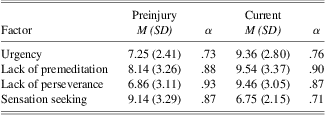
The t tests for independent groups revealed that patients with TBI did not significantly differ either in age or in education from the control participants (Table 1). The Cronbach's alphas indicate that all four subscales of the UPPS scale have acceptable to very good internal reliability (Table 2). In addition, internal reliability of the recent negative task was .25 for the recent and .27 for the nonrecent condition in the patients’ group, and .51 and .38, respectively, in the control group, which indicates rather low reliability. For the stop-signal task, internal reliability was .49 for the patients and .64 for controls, which may be considered moderate reliability.
Means (standard deviations) of the preinjury level and the current level of impulsivity and internal consistency for the informants’ version of the UPPS scale
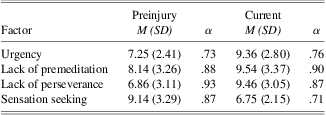
UPPS = Urgency-Premeditation-Perseverance-Sensation seeking Impulsive Behavior scale.
Comparison between Impulsivity at the Preinjury and the Current Levels
A repeated measure multivariate ANOVA was performed on the four dimensions of impulsivity to appraise the changes retrospectively rated by the informants from the preinjury to the current scores, with the condition (preinjury, current) as a within subject factor. Results indicated a significant effect of condition, F(4,24) = 10.58, p < .0001, η2p = .64. A series of post hoc Bonferroni comparison tests yielded a significant increase in urgency (p < .001), lack of premeditation (p < .05), and lack of perseverance (p < .001) when retrospectively compared with the preinjury levels, whereas a significant decrease was observed for sensation seeking (p < .001). Raw scores are presented in Table 2.
Group Comparisons on the Inhibition Measures
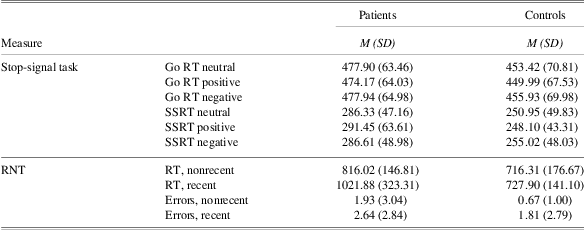
Means and standard deviations for both inhibition laboratory tasks are listed in Table 3. For the emotional stop-signal task, a mixed repeated measure ANOVA, with group (patients, controls) as the between subjects factor and emotional condition (neutral, joy, sadness) as the repeated measure, revealed a main effect of group, F(2,53) = 11.27, p < .001, η2p = .18, indicating that patients had a significantly higher SSRT than matched controls. However, there was no significant effect of the condition, nor an interaction effect (F < 1). The same analysis was also performed on RT on the go trials. Results indicated no significant main effect of group or condition, nor an interaction effect (F < 1).
Means and standard deviations on the inhibition tasks for TBI and control participants
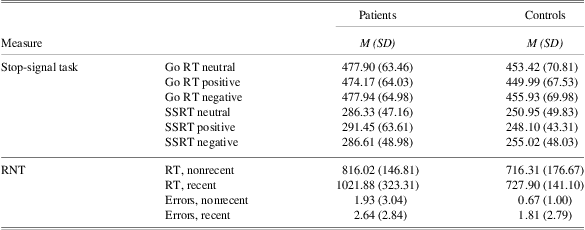
Note. For ease of interpretation, raw scores are presented for the Go RT, the SSRT, and the RT of the RNT, although all statistical analyses are conducted on the natural logarithm of these variables. For the RNT, “nonrecent” refers to the low interference condition of the RNT, whereas “recent” refers to the high interference condition.
RNT = recent negative task; RT = reaction time; SSRT = stop-signal reaction time; TBI = traumatic brain injury.
A mixed repeated measure ANOVA performed on the RT from the recent negative task, with group (patients, controls) as the between subjects variable and condition (recent, nonrecent) as the repeated measure, revealed a main effect of group, F(1,53) = 18.48, p < .0001, η2p = .26, indicating that patients had significantly higher RT than matched controls; a main effect of condition, F(1,53) = 10.89, p < .01, η2p = .17, indicating that participants had higher RT in the high (recent) condition compared with the low interference (nonrecent) condition; and a significant interaction effect, F(1,53) = 6.46, p < .05, η2p = .11. To examine the nature of this interaction, we completed repeated measures ANOVAs separately for each group. Within the TBI group, participants had significantly greater RT on the recent condition than on the nonrecent condition, F(1,27) = 14.46, p < .0001, η2p = .35. In contrast, the difference in RT between the recent and nonrecent conditions among controls was not significant, F(1,26) = 0.36, p = .56, η2p = .01. Regarding the number of errors on a recent negative task, repeated measures ANOVA revealed a main effect of the condition, F(1,53) = 10.39, p < .01, η2p = .16, showing that participants committed more errors in the high than in the low interference condition. However, there was no significant group or interaction effect (F < 1).
Correlation Analyses
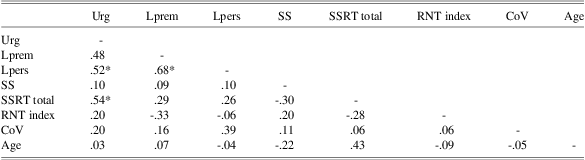
As Table 4 shows, for the patients with TBI, Pearson correlations were computed between the current scores of the four dimensions of impulsivity as assessed by the informants, age, the total SSRT, and a recent negative task index expressed in RT. Because there was no significant effect of emotional condition on the stop-signal task, we considered only the total SSRT. We also computed a measure of intraindividual variability, the “coefficient of variability” (CoV; Duchek et al., Reference Duchek, Balota, Tse, Holtzman, Fagan and Goate2009), by dividing the standard deviation of RT on the go trials in the stop-signal task by the RT of the go trials (SD/M). The CoV enables us to examine the relationship between impulsivity and a more general cognitive measure related to sustained attention performances.
Correlations between impulsivity dimensions, age, and laboratory task performances in patients with TBI
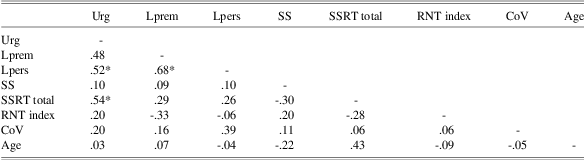
* p < .05, corrected for multiple tests with the Benjamini-Hochberg procedure (1995).
Urg = urgency; Lprem = lack of premeditation; Lpers = lack of perseverance; SS = sensation seeking; SSRT total = stop-signal reaction time total score; RNT index = Interference Index of the recent negative task expressed as reaction times (RT; only RT was considered because there was more variability on RT than on number of errors in the RNT); CoV = coefficient of variation on go trials of the stop-signal task.
With the FDR procedure described by Benjamini and Hochberg (Reference Benjamini and Hochberg1995), results revealed that the total SSRT was strongly and positively associated with urgency (.54). In addition, there were positive and significant correlations between urgency and lack of perseverance (.52) and between lack of premeditation and lack of perseverance (.68). No other correlations reached statistical significance. In particular, there was a nonsignificant relationship between the recent negative task index and the SSRT (−.28), and the performances on the recent negative task did not correlate significantly with any other variables. Of note, neither the CoV nor the performances on the recent negative task significantly correlated with urgency. There was a nonsignificant correlation between the total SSRT and the recent negative task (r = −.04; p = .86) for control participants as well.
To more specifically determine the influence of inhibition of prepotent response on current urgency level in patients with TBI, we performed partial correlations while controlling for the influence of age (because this variable positively correlates with the total SSRT). The correlations between total SSRT and urgency score remained high and significant (r = .58; p < .001).
Discussion
A significant increase in urgency, lack of premeditation, and lack of perseverance in patients with TBI was observed when retrospectively compared with the preinjury condition by patients’ significant others, corroborating previous findings obtained on patients with TBI or Alzheimer's disease (Rochat et al., 2008, 2010, 2013). These significant changes on these dimensions of impulsivity are consistent with the executive impairments frequently described in these patients. More specifically, because we considered four distinct impulsivity-related traits instead of one single trait, these results open up interesting prospects for better comprehension of impulsive-related disorders frequently described after a TBI. They may also shed new light on the nature of the cognitive processes underlying impulsiveness in healthy individuals.
Our results also confirmed previous data showing prepotent response inhibition impairments in patients with TBI (Dimoska-Di Marco et al., Reference Dimoska-Di Marco, McDonald, Kelly, Tate and Johnstone2011) and demonstrated for the first time that resistance to proactive interference in working memory is weakened in these patients. Impaired performances on these two inhibition-related mechanisms might account for urgency (the tendency to experience strong reactions, frequently under conditions of negative affect) and lack of perseverance (the inability to stay focused on long, difficult, or boring tasks) dimensions of impulsivity, respectively. Indeed, as hypothesized, our results emphasized a strong relationship between urgency and prepotent response inhibition in patients with TBI. This result sheds new light on the mechanisms at play in various problematic behaviors related to urgency described in patients with TBI, such as aggressivity, social inappropriateness, eating disturbances, substance use, or compulsive buying (Rochat et al., Reference Rochat, Beni, Billieux, Annoni and Van der Linden2011). Yet, in contrast to the results reported by Verbruggen and De Houwer (Reference Verbruggen and De Houwer2007), there was no significant effect of emotional stimuli on prepotent response inhibition in the stop-signal task. The stimuli used (faces with positive or negative expressions) were probably not arousing enough to capture attention and disturb prepotent response inhibition. These results also suggest that individuals with high urgency are characterized by lower prepotent response inhibition capacities in general (not specifically associated with an emotional context), which make them less able to inhibit rash actions in certain situations.
Nevertheless, one could argue that the relationship between urgency and prepotent response inhibition could be explained by cognitive impairments other than inhibition that are also common after a TBI. However, on the one hand, neither a measure of sustained attention computed on the go trials in the stop-signal task nor the performances on the recent negative task are significantly associated with the current urgency level in patients with TBI. On the other hand, prepotent response inhibition on the stop-signal task is not significantly associated with the other dimensions of impulsivity. Consequently, the link between inhibition of prepotent responses as assessed by an emotional stop-signal task and urgency may be relatively specific and could not be totally accounted for by general cognitive impairments.
Although two studies conducted on healthy participants showed a positive and significant association between lack of perseverance and difficulties in resisting proactive interference in working memory (Gay et al., 2008, 2010), our results failed to find such a relationship. The low reliability of the recent negative task may at least partially explain this lack of association with the perseverance dimension. Another explanation may be that the original long self-report version of the UPPS Impulsive Behavior scale used by Gay et al. (2008, 2010) contains items referring to various aspects of the perseverance dimension, such as completing projects that one has started, the ability to concentrate, and boredom susceptibility (see Whiteside & Lynam, Reference Whiteside and Lynam2001). In contrast, lack of perseverance in the short version of the UPPS scale used in the current study more specifically focused on one aspect: difficulties in completing projects that one has started. Consequently, resistance to proactive interference may better capture items related to concentration and boredom susceptibility, whereas other cognitive mechanisms, such as sustained attention and set-shifting may constitute better candidates for predicting items that refer to completing the projects that one has started (Rochat et al., Reference Rochat, Billieux, Juillerat Van der Linden, Annoni, Zekry, Gold and Van der Linden2013).
We also observed a strong positive association between lack of premeditation and lack of perseverance on the one hand, and between urgency and lack of perseverance on the other hand. Most of the studies that used the UPPS Impulsive Behavior scale, whether in healthy adults or in patients with brain damage, highlighted that the three dimensions related to executive or decisional mechanisms (urgency, lack of premeditation, lack of perseverance) moderately to strongly correlate to each other. Following the observation of Miyake et al. (Reference Miyake, Friedman, Emerson, Witzki, Howerter and Wager2000) of the unity and the diversity of executive functions, the relationships between these three factors of impulsivity (or various executive functions) might be explained by a general factor of attentional resources or working memory.
Finally, although our results emphasized impairments in patients with TBI on both inhibition-related mechanisms when compared with controls, a weak nonsignificant correlation was found between these two tasks for both patients and controls. Although this result deserves further examination, it has important implications. At the theoretical level, it adds supplementary support to the position that prepotent response inhibition and resistance to proactive interference refer to separate mechanisms (Friedman & Miyake, Reference Friedman and Miyake2004). In addition, the separability of these two mechanisms is in accord with their respective neural substrates: right inferior frontal gyrus, presupplementary motor area, and basal ganglia for prepotent response inhibition (Verbruggen & Logan, Reference Verbruggen and Logan2008) and left ventrolateral prefrontal cortex and left anterior prefrontal cortex for resistance to proactive interference in working memory (Nee, Jonides, & Berman, Reference Nee, Jonides and Berman2007). At the clinical level, the current study supports the necessity to specify the type of inhibitory functions that are impaired in individuals with TBI with the view to develop custom-made interventions targeting specific inhibition-related mechanisms. Further single (or multiple) case studies on patients with more focal lesions than what is frequently observed in patients with TBI should be undertaken to examine dissociations between these two inhibition mechanisms.
Finally, some limitations should be discussed. First, because the sample of patients with TBI is small and the gender imbalance is particularly high, the results can only be generalized with caution. However, although on some dimensions males tend to generally report higher levels of impulsivity than women do, the relationships between the UPPS traits and risky outcomes are globally invariant across sex (Cyders, Reference Cyders2013). In addition, a recent study conducted on healthy young adults found a significant positive relationship between urgency and the number of commission errors on a go/no-go task, even when gender was controlled for (Gay et al., Reference Gay, Rochat, Billieux, d'Acremont and Van der Linden2008). Therefore, we are confident that the gender imbalance did not influence the results found in the current study. Second, because the rating scale used is based on retrospective recall of impulsivity before the injury, it is susceptible to a variety of rater biases and distortions associated with faulty recall. Thus, impulsivity should also be assessed by using alternative and also more ecological measures than questionnaires, such as observation in real situations. Third, because there was an interference effect for number of errors in both groups, whereas the interference on RT was present only in the patients’ group, we might question the sensitivity of the recent negative task used to assess proactive interference. In addition, the reliability of the task was rather low. Further studies should thus use more sensitive and reliable tasks to assess proactive interference in working memory, such as Wickens’ paradigm (Wickens, Born, & Allen, Reference Wickens, Born and Allen1963) or recent probe tasks (e.g., Nee et al., Reference Nee, Jonides and Berman2007). Finally, further studies should develop norms that might further help interpret the results for both the retrospective and the current scores on this short version of the UPPS scale, as well as provide more information about the amplitude of impulsivity changes after a TBI.
Acknowledgments
There are no conflicts of interest. This work has not been published previously either electronically or in print. Prof. J.M. Annoni is supported by the Swiss National Science Foundation (Grant #325130_138497). We thank the four reviewers for their helpful comments.