INTRODUCTION
Lancelets (or amphioxus) have long fascinated evolutionary biologists since their vertebrate affinities were first noted in the early 19th Century (Kubokawa et al., Reference Kubokawa, Nobuyuki and Tomiyama1998; Putnam et al., Reference Putnam, Thomas, David, Ferrier, Furlong, Hellsten, Kawashima, Rechavi, Shoguchi, Terry, Yu, Gutierrez, Dubchak, Fernandez, Jeremy, Gibson-Brown, Grigoriev, Horton, Jong, Jurka, Kapitonov, Kohara, Kuroki, Lindquist, Lucas, Osoegawa, Pennachio, Salmov, Satou, Sauka-Spengler, Schmutz, Shin-I, Toyoda, Bronner-Fraser, Fujiyama, Holland, Holland, Sath and Rokhsar2008). Belonging to the subphylum Cephalochordata, lancelets share key anatomical and developmental features with vertebrates and tunicates and have proved crucial in understanding the morphology and evolution of chordates in general. Owing to this fact, research dealing with lancelets has been focused mostly on morphology, genetics, embryology and evolutionary studies (e.g. Putnam et al., Reference Putnam, Thomas, David, Ferrier, Furlong, Hellsten, Kawashima, Rechavi, Shoguchi, Terry, Yu, Gutierrez, Dubchak, Fernandez, Jeremy, Gibson-Brown, Grigoriev, Horton, Jong, Jurka, Kapitonov, Kohara, Kuroki, Lindquist, Lucas, Osoegawa, Pennachio, Salmov, Satou, Sauka-Spengler, Schmutz, Shin-I, Toyoda, Bronner-Fraser, Fujiyama, Holland, Holland, Sath and Rokhsar2008). In contrast, the main aspects of the population ecology of most species are poorly known (Chen et al., Reference Chen, Shin and Cheung2008) in spite that: (i) they may play an important role in marine food webs by transferring substantial amounts of microbial production to higher trophic levels (Chen, Reference Chen2007); and (ii) the conservation status of some populations have already been considered under the category of endangered species (Kubokawa et al., Reference Kubokawa, Nobuyuki and Tomiyama1998).
Lancelets are small fish-like marine animals inhabiting shallow tropical and temperate oceans. They spend most of their lives buried in the sea floor, filter-feeding through jawless, ciliated mouths. About 30 species widely distributed in coastal waters all around the world have been described, comprising two families and three genera (Chen, Reference Chen2007; Anaya, Reference Anaya2010). However, studies dealing with population ecology are restricted to a few species within the genus Branchiostoma, including B. belcheri and B. malayanum in China, Japan and Hong Kong (Henmi & Yamaguchi, Reference Henmi and Yamaguchi2003; Chen et al., Reference Chen, Shin and Cheung2008), B. lanceolatum in the North Sea and the Mediterranean (Courtney, Reference Courtney1975), B. senegalense and B. nigeriense in north-west Africa (Webb, Reference Webb1958; Gosselck & Spittler, Reference Gosselck and Spittler1979), B. floridae in the USA (Stokes & Holland, Reference Stokes and Holland1996) and B. caribaeum in Jamaica and southern Brasil (McShine, Reference McShine1971; da Silva et al., Reference da Silva, Tavares and Soares-Gomes2008). Lancelets inhabit a variety of coastal habitats including estuaries, coastal lagoons, open coasts and river deltas, with population abundances displaying huge differences, ranging between 10 and 9000 ind m−2 (Gosselck, Reference Gosselck1975; Chen, Reference Chen2007; Laudien et al., Reference Laudien, Rojo, Oliva, Arntz and Thatje2007), but little is known about their role in these habitats.
A single species, Branchiostoma elongatum (Sundevall, 1852), has been reported inhabiting shallow sandy bottoms of the Humboldt Current Upwelling System (HCS) of Chile and Peru (Laudien et al., Reference Laudien, Rojo, Oliva, Arntz and Thatje2007). This system is characterized by a huge primary productivity fuelled by the predominant northward flow of the Humboldt Current and the strong, wind-driven upwelling of cool nutrient-rich subsurface waters (Thiel et al., Reference Thiel, Macaya, Arntz, Bastias, Brokordt, Camus, Castilla, Castro, Cortes, Dumont, Escribano, Fernandez, Gajardo, Gaymer, Gomez, Gonzalez, Gonzalez, Haye, Illanes, Iriarte, Lancellotti, Luna-Jorquera, Luxordo, Manriquez, Marin, Muños, Navarrete, Perez, Poulin, Sellanes, Sepulveda, Stotz, Tala, Thomas, Vargas, Vasquez and Vega2007). Intertidal and shallow subtidal filter feeders in this system may display extremely high biomasses and secondary productions (Arntz et al., Reference Arntz, Gallardo, Gutiérrez, Isla, Levin, Mendo, Neira, Rowen, Tarazona and Wolff2006). Therefore, a high density, fast growth and high secondary production, for instance, may be expected for B. elongatum inhabiting coastal areas in the HCS in comparison with other species inhabiting distinct ecosystems.
The objectives of this work were twofold. First, we wanted to study the population dynamics of B. elongatum from a typical upwelling-influenced coastal zone (northern Chile). In a second step, we aimed to compare our own results with available information on key population traits of lancelets within Branchiostoma, as a first attempt to analyse geographical patterns.
MATERIALS AND METHODS
Population dynamics of B. elongatum
STUDY AREA, SAMPLING AND ENVIRONMENTAL PARAMETERS
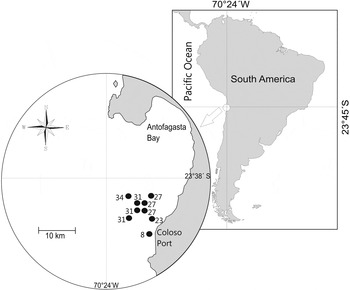
The study was carried out at Coloso Port (23°45′S 70°27′W), at the southern entrance of the Antofagasta Bay, northern Chile (Figure 1). This is a semi-enclosed, southward-facing bay, containing warmer waters than along the adjacent upwelling coasts. The southern entrance of Antofagasta Bay is an important upwelling centre in northern Chile, with upwelling occurring year round (Strub et al., Reference Strub, Mesias, Montecino, Rutland, Robinson and Brink1998; Escribano et al., Reference Escribano, Rosales and Blanco2004; Piñones et al., Reference Piñones, Castilla, Guiñez and Largier2007). Samplings were carried out from February 2008 to January 2009 in the frame of a larger monitoring programme of a soft-bottom benthic community. Three replicate samples were taken from nine sampling stations located at different water depths (Figure 1) using a 0.1 m2 van Veen grab. Samples were stained with rose Bengal to aid the selection of living organisms and sieved through a 0.5 mesh sieve.
Map of the study site and location of sampling stations. Numbers denote water depth in metres of each sampling station.

Temperature and upwelling strength were taken from environmental data sources in order to assess their effect on the variability of abundance and reproduction of Branchiostoma elongatum. Monthly sea surface temperature data were taken from the Servicio Hidrográfico y Oceanográfico de la Armada de Chile, corresponding to an oceanographic station located close to the study site within the Antofagasta Bay (23°38′S 70°24′W). The monthly mean upwelling index (m3 s−1 100 m−1 of coastline) was computed using a 1-degree nominal resolution for the area included between 23°30′S–24°30′S and 72°30′–73°30′W, using the Live Access Server of the Pacific Fisheries Environmental Laboratories—NOAA (available from http://las.pfeg.noaa.gov). The index was calculated at 1-degree offshore to avoid the potential effects of extreme coastal topography of this zone on the calculations.
TEMPORAL PATTERNS OF ABUNDANCE AND BODY LENGTH
In the laboratory, the resulting individuals of B. elongatum in each sample were counted and the monthly mean abundance (ind m−2) was calculated. For each individual, the body length (BL; mm), the length from the tip of the rostrum to the tip of the caudal fin, was measured to the nearest 0.5 mm using a Vernier caliper and the monthly mean L was calculated.
CHANGES IN GONAD CONDITION
Changes in gonad condition were used as an indirect assessment of the reproductive cycle, using the gonad index developed by Yamaguchi & Henmi (Reference Yamaguchi and Henmi2003) for B. belcheri:

where L is the body length and GL is the gonad length, which was measured to the nearest 0.5 mm after dissection of the animal under a binocular microscope equipped with an ocular micrometer.
GROWTH
Length data were used to construct monthly body length–frequency distributions, which were analysed with the ELEFAN routine (Electronic Length Frequency Analysis) under the FiSAT II software (http://www.fao.org/fishery/topic/16072/en). This routine allowed the identification of a growth model that best fits the set of length–frequency distribution, using the Rn value as a criterion. Data were best fitted to the seasonally oscillating von Bertalanffy growth model (von Bertalanffy, Reference von Bertalanffy1938):

where L t is the body length (mm) at age t (year), L ∞ is the asymptotic body length (mm), K is the curvature parameter (year−1), t 0 is the age at zero body length, C is the amplitude of the seasonal oscillation (year−1) and t s is the starting point of the seasonal oscillation.
MORTALITY (Z)
Total mortality Z (yr−1) was calculated by the single negative exponential model:

where t is the time and N 0 is the number of individuals at (t = 0) and the Length-Converted Catch Curve routine of the FiSAT II on the pooled length–frequency data. Based on the parameters of the von Bertalanffy growth model (Equation 2), lengths are converted to ages after the following model:

where N i is the number of individuals in length-class i, Δ t i is the time required to grow through this size-class and t i is the age of the middle length-class i. Mortality was calculated by linear regression analysis:

TOTAL PRODUCTION
A sample of 200 individuals of B. elongatum covering the whole body size-range was used to determine the relationship between L and body mass. Length of each lancelet was measured to the nearest 0.5 mm and afterwards dried at 70°C to constant mass. The ash-free dry mass (AFDM) of each lancelet was obtained by ignition at 550°C for 6 hours. With these data, the constants ‘a’ and ‘b' of the length–mass relationship were estimated using the power function:

The mass specific growth rate method (Crisp, Reference Crisp, Holme and McIntyre1984) was used to calculate total production P (g AFDM m−2 yr−1) using abundance, the pooled length–frequency data, the parameters of the von Bertalanffy growth model and the length–mass relationship:

where N i is the mean annual abundance in length-class i, Mi the mean body mass in length-class i and Gi, the mass-specific growth rate:

where b is the exponent of the annual length–mass relationship (Equation 6), K and L ∞ are parameters of the von Bertalanffy growth model (Equation 2) and Li is the mean length in length-class i. The mean annual biomass B (g AFDM m−2) of the population was estimated as:
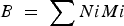
Finally, annual productivity was calculated as the ratio between P and B (Equations 7&9).
Comparison of population traits within Branchiostoma
ABUNDANCE
We collected published data on the mean abundance (ind m−2) for different species within the genus Branchiostoma. Geographical patterns were defined using latitude (centesimal units) as independent variable and population abundance as the dependent variable. The relationship between these variables was modelled by non-linear fitting procedures, selecting the model with the best goodness of fit.
GROWTH PERFORMANCE
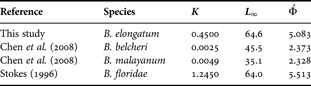
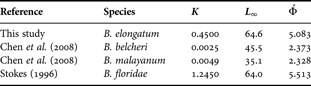
We only considered published growth parameters L ∞ and K based on the von Bertalanffy growth function (Equation 2). Non-linear growth functions are inherently difficult to compare. However, a composite index involving both L ∞ and K is suitable for inter- and intraspecific comparisons (e.g. Munro & Pauly, Reference Munro and Pauly1983; Moreau et al., Reference Moreau, Bambino, Pauly, Maclean, Dizon and Hosillos1986). The index of growth performance P is proportional to the maximum rate of body mass increase during lifetime, i.e. the mass increase at the inflexion point of the von Bertalanffy growth function. As maximum body mass is proportional to L ∞, the index P was calculated by

where L ∞ and K are the parameters of Equation 2.
PRODUCTION TO BIOMASS RATIO (P/B)
We collected published data on the production to biomass ratio for different species within the genus Branchiostoma, provided that the mass specific growth rate method (Crisp, Reference Crisp, Holme and McIntyre1984) was used to estimate total production.
RESULTS
Population dynamics of Branchiostoma elongatum
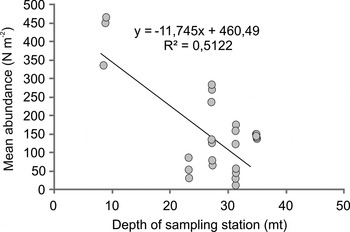
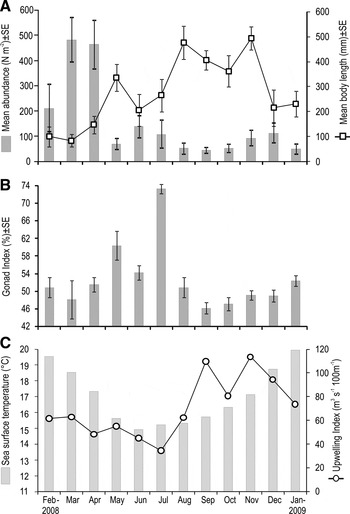
The mean annual abundance of B. elongatum showed a significant (F 1,25= 26.249; P < 0.0001) inverse correlation with water depth (Figure 2). It can be seen that the abundance was twofold higher at the shallower sampling station, suggesting a clear small scale spatial pattern of higher abundance along a narrow sandy belt. The mean abundance and body length of B. elongatum showed an inverse pattern of temporal variability (Figure 3A). Abundance was much higher, and length smaller for the late summer–early autumn seasons (hereafter referring to austral seasons), while the opposite was observed from autumn to spring seasons. The gonad index increased from summer to early winter, and sharply decreased between August and October. Thereafter, a slight increased was observed (Figure 3B). Both sea surface temperature and upwelling index showed a clear seasonal pattern (Figure 3C). Temperature was higher in summer and lower in the winter–spring seasons. The upwelling index was low during the summer–autumn seasons and increased in the winter–spring seasons.
Relationship between depth of sampling stations and the mean annual abundance of Branchiostoma elongatum in Coloso Port between February 2008 and January 2009.

Monthly variability of abundance, body length and gonad index of Branchiostoma elongatum and environmental variables at Coloso Port between February 2008 and January 2009: (A) fluctuations of mean abundance and body length; (B) changes in mean gonad index; and (C) changes in sea surface temperature and upwelling index. Vertical bars represent standard deviation.

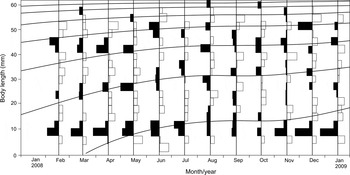
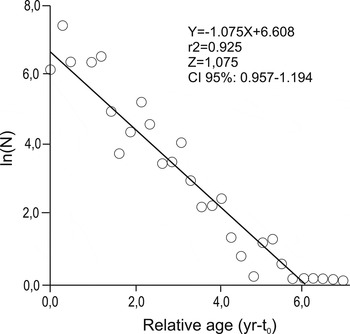
Figure 4 shows the fitting of the seasonalized von Bertalanffy growth function to the structured length–frequency distribution of B. elongatum. The goodness of fit (Rn = 0.30) for the estimated parameters (Table 1) was relatively low. The model indicated a seasonality in growth rate, with faster growth between December and June (summer–autumn) and slower growth between August and November (winter–spring). The regression-based estimation of mortality (Figure 5; Table 1) showed a good fit (r2 = 0.925). As this population is not exploited, the estimated mortality (Z= 1.075 yr−1) can be referred to as the natural mortality. Overall, mortality showed a monotonic trend among (relative) ages, but older lancelets (i.e. >6 years) showed a stationary phase (Figure 5).
Structured length–frequency distributions of Branchiostoma elongatum and fitting of growth curves according to the seasonalized von Bertalanffy growth function. Curves drawn represent individual cohorts identified by the statistical software FISAT.

Linear regression analysis to estimate mortality (Z) of Branchiostoma elongatum at Coloso Port, Antofagasta Bay, Chile.

Parameters of the von Bertalanffy growth function (Equation 2) estimated from body length–frequency distributions of Branchiostoma elongatum.

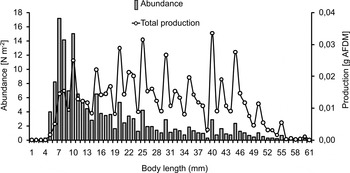
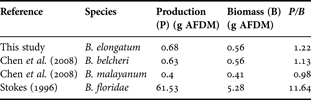
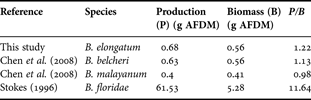
Annual total production of B. elongatum amounted 0.68 g AFDM m−2. Figure 6 shows the annual abundance and total production among body size-ranges. Overall, juvenile lancelets (6 mm to 20 mm in length) were much more abundant, although this dominance was highly transient (Figure 3A). The rather low abundance of smallest lancelets (L < 4 mm) most probably reflects a selection bias during the sorting of the individuals. Generally, total production was higher for medium-sized lancelets, with peaks corresponding well with higher abundance of a specific body size-class. Finally, the mean annual biomass of B. elongatum was 0.56 g AFDM m−2, corresponding to a P/B ratio = 1.22.
Total annual production of Branchiostoma elongatum (empty dots) related to abundance among length-ranges pooled for a year (grey bars).

Comparison of population traits within Branchiostoma
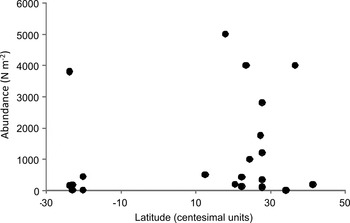
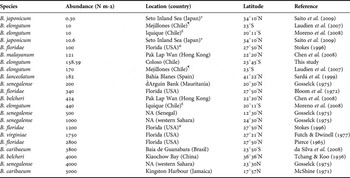
Mean population abundance showed strong differences among and within Branchiostoma species (Table 2). Abundance of B. elongatum in several regions off northern Chile was lower in comparison with that of other Branchiostoma species. In Chile, the highest abundance was observed in Iquique, where abundance was much higher during El Niño 1997–1998 than after El Niño. Several species also showed strong abundance variability among populations (e.g. B. senegalense, B. floridae and B. belcheri). The abundance of Branchiostoma did not show a significant spatial pattern along latitude, although higher abundances were generally observed toward low-latitude places (Figure 7).
Mean abundance of Branchiostoma species along latitude.

Comparison of mean population abundance among and within species in the genus Branchiostoma. NA, not available.

*, abundance estimations corresponding to two sampling depths (near low water mark: 10.6 ind m−2 and furthest low water mark: 0.3 ind m−2); ¶, abundance estimations corresponding to two seasons (summer: 10 ind m−2; winter: 170 ind m−2); £, abundance estimations corresponding to two environmental conditions (El Niño: 440 ind m−2; after El Niño: 10 ind m−2); φ, minimum (100 ind m−2) and maximum (1200) abundance during the two years of the study.
Tables 3 and 4 show the comparison of the growth performance and the production to biomass ratio between distinct species of Branchiostoma. Growth performance of B. elongatum was high in comparison with that of B. belcheri and B. malayanum and similar to that of B. floridae. In contrast, the production to biomass ratio of B. floridae was higher by orders of magnitude in comparison with all other species being compared.
Comparison of parameters of the von Bertalanffy growth function (K, L ∞) and the growth perfomace index ( ) among distinct species of Branchiostoma.
Comparison of annual total production, biomass and the P/B ratio of different species within the genus Branchiostoma.
AFDM, ash-free dry mass.
DISCUSSION
Population dynamics of Branchiostoma elongatum
The abundance of B. elongatum showed a clear stratification across water depth, with the higher abundance at 8 m water depth. Snapshot samplings in Coloso Port indicated that this species cannot be found from the intertidal to 4 m water depth. Unfortunately, the majority of our sampling stations were located between 23 and 35 m water depth and, as a result, the mean annual abundance for all the sampling stations (158.7 ind m−2) may be underestimated. The stratification of abundance of B. elongatum was also evident in Mejillones Bay, although in this case it was only present at 5 m and absent at 10 m and 20 m water depth (Laudien et al., Reference Laudien, Rojo, Oliva, Arntz and Thatje2007). This slightly different pattern may be related to the fact that the continental shelf at Coloso is steeper than that of Mejillones and therefore sampling stations for each depth were more sparsely located. We did not find a clear spatial segregation of size-classes among water depths, as observed for other Branchiostoma (e.g. Stokes & Holland, Reference Stokes and Holland1996; Saito et al., Reference Saito, Mimura, Doi, Inoue, Kawai and Imabayashi2005)
The observed changes in mean abundance, body length and gonad index of B. elongatum can be used to reconstruct the chronology of events of its reproductive cycle, as well as the recruitment process, as depicted in the suggested conceptual model in Figure 8. The short period of high mean abundance and low mean body length observed between February and April 2008 (late summer–early autumn; Figure 3) might be interpreted as the consequence of a strong recruitment pulse resulting from a previous spawning event. This kind of ‘sudden' effect of recruitment on abundance and body size seems common among infauna inhabiting sandy bottoms (e.g. Tarifeño, Reference Tarifeño1980; Riascos, Reference Riascos2006). Recruits may rapidly disappear, particularly when recruits do not exhibit spatial segregation from adults, thus enhancing intraspecific interactions under resource limitation and hence mortality. The gonad index was always higher than ~46%, indicating a continuous gametogenic activity through the year. However, the index increased between autumn and winter, and a major drop was observed between August and October 2008 (late winter–early spring), suggesting a strong spawning pulse for that period. If we assume little interannual variability, this spawning would be reflected in a new recruitment pulse between February and April 2009. Therefore, the larval phase of B. elongatum may last about two months and the settling of small larvae would occur by the end of the year (Figure 8).
Hypothetical model of the chronology of events of the reproductive cycle and its relationship with the recruitment process of Branchiostoma elongatum in Puerto Coloso, northern Chile.

Seasonal changes in sea surface temperature at the HCS are smaller than other marine systems at comparable latitudes (see Arntz et al., Reference Arntz, Brey, Tarazona, Robles, Payne, Gulland and Brink1987; Camus, Reference Camus2001) and hence temperature seasonality may not play an important role in synchronizing biological rhythms of species inhabiting this system (Urban, Reference Urban1994; Riascos et al., Reference Riascos, Carstensen, Laudien, Arntz, Oliva, Güntner and Heilmayer2009). On the other hand, the upwelling process, that fuels the high primary productivity (i.e. food availability for filter-feeders) in the HCS, display a stronger seasonality (Figure 3) and hence may act as an exogenous driving force in determining spawning seasons (e.g. Landaeta et al., Reference Landaeta, Herrera, Pedraza, Bustos and Castro2006; Riascos et al., Reference Riascos, Carstensen, Laudien, Arntz, Oliva, Güntner and Heilmayer2009). Particularly, the hypothesized spawning occurring in August–October 2008 coincides with the increase in upwelling index, in line with the generally supported idea that spawning is synchronized with cycles of food availability in order to assure the best conditions for larval development (Giese & Pearse, Reference Giese, Pearse, Giese and Pearse1974; Pearse & Lockhart, Reference Pearse and Lockhart2004).
The lack of distinctive modes in length–frequency distributions (Figure 4) and thus the low fitting to the growth model can be explained by the combined effect of: (1) the high mortality of juveniles after recruitment; and (2) the continuous gametogenic activity of this species. Recruitment of benthic organisms depends on stochastic and deterministic factors and post-settlement processes may heavily regulate its success (Lima et al., Reference Lima, Brazeiro and Defeo2000; Ripley & Caswell, Reference Ripley and Caswell2006). On the other hand, tropical and subtropical organisms, do not display the strong seasonality that usually sets the limits for gametogenesis, spawning, recruitment and growing seasons for organisms inhabiting temperate or polar areas (Lalli & Parsons, Reference Lalli and Parsons1993; Urban, Reference Urban2001; Pearse & Lockhart, Reference Pearse and Lockhart2004). Nonetheless, environmental seasonality can still play a role for reproductive events as stated before and seems also to define shifts in growth rate, as suggested by the better fit of length–frequency distributions to the seasonalized von Bertalanffy growth function. According to the model, growth rate was higher during the summer–autumn seasons, coinciding with higher temperatures in the study area. It may be common that whereas temperature may determine growth of gonads and body growth in general, other factors may determine the release of the gametes (e.g. Giese, Reference Giese1959; Urban, Reference Urban2001), which seems to be the case for the suggested environmental factors affecting growth and spawning events.
Mortality of B. elongatum showed a good fit to the single negative exponential model, implying that mortality rate of juvenile organisms is high and diminishes toward older animals. This high rate of mortality among juveniles is consistent with the transient increase in mean abundance observed between February and April 2008 after recruitment. The mortality pattern also suggested a stationary state for older animals. Unfortunately, little is known about the natural predators of this species in its habitat, and potential drivers for that pattern are difficult to infer. Only the Chilean sandperch Pinguipes chilensis (Perciformes: Pinguipedidae) has been reported preying on B. elongatum in Chile (Medina et al., Reference Medina, Araya and Vega2004).
The total production among body size-ranges showed a common pattern for marine benthic organisms, in which total production is mostly sustained by animals of medium body sizes in spite that the abundance of juveniles is higher than that of adults (e.g. Urban, Reference Urban1996; Riascos, Reference Riascos2006). This can be explained by the facts that: (i) the power function describing the relationship between body size and body mass (Equation 6) predicts a slow increase in body mass for juveniles; and (ii) the total production among larger adults also decreases as a consequence of the slower growth rate for adults while they approach L∞. The production-to-biomass ratio reported in this study (P/B = 1.22) will be a key parameter for future studies, because this parameter addresses its functional role in the food web, by quantifying the flux of matter and energy passing throughout that species (Brey, Reference Brey1999).
Comparison of population traits within Branchiostoma
The mean annual abundance of B. elongatum in Chile was surprisingly low among other species in the genus, taking into account the huge primary productivity of the HCS. Field experiments on succession of benthic communities off ‘Playa Colorado' (23°30′S), northern Chile demonstrated that B. elongatum was among the most abundant species (546–584 ind m2) during the first six months but strongly decreased (96–169 ind m2) after nine months (Pacheco et al., Reference Pacheco, Laudien, Thiel, Oliva and Arntz2010) reaching similar abundances as those reported from Coloso and Mejillones (Table 2). This suggests that the abundance of B. elongatum may be controlled by competition or predation. Thus, the increased abundance of B. elongatum during El Niño in Iquique (Moreno et al., Reference Moreno, Sepulveda, Badano, Thatje, Rozbaczylo and Carrasco2008) could also be explained as a rapid response of this species after the disturbing effect of El Niño. Nonetheless, spatial and temporal variability in abundance seems also common for other species of Branchiostoma (Table 2). Presumably, lancelets are capable of movement within the sand (Stokes, Reference Stokes1996), which could promote temporal aggregations for reproduction or feeding.
Our results suggest that abundance of Branchiostoma is affected by local environmental settings rather than by large scale environmental gradients (Figure 7). High abundances (>1.000 ind m2; Table 2) are reported for: (1) embayments or ports receiving domestic sewage discharges from nearby cities (Kiaochow Bay, Kingston Harbor, Baía de Guanabara); (2) estuarine systems (Tampa Bay); or (3) highly productive upwelling ecosystems (the western Sahara influenced by the Canary Current). However, increased eutrophication seems to be detrimental for species adapted to oligotrophic conditions (Antoniadou et al., Reference Antoniadou, Krestenitis and Chintiroglou2004).
As discussed before, the consistently low density reported for B. elongatum from several locations off the HCS in Chile is surprising. However, our results indicate that its growth efficiency is comparable to those of B. floridae from Tampa Bay, and higher than that of B. belcheri and B. malayanum (Table 3), which does not support the suggestion that lancelets grow faster in tropical than in temperate and sub-Arctic areas (Saito et al., Reference Saito, Mimura, Doi, Inoue, Kawai and Imabayashi2005). The high abundance of B. floridae also explains differences in P/B ratio among populations (Table 4). Stokes (Reference Stokes1996) only reported the P/B ratio calculated for the maximum density during his study. If the P/B ratio of B. floridae were calculated for the same abundance of B. elongatum, its P/B ratio would be probably lower than that of B. elongatum reported here. Thus, we can conclude that while the huge productivity of the HCS is not reflected in high abundances and biomass of B. elongatum, as commonly reported for benthic organisms inhabiting this system (e.g. Arntz et al., Reference Arntz, Gallardo, Gutiérrez, Isla, Levin, Mendo, Neira, Rowen, Tarazona and Wolff2006), this species displays a high growth efficiency and P/B ratio that are similar to those of other Branchiostoma inhabiting productive ecosystems.
ACKNOWLEDGEMENTS
This study was financed by the Environmental Programme of Minera Escondida Ltda. Aldo Pacheco kindly provided some materials for laboratory analysis and Rodrigo Saavedra supported the fieldwork. J.M.R. was supported by the Programa Bicentenario de Ciencia y Tecnología de Chile, CENSOR-RUE 02 to complete this work.