I. INTRODUCTION
In a previous note in this journal, I reported the textual evidence in Wealth of Nations (WN) of a postulated negative relation between the rate of profit and the rate of accumulation: a high rate of profit undermines “parsimony” and thereby prevents economic growth. It was offered as a counter-example to Paul Samuelson’s claim that the analytical schema of WN could be subsumed under his “Canonical Classical Model” (Waterman Reference Waterman1999; Samuelson Reference Samuelson1978).Footnote 1 My purpose in this article is to suggest a rationale of Smith’s challenging proposition that makes use of the customary analytical framework (e.g., Johansen Reference Johansen and Feinstsein1967, Eltis Reference Eltis, Skinner and Wilson1975, Samuelson Reference Samuelson1978) but that adds a new wrinkle—the degree of parsimony is allowed to be a decreasing function of the rate of profit; and briefly to consider why parsimony, which was so important for Smith, should have been virtually ignored by his successors in the English School.
In Book II, chapter iii of Wealth of Nations (WN II.iii), Adam Smith provided a theory of the accumulation of capital in an eighteenth-century economy of many small masters, each depending largely on circulating capital, needed to pay wages in advance. A notable feature of that theory is its emphasis on “parsimony.” In Book I, chapter viii (WN I.viii), Smith analyzed the relation between capital accumulation and population growth. For present-day readers, at any rate, it is easier to grasp Smith’s entire argument if first we study WN II.iii, as we shall do here, before turning to WNI.viii.
At the end of every production period, which Smith seems to have taken to be one year, each master receives the whole value of what his firm has produced and sold, which are assumed to be the same. Some of this he assigns to “the fund which is destined for the maintenance of productive hands” (WNII.iii.17) in the current production period; the remainder he and his family spend on consumption: food, clothing, shelter, “menial servants” if any, and luxury goods if any.
The proportion of his annual revenue that the master decides to employ in production rather than consumption is determined by his parsimony: a moral habit of which Smith evidently approved and which he contrasted favorably with “prodigality and misconduct” (WN II.iii.14; see also TMS IV.ii.8). The more parsimonious each master, the smaller the allowance his wife and daughters receive for Sunday clothes, fine china, and domestic servants; and the greater his employment of “those hands whose labour adds to the value of the subject upon which it is bestowed,” which thus determines “the exchangeable value of the annual produce of the land and labour of the country” (WNII.iii.17). Evidently there is a degree of parsimony at which—given productivity and the real wage—the employment of productive labor, and therefore the value of national income, remains constant. If masters are more parsimonious than this, national capital and income grow and vice versa.
The chief incentive to parsimony is “the desire of bettering our condition, a desire . . . which comes with us from the womb, and never leaves us till we go into the grave” (WNII.iii.28). But this incentive may be weakened if commercial success comes too easily: specifically, if the rate of profit is very high.
The high rate of profit seems everywhere to destroy that parsimony which in other circumstances is natural to the character of the merchant. When profits are high that sober virtue seems to be superfluous, and expensive luxury to suit much better the affluence of his condition. (WNIV.vii.c.61)
In extreme cases a high rate of profit will drastically reduce or even reverse capital accumulation.
The capital of the country, instead of increasing, gradually dwindles away, and the quantity of productive labour maintained in it grows every day less and less. Have the exorbitant profits of the merchants of Cadiz and Lisbon augmented the capital of Spain and Portugal? (WNIV.vii.c.61)
Smith’s account of parsimony, the rate of profit, and accumulation may be summarized in a simple model.
II. THE CUSTOMARY ANALYTICAL FRAMEWORK: A SIMPLE SMITHIAN MODEL OF ECONOMIC GROWTH
This model has been described and discussed in two recent papers (Waterman Reference Waterman2009, 2011). It bears a family resemblance to most of the better-known “classical” growth models (e.g., Johansen Reference Johansen and Feinstsein1967, Barkai Reference Barkai1969, Eltis Reference Eltis, Skinner and Wilson1975, and Samuelson Reference Samuelson1978) but differs from all of them, except that of Walter Eltis, in identifying masters’ investment decisions with the degree of parsimony. What follows is a summary. All masters are assumed to be identical in their parsimony, to employ the same productive technique, and to face the same wage-rate. Hence, the magnitudes F, K, and Npcan be regarded as aggregates that apply to the economy as a whole.
Capital stock in period t, which consists wholly of circulating capital (“funds destined for the maintenance of productive labour”) measured in units of a homogeneous subsistence good “foodstuff,” is Kt. The degree of parsimony, defined as the fraction of their income that masters decide to spend on productive employment, is π where 0 ≤ π ≤ 1. If output measured in units of “foodstuff” in period t is Ft, then
 $$K_t {\rm{ }} = {\rm{ }}\pi .F_{t - 1} \cdot$$
Production in the current period is
 $$F_t = \alpha N^p _t ,$$
where the technical parameter α is the average and marginal product of labor, and Np is the employment (assumed to be equal to the population) of productive workers. The real wage-rate, determined by supply and demand in the labor market, is w; hence, the employment of productive workers in period t made possible by Ktis
 $$N^p _t = K_t /w_t .$$
Define the continuous proportionate growth-rate as d/dt(lnK) ≡ gK, and assume that this is adequately approximated by (Kt − Kt− 1)/Kt− 1. Then, from (1), (2), and (3), given labor productivity, the rate of accumulation is a decreasing function of the real wage and an increasing function of the degree of parsimony:
 $$gK = \alpha \pi /w - 1.$$
Equations (1) to (4) are intended to paraphrase Smith’s account of the process of capital accumulation in WNII.iii.
The relation between accumulation and population growth is analyzed in Book I, chapter viii, 225 pages ahead of the account of accumulation in the following book. In the former, Smith—taking for granted the conventional wisdom among eighteenth-century economic thinkers up to and including T.R. Malthus—postulated that “every species of animals naturally multiplies in proportion to the means of their subsistence”; and noted that where there is little or no land scarcity, as in “the British colonies in North America,” populations of the human species are found to “double in twenty or twenty-five years” (WN I.viii.39, 23; see also I.xi.b.1; cp. Malthus Reference Malthus1798, pp. 20–25). Hence, we may specify Smith’s implied population-growth function in what are now supposed to be “Malthusian” terms. When N now stands for total population, assumed to be equal to (“productive” + “unproductive) workforce, m > 0 is the speed of adjustment of population to excess subsistence, and s >0 is the “subsistence” or ZPG wage-rate, then population and workforce grow at the proportionate rate:
 $$d\!/\!dt(lnN) \,\equiv \,gN = m(w - s),$$
which Malthus called the “geometric” rate. Note that since π measures the fraction of productive labor in the total workforce when all receive the same wage, then gN = gNp for any given π.
The rates of capital accumulation and population/workforce growth are independent and may differ. But market forces will tend to bring them into equality. For if gK > gN, the demand for labor will soon begin to outstrip supply, wages will rise, gK will decrease, and gN increase; and vice versa if gK < gN. Thus, a dynamically stable, steady-state growth rate g* will exist at which g* = gK = gN, and at which the equilibrium rate of profit r* and the equilibrium real wage w* are determined. Smith understood w* and r*to be the “natural prices” of labor and capital, respectively.
It may be seen from the foregoing that the rate of profit plays no part in Adam Smith’s account of accumulation. Modern treatments of his growth theory that simply specify gK as an increasing function of the rate of profit (e.g., Barkai Reference Barkai1969, Samuelson Reference Samuelson1978) are anachronistic, and properly apply only to Smith’s successors, Malthus and David Ricardo.
Yet, it is easy to transform (4) and (5) into functions of the rate of profit, since historians of economic thought agree that in “classical” thinking the wage and the profit rate are inversely related. This is because Smith and his successors in the English School seem to have assumed that the variable factor applied to fixed land was what Samuelson (Reference Samuelson1978, p. 1416) called a “labor-cum-capital composite.” Under competitive conditions, this factor gets paid the value of its marginal product, which must be divided into wages and profits. Hence, if wages go up, profits must go down, and vice versa.
Define the rate of profit, noting the relations in (2) and (3), as
 $$r \,\equiv\, (F - N^p w)/K = \alpha /w - 1\!\!:$$
an equation that Samuel Hollander (Reference Hollander1987, pp. 108–112) called the “fundamental theorem” on distribution in classical political economy. Then, by solving (6) for wand substituting into (4) and (5), we obtain:
 $$r = (1 + gK)/\pi - 1,\, \rm and$$
 $$r = m\alpha /(gN + ms) - 1.$$
Therefore, when gK = gN = g*, (7) and (8) afford the expression for the steady-state rate of accumulation:
 $$g^*{^^2} + \,(1 + ms)g^* - m(\alpha \pi - s) = 0;$$
which is quadratic because (8) is hyperbolic. It is evident from inspection of (9) that the steady-state rate of accumulation g*is positively related to the degree of parsimony,π.
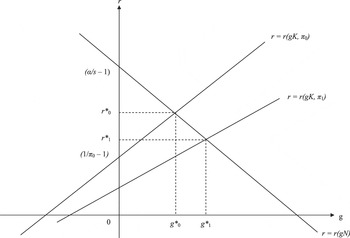
The story thus far may be illustrated diagrammatically. In figure 1, equations (7) and (8) are plotted with the rate of profit, r, on the ordinate and the rate of growth, g, on the abscissa. Since (8) is a rectangular hyperbola with asymptotes r = – 1 and g = – ms, its graph will have two branches. The economically irrelevant branch lying wholly in the second and third quadrants is ignored. Assume that the curvature of the line segment lying in the first quadrant is so slight that it may be approximated as a straight line, with intercepts r = (α/s – 1) and g = m (α – s). The capital accumulation function (7) is a straight line with slope 1/π and intercepts r = (1/π – 1), g = (π – 1). The intersection of these two curves determines the steady-state rate of profit, r*, and growth-rate, g*.
The Effect of Parsimony on Accumulation and the Rate of Profit.

It is evident that the greater the value of π, the smaller the slope of the r(gK) curve and the smaller the absolute value of its intercepts; hence, the greater the value of g* determined by its intersection with the r(gN) curve. This is illustrated in figure 1 where two r(gK) curves are plotted corresponding to two different values of π, π 0 where π 1 > π 0. It is obvious that if π were so small that (1/π – 1) = (α/s – 1) for any value of π, then the two curves would intersect on the r-axis, and both accumulation and population growth would cease. If the degree of parsimony were any smaller than this, the rate of economic growth would be negative. Smith explicitly recognizes and discusses these possibilities (WNI.viii.24, 26, 27, 41, 43, 52; II.iii.14, 16, 17, 20).
III. A NEW WRINKLE: THE DEGREE OF PARSIMONY AS A DECREASING FUNCTION OF THE RATE OF PROFIT
Let us now consider Adam Smith’s conjecture that when profits are high, “that sober virtue [of parsimony] seems to be superfluous, and expensive luxury to suit much better the affluence” (WN IV.vii.c.61) of the masters, hence reducing the degree of parsimony. We can capture this effect by postulating that π = π(r), where π′(r) < 0, π″(r) = 0. The capital accumulation function now becomes
 $$r = (1 + gK)/\pi (r) - 1,$$
having a slope
 $$\partial r/\partial gK = [\pi (r) + (1 + r)\pi \prime (r)]^{ - 1} $$
and a positive second derivative
 $$\partial _2 r/\partial (gK)^2 = - \pi \prime (r)[\pi (r) + (1 + r)\pi \prime (r)]^{ - 2} .$$
The quadratic for g* becomes
 $$g^*{^2} + (1 + ms)g^* - m[\alpha \pi (r) - s] = 0;$$
from which it appears that the higher the rate of profit, the smaller will be the steady-state rate of accumulation.
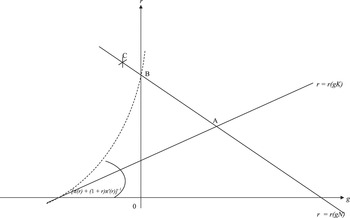
The consequence of allowing π to decrease as r rises is illustrated in figure 2. The r(gN) curve is plotted as before. A single, linear r(gK) curve is plotted as a solid line having a slope [π(0) + π′(0)]– 1. The two intersect in A, determining a steady-state rate of accumulation g* > 0 and rate of profit r* < (α/s –1), which would be the case if the degree of parsimony were independent of the rate of profit.
The Effect of the Rate of Profit on Parsimony.

The locus of r[gK, π(r)], plotted as a dotted line with the same horizontal intercept [π(0) – 1] but a continuously increasing slope by equation (10), is intended to capture Smith’s conjecture. The curve of r[gK, π(r)] has been drawn so as to intersect r(gN) on the vertical axis in B: at an “exorbitant” rate of profit at which the economy is stationary and “the capitals of Spain and Portugal” are not being “augmented.” But there is no reason in general why this need be the case. Depending not only on the curvature of r[gK, π(r)] but also on the demographic and technical parameters that govern the position of r(gN), the point of intersection may lie to the left or the right of the r axis. If the socially determined “subsistence” wage s were greater, for example, r(gN) would lie below and to the left of the locus as drawn, determining a lower rate of profit and a negative rate of growth. If the average product of labor α were higher, r(gN) would lie above and to the right, resulting in a higher rate of profit and positive growth.
However, when the demographic and technical parameters are given and the position of r(gN) determined, the rates of accumulation and profit (and also the real wage) are governed solely by parsimony of the masters. And if that parsimony is seriously eroded by luxurious living made possible by a very high rate of profit, the r[gK, π(r)] locus could have even greater curvature than drawn in figure 2, so as to intersect r(gN) in C, thus determining a rate of decumulation g* <0.
Accumulation is thus prevented in the hands of all those who are naturally the most disposed to accumulate; and the funds destined for the maintenance of productive labour receive no augmentation from the revenue of those who ought naturally to augment them the most. The capital of the country, instead of increasing, gradually dwindles away, and the quantity of productive labour maintained in it grows each day less and less. Have the exorbitant profits of the merchants of Cadiz and Lisbon augmented the capital of Spain and Portugal? Have they alleviated the poverty, have they promoted the industry of those two beggarly countries? (WNIV.vii.c.61)
Smith invites us to compare the “mercantile manners” of Cadiz and Lisbon with those of Amsterdam: we shall then be “sensible how differently the conduct and character of merchants are affected by the high and by the low profits of stock” (WNIV.vii.c.61).
There appears to be a continuum in the relation between the rate of profit and the degree of parsimony that at first sight might seem to justify, or at any rate excuse, the continuous, differentiable character of equation (7a). For Smith believed that London was intermediate in the rate of profit and the degree of parsimony, lying between Cadiz and Lisbon at one extreme, and Amsterdam at the other.
The merchants of London, indeed, have not yet generally become such magnificent lords as those of Cadiz and Lisbon; but neither are they in general such attentive and parsimonious burghers as those of Amsterdam. They are supposed, however, many of them, to be a good deal richer than the greater part of the former, and not quite so rich as many of the latter. But the rate of their profits is commonly much lower than that of the former, and a good deal higher than that of the latter. (WNIV.vii.c.61)
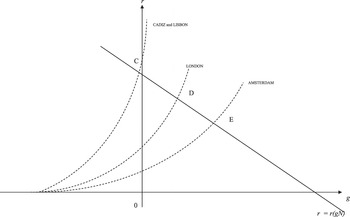
But if the “Smithian” growth theory expounded above be a valid rational reconstruction of Smith’s thinking, then it would seem that the differential behavior associated with Cadiz-and-Lisbon, London and Amsterdam, respectively, requires more explanation than he gives us. For if we assume that all three countries face the same or similar population-growth curves—which for analytical purposes we must if we are to isolate the effect of the profit rate alone upon parsimony and accumulation—then a diagram like figure 2 is unable to explain how London and Amsterdam can have lower profit rates and positive growth. Despite his very modern, economistic desire to understand all human social phenomena in terms of rational responses to relative prices, Smith must be implicitly assuming that there are exogenous cultural differences between the three communities, which affect the sensitivity of the degree of parsimonyto the rate of profit. The popish and profligate merchants of Cadiz and Lisbon, let us suppose, are more readily seduced by a high rate of profit than the prudent and presbyterian burghers of Amsterdam. The merchants of London, being Anglican, lie between these extremes.
Let us assume that |π′(r)|Cadiz-and-Lisbon > |π′(r)|London > |π′(r)|Amsterdam. This is illustrated in figure 3. In order to isolate the effect of the rate of profit (again, simply for analytical purposes), π(0) is taken to be the same in each community. But there is now a specific r[gK, π(r)] curve emerging from the common g-intercept for each of the three locations; that for Cadiz-and-Lisbon having the greatest curvature and that for Amsterdam having the least. For purposes of illustration, the r[gK, π(r)] curve for Cadiz-and-Lisbon has been drawn to intersect the r[gN] curve in C, determining a negative growth-rate and a high rate of profit, which Smith seems to have meant. Those for the other two communities intersect r[gN] in D and E, respectively, thus determining positive growth-rates and lower rates of profit. Thus, the rate of profit is necessary for Smith’s story in WNIV.vii.c.61 but not sufficient. Given the determinants of population growth, the rates of accumulation must depend not only on the rate of profit but also on the sensitivity of parsimony to the latter.
Sensitivity of the Degree of Parsimony to the Rate of Profit.

Is there any textual evidence for this interpretation? Not directly, only hints here and there. Fair-minded and judicious though he was, it would be surprising had Smith not shared to some extent in the deep-rooted and virulent anti-popery of his time and place (e.g., WN V.i.g.24; TMS VII.iv.16ff.) or felt approval of the presbyterian religion in which he was brought up and of which many of his Edinburgh friends were clergymen (e.g., WN V.1.g.37, 41). There are a few other straws in the wind. It is unfashionable not to be a man of business in Holland (WN I.ix.20). Alone in Europe, Spain and Portugal “have gone backwards” since “the first discovery of America” (WN I.xi.g.25, 24). Smith admired “the genius of the British constitution” (WNI.viii.26) that provided a fair and reliable legal framework in which private enterprise could flourish by contrast with the absolutism of the Iberian empires, far less hospitable to the bourgeoisie and its business. It is probable that there were, in fact, genuine differences both in the objective circumstances and in the mercantile culture of the three countries, tending to make parsimony more sensitive to the rate of profit in Cadiz and Lisbon; and very probable that Smith himself believed this to be so. But since we can’t bring the philosopher back to life and ask him to explain himself, this must remain conjectural and to lie beyond the bounds of intellectual history properly considered.
However, there is one further consideration that may be relevant. If the merchants of Cadiz and Lisbon were motivated in the same way as their counterparts in London and Amsterdam, which Smith undoubtedly believed, then “the desire of bettering [their] condition” was what drove them. But this requires not only wealth but also social opportunities, and these differed markedly between countries in eighteenth-century Europe. In the imperial, aristocratic, Roman CatholicFootnote 2 society of Spain and Portugal, birth and blood trumped riches. One might once have earned nobility in Spain by exterminating Moors: never by piling up ducats. But in the Protestant, constitutional, and relatively egalitarian societies of Holland and England, birth was less important, and in England was mediated by the all-important class of the gentry: commoners who were hereditary, armigerous landowners, and who controlled the lower house of Parliament where real power in the state—power of the purse strings—resided. For centuries there had been unhampered mobility between the merchants of London and the country gentry. A rich merchant would retire, purchase an estate, acquire a coat of arms, and become a gentleman. A needy squire would marry his daughters, and apprentice his younger sons, to prosperous merchants. And in two or three generations, given luck and the right political strategy, a formerly mercantile family might even rise to the peerage, and often did.
But the Iberian merchant could never aspire to equality with the ruling nobility, however rich he became, however “beggarly” they remained. He could improve his social position only relative to that of his inferiors. This he achieved by maximizing the excess of his own income over theirs. Note that in figure 2, this is achieved at position B, where the rate of return is the highest permanently sustainable and the wage rate is therefore the lowest. In effect, the merchants of Cadiz and Lisbon had a class interest in keeping the rate of accumulation as low as possible. It is hardly surprising, therefore, that parsimony was less important to them than to their Dutch and English contemporaries, and that it should have been more easily eroded by a high rate of profit.
IV. DISCUSSION: WHY WAS PARSIMONY IMPORTANT FOR SMITH BUT NOT FOR HIS SUCCESSORS?
The “sober virtue” of parsimony is sober because it is a manifestation of the cardinal virtue of prudence that Smith considered in some detail in TMS VI.i: which is “cautious rather than enterprising,” and which recommends to us “real knowledge and skill in our trade or profession, assiduity and industry in the exercise of it, frugality, and even some degree of parsimony, in all our expenses.” But the prudent man, though “sincere,” is “not always frank and open.” He is “reserved in his speech” and “rarely frequents . . . those convivial societies which are distinguished for the jollity and gaiety of their conversation.” Moreover, “he is not always distinguished by the most exquisite sensibility” (TMSVI.i.7, 9, 10). In fact, he is rather dull.
Yet, in his role as a master tradesman, manufacturer, farmer, or merchant, Smith saw the prudent man as vital for the general prosperity of society. And his characteristic sub-virtue of parsimony was essential for the welfare of the great mass of the population—who were not independent, self-employed masters, but “servants” (i.e., employees) who had nothing but their wages to live on. The “frugal man” was, therefore, a public benefactor, because even in a stationary state
he not only affords maintenance to an additional number of productive hands, for that or the ensuing year, but like the founder of a publick workhouse, he establishes as it were a perpetual fund for the maintenance of an equal number in all times to come. (WNII.iii.19)
Capital, upon which the survival of the masses depended, was sacrosanct. Therefore, the “prodigal . . . by not confining his expenses within his income” is like one who “perverts the revenues of some pious foundation to profane purposes.” He “pays the wages of idleness with those funds which the frugality of his forefathers had, as it were, consecrated to the maintenance of industry” (WN II.iii.20). This is strong language even for Smith.
The importance of parsimony in maintaining the stock of capital in stationary state is amplified in a growing economy by its benign effect in continuously augmenting that stock. Equations (4) and (5) yield an expression for the steady-state wage-rate, w*, when gK = gN=g*:
 $$mw^*{^^2} - (ms - 1)w^* = \alpha \pi ,$$
from which we obtain
 $$\partial w^ * /\partial \pi = \alpha /[1 + (2w - s)m] > 0.$$
The greater the degree of parsimony, the higher the real wage in steady state, which Smith thought of as the “natural wage” (WN I.vii.33; Waterman Reference Waterman2009). This is because the steady-state rate of accumulation will be the faster the greater is π. In figure 1 we see that the greater π, the greater g* and the lower r*: hence by equation (6), the higher is w*.
High wages were important for Smith on ethical grounds. “No society can surely be flourishing and happy, of which the far greater part of the members are poor and miserable.” And justice requires it: “It is but equity . . . that those who feed, cloath and lodge the whole body of the people should . . . be themselves tolerably well fed, cloathed and lodged” (WN I.viii.36). Since high wages are a consequence of economic growth, the “progressive state is in reality the chearful and hearty state to all the different orders of the society. The stationary is dull; the declining melancholy” (WNI.viii.43).
However, it is evident from equation (9) and figure 1 that accumulation depends not only on π but also on the technical parameter α and the demographic parameters m and s.
There is much about the division of labor in WN, and its extent must be an important determinant of α. Since the division of labor depends on the scale of operations and the accumulation of capital, it would seem that when growth takes place, α must continually increase. Why, then, has it been treated in the foregoing model as an exogenously determined constant? The reason is that the model is intended to capture the analysis of WN I.viii and II.iii; and there is no trace in these chapters of the continual acceleration in g* that would have to take place if α grows when g* > 0. Nor is there any recognition of dynamic instability of the stationary state if α decreases when g* < 0. Smith’s account of the natural wage in WN I.viii is intelligible only upon the assumption that α remains constant (Waterman Reference Waterman2009). However, even had Smith really meant to say that αwould increase with accumulation, we are still led back to its necessary condition: parsimony.
The demographic parameters m and s receive little attention in WN—that is to say, there is no text that even suggests the possibility that Smith thought analytically about the process of population growth. Equation (5) is actually a rational reconstruction of Malthus’s thinking, which has been adopted here only because it is evident that Malthus followed WN I.viii closely. Smith does note that wage-rates differ as between England, Scotland, and America, but draws no inference from this as to variability of s. Like m, it seems (implicitly) to be a constant of Nature.
In effect, Smith, like most of his eighteenth-century contemporaries, regarded the lower orders as responding merely passively to the economic environment produced by the purposeful activity of their masters. Their welfare, therefore, depended on what the masters did, and could not be much affected by their own behavior. Hence the overriding importance of parsimony. We must, therefore, explain why Malthus and Ricardo and other “classical” political economists, who were just as concerned as Smith to achieve high wages, virtually ignored it.
The words “Parsimony” and “parsimonious” do indeed occur several times in Malthus’ Principles (Malthus [Reference Malthus and Pullen1820] 1989 I, e.g., pp. 8, 352, 355, 363, 363, 369, 471), always in Smith’s sense, and parsimony is even acknowledged to be a virtue (p. 471). But far from recommending a high degree of parsimony, Malthus warned that, carried too far, it causes more harm than good by producing a “general glut,” increasing aggregate supply and depressing aggregate demand, so causing mass unemployment (chap. VII, sec. iii). Ricardo disagreed with Malthus about general gluts, but mentioned “parsimony” only once his Principles (Ricardo [1817] Reference Ricardo and Sraffa1951, p. 278), and no more approvingly. For though a country may indeed become rich through parsimony, technical progress “must be preferred” because “it produces the same effect without the privation and diminution of enjoyments, which can never fail to accompany” the former (p. 279).
I have considered this question in some detail elsewhere (Waterman Reference Waterman2012, hence a summary will suffice. In brief, for Malthus and his successors:
(a) diminishing returns defeat parsimony;
(b) the lower orders can operate on the “subsistence wage” to their own advantage.
Though we can now recognize diminishing returns in the work of several eighteenth-century authors—e.g., Franklin (Reference Franklin1755), Steuart (Reference Steuart1767), Turgot (Reference Turgot, Turgot and Cazes1970), and Anderson (Reference Anderson1777)—and though some passages in WN suggest that Smith is aware of this effect, it is not integrated into his analysis of accumulation. Malthus (Reference Malthus1798, Reference Malthus1815), West (1815), Torrens, (Reference Torrens1815), and Ricardo (Reference Ricardo1815) believed they had discovered something new and important that we can usefully caricature in figure 1. With fixed land, the accumulation of capital and growing employment of productive labor drives down the average product, α, in the absence of technical progress. As α falls, the r-intercept in figure 1 gets smaller and the r(gN) curve shifts downward. If the degree of parsimony and the demographic parameters remain constant, this shift will continue until the r(gN) curve intersects the r(gK) curve on the vertical axis where g* = 0 and r* = (α/s – 1), which from (6) implies that w* = s. Only there can steady state now exist. All that the masters’ parsimony has done for their workers in this case is to drag their wages down to the lowest possible sustainable level.
What, then, is the remedy? Malthus, Ricardo, and, above all, Thomas Chalmers believed that the poor were more than merely “Souris dans une grange” (Cantillon Reference Cantillon and Higgs1931, p. 82). They were true human beings who, like their betters, possessed the same moral ability to better their condition: in this case, to raise the “subsistence” wage, s, by delaying marriage. The sufficient incentive for this, they believed, was that “the labouring classes should have a taste for comforts and enjoyments” as much as possible like that of their social superiors (Ricardo [1820] Reference Ricardo and Sraffa1951, p. 100). The prudential check to population, which Malthus and Chalmers (but not the youthful J.S. Mill) believed should be “moral restraint” (Malthus Reference Malthus1989 I, p. 18), is analytically equivalent to an increase in the target “subsistence” (i.e., ZPG) wage, s (Waterman Reference Waterman2012 equation 8). The effect of this can be seen in diagrams like figure 1, in which an autonomous increase in s would lower the r-intercept of the r(gN) curve, thereby decreasing r* and raising w*; and determining the lowest possible r* and a highest possible w*in stationary state.
In effect, Smith’s successors were willing to attribute to members of the “labouring classes” that psychological characteristic that Smith himself had considered only in relation to their masters: “the desire of bettering our condition.” The master had to deny himself and his family luxuries now, in order to build up his capital and so to be able to enjoy riches later. But Malthus and his contemporaries also saw that servants had to delay marriage now, until by their savings they were able to afford the minimum decencies of life for their wives and children later—and also to give them a reasonable chance of avoiding the workhouse in old age. The prudent servant deferred expenditure in order to better his condition. Therefore, he too was exercising a form of “parsimony,” more conducive to his own welfare than that of his master.