Introduction
Being unemployed for a sustained period can negatively impact mental health (Herbig et al., Reference Herbig, Dragano and Angerer2013; Milner et al., Reference Milner, Page and LaMontagne2013; Taris, Reference Taris2002) and, by increasing the risk of poverty, can also result in social isolation (Gallie et al., Reference Gallie, Paugam and Jacobs2003). At the same time, long-term unemployment is shown to significantly impact on an individual's physical health (McKee-Ryan et al., Reference McKee-Ryan, Song, Wanberg and Kinicki2005). Findings from an Australian national health survey demonstrated that, while poor health may itself impact on the amount of time a person spends in unemployment, sustained periods of unemployment and the financial and/or psychological stress resulting from this may also contribute to poor health. The survey found that those who were long-term unemployed (i.e. for 12 months or more) were four times as likely as employed people to report that their health was only fair or poor (34 per cent versus 9 per cent), twice as likely to be a current smoker (44 per cent versus 22 per cent), twice as likely to have back problems (32 per cent versus 16 per cent) and almost three times as likely to have mental health or behavioural problems (27 per cent versus 11 per cent) (Australian Bureau of Statistics [ABS], 2011).
Governments worldwide have recognised that long-term unemployment is an area of major concern, not only due to the effect it has on individual well-being, but also its role in contributing to both social exclusion (Brenninkmeijer and Blonk, Reference Brenninkmeijer and Blonk2011) and intergenerational disadvantage (Whiteford, Reference Whiteford2009). Unemployment also represents a significant cost to productivity and increased expenditure on services to address the consequences of joblessness (Australian Social Inclusion Board, 2011a; Headey and Verick, Reference Headey and Verick2006). For these reasons, supporting individuals to participate in the workforce has played a significant role in neo-liberal welfare regimes in most western countries, including Australia, the United Kingdom and the United States (McDonald and Marston, Reference McDonald and Marston2005). While it is recognised that people experiencing significant personal barriers to employment, such as mental or physical health issues, do express a desire to work, many report a fear of how they would cope with work (Perkins, Reference Perkins2008). Despite this, labour market programmes across the western world share a common ‘work-first’ approach which is predicated on the notion of moving welfare recipients as rapidly as possible into jobs, with some element of compulsion (Dean, Reference Dean2003). This is the approach which underpins the ‘New Deals’ programme in the UK (Dean, Reference Dean2003), ‘Job Network’ (now known as ‘Job Services Australia’) in Australia (Perkins, Reference Perkins2008), and numerous state based programmes in the US (GAO, 2011). Although some of these programmes are modified for those facing significant disadvantage, one of the central criticisms levelled at the ‘work-first’ approach is that it does little to systematically assist those with complex barriers and is often associated with an element of financial penalty for non-compliance (Dean, Reference Dean2003; Perkins, Reference Perkins2008).
The ‘life-first’ approach, in contrast, aims to prioritise the life needs of individuals above an obligation to work (Dean, Reference Dean2003). It recognises that the need to work is important and should be supported, but this should be balanced with an appreciation of the life needs of people facing multiple challenges, allowing them time and space to resolve their problems as these arise. Through his interviews with individuals with significant social difficulties, Dean (Reference Dean2003) found that engagement with the labour market was problematic without acknowledging the influence that their ‘familial and social milieu’, notably entrenched violence and traumatic family relationships, had on self-identity and hence ‘job-readiness’. He has called for a re-conceptualisation of welfare-to-work which acknowledges the need for sustained, long-term, holistic support from services which understand the client's social context and, at the same time, can work closely with the employment sector.
Social policy experts have highlighted a lack of knowledge about what jobseeking means for the long-term unemployed (Marston and McDonald, Reference Marston and McDonald2008). In particular, in-depth qualitative studies exploring the key components of interventions which produce vocational outcomes, while at the same time acknowledging the individual's personal barriers, are lacking. Furthermore, there exist few robust evaluations of evidence-based interventions designed to assist people to find work in general (Brenninkmeijer and Blonk, Reference Brenninkmeijer and Blonk2011). On the whole, it could be argued that, at least in Western countries, current employment policies and programmes tend to be based more on political ideology than the lived experience of jobless individuals and their perceptions of how programmes can best assist them (McDonald and Marston, Reference McDonald and Marston2005; Caswell et al., Reference Caswell, Marston and Larsen2010). To address this gap, this paper focuses on the first-hand accounts of a group of long-term unemployed people engaged in a ‘life-first’ employment programme in Australia, to shed light on the perceived benefits and drawbacks of such a programme.
The Australian context: Building Family Opportunities
In Australia, the long-term unemployment ratio (the number of long-term unemployed persons as a percentage of the total unemployed population) has risen over the past decade. In 2013, 710,000 individuals were unemployed (5.8 per cent of the labour force), of which 129,000 (18 per cent) were unemployed for 12 months or longer (ABS, 2013). Addressing long-term unemployment is seen as key to breaking intergenerational cycles of disadvantage (Australian Social Inclusion Board, 2011b) and State and Federal Governments have invested in a number of programmes that aim to assist those with complex personal barriers to find employment. This paper is based on one of these programmes; the Building Family Opportunities (BFO) programme, which was an initiative of the South Australian Department of Premier and Cabinet (DPC)Footnote 1 and was administered by the South Australian Department of Further Education, Employment, Science and Technology (DFEEST). The BFO programme operated from June 2010 to December 2013 in three local government areas within South Australia: Playford, Port Augusta and Port Adelaide/Enfield. It was a pilot programme modelled on a ‘life-first’ approach (Dean, Reference Dean2003) and offered strengths-based, intensive case management to families experiencing long-term joblessness.
The three local government areas were chosen on the basis that they experienced significantly higher rates of family joblessness compared to State averages (Moskos et al., Reference Moskos, Osborne, Biedrzycki, Baum and Richardson2009). The BFO programme built on existing employment services by addressing the family dynamic as a whole, with the aim of gaining employment for one or more family members. Participation was voluntary and intensive family support was provided for up to 18 months, at which point the needs of participating families to continue to receive intensive support were reviewed. Participants could be self-referred or referred into the BFO programme by a range of State and Federal organisations or non-government organisations. Once accepted into the BFO programme, case managers worked with families to identify both their strengths and issues of most concern, setting goals that would facilitate their engagement in learning, training and employment. The comprehensive assessment process identified personal and family strengths and issues, family dynamics and any barriers to participation in education/training or employment.
This paper draws on findings arising from a larger evaluation of the BFO programme. Evaluating innovative programmes such as BFO provides an evidence base to ascertain the extent to which the (BFO) programme meets its objectives; inform future developments of the programme; and identify components that are suitable for transferring into similar programmes.
There were two main sources of data that provided the evidence base for evaluating the BFO programme. The first was quantitative administrative data that were collected at various times by the service providers and the administrative agency. In terms of how the quantitative data defined ‘success’ and ‘engagement’, jobseekers' progress was measured against the number of services that were provided to BFO clients, the number of goals set in six domains (employment, education, housing, health, family functioning, and social participation), and outcomes in education and/or training and employment. The second was qualitative data generated via in-depth interviews and focus groups with various participants, providers, and partners involved in the BFO programme. While the analysis of the quantitative data allowed us to know that the BFO programme was successful in engaging its target client group, and strengthened this client group's current level of engagement in education and training, it did not allow us to understand how the programme was able to do this. The qualitative data provided this insight. Interviews with clients explored how the BFO programme addressed their personal barriers to employment, as well as the features they felt enabled ‘successful outcomes’ for them individually and for their wider family unit. In this paper we draw on the findings arising from interviews with jobseekers, or members of participating families, who were actively seeking work. These findings are then used to highlight elements of the BFO programme that can inform the development of future policy and programmes striving to increase the social and economic participation of those who are long-term unemployed.
Methods
Recruitment
Participants were purposively selected with assistance from the three locally based non-government organisations who delivered the BFO programme. Researchers aimed to select participants within each of the three areas to achieve maximum variation in terms of gender, family structure (single parent/couple parent household), age group, and Indigenous status (to include both Aboriginal and non-Aboriginal jobseekers). To do this, a list of all participants was obtained and then stratified according to area, in order to recruit equal numbers of jobseekers in each region. When a list of participants that varied across the above characteristics had been compiled, the researchers communicated with the relevant managers of each organisation, and case managers directly approached each participant on the list to ascertain whether they would be willing to participate. In cases where a participant did not agree, researchers then revisited the original list of participants in that area to select another potential interviewee. For those who agreed, case managers were responsible for liaising directly with the participant to organise a mutually convenient time for interview, which generally took place at the organisations’ offices. To facilitate attendance, case managers offered to collect the participant on the day of interview and return them home at completion of the interview. Case managers did not take part in the interviews.
All interviews lasted on average one hour and were digitally recorded and transcribed verbatim. Participants were compensated with a $AUD20 gift card for their time after completing the interview. Interviews with clients included questions on:
-
• Whether (and how) their involvement in the BFO programme had made a difference in terms of their opportunities for employment, participation in education and/or training, and better health and well-being;
-
• Whether (and how) their involvement in the BFO programme had an impact on their experiences of using other social, health, and employment services;
-
• Relationship, and level of contact, with case manager;
-
• Perceptions of case management processes, for example goal setting;
-
• The context of their involvement in the BFO programme, including relevant issues in their lives and those of their family members;
-
• Pre-existing barriers to participation in employment and/or training; and
-
• Personal goals and aims with regard to employment and education.
Participants
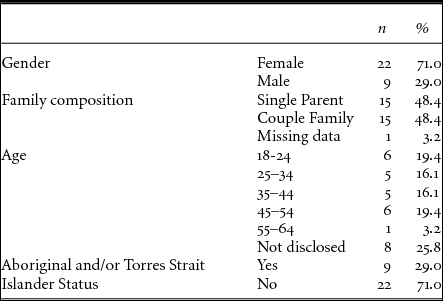
In total, 31 clients took part in the interviews, three of which were conducted with couples where both were involved in the BFO programme. As shown in Table 1, the majority of participants were women (n = 22/31, 71.0 per cent) and just under a third (n = 9/31, 29.0 per cent) were of Aboriginal background. Consistent with our recruitment strategy, equal numbers of participants lived in couple and single-parent households and participants were fairly evenly spread in terms of age.
Characteristics of the sample (n = 31)

Data analysis
Analysis of interview data was conducted according to the ‘Framework’ approach (Ritchie and Spencer, Reference Ritchie, Spencer, Bryman and Burgess1994) which is particularly suited to applied social research. The analysis proceeded through a number of steps. Firstly, the research team began familiarisation with the data through reading transcripts and listening to audio recordings. At the same time, the process of ‘identifying a thematic framework’ began. After an initial period of familiarisation, the research team met to identify a number of a priori and emergent themes. These themes were entered into NVivo as nodes. The process of familiarisation continued with selected transcripts. At the same time, two members of the research team independently coded the transcripts against identified themes to test the thematic framework. After this, the level of agreement between coders was assessed and the framework was altered accordingly. Emergent nodes were then clarified. Coding of the whole data set proceeded according to the thematic framework – which is the ‘indexing’ or coding stage. During the process of coding, researchers made notes in memos and annotations regarding concepts and ideas that emerged and are relevant to the ‘mapping and interpretation’ stage. Throughout this paper, clients have been provided with pseudonyms.
Results
As stated in the introduction, the BFO programme aimed to assist long-term unemployed families who experienced complex and interrelated personal, family and vocational barriers to move towards gaining ‘decent’ employment. The participant interviews illustrated that the programme succeeded in: a) acknowledging and working with complex pre-existing barriers; b) addressing non-vocational barriers to employment and c) providing vocational support. These factors were seen by participants to have been addressed in a holistic way, and each are described in turn below.
1. Acknowledging and working with complex pre-existing barriers
Personal legacies of conflict, abuse and family breakdown
Coping with issues associated with family functioning imposed a significant emotional, practical and financial toll on some participants and their families, and was viewed as a significant barrier to being able to obtain or hold down a paid job. All of the participants to some extent lived with personal legacies of conflict, relationship and family breakdown, and abuse. Some participants described their family backgrounds and childhoods in ways which illustrated the intergenerational disadvantage they had experienced:
I had a hard life growing up. . . . I'm the youngest of six and our parents didn't know how to be parents. You know, there was abuse and I always vowed that my kids would not know that (Caroline, 42, single parent).
In addition to experiences of childhood abuse and neglect, a number of participants also reported experiences of violent and abusive relationships with partners in their adult lives. Many participants had experiences of past relationship breakdown, often characterised by conflict. In numerous cases, participants had moved on to new relationships which meant they had ‘blended families’ with children from previous relationships. Many had also experienced bitter conflict with former partners, which often meant family breakdown, and in the case of some participants, limited or no contact with children from the former relationship. For one participant, her recent abusive relationship had meant she felt unable to cope with employment, along with other areas of her life:
I've been a chef for 20 years, I'm a qualified chef but I don't want to do that anymore and I had a breakdown from working so much and then my partner. . . he's been violent and stuff so I wasn't feeling like I could even hold a job down. . . We've been living together separated for a year and now it's the next step where I'm moving out (Victoria, 43, single parent).
Mental health issues, disability, and caring
Most participants had histories of mental illness, notably depression and anxiety, which they struggled with on a daily basis. For some, however, this was often related to a multitude of other complex family stressors involving the health and well-being of other family members. For Emma, her depression was coupled with immense family trauma involving her daughter who was a severe drug addict with cystic fibrosis. Emma, with help from her case manager, had made the difficult decision to ‘kick’ her daughter out of her home due to the impact it had had on herself and her other daughter:
When my daughter was living at home, me and my youngest daughter were sleeping in a tent because we didn't want to be in the house. There was always fighting. We'd sit up all night, because my other daughter was on drugs and she'd be sitting up all night. There would be a lot of frustration, a lot of hatred, in the house (Emma, 48, single parent).
In another example, a young participant described how both she and her two parents, whom she lived with, experienced depression. Grace's need to support her parents with household and domestic work had prevented her from finishing her education or being able to sustain paid employment:
When I was 15 I worked in fast food for a month or so, but it was too hard and I had a lot of work at home to do to help my parents because they're both sick and I have to help out a lot at home and it just got too hard, having a job, but I do want a job, I want to have the income (Grace, 20, couple family).
All participants had responsibilities in regards to caring for family, and all reported feeling very highly committed to this. Often participants were providing care and support to family members with significant health problems and/or disability, against a backdrop of their own individual health problems, economic disadvantage and limited personal resources. For example, Henry and his partner lived together with their seven children. His partner had a mental illness, which meant he had caring responsibilities for both her and their children:
I used to work. . . for a few years, and then we had a couple more kids, and then I stayed home. Then [partner] got sick, so I look after her as well and do the house, because she has her ups and downs. She's got, what's it called? Bipolar? I found it hard to go to interviews, and appointments and that, because one minute, she might be good, and then the next minute, she's not (Henry, 39, couple family).
In another case, a participant described how her two eldest adult children were in prison, and as a result of this, she became the primary carer for her young grandchild. These caring obligations had severely impacted upon her ability to remain in the paid workforce.
Precarious housing
All of the participants and their families were living on low incomes, in situations of financial and material disadvantage. One of the main areas in which this was evident was in terms of their housing situation. Many participants had extensive personal experience of living in precarious housing, characterised by insecurity of tenure, inadequate conditions such as overcrowding, or being unaffordable. Matt and his young children had experienced housing crisis and temporary homelessness early on in his involvement with the programme:
We got evicted from our house. . . so I went and stayed in the van, my dad's work van, with the kids. . . I emptied all the tools out and stuff, put mats in there for them and I slept up front. . . I went down to Housing Trust and I went ‘help me now. . . these kids and this woman here need somewhere to stay. . . because I will not have these kids in a van again’ (Matt, age not disclosed, single parent).
Participants often had quite transient personal housing trajectories, with frequent moving and a lack of stability, often due to problematic relationships with neighbours or with ex-partners. Some participants, particularly women with children, had experienced living in transitional accommodation such as hostels and homeless shelters. At the same time, a number of participants often lived with big families in crowded circumstances, and this had a negative impact on feeling able to make progress with finding a job. Charlotte described her situation living with her sister:
There is one thing standing in my way is my sister living at my house. I mean I'd like to live on my own, and have my own private life and my own space, and she lives at home with four kids. . . it's just too crowded and it's crowded in my head too (Charlotte, 24, couple family).
2. Perceptions of how the programme addressed non-vocational barriers
Psychosocial support
All participants appreciated the one-on-one emotional and social support provided by case managers. Participants discussed feeling motivated by their case manager, being supported and listened to, treated with respect and, above all, having someone to talk to when things became difficult. For many participants, this was the first time in their lives they had had such a person provide this sense of emotional stability and support, which greatly assisted them in coping with their day-to-day lives.
Just informal chat or informal talk to see how things are going. Half the time it's really just I suppose a friendly talk just to see if things are ok, if there are any problems. . . [my case manager] is a good support unit, yeah for all of us. . . [she] works with the whole family, including my son (Thomas, 52, couple family).
Importantly, this support enabled participants to feel ready and able to undertake paid employment, or activities relevant to this, such as education and training. Victoria described how she was at a low point when she was first referred to the BFO programme, having been in an abusive relationship, and how important the support provided to her by her case manager was:
I would consider that a breakdown, and then it took two days and then I was linked up with [case manager] and after that I was like – I don't know, I felt like I had support, and it just changed my life. . . She kind of looked at every avenue of my life, like my issues with my partner and my kids and dealt with it one by one, and broke down the barriers to me getting work (Victoria, 43, single parent).
Celine spoke at length about how her case manager motivated and supported her in ways which had increased her confidence, particularly in relation to the often disheartening process of jobseeking:
I suppose it's [case manager] who gets me motivated, because normally I would just sit. If there's something that's got to be done, she makes sure that I do it. . . Yeah she's pushing but she's not pushy. . . she makes me actually take that first step forward. . . I've been out of the workforce since I left school, so I don't have; well I have experiences as a mother and a housekeeper, but I don't have much experience for much else. And every time you get the kick in the guts sort of thing, she's there to say ‘well look there are plenty more’ (Celine, 46, couple family).
Many of the participants appreciated the ways in which their case managers assisted their family members, as well as themselves. For example, Henry spoke about the social and emotional support case managers had provided to his partner:
They help me and [partner] out. They'll come over, and have a talk to us, and they make sure things are going all right, and they'll come and pick [partner] up, and they'll take her to the doctors, or certain appointments, and stuff (Henry, 39, couple family).
Practical assistance
As described earlier, participants faced a range of complex and interrelated barriers to obtaining employment, many of which did not directly relate to employment or jobseeking skills. Participants spoke about how practical support from case managers, such as assistance with obtaining a driver's licence, finding stable housing, becoming more financially literate and accessing the health system, had enabled them to lay the groundwork for progressing to education/training and employment.
Being able to take part in community events and attend appointments relating to education and employment opportunities was, for many participants, often constrained by lacking a driver's licence. A case manager's first step in helping participants realise their broader goals frequently involved assisting with the multitude of practical steps which went with (re)obtaining a licence or arranging driving lessons.
Well we set the goals to get my licence back, because I had lost it and I had to re-sit my Learner's Licence. So I did that, I've got my licence again, which has been fantastic [for] getting to my study. Building my relationship with my kids and having my time for them and for me and to shuffle everyone around and to be organised, all of it's been done (Georgia, 26, single parent).
A lack of secure housing was identified by many participants as an area to be addressed before they were in a position to make progress towards being job ready. For example, Annabelle described how she wished to move because of a dispute with a neighbour, and indicated that her case manager was assisting with this because the level of stress and disruption this was causing for her and her family was a barrier to ‘moving forward’:
My next door neighbour is an absolute nightmare, I want to be moving soon but I'm not sure how long that's going to take for the transfer. . . they've [case managers] helped me. . . like helping to write a letter to housing and stuff to complain about her (Annabelle, 23, single parent).
Another participant, who had separated from her abusive partner but was still living in the same house, described how her case manager had assisted her to find a new house:
[Case manager's] got me a brand new house. . . I'm moving out in a week to a brand new house. . . it's through the Benevolent Society. . . and [ex-partner's] moving to a caravan park (Victoria, 43, single parent).
The BFO programme included a brokerage allocation, or designated fund, to enable the purchase of services or goods to address family needs. This could include job interview clothing, footwear, bus tickets, fridges, as well as emergency relief and other necessary interventions based on assessment of need. For Linda, being able to purchase prescription glasses meant she could continue with her studies:
I had to go and get my eyes tested and I just never got round to doing it and I've never had the money to do it and ended up being $500.00 or something for my glasses. They helped me, they didn't pay for all of it, I paid a contribution as well but I actually got good ones instead of wearing $2.00 ones from the cheapie shop. So I've got glasses so I can see now. . . so that's made a big improvement, helps so much. I'm not getting as much headaches, I can do my assignments, I can see what I'm doing (Linda, 24, single parent).
Although case managers had brokerage funds to provide emergency relief to deal with financial issues, this was usually tied to more long-term strategies for jobseekers around developing budgets and advising them on how they could better manage their financial situation:
My finances are [much better] – I've got money to spend now on food and everything, it's excellent, [before] all my money was gone to Radio Rentals, $245 a fortnight out of me pay and then another $170 on top on electricity, so that's been drastically reduced down to $100 to Radio Rentals and $50 to electricity which has made a vast difference (Tanya, 45, single parent).
Providing advice on which health professionals were appropriate for their health needs and how to make contact was an important role played by case managers. Participants were successfully linked with general practitioners (GPs), psychologists and physiotherapists as well as with services supporting mental health, substance misuse and women's health issues. Researching the available options, providing contact details to clients or organising direct referrals, and advocating for their clients were strategies which case managers used to link families into the health system. For some clients, registering with a GP often represented the first time they had felt ‘linked in’ to the health system and this instilled a sense of ‘control’ in their otherwise chaotic lives; as one client said “now I've got doctors etc and I'm on a roll!” Thomas described how his case manager had put him in contact with a psychologist which had helped him to become more stable:
[The psychologist] works mostly on the depression side of things. . . As he said the first time he saw me, I was all over the place, but a few weeks ago when he saw me he said I looked a lot better than what I was. . . I mean if it hadn't been for [case manager] I wouldn't have got to know [psychologist]. . . I need to work, if you understand where I'm coming from, so that I can keep my mind active and not revert back to how things were before. . . I'm not leaving things to the last [minute], you know, letting things go, I'm actually trying to get things stopped before, and sorted (Thomas, 52, couple family).
3. Provision of vocational support
Achieving education or training outcomes
Participants discussed how the BFO programme assisted them to pursue education or training opportunities by liaising with education and training providers and accessing funding through other government initiatives to better enable access to courses. Given that all participants were on low incomes, education and training opportunities were often difficult for them to afford. In these instances the programme either sought funding from job service providers or provided direct brokerage. Further practical assistance was offered with the exploration of training options, referrals to programmes, support with enrolment forms and accompanying clients to information sessions.
For some of the women in the programme, their engagement in education and/or training was restricted by their family and caregiving responsibilities. Case managers encouraged women to participate in education and training even if it was on a part-time basis. Where childcare was required, the programme assisted by helping participants to locate appropriate local childcare as well as providing financial support to pay for the childcare.
We used to set up goals. . . I wanted to do photography. . . I wasn't actually ready to do full time, and then she [case manager] found a course down at Taperoo which was perfect for me because Fridays was the day that [daughter] was in day care and I was able to go, and. . . this program paid for that as well. . . I do find the program helpful, I feel like I'm not doing as much in it now as when I was at the start, but that's because I guess I'm already in. . . the course I want to be in (Annabelle, 23, single parent).
Participant interviews highlighted the positive impact of education and training outcomes, particularly where these were the sort of training options they desired and preferred (which had not always been their experience in other programmes). Education and/or training not only improved their qualifications and scope for employment, but also contributed to an increase in self-worth and personal confidence, and for some, a new perspective on what was possible:
Without [my case manager's] help, I'd still be sitting back in my house doing nothing you know, not having the confidence to approach people to do study. I never thought I'd be in this position at this age you know, studying and that. I thought I was too old (Tanya, 45, single parent).
Achieving employment outcomes
In general, finding work was often experienced by participants as a long-term project requiring ongoing personal and emotional support from case managers to keep them motivated and goal-oriented. Often this took the form of reducing barriers to enable clients to move towards a position of readiness for employment. For some, partaking in unpaid work was recognised as an important step towards developing job networks and securing employment. Case managers often helped participants to secure work experience, volunteer positions, or course placements that were directly linked to future paid work opportunities through the use of the case managers' personal networks. Volunteer work was perceived by participants and case managers as a good opportunity to gain valuable experience in the workplace and to assist them in achieving paid employment. Importantly, work experience, volunteering, and work placement were not only viewed as having a positive impact on employment outcomes, but also as a mechanism to increase social participation.
Few of the participants in this study were, at the time of interview, engaged in employment, with most either in the process of deciding what kind of careers they wanted and how to obtain work with the help and guidance of their case managers, or undertaking training. For the participants who had successfully obtained a job, the process of finding work often began with accessing a training course and or work experience opportunity which then led to employment.
I've done a cooking class – got a Certificate 1 out of that. . . with the cooking class done a bit of work experience at [nursing home] and now since I kept up with my routine going out there on my work experience days, Thursdays and Fridays because that's when [child] goes to pre-school. They want me to do casual now so [now] I'm preparing meals for the elderly out there. So that's a start (Alice, 37, single parent).
Although not all participants had achieved employment outcomes at the time of interview, the sense of achievement experienced by those who had was clear. Securing employment was viewed as being due to both the support received from the programme and the hard work individuals had put in themselves.
I got a job with [retail outlet] in [regional area], did the traineeship in October, and since Christmas I've been made permanent 3 days a week. . . put it this way, I wouldn't be working now [without BFO support] and to [be] perfectly honest with you, I don't know if I would be here now. I mean we've gone in one side and come out the other side. (Thomas, 52, couple family).
The BFO programme was seen to assist participants through job-search activities, facilitating opportunities for work experience and providing support for jobseekers to take incremental steps toward securing decent work. Each of these required case managers to not only have good knowledge of their clients, but also of local job opportunities and job services. Assistance with job-search activities occurred at a range of levels. While some clients required practical help with developing a résumé, others required support with careers counselling. Case managers also assisted in researching job vacancies and, when a suitable position had been identified, with completing application forms and developing interview skills. Liaison also frequently occurred with employment service providers in order to obtain employment pathway plans or provide co-ordinated support to their joint clients. Although some of these activities were offered through local job services, participants reported that they had previously found these agencies difficult to navigate in order to receive the services they required. Participants positively described how the BFO programme had provided more assistance, advocacy and opportunities with regard to obtaining employment than they had previously received.
I find she's done more for me in the last couple of weeks than [Job Services Australia provider name] have done in three or four years. . . Finding information and stuff like that and actually giving me opportunities, showing me there is opportunities there and stuff like that (Mike, 57, couple family).
While participants overwhelmingly highlighted positive aspects of the assistance they achieved with seeking employment, one participant raised the notion of a potential mismatch between job aspirations and the direction in which they were being steered by their case manager:
So yeah, [case manager] knows that I want to get into that field, and that's what she's looking at, but then as she said, you can't specifically go for those jobs, because everybody wants those jobs. So I'm in the process of filling out applications for taxi service, and I'm saying to her the other day like I don't know about this because you've basically got to be your own boss, which means handling money and tax and she's like ‘I'll get you into it, I can make phone calls to see. . .’ (Celine, 46, couple family).
Discussion
Participants’ complex personal histories, which stood as barriers to employment, are consistent with studies of unemployment in the UK (Dean, Reference Dean2003). Importantly, the findings demonstrate that the BFO programme encompassed a number of elements that nonetheless enabled successful engagement with these participants and, in some cases, assisted with training and employment opportunities. As previously mentioned, most of the participants had begun training courses and some had secured jobs at the time of interview. Of the small number who had not experienced these outcomes, all had received psychosocial and practical support which had enabled them to consider what their future education and/or employment goals might be.
Factors important in producing the psychosocial and vocational outcomes illustrated in this research can be attributed to several aspects of the BFO programme. Firstly, the emphasis on ‘outreach’ or finding novel ways to engage and work with considerably disadvantaged families who were often socially isolated, in chaotic personal/family situations, and who had significant distrust of government agencies and employment services. The programme did this by visiting participants in their own homes which was crucial to building rapport and to better understanding the day-to-day reality for these participants, many of whom were experiencing intergenerational cycles of disadvantage. Outreach was therefore a key component of the intensive case management approach adopted in this programme, which enabled case managers to provide a high-intensity service to participants. Intensive case management has typically been used in the area of mental health, where case managers employ a smaller caseload size and maintain a proactive approach to sustaining contact with clients (Hangan, Reference Hangan2006). In the current study, this outreach approach also enabled the provision of holistic and ‘joined up’ service provision for jobless participants. This involved the case manager overseeing all of the personal and vocational barriers that have resulted in long-term unemployment, and providing individualised and context-specific support and resources relevant to all family members.
Secondly, providing tangible resources such as food vouchers, transport and assistance with finding childcare was crucial in enabling families to participate fully in the programme and ultimately work towards their employment and training goals. This type of support, which could be seen as addressing more ‘structural’ causes of joblessness, has been recognised as important yet is often lacking in programmes working with jobseekers (Perkins, Reference Perkins2008).
Thirdly, having the time to develop trusting, non-judgmental relationships with their case managers was crucial for families in this programme. Such relationship building was time and resource intensive for case managers, requiring regular one-on-one contact. Yet such a timeline was vital to enable family members to engage fully in the programme, especially in situations where they had previous negative experiences of service use, or where serious family crises occurred which de-railed progress and required a time of re-building. Developing positive relationships with high levels of trust provided the basis from which case managers could actively support families in a range of areas, including assisting them to access other services, acting as an advocate and drawing upon capacity in their own informal social networks. Closely related to this sense of trust was the knowledge that the programme was voluntary and unrelated to pension entitlements. This seemed to enhance the respect that participants had for their case managers and further distinguished it from other programmes where pension payments could be withheld for non-participation (McDonald and Marston, Reference McDonald and Marston2005).
Implications for policy
This research suggests that assisting those who are long-term unemployed to enter employment or training requires a ‘life-first’ approach to address individual as well as structural barriers. In the current study, this approach recognised that jobless families faced multiple and intergenerational disadvantages which needed to be addressed in tandem with their joblessness. Participants faced a range of barriers to employment including lack of work experience and low levels of formal education, which is consistent with national statistics on long-term unemployment (ABS, 2011). At the same time, they experienced a range of personal issues such as family violence and conflict, mental and physical health problems, substance abuse issues, criminal records and insecure housing.
Since this research was conducted, the BFO programme has been taken up more broadly by the South Australian government. The original programme, which was a demonstration project, has been expanded to one further metropolitan site and three regional areas of South Australia as well as being retained in the three existing sites. In terms of future programme development, it is crucial that policy-makers understand the connection between vocational and non-vocational barriers and the need to deal with them simultaneously rather than separately. Current programmes that aim to support those who are long-term unemployed experiencing a range of barriers such as mental health issues and homelessness tend to refer clients to separate agencies and then ‘bring them back’ to the welfare-to-work system once these are ‘addressed’. Such fragmentation can lead to a lack of systematic support and diminished likelihood of gaining or sustaining employment (Perkins, Reference Perkins2008).
The integration of vocational assistance with intensive personal support for the whole family was certainly valued by participants as acknowledging the range of problems they faced, not solely their joblessness. This suggests that, in addition to employment, future programmes must give attention to whole-of-family issues relating to physical and mental health, housing and education if they are to be effective when assisting jobseekers with multiple barriers to gain and maintain employment. Additionally, although it was focused on employment outcomes, the BFO model represented more than a ‘job service’. A key difference noted by the organisations delivering the programme was the breadth of assistance which the programme could offer in comparison to employment agencies that are bound by their respective funding models. For example, whilst mainstream employment services under Job Services Australia are funded on training and employment outcomes only, the BFO programme was funded to work with families towards obtaining employment, and to focus on issues stopping an individual from being able to work.
It is important to recognise that using indicators such as entry into paid employment as the sole measure of an intervention's success is inadequate, and that ‘distance travelled’ by the client is also an important indicator (Lindsay et al., Reference Lindsay, McQuaid and Dutton2007). For disadvantaged jobseekers in this research, a successful ‘road’ to employment required a range of social and work-focused skills to be accrued. These included the acquisition of basic literacy and numeracy, finding more suitable/stable housing, obtaining a driver's licence, accessing affordable and continuing childcare, dealing with substance abuse issues, accessing required health services on a regular basis, etc. Moving people several steps along the pathway to addressing these issues represented a significant outcome for an individual and family but did not immediately result in employment. More appropriate measures of success are those that look at the important wider outcomes for jobseekers and their families in terms of health, housing, and family life.
The development and maintenance of effective partnerships between a range of health and social care agencies emerged as essential in this research. It was evident that meeting the needs of disadvantaged jobseekers required enabling them to access a wide range of supporting and intermediate services concerned not only with vocational assistance but also with other social, health and welfare needs. This was most effectively achieved through the development of partnerships which allowed better integration between different types of services and support for the individual jobseeker. Integrated delivery of services among the ‘third’ or non-government sector is recognised as vital for achieving person-centred care and service (Hardwick, Reference Hardwick2013), although it is not without its challenges associated with protection of ‘territory’ and competition for funding (Milbourne, Reference Milbourne2009).
Members of jobless families who were seeking work had the potential to bring a variety of problems into a job which could affect their ability to maintain their employment. Those who had obtained work benefited from receiving a six-month period of on-going assistance with pre-existing issues and any new problems that arose once in work. Therefore it is important for programmes and services to offer support for a period of time after employment has commenced (Dean, Reference Dean2003), and to take into account preferences of jobseekers around such factors as hours of work (school hours, after-hours), and geographical location (proximity to public transport).
This study is not without its limitations. The sample of participants was recruited from a specific programme operating in Australia. Jobless families in other settings and countries may report different insights, and may have different needs, although there were many similarities in terms of the themes expressed by these participants and those of UK participants (Dean, Reference Dean2003). In addition, because the interviews were set up with the co-operation of case managers, participants might have had a tendency to express positive opinions of the BFO programme which may have limited the discussion of needs which were not being met, or negative experiences. However, at the beginning of the interviews, researchers emphasised that all discussion would remain anonymous and that participants’ perceptions of the BFO programme would not be identifiable or fed back directly to case managers and/or organisations.
This study nonetheless fills a significant gap in the literature by examining the experiences of long-term unemployed individuals, whose voices are often not heard. It included the experiences of a diverse range of participants in terms of Indigenous and non-Indigenous background, single and couple parent families, and those aged over 45 years, in addition to younger people. Overall this study reinforces that a ‘life-first’ approach is the most effective and empowering way to engage those who are long-term unemployed, and to enable successful outcomes which have meaning for those involved. Employment services in countries including Australia and the UK tend to be dominated by instrumental case management models in a market environment (Considine et al., Reference Considine, Lewis and O'Sullivan2011). Time-intensive programmes such as BFO could be seen to run counter to the competitive-tendering model which underpins the market approach, where efficiencies are one of the central drivers (Considine et al., Reference Considine, Lewis and O'Sullivan2011). To be supported and made more widely available in such environments it would be vital that these programmes are shown to not only be successful in terms of improving job outcomes and the broader well-being of the long-term unemployed, but that the delivery of the programme demonstrates a cost-effective approach. At the time of writing, these sorts of outcomes were not available. The research demonstrates, however, that any evaluation of cost-effectiveness would need to move beyond a simple analysis of cost per job gained by participants, to include a broader range of benefits such as personal health and well-being, education outcomes and social engagement. If this kind of analysis was conducted then governments might be more inclined to adopt such a life-first approach to long-term unemployment.
Acknowledgements
This research is based on work undertaken as part of an evaluation of the Building Family Opportunities programme, a Social Inclusion demonstration project administered by the Department of State Development (formally DFEEST), South Australia. All co-authors were on the team responsible for undertaking the evaluation.