INTRODUCTION
Sedation at the End of Life
The use of sedation is increasingly accepted as an intervention of last resort to relieve intractable physical symptoms at the end of life. There is also a growing tendency, still controversial, to employ this intervention as a response to severe existential and/or psychological suffering (Claessens et al., Reference Claessens, Menten and Schotsmans2008; Bruce & Boston, Reference Bruce and Boston2011; Cherny, Reference Cherny2006; National Ethics Committee and Veterans Health Administration, 2006; Morita et al., Reference Morita, Akechi and Sugawara2002; Moynier-Vantieghem & Beauverd, Reference Moynier-Vantieghem and Beauverd2008; Chater et al., Reference Chater, Viola and Paterson1998; Seale, Reference Seale2010).
Palliative sedation is defined here as a practice primarily intended to relieve refractory symptoms, that is, symptoms that cannot be suitably controlled through appropriate efforts with a tolerable intervention without compromising consciousness (Cherny & Portenoy, Reference Cherny and Portenoy1994) in an imminently dying patient, as opposed to practices intended to deliberately shorten or end a patient's life (Bruce & Boston, Reference Bruce and Boston2011; Rys et al., Reference Rys, Deschepper and Mortier2012). The nonstandardized terminology used in the literature (Claessens et al., Reference Claessens, Menten and Schotsmans2008; Beel et al., Reference Beel, McClement and Harlos2002) and the inconsistency in the definition of sedation (Claessens et al., Reference Claessens, Menten and Schotsmans2008; Chater et al., Reference Chater, Viola and Paterson1998; Beel et al., Reference Beel, McClement and Harlos2002; Braun et al., Reference Braun, Hagen and Clark2003; Cooney, Reference Cooney2005) have been widely documented. Variability in the use of sedation across countries is also reported (Claessens et al., Reference Claessens, Menten and Schotsmans2008; Miccinesi et al., Reference Miccinesi, Rietjens and Deliens2006; Fainsinger et al., Reference Fainsinger, Waller and Bercovici2000b ; Anquinet et al., Reference Anquinet, Rietjens and Seale2012), due likely to cultural differences (Fainsinger et al., Reference Fainsinger, Waller and Bercovici2000b ; Anquinet et al., Reference Anquinet, Rietjens and Seale2012; Fainsinger et al., Reference Fainsinger, de Moissac and Mancini2000a ), ethnicity (Curlin et al., Reference Curlin, Nwodim and Vance2008), or religious proscriptions (Seale, Reference Seale2010; Curlin et al., Reference Curlin, Nwodim and Vance2008). The utilization of sedation also varies among clinicians (Cowan & Walsh, Reference Cowan and Walsh2001), which may be explained in part by the great difficulty involved in deciding on the use of sedation (Morita et al., Reference Morita, Akechi and Sugawara2002; Chater et al., Reference Chater, Viola and Paterson1998; González Barón et al., Reference González Barón, Gomez Raposo and Pinto Marin2005) and the poor understanding of sedation as a means of controlling end-of-life suffering (Seymour et al., Reference Seymour, Janssens and Broeckaert2007). Fear of hastening a patient's death and its legal implications may also deter its use (Rousseau, Reference Rousseau2006). Previous studies have shown that some clinicians associate palliative sedation with a risk of shortening a patient's life (Morita et al., Reference Morita, Akechi and Sugawara2002), while others who had administered sedation more or less had the intention of hastening death (Seale, Reference Seale2010; Rietjens et al., Reference Rietjens, van Delden and van der Heide2006; Douglas et al., Reference Douglas, Kerridge and Ankeny2008). However, this contrasts with the findings of other studies refuting the assumed life-shortening effect related to palliative sedation (Maltoni et al., Reference Maltoni, Pittureri and Scarpi2009; Chiu et al., Reference Chiu, Hu and Lue2001; Muller-Busch et al., Reference Muller-Busch, Andres and Jehser2003; Morita et al., Reference Morita, Tsunoda and Inoue1999; Sykes & Thorns, Reference Sykes and Thorns2003; Maltoni et al., Reference Maltoni, Scarpi and Rosati2012).
Sometimes perceived as a more acceptable practice than euthanasia (Seymour et al., Reference Seymour, Janssens and Broeckaert2007; Georges et al., Reference Georges, The and Onwuteaka-Philipsen2008; Sercu et al., Reference Sercu, Pype and Christiaens2012) or physician-assisted suicide (Pomerantz et al., Reference Pomerantz, Bhatt and Brodsky2004; Raus et al., Reference Raus, Sterckx and Mortier2011), palliative sedation is often considered in the context of a patient's request for hastening death (Seale, Reference Seale2010; Muller-Busch et al., Reference Muller-Busch, Andres and Jehser2003; Pomerantz et al., Reference Pomerantz, Bhatt and Brodsky2004; Rietjens et al., Reference Rietjens, Buiting and Pasman2009; Chambaere et al., Reference Chambaere, Bilsen and Cohen2010; Raus et al., Reference Raus, Anquinet and Rietjens2012; Blondeau et al., Reference Blondeau, Dumont and Roy2009). Rietjens and coworkers (Reference Rietjens, van Delden and Onwuteaka-Philipsen2008) found that in 9% of cases continuous deep sedation was preceded by an unsuccessful request for euthanasia. Similarly, Blanker et al. (Reference Blanker, Koerhuis-Roessink and Swart2012) reported that in 77% of cases euthanasia was discussed with the patient prior to the decision to employ continuous sedation. Some authors have suggested that in complex situations where patients ask for hastening of death, unskilled or emotionally exhausted physicians could apply sedation as an easy alternative to physician-assisted suicide or euthanasia (Morita et al., Reference Morita, Akechi and Sugawara2002; Billings & Block, Reference Billings and Block1996; Quill & Byock, Reference Quill and Byock2000). Similar results were reported by Blanker and colleagues (Reference Blanker, Koerhuis-Roessink and Swart2012), who showed that patients' requests for euthanasia coincided with a higher prevalence of pressure experienced by general practitioners to start continuous sedation, especially by those without previous experience of euthanasia.
In a study by Anquinet and colleagues (Reference Anquinet, Rietjens and Seale2012), the variability in the prevalence of continuous deep sedation appeared to reflect complex legal, cultural, social, and organizational factors more than differences in patients' characteristics or clinical profiles. Similarly, Rietjens et al. (Reference Rietjens, Voorhees and van der Heide2012) found that physicians' openness to discuss sedation with patients and relatives varies depending on local laws and ethics.
The present study focused on comparing the use of sedation in two different socio-jurisdictional environments: one where euthanasia and physician-assisted suicide are criminal practices (Quebec) and the other where physician-assisted suicide is tolerated and euthanasia prohibited (Switzerland).
Objectives
The aim of our study was to determine whether different attitudes toward palliative sedation could be observed between physicians from two socio-jurisdictional environments where pertinent laws and regulations differed. More precisely, it intended to compare the attitudes of French-speaking physicians from Quebec to those of French-speaking physicians from Switzerland.
METHODS
Study Design and Measurement Instrument
The target population consisted of physicians working in palliative care who had the ability to prescribe sedation in both the Province of Quebec and the French cantons of Switzerland. The data from Quebec were drawn from a study performed in 2002–2005 by Blondeau et al. (Reference Blondeau, Roy and Dumont2005). The Swiss data were drawn from a replicated study performed in 2009–2011 by Beauverd et al. (Reference Beauverd, Bernard and Currat2013) in the cantons of Vaud, Genève, Neuchâtel, Valais, and Jura. Respondents in Quebec practiced in palliative care homes, in hospitals with a palliative care unit or with beds for palliative care patients in various wards, or within in-home palliative care. In Switzerland, they practiced in palliative care units, on palliative care mobile teams, and in rehabilitation centers with palliative care beds.
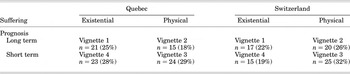
The studies of Blondeau et al. (Reference Blondeau, Roy and Dumont2005) and Beauverd et al. (Reference Beauverd, Bernard and Currat2013) employed the same two-by-two experimental design, which manipulated two independent variables: length of prognosis and type of suffering. Four clinical vignettes were employed to measure the effect of these variables (see the Appendix). These vignettes consisted of sample situations presenting different combinations of variables. The measured dependent variable was the attitude toward the use of palliative sedation.
In order to control the independent variables, each respondent was assigned only one vignette. A definition of sedation was purposefully omitted in the questionnaire to avoid bias. The attitudes toward the use of palliative sedation were measured using a 6-point Likert-type scale, ranging from 1 (strongly disagree) to 6 (strongly agree). Respondents were then asked an open question inviting them to comment on their situation.
Data Analysis
Statistical analyses were performed with SAS 9.2 (Cary, North Carolina) software. A variance analysis (unbalanced ANOVA) was performed by means of the general linear models (GLM) procedure. This analysis allowed measuring both the effect of the type of suffering and prognosis length, and the effect of their interaction on physicians' attitudes toward sedation. Attitudes toward sedation were then compared between the two jurisdictions for each vignette. A Wilcoxon test was then performed. This test was chosen because of the limited size of the subsample of respondents for each vignette.
The written comments were submitted to qualitative content analysis. Two members of the research team separately analyzed the content of all written comments and developed an open coding. Each unit of analysis (word, phrase, or paragraph) was given a code name and sorted into groups with related themes. This process was continued until all of the codes and categories were mutually exclusive and covered all variations. A comparative process of data analysis was then carried out. The two members met together to compare and discuss their coding. Each point of divergence was debated and clarified until agreement on the set of codes was reached.
RESULTS
Respondents
The sample comprised 98 physicians from Quebec and 77 from Switzerland. The Quebec sample was 48% female. About 47% were ≤45 years old, 41% were 46–55 years old, and 11% were ≥56 years old. About 31% had less than 6 years of experience in palliative care; 31% had between 6 and 10 years of experience, and 38% had more than 10 years of experience. The detailed results of the Quebec study were reported by Blondeau et al. (Reference Blondeau, Roy and Dumont2005). The Swiss sample was 44% female. About 34% were ≤45 years old, 31% were aged 46–55 years old, and 33% were ≥56 years old. About 29% had less than 6 years of experience in palliative care, 20% had between 6 and 10 years of experience, and 39% had more than 10 years of experience. The detailed results of the Swiss study were reported by Beauverd et al. (Reference Beauverd, Bernard and Currat2013).
The analyses (chi-square test) indicated that the four subgroups from Quebec and the four subgroups from Switzerland (formed from the four clinical situations) were equivalent to each other in terms of sex and experience in palliative care (p > 0.05), but different in terms of age (p < 0.05). In Quebec, the number of subjects per vignette ranged from 19 to 28, and in Switzerland from 15 to 25 (see Table 1).
Content of vignettes and respondents to each

Physicians' Attitudes Toward Palliative Sedation
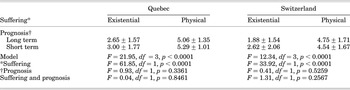
The analysis of variance showed that only the type of suffering variable had an effect on physicians' attitudes toward sedation (Table 2). In fact, in both jurisdictions neither prognosis nor sociodemographic characteristics (sex, age, and years of experience in palliative care) influenced physicians' attitudes.
Physicians' attitudes toward palliative sedation (mean ± standard deviation)

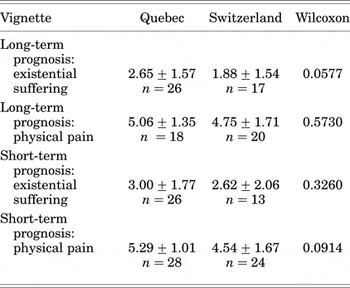
The results of the Wilcoxon test indicated that the attitudes of physicians from Quebec and Switzerland tended to be different for two vignettes: long-term prognosis with existential suffering (p = 0.0577) and short-term prognosis with physical suffering (p = 0.0914). In both cases, Swiss physicians were less prone to employ palliative sedation (Table 3).
Comparison of the attitudes toward palliative sedation between the Quebec and Switzerland subgroups

Written Comments
Written comments from Quebec respondents (n = 83/98) and Swiss respondents (n = 77/77) were summarized in a comparative perspective. The following contents highlight their main personal concerns.
A number of participants, mainly from Quebec, would agree that sedation is appropriate where the patient's prognosis is extremely guarded and physical suffering is intolerable and intractable. Some Quebec participants would consider it inhumane to allow someone to suffer without doing anything, writing that “ethically, it's the right thing to do” (translated). Other Quebec and Swiss participants would be more inclined to take recourse to sedation only after all other pain relief alternatives were exhausted. In the case of a long prognosis, however, one Quebec participant wondered if sedation to relieve physical suffering might become a kind of “legal active euthanasia” (translated), while one Swiss participant saw this as a proper situation for assisted suicide.
In the absence of intractable physical symptoms or uncontrolled pain, that is, only in the presence of “existential” suffering, close to half of the Quebec and Swiss participants did not see sedation as appropriate. Quebec participants noted that such suffering is very common at the end of life. As one participant put it, “If we prescribed terminal sedation for every patient who brought up [wanting to die], we'd be putting a lot of people to sleep” (translated). Other participants from Quebec and Switzerland disapproved of sedation for the relief of existential suffering where the patient's prognosis did not suggest impending death. Some participants, particularly from Quebec, saw the use of sedation in such conditions as unacceptable, unethical, or as a form of abandonment of the patient by the care team. Some participants, mainly from Quebec, also saw sedation for the relief of existential suffering as a form of euthanasia or assisted suicide. “It still bothers me for a prognosis of one or two months” (translated), wrote one Quebec participant. “The patient looks on death as deliverance, which for me blurs the line between sedation and euthanasia” (translated). In such cases, Swiss participants would be more inclined to discuss assisted suicide with the patient. For them, it was inappropriate to propose sedation to patients who want to die.
Some Quebec and Swiss participants were more open to sedation in the case of existential suffering, however. One Swiss participant expressed these views by describing sedation as a “good alternative to assisted suicide and something families might be more likely to accept” (translated), while another Swiss participant felt that “sedation is an acceptable response because its first goal as a treatment is to relieve an intractable symptom, not to affect life expectancy” (translated). There were also some Quebec participants who saw existential suffering as equivalent to physical suffering and should therefore be considered in the same way.
Both Quebec and Swiss participants felt it was important to discuss and clarify what the patient wanted before considering sedation. As one Swiss participant put it, “A loss of meaning doesn't mean you need to be put to sleep. And did the patient ask for it?” (translated). Some participants, mainly from Quebec, were more inclined toward sedation if it was clear that this was what the patient wanted. One Quebec participant wrote, “If the patient ‘clearly’ asks for it, I think not providing end-of-life sedation would be unethical” (translated). A number of participants, mainly from Quebec, were more favorable to sedation if the patient was able to consent to it and had done so. As one Quebec participant put it, “I think it's okay to prescribe sedation but not to impose it” (translated). Quebec and Swiss participants emphasized the importance of involving loved ones in the process. Some participants, mainly from Quebec, noted that consent from the patient's family should be obtained before sedation was initiated.
DISCUSSION
Our study results suggest that the attitudes of the participating physicians from Quebec and Switzerland toward palliative sedation, particularly regarding prognosis and type of suffering, were similar, despite the different legislations in place regarding physician-assisted suicide in their respective environments of practice. The group from Quebec did reach higher means on the Likert scale than did the group from Switzerland for all vignettes, which could suggest that respondents from Quebec would be more open to palliative sedation than respondents from Switzerland seemed to be, even though the majority were not in favor of sedation as an answer to end-of-life existential suffering.
Faced with a request for a “hastened-death,” some respondents from Switzerland would suggest considering physician-assisted suicide instead of palliative sedation. This could mean that in Switzerland there is a need to distinguish palliative sedation and physician-assisted suicide. A study by Raus and colleagues (Reference Raus, Sterckx and Mortier2011) demonstrated that physician-assisted suicide and palliative sedation are usually applied to different groups of patients. Physician-assisted suicide is usually requested by terminal patients who value control during the dying process and who feel that their disease has harmed or threatens to harm their dignity, while palliative sedation is employed predominantly for patients who want to avoid pain and suffering (Raus et al., Reference Raus, Sterckx and Mortier2011). Different results were reported by Seale (Reference Seale2010), who found that palliative sedation was associated with a higher rate of requests from patients or relatives for a hastened death. In the same way, the physicians who were in favor of assisted suicide legislation were more likely to report using palliative sedation. As this study was performed in the United Kingdom, where physician-assisted suicide and euthanasia are a criminal offence, this could suggest that palliative sedation is sometime used in response to requests for a hastened death when physician-assisted suicide or euthanasia is not an option.
Some respondents from Quebec would be in favor of sedation for a patient experiencing severe psychological or existential suffering if the prognosis was limited. These respondents mentioned that psychological or existential suffering should be given the same consideration as physical pain. Intractable psychological distress is sometimes the reason given by physicians for starting palliative sedation (Seale, Reference Seale2010), while others consider its use in such a situation as a death-hastening measure to be tantamount to physician-assisted suicide or euthanasia (Beel et al., Reference Beel, McClement and Harlos2002). In the current study, some respondents from both Quebec and Switzerland would equate using sedation in the presence of existential suffering with a form of euthanasia, particularly if the patient's prognosis was longer.
Naturally, the desire for a hastened death depends on numerous factors. This desire may fluctuate over time (Goelitz, Reference Goelitz2003) and may be influenced by interventions made by palliative care clinicians (Seale, Reference Seale2010; Goelitz, Reference Goelitz2003). As well, prior studies have revealed concerns about patients requesting a hastened death in order to avoid being a burden to others (Lee et al., Reference Lee, Nelson and Tilden1996; Cavalieri et al., Reference Cavalieri, Pomerantz and Ciesielski2002) or when they felt familial, institutional, or social pressures (Battin, Reference Battin2008). In a study by Blanker et al. (Reference Blanker, Koerhuis-Roessink and Swart2012), general practitioners more often experienced pressure from patients and their relatives to start continuous sedation until death when patients had a longer prognosis and showed psychological symptoms as compared to a shorter prognosis and physical symptoms only.
It is often recommended that initiating palliative sedation should be the result of a rigorous decision-making process involving an interdisciplinary team, the patient, and his loved ones (Moynier-Vantieghem & Beauverd, Reference Moynier-Vantieghem and Beauverd2008; de Graeff & Dean, Reference de Graeff and Dean2007; Goncalves et al., Reference Goncalves, Cordero and Almeida2012). Few of our respondents mentioned that the decision to use sedation should be discussed with the care team. However, more respondents considered that the utilization of sedation should be discussed with patient and family. Some respondents from both groups highlighted the importance of clarifying a patient's desires, and would agree to initiate sedation if this was congruent with those desires. Similarly, obtaining the patient's agreement was also cited in both groups as a criterion that should be met, which is in line with prior studies (Claessens et al., Reference Claessens, Menten and Schotsmans2008; Braun et al., Reference Braun, Hagen and Clark2003).
LIMITATIONS
Some of the limitations of our study include the years separating the two studies (2004–2005 and 2009–2011), the limited response rates in both (36% in Switzerland and 42% in Quebec), and the study population being restricted to physicians. Potential confounding effects that could explain some differences observed between the two groups were not controlled, such as physicians' age and level of religious faith. To facilitate interpretation of the results and their analyses, the concepts of physical suffering and existential suffering were separated in the vignettes, which is rarely the case in daily clinical practice. Another limitation concerns the fact that only two independent variables were investigated in our study: length of prognosis and type of suffering. Last, respondents were invited to comment about their position only with respect to their specific vignette, which may limit the generalizability of these testimonies, despite their richness and relevance.
CONCLUSION
The attitudes of physicians from Quebec and Switzerland toward palliative sedation, particularly regarding prognosis and type of suffering, seem similar, despite the different legislation in place regarding physician-assisted suicide in each practice environment. However, the results suggest that physicians from Quebec could be slightly more open to palliative sedation, even though the majority were not in favor of this practice as an answer to end-of-life existential suffering. In a context where physician-assisted suicide is authorized, it is possible that physicians are more inclined to favor physician-assisted suicide over palliative sedation when patients experience existential suffering, particularly if their prognosis is more extended.
ACKNOWLEDGMENTS
We gratefully thank all the participating physicians at both study sites. We also are grateful to Stéphane Turcotte, biostatistician, for the quantitative analyses, and Sandy Lavoie, research assistant, who contributed to the qualitative analyses. We also thank the institutions that granted funds: the Chaire de soins palliatifs of Laval University in Quebec and the Social Sciences and Humanities Research Council of Canada.
APPENDIX. CLINICAL VIGNETTES
Clinical Vignette No. 1: Robert
Robert Casey has been married to Jane for 36 years. They have two married sons and three granddaughters. He retired two years ago, two months before being diagnosed with colorectal cancer (carcinoma). At that time, staging did not indicate any spread of the tumor. He underwent a left hemicolectomy with a colostomy. Resection margins were clear, but 3 out of 10 ganglia were positive.
Some 15 months later, a recurrence was discovered in the true pelvis. Examination showed a 3 × 5 cm mass in the true pelvis, retroperitoneal ganglionic damage, and two hepatic metastases (4 and 2.5 cm). Robert underwent chemotherapy, which was terminated after six cycles because the illness was progressing.
Some 18 days ago, Robert was admitted to hospital in the palliative care unit. His state of health is deteriorating progressively. There is one major problem: the pain is not subsiding despite multiple attempts to alleviate it. The abdominal pain is diffuse, described as shooting with a sensation of heaviness, and very sharp frequent exacerbations in the form of stabbing pain that reaches an intensity of 10 out of 10 on the visual scale.
Examination shows that Robert has lost weight and is jaundiced and very weak. His abdomen has increased in volume with moderate ascites. The hepatic lobe is painful to palpation, and the liver is greater in volume and filled with hard nodules. A recent investigation does not show any lesion of the bone structure.
Multiple attempts to alleviate his pain have failed to provide acceptable comfort for the patient. Robert is currently on the following medications:
-
• hydromorphone 5 mg/h continuous subcutaneous drip and breakthrough doses every 30 minutes if needed
-
• gabapentin 400 mg, 1 capsule, 4 times daily
-
• dexamethasone 4 mg, subcutaneous, 4 times daily
-
• naproxen 500 mg, 1 tablet, twice daily
-
• ketamine 8 mg/h continuous subcutaneous drip
-
• amitryptiline 50 mg, 1 tablet at bedtime
-
• clonazepam 0.5 mg, 1 tablet lid, and 2 mg, 1 tablet at bedtime
-
• haloperidol 1 mg, 1 tablet, twice daily
-
• laxatives (emollient and stimulant), bowel movements are regular
Note. Methadone was tried but brought about major intolerable side effects; antiarrhythmics did not provide relief.
Given the patient's state and considering how quickly he is deteriorating, one can estimate a prognosis of no longer than 5 to 10 days.
Robert is constantly in pain and rests only for short periods of time. He has received 10 breakthrough doses within the last 24 hours despite the fact that his medication had been readjusted.
Clinical Vignette No. 2: Claire
Claire Germain is a 55-year-old lawyer and divorcee with no children. However, her family network is large, and she has many friends. Ovarian cancer (mucinous carcinoma) was diagnosed 15 months ago. She underwent surgeries: hysterectomy, oophorectomy, bilateral salpingectomy, and cytoreduction of neoplastic implants found at the peritoneal level. Last year, the cancer progressed in spite of many cycles of different types of chemotherapy.
Claire has therefore been admitted to the palliative care unit because the situation at home was becoming too trying. She has multiple hepatic metastases and major peritoneal carcinomatosis with no intestinal obstruction. She also presents large ascites that were tapped twice in the past 10 days. She suffers from diffuse pain in the abdomen and the right lower part of the thorax. Analgesic medication makes her comfortable.
Examination shows that the patient has lost weight but is not jaundiced. She is lucid but has slower motor skills. She needs help with all her activities. Pulmonary auscultation shows a decreased vesicular murmur by one third on the lower right, which is evidence of pleural effusion. The patient is not, however, dyspneic. The abdomen has been supple since the last ascites puncture; the multiple hepatic and peritoneal nodules can be felt. Claire is on the following medications:
-
• fentanyl 50 µg/h, 1 patch every 3 days
-
• hydromorphone 1 mg subcutaneously, every 30 minutes if in pain (she takes 1 breakthrough (dose every 2 days)
-
• naproxen 375 mg, 1 tablet twice daily
-
• lorazepam 1 mg, 1 tablet at bedtime
-
• laxatives (bowel movement every 2 to 3 days)
She is deteriorating quickly, and one can reasonably assume that the prognosis is less than 10 days.
Physical pain is well alleviated and the patient feels comfortable; however, she requires help with all her activities. She is grateful for the help given, but Claire says she can no longer stand this deterioration, which she finds degrading. Despite the psychosocial support she receives from the social worker and the joint follow-up by her physician, she constantly repeats that her life no longer “makes sense.”
Clinical Vignette No. 3: Jim
Jim Foster is a retired civil engineer. Twice divorced, he has been living with the same woman for the past 14 years. He has two daughters (37 and 47 years old) from his first marriage and one son (30 years old) from his second. He gets on well with them, but they all live abroad. For the past 12 years, he has been suffering from prostate cancer.
Over the years, he has been treated in the usual manner for this condition: prostatectomy, hormone therapy, chemotherapy, and radiotherapy. He has also taken part in clinical trials during the past two years and has gone across the border for a second opinion. However, the illness is out of control. The last staging showed multiple osseous metastases, as well as major liver and ganglionic damage.
At his request, Jim has been hospitalized to lessen the burden on the woman he lives with. Being younger than him, she works full time. Since his state of health has deteriorated, the patient needs a great deal of help with his daily care and to just move around. He is fed up with being dependent. His medications are as follows:
-
• morphine–LA 60 mg, 1 tablet twice daily
-
• morphine 10 mg, 1 tablet every hour if needed
-
• rofecoxib 25 mg, 1 tablet twice daily
-
• zoledronate 8 mg, IV every month
-
• biculatamide 50 mg, 1 tablet daily
-
• goselerine 10.8 mg, subcutaneously every 3 months
-
• omeprasole 20 mg, 1 tablet daily
-
• lorazepam mg, 1 tablet at bedtime
-
• acebutolol 200 mg, 1 tablet daily
-
• amlodipine 10 mg, 1 tablet daily
-
• isosorbide extended release 60 mg, 1 tablet daily
-
• acetylsalicylic acid 325 mg, 1 tablet daily
-
• lisinopril 20 mg, 1 tablet daily
This medication usually relieves his pain. From the way his condition is changing, one can estimate his prognosis at one to two months.
Jim constantly expresses his wish to die. Since his life has no more meaning for him, he sees death as a release. He mentions that his next of kin are aware of his wishes. As for himself, he has nothing to expect from life in this state of dependence on others. According to the psychiatrist and the social worker, Jim shows no signs of depression and is able to make decisions for himself.
Clinical Vignette No. 4: Julian
Julian Davis is a 60-year-old painter who has traveled the world. He suffers from recurrent epidermoid carcinoma located in the right oropharynx. Three years ago, he underwent surgery and radiotherapy. Recurrence of the disease was diagnosed six months ago. Because the tumor could not be treated surgically, radiotherapy and chemotherapy were indicated. The initial response was positive, but eventually the lesion continued developing. It has now spread to the right side of the neck, but there is no skin ulceration.
The patient complains of shooting pain, a burning feeling, and neuralgia on the right side of the cervix, with pain spreading toward the right ear. This pain is rated at 9–10/10 and drops to 8/10 for short periods following breakthrough doses. Medications are as follows:
-
• fentanyl 250 µg/h patches
-
• morphine 20 mg, subcutaneously every 30 minutes if any discomfort
-
• methotrimeprazine 15 mg, subcutaneously 4 times daily
-
• sodium naproxen 500 mg, twice daily
-
• dexamethasone 4 mg, subcutaneously 4 times daily
-
• clonazepam 1 mg, 4 times daily
-
• gabapentin 800 mg, 1 capsule 4 times daily
-
• flecainide 100 mg, 1.5 tablets twice daily
-
• omeprasole 20 mg, 1 tablet daily
-
• laxatives
-
• olanzapine 7.5 mg regularly at bedtime and 5 mg 3 times daily if confused or agitated
The pain has not subsided, despite multiple attempts to alleviate symptoms, and Julian experiences constant discomfort. The pain is never under the 8/10 level, which he finds unbearable. Any increase in analgesic medication is hampered because of major side effects, such as cognitive impairment and agitation. Methadone, ketamine, clonidine, and topiramate have been tried without results or, worse, with unbearable side effects.
The patient was admitted to the palliative care unit many weeks ago. He is progressively deteriorating, losing weight, and becoming increasingly tired. The professionals who care for him think his prognosis is between four and eight weeks.
Julian repeats over and over again that he cannot bear the situation any longer. He is obsessed with the discomfort and pain, which have taken over his whole life. He asks you to do something.