Introduction
Over the past several decades, the association between social relations and health has been well documented (Cassel, Reference Cassel1976; Cobb, Reference Cobb1976; Berkman & Syme, Reference Berkman and Syme1979; Thoits, Reference Thoits1995; Berkman et al., Reference Berkman, Glass, Brissette and Seeman2000). Several studies have shown that individuals who lack social support tend to have a higher incidence of physical illness and lower levels of psychological well-being (Gove, Reference Gove1972; Syme, Reference Syme1974). Social support is associated with cardiovascular morbidity and mortality (Olsen, Reference Olsen1993; Kawachi et al., Reference Kawachi, Colditz, Ascherio, Rimm, Giovannucci, Stampfer and Willett1996), recovery from myocardial infarction, cancer and stroke (Vogt et al., Reference Vogt, Mullooly, Ernst, Pope and Hollis1992; Berkman, Reference Berkman1995), the occurrence of psychiatric disorders (Stansfeld et al., Reference Stansfeld, Rael, Head, Shipley and Marmot1997; Fratiglioni et al., Reference Fratiglioni, Wang, Ericsson, Maytan and Winblad2000), quality of life (Achat et al., Reference Achat, Kawachi, Levine, Berkey, Coakley and Colditz1998), health functioning (Michael et al., Reference Michael, Colditz, Coakley and Kawachi1999) and health status (Litwin, Reference Litwin1998; Krantz & Östergren, Reference Krantz and Östergren2000). Also, individuals having higher levels of social support tend to show lower rates of age-adjusted mortality (Berkman & Syme, Reference Berkman and Syme1979; House et al., Reference House, Robbins and Metzner1982; Sugisawa et al., Reference Sugisawa, Liang and Liu1994).
Although much research has examined the association between social support and perceived health, few studies have focused on age and gender differences in the relationship between social support and self-rated health. Most research has not differentiated between males and females or has focused on certain age groups, such as only the elderly (Weinberger et al., Reference Weinberger, Hiner and Tierney1987; Everard et al., Reference Everard, Lach, Fisher and Baum2000; Lund et al., Reference Lund, Avlund, Modvig, Due and Holstein2004), middle-aged (Melchior et al., Reference Melchior, Berkman, Niedhammer, Chea and Goldberg2003) or all age groups (Lee et al., Reference Lee, Jang, Lee, Cho and Park2008).
Social support has been divided into two types: emotional and instrumental support (Berardo, Reference Berardo1967; Sugisawa et al., Reference Sugisawa, Liang and Liu1994; Rose, Reference Rose2000). These forms of social support are most frequently assessed in terms of the contact with or existence of potentially supportive persons. Emotional support is measured by responses to a question similar to ‘Can you count on anyone to provide you with emotional support, for instance, talking over problems or helping you make a difficult decision?’ (Sugisawa et al., Reference Sugisawa, Liang and Liu1994). Instrumental support is measured by the availability of tangible services that the respondent receives from network members. Examples include help when sick and financial assistance (Berardo, Reference Berardo1967).
Engagement in social activities has been suggested as one determinant of health status (Dalgard & Haheim, Reference Dalgard and Haheim1998; Hyyppä & Mäki, Reference Hyyppä and Mäki2003; Lindstrom et al., Reference Lindstrom, Moghaddassi and Merlo2004). Low social activities may influence health, through relative deprivation. For example, social activities may transmit health promotion information and enhance motivation to practise healthy behaviours. Also, social activities may lead to greater emotional support and community involvement (Kawachi et al., Reference Kawachi, Kennedy and Glass1999).
Although the number of studies focusing on the relationship between social activities and health has increased, those studies have rarely investigated age and gender differences in these effects. Previous studies have typically focused on a certain groups, such as elderly people (Bukov et al., Reference Bukov, Mass and Lampert2002), women (Cheng et al., Reference Cheng, Chi, Boey, Ko and Chou2002) or men (Hanson, 1989). Also, the studies have focused on a specific social activities, such as volunteer obligations (Van Willigen, Reference Van Willigen2000), religious service attendance (Hyyppä & Mäki, Reference Hyyppä and Mäki2003) and participation in clubs (Veenstra, Reference Veenstra2000).
The influence of social activities on health may differ by age and gender. Older adults generally have limited opportunities for employment, whereas they may have more spare time for participating in social activities, such as volunteering, hobby groups or gatherings of friends, than do middle-aged adults. Generally, women have more extensive networks through engagement in social activities than do men, and women have a wider range of sources of emotional support, whereas health-promoting networks are more common among men (Vaux, Reference Vaux1985; Belle, Reference Belle, Barnett, Biener and Baruch1987).
The objective of this study was to examine age and gender difference in the effects of social support and social activities on perceived health in middle-aged and older adults. Also, the influence of the type of social support, including emotional support and instrumental support, was examined.
Methods
Design and study population
Raw data were acquired from the Seoul Citizens Health and Social Indicators Survey, 2005. The survey is the most representative population-based health and social behaviours survey in South Korea. Seoul is a capital city composed of 25 ku, or administrative districts. It has about 10 million inhabitants, representing about 20% of the South Korean population.
To obtain a representative sample for the present study, a sample of these data was selected using a stratified multistage sampling method, based on geographical location, gender and age, using the Korean National Census Registry, 2000. Accordingly, an average of 600 households were selected for each district. The survey was performed using face-to-face interviews with, and self-reports from, members of 15,121 households, aged 19 years and older, from 25 districts in Seoul.
The 125 skilled and experienced surveyors performed visit interviews with one person from each household. Construction of the survey questionnaire was based on the Health City Indicators of WHO. The questionnaire assessed mental and physical health, social support and health-related behaviours.
Participants in the study were 8725 adults, including 7301 middle-aged (40–64 years old) and 1424 older adults (65 years old and older). The mean age of middle-aged participants was 49.1 years (SD 6.9): 49.2 years (SD 6.9) for men and 49.0 years (SD 7.0) for women. The mean age of older adult participants was 72.0 years (SD 6.0): 71.3 years (SD 5.4) for men and 72.4 years (SD 6.4) for women.
Outcome measure
Self-rated health (SRH), which is most frequently used as a perceived general health indicator, was used as an outcome measure for this analysis. It was assessed by a single item, ‘How would you rate your health in general?’ This variable was dichotomized between good (very good/good) and poor (fair/poor/very poor). This measure has been reported to be a valid and reliable indicator of general health and well-being (Idler & Kasl, Reference Idler and Kasl1995; Kawachi et al., Reference Kawachi, Kennedy and Glass1999; Sturgis et al., Reference Sturgis, Thomas, Purdon, Bridgwood and Dodd2001).
Sociodemographic measures
Marital status was classified as widowed or living with a spouse. Educational status was classified as elementary school or less, middle school, high school graduate and college graduate and over. Household income status was classified in units of ten thousand won (∼US$10) as low (less than 200 units (or 2,000,000 won) per month, US$2000), medium (201–300 units, US$2001–3000) and high income (301 units and above, US$3001 and above) or missing (no response).
Health behaviour
The study used three indicators of health behaviour. Smoking was classified as non-, ex- and current smoker, and alcohol use as never, less than daily and daily drinker. Depressive feelings were identified when participants reported having experienced persistent feelings of sadness or depression, sufficient to affect daily life, for two weeks or more in the past year. For this item, a dichotomous outcome measure was used (1=yes, 0=no).
Social support and engagement in social activities
Social support and social activities were classified with five items, representing different aspects and functions of social relationships. Social support was divided into two forms: emotional and instrumental support. The questions assessing emotional support included the following: ‘Have you been paid a visit by close family or relatives living nearby?’ and ‘Do you have a person who listens to your worries?’ The questions regarding instrumental support were as follows: ‘Do you have a caregiver when you are sick?’ and ‘Do you have someone who provides economic support?’ The questions addressing social activities were as follows: ‘Do you participate in any of the following four social activities: religious organizations, hobby groups, volunteering or gatherings of friends?’ These questions were answered with ‘Yes’ or ‘No’ responses.
Statistical methods
The study investigated the relationship between self-rated poor health and social support, engagement in social activities and other covariates by gender and age subgroups and among middle-aged compared with older adults. First, Wald χ 2 statistics were used to test the difference in the coefficients between middle-aged and older adults. Second, multiple logistic regression analysis was used (odds ratio, OR; 95% confidence interval, CI) to assess the effects of social support and activities on self-rated poor health of middle-aged and older adults. All analyses demonstrated sufficient goodness-of-fit (Hosmer–Lemeshow test, p>0.10). All statistical analyses were performed with SPSS (version 12.0, SPSS Inc, Chicago, IL, USA).
Results
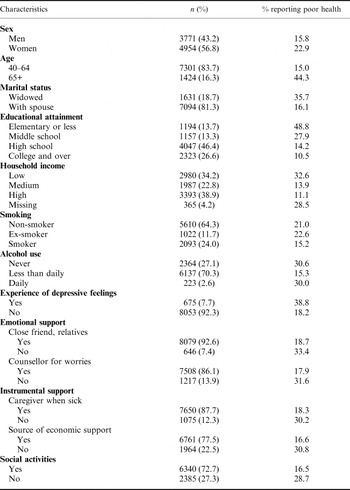
Overall, 42.8% of individuals reported that their health was fair (n=2005; 23.0%), poor (n=1500; 17.2%) or very poor (n=227; 2.6%), whereas 57.2% reported that their health was very good (n=373; 4.2%) or good (n=4620; 53%). Table 1 shows the sample characteristics and the percentage of participants reporting poor health. Consistent with a previous study (Idler & Yael, Reference Idler and Yael1997), perceived poor health was associated with widowed status, lower educational attainment and lower household income. A nearly five-fold gradient was observed in the proportion of individuals reporting poor health across levels of educational attainment. The participants who received social support, including emotional support and instrumental support, showed a low proportion of poor SRH.
General characteristics of the study participants aged 40 years or older for reporting self-rated poor health

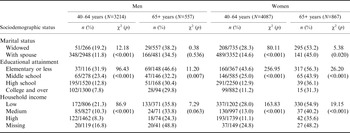
The association between sociodemographic status and poor health was statistically significant ( Table 2). Individuals aged 40 and older who had no spouse were more likely to rate their health as poor, except for men aged 65 and over. As expected, lower education and lower household income were associated with poor SRH; however, the association between household income and poor health in men 65 years and older was not statistically significant.
Distribution of poor self-rated health of middle-aged and older adults by sociodemographic status

Note: Wald χ 2 statistic for testing the difference between coefficients for age and sex.
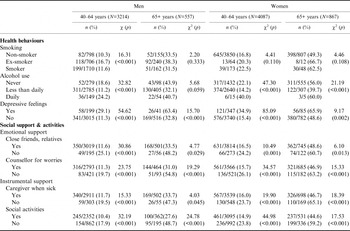
Among smokers, only middle-aged men perceived their health as poorer than that of their non-smoking peers. People who drank daily perceived themselves to have poorer health, compared with those who did not drink alcohol or did so only occasionally; however, men aged 65 years and older were an exception to this finding.
The experience of depressive feelings sufficient to interfere with daily life over more than two weeks in the last year was strongly negatively related to SRH (Table 3).
Distribution of poor self-rated health of middle-aged and older adults by health behaviours, social support and social activities

Note: Wald χ 2 statistic for testing the difference between coefficients for age and sex.
Poor support was associated with poor SRH, especially in men and women aged 65 years and older. A lack of friends, a counsellor, a caregiver and a source of economic support were strongly associated with poor SRH in men and women aged 65 years and older. Social activities was closely related to SRH in middle-aged and older adults. However, the difference in perceived poor health between participants and non-participants in social activities was small among middle-aged adults, whereas it was nearly two-fold in older adults.
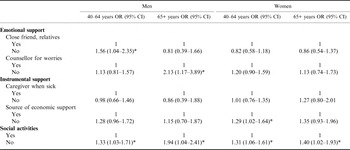
Table 4 shows the results from the multivariate logistic regression of poor SRH on social support and social activities of middle-aged and older adults. Middle-aged men who had no close friend or relative considered their health poorer than those did who had a close friend or relative (OR=1.56, 95% CI=1.04–2.35), whereas the absence of a source of economic support was associated with poor SRH only in middle-aged women (OR=1.29, 95% CI=1.02–1.64). The absence of emotional support from a ‘counsellor for worries’ was most strongly associated with poor SRH in older men (OR=2.13, 95% CI=1.17–3.89), after controlling for sociodemographic factors and health behaviours. The presence of a caregiver when one is sick was not associated with poor SRH in either middle-aged or older adults.
Adjusted odds ratios (95% confidence interval) for poor self-rated health estimated with multivariate logistic regression focusing on social support and activities of people over 40

* p<0.05.
Note: Adjusted for sociodemographic factors and health behaviours, including marital status, educational attainment, household income, smoking, alcohol use and depressive feelings.
Low engagement in social activities, including religious organizations, hobby groups, volunteer activities or gatherings of friends, was strongly associated with poor health in middle-aged and older adults (Table 4). The effect of social activities on perceived poor health was stronger for those aged 65 years and older (OR=1.94, 95% CI=1.04–2.41 among men; OR=1.40, 95% CI=1.02–1.93 among women) than for those aged 40–64 years (OR=1.33; 95% CI=1.03–1.71 among men; OR=1.31, 95% CI=1.06–1.61 among women), after controlling for sociodemographic factors and health behaviours.
Discussion
The aim of this study was to investigate gender difference in the effects of social support, including emotional support and instrumental support, and social activities on perceived health of middle-aged and older adults. The results demonstrated that the absence of emotional support from close friends, relatives or someone who provides counsel for one's worries was strongly associated with poor self-rated health in men, particularly older men. Lack of engagement in social activities was associated with self-rated poor health in older adults, especially in older men. Additionally, poor instrumental support was associated with perceived poor health only in middle-aged women.
Relationship between emotional support and perceived health, especially of older men
Poor emotional support, such as that provided by counsellors for personal issues or important decisions, and poor social relations have been found to be associated with poor self-rated health in older men and women, aged 70–95 years (Melchior et al., Reference Melchior, Berkman, Niedhammer, Chea and Goldberg2003). In older adults, a lack of relationships, as evidenced by small diversity of contacts and low contact frequency, has been found to be predictive of poor health status after four and eight years (Lund, 2004). The results of the present study demonstrated a negative effect of lack of emotional support on perceived health, especially in older men. This has at least two possible explanations.
First, men may be coping poorly with life changes. Men are less socially integrated and reported fewer sources of social support than did women. As a result, women may be better able to handle change than men are, owing to women's family roles, interpersonal coping strategies and larger social networks (Möller-Leimkühler, Reference Möller-Leimkühler2003). Older men depend on their wives for intimacy, and they then experience greater social disruption with the loss of a spouse (Berardo, Reference Berardo1967; Blau, Reference Blau1961). Further, older men have often experienced various forms of diminished social contact and constriction of their social worlds, including lessened social participation, retirement, loss of income and widowhood. These changes in later life may bring about direct or indirect detrimental effects such as depression in older men. Emotional support from persons who counsel older men about their worries may buffer these potential negative health outcomes in older men.
Second, conservative male gender roles may result in the association between poor emotional support and self-rated poor health in older men. The traditional male gender role is characterized by attributes such as independence, rationality, control, reluctance to seek help and invulnerability (Möller-Leimkühler, Reference Möller-Leimkühler2003). Especially in Korea, Confucian ideas have added to the male gender role qualities such as emotional un-expressiveness and dominance. Men aged 65 and over may have more traditional Confucian ideas than do middle-aged men.
Relationship between engagement in social activities and perceived health of older adults
Social group activities may influence individual health by fostering more rapid diffusion of health information, increasing the adoption of healthy behaviour such as physical activity, and exerting control over unhealthy behaviour (Kawachi et al., Reference Kawachi, Kennedy and Glass1999; Veenstra, Reference Veenstra2000). Low social group participation is related to the risk of low physical activity (Lindstrom et al., Reference Lindstrom, Hanson and Östergren2001), suggesting that social activities can improve health-related behaviours. The results of our study suggest that lack of engagement in social activities was associated with self-rated poor health among older adults, especially in older men.
These results were partially the result of gender differences in social contact patterns. Women have more comprehensive engagement in social activities and diverse social contacts than do men (Blau, Reference Blau1961; Booth, Reference Booth1972; Booth & Hess, Reference Booth and Hess1974). The intimate social networks of women developed through engagement in social activities may allow better coping with the difficulties of widowhood or detrimental health outcomes in late life. Participation in social group activities, including church membership and other formal and informal affiliations, could play an important role in women's perceived health and their future health (Rietschlin, Reference Rietschlin1998; Hyyppä & Mäki, Reference Hyyppä and Mäki2003). Membership in any religious association has been reported to be significantly and independently associated with self-rated good health (Hyyppä & Mäki, Reference Hyyppä and Mäki2001).
Emotional support, instrumental support and perceived health of middle-aged adults
The findings of this study show that poor emotional support due to the absence of a close friend or relative was significantly independently associated with poor self-rated health in middle-aged men. Schaefer and colleagues (Schaefer et al., Reference Schaefer, Coyne and Lazarus1981) reported benefits of the presence of close persons for perceived health, especially among the middle-aged. They demonstrated that feelings of support provided by membership in a close social network could be more significant than tangible services or aid in determining psychological functioning, but not physical health, of 45- to 64-year-old adults. Persons who have an intimate friend or confidant have lower levels of depression and distress (Holahan & Moos, Reference Holahan and Moos1981; Bloom & Spiegal, Reference Bloom and Spiegel1984). Social support has also been associated with improved adaptation to especially stressful circumstances resulting from life crises, such as functional disability or loss of job (Turner, Reference Turner1981; Lin et al., Reference Lin, Woelfel and Light1985). From this literature, emotional support provided by relatives and friends is associated with decreased distress during times of life crises and with improved psychological functioning following illness.
The decline in the South Korean economy may also be a partial explanation for poor perceived health among older Koreans. A downturn due to the economic crisis in South Korea in late 1997 (Korea National Statistical Office, 1999) had various adverse impacts, such as difficulties in household economies due to increased unemployment, voluntary retirements, an excessively competitive labour environment and an increase in suicide in middle-aged men (Kwon et al., Reference Kwon, Chun and Cho2009). Under these circumstances, the lack of perceived social support from someone to confide in or friends with whom one could get together for relaxation may have a more deleterious effect on perceived health in middle-aged men than would be the case in a boom period. Of course, this is a real possibility, and the association between the absence of emotional support from a close friend or relative and perceived poor health should be further examined in a future longitudinal study.
On the other hand, poor instrumental support, such as the absence of a source of economic support, was significantly associated with poor self-rated health in middle-aged women. Self-rated economic condition was a significant predictor of self-rated health among middle-aged women, as well as of functional health, physical illness and mental health status, after controlling for sociodemographic variables (Cheng et al., Reference Cheng, Chi, Boey, Ko and Chou2002). A possible explanation may involve the financial burdens on middle-aged women. Compared with other age groups, women in their mid-forties often have heavy financial burdens, such as their offspring's educational expenses, retirement of their husbands and widowhood. Also, because of the insecure employment situation in South Korea, most employed women in their forties and older are temporary or part-time workers (Korea National Statistical Office, 2005).
Limitations
Several limitations should be considered in interpreting this study. First, the study was cross-sectional, which raises questions about causality. In older adults, the causal underpinning of the association between lack of participation in social activities and perceived poor health can be understood in either direction. That is, the decrease in social activities may result in poor health status, and conversely, poor health status, including chronic diseases, may also restrict participation in social group activities. A few longitudinal studies have shown that individuals who experienced a physical and functional decline had a significant decrease in frequent social contacts and in the numbers of relatives, neighbours and friends (Asakawa et al., Reference Asakawa, Koyano, Ando and Shibata2000; Lund et al., Reference Lund, Avlund, Modvig, Due and Holstein2004), and this vicious cycle can result in poor health. However, poor social relationships were significantly associated with self-rated poor health, even after adjusting for limitations due to physical functioning (Lund et al., Reference Lund, Avlund, Modvig, Due and Holstein2004). Second, work-related social activities in this study were confined to ‘unpaid work’. Whether paid or unpaid, work is a strong predictor of self-rated health. This study, however, focused on the effect of only unpaid work on self-rated health of middle-aged and older adults. Social activity variables were not subdivided into type of social group or participation frequency because of the broad nature of the question. The study used the single question, ‘Do you participate in any of the following four social activities: religious organizations, hobby groups, volunteering or gatherings of friends?’ However, social groups are extremely diverse; some merely require the payment of membership fees and involve only passive group activities, whereas others encourage more face-to-face contact (Kawachi et al., Reference Kawachi, Kennedy and Glass1999). Also, differences in perceived health may be related to the frequency of participation in social group activities. However, the study did not consider such variations because of data limitations.
Third, the study may suffer from selection bias. The subjects were limited to 8725 adults aged 40 years or older. The 8725 adults were selected from the total population obtained after excluding subjects with missing values for questions such as education and household income, and this exclusion may have biased the selection of subjects.
Fourth, the number of older adult participants is relatively smaller than that of middle-aged participants. Even so, the results demonstrated an association between low social support and social participation and poor self-rated health among older adults, even after considering the loss of statistical power resulting from fewer participants.
In conclusion, as a health improvement strategy for men 40 years of age and older, emotional support should be considered, especially for older men. For example, it is possible to provide a counselling service by installing counselling phone lines exclusively for older men. Instrumental support, such as providing an economic backup, is more important for middle-aged women. Measures should be considered for encouraging social activities for older adults, particularly older men.
Acknowledgment
This work was supported and funded by the Hanyang Women's University.