Introduction
Abnormal body mass index (BMI) has been shown to be associated with psychopathology in both adults and young. For example, meta-analyses have shown that obese people have an increased risk of developing depression (Luppino et al. Reference Luppino, de Wit, Bouvy, Stijnen, Cuijipers and Penninx2010; de Wit et al. Reference de Wit, Luppino, van Straten, Penninx, Zitman and Cuijpers2010).
This apparent link is also shown to exist in children. Cross-sectional analyses (Sanders et al. Reference Sanders, Han, Baker and Cobley2015) show that obesity in childhood is associated with unfavourable mental health outcomes. Diagnostic interviews and self-report questionnaires with obese children showed that they are more likely to have a psychiatric diagnosis, as well as impaired emotional, social and/or school functioning (Schwimmer et al. Reference Schwimmer, Burwinkle and Varni2003; Vila et al. Reference Vila, Zipper, Dabbas, Bertrand, Robert and Ricour2004). Additionally, being underweight in childhood has been associated with higher internalising and externalising problems (Cimino et al. Reference Cimino, Cerniglia, Almenara, Stanislav, Errie and Tambelli2016).
Longitudinal analysis has shown an association between BMI and internalising symptoms (Patalay & Hardman, Reference Patalay and Hardman2019). However, the association between change in BMI and development of psychopathology has been less investigated. To our knowledge, only three studies have investigated the association with change in BMI. The first, a longitudinal study of Australian children (Gifford Sawyer et al. Reference Gifford Sawyer, Harchak, Wake and Lynch2011), showed that large increases in weight were associated with higher likelihood of scoring above the ‘at-risk’ cut-off on the Paediatric Quality of Life scale. The others showed that increasing or decreasing weight trajectories in children were associated with increased risk of adverse psychosocial outcomes (Van Grieken et al. Reference Van Grieken, Renders, Wijtzes, Hirasing and Raat2013; Kelly et al. Reference Kelly, Patalay, Montgomery and Sacker2016). However, these papers only look at the psychological outcome in childhood and their focus does not extend to psychopathology in the adolescent. Our aim with this project is to assess whether change in BMI (both increasing or decreasing) over the period from childhood to early adolescence is associated with risk of developing psychopathology. By looking at psychopathology in early adolescence, we will be able to capture an important transition point (childhood to adolescence), during which BMI change is likely to have a particularly influential effect. Assessing the effect of change in BMI is important as weight consciousness and stigma is particularly prevalent in adolescence now (Canadian Paediatric Society, 2004). Meanwhile, it is becoming increasingly apparent that sustained weight loss in the overweight is hard to maintain, and that weight fluctuation between healthy and overweight is a more likely trajectory (Rothblum, Reference Rothblum2018; Ng & Cunningham, Reference Ng and Cunningham2020).
Importantly, this study will be the first research of its kind to use Irish nationally representative data. In Ireland, there has been concern in recent years over the increasing prevalence of overweight BMI in children, with Ireland existing amongst the countries with higher rates of prevalence (NCD Risk Factor Collaboration, 2017).
Methods
Participants
The study population comprised the ’98 cohort (child cohort) of the Growing Up in Ireland (GUI) study. This is a national longitudinal study of children and adolescents in Ireland. The cohort was recruited at age 9 and comprises 8658 children and their families. Participants were recruited from 910 primary schools (82% of those invited to participate), selected to accurately represent the school population of Ireland as a whole, with respect to location, disadvantage of pupils, gender mix, denominational status and number of 9-year-old pupils. A maximum of 40 students were recruited from each school, to minimise burden on school staff and to prevent larger schools from biasing the sample. Multiple rounds of information and consent forms were given to families to minimise refusal. Between August 2007 and May 2008, 50% of the 17 054 invited families consented to participate and provided useable data. A follow-up study (wave two) was carried out at age 13, and 7423 (87.7%) were interviewed between August 2011 and March 2012. Interviews and questionnaires were undertaken with children and primary caregivers at all ages. To account for the demographic differences between the baseline and follow-ups caused by differential attrition, the data were ‘reweighted’ with respect to differential response characteristics.
Ethics and consent
Written consent was obtained from all participants and their primary caregivers in the Growing Up in Ireland Study. Participants are not identifiable from the anonymised microdata file.
Exposures
At age 9/13, the child was measured (for height in cms) and weighed (kgs) to enable calculation of BMI (kgs/height).
For this paper, we defined overweight BMI according to the British Medical Journal (BMJ) worldwide standard definition, obtained by averaging the centile curves of multi-site international data (Cole et al. Reference Cole, Bellizzi, Flegal and Dietz2000). Overweight was defined as BMI over the healthy range, thus including obese.
We defined underweight BMI according to a standard definition, which determined cut-offs to define thinness in children and adolescents (Cole et al. Reference Cole, Flegal, Nicholls and Jackson2007). These cut-offs for thinness were divided into grades 1, 2 and 3, according to increasing severity of thinness. For our paper, we decided to adopt grade 1 cut-off for underweight BMI.
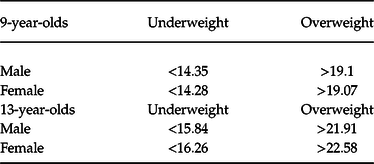
The combined table of the BMJ cut-off definitions is represented in Table 1.
Body mass index cut-offs for underweight and overweight

Outcomes
The Strengths and Difficulties Questionnaire (SDQ) (Goodman et al. Reference Goodman, Ford, Simmons and Gatward2000), a short behavioural screening questionnaire for age 3–16, administered to the primary caregiver at age 13, was used for the outcomes. The Total Difficulties score was used for this project, which was generated by summing the scores from the emotional problems, conduct problems and hyperactivity scales. A score of ≥17 indicates psychopathology (Goodman, Reference Goodman2001).
Persistent psychopathology was also used as an outcome. This was defined as SDQs scores above the threshold at both ages (i.e at both 9 and 13 years). This included both SDQ scores that remained high within the one domain (e.g. emotional problems) and those that were high in different domains over the two time points.
Confounders
Confounders were adjusted for at age 9 wave. These confounders were chosen based on the existing literature, showing them to be associated with both BMI and psychopathology. The confounding variables included were as follows:
-
a. Socioeconomic status. This was measured by investigating household income quintile (lowest quintile to highest). Socioeconomic status has been shown to be associated with obesity (Sobal & Stunkard, Reference Sobal and Stunkard1989; Bronner, Reference Bronner1996), as well as with development of psychotic episodes (Linscott & Van, Reference Linscott and Van2013).
-
b. Maternal education. This was used as a proxy variable of socioeconomic status. It was measured by determining the highest level of education completed by the primary caregiver. Education received was broken down into six levels (none through to postgraduate).
-
c. Physical activity. This was defined as the number of times in the last 14 days that the child engaged in hard exercise (none through to ≥9 times). Physical activity is shown to be protective against poor mental health (Chekroud et al. Reference Chekroud, Gueorguieva, Zheutlin, Paulus, Krumholz and Krystal2018).
-
d. Chronic illness. Chronic illness has been shown to be associated with higher BMI and obesity (Anis et al. Reference Anis, Zhang, Bansback, Guh, Amarsi and Birmingham2010) and with an increased risk of emotional and behavioural problems in children (Hysing et al. Reference Hysing, Elgen, Gillberg, Lie and Lundervold2007). Here, we measured it as the presence or absence of any ongoing chronic physical or mental health problems in the child.
-
e. Gender. Gender has been shown to be associated with differences in risk of developing psychopathology. Women have been shown to be at increased risk of internalising problems and depression than males (Leadbeater et al. Reference Leadbeater, Kuperminc, Blatt and Hertzog1999; Sutaria et al. Reference Sutaria, Devakumar, Yasuda, Das and Saxena2019). Additionally, women have been shown to be at a higher risk of obesity (Arroyo-Johnson & Mincey, Reference Arroyo-Johnson and Mincey2016).
-
f. Screen time. Screen time may be associated with both psychopathology and higher BMI (Stiglic & Viner, Reference Stiglic and Viner2019). It was measured as the average number of hours the child spends watching TV or DVDs (none through to ≥7 times) on an average day.
-
g. Foreign-born. This was measured by proxy as whether the child was born in Ireland or not, as immigration in some circumstances may be associated with increased risk of developing psychopathology (Cantor-Graae & Pederson, Reference Cantor-Graae and Pederson2013).
-
h. Childhood psychopathology. This was included as a confounder as it is likely that psychopathology at age 9 will predispose to psychopathology at age 13.
Statistical analyses
All analyses were weighted to take account of attrition between the waves, differential response rates and missing data. The IBM SPSS Statistics Version 25 package was used to carry out the analysis. We examined demographic differences between the children of average, low and high BMI.
Logistic regression: Logistic regression was used to investigate if overweight BMI and underweight BMI in children at age 9, and separately at age 13, are associated with psychopathology at age 13. This was done firstly in a univariate analysis and then in a multivariate analysis to adjust for confounders.
Logistic regression: Change analysis logistic regression was used to assess whether a change in BMI between the waves increased the risk of developing psychopathology. The unadjusted and adjusted ORs of developing adolescent psychopathology were determined. A secondary analysis was then performed with childhood psychopathology included as a confounder.
The files were stratified by genders to analyse if the above relationships were different according to the gender.
Results
Prevalence of BMI categories
Of the children at age 9, 6.1% (n = 431) were underweight and 29.4% (n = 2087) were overweight. Of the children at age 13, 4.4% (n = 323) were underweight and 28.6% (n = 2084) were overweight.
Demographics of BMI categories
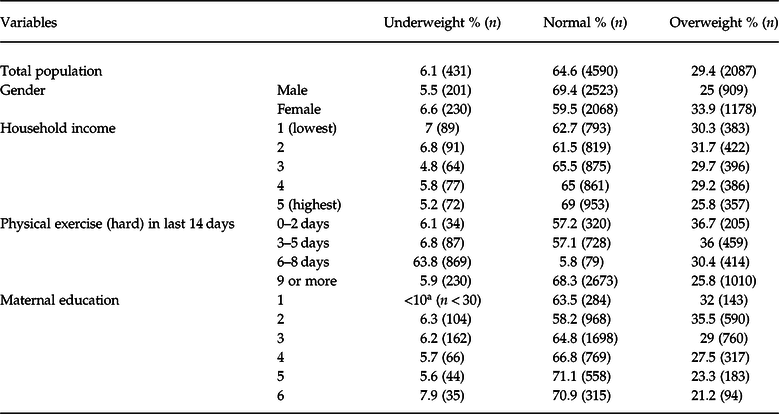
The demographics of the 9-year-olds of underweight, overweight and normal BMI are shown in Table 2.
Demographic characteristics of 9-year-olds of underweight, overweight and healthy BMI

BMI, body mass index.
a Value bottom coded for statistical disclosure purposes.
Underweight children were more likely to be female, from a household of the lowest income quintile and to come from parents with the highest level of parental education.
Overweight children were more likely to be female, from a household of the lowest income quintile, to come from parents with the lowest level of parental education and to engage in less physical activity.
BMI and psychopathology
A total of 6.5% (n = 489) of 13-year-olds showed psychopathology.
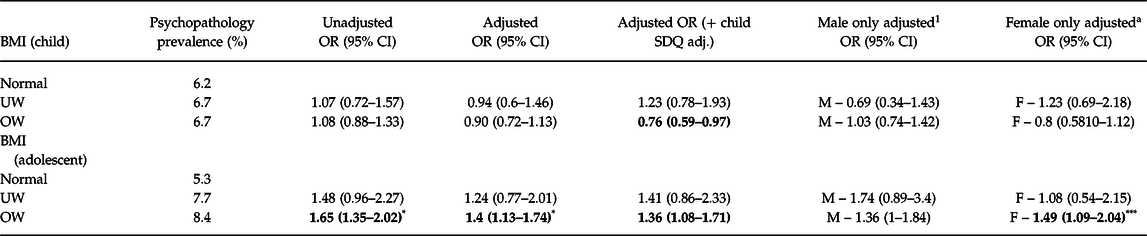
The unadjusted, adjusted and gendered ORs of psychopathology are shown in Table 3.
The unadjusted, adjusted and gendered ORs of psychopathology in underweight and overweight children at age 9/13

BMI, body mass index; OR, odds ratio; CI, confidence interval; OW, overweight; UW, underweight.
a Adjusted for SES, maternal education, physical activity, chronic illness, gender, screen time and nationality.
* p < 0.05.
** p < 0.01.
*** p < 0.001.
Age 9: Being overweight at age 9 did not have a significant association with age 13 psychopathology (OR 0.9; CI 0.72–1.13) but did have a significant association with persistent psychopathology (OR 0.76; CI 0.51–0.97) when both were adjusted for confounders.
Being underweight at age 9 was not significantly associated with either age 13 psychopathology (OR 0.94; CI 0.60–1.46) or persistent psychopathology (OR 1.23; CI 0.78–1.93) when adjusted for confounders.
Age 13: Being overweight at age 13 was significantly associated with both age 13 psychopathology (OR 1.40; CI 1.13–1.74) and persistent psychopathology (OR 1.36; CI 1.08–1.71) when adjusted for confounders.
Being underweight at age 13 was not significantly associated with age 13 (OR 1.24; CI 0.77–2.01) or persistent psychopathology (OR 1.41; CI 0.86–2.34) when adjusted for confounders.
Stratified analysis
The stratified analyses are shown in Table 4.
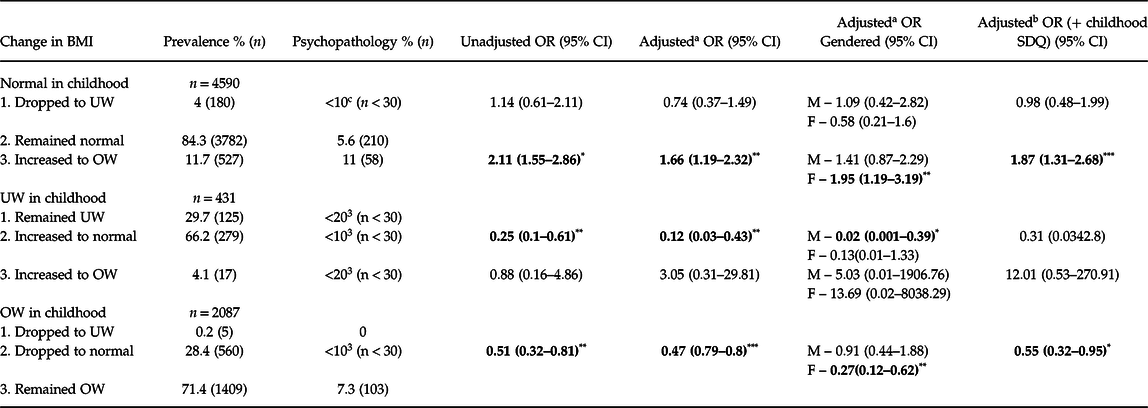
The association between change in BMI and unadjusted, adjusted and gendered ORs of psychopathology

BMI, body mass index; OR, odds ratio; CI, confidence interval; OW, overweight; UW, underweight.
a Adjusted for SES, maternal education, physical activity, chronic illness, gender, screen time and nationality.
b Adjusted for SES, maternal education, physical activity, chronic illness, gender, screen time, nationality and childhood psychopathology.
c Value bottom coded for statistical disclosure.
* p < 0.05.
** p < 0.01.
*** p < 0.001.
Healthy BMI in childhood
Of the children with healthy BMI in childhood, 4% (n = 180) dropped to underweight by age 13 and 11.7% (n = 527) increased to overweight. An increase in overweight from healthy BMI was significantly associated with adolescent psychopathology (adjusted OR 1.66; 95% CI 1.19–2.32). This association was also significant when also adjusted for childhood psychopathology (adjusted OR 1.87; CI 1.31–2.68).
Healthy to underweight was not significantly associated with adolescent psychopathology (adjusted OR 0.74; CI 0.37–1.49).
Underweight in childhood
Of the children who were underweight in childhood, 29.7% (n = 125) remained underweight, 66.2% (n = 279) increased to healthy and 4.1% (n = 17) increased to overweight. Change to healthy BMI from underweight (adjusted OR 0.12; 95% CI 0.03–0.43) was associated with a significantly reduced OR of developing psychopathology.
Underweight to overweight BMI was not significantly associated with adolescent psychopathology (adjusted OR 3.1; CI 0.31–29.81).
Overweight in childhood
Of the children who were overweight in childhood, 0.2% (n = 5) dropped to underweight, 28.4% (n = 560) dropped to healthy and 71.4% (n = 1409) remained overweight. Change to healthy BMI from overweight (adjusted OR 0.47; 95% CI 0.79–0.8) was associated with a significantly reduced OR of developing psychopathology. The association remained significant when childhood psychopathology was also adjusted for (adjusted OR 0.55; CI 0.32–0.95).
The number of those who changed from overweight to underweight was too small for a statistical analysis to be conducted on them.
Discussion
From this large, longitudinal, nationally representative sample, we revealed that change from normal BMI to overweight between childhood and adolescence is associated with an increased risk of development of psychopathology in adolescence to those who remained normal. Our results complement existing findings (Shunk & Birch, Reference Shunk and Birch2004; Gifford Sawyer et al. Reference Gifford Sawyer, Harchak, Wake and Lynch2011; Van Grieken et al. Reference Van Grieken, Renders, Wijtzes, Hirasing and Raat2013; Carr & Jaffe, Reference Carr and Jaffe2013). The association between overweight BMI and psychological outcome may be mediated by factors, such as social stigmatisation, isolation and victimisation (Puhl & Brownell, Reference Puhl and Brownell2001) and through the internalising of negative perceptions towards obesity (Wang et al. Reference Wang, Brownell and Wadden2004). Internalising factors (e.g. self esteem, loneliness), which have been found to mediate the association between an increase in BMI and poor school performance (Martin et al. Reference Martin, Booth, McGeown, Niven, Sproule, Saunders and Reilly2017), may also be mediators. Explanations for the association between being underweight and psychopathology are harder but may involve body dissatisfaction and eating disorders (Ali & Lindstrom, Reference Ali and Lindstrom2005).
This association between change and adverse psychological outcome could be explained by the theory that stable weight allows a stable concept of one’s identity, whereas weight fluctuation means the person ‘struggles between two identities: the weight they actually are and the weight they believe exemplifies who they are’ (Bronner, Reference Bronner1996). Another theory for this association is the temporal comparison theory. The temporal comparison theory states that change to a high BMI leads a person to negatively compare themselves to their earlier self, leading to experience of social devaluation (Albert, Reference Albert1977). Meanwhile, the ability to develop resistance strategies to psychological threats of stigma in those with persistent high BMI (Crocker & Major, Reference Crocker and Major1989) may be a protective factor for those who do not experience weight change.
The ‘change’ analysis also revealed that those whose weight changes from overweight or underweight to healthy BMI had a decreased risk of developing psychopathology. The psychological benefit of weight loss in overweight or obese individuals has been documented (Lasikiewicz, Lawton, Reference Lasikiewicz and Lawton2014; Alhalel et al. Reference Alhalel, Schueller and O’Brien2018), although it is not as well documented as the physiological benefits of weight loss (Franz et al. Reference Franz, Van Wormer, Crain, Boucher, Histon and Caplan2007). Weight loss mediated by behavioural interventions has been shown to improve self-esteem, while depressive symptoms have been shown to be alleviated by pharmacological or surgical interventions (Blaine et al. Reference Blaine, Rodman and Newman2007) Therefore, our results support the hypothesis that intervening in encouraging weight loss in overweight children improves psychological well-being. Behavioural interventions are a common approach to weight loss and include forms such as attempting to understand and control eating behaviour and attitudes, maintaining good nutrition, seeking social support and exercise (Brownell & Kramer, Reference Brownell and Kramer1998).
The literature suggesting an association between low BMI and psychopathology is not as extensive. Some studies have found low BMI to be associated with better mental health (Mond et al. Reference Mond, Robertson-Smith and Vitere2006), while others have found an association with impaired mental health and that this was not due to higher levels of body dissatisfaction or eating disorder behaviour but other non-defined factors (Zhao et al. Reference Zhao, Ford, Dhingra, Li, Strine and Mokdad2009; Mond et al. Reference Mond, Rodgers, Hay and Owen2011). Therefore, the mechanism for the decreased psychopathology risk in children who changed from underweight to healthy BMI does not appear as straightforward. The change, nevertheless, appears to be beneficial.
We found, additionally, that being overweight in adolescence increases the risk of having psychopathology in adolescence but that no such association exists between being overweight in childhood and psychopathology in adolescence. This is supported by studies that have found that, in different child age groups, being overweight or obese increases the risk of co-occurring psychological and emotional problems at that particular age (Schwimmer et al. Reference Schwimmer, Burwinkle and Varni2003; Vila et al. Reference Vila, Zipper, Dabbas, Bertrand, Robert and Ricour2004; Gifford Sawyer et al. Reference Gifford Sawyer, Harchak, Wake and Lynch2011; Sanders et al. Reference Sanders, Han, Baker and Cobley2015; Kelly et al. Reference Kelly, Patalay, Montgomery and Sacker2016). However, there appears to be less evidence to show that a higher BMI in childhood increases the risk of such problems arising later in the child’s life.
This study does not out rule the possibility that the BMI change might actually be due to the psychopathology itself (e.g. an eating disorder).
Strengths and limitations
The size and representative nature of the sample used and the validity of the outcome measures strengthen the results and conclusions that can be drawn from our study and the applicability of the results to the population as a whole. Each analysis used confounders to strengthen the validity of the associations observed.
Yet, despite the large nature of the study size, the sample of underweight participants was significantly lower than that of both the normal or overweight sample. This makes the change analysis involving change to or from underweight, less reliable. In certain cases, such as change from overweight to underweight, it was not possible to conduct a meaningful statistical analysis as too few participants had such a dramatic change in BMI.
The study was reliant on parent-reported measures for outcomes, a weakness as there is some evidence that child-reported measures of psychopathology differ from parent-reported ones, especially when the child is in adolescence (Van Roy et al. Reference Van Roy, Groholt, Heyerdahl and Clench-As2010). This may lead to an underestimation of the total internalising and externalising factors reported, potentially impacted by family structure (Van Roy et al. Reference Van Roy, Groholt, Heyerdahl and Clench-As2010).
Screen time should ideally have included phone and computer use but this was not included in the GUI. The presentation of dietary data is not available in a form that allows itself to be easily used as a confounding variable. Therefore, it was not used.
Conclusions
Overall, our study has shown that change in BMI from normal to overweight increases a child’s risk of developing psychopathology. Additionally, we have shown that a change in BMI from overweight or underweight back to within normal range decreases a child’s risk of developing psychopathology. These effects are unlikely to be purely biological and future research into possible mediators, for example, self-esteem and peer relationships, would be an important next step. The mechanism for this improvement in BMI is worth investigating, as it may guide weight interventions, by analysing what interventions were most effective amongst the children whose weight improved (i.e. diet, exercise, social). Our study shows the need for obesity to be tackled at a societal level, as it has negative effects on both physical and mental health. The psychological benefit we observed from weight improvement is an optimistic finding, which coupled with further investigation, should educate on intervention forms for preventing psychological illness.
Conflicts of interest
Each author has no conflicts of interest to disclose.
Ethical standards
The GUI has its own designated ethics committee which approved this study. The authors assert that all procedures contributing to this work comply with the ethical standards of the relevant national and institutional committee on human experimentation with the Helsinki Declaration of 1975, as revised in 2008.
Financial support
IC was funded by a HRB Summer Studentship. MC and CH were funded by the European Research Council Consolidator Award.