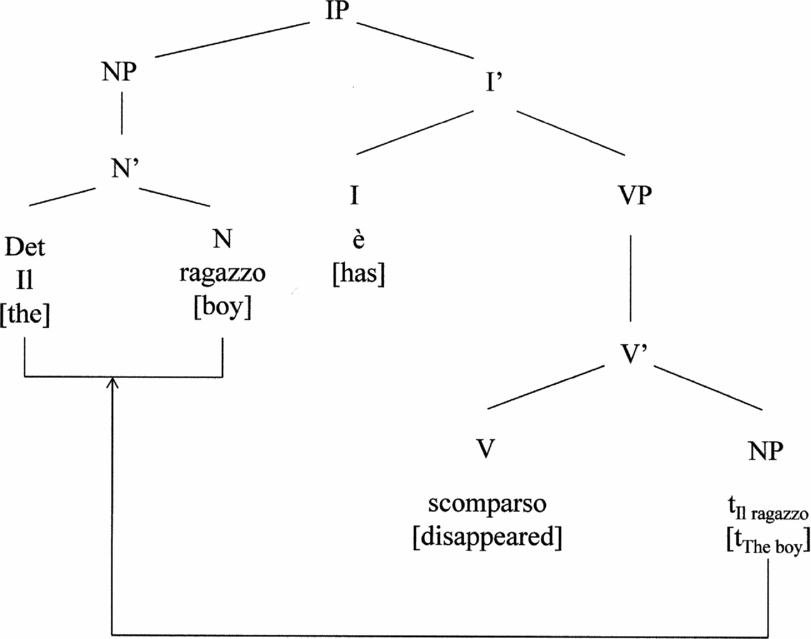
Verb argument structure (VAS) is a lexical feature that indicates the number and type of participants in the event described by a verb. Models of lexical production (Levelt, Reference Levelt1989; Levelt, Roelofs, & Meyer, Reference Levelt, Roelofs and Meyer1999) report this information as being stored in the lemma, that is, a “package of syntactic information” associated with a given lexical form. Lemmas contain information about the number of arguments required by a verb and the thematic roles the verb assigns to its arguments. In Levelt's model of lexical production, the activation of the information stored at the lemma level is followed by the retrieval of the phonological word form at the lexeme level, and then by the articulation of the target verb. Arguments are defined as obligatory elements required by verbs and receive a thematic role specifying the function of each participant in the action described by the verb. Verbs are classified as transitive when they require a direct object. Agentive transitive verbs assign the thematic roles of agent, that is, the performer of the action, and theme, that is, the undergoer, to their arguments.Footnote 1 In active sentences containing agentive transitive verbs (e.g., to chase) the agent corresponds to the grammatical subject of the sentence, whereas the direct object is the theme. For intransitive verbs, that is, verbs that do not take a direct object, unergative verbs (e.g., to sneeze) usually take only one argument, which receives the role of agent; on the contrary, unaccusative verbs (e.g., to disappear) assign the role of theme to their grammatical subjects. The latter are also supposed to differ from unergative verbs in their underlying syntactic structure. In Noam Chomsky's government and binding framework (Reference Chomsky1981), sentences have both a surface structure, representing the sentence as it appears to the hearer/reader (e.g., passive, interrogative, or relative clauses), and a deep structure (i.e., the clause in the affirmative active form). Furthermore, each clause is composed of a noun phrase (NP), that is, the grammatical subject, and a verb phrase (VP), which splits into a head (i.e., the main verb) and a complement, which in the case of transitive verbs often corresponds to a NP serving as direct object. According to the unaccusative hypothesis (Burzio, Reference Burzio1986; Perlmutter, Reference Perlmutter1978), the grammatical subject of unaccusative verbs is generated in the VP-internal position, that is, the position usually occupied by the direct object in transitive sentences, but moves to the subject position leaving a trace behind (Figure 1). Therefore, sentences containing an unaccusative verb are subject to syntactic movement (argument movement, or A-movementFootnote 2) analogous to the movement underlying passive sentences. As in English, Italian unaccusative verbs are supposed to entail syntactic movement of the NP subject (A-movement), which is assigned the thematic role of theme before moving out of the VP. However, unlike English, where the distinction between unergative and unaccusative verbs relies exclusively on the possibility of using unaccusative verbs in certain linguistic constructions that are not supported by unergative verbs,Footnote 3 Italian verbs select different auxiliaries. Unaccusative verbs (e.g., scomparire [to disappear]) are preceded, in composite past forms, by the auxiliary essere (to be), whereas unergative verbs (e.g., dormire [to sleep]) take the auxiliary verb avere (to have); as an example, the composite past form of the verb scomparire is è scomparso (e.g., il ragazzo è scomparso [the boy has disappeared, lit. the boy is disappeared]), whereas in the case of the verb dormire, the composite past form is ha dormito (e.g., il ragazzo ha dormito [the boy has slept]). The claim that passive and unaccusative syntactic movement are the same operation is also supported by the use of the same auxiliary in the composite form of both verb types. In both cases, the auxiliary verb essere signals syntactic movement of the action theme to the subject position, as in the following examples: il ragazzo è scomparso (unaccusative movement, see above) and il gatto è inseguito dal cane (passive movement [the cat is chased by the dog]).
A syntactic representation of an unaccusative sentence (i.e., il ragazzo è scomparso [the boy has disappeared]). The arrow indicates the syntactic movement (argument movement) allowing thematic role assignment.

Several studies conducted on agrammatic patients speaking different languages have demonstrated that these patients experience increasing difficulty in processing verbs as the number of their arguments increases. For instance, Thompson, Lange, Schneider, and Shapiro (1997) tested 10 agrammatic patients with both a sentence production and a confrontation naming task, showing that their verb production was significantly more impaired for three-place verbs, that is, verbs that take obligatorily three arguments (e.g., to put: Mike puts the book on the shelf), relative to two-place transitive verbs (e.g., to wash: Tom washes the dishes), which in turn proved to be more difficult to produce than one-place verbs such as to snore (e.g., John snores). Similar results were obtained by Kim and Thompson (Reference Kim and Thompson2000, Reference Kim and Thompson2004) in a task in which agrammatic patients were asked to categorize verbs according to VAS. Difficulty in retrieving transitive verbs compared to unergative verbs was also reported by Luzzatti et al. (Reference Luzzatti, Raggi, Zonca, Pistarini, Contardi and Pinna2002) for Italian agrammatic patients in a picture-naming task. In addition, these authors found the whole group of nonfluent aphasic patients (N = 15 participants, 6 with agrammatism) to be impaired on unaccusative verbs relative to both unergative and transitive verbs. A specific impairment affecting the naming of unaccusative verbs, which confirms that verb processing demands increase as the number of arguments they take increases, was also reported by Kegl (Reference Kegl1995) and by Thompson (Reference Thompson2003) in English agrammatic patients, and by Sanchez-Alonso, Martinez-Ferreiro, and Bastiaanse (Reference Sanchez-Alonso, Martinez-Ferreiro, Bastiaanse, Hendrickx, Devi, Branco and Mitkov2011) in Spanish agrammatic patients. In order to account for these data, Thompson proposed the argument structure complexity hypothesis (ASCH), which explains the pattern of impairment of the agrammatic patients’ verb production as a function of VAS complexity, in terms of both the number of arguments taken by a verb and the presence of underlying syntactic movement. A more recent study (McAllister, Bachrach, Waters, Michaud, & Caplan, Reference McAllister, Bachrach, Waters, Michaud and Caplan2009) reported greater difficulty in both production and comprehension of sentences containing unaccusative verbs compared to sentences containing unergative verbs, not only in a group of aphasic patients, most of whom were suffering from fluent aphasia, but also in the group of age-matched control participants. Given that difficulty with the production and comprehension of the unaccusative sentences was not restricted to the aphasic patients, the authors interpreted their findings as a general effect of complexity rather than as the result of a linguistic deficit concerning syntactic movement, as assumed by the ASCH. Evidence for the influence of VAS complexity on verb processing has also been found in neuroimaging studies on normal participants, in which brain activation is more pronounced for two- and three-place transitive verbs than for unergative verbs. This activation, which was elicited by picture naming, short action video clips (den Ouden, Fix, Parrish, & Thompson, Reference den Ouden, Fix, Parrish and Thompson2009), and a lexical decision task (Thompson et al., Reference Thompson, Bonakdarpour, Fix, Blumenfeld, Parrish and Gitelman2007), was located in the posterior left language areas and in the corresponding right hemisphere regions. However, not all experimental data are in line with the ASCH: for instance, Shetreet, Palti, Friedmann, and Hadar (Reference Shetreet, Palti, Friedmann and Hadar2007) found an effect of the number of alternative subcategorization optionsFootnote 4 (but not of the number of arguments) on the activation of the language areas in normal participants. Findings of an effect of multiple verb subcategorization options on neural activity during sentence processing are consistent with behavioral studies on both normal and nonfluent aphasic participants (see Shapiro & Levine, Reference Shapiro and Levine1990; Shapiro, Zurif, & Grimshaw, Reference Shapiro, Zurif and Grimshaw1987).
Vis-à-vis the issue of unaccusativity, almost all data come from studies on language production in aphasia, with only a few reports from the neuroimaging literature, that is, the studies by Shetreet, Friedmann, and Hadar (Reference Shetreet, Friedmann and Hadar2009) and by Shetreet and Friedmann (Reference Shetreet and Friedmann2012). These studies reported increased activation in the left inferior frontal gyrus and in the left middle temporal gyrus when healthy participants were processing unaccusative sentences as opposed to transitive or unergative sentences. The latter results support the aforementioned evidence from studies on aphasic participants: as mentioned earlier, Luzzatti et al. (Reference Luzzatti, Raggi, Zonca, Pistarini, Contardi and Pinna2002) and Thompson (Reference Thompson2003) reported more difficulties in retrieving unaccusative than unergative verbs, which was confirmed by Lee and Thompson (Reference Lee and Thompson2004) in an elicited sentence production task with agrammatic patients who, however, did not show any comprehension deficit in sentences containing unaccusative verbs (but, for opposing results, see McAllister et al., Reference McAllister, Bachrach, Waters, Michaud and Caplan2009).
GRAMMATICAL CLASS EFFECTS IN DEEP DYSLEXIA (DD)
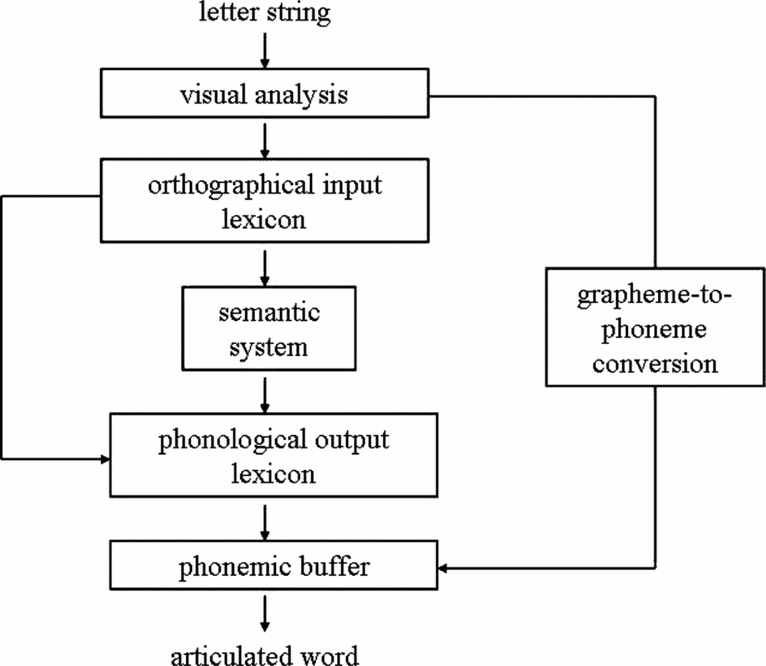
DD (Coltheart, Patterson & Marshall, Reference Coltheart, Patterson and Marshall1980; Marshall & Newcombe, Reference Marshall and Newcombe1973) is an acquired reading disorder often co-occurring with agrammatic aphasia. Its main characteristic is the production of semantic errors when reading; for instance, night is read as sleep, or river as ocean (Patterson & Marcel, Reference Patterson and Marcel1977; Plaut & Shallice, Reference Plaut and Shallice1993). As well as semantic errors, patients suffering from DD also produce visual (e.g., white for while) and morphological (e.g., class for classify) errors. Their performance is also characterized by word frequency and imageability effects, that is, concrete nouns are read better than abstract nouns. DD reading performance is also influenced by the grammatical class of the word stimuli, with nouns being read better than adjectives, which in turn are read better than verbs and function words (prepositions, auxiliaries, etc.; see Luzzatti, Mondini & Semenza, Reference Luzzatti, Mondini and Semenza2001). Finally, DD patients are unable to read nonwords because of severe damage to the sublexical route of reading. Since the early 1970s, reading has been conceived as a dual-route process, that is, letter strings are read through two different routes (see Figure 2): the sublexical route, in which reading is accomplished by means of a grapheme-to-phoneme conversion (GPC) routine with no access to lexical information, and a lexical–semantic route, in which the phonological output word form of a written stimulus is accessed after retrieving a stored written lexical representation and the underlying conceptual knowledge. While the first route allows reading of regular words and of nonwords, that is, letter strings that do not have a lexical entry in the mental lexicon, the lexical route allows reading of regular words and of words with irregular grapheme-to-phoneme correspondence (e.g., yacht, pint, or colonel).
The dual-route model of reading (Coltheart, Reference Coltheart2000). The model entails two distinct procedures for reading letter strings aloud: (right) the sublexical route and (b) the lexical–semantic route. The third route (i.e., the direct lexical route) differs from the lexical–semantic route in that it allows the lexical reading process to bypass the semantic system through a direct connection between the orthographical input and the phonological output lexicons.
Observation of patients with preserved reading ability for irregular words but poor comprehension of their meaning (e.g., Schwartz, Saffran, & Marin, Reference Schwartz, Saffran, Marin, Coltheart, Patterson and Marshall1980) resulted in the introduction of a direct lexical route connecting the orthographic input lexicon to the phonological output lexicon (and bypassing the underlying conceptual knowledge), in addition to the aforementioned lexical–semantic route. Within this theoretical framework, DD is assumed to result from damage to the sublexical route and concomitant disruption of the direct lexical route (Nolan & Caramazza, Reference Nolan and Caramazza1982), which forces retrieval of phonological representations to follow access to conceptual knowledge. In addition, the fragility of either the semantic system itself or the connection between conceptual knowledge and the phonological output lexicon would account for the occurrence of semantic errors (Shallice & Warrington, Reference Shallice, Warrington, Coltheart, Patterson and Marshall1980). This account, which is known as the “multiple-deficits account” of DD, considers the pattern of errors to be a result of residual left-hemisphere (LH) reading abilities. On the contrary, other authors (Coltheart, Reference Coltheart, Coltheart, Patterson and Marshall1980, Reference Coltheart2000; Saffran, Bogyo, Schwartz, & Marin, Reference Saffran, Bogyo, Schwartz, Marin, Coltheart, Patterson and Marshall1980) suggested that DD might reflect the emergence of right-hemisphere (RH) linguistic abilities, which are supposed to be limited to high-frequency concrete nouns. Examining this concept in greater depth, the right-hemisphere hypothesis (RHH) holds that an extensive LH lesion would cause damage to the LH orthographic lexicon, thus forcing reading performance to rely on RH orthographic processing, that is, rough lexical and conceptual stores, which are limited to high-frequency concrete nouns and no GPC. In addition, the RH is assumed to have almost no phonological output competence; therefore, any access to phonology would have to occur within the LH. A further account of DD stems from the failure-of-inhibition theory (FIT) proposed by Buchanan, McEwen, Westbury, and Libben (2003; see also Colangelo & Buchanan, Reference Colangelo and Buchanan2005), according to which semantic substitutions in DD results from defective inhibition of semantically related competitors within the phonological output lexicon.
Investigations of DD have frequently provided the opportunity to test lexical processing models; Luzzatti et al. (Reference Luzzatti, Mondini and Semenza2001), for instance, analyzed the performance of an Italian agrammatic patient with phonological/DD when reading morphologically complex words, in order to test Baayen et al.'s (Baayen, Burani, & Schreuder, Reference Baayen, Dijkstra and Schreuder1997; Baayen, Dijkstra, & Schreuder, Reference Baayen, Burani, Schreuder, Booij and van Marle1997) dual-route model of complex word processing.Footnote 5 This theory assumes an interaction between word frequency and (de)compositional processes and predicts that frequent forms are stored as a whole and thus retrieved faster than less frequent forms, which instead are subject to online (de)composition. The results reported by Luzzatti et al. (Reference Luzzatti, Mondini and Semenza2001) supported this prediction by showing a significantly better reading performance on singular forms for singular-dominant nouns, that is, for nouns whose singular form is more frequent than the plural (e.g., nose vs. noses), whereas no difference emerged between the singular and the plural form of plural-dominant nouns. Another example is Buchanan et al.'s (2003) investigation of a DD patient's (JO) ability to implicitly and explicitly access semantic information and to use this information in a naming task. Their results, which showed that JO's ability to read nonwords as novel compounds (e.g., earfly vs. earlark) was influenced by semantics, supported the theory of implicit access to semantic information and were interpreted as evidence for a model of lexical processing known as PEIR.Footnote 6 In addition, studies of patients with DD have supplied information about cognitive models of processing of other types of stimuli, such as numbers (see, for instance, Cohen, Dehaene, & Verstichel, Reference Cohen, Dehaene and Verstichel1994).
AIM OF THE STUDY
The aim of the present study is to investigate the influence of VAS complexity while reading verbs as singletons, by testing a patient suffering from agrammatism and DD. The studies on agrammatic patients mentioned above (see Luzzatti et al., Reference Luzzatti, Raggi, Zonca, Pistarini, Contardi and Pinna2002; Thompson, Reference Thompson2003; Thompson et al., Reference Thompson, Lange, Schneider and Shapiro1997) revealed difficulty in producing both unaccusative and transitive verbs compared to unergative verbs. These data are accounted for by the ASCH (Thompson, Reference Thompson2003), which explains the dissociation across verb categories in terms of greater complexity (due either to the number of arguments or to syntactic movement of the constituents) of transitive and unaccusative verbs versus unergative verbs. Because agrammatism and DD share several features and usually co-occur, the hypothesis behind the present study was that a similar set of effects would also be found in the reading performance of deep dyslexic patients. In the “multiple-deficit account,” DD is the consequence of an extensive left perisylvian lesion causing complete disruption of both the sublexical and the direct lexical reading route, obliging patients to rely on the lexical–semantic route, and so accessing word lemmas where information about VAS is stored (Levelt et al., Reference Levelt, Roelofs and Meyer1999). Assuming that VAS properties are spared, the fact that DD patients are forced to read via the lexical–semantic route predicts that their reading performance should reflect an ASCH complexity effect in single-verb reading tasks as well.
Specifically, the goals of the present study are (a) to describe a specific impairment in reading verbs in comparison to nouns, in line with several previous studies showing an influence of grammatical class on the reading performance of DD patients, and (b) to test the hypothesis of a dissociated impairment across verb categories, based on their underlying VAS, in line with the predictions of the ASCH, particularly testing the argument number effect, by comparing unergative to transitive verbs, and testing the influence of A-movement, by comparing unergative to unaccusative verbs. As far as the first issue is concerned, we predict that verbs will be more impaired than nouns, as part of the grammatical class effect that usually occurs in DD. As to the second objective, we predict that the argument number effect will be elicited in a simple reading task, in line with neuroimaging studies that showed the modulation of language areas by argument number even in a lexical decision task (Thompson, Bonakdarpour, & Fix, Reference Thompson, Bonakdarpour and Fix2010; Thompson et al., Reference Thompson, Bonakdarpour, Fix, Blumenfeld, Parrish and Gitelman2007). These data indicate an argument number effect that takes place as soon as lexical entries are accessed, so we expect DD patients to be more accurate in reading unergative than transitive verbs. Our expectations regarding the unaccusativity issue are less well defined; as for the argument number effect, almost all evidence in support of greater complexity of unaccusative versus unergative verbs comes from studies on verb production in aphasic participants (Kegl, Reference Kegl1995; Luzzatti et al., Reference Luzzatti, Raggi, Zonca, Pistarini, Contardi and Pinna2002; Thompson, Reference Thompson2003). Furthermore, contrary to the argument number issue, the only two neuroimaging studies reporting an unaccusativity effect used a semantic plausibility sentence judgment (Shetreet & Friedmann, Reference Shetreet and Friedmann2012; Shetreet et al., Reference Shetreet, Friedmann and Hadar2009). The same holds for the study on normal participants conducted by Friedmann, Taranto, Shapiro, and Swinney (Reference Friedmann, Taranto, Shapiro and Swinney2008), who analyzed the processing of sentences containing unaccusative verbs. Therefore, we conducted a test to assess whether the syntactic complexity underlying the processing of unaccusative verbs would also occur in a reading task.
MATERIALS AND METHODS
Participant
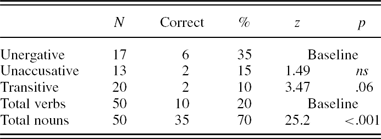
GR is a 34-year-old office worker with 13 years of education, who suffered from a left frontoparietal hematoma 3 years prior to the present study. Her language and cognitive abilities were assessed before and after intensive language training at the Villa Beretta Rehabilitation Unit. Her performance on the Italian version of the Aachen Aphasia Test (AAT; Luzzatti, Willmes, & de Bleser, Reference Luzzatti, Willmes and de Bleser1996) revealed a moderate Broca aphasia with agrammatism; her speech was limited to short agrammatic utterances with rare production of verbs and almost complete omission of function words. Lexical retrieval in spontaneous speech was characterized by severe anomia and semantic paraphasias, whereas few phonological errors were observed. Confrontation naming on the AAT was mildly to moderately impaired; written comprehension was mildly impaired for single wordsFootnote 7 and moderately impaired for sentences (see Marelli, Aggujaro, Molteni, & Luzzatti, Reference Marelli, Aggujaro, Molteni and Luzzatti2012, for a summary of the results obtained on the AAT). Her ability to retrieve nouns and verbs was further investigated with a picture-naming task (Crepaldi et al., Reference Crepaldi, Aggujaro, Arduino, Zonca, Ghirardi and Inzaghi2006), in which GR was asked to name an equal number of objects (N = 50) and actions (N = 50). The results obtained on this task are illustrated in Table 1 and reveal significantly better performance on nouns than on verbs, as well as a difference in accuracy among different verb types. Semantic errors were found in naming both objects (33%) and actions (52%), and action naming elicited morphological errors (15%) that were frequently characterized by the substitution of verbs with derived nominals (e.g., preghiera [prayer] instead of pregare [to pray]; see Marelli et al., Reference Marelli, Aggujaro, Molteni and Luzzatti2012).
Participant's (GR) rate of accuracy in the picture- naming task
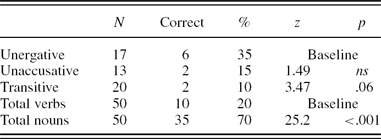
Note: The statistical parameters (z) and significance result from a multivariate logistic regression analysis including word type, word frequency, imageability, and length.
Her reading performance was assessed with two additional tasks: a standard task (Toraldo, Cattani, Zonca, Saletta, & Luzzatti, Reference Toraldo, Cattani, Zonca, Saletta and Luzzatti2006), evaluating her ability to read words and nonwords, and a test specifically designed to investigate the emergence of semantic errors in reading. The first task included a list of concrete nouns, abstract nouns, and function words. Words were mixed with phonotactically plausible pseudowords, in order to assess the integrity of the GPC reading routine, which is required for nonword processing. GR's performance on this task revealed that she was unable to read nonwords and function words, made a few semantic errors in reading words, and had a higher level of accuracy in reading concrete nouns as opposed to abstract nouns. The second task further explored the pattern of semantic errors in reading: the reading list was composed of pairs of semantically related words, each pair being composed of a high-frequency and a low-frequency word (e.g., gatto–micio [cat–kitten]). As expected, GR tended to produce semantic substitutions when reading low-frequency nouns, which were often substituted with a high-frequency synonym or a semantically related word (e.g., micio was read as gatto; see Marelli, Aggujaro, Molteni, & Luzzatti, Reference Marelli, Aggujaro, Molteni and Luzzatti2009). Based on the results on both tasks, which demonstrated significant effects of lexicality, grammatical class, and imageability, GR was assessed as suffering from DD.
Materials
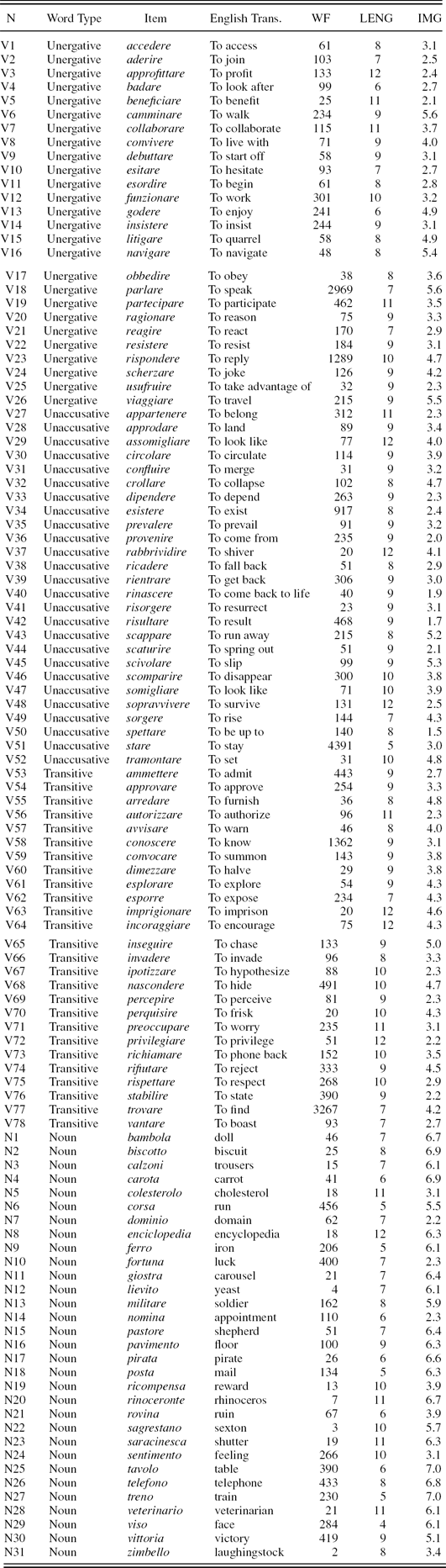
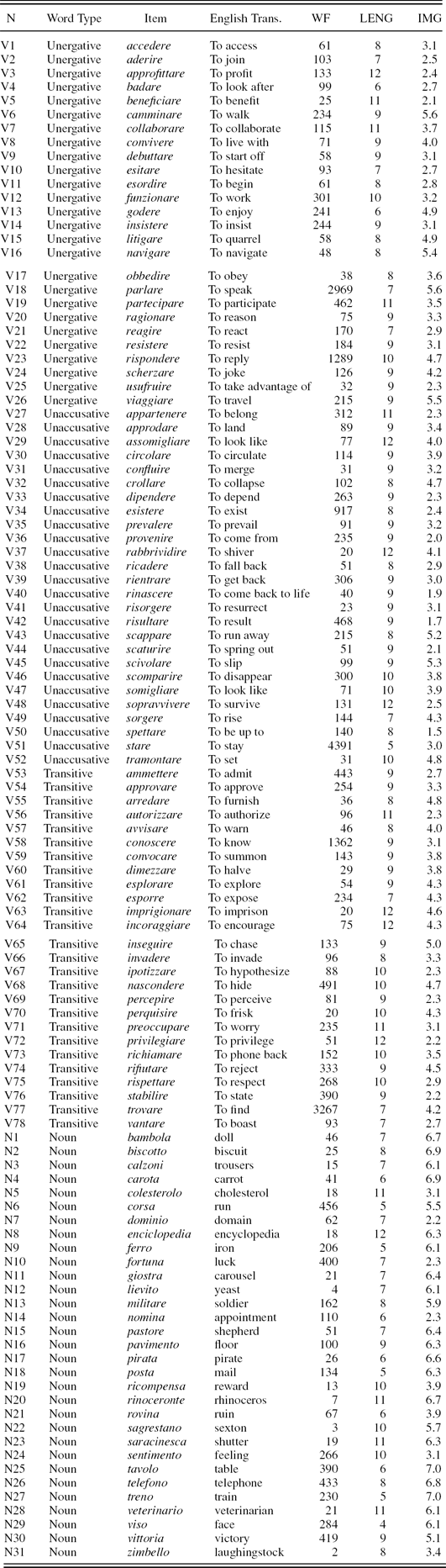
Seventy-eight verbs and 31 nouns were included in the experimental reading task. Verbs included in the task had to belong to only one of the following categories: unaccusative verbs, unergative verbs, or two-place transitive verbs. Optionally transitive verbs, that is, verbs that can be used both as unergative and as transitive (e.g., mangiare [to eat]),Footnote 8 and alternating unaccusative verbs, that is, verbs that can subcategorize both an unaccusative and a transitive sentence structure (e.g., affondare [to sink]),Footnote 9 were not included in the reading list. As far as the distinction between unaccusative and unergative verbs is concerned, the first criterion used to classify verbs as belonging to one of the two categories was agentivity: verbs in which the grammatical subject receives the role of theme were considered unaccusatives, whereas verbs in which the grammatical subject identifies the performer of the action (agent) were classified as unergative. An additional criterion used to identify unaccusative verbs was the auxiliary taken in the composite past form; for instance, crollare (to collapse) was classified as unaccusative, whereas litigare (to quarrel) was classified as unergative, because the first takes the auxiliary verb essere (to be) in the composite past tense (e.g., l'edificio è crollato [the building has collapsed, lit. is collapsed]), whereas the second takes avere (to have) as the auxiliary verb in the composite past form (e.g., Maria e Gianni hanno litigato [Maria and Gianni have quarreled]). Regarding the question of transitivity, all the verbs included in this class were classified as transitive by the authors and confirmed by an independent expert in linguistics. All verbs were matched for lemma frequency, length, and imageability; for the latter variable, values were obtained by asking a sample of 15 control participants to evaluate each verb on a Likert scale, ranging from 1 (very low imageability) to 7 (very high imageability). The final set of stimuli contained 78 verbs, 26 per category. All verbs were presented in the infinitive form (e.g., parlare [to talk]), which is the citation form of verbs in Italian and generally is the easiest verb form for agrammatic patientsFootnote 10 to produce. Thirty-one nouns, all in the singular form (with the grammatical gender equally distributed between masculine and feminine), were also included in the reading list.
Procedure
The stimuli were randomly presented on a computer screen after projection of a fixation cross for 1500 ms. GR was asked to read each word aloud and then to press the spacebar to pass to the following item. There was no time limit, but if she was unable to read a word, she was encouraged to press the spacebar and proceed to the following word. Her entire production, pauses included, was transcribed manually. The task was administered twice, in order to assess test–retest consistency in the reading performance. The two testing sessions were separated by a 30-day interval to avoid any practice effects. No treatment was provided in between the two sessions. Performance over the two sessions was highly correlated (Pearson r = .681, p < .001). Given the high correlation between accuracy patterns in the two sessions and the relatively low number of correct responses in each session, the final scoring was computed as follows: items that were read correctly (including self-corrections) in at least one of the two sessions were assigned a score of 1, whereas items that were read incorrectly in both sessions were assigned a score of 0. Only responses that fully matched the target were computed as correct; that is, phonological substitutions were scored as errors.
RESULTS
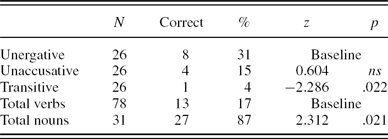
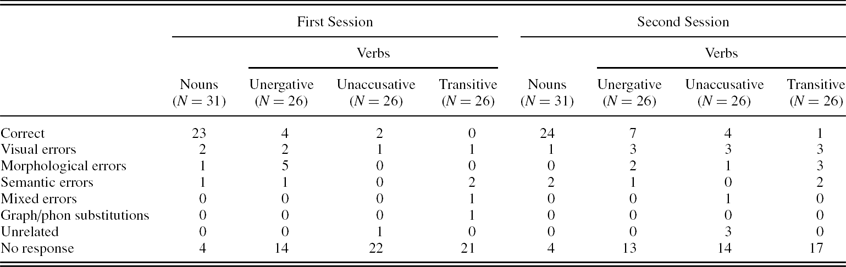
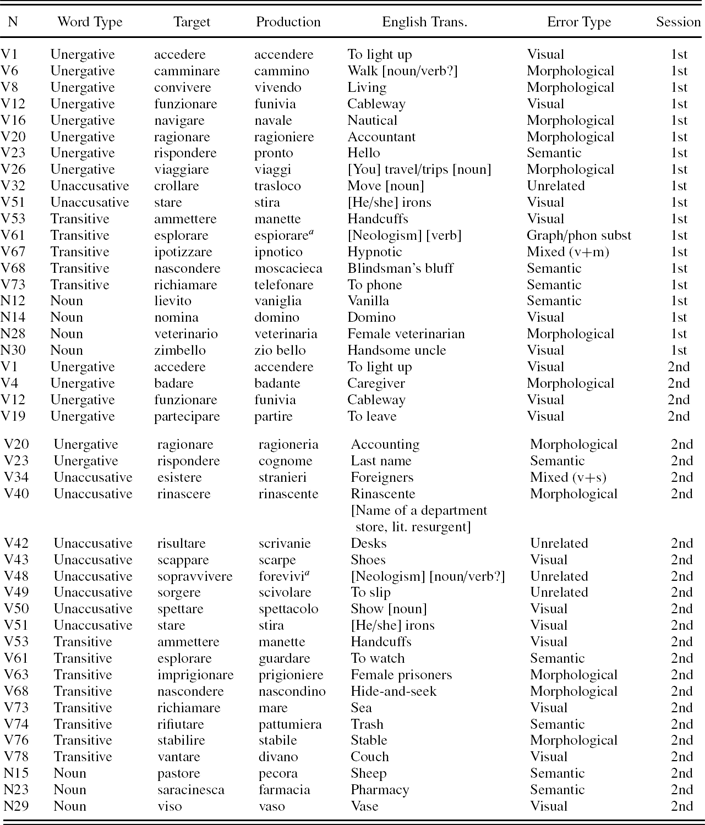
The first observation about GR's results is her overall low performance on reading verbs (13 correct responses out of 78, see Table 2), which is in contrast with her high level of accuracy when reading nouns (27 correct responses out of 31). This performance is comparable to the results obtained in the picture-naming task, where she named 35 objects out of 50 and 10 actions out of 50 correctly (Table 1). Her high level of accuracy in reading nouns was constant across sessions, whereas her ability to read verbs improved in the second session (12 correct responses in the second session compared to 6 correct responses in the first session, out of a total of 78 verbs). With respect to our primary objective, that is, to investigate the possibility that the verb category (unergative, unaccusative, or transitive) could have influenced GR's ability to read verbs in isolation, the data indicate that she reads unergative verbs significantly better than unaccusative verbs, which in turn she found easier to read than two-place transitive verbs (see Table 2). A similar pattern of performance was also found in the picture-naming task (Table 1). An analysis of GR's errors in the reading task indicates that when encountering difficulty, she tended to give up and move on to the following item without giving any response (see Table 3), something she did most frequently when reading verbs. Among the types of error that usually characterize DD, visual errors (e.g., accedere [to access] → accendere [to light up]) were more frequent than morphological errors (e.g., badare [to look after] → badante [employed caregiver]), which in turn were more frequent than semantic errors (e.g., rispondere [to answer] → pronto [hello]). A few unrelated responses and two mixed errors, that is, errors that were classified as being both visual and morphological (e.g., ipotizzare [to hypothesize] → ipnotico [hypnotic], via ipnotizzare [to hypnotize]) or both visual and semantic (e.g., esistere [to exist] → stranieri [foreigners], via estero [abroad]), also emerged (see Appendix B).
Participant's (GR) rate of accuracy in the word-reading task
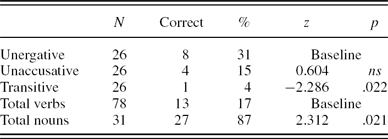
Note: The statistical parameters (z) and significance result from a multivariate logistic regression analysis including word type, word frequency, imageability, and length.
Qualitative analysis of participant's (GR) performance over the two sessions
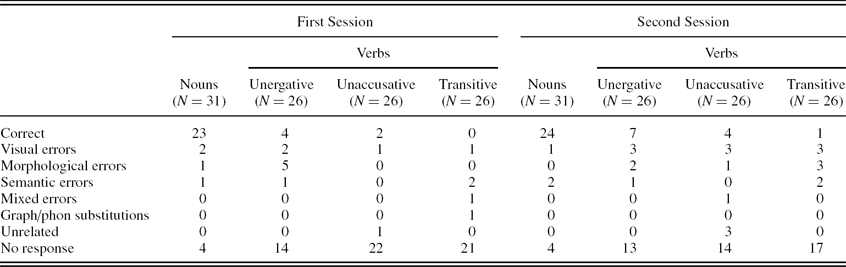
Note: Mixed errors refers to those errors that were classified as belonging simultaneously to two of the following categories: visual errors, morphological errors, or semantic errors. Graph/phon substitutions are substitutions of a grapheme/phoneme, when it was not clear if it was classifiable as a phonological substitution or as a visual error.
As shown in Table 3, errors occurred with almost the same frequency across the two sessions. Errors in reading nouns were mostly visual (N = 3) or semantic (N = 3); in only one case did a morphological error occur. Visual errors were equally distributed across verb types, whereas morphological and semantic errors were mostly limited to unergative and transitive verbs. Morphological errors occurring more frequently when reading unergative (N = 7) than transitive verbs (N = 3). Only one morphological error occurred on unaccusative verbs. On the contrary, unrelated errors mostly emerged for unaccusative verbs. In a few cases (N = 3), visual errors caused target verbs to be misread as verbs with a different argument structure: a transitive verb was produced for an unergative verb (accendere [to light up] for accedere [to access], stira [(he/she) irons] for stare [to stay]), and an unaccusative verb was produced for an unergative verb (partire [to leave] for partecipare [to participate]). In another case, a semantic error caused an unergative verb to be produced for a transitive verb (telefonare [to phone] for richiamare [to call back]). The number of semantic errors found for verbs (6% of the total number of errors) in the reading task is clearly lower than the proportion of semantic errors found in the picture-naming task (52%), whereas morphological errors only show a mild discrepancy across tasks (11% vs. 15%).
Quantitative data analysis
The first aspect to be investigated was the grammatical class effect. A logistic regression, conducted using the mixed-effects model approach (Jaeger, Reference Jaeger2008) and running in R (R Core Team, Reference Core2012) with the lme4 package (Bates, Maechler, & Bolker, Reference Bates, Maechler and Bolker2012), was performed on GR's accuracy data, with the dependent variable being the probability that a given item was read correctly in at least one of the two sessions. Verb regularity (for verbs) and grammatical gender (for nouns) were introduced as random factors in the analyses. Grammatical class and all the remaining variables (word frequency, length, and imageability) were included as predictors in the regression design. In order to reduce the skewness of their distribution, length, frequency, and imageability values were transformed into logarithms. The regression was performed by introducing one predictor at a time and by using an analysis of variance (ANOVA) to compare the previous model with that including the newly introduced variable. The effect of grammatical class was found to be highly significant both as a single predictor (estimate = 4.196, SE = 1.112, z = 3.773, p < .001) and following the addition of imageability (grammatical class, estimate = 3.443, SE = 1.121, z = 3.071, p = .002; imageability, estimate = 4.533, SE = 1.304, z = 3.478, p < .001) as well as of the other lexical variables. The model that best fitted the data contained grammatical class, length, word frequency, and imageability as predictors in the regression analysis. With the exception of word frequency, which was found to be slightly above the threshold for statistical significance (estimate = 0.634, SE = 0.330, z = 1.920, p = .055), all the other factors significantly predicted GR's accuracy on the reading task (grammatical class, estimate = 5.453, SE = 2.358, z = 2.312, p = .021; imageability, estimate = 5.902, SE = 1.605, z = 3.677, p < .001; length, estimate = −4.606, SE = 2.201, z = −2.092, p = .036). The data show that the grammatical class effect persists after the effect of imageability was taken into account.
We then performed an additional logistic regression analysis on GR's accuracy for verbs only, in order to investigate the effect of VAS complexity. In this case, verb type replaced grammatical category as a predictor in the regression analysis. The model that proved to best fit our data contained verb type, imageability, and length as predictors. Although length was not significant in the multivariate analysis (estimate = −5.947, SE = 3.586, z = −1.659, ns), imageability was found to predict the patient's response to the task (estimate = 10.322, SE = 3.380, z = 3.054, p < .001). As far as the effect of verb type is concerned, accuracy in reading verbs was highest for unergative verbs and progressively less accurate for unaccusative and for transitive verbs, but only the difference between unergative and transitive verbs proved to be statistically significant (estimate = −3.499, SE = 1.530, z = −2.286, p = .022), with the comparison between unaccusative and transitive verbs being marginally significant (estimate = −2.745, SE = 1.427, z = −1.923, p = .054). On the contrary, the comparison between unergative and unaccusative verbs (estimate = −0.754, SE = 1.248, z = −0.604, ns) did not approach significance (Table 2).
A subsequent analysis was performed to investigate any associations between error types and verb categories. The analysis was carried out by collapsing the number of errors across the two sessions and excluding items that did not elicit any response. In addition, the only grapheme/phoneme substitution error (see Table 3) was collapsed into the category of unrelated responses just for the purpose of the present analysis. The chi-square statistics demonstrated a tendency toward statistical significance (χ2 = 12, p = .06) when considering all verb categories (unergative, unaccusative, and transitive). A significant difference in the distribution of error types across verb categories was found when considering unergative and unaccusative verbs only (χ2 = 8.51, p = .036), whereas no significant association between error type and verb type was found for unergative and transitive verbs (χ2 = 2.56, ns).
DISCUSSION
The present study investigated the effect of grammatical class on the reading performance of an agrammatic patient suffering from DD (GR) with respect to two main issues: (a) the dissociation between nouns and verbs and its relationship to imageability; and (b) the effect of verb type as defined by the ASCH (Thompson, Reference Thompson2003). The specific aim of the present study was to investigate the prediction that verbs with a more complex VAS, that is, more complex either because they take more than one argument (e.g., transitive verbs) or because their syntactic structure entails A-movement (i.e., unaccusative verbs), are more difficult to produce than verbs with a simpler VAS. GR performed a reading task including both nouns and verbs, the latter being unergative, unaccusative, or transitive. The majority of errors consisted of no responses. The qualitative analysis of the remaining errors revealed a rate of visual, morphological, and semantic errors that is similar to the pattern that emerged on the baseline reading task (Toraldo et al., Reference Toraldo, Cattani, Zonca, Saletta and Luzzatti2006) but lower than that arising from a specific test designed to elicit semantic errors (Marelli et al., Reference Marelli, Aggujaro, Molteni and Luzzatti2009). Picture naming of nouns and verbs (Crepaldi et al., Reference Crepaldi, Aggujaro, Arduino, Zonca, Ghirardi and Inzaghi2006) was also severely impaired, and the rate of morphological and semantic errors was higher than in the reading task.
The distribution of error types in reading verbs was significantly different across verb categories for the comparison between unergative and unaccusative verbs, with morphological and semantic errors occurring more frequently when reading unergative verbs. No differences were found between transitive and unergative verbs with respect to the distribution of error types. The analysis of GR's performance on this task revealed that her ability to read verbs was greatly impaired, whereas her reading of nouns was only slightly impaired. The pattern of impairment found replicates the data reported by Marelli et al. (Reference Marelli, Aggujaro, Molteni and Luzzatti2012), who tested the same patient on several tasks and found an effect of grammatical class and concreteness in her production. These findings are in line with the literature reporting a grammaticality effect in DD, as outlined by Coltheart et al. (Reference Coltheart, Patterson and Marshall1980) and supported by subsequent research (see, for instance, Luzzatti et al., Reference Luzzatti, Mondini and Semenza2001). The main finding of the present study is a dissociated pattern of impairment among verb types, that is, a disproportionate impairment of transitive verbs, which replicates, using a reading task, the effect of VAS complexity found in the production of agrammatic patients on picture naming, picture description, and verb categorization in various languages (see Luzzatti et al., Reference Luzzatti, Raggi, Zonca, Pistarini, Contardi and Pinna2002, for Italian; Lee & Thompson, Reference Lee and Thompson2004; and Thompson, Reference Thompson2003, for English; Jonkers, Reference Jonkers, Bastiaanse and Grodzinsky2000; and Jonkers & Bastiaanse, Reference Jonkers and Bastiaanse1996, Reference Jonkers and Bastiaanse1998, for Dutch; De Bleser & Kauschke, Reference De Bleser and Kauschke2003, for German; Sanchez-Alonso et al., Reference Sanchez-Alonso, Martinez-Ferreiro, Bastiaanse, Hendrickx, Devi, Branco and Mitkov2011, for Spanish). The results will be discussed (a) in light of the debate on the relation between imageability and grammatical effects, (b) with reference to theories of the mental representation of VAS at the lemma level, and (c) in light of theoretical accounts of DD.
Grammatical class effects and imageability
Grammatical class and imageability effects on reading accuracy are typical symptoms of DD. They have often been interpreted as strongly interconnected, particularly in relation to the impaired ability to read function words and verbs with respect to nouns. A similar position has been assumed by some authors to account for the disproportionate verb impairment in the production of agrammatic patients (Bird, Howard, & Franklin, Reference Bird, Howard and Franklin2000, Reference Bird, Howard and Franklin2003): according to this account, grammatical class effect would result from differences in imageability between nouns and verbs. This assumption is in contrast with the position of other authors (Berndt, Haedinges, Burton, & Mitchum, Reference Berndt, Haedinges, Burton and Mitchum2002; Caramazza & Hillis, Reference Caramazza and Hillis1991; Rapp & Caramazza, Reference Rapp and Caramazza2002), who assumed a separate representation of nouns and verbs within the mental lexicon, and is challenged by the experimental evidence of a persistent grammatical class effect even after partialing out the effect of imageability (see Aggujaro, Crepaldi, Pistarini, Tarico, & Luzzatti, Reference Aggujaro, Crepaldi, Pistarini, Taricco and Luzzatti2006; Luzzatti et al., Reference Luzzatti, Raggi, Zonca, Pistarini, Contardi and Pinna2002). However, as discussed by Crepaldi, Berlingeri, Paulesu, and Luzzatti (Reference Crepaldi, Berlingeri, Paulesu and Luzzatti2011) in a recent review, many studies addressing the issue of noun–verb processing have revealed the influence of several other nongrammatical factors (word frequency, actionality, and semantic distinctions within grammatical classes) on the dissociated noun–verb performance found in aphasic patients. Hence, instead of a distinct representation of nouns and verbs within the mental lexicon, those results suggest that grammatical and lexical–semantic factors may both contribute to dissociated performance on nouns and verbs in aphasia. The present experiment outlines a highly significant grammatical class effect in reading, which is in line with the data obtained from the picture-naming task, and indicates a much better production of nouns than of verbs. Although initially nouns and verbs were not matched for length, frequency, and imageability, these variables and their interactions were included as predictors in the logistic regression model. The results show a persistent grammatical class effect despite the introduction of imageability in the regression model, indicating that the dissociated performance between nouns and verbs was not caused by the different degree of imageability, which is in contrast with Bird et al.'s (Reference Bird, Howard and Franklin2000, Reference Bird, Howard and Franklin2003) hypothesis.
The main finding of this study regards the dissociation between verb categories (unergative, transitive, and unaccusative verbs). In this case, the three lists of verbs were matched for imageability, as well as for the usual lexical variables. Imageability was also included as a predictor in the logistic regression analysis to partial out its influence from the VAS effect. As in the noun–verb dissociation, the effect of verb type persisted even after partialing out the effect of imageability.
Word reading and argument structure complexity
With regard to VAS complexity, the patient's performance on a reading task followed the gradient of complexity indicated by the ASCH: unergative verbs elicited the highest number of correct responses, and accuracy was progressively lower for unaccusative and transitive verbs, although only the difference between unergative and transitive verbs proved to be statistically significant, with the comparison between unaccusative and transitive verbs being marginally significant. As outlined in the introduction, the ASCH assumes two aspects of argument structure complexity: the number of arguments taken by verbs and the presence of underlying syntactic movement. On the basis of expectations grounded in VAS complexity, verbs taking more than one argument, for instance, transitive verbs, are more difficult to retrieve than are unergative verbs, which take only one. With respect to syntactic movement, unaccusative verbs are expected to be more difficult to process than are unergative verbs because their construction entails the movement of one of the constituents, similar to the movement occurring in passive sentences (Burzio, Reference Burzio1986; Perlmutter, Reference Perlmutter1978). The results obtained in the present study are in line with the first of these two predictions but not the second, because syntactic movement did not elicit a significant decrease in accuracy on unaccusative verbs in GR. The absence of an A-movement effect in our data could be due to the limited number of correct responses given by GR. However, an alternative account of this result is possible, that is, that these two effects (argument number and syntactic movement) occur at different levels of lexical processing. Specifically, we assume that argument number, being lexical in nature, becomes available as soon as the lemma is accessed. As far as the issue of unaccusativity is concerned, a further step in terms of language processing is necessary. Unaccusative and unergative verbs do not differ in the number of required arguments but in the way their arguments are subcategorized in a sentence; therefore, the higher complexity of unaccusative verbs compared to unergative verbs may arise only when minimal syntactic activation is required. This hypothesis, as well as accounting for the present data, offers an explanation for the fact that the effect of A-movement for verbs has been found both in a sentence context and in a picture-naming task, but not in a single-word reading task, as discussed further below.
As already mentioned, the influence exerted by the number of arguments taken by verbs has been reported in studies assessing verb production in aphasic patients both as singletons and in a sentence context (Jonkers & Bastiaanse, Reference Jonkers and Bastiaanse1998; Luzzatti et al., Reference Luzzatti, Raggi, Zonca, Pistarini, Contardi and Pinna2002; Thompson, Reference Thompson2003), as well as in neuroimaging studies testing the processing of both isolated verbs and of verbs in a sentence context (Ben-Shachar, Hendler, Kahn, Ben-Bashat, & Grodzinsky, Reference Ben-Shachar, Hendler, Kahn, Ben-Bashat and Grodzinsky2003; den Ouden et al., Reference den Ouden, Fix, Parrish and Thompson2009; Shetreet et al., Reference Shetreet, Palti, Friedmann and Hadar2007; Thompson et al., Reference Thompson, Bonakdarpour, Fix, Blumenfeld, Parrish and Gitelman2007). Moreover, the complexity effect deriving from the number of arguments was elicited not only in tasks requiring production but also by verb categorization (Kim & Thompson, Reference Kim and Thompson2000) and lexical decision (Thompson et al., Reference Thompson, Bonakdarpour, Fix, Blumenfeld, Parrish and Gitelman2007, Reference Thompson, Bonakdarpour and Fix2010), that is, in the absence of a syntactic context.
As far as the effect of syntactic movement is concerned, evidence that the processing of unaccusative verbs is more demanding than that required for unergative verbs stems mainly from studies on verb retrieval deficits in aphasic patients, both in picture-naming (Luzzatti et al., Reference Luzzatti, Raggi, Zonca, Pistarini, Contardi and Pinna2002; Thompson, Reference Thompson2003) and in sentence-production tasks (Lee & Thompson, Reference Lee and Thompson2004; Thompson, Reference Thompson2003). A more recent study (McAllister et al., Reference McAllister, Bachrach, Waters, Michaud and Caplan2009) also reported an effect of A-movement on the performance of both aphasic patients and control participants, showing higher levels of accuracy in producing and comprehending sentences that contain unergative verbs relative to unaccusative verbs. Neuroimaging studies conducted to date have shown an effect of unaccusativity only when processing sentences (see Shetreet et al., Reference Shetreet, Friedmann and Hadar2009, Reference Shetreet and Friedmann2012). In conclusion, there is no evidence of an unaccusativity effect for verbs as singletons in tasks other than picture naming, which, when designed to elicit verb production, entail the depiction of the participant(s) in the action, thus increasing the likelihood that a (minimal) sentence structure will be prepared. This assumption is consistent with the results obtained by Cairns, Marshall, Cairns, and Dipper (Reference Cairns, Marshall, Cairns and Dipper2007), showing that when asked to name the participants of a given action, control subjects mostly start with the agent, following the same participant order as when producing sentences. Thus, it can be assumed that the effect of unaccusativity, that is, the effect of syntactic movement, may occur while retrieving verbs in a picture-naming task but not when participants are asked to perform a lexical decision task or to read verbs aloud, because syntax is unlikely to be activated in the last two conditions. Therefore, it can be assumed that the representation of the number of arguments taken by verbs is contained at the lemma level, whereas the effect of unaccusativity is likely to arise at a postlemma level (e.g., the stage of grammatical encoding).Footnote 11 In our study, picture-naming data were collected from a different pool of verbs than those used in the word-reading task, thus impeding a full comparison between results of the two tests. GR's performance on the picture-naming task revealed a tendency in line with the aforementioned hypothesis. Of the few verbs GR correctly retrieved, the majority were unergative (35%), whereas only 15% of unaccusative and 10% of transitive verbs were named correctly, suggesting better lexical retrieval when an action is described by an unergative verb rather than by either an unaccusative or a transitive verb.
Lemma access and theories of DD
The present study showed that, in spite of the severity of the lexical damage GR suffered and the resulting severity of her reading impairment, her access to lexical–syntactic features, that is, lemmas, where information about VAS is stored, is relatively well preserved. This is consistent with an interpretation of DD based on a cognitive model of the reading process: assuming damage to both the GPC and the direct lexical route (“multiple-deficits account”; Newcombe & Marshall, Reference Newcombe, Marshall, Coltheart, Patterson and Marshall1980; Nolan & Caramazza, Reference Nolan and Caramazza1982; Shallice & Warrington, Reference Shallice, Warrington, Coltheart, Patterson and Marshall1980), reading can be achieved through the lexical–semantic route only, thus implying access to the semantic and lexical features of words. Therefore, the possibility of accessing lemma information (assumed to be located between semantics and lexeme information in the processing stream; Levelt, Reference Levelt1989, Reference Levelt2001) is in line with this model. As described in the introductory section, another interpretation of DD is the RHH (Coltheart, Reference Coltheart, Coltheart, Patterson and Marshall1980, Reference Coltheart2000; Saffran, Bogyo, Schwartz, & Marin, Reference Saffran, Bogyo, Schwartz, Marin, Coltheart, Patterson and Marshall1980), which considers the symptoms of DD as resulting from the emerging linguistic abilities of the RH, limited to frequent and concrete nouns. Within this theoretical framework, if lemma information is retrieved before the phonological word form, two alternative options need to be considered: (a) lemma information is stored in both hemispheres, and so DD patients may access it in the RH; (b) lemmas are represented only in the LH, so DD patients would still be able to access this information. The second option seems to be more likely: written words are processed in the RH up to the retrieval of semantic features, after which the processing has to shift to the LH to access lemma information. Given that the RH is assumed to have a concrete linguistic competence, the possibility of accessing abstract lemma information seems unlikely.
A third account of DD is the FIT (Buchanan et al., Reference Buchanan, McEwen, Westbury and Libben2003), according to which both semantic paralexia and the impossibility of reading nonwords are explained as defective inhibition of the semantic competitors within the semantic system and of the coactivated words within the phonological output lexicon respectively. This theory has a significant advantage in that it explains the complexity of DD symptoms in terms of a single mechanism: the defective inhibition of active competitors. Unfortunately, it does not offer an explanation for the grammatical class and imageability effects that are often observed in DD. The FIT is based on the PEIR model of lexical production, which posits a distinction between implicit and explicit access to phonological, semantic, and morphological information. According to this model, DD is caused by impaired explicit access to phonological representations, in spite of preserved implicit access. Because GR was able to access VAS information, our results are consistent with a spared implicit access to word lexical information. However, Buchanan et al's theory does not offer an explanation for the grammatical class and imageability effects, and inhibition of lexical competitors is not sufficient to explain a greater impairment in reading transitive versus unergative verbs.
Conclusion
To conclude, the results of this study reveal a dissociated pattern of impairment between unergative and transitive verbs, which indicates, in line with the ASCH, that the effect of the number of arguments is also present in a reading task. However, the absence of a clear difference in levels of accuracy between unergative and unaccusative verbs, which would also be predicted by the ASCH, suggests that the processing of unaccusative verbs may arise at a separate postlexical grammatical encoding level. Given the slight difference in the raw scores obtained by GR on unergative and unaccusative verbs, this claim requires substantiation by further evidence from studies of other DD patients. GR's sensitivity to VAS properties supports the theory that her access to lexical–syntactic word properties (stored at the lemma level) has been spared. The possibility for DD patients to access lemma information is in line with both the multiple-deficit and the RHH accounts of DD, while the FIT only partially accounts for our data.
Items included in the word-reading task
Reading errors committed by a patient (GR) on both sessions
ACKNOWLEDGMENTS
Preliminary results of this study were presented at the Seventh International Conference on the Mental Lexicon, Windsor, 2010; at the American Academy of Clinical Neuropsychology Congress, Chicago, 2010; and at Structuring the Argument: A Multidisciplinary Workshop on the Mental Representation of Verbal Argument Structure, Paris, 2011. The authors are thankful to Cynthia K. Thompson and to the reviewers for the comments on a previous version of the manuscript, as well as to Jennifer Mack, Carlo Geraci, and Alessio Toraldo for some helpful suggestions. The last author acknowledges support from Ministero dell'Istruzione, dell'Università e della Ricerca (20074EKLSX_002) and Finlombardia (ASTIL 2010).