Implications
Enterotoxigenic Escherichia (E.) coli are a major cause of diarrhoea and death among young pigs. Escherichia coli infections contribute significantly to the use of antibiotics. Bacteria carrying different fimbriae are able to colonize the small intestine by adhering to specific receptors. There they produce toxins which may turn the infected pig sick. Selection for genetic resistance is a sustainable approach for improving piglet health, performance and welfare and to reduce antibiotic use. Present breeding results show that the genetic background of disease resistance to E. coli F4ad colonization is a complex trait and includes at least three genes.
Introduction
Enterotoxigenic Escherichia coli diarrhoea in neonatal and weaned pigs causes severe economic losses (Melkebeek et al., Reference Melkebeek, Goddeeris and Cox2013). The disease is a frequent indication for oral use of antimicrobials (Jensen et al., Reference Jensen, Eborg and Aarestrup2011), a practice causing severe concern due to the continuously increasing microbial resistances. Immunoprophylaxis appears principally effective. So far, however, no vaccine for protection of weaned pigs is available on the European market (Melkebeek et al., Reference Melkebeek, Goddeeris and Cox2013). At the long range, breeding of genetically resistant pigs offers a sustainable and economic alternative. Spontaneously resistant pigs due to lack of adhesion of E. coli to the intestinal mucosa were detected in most breeds of pigs. In porcine E. coli the two families of adhesive bacterial fimbriae F18 and F4 are highly predominant in weaned pigs all over the world. The two variants of the fimbriae F18 bind to the same host receptor, whereas the three F4 variants F4ab, F4ac and F4ad each exhibit a specific binding pattern including variation in binding strength (Bijlsma et al., Reference Bijlsma, de Nijs, van der Meer and Frik1982; Billey et al., Reference Billey, Erickson and Francis1998). The fully adhesive receptor(s) for F4ab and F4ac is/are either controlled by one gene (F4bcR) or by two closely linked genes (Python et al., Reference Python, Jörg, Neuenschwander, Asai-Coakwell, Hagger, Bürgi, Bertschinger, Stranzinger and Vögeli2005; Yan et al., Reference Yan, Huang, Ren, Zou, Yang, Ouyang, Zeng, Yang, Xiao and Huang2009; Schroyen et al., Reference Schroyen, Stinckens, Verhelst, Niewold and Buys2012).
The fimbrial variant F4ad has received little attention so far. This may be due to the complex observations cited above as well as to the limited prevalence of this fimbrial variant in the Western hemisphere (Guinée and Jansen, Reference Guinée and Jansen1979). In addition, lower virulence compared with the other F4 variants was reported (Francis et al., Reference Francis, Erickson and Grange1999). In contrast, a high prevalence was observed in Central China (Wang et al., Reference Wang, Jiang, Chen, Liu and Peng2006). Chinese reports on the development of vaccines against E. coli F4ad with high virulence in neonatal pigs are of limited credibility since the authors and the Chinese Veterinary Culture Collection are not willing to clarify the confusion regarding the bacterial type strains they used.
The genetics of the partially adhesive (PA) receptors for F4ab and for F4ad, however, are less clear. Bijlsma and Bouw (Reference Bijlsma and Bouw1987) postulated a separate locus for the F4ad receptor underlying complete or partial suppression by an epistatic gene. They were struck at obtaining adhesive progeny from phenotypically resistant parents. In contrast, Hu et al. (Reference Hu, Hasler-Rapacz, Huang and Rapacz1993) distinguished a high affinity F4ad receptor cosegregating with receptors for F4ab and F4ac from a low affinity F4ad receptor expressed only in pigs under 16 weeks of age. The hypothesis of two F4ad receptors was supported by earlier observations in the Swiss experimental herd. The PA receptor was found in adult pigs as well. The high standard deviations in the percentage of enterocytes expressing F4adR led to confusion and did not allow any conclusion regarding the mode of inheritance (Python et al., Reference Python, Jörg, Neuenschwander, Asai-Coakwell, Hagger, Bürgi, Bertschinger, Stranzinger and Vögeli2005).
In the following evidence is given for the existence of two F4ad receptors, their relation to other F4 variant receptors is analysed, and hypotheses are presented as to the modes of inheritance of the F4ad receptors.
Material and methods
Pigs
The animals used in this study originated from an experimental herd at the Department of Farm Animals, Vetsuisse Faculty at the University of Zurich. In 1998 a Large White purebred family and a Large White/Landrace crossbred family were originally bred for eight generations. Since the year 2000, the E. coli F4 microscopic adhesion test (MAT) was routinely applied to determine the inheritance of the resistant and susceptible alleles to the three variants of E. coli F4 fimbriae. A total of 489 pigs from 63 litters (456 offspring as well as 33 breeders including 19 founders and 14 offspring) were used to elucidate the inheritance of the receptors for E. coli F4ad (F4adR).
Sampling of intestinal tissue and MAT
Pigs were slaughtered and phenotyped at 7 months of age. Founders and the offspring which were used for breeding were tested when they were eliminated from breeding. Occasionally we slaughtered weaner pigs (51) at 2 to 3 months of age. Usually, feed was withheld for 16 h before the pigs were slaughtered; water and straw were always offered.
For the MAT the small intestine was separated from the mesentery, and at four sites a 10 to 20 cm empty segment of jejunum was taken. One segment was taken 2 m distal from the cranial mesenteric artery (site A); another one 2 m proximal to the ileocaecal valve (site D); and the other two segments at 1/3 (site B) and 2/3 (site C) of the distance between sites A and D. All segments were opened longitudinally, placed in PBS-EDTA, and stored at 4°C until further processing. The interval between killing and sampling of intestinal tissue was not more than 20 to 40 min to avoid degeneration of the epithelial intestinal cells. The enterocytes were prepared and the MAT performed according to Vögeli et al. (Reference Vögeli, Bertschinger, Stamm, Stricker, Hagger, Fries, Rapacz and Stranzinger1996) and Python et al. (Reference Python, Jörg, Neuenschwander, Hagger, Stricker, Bürgi, Bertschinger, Stranzinger and Vögeli2002). Escherichia coli test strains E68I (O 141: K 85ab: F4ab), G4 (O 45: K (E 65): F4ac) and Guinée (O 8: K 87: F4ad) were procured from the Veterinary Laboratory Agency Weybridge, Surrey GB (Thorns et al., Reference Thorns, Boarer and Morris1987). Expression of the fimbriae was checked serologically and the variant specificity by PCR (Alexa et al., Reference Alexa, Štouračová, Hamřík and Rychlík2001). Adhesive and non-adhesive enterocytes were conserved frozen and used as controls in each MAT. All four segments were tested for F4ad adhesion and sites B or C also for F4ab and F4ac. The same person performed sampling of jejunum, preparation and classification of the enterocytes.
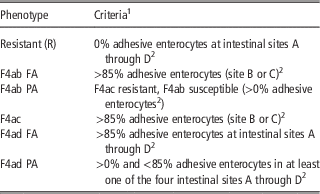
Twenty intact enterocytes were scored under an optical microscope; an enterocyte was classified as adhesive if more than five bacteria adhered to the brush border. Twenty additional enterocytes were scored if adhesion of more than five bacteria was observed in >0% and <30% of the scored enterocytes. In the case of F4ad pigs with 0% of adhesive enterocytes at all the four sites were considered to be resistant (R). Based on the phenotyping of complete families for F4ad adherence at four sites of the small intestine, we propose the term fully adhesive (FA) for the phenotype exhibiting more than 85% adhesive enterocytes at all sites. For pigs with more than 0% and <85% adhesive enterocytes in at least one of the sites, we propose the term partially adhesive (PA) (Table 1). We postulate a similar classification for F4abR but have insufficient evidence.
Criteria for determination of the F4 phenotypes based on the results of the microscopic adhesion test (MAT)

FA=fully adhesive; PA=partially adhesive.
1 A total of 20 to 40 enterocytes were tested per site A through D.
2 Adhesive enterocyte: >5 adherent bacteria per enterocyte.
Biopsies
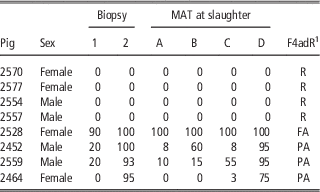
In order to perform matings with known F4ad phenotypes eight pigs (four founders and three breeders, one pig was not used for breeding) were selected, and a biopsy was taken from an undeterminable site of the small intestine under general anaesthesia at around 1 month of age. The biopsies were repeated around 5 months later. The results of the biopsies were completed at slaughter by the MAT examination at intestinal sites A through D (Table 2).
Determination of the F4ad phenotype (per cent adhesive enterocytes) by two subsequent biopsies at an age of 1 month (biopsy 1), 6 months (biopsy 2) and at slaughter (sites A through D)

R=resistant; FA=fully adhesive; PA=partially adhesive.
1 Phenotypes based on the MAT at slaughter.
Segregation analysis and estimation of heritability
A total of 489 pigs split into three pedigrees were included in the segregation analysis. To each pig one of the three F4ad phenotypes was allocated: R, FA or PA. The prevalences for R, FA and PA were 25%, 35% and 40%, respectively. The values were equal in both sexes. Likelihoods were computed with the Pedigree Analysis Package version 5.0 (Hasstedt, Reference Hasstedt2002) and maximized with NPSOL (Gill et al., Reference Gill, Murray, Saunders and Wright1984).
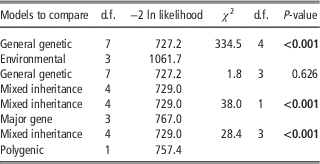
Five different models were considered in the analysis. A general genetic model estimating the allele frequency, the transmission probabilities, the dominance effect, and the displacement to characterize a major gene, and the heritability to characterize a polygenic component was compared with an environmental model, where a major gene was excluded by setting the transmission probabilities equal to the allele frequency and the heritability to zero. In the case where the general genetic model turns out to explain the data better than the environmental model, it is compared with a mixed inheritance model which is the very same model with the exception that the transmission probabilities are set to be Mendelian. In the case where the mixed inheritance model turns out to be better than the general genetic model it is compared with a major gene model and a polygenic model. The major gene model is the same as the mixed inheritance model with the exception that a polygenic component is excluded by setting the heritability to zero.
The heritability for F4adR was estimated using the program MTDFREML (Boldman et al., Reference Boldman, Kriese, van Vleck and Kachman1995).
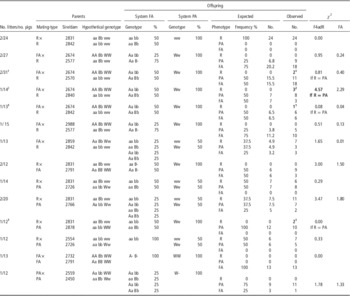
In order to further elucidate the inheritance of the F4ad receptors we performed repetitive and targeted matings where the same sire or dam was mated to different phenotypes. The largest litters (>12 progeny) were analysed and the hypothetical genotypes of the parents were deduced from the phenotypes of the offspring. A χ 2 value was calculated for the Hardy–Weinberg equilibrium for each litter.
Results
Biopsies
The phenotypic results of the two biopsies were only consistent for the F4adRFA and the resistant phenotype (R) whereas F4adRPA phenotype gave misleading results when compared with the MAT results at slaughter (Table 2). We therefore decided to test four sites of the small intestine to reliably differentiate the three phenotypes.
F4-phenotyping
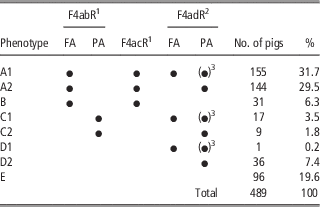
Only 19.6% of the investigated pigs were resistant to all E. coli F4 variants (Table 3). In all phenotypes F4acR+ (average over 98% of adhesive enterocytes determined at site B or C) we also found F4ab full adhesion to the same extent (97.7%, data not shown). Among the 63 (12.9%) pigs which did not express F4acR we found in three independent pedigrees 26 pigs of the phenotype F4acR−/F4abR+ (F4abRPA). In these pigs the numbers of F4ab adhesive enterocytes were significantly reduced (average 14.4%, range from <1% to 60%), compared with the F4abRFA/F4acR+ phenotypes (data not shown). The designations for the porcine phenotypes were derived from Bijlsma and Bouw (Reference Bijlsma and Bouw1987).
Eight F4 receptor phenotypes. The presence of the receptor is marked with ●

FA=fully adhesive (>85% adhesive enterocytes); PA=partially adhesive (>0% to 85%).
1 For the detection of F4abR and F4acR only one intestinal segment was examined.
2 Four segments examined for F4adR.
3 The F4adRFA phenotype masks the expression of the F4adRPA phenotype.
F4ad FA and PA receptors
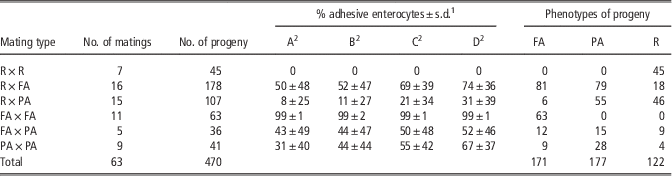
From the offspring we classified 171 pigs (36.4%) as FA, 177 (37.6%) as PA, and 122 (26%) as resistant to E. coli F4ad adhesion (Table 4). The matings of R×R parents generated only R pigs. The matings of FA×FA pigs generated only FA pigs. However, the matings R×PA, R×FA, FA×PA and PA×PA generated FA, PA and R offspring.
Distribution of the three F4ad receptor phenotypes FA, PA and R in the progeny of phenotyped parents

R=resistant; FA=fully adhesive receptor (F4adRFA), PA=partially adhesive receptor (F4adRPA).
1 Adhesive enterocyte: >5 adherent bacteria per enterocyte. 20 to 40 enterocytes tested per site.
2 Sampling sites in the small intestine.
Progeny of F4adR phenotyped parents
The numbers of adhesive enterocytes varied considerably within the same site except for the R×R and FA×FA matings. All other mating types resulted in more than one phenotype in the offspring and therefore in a high standard deviation of the mean numbers of adhesive enterocytes (Table 4). However, there seems to be a tendency that the numbers of adhesive enterocytes are increasing from sites A through D.
Segregation analysis and estimation of the heritability
The segregation analysis revealed that the mixed inheritance model explained our data best (Table 5), as the mixed inheritance model compared with the general genetic model needs less parameters to explain the data. The mixed inheritance model revealed that the F4ad-adhesion is controlled by a major gene and a polygenic component. This implies that phenotypes FA and PA are not the product of a single receptor gene.
Segregation analysis of the Escherichia coli F4ad receptor phenotypes

Comparison of Pedigree Analysis Package (PAP) models. The differences in the −2 ln likelihoods of the different models follow a χ 2 distribution where the degrees of freedom (d.f.) are equal to the difference in the number of parameters estimated. Significant differences (P<0.01) are in bold.
The heritability of the F4adR phenotype was estimated to be 0.7±0.1 and the 95% confidence interval spans from 0.53 to 0.87.
Inheritance of F4ad receptors
In the offspring of R×PA and PA×PA matings we found FA phenotypes (Table 6). This is not explainable by a one locus model and therefore we tested a two locus model for FA and a one locus model for PA, respectively. We then assigned hypothetical genotypes for F4ad receptors to the breeder pigs and the Hardy–Weinberg equilibrium was calculated comparing the number of expected pigs with the number of observed pigs for each phenotype in each litter (Table 6).
Analyses of the largest litters (⩾12 pigs, n=232 offspring) for demonstration of the inheritance of the F4ad receptors

The same sire or dam appears in different mating types. Offspring of repetitive matings were put together. Hypothetical genotypes of parents were deduced from phenotypes observed in progeny. For each litter, the parents, the number of piglets, the F4adR phenotypes and F4adR hypothetical genotypes of the parents and the offspring are indicated. The genotype frequencies in the systems FA and PA, the expected and the observed phenotypes are shown. A chi-square value (χ 2) for the Hardy-Weinberg equilibrium is calculated for each mating. A separate χ 2 is calculated only for the FA genotype. Significant differences (P<0.05) are in bold.
1 In these matings resistant pigs were not expected based on the parents supposed genotype. If the pigs were classified as PA, the χ 2 showed no significant difference (P<0.05).
2 In this mating resistant pigs were not expected based on the parents supposed genotype. χ 2 showed a significant difference (P<0.05) even if the pigs classified as resistant were considered as PA pigs.
Hardy–Weinberg equilibrium (χ 2: P<0.05) was respected in all litters but one. Eight pigs (in bold) expressed unexpected phenotypes (8/232=3.4% from offspring presented in Table 6). These pigs were phenotyped as R and came from matings R×FA and R×PA.
Discussion
The biopsies contributed significantly to this study, because they permitted to identify resistant breeders in vivo. They turned out to be quite laborious. Several pigs developed inflammatory adhesions despite the great efforts taken for aseptic operation conditions.
Statistical analyses indicate that F4ad receptors are highly heritable and regulated by a major gene and a polygenic component which could not be further characterized. The fact that mating types R×PA, R×FA, FA×PA and PA×PA have generated FA, PA and R pigs shows that the FA phenotype masks the PA phenotype, and that FA and PA are independently inherited. Moreover, matings of PA×PA and of R×PA leading to FA phenotypes in the offspring support the hypothesis that FA is controlled by more than one gene. These interpretations of the F4adR inheritance are still consistent with the above mentioned mixed inheritance model of the segregation analysis. The PA phenotype was not an artefact caused by poor cell quality or mistakes in the MAT. We observed that only pigs with no adhesive enterocytes in all sites were truly resistant. Pigs with even <1% of F4ad adhesive enterocytes were shown to produce susceptible progeny if mated with a true resistant pig (data not shown). We postulate that the FA receptor is encoded by two complementary or epistatic genes, with the alleles A and a, or B and b, respectively. It is expressed only when both hypothetical alleles, A and B, occur in the dominant form, either homozygously or heterozygously. The PA receptor is controlled by only one gene with the alleles W and w. It is expressed as a mendelian dominant trait. To test this hypothesis we performed repetitive and targeted matings in which the same pig was mated to different phenotypes (Table 6), for example, sire 2674 was mated to four different resistant dams and sire 2831 was mated to five different dams which were resistant, FA or PA. Dam 2842 was mated to R and FA sires. Although we increased the number of intestinal sites for the adhesion test to four compared with only one site used in previous studies (Python et al., Reference Python, Jörg, Neuenschwander, Hagger, Stricker, Bürgi, Bertschinger, Stranzinger and Vögeli2002 and Reference Python, Jörg, Neuenschwander, Asai-Coakwell, Hagger, Bürgi, Bertschinger, Stranzinger and Vögeli2005) it cannot be excluded that we mistyped PA pigs by chance as resistant pigs.
A separate χ 2 was calculated in litters with expected FA phenotype to test the two gene inheritance model for the FA receptor. The data showed no significant difference in all litters examined for FA (Table 6).
Hu et al. (Reference Hu, Hasler-Rapacz, Huang and Rapacz1993) described a high affinity F4ad receptor co-segregating with receptors for F4ab and F4ac forming the phenotype F4abR+/F4acR+/F4adR+ which is expressed during the entire life cycle. The low affinity receptor is associated with the adhesion phenotype F4abR−/F4acR−/F4adR+ and its expression is terminated at 16 weeks of age. In contrast we found high affinity (FA) and low affinity (PA) F4ad receptor expression independent of the F4ab and F4ac receptor phenotype (Table 3). A further explanation for this discrepancy could be the higher threshold value for resistant phenotypes used by Hu et al. (Reference Hu, Hasler-Rapacz, Huang and Rapacz1993). Moreover, we identified F4adPA receptors independent of the age but in a variable number of the small intestinal sites (Table 2, pigs 2452, 2559 and 2464). Furthermore fifteen pigs of phenotypes A2, C2 and E2 (F4adPA) were between one and 5 years of age. In all studies so far a specimen of only one site of the small intestine was phenotyped. Therefore, there is a chance to classify partially adhesive (F4adPA) pigs as resistant and to postulate an age dependent expression of the F4ad receptor.
Our model for F4adR inheritance is mostly valid and confirms Bijlsma and Bouw’s (Reference Bijlsma and Bouw1987) assumption of the existence of more than one gene controlling the F4ad receptor. Besides mistyping mistakes in allocating the hypothetical genotypes of the parents cannot be excluded. This would be the case if receptor FA expression would be controlled by more than two genes. Mutations in the genes controlling receptors for E. coli F4ad adhesion or expression of PA inhibitors could explain the inhomogeneous presence of the PA E. coli F4ad receptor in the small intestine. Pigs should be tested for the PA phenotype at more than four intestinal sites to show the variation of the number of adhesive enterocytes. Finally, genome scans should be performed to find possible candidate genes for the hypothesized FA and PA F4ad receptor loci.
The receptor for F4ab is either controlled by one gene or by two closely linked genes together with F4ac (Python et al., Reference Python, Jörg, Neuenschwander, Asai-Coakwell, Hagger, Bürgi, Bertschinger, Stranzinger and Vögeli2005; Yan et al., Reference Yan, Huang, Ren, Zou, Yang, Ouyang, Zeng, Yang, Xiao and Huang2009; Schroyen et al., Reference Schroyen, Stinckens, Verhelst, Niewold and Buys2012). Ren et al. (Reference Ren, Yan, Ai, Zhang, Huang, Ouyang, Yang, Yang, Han, Zeng, Chen, Guo, Xiao, Ding and Huang2012) showed evidence that MUC13 is a good candidate for the F4ac receptor. Among the 489 pigs tested with MAT, 26 showed a resistance to E. coli F4ac and a partial susceptibility to E. coli F4ab (F4abRPA/F4acR−/F4adR+) (Table 3). Most pigs with PA F4ab receptor originated from litters with a common ancestor indicating that a genetic component may be involved in the F4abRPA/F4acR− phenotype. Escherichia coli F4ab adhesion was tested in the MAT by examining only one intestinal site. In a pig examined at five sites for F4abRPA, adhesion values varied between 0% and 87% (personal observation of A. Bratus). Therefore some of the F4ab resistant phenotypes may have the PA F4abRPA. It is possible that like E. coli F4ad, E. coli F4ab adhesion is also governed by two receptors: F4abRFA and F4abRPA somehow associated with the F4adRPA phenotype. It may be speculated that E. coli F4ab can partially bind to a mutated E. coli F4adPA receptor. More data are necessary to further examine this hypothesis.
In summary, we think that our data give strong evidence for the existence of eight F4 receptor phenotypes which refines the classification proposed by Bijlsma et al. (Reference Bijlsma, de Nijs, van der Meer and Frik1982), Bijlsma and Bouw (Reference Bijlsma and Bouw1987) and Hu et al. (Reference Hu, Hasler-Rapacz, Huang and Rapacz1993) who proposed four and five F4 receptor phenotypes. Following the notation of Bijlsma and Bouw (Reference Bijlsma and Bouw1987) we propose A1 (F4abRFA/F4acR+/F4adRFA); A2 (F4abRFA/F4acR+/F4adRPA); B (F4abRFA/F4acR+/F4adR−); C1 (F4abRPA/F4acR−/F4adRFA); C2 (F4abRPA/F4acR−/F4adRPA); D1 (F4abR−/F4acR−/F4adRFA); D2 (F4abR−/F4acR−/F4adRPA); E (F4abR−/F4acR−/F4adR−).
Furthermore, we propose the existence of two F4ab and two F4ad receptors, a FA and a PA receptor. The F4abRFA and F4adRFA are detected throughout the small intestine with more than 85% of adhesive enterocytes. The F4adRPA receptor is irregularly distributed with a tendency to higher expression in the lower small intestine.
The F4adRFA is presumably controlled by two genes which have an epistatic component, whereas the F4adRPA is controlled by a dominant gene.
To our knowledge E. coli F4ad adhesion susceptibility in the pig is the first example in farm animals of a complex trait including three genes and epistasis for which we were able to determine a potential mode of inheritance.
Acknowledgements
Biopsies of the intestines were performed by Dr med. vet. C.S. Schwandt, Clinics for Small Animal Surgery, Department for Small Animals, Vetsuisse Faculty, University of Zurich, 8057 Zurich, Switzerland. General anaesthesia was performed by the Anaesthesiology Unit (Prof. Dr med. vet. R. Bettschart-Wolfensberger) of the Equine Department, Vetsuisse Faculty, University of Zurich, 8057 Zurich, Switzerland. The study was supported by the Swiss National Science Foundation (Grant No. 3100A0-120255/1), by the ETH Zurich, and the SUISAG, Sempach (Dr Andreas Hofer)