Early diagnosis of hypertension and recommendations of lifestyle changes are important strategies in detection and treatment, especially in primary health care. It is accepted that the first traces of the pathology leading to cardiovascular diseases in adulthood begin during the childhood and adolescent periods. Reference Berenson, Srinivasan and Bao1,Reference Daniels2 In the last century, the frequency of HT has been gradually increasing in childhood. Reference Song, Zhang and Yu3,Reference Larkins, Teixeria-Pinto and Craig4 In a meta-analysis evaluating 47 studies, the prevalence of HT in children 19 years or younger was 4.00% (95% CI = 3.29–4.78%). Reference Song, Zhang and Yu3 The same study evaluated the prevalence of HT according to weight and determined that the prevalence of HT was 5.27% in obese, 4.99% in overweight, and 1.9% in normal-weight patients. Reference Song, Zhang and Yu3
Considering the concerns in the diagnosis of children, new updates have been made to paediatric HT guidelines in the past few years. Reference Lurbe, Agabiti-Rosei and Cruickshank5,Reference Flynn, Kaelber and Baker-Smith6 In 2016, the European Society of Hypertension guidelines was revised based on the reference data of the United States Task Force. Reference Lurbe, Agabiti-Rosei and Cruickshank5 The most important innovation in the ESHG2016 guideline, the diagnosis of HT in adolescents 16 years or older was determined as systolic blood pressure ≥140 mmHg and/or diastolic BP ≥90 mmHg. In the ESHG2016 guideline, BP percentiles based on age, gender, and height stated in the Fourth Report for the Diagnosis of HT in Childhood continued to be used. 7 Thereafter, in 2017, the United States Task Force guideline was renewed by the American Academy of Pediatrics. Reference Flynn, Kaelber and Baker-Smith6 In the AAP2017 guideline, the use of percentiles according to age, gender, and height was recommended until the age of 13; for adolescents aged 13 and over, HT diagnosis was based on blood pressure >130/80 mmHg. Besides, only normal-weight individuals were taken into consideration in the AAP2017 guideline; overweight and obese children were ignored. Reference Flynn, Kaelber and Baker-Smith6
It is noteworthy that, for adolescents aged at least 13 years and less than 16 years, the ESHG2016 guideline recommends the use of percentile based on age, gender, and height; whereas, the AAP2017 guideline determines a fixed cut-off value. Based on this difference, this study aimed to evaluate the agreement of HT diagnosis with the ESHG2016 and AAP2017 guidelines in adolescents aged ≥13 and <16 years. We also sought to determine whether the frequency of HT in obese adolescents varies with the use of either guideline.
Methods
The study included adolescents aged at least 13 years and less than 16 years who presented to the University of Health Sciences, Antalya Training and Research Hospital, Pediatric Nephrology Department, Antalya, Turkey, with suspicion of HT between January, 2017 and December, 2019. Patients with 24-hour ambulatory blood pressure measurements in addition to office BP measurements were included in the study. Patients without anthropometric measurements and patients with antihypertensive drug use were excluded from the study. Ethics committee approval was received from the University of Health Sciences, Antalya Training, and Research Hospital (22.10.2020-311).
Anthropometric measurements
Height was measured to the nearest 0.1 cm using a portable wall-mounted stadiometer and weight was measured to the nearest 0.1 kg. Percentile values for height were obtained using reference values for Turkish children. Reference Neyzi, Bundak and Gökçay8 Body mass index was calculated as body weight (kg) divided by height (m) squared (kg/m2). Adolescents were classified into three3 subgroups according to BMI z score; BMI z score ≤1.5 (normal), BMI z score 1.5–2 (overweight), and BMI z score ≥ 2 (obese).
Office blood pressure measurements
Automated oscillometric devices were used on the upper arm (with anthropometrically suitable cuff size) for office BP measurement. Oscillometric device used in the study was validated by the biomedical department of our hospital before the study started. All measurements were performed in the seated position, at 5-minute intervals, and by the same trained nurse. Three measurements were taken for each adolescent and an average of the values from the second and third were used. Office BP for adolescents at each screen was classified by both ESHG2016 guidelines and AAP2017 guidelines. Reference Lurbe, Agabiti-Rosei and Cruickshank5,Reference Flynn, Kaelber and Baker-Smith6 According to the ESHG2016 guidelines, office BP has to be persistently in the ≥95th percentile for gender, age, and height was defined as HT. Systolic BP and/or diastolic BP between ≥90th percentile and <95th percentile was defined as high-normal BP. Hypertension was also classified as stage 1 (95th percentile to the 99th percentile and 5 mmHg) and stage 2 (>99th percentile and 5 mmHg). Reference Lurbe, Agabiti-Rosei and Cruickshank5
According to the AAP2017 guidelines, elevated BP was defined as systolic BP 120–129 mmHg and diastolic BP less than 80 mmHg, while HT was defined as at least 130/80 mmHg for adolescents aged 13 years and older. Hypertension was also classified as stage 1 (BP between 130/80 mmHg and 139/89 mmHg) and stage 2 (at least 140/at least 90 mmHg) in these patients. Reference Flynn, Kaelber and Baker-Smith6
Twenty-four-hour ambulatory blood pressure measurements
Twenty-four hour ambulatory blood pressure was measured on the non-dominant arm, with cuff size selected according to the mid-arm circumference, on the same day as office blood pressure. The oscillometric Space Labs 90207 monitors (SpaceLabs Inc., Redmond, Washington, USA) were used for records. ABPM recordings started at 9 am and continued until 9 am the next morning. Awake and sleep periods were separated using self-reported sleep and wake times. Blood pressure reading was obtained every 20 min during the awake period and every 30 min during the sleep period. Based on the European guidelines, records with at least 70% measurements (and at least seven times during sleep period) were deemed to be suitable for inclusion; thus, all patients meeting these conditions were included in the study. Reference Parati, Stergiou and O'Brien9
Reference values for ABPM measurements provided by the German Working Group on Pediatric Hypertension. Reference Wühl, Witte and Soergel10 Four subgroups were created with office BP and ABPM measurements; normotension, hypertension, white-coat hypertension, and masked HT. Reference Halbach11,Reference Flynn, Daniels and Hayman12 The definitions of these definitions were presented in detail in Table 1.
Office blood pressure and ambulatory blood pressure measurement definitions according to guidelines

AAP2017 = American Academy of Pediatrics guideline; ABPM = ambulatory blood pressure monitoring; BP = blood pressure; ESHG2016 = European Society of Hypertension guidelines; HT = hypertension.
Statistical analysis
Descriptive statistics were presented as frequency, percentage, mean, standard deviation, median, and interquartile range. The Shapiro–Wilk test, histogram, and Q-Q graphics were used for the evaluation of normality of distribution. The chi-square analysis was used in the analysis of relationships between categorical variables. For the comparison of continuous variables, the Student’s t-test and one-way ANOVA were used with variables that showed normal distribution, while the Mann–Whitney U-test and Kruskal–Wallis were used in those with non-normal distribution. Pairwise comparisons were conducted by Tukey post hoc multiple comparison tests. McNemar–Bowker test was used to evaluate the change in the distribution of ABPM diagnosis. Cohen’s kappa and overall accuracy were calculated to compare item agreements between ESHG2016 and AAP2017 guidelines. Cohen suggested the kappa result be interpreted as follows: values ≤0 indicating no agreement, 0.01–0.20 none to a slight agreement, 0.21–0.40 as fair, 0.41– 0.60 as moderate, 0.61–0.80 as substantial, and 0.81–1.00 as almost-perfect agreement. Reference McHugh13 Overall accuracy is the probability that an individual will be correctly classified by a test; that is, the sum of the true positives and true negatives divided by the total number of individuals tested. Reference Alberg, Park and Hager14 Statistical analyses were performed using the SPSS version 21.0 package program for Windows (IBM, Armonk, NY, USA). p values of <0.05 were accepted to show statistical significance.
Results
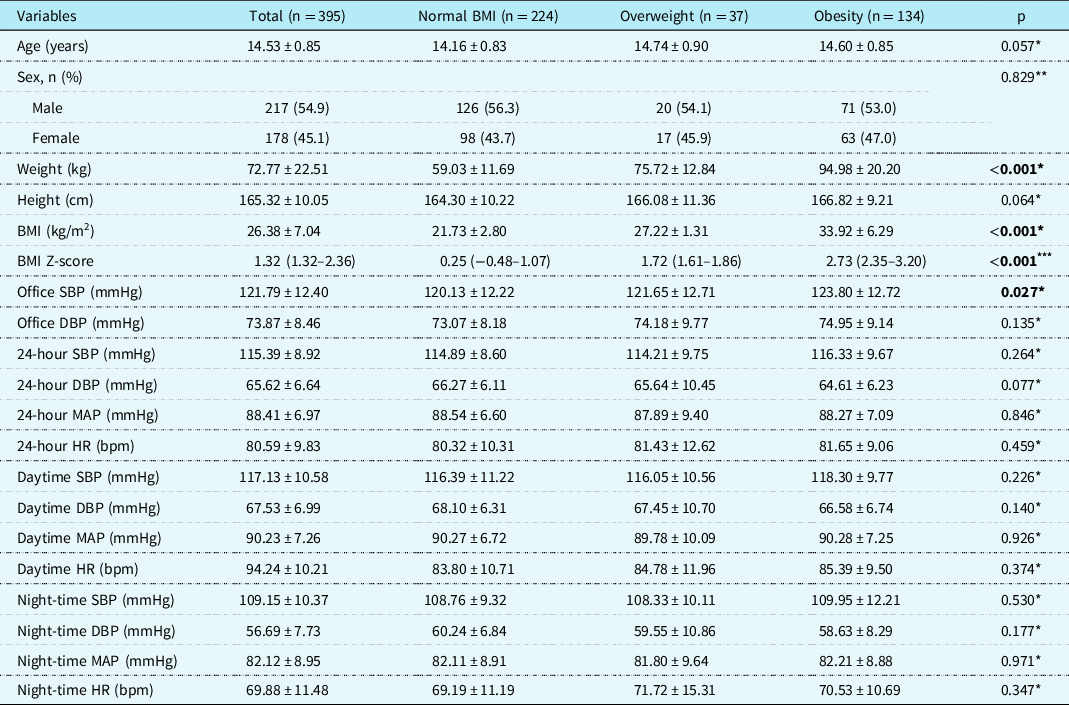
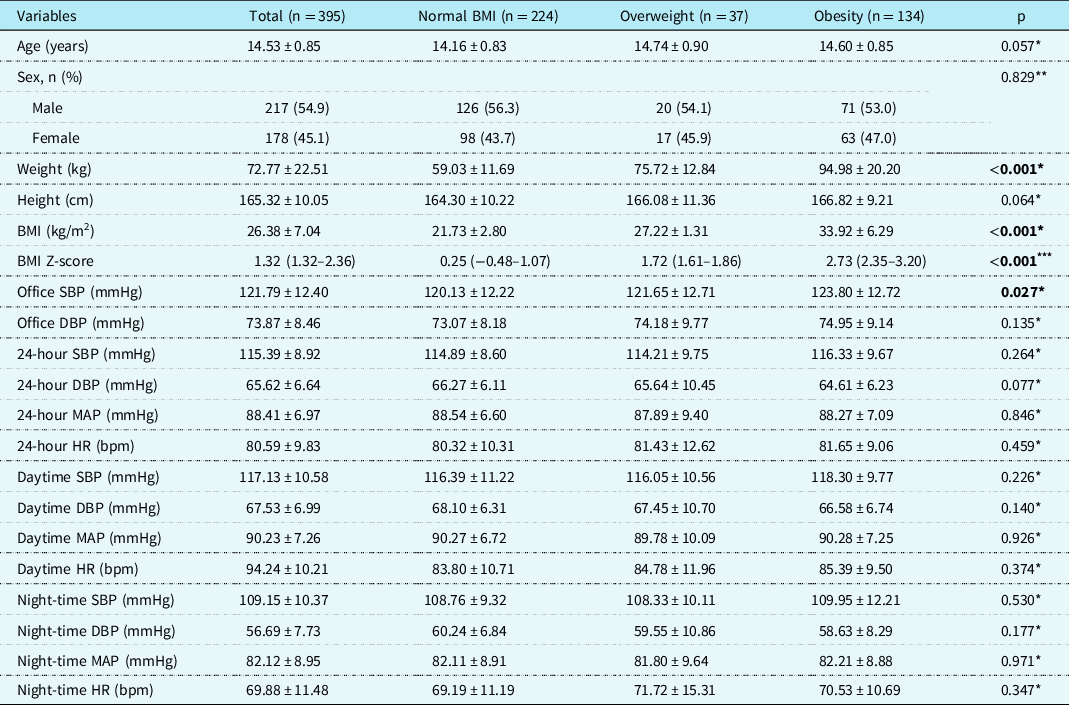
A total of 2508 children and adolescents were admitted or referred with the suspicion of HT to the paediatric nephrology department during the study period. ABPM measurement was applied to 2124 (84.7%) of them, and 1729 of these children were excluded based on their age (<13 or ≥16 years). A total of 395 adolescents (217 boys, 54.9%) with a mean age of 14.53 ± 0.85 years at the time of study inclusion were enrolled. The distribution of adolescents according to BMI was as follows: normal weight (n = 224, 56.7%), overweight (n = 37, 9.4%), obese (n = 134, 33.9%). The frequency of obesity was similar in boys and girls (32.7% versus 35.4%, p = 0.652). The mean age and height were similar between normal weight, overweight, and obese groups (p = 0.057 and p = 0.064, respectively). The characteristic features of the groups were presented in Table 2.
Demographic and blood pressure characteristics of the study group
BMI = body mass index; DBP = diastolic blood pressure; HR = heart rate; MAP = mean arterial blood pressure; SBP = systolic blood pressure.
The bold values are statistically significant.
* One-way ANOVA test.
** Chi-square test.
*** Kruskal–Wallis test.
In the whole study population, mean systolic and diastolic BPs were 121.79 ± 12.40 and 73.87 ± 8.46, respectively. While the mean systolic BP of obese adolescents was higher than those with normal weight; such a relationship was not observed in the comparison of diastolic BP (p = 0.020 and p = 0.135, respectively).
Categories of office blood pressure
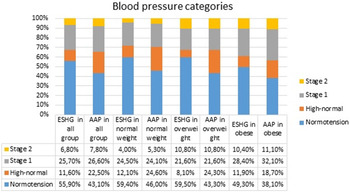
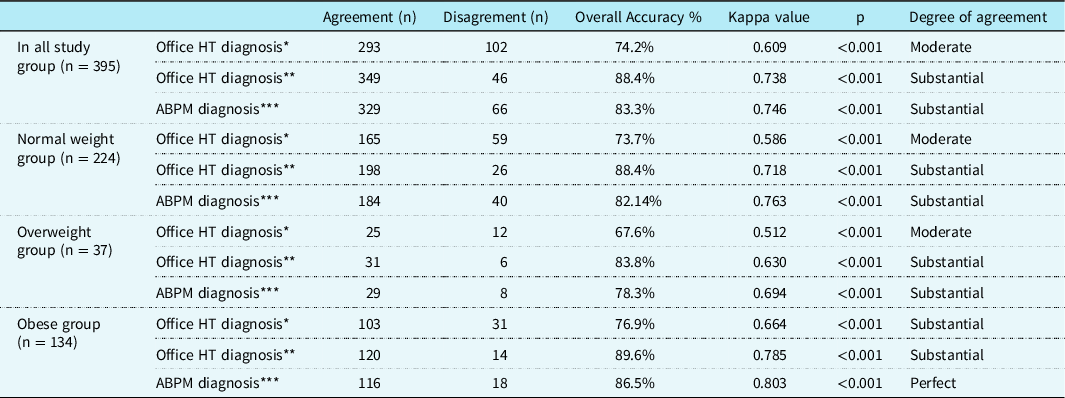
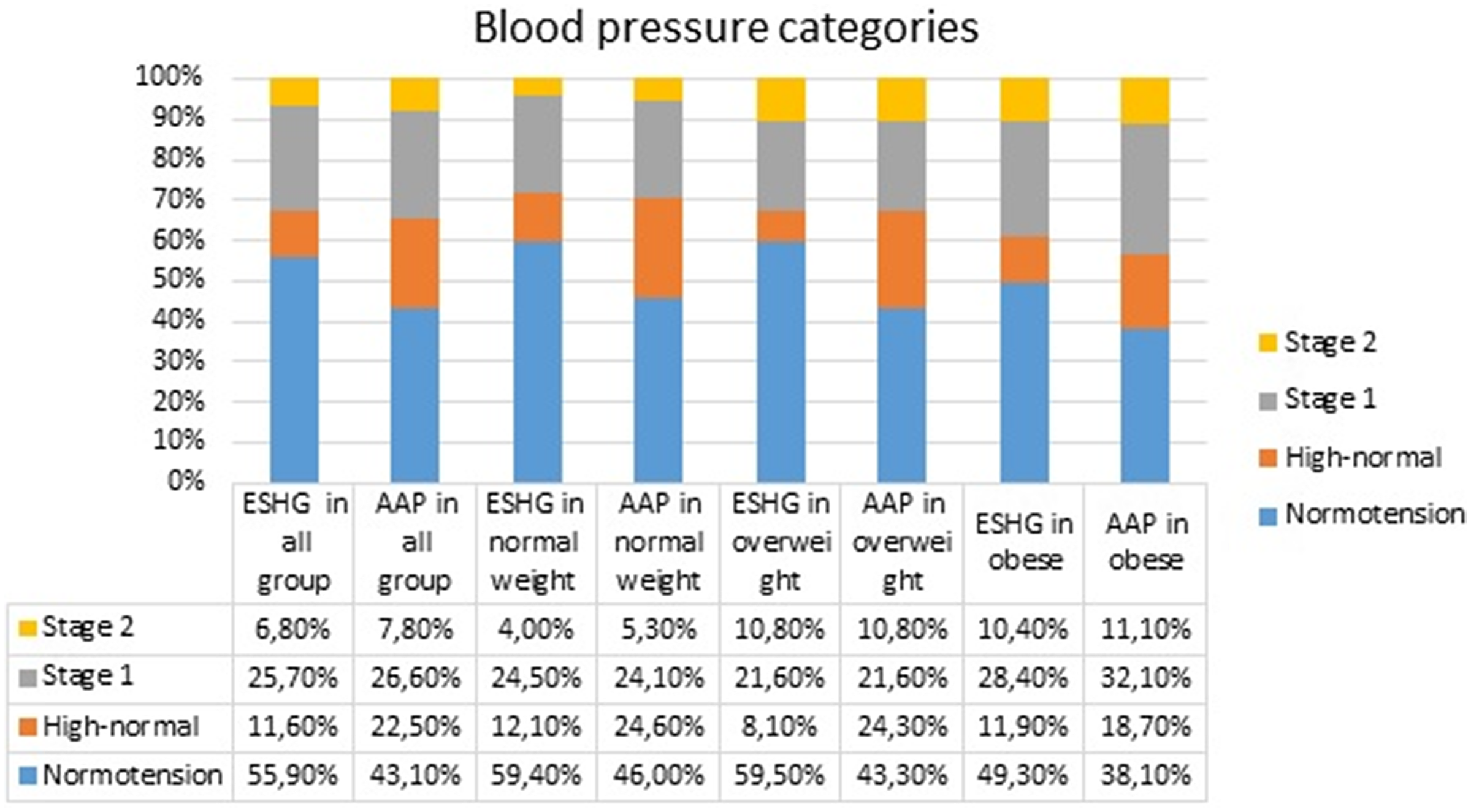
The majority of adolescents were normotensive by both guidelines, 55.9% by ESHG2016 and 43.1% by AAP2017. The frequency of normotension, high-normal (elevated) BP, stage 1 HT, and stage 2 HT were 55.9%, 11.6%, 25.7%, 6.8% with the ESHG2016 and 43.1%, 22.5%, 26.6%, 7.8% with the AAP2017 guideline (Fig 1). The compatibility of ESHG2016 and AAP2017 guidelines was evaluated in the distribution of office blood pressure categories: there was significant agreement at a moderate level (kappa value = 0.609, p < 0.001). However, 40 (20.8%) of the adolescents diagnosed with normotension in the ESHG2016 guideline were in the elevated BP category as per the AAP2017 guideline. Also, 20 (43.5%) of the adolescents defined as high-normal BP in ESHG2016 were classified as stage 1 HT with AAP2017 (Table 3).
Distribution of office blood pressure categories in whole study group and grouped by weight status.
Distribution of office BP categories according to the HT guidelines

The bold values indicate the number of cases with the same classification for both guidelines.
* Column percentage (unless otherwise specified row percentage is presented).
The distribution of office blood pressure categories in normal weight, overweight, and obese groups were shown in Figure 1. The agreement of the ESHG2016 and AAP2017 guidelines in-office blood pressure categories was evaluated separately in normal weight, overweight, and obese groups (kappa values, respectively: 0.586, 0.512, and 0.664, the p-value for all <0.001) (Table 4).
Evaluation of the agreement for the diagnosis of HT between ESHG 2016 and AAP 2017 guidelines

AAP2017 = American Academy of Pediatrics guidelines 2017; ESHG2016 = European Society of Hypertension guidelines 2016.
* Categories for office HT diagnosis: Normotension/High-normal/Stage 1 HT/Stage 2 HT.
** Categories for office HT diagnosis: Normotension/HT.
*** Categories for ABPM diagnosis: Normotension/White-coat HT/Masked HT/HT.
In the whole study population, the frequency of HT was 32.4% (n: 128) and 34.4% (n = 136) according to ESHG2016 and AAP2017 guidelines, respectively. The frequency of HT was 28.6% in the normal-weight group, 32.4% in the overweight group, and 38.8% in the obese group using ESHG2016 criteria (p = 0.046). With the AAP2017 guidelines, these percentages were found as: 29.5%, 32.4%, and 43.3%, respectively, (p = 0.009). The compatibility of both guidelines in the diagnosis of HT was evaluated separately according to weight groups (in addition to the analysis of the whole study population). The results showed that there were significant agreements at a substantial level in the whole group and also the subgroups (Table 4).
Distribution of 24-hour ambulatory blood pressure measurement categories
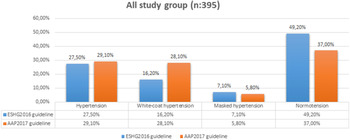
Systolic, diastolic, mean arterial BP, and heart rates obtained in ABPM were presented in Table 2. There were 136 adolescents (34.4%) with mean ABPM >95th and systolic/diastolic load ≥25% according to the AAP2017 guideline, and 123 adolescents (31.1%) with mean ABPM ≥95th percentile or ABPM >130/80 mm according to the ESHG2016 guideline. Adolescents were classified into separate groups using ABPM and office BP measurements; the frequency of HT, WCT, masked HT, and normotension obtained according to ESHG2016 and AAP2017 guidelines were shown in Figure 2. A total of 64 (16.2%) adolescents were classified as WCT with ESHG2016 criteria, whereas 111 (28.1%) adolescents were diagnosed with WCT using the AAP2017 criteria (p < 0.001). In contrast, the frequency of adolescents with normotension was higher in the ESHG2016 guidelines than in the AAP2017 guidelines (49.2% versus 37.0%, p < 0.001). There was no difference between the masked HT and HT frequency (p = 0.163 and 0.324, respectively). The compatibility of the ESHG2016 and AAP2017 guidelines for ABPM diagnosis was evaluated in the whole study group and showed substantial agreement (kappa value = 0.746, p < 0.001).
Distribution of ABPM diagnosis in whole study group according to AAP2017 and ESHG2016 guidelines.

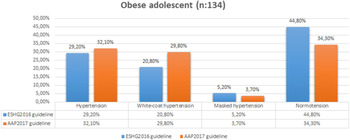
In the ABPM diagnosis, the frequency of HT in obese adolescents was 29.2% with ESHG2016 guideline and 32.1% with AAP2017 guideline. Similar to the overall study population, the frequency of WCT was higher with the AAP2017 guideline (29.8% versus 20.8%, p = 0.002) and the frequency of normotension was higher with the ESHG2016 guideline in obese adolescents (44.8% versus 34.3%, p < 0.001) (Fig 3). The agreement of both guidelines for ABPM diagnoses was evaluated separately in the normal weight, overweight, and obese groups. This analysis demonstrated that there was significant agreement at a substantial level in the normal weight and overweight groups (kappa value = 0.763 and 0.694, respectively); whereas, the obese group showed perfect-level agreement (kappa value = 0.803) (Table 4).
Distribution of ABPM diagnosis in obese group according to AAP2017 and ESHG2016 guidelines.

Discussion
In this study, the frequency of HT in adolescents aged between 13 and 16 years was found to be 32.4% with the ESHG2016 guideline and 34.4% with the AAP2017 guideline. Our study found substantial agreement between the ESHG2016 and AAP2017 guidelines in the diagnosis of HT according to office BP measurements. Further, the moderate agreement was found in the comparison of office blood pressure categories. In particular, the diagnosis of elevated HT and stage 1 HT was higher in the AAP2017 guideline compared to the ESHG2016 guideline.
The results of a study evaluating 2957 children, 747 of whom were 13–15 years old, stated that the AAP2017 guideline found a higher percentage of high-normal and stage 1 HT than the ESHG2016 guideline. Reference Lurbe, Torró and Álvarez15 It is emphasised that this difference increases especially in boys and those over 13 years of age. Reference Lurbe, Torró and Álvarez15 Blood pressure measurements of 15,647 healthy children from National Health and Nutrition Examination Surveys between 1999 and 2014 were re-evaluated with the AAP2017 guideline; 381 patients had newly diagnosed HT and the HT staging of 524 patients worsened. Reference Sharma, Metzger and Rodd16 In a study comparing the AAP2017 guideline with the 2004 Fourth Report on the Diagnosis, Evaluation, and Treatment of High Blood Pressure in Children and Adolescents, the percentage of elevated HT for adolescents 13–15 years of age was higher with the AAP2017 guideline, but there was no increase in the frequency of hypertension. Reference Bell, Samuel and Samuels17 The same study evaluated the agreement of the AAP2017 HT guideline with the Fourth Report, and the kappa value and overall accuracy were determined to be good in older patients (0.85% and 92.6%). Reference Bell, Samuel and Samuels17
In this study, we found that the frequency of obesity was 33.9%. Both guidelines resulted in the determination of a higher frequency of HT in obese adolescents compared to those with normal weight. Throughout the world, the prevalence of childhood obesity has been increasing, especially in the last decade. Reference Dong, Ma and Song18,Reference Cho and Kim19 Especially the effect of sedentary life on obesity is well known. Reference Sook, Sablihan, Ismail, Devaraj and Mooi20 In our country, obesity prevalence was 9.8% and overweight prevalence was 23.2% in a cross-sectional study that included 1687 school-aged children. Reference Çelmeli, Çürek and Arslan Gülten21 The frequency of obesity in this study was higher than the predicted prevalence for our country, possibly because our study population was selected from patients suspected to have hypertension. Besides, since obese children are at risk for HT, BP measurement is usually not neglected during the routine examinations of these patients.
In a study of 6137 obese and overweight children with a mean age of 10.8 ± 2.7 years, the prevalence of HT was 30.7% with the ESHG2016 guideline and 34.8% with the AAP2017 guideline. Reference Di Bonito, Valerio and Pacifico22 It was emphasised that the diagnosis of HT was 13% higher than ESHG2016 with the AAP2017 guideline, and this difference was increased especially in overweight children over 13 years of age. Reference Di Bonito, Valerio and Pacifico22 A multicentre randomised controlled study from China found that the prevalence of HT diagnosed with the AAP2017 guideline in obese children aged 13–17 years was 8.5% higher than the Fourth Report (34.0% versus 25.5%; p < 0.001). Reference Dong, Song and Zou23 In our study, the frequency of HT in obese adolescents was 43.3% with the AAP2017 guideline, 38.8% with the ESHG2016 guideline. The agreement between the AAP2017 guideline and ESHG2016 guideline in the diagnosis of hypertension was substantial in all normal weight, overweight and obese groups.
In the ABPM diagnosis, the frequency of WCT was significantly higher in the AAP2017 guidelines. Also, the frequency of normotension was observed more frequently with the ESHG2016 guidelines. This difference in the whole study group was also observed in the obese adolescent subgroup. The reason for the increase in the frequency of WCT with the AAP2017 guideline is quite feasibly associated with the fact that many patients' BP levels that were >130/80 mmHg in-office measurements were actually below the 95th percentile according to the ESHG2016 guidelines. Similarly to our study, Lurbe et al demonstrated that the frequency of WCT was higher with the AAP2017 guideline. Reference Alberg, Park and Hager14 In different studies, the frequency of WCT varies between 7% and 52% in patients referred for high BP. Reference Halbach11,Reference Halbach, Hamman, Yonekawa and Hanevold24,Reference Kavey, Kveselis, Atallah and Smith25 Venettacci et al evaluated the compatibility and inconsistency of both guidelines on ABPM diagnoses, and found that masked HT was prominent in the ESH guideline and white coat HT was prominent in the AAP guideline. Reference Venettacci and Larkins26 Adult studies emphasise that approximately half of the patients with WCT had sustained HT at a 10-year follow-up. Reference Mancia, Facchetti, Grassi and Bombelli27,Reference Seven, Niiranen, Kantola and Jula28
In this study, the agreement between AAP2017 and ESHG2016 guidelines in the categories of ABPM diagnosis was evaluated, and the perfect level was found to be in the obese group. Among the ABPM diagnoses, the frequency of normotension was significantly different between the two guidelines. Compared to the whole study group, the proportion of normotensive adolescents decreased in obese patients, and we think that this leads to a better agreement between the two guidelines observed in obese patients.
Study limitations
This study has some limitations to be mentioned. First, the study group was comprised of adolescents who were suspected to have HT. It did not consist of a homogeneous group that would have been required to conclude community characteristics and screening of patients. Therefore, the frequency of HT is higher than in other studies. Besides, all data were drawn from a single centre; larger-scale and multicentre studies are needed. Despite these limitations, this study compared two hypertension guidelines with different approaches for adolescents aged ≥13 and <16 years ages, including the use of ABPM; thereby providing important evidence for the agreement between the two guidelines.
Conclusion
Both the AAP2017 and the ESHG2016 guidelines can be used in the diagnosis of HT, taking into account the centre experience, and both guidelines have a signed agreement. However, it should be remembered that there is a possible increase in the likelihood of identifying elevated blood pressure and stage 1 HT in the AAP2017 group. Also, the number of adolescents with WCT was higher when the AAP2017 guideline was employed. Even though these differences were identified with our results, there is a need for further research on this subject, and a cautious suggestion would be that physicians should first aim to identify children in risk groups and follow these patients regularly; when a diagnostic evaluation is indeed required, clinicians may benefit from utilising the guideline with which they have higher experience, especially because the agreement levels between these two approaches seem to be very high.
Acknowledgements
None.
Conflicts of interest
None.
Authorship contributions
Concept – G.K.A., Ç.S.D.; Design – G.K.A., Ç.S.D.; Supervision – Ç.S.D.; Fundings – None; Materials – G.K.A., Ç.S.D., N.S.K.; Data collection and/or processing – G.K.A., Ç.S.D.; Analysis and/or interpretation – G.K.A., D.Y.; Literature search – G.K.A., Ç.S.D.; Writing – G.K.A.; Critical review – Ç.S.D.